
Interested in working with us in the future?
Follow to see new jobs and posts in your feed.
No news yet.

Names
Nanjing
The name "Nanjing" (literally "Southern Capital") was formally established to designate the modern-day city in 1368, the first year of the Ming dynasty. Upon establishing his capital there, the Hongwu Emperor officially named it "Southern Capital" to distinguish it from the "Northern Capital" at Kaifeng. The name later served as a counterpart to the Northern Capital, Beijing.
Nanjing, formerly romanized as Nanqim, Nankin, and Nanking, was also transcribed in the Wade–Giles system as Nan-ching.
Jinling
There was a yi (settlement) known as Jinling (Chinese: 金陵; pinyin: Jīnlíng; lit. 'Ridge with the Gold') around the 4th century BCE in the area—mentioning the specific metal that later lore insisted must have been buried by the Chu monarch, before it was renamed Moling (Chinese: 秣陵; pinyin: Mòlíng; lit. 'Haltered Ridge') after Qin's unification. Between 624 and 626, the name "Jinling" was briefly restored as a county designation. By the early 10th century, the Yang Wu regime once again designated this area as Jinling. In the early Republican era, Jinling Circuit was established to administer Nanjing and its surrounding counties.
Jiangning and Shangyuan
At the turn of the 4th century, Jiangning (Chinese: 江寧; pinyin: Jiāngníng; lit. 'Tranquil Jiang[nan]') county was established to the southwest of the former Eastern Wu capital, with its seat located in what is now Jiangning Subdistrict. Following the Sui dynasty's destruction of Jiankang, several counties within the former metropolitan area were annexed into Jiangning, and this remained the primary designation for the county until the mid-Tang period.
In 761, Emperor Suzong of Tang renamed the area Shangyuan (Chinese: 上元; pinyin: Shàngyuán; lit. 'Upper Prime'), after his regnal era. In 917, Jiangning county was partitioned from the southern territories; since then, both county seats came to be located within the same walled city. Subsequently, during the periods of 937–975, 1018–1129, and 1645–1911, the Nanjing region was designated as Jiangning Prefecture, with Shangyuan long serving as the prefectural seat.
History

Pre-imperial and early imperial eras
Human habitation in the Nanjing region dates to the Neolithic period. Sites near the modern urban core, including the type-site of the Beiyinyangying (北阴阳营) culture, contain a cemetery with 225 burials and grave goods like polished stone tools, jade, and agate, indicating connections with the Lake Tai region. Incised pictorial marks on zun pottery vessels have also been recovered from Beiyinyangying and related late Dawenkou-period deposits.
The lower strata of the Dianjiangtai (点将台) site in Pukou are contemporaneous with the Erlitou period and predate the Bronze Age Hushu (湖熟) culture, which characterized the Ning–Zhen (Nanjing–Zhenjiang) area during the second millennium BCE.
At the Xijie (西街) site on the south bank of the Qinhuai River, archaeological excavations have identified a fortified settlement with concentric ditches and wall foundations dating to the Shang–Zhou transition. While its precise relationship to later historical cities is undetermined, the site indicates organized settlement in the Qinhuai area prior to the urban foundations documented in transmitted texts.
Historical records attribute early named urban foundations in the area to the 5th century BCE: Yuecheng, reportedly built by Fan Li of Yue, and Yecheng, associated in later accounts with metallurgical activity and attributed to King Fuchai of Wu. However, their exact locations and chronologies remain subjects of academic debate. Under Chu rule, the area was known as Jinling, before being renamed Moling following the Qin unification.
Six Dynasties period
Throughout the Six Dynasties period, successive regimes in the southeast maintained their administrative center at Jiankang (originally Jianye), except for brief intervals in 221–229, 265–267, and 552–554, when the seat of government relocated to the middle Yangtze.
In 211, Sun Quan moved his headquarters to Moling. The following year, he fortified Shitou Hill to build the Stone City and renamed the region Jianye (建業). After proclaiming himself emperor in 229, Sun Quan established his capital here and built the Taichu (太初) Palace, followed by the larger Zhaoming (昭明) Palace in 267. These structures were largely destroyed during the Western Jin conquest and subsequent early 4th-century conflicts.
Geography

Nanjing, with a total land area of 6,598 square kilometres (2,548 sq mi), is situated in the heartland of the drainage area of the lower reaches of the Yangtze River, and in the Yangtze River Delta, one of the largest economic zones of China. The Yangtze River flows past the west side and then the north side of Nanjing City, while the Ningzheng Ridge surrounds the north, east and south sides of the city. The city is 650 kilometres (400 mi) southeast of Luoyang, 900 kilometres (560 mi) south-southeast of Beijing, 270 kilometres (170 mi) west-northwest of Shanghai, and 1,200 kilometres (750 mi) east-northeast of Chongqing. The Yangtze flows downstream from Jiujiang, Jiangxi, through Anhui and Jiangsu to the East China Sea. The northern part of the lower Yangtze drainage basin is the Huai River basin and the southern part is the Zhe River basin. They are connected by the Grand Canal east of Nanjing. The area around Nanjing is called Xiajiang (下江, Downstream River) region, with Jianghuai dominant in the northern part and Jiangzhe dominant in the southern part. The region is also well known as Dongnan (东南, South East, the Southeast) and Jiangnan (江南, and River South, South of Yangtze).
Nanjing borders Yangzhou to the northeast; Zhenjiang to the east; and Changzhou to the southeast. On its western boundary is Anhui, where Nanjing borders five prefecture-level cities: Chuzhou to the northwest, Wuhu, Chaohu, and Ma'anshan to the west and Xuancheng to the southwest.
Climate and environment
Nanjing has a humid subtropical climate (Köppen Cfa) and is influenced by the East Asian monsoon. The four seasons are distinct, with damp conditions seen throughout the year, very hot and muggy summers, cold, damp winters, and in between, spring and autumn are of reasonable length. Along with Chongqing and Wuhan, Nanjing is traditionally referred to as one of the "Three Furnaces" along the Yangtze River for the perennially high temperatures in the summertime. However, the time from mid-June to the end of July is the plum blossom blooming season in which the meiyu (rainy season of East Asia; literally "plum rain") occurs, during which the city experiences a period of mild rain as well as dampness. The northeast wind prevails in winter.
Government

At present, the full name of the government of Nanjing is "Nanjing Municipal People's Government" and the municipality is under the one-party rule of the Chinese Communist Party, with the Party Secretary of Nanjing as the de facto governor of the municipality and the mayor as the executive head of the government working under the secretary.
Administrative divisions
The sub-provincial city of Nanjing is divided into 11 districts.
Demographics
At the time of the 2010 census, the total population of the City of Nanjing was 8.005 million. The OECD estimated the encompassing metropolitan area at the time as 11.7 million. Official statistics in 2011 estimated the city's population to be 8.11 million. The birth rate was 8.86 percent and the death rate was 6.88 percent. The urban area had a population of 6.47 million people. The sex ratio of the city population was 107.31 males to 100 females.
As in most of eastern China, the official ethnic makeup of Nanjing is predominantly Han nationality (98.56 percent), with 50 other official ethnic groups. In 1999, 77,394 residents belonged to officially defined minorities, among which the vast majority (64,832) were Hui, contributing 83.76 percent to the minority population. The second and third largest minority groups were Manchu (2,311) and Zhuang (533). Most of the minority nationalities resided in Jianye District, comprising 9.13 percent of the district's population.
Languages
Huai Chinese is spoken throughout much of Nanjing, with Nanjingese narrowly defined as being the variety spoken in and around the city centre. There is considerable variation in phonology and lexicon between older and younger speakers, as well as those from the inner city and the outer suburbs. Areas north of the Yangtze and those south of the Yangtze are said to each form a clade. In the former counties of Gaochun and Lishui in southern Nanjing prefecture, Northern Wu and Xuanzhou Wu varieties are spoken.
Speakers of modern Huai varieties first settled in Nanjing and its peripheries during the Southern Song dynasty, replacing Wu Chinese-speaking populations that used to live in the area. As such, many Huai varieties, including those in Nanjing, have considerable similarities with those of Wu Chinese. During the Ming and Qing dynasties, a court language that is widely believed to be a Nanjingese-derived koine was used. Transcriptions of this language can be found up to the mid-nineteenth century, when the court language shifted to that of modern-day Beijing instead.
Economy

As of 2025, Nanjing had a GDP of CN¥1.942 trillion (US$272 billion) and a GDP per capita of CN¥202,900 (US$28,406). The current economy of the city, is dominated by the service industries, accounting for about 60 percent of the GDP of the city, and financial industry, culture industry and tourism industry are the top three. Industries of information technology, energy saving and environmental protection, new energy, smart power grid and intelligent equipment manufacturing have become the pillar of the industries. Big civilian-run enterprise include Suning Commerce, Yurun, Sanpower, Fuzhong, Hiteker, 5stars, Jinpu, Tiandi, CTTQ Pharmaceutical, Nanjing Iron and Steel Company and Simcere Pharmaceutical. Big state-owned firms include Panda Electronics, Yangzi Petrochemical, Jinling Petrochemical, Nanjing Chemical, Jincheng Motors, Jinling Pharmaceutical, Chenguang and NARI. The city has also attracted foreign investments. Multinational firms such as Siemens, Ericsson, Volkswagen, Iveco, A.O. Smith, and Sharp have established their offices, and a number of multinationals such as Ford, IBM, Lucent, Samsung and SAP have established research center here. Many China-based leading firms such as Huawei, ZTE and Lenovo have key R&D institutes in the city. Nanjing is an industrial technology research and development hub, hosting many R&D centers and institutions, especially in areas of electronics technology, information technology, computer software, biotechnology and pharmaceutical technology and new material technology.
In recent years, Nanjing has been developing its economy, commerce, industry, as well as city construction.
In 2013 the city's GDP was RMB 801 billion (3rd in Jiangsu), and GDP per capita (current price) was RMB 98,174(US$16041), an 11 percent increase from 2012. The average urban resident's disposable income was RMB 36,200, while the average rural resident's net income was RMB 14,513. The registered urban unemployment rate was 3.02 percent, lower than the national average (4.3 percent). Nanjing's Gross Domestic Product ranked 12th in 2013 in China, and its overall competence ranked 6th in mainland and 8th including Taiwan and Hong Kong in 2009.
Suburbanization
Starting in the 1990s, Nanjing experienced rapid urban expansion, with areas outside the city center gradually becoming suburbanized. Following the reform and opening up, rapid population growth and housing policy reforms strongly promoted the development of residential and commercial areas surrounding Nanjing. Simultaneously, newly developed suburbs absorbed an increasing number of urban residents, reducing population density in the city center and reshaping land use and population distribution. The suburbanization of Nanjing's surrounding areas also reflects the urban development trends of many major Chinese cities after the reforms.
University Town Development
The booming development of university towns played a significant role in the suburbanization of Nanjing's surrounding areas. The concentration of universities in the suburbs facilitated the expansion of educational infrastructure and improved the educational level of schools outside the city center. University towns also promoted the development of nearby residential areas, commercial service areas, and public transportation networks. For example, Xianlin University Town, located in the northeast part of Nanjing, boasts numerous higher education institutions and research facilities, along with diverse commercial services and convenient transportation.
New Urban Zones
Besides university towns, several newly planned urban areas, such as Hexi New Town and Jiangning, have also become major residential and commercial centers in Nanjing. These new urban areas, supported by government planning and policies, have developed rapidly, attracting investment in real estate, public facilities, and commercial services, and have grown rapidly. These new urban areas have promoted the decentralization of economic activities, enabling the economy of the entire city of Nanjing to develop and progress together.
Transport

Nanjing is the transport hub in eastern China and the downstream Yangtze River area. Different means of transport constitute a three-dimensional transport system that includes land, water and air. As in most other Chinese cities, public transport is the dominant mode of travel for the majority of citizens. As of October 2014, Nanjing had four bridges and two tunnels over the Yangtze River, linking districts north of the river with the city center on the south bank.
Rail
Nanjing is an important railway hub in eastern China. It serves as rail junction for the Beijing-Shanghai (Jinghu) (which is itself composed of the old Jinpu and Huning Railways), Nanjing–Tongling Railway (Ningtong), Nanjing–Qidong (Ningqi), and the Nanjing-Xi'an (Ningxi) which encompasses the Hefei–Nanjing Railway.
Nanjing is connected to the national high-speed railway network by Beijing–Shanghai High-Speed Railway and Shanghai–Wuhan–Chengdu Passenger Dedicated Line, with several more high-speed rail lines under construction. The main stations in Nanjing are Nanjing Station, Nanjing South Station, Jiangning Station, Lishui Station, Xianlin Station, Jiangning West Station, Nanjing East Station, Nanjing Passenger and Technical Station, as well as the new Nanjing North Station and Lukou Air-Rail Intermodal Transport Hub Station planning in. Among them, Nanjing Railway Station is the national railway hub station and China's top ten railway hubs, Nanjing South Railway Station is the national railway hub station and Asia's largest high-speed railway station, and Nanjing East Railway Station is the largest marshalling station in East China and the country's 15th largest railway network marshalling station. Nanjing Passenger Technology Station is a train technology station
Among all 17 railway stations in Nanjing, passenger rail service is mainly provided by Nanjing Railway Station and Nanjing South Railway Station, while other stations like Nanjing West Railway Station, Zhonghuamen Railway Station and Xianlin Railway Station serve minor roles. Nanjing Railway Station was first built in 1968. On November 12, 1999, the station was burnt in a serious fire. Reconstruction of the station was finished on September 1, 2005. Nanjing South Railway Station, which is one of the five hub stations on Beijing–Shanghai High-Speed Railway, has officially been claimed as the largest railway station in Asia and the second largest in the world in terms of GFA (Gross Floor Area). Construction of Nanjing South Station began on January 10, 2008. The station was opened for public service in 2011.
Culture and art

Being one of the four ancient capitals of China, Nanjing has always been a cultural center attracting intellectuals from all over the country. In the Tang and Song dynasties, Nanjing was a place where poets gathered and composed poems reminiscent of its luxurious past; during the Ming and Qing dynasties, the city was the official imperial examination center (Jiangnan Examination Hall) for the Jiangnan region, again acting as a hub where different thoughts and opinions converged and thrived.
Nanjing has a long cultural history, with the local education institutions contributing to city's cultural activities.
Art
Some of the leading art groups of China are based in Nanjing; they include the Qianxian Dance Company, Nanjing Dance Company, Nanjing Little Red Flower Art Troupe, Jiangsu Peking Opera Institute and Nanjing Xiaohonghua Art Company among others.
Jiangsu Art Gallery is the largest gallery in Jiangsu Province, presenting some of the best traditional and contemporary art pieces of China like the historical Master Ho-Kan; many other smaller-scale galleries, such as Red Chamber Art Garden and Jinling Stone Gallery, also have their own special exhibitions. As of 2019, Nanjing has 14 cultural centers, 100 cultural stations, 15 public libraries (excluding libraries for education systems and enterprises and institutions), 132 movie theaters, and 2 large-scale convention and exhibition centers. They are Nanjing International Exhibition Center and Nanjing International Expo Center, 87 various museums, including 77 state-owned museums and 10 non-state-owned museums. As of the end of August 2020, there are 137 calligraphy and painting academies, art museums, and art galleries in Nanjing.
Nanjing is an important town of Chinese painting and calligraphy. In the Six Dynasties, there were painting and calligraphy masters such as Wang Xizhi, Wang Xianzhi, Zhang Sengyou, Lu Tanwei, and Gu Kaizhi. The earliest extant painting theory work "Paintings" has a profound impact on later generations. The Nantang Art Academy brought together outstanding calligraphy and painting masters at a time. Dongyuan and Juran pioneered the Southern School of Landscape and became a generation of masters. Xu Xi's flower and bird paintings, Zhou Wenju, and Gu Hongzhong's figure paintings continue to pass. "Han Xizai's Night Banquet" is a masterpiece of ancient Chinese meticulous brushwork. The system of Nantang Painting Academy was also inherited by later generations. The Painting Book of Ten Bamboo Studios in the Ming dynasty reproduced the paintings with the pinnacle of three-dimensional color printing techniques. The Painting Book of Mustard Seed Garden in the early Qing dynasty was regarded as a must-read for learning Chinese painting. The "Eight Masters of Nanjing" headed by Gong Xian were active in Nanjing in the early Qing dynasty and created the Jinling School of Painting. In the 1930s, celebrities in painting circles such as Lv Fengzi, Xu Beihong, Zhang Daqian, Yan Wenliang, Lu Sibai, Chen Zhifo, Gao Jianfu, Pan Yuliang, and Pang Xunqin gathered in Nanjing. Among them, Xu Beihong, Zhang Shuqi, and Liu Zigu were hailed as the "Three Masters of Jinling". Contemporary "New Jinling Painting School" represented by Fu Baoshi, Qian Songyan, Song Wenzhi, Wei Zixi, Yaming,
Education
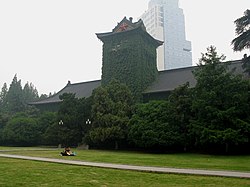
By 2021, Nanjing has 68 institutions of higher learning, including ten 111-plan universities, eight 211 universities, and 97 academicians. As the educational center of southern China for more than 1,700 years, Nanjing has many highly ranked educational institutions, with the number of universities (13) listed in 147 Double First-Class Universities ranking third (after Beijing and Shanghai). The ratio of college students to the total population ranks No.1 among large cities nationwide. Nanjing was ranked 59th globally by the QS Best Student City in 2026.
Nanjing has the fifth-largest scientific research output of any city in the world. When compared to other countries in the region, Nanjing ranked higher than South Korea, securing third place in Asia and Oceania after China and Japan, according to the Nature Index for 2025. For instance, Nanjing's share of the 2024 Nature Index is 2,135.61, with a count of 4,282, while South Korea's share is 2,017.95, with 3,431 counts. Since 2022, it has been ranked as the world's top second scientific research center in earth & environmental sciences after Beijing and the world's top third scientific research center in chemistry, physical sciences, and natural sciences after Beijing and Shanghai, according to the Nature Index.
Nanjing University is considered one of the top national universities nationwide, and it is ranked among the world's top 10 universities by Nature Index. As of 2026, Nanjing University ranked 7th in China, 13th in Asia and 62nd globally by Times Higher Education World University Rankings. Southeast University is also among the top universities in China, ranking 89th globally. It is considered one of the best universities for Architecture and Engineering in China. Many universities in Nanjing have satellite campuses or have moved their main campus to Xianlin University City in the eastern suburb. Some of the other most prominent national universities in Nanjing are:
Sister cities and twin towns
Nanjing's sister-city relationship with Nagoya, Japan, was suspended on February 21, 2012, following public comments by Nagoya mayor Takashi Kawamura denying the Nanjing Massacre. Non-governmental relations have been subsequently restored.
Kaynak: Wikipedia – Nanjing · CC BY-SA 4.0
Tarihçe
Modern Zamanlar
Ocak 1912'deki Çin Devrimi Çin Cumhuriyeti'nin kurulmasına, Sun Yat-sen'in ilk başkanı olması ve Nankin'in de başkent seçilmesine neden oldu. Ama, Qing Hanedanlığı hâlen kuzeydeki birçok bölgeyi kontrol altında tutuyordu, bu yüzden devrimciler Yuan Shikai'den Sun'un yerine geçmesini İmparatorun tahttan çekilmesine karşılık istediler. Yuan başkentin güçlerine daha yakın olan Pekin'in başkent olmasını emretti.
Chiang Kai-Shek komutasındaki Kuomintag ordusu 1927'de Nankin'i tekrar Çin Cumhuriyeti'nin başkenti ilan etti. KMT güçleri Pekin'i 1928 yılında ele geçirince Nankin uluslararası kabul gördü.
1937 yılında Japon ordusu o zamanlar Çin'in başkenti olan Nankin'i işgal etti. İşgal sırasında Nankin Katliamının Japon ordusu tarafından yapıldığı bugün kabul edilmektedir. Tam ölü sayısı resmî kayıtlar tutulmadığı için bilinmemektedir ama çoğu araştırmacı ölü sayısını 300.000 civarında tahmin etmektedir. Yahudi soykırımından farklı olarak bu olay dünyanın diğer bölgelerinde fazla bilinmemektedir. 1985'te Nankin Anıtı inşa edilmiştir.
Chiang hükûmetine karşı Japon işbirlikçisi Wang Jingwei tarafından Nankin'de yeni bir yönetim kuruldu ve II. Dünya Savaşından sonra KMT merkezi hükûmeti Nankin'e taşıdı. 23 Nisan 1949'da Çin Halk Cumhuriyeti ordusu Nankin'i işgal etti ve anakıtadaki Çin Cumhuriyeti yönetimi fiilen sona erdi.
2002 yılına kadar Çin Cumhuriyeti İç İşleri Bakanlığı ve Tayvan'da basılan ders kitapları Nankin'i Çin Cumhuriyeti başkenti olarak göstermekteydi.
Coğrafya

Toplam 6.598 kilometrekare (2.548 mil2) yüzölçümüne sahip Nankin, Yangtze Nehri'nin alt kısımlarının drenaj alanının ortasında ve Çin'in en büyük ekonomik bölgelerinden biri olan Yangtze Nehir Deltası'ndadır.
Yangtze Nehri, Nankin şehri'nin önce batı, sonra kuzey tarafından akarken, Ningzheng sırtı şehrin kuzey, doğu ve güney taraflarını çevreler. Şehir, Luoyang'ın 650 kilometre (400 mi) güneydoğusunda, Pekin'in 900 kilometre (560 mi) güney-güneydoğusunda, Şanghay'ın 270 kilometre (170 mi) batı-kuzeybatısında ve Çongçing'in 1.200 kilometre (750 mi) doğu-kuzeydoğusundadır.
Yangtze Nehri, Jiujiang, Jiangxi'den, Anhui ve Jiangsu'dan geçerek Doğu Çin denizine doğru akar. Alt Yangtze drenaj havzasının kuzey kısmı Huai Nehir havzası ve güney kısmı Qiantang Nehir havzasıdır. Bu havzalar Nankin'in doğusundaki Büyük Kanal ile birbirine bağlıdır. Nankin çevresindeki alan Xiajiang (Çince: 下江, Aşağı Akış Nehri) bölgesi denir. Kuzey kısımda Jianghuai, güney kısımda ise Jiangzhe baskındır. Bölge ayrıca Dongnan (Çince: 东南, Güney Doğu, Güneydoğu) ve Jiangnan (Çince: 江南 ve Nehir Güneyi, Yangtze'nin Güneyi) olarak da iyi bilinir.
Nanjing, kuzeydoğuda Yangzhou; doğuda Zhenjiang; ve güneydoğuda Changzhou ile komşudur. Batı sınırında Anhui vardır ve Nankin, kuzeybatıda Chuzhou, batıda Wuhu, Chaohu ve Ma'anshan ve güneybatıda Xuancheng olmak üzere il düzeyindeki beş şehirle komşudur.
Nankin doğal kaynaklar bakımından oldukça zengindir. Şehirde 40'tan fazla çeşitte maden bulunmaktadır. Bunlar arasında demir ve kükürt Jiangsu bölgesinde bulunanın %40'ını karşılık gelmektedir. Şehrin Strontium kaynakları Doğu Asya'da birinci sıradadır. Nankin aynı zamanda oldukça iyi su kaynaklarında sahiptir. Yangtse nehri ve çeşitli yeraltı suyu kaynakları bu durumu sağlamıştır.
Yangtse nehri ile ve dağlarla çevrili olması sayesinde Nankin şehri aynı zamanda harika doğal güzelliklere de sahiptir. Xuanwu Gölü ve Mochou Gölü gibi doğal göller insanların rahatlıkla ulaşabilecekleri şehir merkezindeyken çeşitli tepeler ve dağlar da yeşil alanlara sahiptirler ve tarihi ve kültürel alanlar içermektedirler.
Hükümet
Nankin hükûmetinin tam adı "Nankin Şehri Halk Hükümeti"dir. Şehir, şehrin fiilen valisi ve belediye başkanı ve hükümetin icra başkanı olan ÇKP Nanjing Komitesi Sekreteri ile ÇKP'nin tek parti yönetimindedir.
İdari bölümler
Nankin Eyalet altı şehri, 11 semt'e bölünmüştür.
Ekonomi
İlk gelişmeler
Üç Krallık döneminden beri Nankin avantajlı yeri ve ulaşım olanakları sayesinde tekstil ve darphane merkezi olagelmiştir. Ming hanedanlığı döneminde Nankin sanayisi daha da gelişti ve Çin'in hatta dünyanın en gelişmiş şehirlerinden biri haline geldi. Tekstil, para basımı, matbaacılık, gemi yapımı ve başka pek çok sektörde Nankin lider oldu ve Uzak Doğu'nun en işlek merkezi haline geldi.
20. yüzyılın ilk yarısında Nankin üretim merkezi olma durumundan giderek tüketim merkezi olmaya doğru yol aldı. Bunun nedeni Nankin'in tekrar Çin'in gündemine gelmesi ile birlikte Nankin'de yaşayan zengin kesimin hızlı artışıdır. Birçok mağaza Nankin'de ürünlerini satmaya başladılar. 1933'te Nankin'deki gıda ve eğlence sektörünün cirosu üretim ve tarım sektörünün cirosunu çoktan geçmişti. Şehir nüfusunun üçte biri hizmet sektöründe çalışıyordu ve aynı zamanda fuhuş, uyuşturucu ve kumar da yaygınlaşmıştı.
1950'lerde ÇKP ulusal hızlı sanayileşme planına uygun olarak Nankin'de birçok devlet yatırımı yapıldı. Elektrik, mekanik, kimya ve çelik fabrikaları ardı ardına kuruldu ve Nankin'i Doğu Çin'in ağır sanayi şehrine çevirdi. Nankin'i "dünya sınıfı" bir sanayi kentine dönüştürmeye fazlasıyla hevesli liderler birçok hatalar da yaptılar, örneğin kömürün olmamasına rağmen yüz milyonlarca Yuan'ın kömür bulunması için harcanması 1960'larda ekonomik gelişime kötü etki yaptı.
Bugün
Şehirdeki şu anki sanayi temel olarak geçen yüzyılın 60'larının özelliklerini gösterir; elektronik, otomotiv sanayi, petrokimyasallar, çelik ve enerji sektörü "beş temel sanayi" olarak bilinmektedir. Devletin sahip olduğu bazı büyük firmalara örnek olarak Panda Elektronik, Jincheng Otomotiv ve Nankin Çelik verilebilir. Birçok uluslararası firma da Nankin'e doğrudan yabancı yatırım yapmıştır, örneğin Fiat, A. O. Smith, Sharp gibi. Nankin'in DTÖ'ye girişinin ardından şehre yabancı yatırımcı ilgisi artmıştır ve günde ortalama iki firma şehirde bürolarını açmaktadırlar.
Ulaşım
Nankin, doğu Çin'in ve aşağı Yangtse Nehri alanının ulaşım merkezi konumundadır. Şehir çeşitli ulaşım olanaklarıyla kara, hava ve su yollarını kullanan üç boyutlu bir ulaşım ağına sahiptir. Diğer Çin şehirlerinde olduğu gibi toplu taşıma halkın çoğunluğunun kullandığı ulaşım seçeneğidir. Nankin Metrosu, 2005 yılında açılmış olup 225 km uzunluğa ve 6 hata sahiptir. Nankin Lukou Uluslararası Havalimanı, hem ulusal ve hem de uluslararası uçuş hizmeti vermektedir.
Demiryolu
Nankin, Çin'in doğusunda önemli bir demiryolu merkezidir.
Pekin-Şangay (Jinghu) (eski Jinpu ve Huning Demiryollarından oluşan), Nankin-Tongling Demiryolu (Ningtong), Nankin-Qidong (Ningqi) ve Nankin-Şi'an (Ningxi), Hefei-Nankin demiryolunu kapsar. Nankin, ulusal yüksek hızlı demiryolu ağına Pekin-Şangay Yüksek Hızlı Demiryolu ve Şanghay-Wuhan-Chengdu Yolcu Tahsisli Hattı ile ve yapım aşamasındaki birkaç yüksek hızlı demiryolu hattıyla bağlanır.
Nankin'deki ana istasyonlar Nankin İstasyonu, Nankin Güney İstasyonu, Jiangning İstasyonu, Lishui İstasyonu, Xianlin İstasyonu, Jiangning Batı İstasyonu, Nankin Doğu İstasyonu, Nankin Yolcu ve Teknik İstasyonu ile yeni Nankin Kuzey İstasyonu ve Lukou Air-Rail Intermodal Taşıma Merkezi İstasyonu planlama aşamasındadır. Bunlar arasında, Nankin Tren İstasyonu ulusal demiryolu merkez istasyonu ve Çin'in ilk on demiryolu merkezidir, Nankin Güney Tren İstasyonu ulusal demiryolu merkez istasyonu ve Asya'nın en büyük yüksek hızlı tren istasyonudur ve Nankin Doğu Tren İstasyonu Doğu Çin ve ülkenin en büyük 15. demiryolu ağı sıralama istasyonudur. Nankin Yolcu Teknoloji İstasyonu, tren teknoloji istasyonudur.
Nankin'deki 17 tren istasyonunun tamamı arasında, yolcu demiryolu hizmeti esas olarak Nankin Tren İstasyonu ve Nankin Güney Tren İstasyonu tarafından sağlanırken, Nankin Batı Tren İstasyonu, Zhonghuamen Tren İstasyonu ve Xianlin Tren İstasyonu gibi diğer istasyonlar küçük roller üstlenir. Nanjing Tren İstasyonu ilk olarak 1968'de inşa edildi. 12 Kasım 1999'da istasyon ciddi bir yangında yandı. İstasyonun yeniden inşası 1 Eylül 2005'te tamamlandı. Pekin-Şanghay Yüksek Hızlı Demiryolu üzerindeki 5 aktarma istasyonundan biri olan Nanjing Güney Tren İstasyonu'nun resmi olarak Asya'daki en büyük ve GFA (Brüt Kat Alanı) açısından dünyadaki ikinci en büyük tren istasyonu olduğu iddia edildi. Nanjing Güney İstasyonu'nun inşaatı 10 Ocak 2008'de başladı. İstasyon 2011 yılında kamu hizmetine açılmıştır.
Kaynak: Wikipedia – Nankin · CC BY-SA 4.0