
Interested in working with us in the future?
Follow to see new jobs and posts in your feed.
No news yet.

Names
Chángshā is the pinyin romanization of the Mandarin pronunciation of the Chinese name written 長沙 in traditional characters or 长沙 in simplified ones. The name—meaning "long sandy place"—is attested as early as the 11th century BC, when a vassal lord of the area sent King Cheng of Zhou a gift described as a "Changsha softshell turtle" (长沙鳖; 長沙鼈; Chángshā biē). Its precise origin is unknown but it originally referred to the region around the city rather than the settlement itself. In the 2nd century AD, the historian Ying Shao wrote that the Qin use of the name Changsha for the area was a continuance of its old name.
The Chu settlement in the Changsha area was known as Qingyang. Under the Han, the principality of Changsha called its capital Linxiang ("[Place] Overlooking the Xiang River"). During the Tang and Southern Chu, it was known as Tanzhou from its role overseeing their Tan Prefecture.
History
Early history
Development started around 3000 BC when Changsha developed with the proliferation of Longshan culture, although there is no firm evidence of such a link. Evidence exists that people lived and thrived in the area during the Bronze Age. Numerous examples of pottery and other objects have been discovered.
Later Chinese legends related that the Flame and Yellow Emperors visited the area. Sima Qian's history states that the Yellow Emperor granted his eldest son Shaohao the lands of Changsha and its neighbors. During the Spring and Autumn period (8th–5th century BC), the Yue culture spread into the area around Changsha. During the succeeding Warring States period, Chu took control of Changsha. Its capital, Qingyang, became an important southern outpost of the kingdom. In 1951–57 archaeologists explored numerous large and medium-sized Chu tombs from the Warring States Era. More than 3,000 tombs have been discovered. Under the Qin dynasty (221–206 BC), Changsha was a staging post for expeditions south into Guangdong that led to its conquest and the establishment of the Nanyue kingdom.
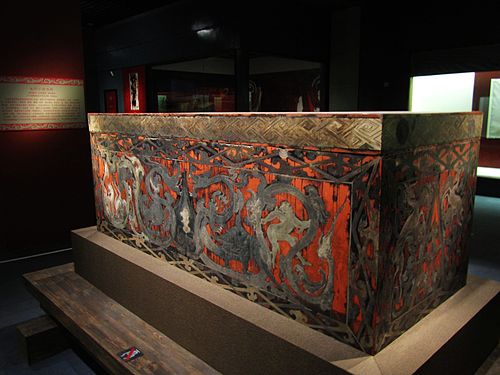
Under the Han (3rd century BC – 3rd century AD), Linxiang was the capital of the principality of Changsha. At first this was a client state held by Liu Bang's Baiyue ally Wu Rui that served as a means of controlling the restive Chu people and as a buffer state against Nanyue. By 202 BC, Linxiang had city walls to protect it against uprisings and invasions. The famous Mawangdui tombs were constructed between 186 and 165 BC. Lady Xin Zhui was buried in the earliest tomb (No. 2) and, during its excavation in the 1970s, was found to have been very well preserved. More importantly, the tombs included the earliest surviving copies of the Tao Te Ching and other important literary and historical documents.
When Wu Rui's descendant Wu Zhu (吳著, Wú Zhù) died childless in 157 BC, the kingdom was granted to a cadet branch of the imperial family as their fief. The kingdom was abolished under Wang Mang's short-lived Xin dynasty and briefly revived by the Eastern Han. In AD 33, its prince was demoted and the area administered as Linxiang County and Changsha Commandery.
Geography

Changsha is in northeast Hunan Province, the lower reaches of the Xiang River and the western part of the Changliu Basin. It lies between 111°53' to 114°15' east longitude and 27°51' to 28°41' north latitude. The city borders Yichun and Pingxiang of Jiangxi Province in the east, Zhuzhou and Xiangtan in the south, Loudi and Yiyang in the west, and Yueyang and Yiyang in the north. It is about 230 kilometres from east to west and about 88 kilometres from north to south. Changsha covers an area of 11,819 km2 (4,563 sq mi), of which the urban area of 2,150.9 km2 (830.5 sq mi), the urban built-up area is 374.64 km2 (144.65 sq mi). Changsha's highest point is Mount Qixing (七星岭) in Daweishan Town, 1,607.9 m (5,275 ft). The lowest point is Zhanhu (湛湖) in Qiaokou Town, 23.5 m (77 ft).
The Xiang is the main river in the city, running 74 km (46 mi) northward through the territory. 15 tributaries flow into the Xiang, of which the Liuyang, Laodao, Jinjiang and Wei are the four largest. The Xiang divides the city into two parts. The eastern part is mainly commercial and the west is mainly cultural and educational. On 10 October 2001, the seat of Changsha City was transferred from Fanzheng Street to Guanshaling. Since then, the economy of both sides of the Xiang River has achieved a balanced development.
Hydrology
Most of the rivers in Changsha belong to the Xiang River system. In addition to the Xiangjiang River, 15 tributaries flow into the Xiang, mainly including Liuyang River, Laodao River, Minjiang River, and Qinshui River. 302 tributaries are more than five kilometers long, including 289 in the Xiang River Basin. According to the tributary grading there are 24 primary tributaries, 128 secondary tributaries, 118 third tributaries, and 32 tributaries; and 13 are Zijiang water systems; a fairly complete water system is formed, and the river network is densely distributed. Hydrological characteristics of Changsha: the water system is complete, the river network dense; the water volume greater, the water energy resources abundant; the winter not frozen, and the sediment content small.
Administration

The municipality of Changsha exercises jurisdiction over six districts, one county and two county-level cities:
Government
The current CPC Party Secretary of Changsha is Chen Jing and the current mayor is Chen Bozhang.
Economy

Changsha is one of China's 15 most "developed and economically advanced" cities. As of 2024, Changsha's GDP per capita exceeded CN¥144,525 ( US$20,294 in nominal or US$42,136 in PPP), which is considered a high-income status by the World Bank and a primary developed city according to the international standard. The HDI of Changsha reached 0.817 (very high) in 2016, which is roughly comparable to a moderately developed country. Changsha is now one of the core cities in the South Central China region, the Yangtze River Economic Belt and the Belt and Road Initiative, a Beta- (global second-tier) city by the Globalization and World Cities Research Network, a new Chinese first-tier city and also a pioneering area for China-Africa economic and trade cooperation. Known as the "Construction Machinery Capital of the world", Changsha has an industrial chain with construction machinery and new materials as the main industries, complemented by automobiles, electronic information, household appliances, and biomedicine.
Since the 1990s, Changsha has begun to accelerate economic development, and then achieved the highest growth rate among China's major cities during the 2000s. The Xiangjiang New Area, the first state-level new area in Central China, was established in 2015. Changsha also has a prominent media and publishing industry, and has been named the first "UNESCO City of Media Arts" in China. Changsha is home to the Hunan Broadcasting System (HBS), the most influential provincial TV station in China.
In 2013, the financial news portal Yicai.com published its first edition of a list of ranking cities in China, with Changsha being included as one of 15 new first-tier cities. In 2017, Changsha made its way into the 1-trillion-yuan GDP club, becoming the 13th city in China with a GDP of one trillion yuan (154 billion US dollars). As of 2020, more than 164 Global 500 companies have established branches in Changsha. As a new first-tier city, Changsha was rated #10 nationwide in terms of its commercial worth in 2022.
Tourism
Places of interest
Tourism is a major industry in Changsha. Changsha has been consistently ranked as China's top tourist city. There are several sites in Changsha, notably the Yuelu Academy and the Changsha Meixihu International Culture and Arts Centre, a cultural complex designed by the British firm Zaha Hadid Architects overlooking the Meixi Lake at the Meixihu subdistrict of the city. Others include the Young Mao Zedong statue on Orange Isle, Meixi Lake Park, Changsha IFS Tower, Window of the World, Kaifu Temple and Changsha Ice World.
Mt. Yuelu
Yuelu Mountain is named after the "Nanyue Ji" written in the Liu and Song dynasties in the Southern and Northern dynasties, which states that "the surrounding area of Nanyue is eight hundred miles, with Huiyan as the head and Yuelu as the foot." Yuelu Mountain is located on the west bank of the Xiangjiang River in Yuelu District, Changsha City, Hunan Province; Orange Island is located in the middle of the Xiangjiang River, running through the center of the river from south to north, looking at Yuelu to the west and the ancient city to the east. There are 977 species of plants in 559 genera and 174 families in Yuelu Mountain Scenic Area. They are mainly typical subtropical evergreen broad-leaved forests and subtropical warm coniferous forests. In some areas, large areas of native evergreen broad-leaved secondary forests are preserved. A large number of precious endangered tree species and ancient and famous trees.
Orange Island
Orange Island is located in the center of the Xiangjiang River in Yuelu District, Changsha City, Hunan Province. The original area is about 17 hectares, and the overall developed land area of the scenic spot reaches 91.64 hectares. It is the largest sandbar among the many alluvial sandbars in the lower reaches of the Xiangjiang River, and is known as "China's First Continent". Orange Island has Mao Zedong Youth Art Sculpture, Wen Tiantai and other attractions. According to historical records, Orange Island was formed in the second year of Yongxing (305), the second year of Emperor Hui of the Jin dynasty. It was formed by the alluvial accumulation of rapids and sand and gravel.
Demographics
As of the 2020 Chinese census, Changsha was home to 10,047,914 people, whom 7,355,198 lived in its built-up (or metro) area made of the 6 urban Districts plus Changsha County largely conurbated. The majority of people living in Changsha are Han Chinese. A sizeable population of ethnic minority groups also live in Changsha. The three largest are the Hui, Tujia, and Miao peoples. The 2000 census showed that 48,564 members of ethnic minorities live in Changsha, 0.7% of the population. The other minorities make up a significantly smaller part of the population. Twenty ethnic minorities have fewer than 1,000 members living in the city.
Culture

Media
Hunan Broadcasting System is China's largest television after China Central Television (CCTV). Its headquarters is in Changsha and produces some of the most popular programs in China, including Super Girl. These programs have also brought a new entertainment industry into the city, which includes singing bars, dance clubs, theater shows, as well as related businesses including hair salons, fashion stores, and shops for hot spicy snacks at night (especially during summer). While Changsha has developed into an entertainment hub, the city has also become increasingly westernized and has attracted a growing number of foreigners.
Cuisine
Various types of cuisine are found in Changsha, yet the hot and spicy Hunan cuisine typical of the region remains the most popular. The snack chain Juewei Duck Neck, which now has over 10,000 outlets, originates from Changsha.
In May 2008, the BBC broadcast, as part of its Storyville documentary series, the four-part The Biggest Chinese Restaurant in the World, which explored the inner workings of the 5,000-seating-capacity West Lake Restaurant (Xihu Lou Jiujia) in Changsha.
During the Warring States period, Qu Yuan, a great patriotic poet, recorded many dishes in Hunan in his famous poem "The Soul"(招魂). During the Western Han dynasty, there were 109 varieties of dishes in Hunan, and there were nine categories of cooking methods. After the Six Dynasties, Hunan's food culture was rich and active. The Ming and Qing dynasties are the golden age for the development of Hunan cuisine. The unique style of Hunan cuisine is basically a foregone conclusion. At the end of the Qing dynasty, there were two kinds of Hunan cuisine restaurants in Changsha. In the early years of the Republic of China, the famous Dai (Yang Ming) School, Sheng (Shan Zhai) School, Xiao (Lu Song) School, and Zuyu School appeared in various genres, which laid the historical status of Hunan cuisine. Since the founding of New China, especially since the reform and opening up, it has been better developed.
Education and research

Research and Innovation
Changsha is the birthplace of super hybrid rice, Yinhe-1, the first China's supercomputer built in the 1980s, the Tianhe-1 supercomputer, China's first laser 3D printer, and China's first domestic medium-low speed maglev line. In November 2010, the National Supercomputing Changsha Center was established at Hunan University, becoming the first National Supercomputing Center in Central China and third National Supercomputing Center in China, after those in Tianjin and Shenzhen.
Changsha is a major city for research and innovation in Central China, as well as in the Asia-Pacific region. It ranked 23rd globally, 15th in the Asia & Oceania region, 13th in China, 5th in the South Central region after (Guangzhou, Wuhan, Shenzhen, and Hong Kong), and 2nd in the Central China region after Wuhan by scientific research outputs, as tracked by the Nature Index 2025 Science Cities. When compared to other countries in the region, Changsha ranked higher than Singapore, securing fifth place in Asia after China, Japan, South Korea, and India, according to the Nature Index for 2025. For instance, Changsha's share of the 2024 Nature Index is 781.10, with a count of 1,621, while Singapore's share is 690.01, with 1,799 counts.
Changsha was also ranked 32nd globally and 3rd in the South Central region after (Shenzhen–Hong Kong–Guangzhou and Wuhan) in the "Top 100 Science & Technology Cluster Cities" rankings based on "publishing and patent performance" released by the Global Innovation Index 2024.
As of 2020, Changsha ranked 8th in the top 10 China's innovation-oriented cities, and 6th (behind Shenzhen, Hangzhou, Shanghai, Chengdu and Beijing) in the Top 10 China's most attractive cities for talent, according to the 21st Century Business Herald report. Changsha has held the title "China's Leading Smart City" since 2021. As of 2021, Changsha had 97 independent scientific research institutions, 14 national engineering and technology research centers, 15 national key engineering and technology laboratories, and 12 national enterprise technology centers.
Transportation

Changsha is well connected by roads, river, rail, and air transportation modes, and is a regional hub for industrial, tourist, and service sectors.
The city's public transportation system consists of an extensive bus network with over 100 lines. Changsha Metro is the city's 6-line network. Metro Line 2, the first line, opened on 29 April 2014 and 20 stations for Line 2 opened on 28 June 2016. Line 3 runs southwest–northeast and is 33.4 kilometres (20.8 mi) long, Line 4 northwest-southeast and 29.1 kilometres (18.1 mi) long. A maglev link running 16.5 kilometres (10.3 mi) between Changsha South station and Changsha airport opened in April 2016, with a construction cost of €400m. Connecting Changsha with Zhuzhou and Xiangtan, Changzhutan Intercity Rail opened on 26 December 2016.
The G4, G4E, G4W2, G5513 and G0401 of National Expressways, G107, G106 and G319 of National Highways, S20, S21, S40, S41, S50, S60 and S71 of Hunan provincial Expressways, connect the Changsha metro area nationally. There are three main bus terminals in Changsha: the South Station, East Station and West Station, dispatching long- and short-haul trips to cities within and outside the province of Hunan. Changsha is surrounded by major rivers, including the Xiang (湘江) and its tributaries such as the Liuyang, Jin, Wei, Longwanggang and Laodao. Ships mainly transport goods from Xianing port in North Changsha domestically and internationally.
Changsha Railway Station is in the city center and provides express and regular services to most Chinese cities via the Beijing–Guangzhou and Shimen–Changsha Railways. The Changsha South Railway Station is a new high-speed railway station in Yuhua district on the Beijing–Guangzhou High-Speed Railway (as part of the planned Beijing–Guangzhou–Shenzhen–Hong Kong High-Speed Railway). The station, with eight platforms, opened on 26 December 2009. Since then passenger volume has increased greatly. The Hangzhou-Changsha-Huaihua sector of the Shanghai-Changsha-Kunming high-speed railway entered service in 2014.
City honors and rankings
The city ranked 21st in the world by numbers of 150m+completed buildings as of October 2025
Changsha IFS Tower T1 ranked the 16th tallest completed building in the world as of 2020
China's Top 2nd Most Influential City of Nighttime Economy in 2022
One of China's 15 new first-tier cities in 2013
32nd globally in the "Top 100 Science & Technology Cluster Cities" rankings by "publishing and patent performance" released by the Global Innovation Index 2024
23rd globally and 15th in the Asia & Oceania region in the "Top 200 cities" by scientific research outputs released by the Nature Index 2024 Science Cities Rankings.
67th worldwide in the Global Cities Outlook rankings of the 2018 Global Cities Report released by AT Kearney
68th worldwide in terms of "Urban Economic Competitiveness" in 2019 jointly released by the Chinese Academy of Social Sciences (CASS) and the United Nations Programme for Human Settlements (UN-Habitat)
The first Chinese city to be recognized as a "World Creative City in Media Arts" by UNESCO
Changsha was classified as a Beta- (global second tier) city together with Manchester (the U.K), Geneva (Switzerland) and Seattle (the U.S) by the Globalization and World Cities Research Network.
The 10 fastest growing cities in the world Changsha's nominal GDP is projected to be among the world top 50 largest cities according to a study by Oxford Economics in 2035, and its nominal GDP per capita will reach US$41,000 in 2030.
Twin towns – sister cities
By the end of June 2018, Changsha has established friendly city relationship with 49 foreign cities.
Consulates general/consulates
Changsha is home to two foreign consulates, making it the second city hosting foreign representatives in Central China after Wuhan.
Astronomy
Changsha is represented by the star Zeta Corvi in a Chinese constellation.
Kaynak: Wikipedia – Changsha · CC BY-SA 4.0