
Interested in working with us in the future?
Follow to see new jobs and posts in your feed.
No news yet.

Etymology
"Qiqihar" is a Dagur word meaning "border" or "natural pasture". The name Qiqihar comes from Manchu: ᠴᡳᠴᡳᡥᠠᡵ, Möllendorff: Cicihar, Abkai: Qiqihar, IPA: /t͡ɕʰi.t͡ɕʰi.χar/.
History

Early history
The region was originally settled by nomadic Daur and Tungus herdsmen. The city's original name was Bukui (卜奎), the Chinese transcription of a Dagur word meaning "auspicious". The city's oldest mosque, the Bukui Mosque, predates the foundation of the city by seven years. During the Imperial Russian eastward advance to the Pacific, Qiqihar became a major garrison center in 1674. In 1691, a stronghold was constructed in Qiqihar because the Qing government campaigned against the Mongols.
Around 1700 it was a centre for Russo-Chinese trade. A military depot with barracks and an arsenal was set up there, and many convicted criminals were exiled to the area. Heilongjiang Martial was domiciled in Qiqihar City in 1699. Qing China had initially intended to keep the far-northern Heilongjiang province as a semi-pastoral area, separate from the wider Chinese agricultural economy, so it did not allow seasonal urban migrants, such as those from Hebei and Shandong who wished to participate in the Qiqihar fur trade, to own farms or develop the land.
After the Russian Empire seized Outer Manchuria according to the Treaty of Aigun and the Convention of Peking, the Qing decided to lift the various restrictions on settlement that it placed on Northeast China and on Heilongjiang residency in particular, in 1868, 1878, and 1904. It enlisted Han Chinese to help to teach the local Solon people farming techniques, provide materials and tax exemptions to convert them from hunting. In 1903, the completion of the Chinese Eastern Railway made Qiqihar a centre for communications between China and Russia. A network of lines radiating from Qiqihar was extended into the northwestern part of Heilongjiang Province including Jiagedaqi and Manzhouli in the late 1920s.
Second Sino-Japanese War
In 1931, Japan used a false flag attack, known as the September 18 Incident, to justify moving its Guandong Army to capture major cities in Northeast China that month, starting with Shenyang, Changchun, then Jilin City. General Ma Zhanshan was ordered to act as Governor and Military Commander-in-chief of Heilongjiang Province on 10 October. General Ma declined a Japanese ultimatum to surrender Qiqihar on 15 November. However, after their success in the Jiangqiao campaign, the Japanese began their occupation of Qiqihar on 19 November. Liaoning fell in December, and Harbin in February; the puppet Manchukuo government of the Japanese-occupied territory under General Zhang Jinghui established Qiqihar as its administrative center and of Longjiang province. Qiqihar became a major military base for the Guandong Army and its economic importance also grew rapidly. During the occupation, the Imperial Japanese Army established Unit 516 in Qiqihar for research into chemical warfare. A major mustard gas tank left over from the Second Sino-Japanese War buried underground was accidentally damaged in August 2003, causing 43 injuries and one death.
Geography
Qiqihar City occupies a land area of 42,289 square kilometers at an altitude of 100–500 meters, with an average elevation of 146 meters.
Border
Qiqihar is located along the middle and lower reaches of the Nen River and the hinterland of Songnen Plain, which is adjacent to the Greater Khingan Range and Hulunbuir Prairie. Bordering prefecture cities are:
The city's metro area is located 359 km (223 mi) from the provincial capital of Harbin, 282 km (175 mi) from Baicheng, 139 km (86 mi) from Daqing, and 328 km (204 mi) from Suihua. The total area under the city's jurisdiction is 42,289 km2 (16,328 sq mi). The region's elevation above sea level is generally between 200 and 500 m (660 and 1,600 ft).
Climate
Qiqihar has a cold, monsoon-influenced, humid continental climate (Köppen Dwa), with four distinct seasons. It has long, bitterly cold, but dry winters, with a 24-hour average in January of −18.1 °C (−0.6 °F). Spring and fall are mild, but short and quick transitions. Summers are very warm and humid, with a 24-hour average in July of 23.3 °C (73.9 °F). The average annual precipitation is 415 millimetres (16.3 in), with over two-thirds of it falling from June to August. The annual mean is 4.38 °C (39.9 °F). With monthly percent possible sunshine ranging from 56% in July to 73% in February, the city receives abundant sunshine, with 2,839 hours of bright sunshine annually. Extreme temperatures have ranged from −39.5 °C (−39 °F) on January 8, 1956, to 42.1 °C (108 °F) on 26 June 1980. Unusually for a place with such cold winters, it has never experienced a temperature of -40 degrees (C/F) or lower.
Subdivisions

Qiqihar is divided into 16 divisions: 7 districts (区; qū), 8 counties (县; xiàn) and 1 county-level city (县级市; xiànjí shì).
Demographics
According to the Seventh national population census, the population amounted to 4,067,489. Compared with 5,367,003 people in the Sixth national census in 2010, it decreased by 1,299,514 people, a drop of 24.21%, with an average annual growth rate of -2.73%.
There were 2,044,598 males, accounting for 50.27%. There were 2,022,891 women, accounting for 49.73%. The sex ratio (with females as 100, the proportion of males to females) decreased from 102.00 in the Sixth national census in 2010 to 101.07.
Economy
Qiqihar is a heavily industrialized city involved in manufacturing.
In 2009, the city's 95 large-scale equipment manufacturing enterprises, with total assets of 30.6 billion yuan, accounting for the city's industrial enterprises above designated size of 46.5% of total assets, the number of employees 5.2 million, accounting for the city's industrial enterprises above the size of 45.6% of the total number of employees. The main business income of 25.57 billion yuan, industrial added value of 8.05 billion yuan, profits of 1.96 billion yuan, 1.03 billion yuan of taxes, respectively, year on year growth of 2.9%, 3%, 19.6% and 22.3%, accounting for the city's industrial enterprises above designated size were 40.6%, 40%, 44.3% and 31.7%, respectively.
Companies
Companies conducting business in Qiqihar include RT-Mart, Walmart, GOME Electrical Appliances, and Suning Commerce Group.
Banks
Since Qiqihar is a large city, numerous banks are represented here. Some of the banks include Bank of China, China Construction Bank, Industrial and Commercial Bank of China, and Agricultural Bank of China.
Tourism
Qiqihar is very close to the Zhalong Nature Reserve and the Longsha park.
Transportation
Airport
Qiqihar is served by its own domestic airport, Qiqihar Sanjiazi Airport.
Trains
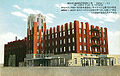
Qiqihar is well connected in terms of railway transportation. Trains from Qiqihar Railway Station connect the city with Harbin, Beijing, Dalian, Hangzhou, Xi'an and several other major cities in China. Qiqihar Sanjiazi Airport, 13 km (8.1 mi) from Qiqihar's downtown area, operates daily flights to Beijing, Guangzhou, Shanghai and other major cities in China. In the district of Ang'angxi, the Harbin-Manzhouli Railway intersects with the Qiqihar-Bei'an Railway.
The Harbin–Qiqihar intercity railway opened on 17 August 2015; it provides frequent high-speed service to Harbin, as well as some direct trains to Beijing.
River
The Nen River is used to transport freight.
Education
Numerous schools exist in the city. Four elementary schools feed into 8 city or county high schools.
There are two universities: Qiqihar University and its medical school.
Sister cities
New Castle County, Delaware, United States
Notable people from Qiqihar
Zhou Tienong - Vice chair of Standing committee of Congress of China
Li Yingying - Chinese female national volleyballer
Kaynak: Wikipedia – Qiqihar · CC BY-SA 4.0

İdari bölümler
Qiqihar şehri yedi semt, bir ilçe düzeyi şehir ile sekiz ilçeden oluşmaktadır.
Kaynak: Wikipedia – Qiqihar · CC BY-SA 4.0