
Interested in working with us in the future?
Follow to see new jobs and posts in your feed.
No news yet.

Name
The name Chengdu is attested in sources dating back to the Warring States period. It has been called the only major city in China to have remained at an unchanged location with an unchanged name throughout the imperial, republican, and communist eras. However, it also had other names; for example, it was briefly known as "Xijing" (Western Capital) in the 17th century. The etymology of the name is unclear. The earliest and most widely known explanation, although not generally accepted by modern scholars, is provided in the 10th-century geographical work Universal Geography of the Taiping Era, which states that the ninth king of Shu's Kaiming dynasty named his new capital Chengdu after a statement by King Tai of Zhou that a settlement needed "one year to become a town, two to become a city, and three to become a metropolis." (The character for cheng Chinese: 成 may mean "turned into" while du Chinese: 都 can mean either a metropolis or a capital).
The present spelling is based on pinyin romanization; its Postal Map romanization was "Chengtu". Its former status as the seat of the Chengdu Prefecture prompted Marco Polo's spellings "Sindafu", "Sin-din-fu", and the Protestant missionaries' romanization "Ching-too Foo".
Although the city's official name has remained (almost) constant, the surrounding area has sometimes been known by other names, including "Yizhou". Chinese nicknames for the city include the "Turtle City", variously derived from the old city walls' shape on a map or a legend that Zhang Yi had planned their course by following a turtle's tracks; the "Brocade City" (see Sichuan brocade), a contraction of the earlier "City of the Brocade Official", after an imperial office established under the Western Han; the "Hibiscus City" (Rongcheng, 蓉城), from the hibiscus which King Meng Chang of the Later Shu ordered planted upon the city wall during the 10th century.
Emblem
The city emblem, adopted in 2011, is inspired by the Golden Sun Bird, an ancient relic unearthed in 2001 from the Jinsha Site.
History

Early history
Archaeological discoveries at the Sanxingdui and Jinsha Site have established that the area surrounding Chengdu was inhabited over four thousand years ago, in the 18th–10th century BC. At the time of China's Xia, Shang, and Zhou dynasties, it represented a separate ancient bronze-wielding culture that, following its partial sinification, became known to the Chinese as Shu. Shu was conquered by Qin in 316 BC, and the settlement was re-founded by Qin general Zhang Yi.
Pre-Qin to Qin and Han dynasties
In the early stage of the Xia dynasty or even earlier, the ancient Shu Kingdom, located on the Chengdu Plain, had developed a relatively advanced bronze civilization, becoming an important source of Chinese civilization and one of the birthplaces of the Chinese nation. According to records, there were five dynasties in the ancient Shu Kingdom, and their capitals were Qushang (now Wenjiang District, Chengdu), Piyi (now Pidu District), Xindu, and Guangdu. At the end of the Spring and Autumn period (around the 4th century BC), the fifth King Kaiming moved the capital to Chengdu. According to "Taiping Huanyu Ji", the name of the city is borrowed from the history of the establishment of the capital in the Western Zhou dynasty. The allusion in Zhou Wang Qianqi's "one year, he lived in a cluster, two years became a city, and three years Chengdu" is to the name Chengdu; it has been used to this day. Therefore, Chengdu has become a rare city in China and the world that has not changed its name since its establishment. Some people think that Chengdu is a transliteration of ancient Shu place names. There is a saying that "Guangdu, Xindu, and Chengdu" are collectively referred to as the "Three Capitals of Ancient Shu". Nowadays, many cultural relics of the ancient Shu Kingdom are located on the Chengdu Plain, including Sanxingdui Ruins, Jinsha Ruins, Yufu Ancient City Ruins, and Wangcong Temple. Jinsha Ruins, located in Chengdu's urban area, is a pinnacle of ancient Shu culture.
Geography

The vast plain on which Chengdu is located has an elevation ranging from 450 to 720 meters (1,480 to 2,360 feet).
Northwest Chengdu is bordered by the high and steep Longmen Mountains in the north-west and in the west by the Qionglai Mountains, the elevation of which exceeds 3,000 m (9,800 ft) and includes Miao Jiling (5,364 m, 17,598 ft) and Xiling Snow Mountain (5,164 m, 16,942 ft). The western mountainous area is also home to a large primitive forest with abundant biological resources and a giant panda habitat. East of Chengdu stands the low Longquan Mountains and the west bordering area of the hilly land of the middle reaches of Min River, an area noted by several converging rivers. Since ancient times, Chengdu has been known as "the Abundant Land" owing to its fertile soil, favorable climate, and novel Dujiangyan Irrigation System.
Chengdu is located at the western edge of the Sichuan Basin and sits on the Chengdu Plain; the dominating terrain is plains. The prefecture ranges in latitude from 30° 05' to 31° 26' N, while its longitude ranges from 102° 54' to 104° 53' E, stretching for 192 kilometers (119 mi) from east to west and 166 km (103 mi) south to north, administering 12,390 km2 (4,780 sq mi) of land. Neighboring prefectures are Deyang (NE), Ziyang (SE), Meishan (S), Ya'an (SW), and the Ngawa Tibetan and Qiang Autonomous Prefecture (N). The urban area, with an elevation of 500 m (1,600 ft), features a few rivers, three of them being the Jin, Fu, and Sha Rivers. Outside of the immediate urban area, the topography becomes more complex: to the east lies the Longquan Mountains (龙泉山脉) and the Penzhong Hills (Chinese: 盆中丘陵); to the west lie the Qionglai Mountains, which rise to 5,364 m (17,598 ft) in Dayi County. The highest point in Chengdu is Daxuetang (also known as Miaojiling) in Xiling Snow Mountain, Dayi County, at an altitude of 5,364 meters. The lowest point is the riverbank at the exit of the Tuojiang River in Jianyang City, with an altitude of 359 meters.
Administrative divisions
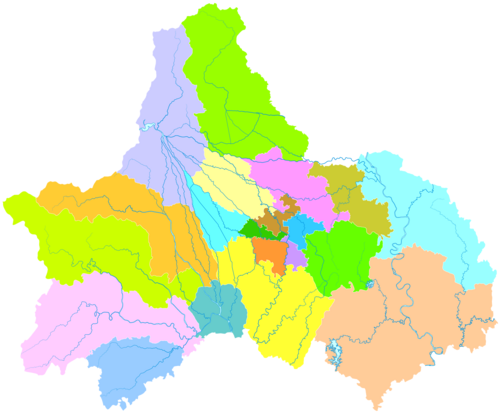
Chengdu is a sub-provincial city, serving as the capital of Sichuan. It has direct jurisdiction over 12 districts, 5 county-level cities and 3 counties:
Chengdu Economic and Technological Development Zone
Chengdu Hi-tech Industrial Development Zone
Cityscape

In 1988, the Implementation Plan for a Gradual Housing System Reform in Cities and Towns marked the beginning of overall housing reform in China's urban areas. More than 20 real estate companies set up in Chengdu, which was the first step for Chengdu's real estate development.
The comprehensive Funan River renovation project in the 1990s was another step towards promoting Chengdu's environmental development. The Funan River Comprehensive Improvement Project won the UN-Habitat Scroll of Honour Award in 1998, as well as winning the "Local Initiative Award" by the International Council for Local Environmental Initiatives in 2000.
Construction of the Five Main Roads & One Bridge project began in 1997. Three roads served the eastern part of the city; the other two led south. It established the foundation of the Eastern and Southern sub-centers of Chengdu. The two major sub-centers determined people's eastward and southward living trends. Large numbers of buildings appeared around the east and south of the 2nd Ring Road. The Shahe River renovation project, along with the Jin River project, also sparked a trend among residents living along both rivers. It was said that the map of Chengdu should be updated every three months.
A speculative housing boom occurred in the late 1990s and early 2000s. In 2000, dozens of commercial real estate projects also appeared. While promoting the real estate market, the Chinese government encouraged citizens to buy their own houses by providing considerable subsidies for a certain period. Houses were included in commodities.
As of February 2026, the world's third-largest building by floor area, the New Century Global Center, is located in the city. The 100-meter-tall (330 ft) structure is 500 by 400 meters (1,600 by 1,300 ft) in size with 1,700,000 square meters (18,000,000 sq ft) of floor area, housing retail outlets, a movie theaters, offices, hotels, a water park with artificial beach and waves and a Mediterranean-style village comprising a large 5-star hotel, a skating rink and a 15,000-spot parking area.
Demographics
According to the 2020 Chinese census, the municipality had 20,937,757 inhabitants; the metropolitan area itself was home to 16,045,577 inhabitants, including those of the 12 urban districts plus Guanghan City (in Deyang). Chengdu is the largest city in Sichuan and the fourth largest in China. 21,192,000 for 2021, adding more residents than any other city in the country.
As of 2015, the OECD (Organization for Economic Cooperation and Development) estimated the population of the Chengdu metropolitan area at 18.1 million.
Culture

In 2006, China Daily named Chengdu China's fourth-most-livable city.
Literature
Some of China's most important literature comes from Chengdu. The city has been home to literary giants, such as Sima Xiangru and Yang Xiong, two masters of Fu, a mixture of descriptive prose and verse during the Tang dynasty; Li Bai and Du Fu, the most eminent poets of the Tang and Song dynasties respectively; Yang Shen'an, a famous scholar of the Ming dynasty; and Guo Moruo and Ba Jin, two well-known modern writers. Chang Qu, a historian of Chengdu during the Jin dynasty, compiled the earliest local historical records, the Record of Hua Yang State. Zhao Chongzuo, a poet in Chengdu during the Later Shu Kingdom, edited Among the Flowers, the first anthology of Ci in China's history. Meng Chang, the king of Later Shu, wrote the first couplet for the Spring Festival, which says, "A harvest year accepts celebrations, good festivals foreshadow long springs."
In 2023, Chengdu hosted the 81st World Science Fiction Convention, having beat out Winnipeg, Canada, in site-selection voting in 2021.
Fine art
During the period of the Five Dynasties, Huang Quan, a painter in Chengdu, initiated the Fine-Brush Flower-and-Bird Painting School with other painters. At that time, "Hanlin Painting Academy" was the earliest royal academy in China.
Religion
Islam has a long history in Sichuan dating to the Tang dynasty (618–907), 12 mosques are located in Chengdu. Huangcheng Mosque in the center of Chengdu dates from the 16th century.
Chengdu contains official, Roman Catholic and Protestant congregations, some of which are underground churches.
The Apostolic Vicariate of Szechwan (now known as Diocese of Chengdu) was established on 15 October 1696. Artus de Lionne, a French missionary of Paris Foreign Missions Society, was appointed as the first Apostolic Vicar.
Main sights

Mount Qingcheng
Mount Qingcheng is amongst the most important Taoism sites in China. It is situated in the suburbs of Dujiangyan City and connected to downtown Chengdu 70 km (43 mi) away by the Cheng-Guan Expressway.
At its peak, 1,600 m (5,200 ft) above sea level, Mount Qingcheng enjoys a cool climate, yet remains lush and green year-round, surrounded by hills and waterways. Mount Qingcheng's Fujian Temple, Tianshi Cave, and Shizu Hall are among the better-known Taoist holy sites. Shangqing Temple is noted for an evening phosphorescent glow locally referred to as "holy lights".
Dujiangyan Irrigation System
The Dujiangyan Irrigation System (58 km (36 mi) from downtown Chengdu) is the oldest existing irrigation project in the world, with a history of over 2000 years, diverting water without a dam to distribute water and filter sand, with inflow quantity control. Libing and his son built the system. The irrigation system prevents floods and droughts throughout the Plain of Chengdu.
Sichuan Giant Panda Sanctuaries
Covering a total of 9,245 km2 (3,570 sq mi) over 12 distinct counties and 4 cities, Sichuan Giant Panda Sanctuaries, lie on the transitional alp-canyon belt between the Sichuan Basin and the Qinghai-Tibetan Plateau. It is the largest remaining continuous habitat for giant pandas and is home to more than 80 percent of the world's wild giant pandas. Globally speaking, it is also the most abundant temperate zone of greenery. The reserves of the habitat are 100–200 km (62–124 mi) away from Chengdu.
The Sichuan Giant Panda Sanctuaries are among the best-known of their kind in the world, with Wolong Nature Reserve generally considered the "homeland of pandas". It is a core habitat with unique natural conditions, complex landforms, and a temperate climate, supporting diverse wildlife. Siguniang Mountain, sometimes called the "Oriental Alpine," is approximately 230 km (140 mi) away from downtown Chengdu, and is composed of four adjacent peaks of the Traversal Mountain Range. Among the four peaks, the fourth and highest stands 6,250 m (20,510 ft) above sea level, and is perpetually covered by snow.
Economy

China's state council has designated Chengdu as the country's western center of logistics, commerce, finance, science and technology, as well as a hub of transportation and communication. It is also an important base for manufacturing and agriculture.
According to the World Bank's 2007 survey report on global investment environments, Chengdu was declared "a benchmark city for investment environment in inland China."
Also based on a research report undertaken by the Nobel economics laureate, Dr. Robert Mundell and the celebrated Chinese economist, Li Yining, published by the State Information Center in 2010, Chengdu has become an "engine" of the Western Development Program, a benchmark city for investment environment in inland China, and a major leader in new urbanization.
In 2010, 12 of the Fortune 500 companies, including ANZ Bank, Nippon Steel Corporation, and Electricité de France, opened offices, branches, or operation centers in Chengdu, the largest number in recent years. Meanwhile, the Fortune 500 companies that have opened offices in Chengdu, including JP Morgan Chase, Henkel, and GE, increased their investment and upgraded the involvement of their branches in Chengdu. By the end of 2010, over 200 Fortune 500 companies had set up branches in Chengdu, ranking it first among Central and Western China cities in terms of the number of Fortune 500 companies. Of these, 149 are foreign enterprises, and 40 are domestic companies.
According to the 2010 AmCham China White Paper on the State of American Business in China, Chengdu has become a top investment destination in China.
The main industries in Chengdu—including machinery, automobile, medicine, food, and information technology—are supported by numerous large-scale enterprises. In addition, an increasing number of high-tech enterprises from outside Chengdu have also settled down there.
Transport

Air
Chengdu is the third Chinese city with two international airports (Chengdu Shuangliu International Airport and Chengdu Tianfu International Airport) after Beijing and Shanghai. Chengdu Shuangliu International Airport (IATA: CTU, ICAO: ZUUU) is located in Shuangliu District 16 km (9.9 mi) southwest of downtown. Chengdu Shuangliu International Airport is the busiest airport in Central and Western China and the nation's fourth-busiest in 2018, with a total of 53 million passengers.
Chengdu airports (including Shuangliu International Airport and Tianfu International Airport) is also a 240-hour visa-free transit port for foreigners from 53 countries Besides, Chengdu airports also offer 24-hour visa-free transit for most nationals when having a stopover in Chengdu.Chengdu Shuangliu International Airport has two runways and is capable of operating the Airbus A380, currently the largest passenger aircraft in operation. Chengdu is the fourth city in China with two commercial-use runways, after Beijing, Shanghai, and Guangzhou. On 26 May 2009, Air China, the Chengdu City Government, and the Sichuan Airport Group signed an agreement to improve airport infrastructure and increase the number of direct international flights to and from Chengdu. The objective is to increase passenger traffic to more than 40 million by 2015, making Chengdu Shuangliu International Airport the fourth-largest international hub in China, after Beijing, Shanghai, and Guangzhou, and one of the top 30 largest airports in the world. Chengdu Shuangliu Airport ranked the No.1 and No.2 busiest airport in China in 2020 and 2021, respectively. The airport is currently operating only domestically.
A second international airport, the Chengdu Tianfu International Airport (IATA: TFU, ICAO: ZUTF), currently with two main terminals and three runways, opened in June 2021. The new airport is 51 kilometers (32 mi) southeast of the city and will have a capacity of 80–90 million passengers per year.
Education and research

Wen Weng, administrator of Chengdu in the Han dynasty, established the first local public school in the world, now named Shishi (literally "stone house"). The school site has not changed for more than 2,000 years, which remains the site of today's Shishi High School. No. 7 High School and Shude High School are also two famous local public schools in Chengdu.
Chengdu is a leading scientific research city, one of the only two cities in the Western China region (alongside Xi'an), ranking in the top 25 cities worldwide by scientific research outputs. It is consistently ranked # 1 as the center of higher education and scientific research in Southwest China. The city is home to more than 58 universities, with the two reputable ones being Sichuan University and the University of Electronic Science and Technology of China, ranking # 77 and #151 worldwide, respectively.
Higher education
Sichuan University (SCU) (Founded in 1896), including the West China Medical Center of Sichuan University (Founded in 1910)
Southwest Jiaotong University (Founded in 1896)
Southwestern University of Finance and Economics (Founded in 1925)
University of Electronic Science and Technology of China (Founded in 1956)
Chengdu University of Technology (Founded in 1956)
Sichuan Normal University (Founded in 1946)
Chengdu University of Traditional Chinese Medicine (Founded in 1956)
Chengdu Kinesiology University (Founded in 1942)
Southwest University for Nationalities (Founded in 1951)
Sichuan Conservatory of Music (Founded in 1939)
Southwest Petroleum University (Founded in 1958)
Chengdu University of Information Technology (Founded in 1951)
Chengdu Medical College (Founded in 1947)
Note: Private institutions or institutions without full-time bachelor's programs are not listed.
Consulates
The United States Consulate General at Chengdu opened on 16 October 1985. It was the first foreign consulate in west-central China since 1949. The United States Consulate General at Chengdu was closed on 27 July 2020, corresponding to the closure of Chinese Consulate-General, Houston. The Sri Lankan consulate in Chengdu opened in 2009, and was temporarily closed in 2016. Currently, 13 countries have consulates in Chengdu. The Philippines, India, Greece, Argentina have been approved to open consulates in Chengdu.
Sports

Soccer
Soccer is a popular sport in Chengdu. Chengdu Tiancheng, Chengdu's soccer team, played in the 42,000-seat Chengdu Sports Stadium in the Chinese League One. The club was founded on 26 February 1996 and was formerly known as Chengdu Five Bulls, named after their first sponsor, the Five Bulls Cigarette Company. English professional soccer club Sheffield United F.C took over the club on 11 December 2005. The club was later promoted into the China Super League until they were embroiled in a match-fixing scandal in 2009. Punished with relegation the owners eventually sold their majority on 9 December 2010 to Hung Fu Enterprise Co., Ltd and Scarborough Development (China) Co., Ltd. On 23 May 2013 the Tiancheng Investment Group announced the acquisition of the club.
Currently, Chengdu Rongcheng F.C. plays in the Chinese Super League.
Longquanyi Stadium was one of the four venues which hosted the 2004 AFC Asian Cup. Chengdu, along with Shanghai, Hangzhou, Tianjin, and Wuhan, hosted the 2007 FIFA Women's World Cup.
Tennis
Chengdu is the hometown of Grand Slam champions Zheng Jie and Yan Zi, who won the women's double championships at both the Australian Open and Wimbledon in 2006, and Li Na who won the 2011 French Open and 2014 Australian Open, has led to increased interest in tennis in Chengdu. Over 700 standard tennis courts have been built in the city in the past 10 years (2006–2016), and the registered membership for the Chengdu Tennis Association has grown to over 10,000 from the original 2,000 in the 1980s.
Chengdu is now part of an elite group of cities that host ATP (Association of Tennis Professionals) Champions Tour tournaments, along with London, Zürich, São Paulo, and Delray Beach. Chengdu Open, an ATP Championships Tour starting in 2009, have successfully invited star players including Pete Sampras, Marat Safin, Carlos Moya, Tomas Enqvist, and Mark Philippoussis.
Kaynak: Wikipedia – Chengdu · CC BY-SA 4.0
Ekonomi
Çin eyalet konseyi, Çengdu'yu ülkenin batıdaki lojistik, ticaret, finans, bilim ve teknoloji merkezinin yanı sıra bir ulaşım ve iletişim merkezi olarak belirledi. Aynı zamanda imalat ve tarım için önemli bir üstür.
Dünya Bankası'nın küresel yatırım ortamlarıyla ilgili 2007 anket raporuna göre, Çengdu "Çin'in iç kesimlerinde yatırım ortamı için örnek şehir" ilan edildi.
Ayrıca, Nobel ekonomi ödüllü Dr. Robert Mundell ve ünlü Çinli ekonomist Li Yining tarafından 2010 yılında Devlet Enformasyon Merkezi tarafından yayınlanan bir araştırma raporuna dayanarak, iç Çin'de yatırım ortamına referans şehir ve yeni kentleşmede önemli bir lider olan Çengdu, Batı Kalkınma Programının "motoru" oldu.
2010 yılında ANZ Bank, Nippon Steel Corporation ve Electricité de France dahil olmak üzere Fortune 500 şirketlerinden 12'si Çengdu'da son yıllardaki en büyük sayıdaki ofis, şube veya operasyon merkezi açtı. Bu arada, JP Morgan Chase, Henkel ve GE dahil olmak üzere Çengdu'da ofis açan Fortune 500 şirketleri yatırımlarını artırdı ve Çengdu'daki şubelerinin katılımını artırdı. 2010'un sonunda, 200'den fazla Fortune 500 şirketi Çengdu'da şubeler açarak Orta ve Batı Çin'deki Fortune 500 şirketlerinin sayısı açısından birinci sırada yer aldı. Bunların 149'u yabancı, 40'ı yerli şirkettir.
Çin'deki Amerikan Ticaretinin Durumuna İlişkin 2010 AmCham Çin Beyaz Kitabına göre Çengdu Çin'deki en önemli yatırım yerlerinden biri oldu.
Makine, otomobil, ilaç, gıda ve bilgi teknolojisi dahil olmak üzere Çengdu'daki ana endüstriler çok sayıda büyük ölçekli işletme tarafından desteklenmektedir. Ayrıca, Çengdu dışından artan sayıda yüksek teknoloji işletmesi de buraya yerleşti.
Çengdu, Orta ve Batı Çin'de yatırım için gözde şehirlerden biri haline gelmektedir. Dünyanın en büyük 500 şirketi arasında, 133 çok uluslu kuruluşun Ekim 2009 itibarıyla Çengdu'da yan kuruluşları veya şubeleri vardır. Bu ÇUİ'ler arasında montaj ve üretim üsleri bulunan Intel, Cisco, Sony ve Toyota ile Çengdu'da Ar-Ge merkezleri bulunan Motorola, Ericsson ve Microsoft vardır.
Uluslararası ilişkiler
Diplomatik temsilcilikler
Çengdu'da 13 farklı ülkenin konsolosluğu bulunmaktadır. Bunlar:
Almanya Federal Cumhuriyeti Başkonsolosluğu
Pakistan İslam Cumhuriyeti Başkonsolosluğu
Kardeş şehirler
Çengdu'nun kardeş şehirleri şunlardır. Bu kardeş şehir anlaşmalarının girildiği tarihler de gösterilmektedir:
Kaynak: Wikipedia – Çengdu · CC BY-SA 4.0