
Interested in working with us in the future?
Follow to see new jobs and posts in your feed.
No news yet.

History
Early history
The celebrated neolithic culture of Hemudu is known to have inhabited Yuyao, 100 km (62 mi) south-east of Hangzhou as far back as seven thousand years ago. It was during this time that rice was first cultivated in southeast China. Excavations have established that the jade-carving Liangzhu culture (named for its type site just northwest of Hangzhou) inhabited the area immediately around the present city around five thousand years ago. The first of Hangzhou's present neighborhoods to appear in written records was Yuhang, which probably preserves an old Baiyue name.
In 222 BC, the First Emperor of the Qin established Qiantang (錢唐) as a county under the direction of Kuaiji Commandery (now Shaoxing). It was located in the area of the Wulin Mountains and the Wulin Lakes. Under the Han, the same area was known as Wulin (武林).
Hangzhou was made the seat of the prefecture of Hang under the Sui in AD 589, entitling it to a city wall which was constructed two years later. By a longstanding convention also seen in other cities like Guangzhou and Fuzhou, the city took on the name of the area it administered and became known as Hangzhou. Hangzhou was at the southern end of China's Grand Canal which extends to Beijing. The canal evolved over centuries but reached its full length by 609.
Tang dynasty
In the Tang dynasty, Bai Juyi, a renowned poet, was appointed governor of Hangzhou. He noticed that the farmland nearby depended on the water of West Lake, but due to negligence the old dyke had collapsed, and the lake so dried out that the local farmers were suffering from severe drought. He ordered the construction of a stronger and taller dyke, with a dam to control the flow of water, mitigating the drought problem. The livelihood of local people of Hangzhou improved over the following years. Bai Juyi used his leisure time to enjoy the West Lake, visiting it almost daily. He then had willows and other trees planted along the dyke, making it a landmark.
Geography

Hangzhou is located in northwestern Zhejiang province, at the southern end of the Grand Canal of China, which runs to Beijing, in the south-central portion of the Yangtze River Delta. Its administrative area (sub-provincial city) extends west to the mountainous parts of Anhui province, and east to the coastal plain near Hangzhou Bay. The city center is built around the eastern and northern sides of the West Lake, just north of the Qiantang River.
The Qiantang River is the largest river in Zhejiang Province, China. Every year during August 15 to August 18 of the lunar month in China, the Qiantang Tide occurs. It is called "the Biggest Tide in the World". The world's largest tidal bore races up the Qiantang River through Hangzhou reaching up to 12 m (39 ft) in height.
Climate
Hangzhou's climate is humid subtropical (Köppen Cfa) with four distinct seasons, characterised by long, very hot, humid summers and chilly, cloudy and drier winters, albeit with occasional snow. The mean annual temperature is 17.0 °C (62.6 °F), with monthly daily averages ranging from 5 °C (41.0 °F) in January to 29.3 °C (84.7 °F) in July. The city receives an average annual rainfall of 1,438 mm (56.6 in) and is affected by the plum rains of the Asian monsoon in June. In late summer (August to September), Hangzhou suffers typhoon storms, but typhoons seldom strike it directly. Generally they make landfall along the southern coast of Zhejiang, and affect the area with strong winds and stormy rains. Extremes since 1951 have ranged from −9.6 °C (15 °F) on 6 February 1969 up to 41.9 °C (107 °F) on 3 August 2024; unofficial readings have reached −10.5 °C (13 °F), set on 29 December 1912 and 24 January 1916, up to 42.1 °C (108 °F), set on 10 August 1930. With monthly percent possible sunshine ranging from 30% in March to 51% in August, the city receives 1,709.4 hours of sunshine annually.
Demographics

As of 2023, Hangzhou had a permanent population of 12.522 million (including Xiaoshan and Yuhang), of which 10.543 million (84.2%) lived in urban areas. The encompassing metropolitan area was estimated by the OECD (Organisation for Economic Co-operation and Development) to have, as of 2010, a population of 13.4 million, although other sources put the figure at over 21 million. The Hangzhou metropolitan area includes the major cities of Shaoxing, Jiaxing and Huzhou.
Hangzhou has a life expectancy of 83.18 years for the city's registered population as of 2021, one of the highest in China.
Religion
In 1848, during the Qing dynasty, Hangzhou was described as the "stronghold" of Islam in China, the city containing several mosques with Arabic inscriptions. A Hui from Ningbo also told an Englishman that Hangzhou was the "stronghold" of Islam in Zhejiang province, containing multiple mosques, compared to his small congregation of around 30 families in Ningbo for his mosque. Within the city of Hangzhou are two notable mosques: New Hangzhou Great Mosque and the Phoenix Mosque. As late as the latter part of the 16th and early 17th centuries, the city was an important center of Chinese Jewry, and may have been the original home of the Kaifeng Jewish community. There was formerly a Jewish synagogue in Ningbo, as well as one in Hangzhou, but no traces of them are now discoverable, and the only Jews known to exist in China were in Kaifeng. Two of the Three Pillars of Chinese Catholicism were from Hangzhou. The Immaculate Conception Cathedral of Hangzhou is one of the oldest Catholic churches in China, dating back 400 years to the Ming dynasty. There was persecution of Christians in the early 21st century in the city.
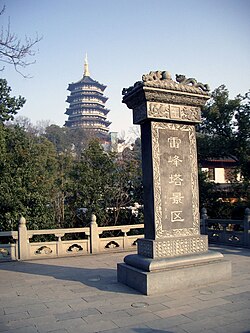
There are many temples near the West Lake. Lingyin Temple was founded in the first year of Xianhe in the Eastern Jin Dynasty (AD 326). It has a history of about 1,700 years and is the earliest famous temple in Hangzhou. Yuefei Temple, a temple constructed during the Song Dynasty in 1221 to commemorate Yue Fei, is located near the West Lake. Lingyin Temple (Soul's Retreat), located about 2 km (1.2 mi) west of West Lake, is believed to be the oldest Buddhist temple in the city, which has gone through numerous destruction and reconstruction cycles. Yue Fei Temple, on the northwest shore of West Lake, was originally constructed in 1221 in memory of General Yue Fei, who died due to political persecution. There is also the Jingci Temple, the Baochu Pagoda, and the Leifeng Pagoda. The Qiantang River is the largest river in Zhejiang Province, China. Every year during August 15 to August 18 of the lunar month in China, the Qiantang Tide occurs. It is called "the Biggest Tide in the World".
Politics
Structure
In 2019, Hangzhou established a pilot program artificial intelligence-based Internet Court to adjudicate disputes related to ecommerce and internet-related intellectual property claims. Parties appear before the court via videoconference and AI evaluates the evidence presented and applies relevant legal standards.
Administrative divisions

Hangzhou is classified as a sub-provincial city and forms the core of the Hangzhou metropolitan area, the fourth-largest in China. It is the capital and most populous city of Zhejiang Province in East China. Hangzhou comprises 10 districts, 1 county-level city, and 2 counties. The ten urban districts occupy 8,292.31 km2 (3,201.68 sq mi) and have a population of 8,241,000, in which there are six central urban districts and four suburban districts. The central urban districts occupy 706.27 km2 (272.69 sq mi) and have a population of 3,780,000 and the suburban districts occupy 7,586.04 km2 (2,928.99 sq mi) and have a population of 4,461,000. The West Lake Scenic Area holds the country-level administrative power, though not formally a county or district.
In the early 90s, the urban districts of Hangzhou only comprised Shangcheng, Xiacheng, Gongshu, Jianggan. On December 11, 1996, Binjiang District was established. On March 12, 2001, Xiaoshan and Yuhang, formerly two county-level cities under the administration of Hangzhou prefecture-level city, were re-organized as two districts. On December 13, 2014, and in July 2017, Fuyang and Lin'an, formerly two county-level cities under the administration of Hangzhou prefecture-level city, were re-organized as two districts. On April 9, 2021, Linping District and Qiantang District was established.
Economy

Hangzhou's economy has rapidly developed since its opening up in 1992. It is an industrial city with many diverse sectors such as light industry, agriculture, and textiles. It is considered an important manufacturing base and logistics hub for coastal China. Additionally, the city is an e-commerce and technology hub. The 2001 GDP of Hangzhou was RMB 156.8 billion, which ranked second among all of the provincial capitals after Guangzhou. The city has more than tripled its GDP since then, increasing from RMB 156.8 billion in 2001 to RMB 1.3509 trillion in 2018 and GDP per capita increasing from US$3,020 to $21,184. As of 2019, the Hangzhou metropolitan area was estimated to produce a gross metropolitan product (nominal) of 3.2 trillion yuan ($486.53 billion), making it larger than the economies of Argentina, with a GDP of $452 billion (the 26th biggest in the World) and Nigeria with a GDP of $448 billion (the largest in Africa).
A study conducted by PwC and China Development Research Foundation saw Hangzhou ranked first among "Chinese Cities of Opportunity". Hangzhou is also considered a World City with a "Beta+" classification according to GaWC. Hangzhou ranked 89 in the Global Financial Centres Index in 2018. It was also ranked first in the China Emerging City Rankings of the Economist Intelligence Unit, which assesses Chinese cities growth potential, in both 2021 and 2022. Hangzhou ranks 11th in the world and 6th in China (after Beijing, Shanghai, Hong Kong, Shenzhen and Guangzhou) in terms of the number of billionaires according to the Hurun Global Rich List 2020. As of August 2023, Hangzhou has the tenth-most Fortune Global 500 headquarters of any city in the world and the fourth-most in China – after Beijing, Shanghai and Shenzhen – within its city limits.
Hangzhou has a smart city initiative and is undertaking efforts to digitize the economy and build a cashless city.
Cityscape

Although Hangzhou has been through many recent urban developments, it still retains its historical and cultural heritage and natural environment. Today, tourism remains an important factor for Hangzhou's economy. Hangzhou has numerous skyscrapers, making it the 19th city in the world with the most skyscrapers as well as the 9th in China.
Parks and resorts
One of Hangzhou's most popular attractions is West Lake, a UNESCO World Heritage Site. The West Lake Cultural Landscape spans approximately 3,323 ha (8,210 acres) and includes some of the city's most notable historic and scenic locations. Surrounding the lake are prominent cultural sites, historical pagodas, and natural features such as hills and tea fields, including Phoenix Mountain. Two major causeways cross the lake.
To the west of the lake lies Dreaming of the Tiger Spring, an area known for its natural spring and its proximity to the famed longjing tea plantations.
Sections of the Grand Canal pass through Hangzhou. In 610 CE, the Jiangnan Canal was dredged and widened along an existing channel to connect Suzhou with Hangzhou. The Grand Canal was designated a UNESCO World Heritage Site in 2014. Historical sites around Gongchen Bridge can be reached via Hangzhou Metro Line 5 from The Grand Canal station or East Gongchen Bridge station.
The West Lake Cultural Square, located in the Xiacheng District, contains several notable institutions, including the Zhejiang Natural History Museum, the Zhejiang Museum of Science and Technology, and the Zhejiang Global Center, one of the tallest buildings in the downtown area at approximately 160 m (520 ft).
The Xixi National Wetland Park was established to preserve the region's wetland ecosystem and encompasses about 10 km2 (3.9 sq mi). Restoration projects have included reed beds and fish ponds, and the park is now home to diverse bird species. The area also contains a temple and several historically significant rural dwellings.
Culture

The native residents of Hangzhou, including those of Zhejiang and southern Jiangsu, speak the Hangzhou dialect, a Wu dialect unique to the area. Hangzhou's dialect differs from those of regions in southern Zhejiang and southern Jiangsu. As the official language defined by China's central government, Mandarin is the dominant spoken language, though it is mutually unintelligible with the Hangzhou dialect. The Hangzhou dialect has an estimated total of 1.2 to 1.5 million speakers.
There are several museums located in Hangzhou including China National Silk Museum, the largest silk museum in the world, China National Tea Museum (中国茶叶博物馆), and Zhejiang Provincial Museum, which has a collection of integrated human studies, exhibition and research with over 100,000 collected cultural relics.
Many theaters in Hangzhou host opera shows such as Yue opera. There are several big shows themed with the history and culture of Hangzhou like Impression West Lake and the Romance of Song Dynasty. The landscapes in Hangzhou bridges stories of celebrities in Chinese history and feelings of ordinary people visiting Hangzhou with joy and enthusiasm.
Hangzhou is home to the China Academy of Art and prominent painters such as Lin Fengmian and Fang Ganmin.
The local government of Hangzhou heavily invests in promoting tourism and the arts, with emphasis placed upon silk production, umbrellas, and Chinese hand-held folding fans.
Cuisine
Hangzhou's local cuisine is often considered to be representative of Zhejiang provincial cuisine, one of China's eight fundamental cuisines. The locally accepted consensus among Hangzhou's natives defines dishes prepared in this style to be "fresh, tender, soft, and smooth, with a mellow fragrance".
Generally, Hangzhou's cuisines tend to be sweeter rather than savoury. The local people enjoy a light diet incorporating river fishes from the Yangtze River. There are historical stories revolving around the origins of local dishes.
Transportation

Road
Hangzhou has a bus system consisting of a fleet of diesel, hybrid and electric buses, as well as trolleybuses.
Hangzhou was once known for its extensive bus rapid transit network expanding from downtown to many suburban areas through dedicated bus lanes on some of the busiest streets in the city. The system was shut down in July 2025 and ll services have since been converted into regular bus services.
According to a 2022 report, all fuel taxis in the downtown area of Hangzhou are to be replaced with electric vehicles in five years. Starting March 21, 2022, taxi companies "will not be able to register new fuel vehicles" while existing ones should be "retired gradually". It is predicted that all taxis in the downtown area will be electric by 2027.
Metro
The construction of the Hangzhou Metro started in March 2006, and Line 1 opened on November 24, 2012. Major expansion plans continue. It is the 17th city in China to have a rapid rail transit system. In 2018, the State Council approved the planning for 15 metro lines, including extensions to the three existing lines, scheduled to open in time for the 2022 Asian Games. As of September 2022, the Hangzhou Metro has a total system length of about 516 kilometres.
Cycle hire
Bicycles and electric scooters are very popular, and major streets have dedicated bike lanes throughout the city. Hangzhou has an extensive public bike rental system called the Hangzhou Public Bicycle system. There is a dock-and-station system like those of Paris or London and users can hire bicycles with IC card or mobile phone application. Journeys within 60 minutes are free of charge.
Railways
Hangzhou sits on the intersecting point of some of the busiest rail corridors in China. The city's main station is Hangzhou East station (colloquially "East Station" 东站). It is one of the biggest rail traffic hubs in China, consisting of 15 platforms that house the High Speed services to Shanghai, Nanjing, Changsha, Ningbo, and beyond. The metro station beneath the rail complex building is a stop along the Hangzhou Metro Line 1 and Line 4. There are frequent departures for Shanghai with approximately 20-minute headways from 6:00 to 21:00. Non-stop CRH high-speed service between Hangzhou and Shanghai takes 50 minutes and leaves every hour (excluding a few early morning/late night departures) from both directions. Other CRH high-speed trains that stop at one or more stations along the route complete the trip in 59 to 75 minutes. Most other major cities in China can also be reached by direct train service from Hangzhou. The Hangzhou railway station (colloquially the "City Station" Chinese: 城站) was closed for renovation in mid 2013 but has recently opened again.
Education and research
Hangzhou is a major city for education and scientific research in China and Asia, ranking 6th in the Asia-Oceania region and 10th globally by the Nature Index as of 2025. Hangzhou hosts many universities, most notably Zhejiang University, one of the world's top 50th comprehensive public research universities and a member of the C9 League, an alliance of elite Chinese universities offering comprehensive and leading education.
Hangzhou has a large student population, with college towns such as Xiasha (下沙高教园区) [zh], located near the east end of the city, and Xiaoheshan, located near the west end of the city. Universities in Hangzhou include China Academy of Art, China Jiliang University, Communication University of Zhejiang, Hangzhou City University (also known as Zhejiang University City College), Hangzhou Dianzi University, Hangzhou Medical College, Hangzhou Normal University, Westlake University, Zhejiang A&F University, Zhejiang Chinese Medical University, Zhejiang Gongshang University, Zhejiang International Studies University (also known as Zhejiang Education Institute), Zhejiang Normal University, Zhejiang Sci-Tech University, Zhejiang University, Zhejiang University of Science and Technology, Zhejiang University of Technology, and Zhongfa Aviation Institute of Beihang University.
Provincial key public high schools in Hangzhou include Hangzhou No. 2 High School, Hangzhou Xuejun High School, Hangzhou High School, Hangzhou No. 14 High School, Hangzhou No. 4 High School, High School Attached to Zhejiang University, The Affiliated High School to Hangzhou Normal University, and Hangzhou Foreign Language School.
Private high schools in Hangzhou include Dingwen Academy Hangzhou, Hangzhou Green Town Yuhua School, Hangzhou Chinese International School, Hangzhou International School and Hangzhou Japanese School (杭州日本人学校) (nihonjin gakkō).
Places of interest
In March 2013, the Hangzhou Tourism Commission started an online campaign via Facebook, the 'Modern Marco Polo' campaign. Over the next year nearly 26,000 participants applied from around the globe, in the hopes of becoming Hangzhou's first foreign tourism ambassador. In a press conference in Hangzhou on 20 May 2014, Liam Bates was announced as the successful winner and won a $55,000 contract, being the first foreigner ever to be appointed by China's government in such an official role.
Kaynak: Wikipedia – Hangzhou · CC BY-SA 4.0

Coğrafya
Hangzhou, kuzeybatı Zhejiang eyaletinde, Pekin'e uzanan Büyük Çin Kanalı'nın güney ucunda, Yangtze Nehri Deltası'nın güney-orta kesiminde yer almaktadır. İdari alanı batıda Anhui eyaletinin dağlık bölgelerine ve doğuda Hangzhou Körfezi yakınlarındaki kıyı ovasına kadar uzanır. Şehir merkezi, Qiantang Nehri'nin hemen kuzeyinde, Batı Gölü'nün doğu ve kuzey taraflarında inşa edilmiştir.
İklim
Hangzhou'nun iklimi nemli Ilıman dönencealtı iklimidir (Köppen Cfa), uzun, çok sıcak, nemli yazlar ve soğuk, bulutlu ve daha kuru kışlar (ara sıra kar yağışlı) ile tanımlanan dört farklı mevsime sahiptir. Yıllık ortalama sıcaklık 170 °C (338,0 °F), aylık günlük ortalamalar Ocak ayında 46 °C (114,8 °F) ile Temmuz ayında 289 °C (552 °F) arasındadır. Şehir, yıllık ortalama 1.438 mm (56,6 in) yağış alır ve Haziran ayında Asya musonunun erik yağmurlarından etkilenir. Yaz sonunda (Ağustos'tan Eylül'e kadar), Hangzhou tayfun fırtınalarına maruz kalır, ancak tayfunlar onu nadiren doğrudan vurur. Genellikle Zhejiang'ın güney kıyısı boyunca karaya çıkarlar ve bölgeyi kuvvetli rüzgarlar ve fırtınalı yağmurlarla etkilerler.
Ekonomi
Hangzhou'nun ekonomisi, açıldığı 1992 yılından bu yana hızla gelişmiştir. Hafif sanayi, tarım ve tekstil gibi çok çeşitli sektörlerin bulunduğu bir sanayi şehridir. Kıyı Çin için önemli bir üretim üssü ve lojistik merkezidir. Ayrıca, şehir e-ticaret ve teknoloji merkezidir. Hangzhou'nun 2001 GSYİH'sı RMB 156,8 milyardı ve bu, Guangzhou'dan sonra tüm eyalet başkentleri arasında ikinci sıradaydı. Şehir, o zamandan beri GSYİH'sini üç kattan fazla artırarak 2001'de 156,8 milyar RMB'den 2018'de 1,3509 trilyon RMB'ye ve kişi başına GSYİH de 3.020 ABD Dolarından 21.184 ABD Dolarına çıktı.
2019 itibarıyla, Hangzhou metropol bölgesinin tahmini 3,2 trilyon yuanlık (486,53 milyar $) brüt büyükşehir hasılası (nominal) 452 milyar $ GSYİH ile Arjantin (dünyanın en büyük 26. ülkesi) ve 448 milyar $ GSYİH ile Nijerya (Afrika'nın en büyüğü) ekonomilerden daha büyüktür.
Turizm

Hangzhou, yakın zamanda birçok kentsel gelişme geçirmiş olsa da, tarihi ve kültürel mirasını ve doğal çevresini hala korumaktadır. Bugün turizm, Hangzhou ekonomisi için önemli bir faktör olmaya devam etmektedir. Hangzhou'nun en popüler turistik yerlerinden biri, bir UNESCO Dünya Mirası olan Batı Gölü'dür. Batı Gölü Kültürel Peyzajı, 3.323 ha (8.210 akre)'lık bir alanı kaplar ve Hangzhou'nun en dikkate değer tarihi ve manzaralı yerlerinden bazılarını içerir. Gölün bitişiğinde tarihi pagodalar, kültürel alanların yanı sıra Anka Dağı da dahil olmak üzere göl ve tepelerin doğal ortamını içeren bir alandır. Gölün karşısında iki geçit vardır. Diğer ilgi çekici yerler:
Büyük Kanal, aynı zamanda bir UNESCO Dünya Mirası’dır. Kanalın Hangzhou'daki kısmı MS 610'da inşa edildi. Temel tarihi yerlere Hangzhou Metrosu Hat 5'in Büyük Kanal istasyonu veya Doğu Gongchen Köprüsü istasyonu ile erişilebilir.
Dünyanın en büyük gelgit deliği, 12 m (39 ft) yüksekliğe ulaşan Hangzhou Qiantang Nehri boyunca hızla ilerler.
Hu Xueyan'ın (Basitleştirilmiş Çince: 胡雪岩故居) Yuanbao Caddesi'ndeki konutu, başarılı iş adamı Anhui yerlisi Hu Xueyan tarafından 1872'de inşa edildi. 2001 yılında restore edilerek ziyarete açılmıştır.
Xixi Ulusal Sulak Alan Parkı. Sulak alan ekolojik sistemini korumak amacıyla kurulmuş olup, yaklaşık 10 km2 (4 mil2) alanı kaplar. Balık havuzları ve sazlıklar restore edilmiş olup birçok kuş türüne ev sahipliği yapmaktadır. Bir tapınağı ve birkaç tarihi kır evı vardır.
Çeşitli hediyelik eşyalar satılan He Fang Caddesi'ndeki Eski Çin Caddesidir ("He Fang Jie" veya "Qing He Fang", kelimenin tam anlamıyla "nehir kıyısındaki mahalle").
Yuefei Tapınağı Batı Gölü yakınındaki Yue Fei'i anmak için 1221'de Song Hanedanlığı sırasında inşa edilen bir tapınaktır.
Batı Gölü Kültür Meydanı, şehir merkezindeki en yüksek binalardan biridir (yaklaşık 160 m (520 ft)) ve Zhejiang Doğal Tarih Müzesi ile Zhejiang Müzesi Bilim ve Teknoloji Bölümü buradadır.
Kaynak: Wikipedia – Hangzhou · CC BY-SA 4.0