
Interested in working with us in the future?
Follow to see new jobs and posts in your feed.
No news yet.

History

Pre-Qin dynasty (before 220 BC)
There are few references to Hanzhong before the Qin dynasty's unification of China in 221 BC. The Book of Documents refers to an area called Liangzhou (梁州), while Sima Qian's book Records of the Grand Historian speaks of a "Bao state" (褒國; where the ancient beauty Bao Si came from), both of which are believed to refer to the area now called Hanzhong.
From 900 BC, the area has been called Nanzheng (Chinese: 南鄭; lit. 'southern Zheng'). The ancient geographical treatise entitled Shui Jing Zhu records that Duke Huan of Zheng, a vassal lord from the Western Zhou dynasty, was slain in a battle with the nomadic Quanrong people, and some of the Zheng citizens fled the capital to establish a new settlement to the south, giving rise to the area's name. However, the veracity of this story is controversial.
Qin and Han dynasties (220 BC – 200 AD)
In the Qin dynasty the area was governed as the Hanzhong Commandery, whose seat was in current day Nanzheng County, south of the Hanzhong urban area. In 207 BC, the Qin dynasty collapsed. Liu Bang, who would later become the founding emperor of the Han dynasty, was made lord of Hanzhong. He spent several years there before raising an army to challenge his arch-rival, Xiang Yu, during the Chu–Han Contention. In 206 BC, after the victory at Gaixia, Liu Bang named his imperial dynasty after his native district, as was customary. However, he chose Hanzhong rather than his birthplace Pei County (present-day Xuzhou, Jiangsu Province). Thus, Hanzhong gave its name to the Han dynasty.
In the second century AD, the Eastern Han dynasty gradually weakened. Outsiders from the Ba region attacked the Hanzhong area, as they had in the past. The Han dynasty lost power. Zhang Lu, supported by followers of a Taoist sect, Way of the Celestial Masters, led an independent theocratic government in Hanzhong. Thirty years later, after the Battle of Yangping, Zhang Lu surrendered Hanzhong to the warlord, Cao Cao.
Administration

The governance of Hanzhong, including the municipal executive, the legislature and the judiciary are located in Hantai District (汉台区). The offices of the CCP and the Public Security Bureau are also located in Hantai District.
Hanzhong consists two urban districts and nine rural counties.
Economy
In 2021, the Hanzhong regional gross domestic product was 176.87 billion yuan. The annual gross domestic product per capita was 55279 yuan.
Military industry
The 012 base was established in Hanzhong in the 1960s. It is responsible for military transport aircraft and Air-to-air missiles in Yangxian County.
Geography
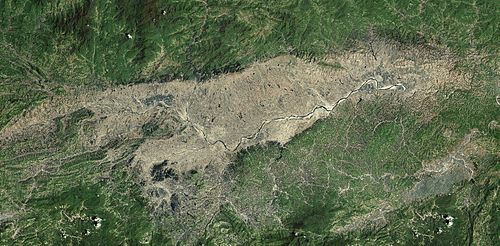
Hanzhong is located in southwestern Shaanxi, near the border with Gansu and Sichuan Provinces. It is part of the Shannan region. Hanzhong lies in the centre of the Hanzhong Basin, on the banks of the Han River (Hanshui).
The Daba Mountains rise to the south of the city. To the north are the Qin Mountains. These mountains make a northern geographical limit of southern China. However, officially, Shaanxi is part of the northwest. For more on the divisions between northern and southern China, see Northern and southern China.
The coordinates of the city's prefecture ranges in latitude from 33° 02' to 33° 22' N and in longitude from 106° 51' to 107° 10' E. It covers 27,246 square kilometres (10,520 sq mi). The northern part of the prefecture is elevated while the southern part is generally low lying. Height above sea level varies from around 500 metres (1,600 ft) in the urban area to 2,038 metres (6,686 ft) in the Qin Mountains.
The Wuchiapingian Age in the Permian Period of geological time is named from Wuchiaping (from Chinese: 吴家坪; pinyin: Wújiāpíng; lit. 'Wu Family Flatland') in the Liangshan area of Hanzhong.
Climate
Hanzhong has a temperate and humid climate. It is classified as humid subtropical (Köppen Cwa), with cool, dry winters and hot, humid summers.
The Qin Mountains to the north help shield the city from cold Siberian winds in the winter. Hence, the winter in Hanzhong is warmer than that at similar latitudes east of Shannan. This is despite Hanzhong's elevation and inland location.
In contrast, because of its elevation, Hanzhong summers are temperate, with average highs in July and August about 30 °C (86 °F). The area is far more humid than central and northern Shaanxi. In Hanzhong, there is 853 mm (33.6 in) precipitation annually, as compared to 553 mm (21.8 in) in Xi'an, the provincial capital. The chance of sunshine days per month varies from twenty-six percent in November and December to fifty percent in August. Hanzhong receives 1,569 hours of bright sunshine each year. The monthly 24-hour average temperature ranges from 2.8 °C (37.0 °F) in January to 25.6 °C (78.1 °F) in July. The annual mean is 14.67 °C (58.4 °F). Record extremes there have ranged from −10.1 °C (13.8 °F) on 14 January 1957 to 41.1 °C (106.0 °F) on 16 July 2025.
Transport

Hanzhong's transport needs are served by the Hanzhong Chenggu Airport and Yangpingguan–Ankang Railway. Hanzhong Airport provides air access to Beijing, Xi'an, Shanghai and Shenzhen with daily flights to each.
Hanzhong railway station lies in downtown Hanzhong, and is served by the Xi'an–Chengdu high-speed railway and Yangpingguan–Ankang railway lines.
Hanzhong is also part of a national system of highways. It joins the G5 Beijing-Kunming expressway and the G7011 Shiyan-Hanzhong-Tianshui expressway. National Highway 108, China National Highway 316, China National Highway 210 and the provincial roads 211 and 309 constitute the developed traffic network of Hanzhong.
Education
At the end of 2012, Hanzhong had two hundred and seven middle schools and several centres of higher education.
Shaanxi Institute of Aeronautical Technology
Kaynak: Wikipedia – Hanzhong · CC BY-SA 4.0

İdari bölümler
Hanzhong şehri bir semt ile dokuz ilçeye ayrılmaktadır.
Kaynak: Wikipedia – Hanzhong · CC BY-SA 4.0