
Interested in working with us in the future?
Follow to see new jobs and posts in your feed.
No news yet.
Romanization
Before the official adoption of Hanyu Pinyin, the city's name was typically romanized as Suchow or Süchow, though it also appeared as Siu Tcheou [Fou], Hsu-chou, Hsuchow, and Hsü-chow.
History

Early history
Archaeological remains in the Xuzhou region are largely associated with Dawenkou culture, while the Huating site indicates an early integration of Dawenkou and Liangzhu cultural elements.
In the Shang dynasty, Dapeng ("Great Peng") or Peng, associated with the Dongyi, was a dominant polity in the region. Archaeological evidence from the Qiuwan (丘灣) site shows both Shang-style ritual remains and indigenous pottery, reflecting cultural integration between Shang and local traditions. Following King Wu Ding's military campaigns, Dapeng was eventually subordinated to Shang authority.
During the Western Zhou period, the Xu people migrated south from Shandong to the Xuzhou region to establish a polity. Their territory once encompassed the lower reaches of the Huo River (an ancient tributary of the Si River), a corridor connecting the Central Plains with the southeast. The region was eventually annexed by the State of Song, which dominated the river's upper reaches.
Pengcheng, named after the Dapeng, first appears in records in 573 BCE as a Song fortified city at the confluence of the ancient Bian and Si rivers. Contested during the Chu–Jin rivalry, the city was briefly occupied by the official Yu Shi with Chu support before being recovered by a Jin-led coalition.
Around the 4th century BCE, Song had reportedly moved its capital to Pengcheng; in 385 BCE Duke Dao of Song was captured there by the State of Wei. Following Song's annexation by Qi in 286 BCE, Pengcheng served as a frontier stronghold. It later fell to Chu and was incorporated into the Qin Empire in 223 BCE.
Qin and Han dynasties
Following Qin unification, the region was organized as Sichuan (四川) commandery. During the Qin collapse, Pengcheng became a locus for Chu cultural revival: it was where Emperor Yi of Chu moved his seat in 208 BCE, and it was where Xiang Yu established the capital of Western Chu in 206 BCE, designating the area as his capital. Despite Xiang Yu's victory at the Battle of Pengcheng (205 BCE), the city passed to Han control.
Administration

The prefecture-level city of Xuzhou administers ten county-level divisions, including five districts, two county-level cities and three counties.
These are further divided into 161 township-level divisions, including 63 subdistricts and 98 towns.
Geography

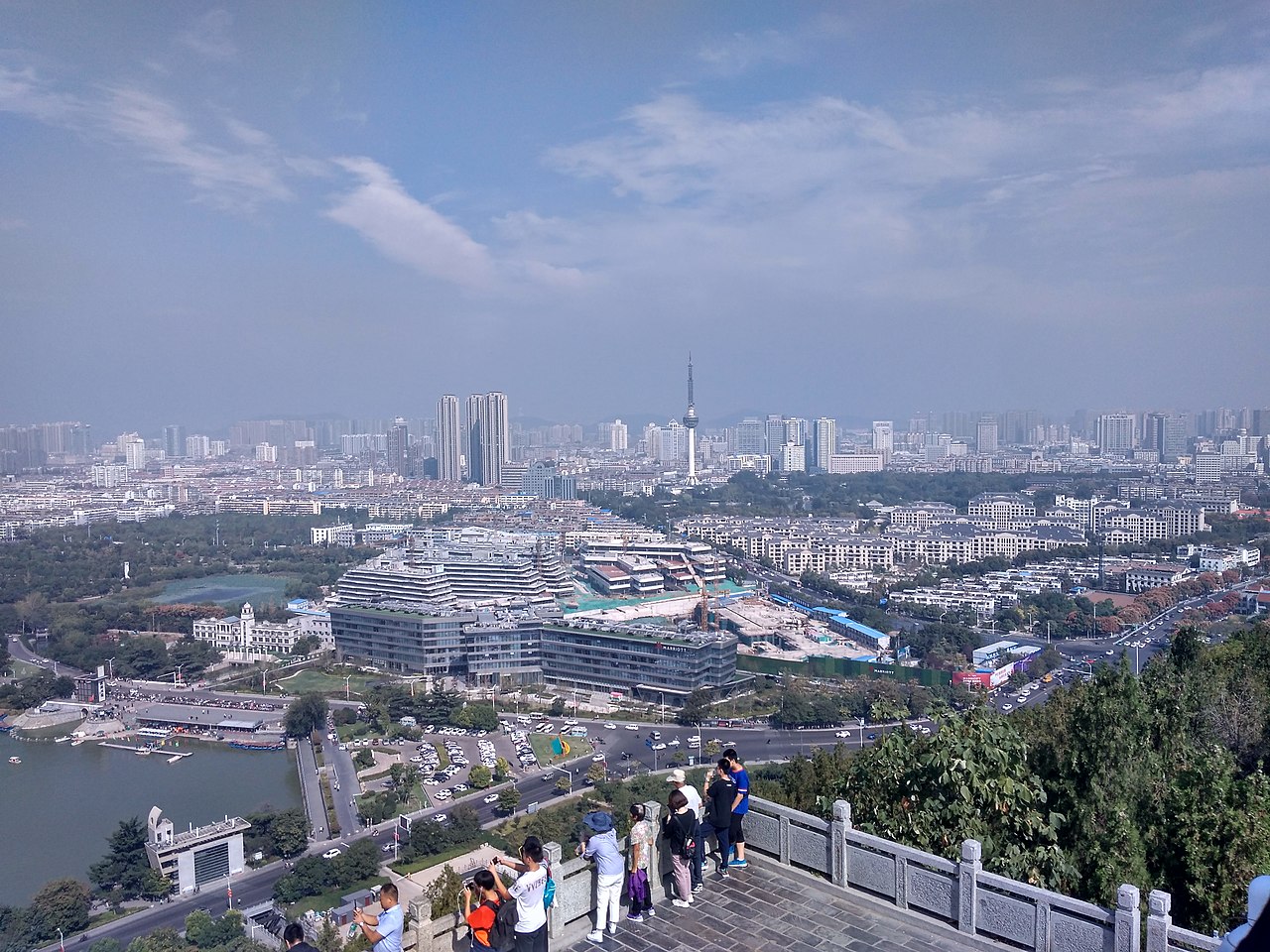
Xuzhou is situated at the southeastern extremity of the North China Plain, serving as a geographical transition zone between the Yellow River's alluvial fan and the Huai River basin. The landscape comprises an undulating plain underlain by 10–60 metres (33–197 ft) of deep alluvial deposits from historical Yellow River migrations.
This terrain is punctuated by limestone inselberg (isolated rock hills) that rise abruptly from the floodplain, including Yunlong Mountain [142 metres (466 ft)] and the region's highest point, Dadong Mountain [361 metres (1,184 ft)]. Geologically, these formations constitute the Xuzhou–Huaibei fold-thrust belt at the southeastern margin of the North China Craton.
Tectonic activity along the Tancheng–Lujiang (Tan-Lu) fault zone led to the formation of the Xuzhou and Feng-Pei coalfields. By the late 1990s, the region's proven coal reserves reached 3.94 billion tonnes—accounting for over 93% of Jiangsu province's total.
Intensive coal mining has caused landscape fragmentation and subsidence-induced flooding. Through the closure of small-scale mines and ecological restoration—including the conversion of waterlogged subsidence areas in northern Xuzhou and Jiawang into the Jiuli Lake and Pan'an Lake artificial wetlands—the local environment has partially recovered.
The regional hydrology is defined by two major man-made waterways: the Beijing–Hangzhou Grand Canal and the Abandoned Course of the Yellow River. Functioning as a "perched river" with its bed elevated 2–5 metres (6.6–16.4 ft) above the surrounding terrain, the abandoned course now acts as a drainage divide between the Huai and Yi-Shu-Si river systems.
Due to its low-lying topography, the elevated riverbed, and its location at the meandering transition, the region was historically plagued by floods; records indicate 59 levee breaches near Xuzhou between 1550 and 1855.
Demographics
In the 2020 census, Xuzhou recorded a permanent population of 9,083,900, an increase of 5.9% from 2010. By 2023, its permanent population accounted for approximately 10.6% of the total population of Jiangsu province.
Historically, the population of Xuzhou Prefecture (which then included present-day Dangshan, Xiao counties, and the urban districts of Suqian) grew from 2.95 million in 1776 to 4.34 million in 1910. Despite this growth, the region remained predominantly agricultural with minimal industrial or commercial activity; in 1910, the urban population of the prefectural seat was only approximately 32,000. Urbanization accelerated in the 20th century: the city's population reached 171,903 in 1931, 314,773 in 1947, and 333,190 in the 1953 Census.
Economy
As of 2023, Xuzhou's GDP reached RMB 890.04 billion, with a per capita GDP of RMB 98,683 (c. US$14,000). The city serves as the largest economy of the Huaihai Economic Zone, recording the highest GDP, per capita GDP, and total retail sales (RMB 444.51 billion) among the region's member cities.
Energy Industry and Transition
Xuzhou's modern coal industry originated with the establishment of the Jiawang Coal Mine in 1882. Until the 1950s, it remained the only site of industrial-scale coal extraction in Jiangsu province. Driven by the 1970s energy crisis, a "multi-party development" model emerged, involving the Datun Mining Area (a "Shanghai Enclave") alongside mines operated by other regional authorities.
Since the 2000s, resource depletion led to the closure of most local mines, with the sector consolidating under three major entities: Xuzhou Mining Group, Shanghai Datun Energy Resources, and China Resources Tianneng Xuzhou Coal and Power. As of 2023, the industry's total assets for above-scale enterprises reached 41.98 billion RMB.
The transition to renewables began in 2006 with the establishment of GCL Silicon. In the same year, the company commissioned its first polysilicon facility in Xuzhou, which subsequently developed into a major production site for photovoltaic materials. In 2024, BYD began building a 30 GWh sodium-ion battery plant in Xuzhou.
Manufacturing and Engineering
The demands of coal mining anchored Xuzhou's equipment manufacturing sector, which evolved into a modern construction machinery cluster. XCMG, headquartered in Xuzhou, ranked fourth globally among construction equipment manufacturers by 2024 revenue.
As of 2023, the city's specialized equipment manufacturing sector comprised 225 enterprises above designated size. Annual output for major products included 143,167 tons of mining equipment and 729,259 tons of cranes. In addition to heavy machinery, Xuzhou has developed into a production base for two-wheelers, with annual motorcycle output totaling 526,300 units in 2023.
Public services
Education
Xuzhou is a regional center for higher education, hosting 12 universities and colleges with a total enrollment of approximately 267,000 students as of 2023. Major institutions include:
China University of Mining and Technology (CUMT): A national "Double First-Class" university; its predecessor, the Sichuan Institute of Mining and Technology, relocated from Hechuan in 1978.
Jiangsu Normal University (JSNU): Founded in 1958 by merging the Jiangsu Teachers College (relocated from Wuxi) with the Xuzhou Teachers College.
Xuzhou Medical University (XZMU): Established in 1958, originally as a branch of Nanjing Medical College.
Xuzhou Institute of Technology: A municipal institution established in 2002.
Healthcare
Xuzhou serves as a regional healthcare hub for the Huaihai Economic Zone. As of 2023, the city hosts several Grade A tertiary comprehensive hospitals, notably the Affiliated Hospital of Xuzhou Medical University, Xuzhou Central Hospital, Xuzhou First People's Hospital, and Xuzhou Mining Group General Hospital.
Culture and Society

Performing arts
During the Ming dynasty, Yuyao qiang was prevalent in Xuzhou. By the mid-Qing, Lahun qiang—a form popular across border regions among provinces—emerged, with its local variant evolving into Liuqin Opera. Concurrently, Northern Bangzi (Clapper) was introduced and localized, being officially designated as Jiangsu Bangzi (江苏梆子) in 1960.
In terms of modern facilities, the Xuzhou Concert Hall opened in 2011. Shaped like a myrtle flower, it has hosted the city's first philharmonic orchestra since its establishment in 2015.
Museums
Xuzhou contains various Han dynasty sites. The Xuzhou Museum houses jade artifacts and jade burial suits. The tombs of the Princes of Chu include the Lion Mountain (Shizishan) site, which contains a terracotta army, and the Guishan Han Tomb, a rock-cut structure. The Xuzhou Museum of Han Stone Reliefs preserves stone carvings from the period.
Cuisine
The regional cuisine blends characteristics of Huaiyang and Shandong cuisine, defined by salty and pungent flavors.
A staple is laomo (烙馍, locally pronounced luomo), a thin, chewy, unleavened flatbread used to wrap ingredients. Other common foods include local-style goat-meat noodles, rice noodles, and bazirou (braised pork belly). The city is noted for spicy soup (eel, hen, and gluten heavily seasoned with black pepper) and Sha soup (汤, hen, barley, and gluten seasoned with sesame oil); both can be served with beaten raw eggs.
The region also features diguo ("earth-pot") cookery: meat is simmered into a concentrated gravy while unleavened dough patches are pressed onto the pot's rim to be cooked by the rising steam. Historically, dog meat consumption was prevalent in the area. Since the 1980s expansion of goat husbandry, the annual Fuyang Festival (伏羊节, est. 2002) has institutionalized summer goat-meat consumption as a local tradition.
Landmarks

Yellow Pavilion
The Yellow Pavilion (黃樓) was built in 1078 during Su Shi's tenure as the Prefect of Xuzhou to commemorate the completion of the city's wall fortification project under his leadership. The name "Yellow" carries a dual significance: it symbolically represents the element of earth, which conquers water and literally refers to the pounded earth (hangtu) used in the construction of the new defenses and the pavilion's foundation. The current structure is a reconstruction dating to 1988.
Transport

Roads
Xuzhou has many urban expressways: Xuzhou 3rd Ring Road expressways (east, north and west), Xuzhou East Ave. expressway (城东大道快速路), Xuzhou-Pantang expressway, Xuzhou-Jiawang expressway and Xuzhou-Suqian expressway etc.
Railways
Xuzhou is a major railway hub in China. Xuzhou Railway Station is the junction of the Beijing–Shanghai and Lianyungang–Lanzhou (Longhai) railways. Xuzhoudong Railway Station, located in the east, serves as the interchange between the Beijing–Shanghai and Xuzhou–Lanzhou high-speed railways; it also functions as the terminal for the Xuzhou–Lanzhou, Xuzhou–Yancheng, and Lianyungang–Xuzhou lines. The two stations are linked via the Dahu connection line.
Xuzhoubei Railway Station, located in the north, is the largest marshalling yard of the China Railway Shanghai Group, handling over 20,000 wagons daily. As one of 14 designated China Railway Express assembly centers, Xuzhou maintains sea-rail intermodal connections to the ports of Ningbo-Zhoushan, Lianyungang, Yangshan, and Qingdao. In 2023, the annual rail freight volume reached 54.53 million tons.
Aviation
Xuzhou Guanyin International Airport is one of the three biggest international airports in Jiangsu Province, it serves the area with scheduled passenger flights to major airports in China. Xuzhou Guanyin International Airport (徐州观音国际机场) has two terminals until 2019. Domestic Terminal (Terminal 2) and International Terminal (Terminal 1).
Metro System
Xuzhou is the first city in Northern Jiangsu to operate a rapid transit system.
Operational Lines
Line 1 (Sep 2019): Xuzhoudong Railway Station – Luwo. Interchanges at Pengcheng Square (L2) and Xuzhou Railway Station (L3).
Line 2 (Nov 2020): Keyunbei – Xinchengqudong. Serves JSNU Yunlong Campus.
Line 3 (Jun 2021): Xiadian – Gaoxinqu'nan. Serves CUMT Wenchang Campus and JSNU Quanshan Campus.
Line 6 (Sep 2025): Xuzhoudong Railway Station – Tongshan Chinese Medical Hospital.
Military
Xuzhou is headquarters of the 12th Group Army of the People's Liberation Army, one of the three group armies that compose the Nanjing Military Region responsible for the defense of China's eastern coast and possible military engagement with Taiwan. The People's Liberation Army Navy also has a Type 054A frigate that shares the name of the region.
Kaynak: Wikipedia – Xuzhou · CC BY-SA 4.0
İdari bölümler
Xuzhou şehri beş semt, üç ilçe ile iki ilçe düzeyi şehirden oluşmaktadır.
Kaynak: Wikipedia – Xuzhou · CC BY-SA 4.0