
Interested in working with us in the future?
Follow to see new jobs and posts in your feed.
No news yet.

Administration

Currently, the prefecture-level city of Yangzhou administers six county-level divisions, including three districts, two county-level cities and one county. Accordingly, they are further divided into 98 township-level divisions, including 87 towns and townships, and 11 subdistricts.
History

Ancient China
During the Spring and Autumn period of the Eastern Zhou dynasty, the hegemon Fuchai of Wu constructed the Han or Hangou Canal (t 邗溝, s 邗沟, Hángōu) to improve his supply lines from his center of power around present-day Suzhou to the North China Plain, where he was engaged in an ongoing conflict with Qi. Taking advantage of the many streams and lakes of the Jianghuai Plain, the canal connected the Yangtze River within present-day Yangzhou to the Huai River within present-day Huai'an by 486 BC. The next year, Fuchai established a fortress to protect the southern end of the new canal at Hancheng. Following the Chinese urban design principles of the time, it was constructed as a 3 li by 3 li square about 12 m (39 ft) above the water level on the Yangtze's northern bank, with the Han Canal forming a moat around the southern and eastern sides of the city. The town was intended to stall any possible counterattack from Qi down the canal, giving time to raise reinforcements from Suzhou and Wu's other lands in the Yangtze Delta.
Imperial China
Under the Eastern Han dynasty, the area was organized as the Guangling Commandery of Xu Province. Its seat of government—also known as Guangling—was also near the confluence of the Yangtze and the Han Canal, although at a slightly different location than the former Wu fortress.
Under the Sui, Guangling was reorganized as Yang Province (zhou) in the year AD 590. Its seat of government took the new name as well. Prospering as the Emperor Yang (r. 604–617) connected the Han Canal to other waterways north and south to form the core of the Grand Canal, Yangzhou became the southern capital of China under the name Jiangdu. With the failure of his invasions of Korea and a series of natural disasters, Emperor Yang abandoned to north entirely in 616 and made Jiangdu his primary capital until his assassination in 618.
Geography

Yangzhou is located on a plain north of the Yangtze. The Grand Canal, also known as the Jing-Hang Canal, crosses the prefecture-level from the north to the south; its modern route passes through the eastern outskirts of Yangzhou's main urban area, while its old route runs through the city center. Other major bodies of water within the prefecture-level city include the Baoshe River, Datong River, Beichengzi River, Tongyang Canal, Xintongyang Canal, Baima Lake, Baoying Lake, Gaoyou Lake and Shaobo Lake.
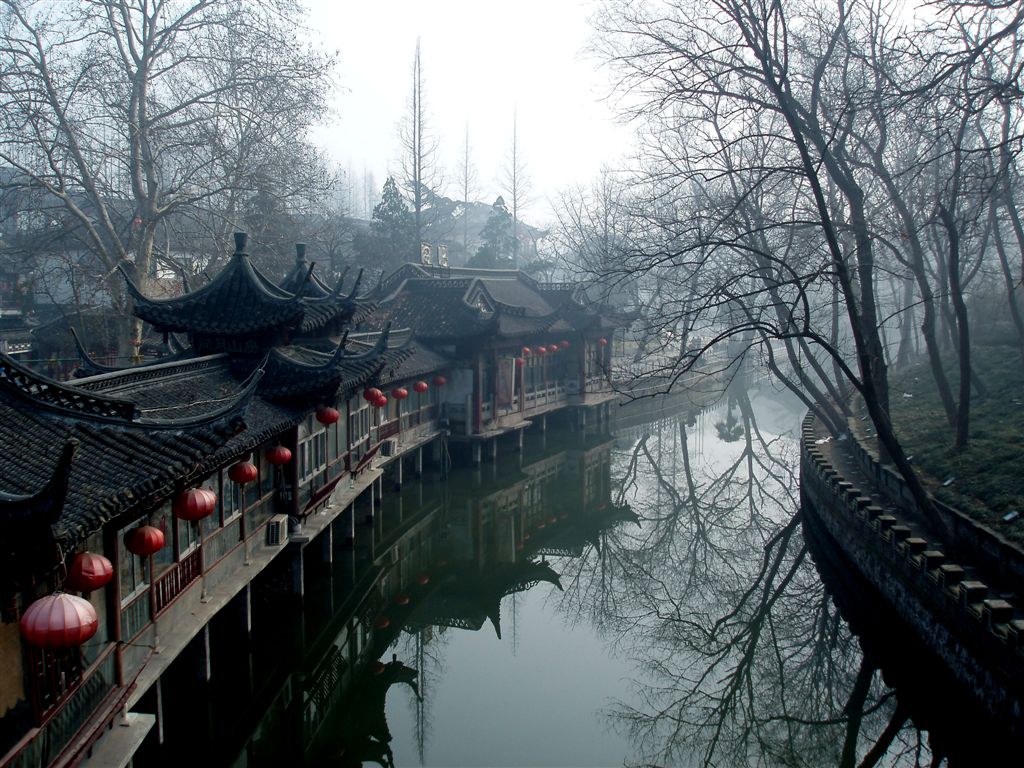
Like much of the entire prefecture-level city, Yangzhou's main urban area (the "city proper") is criss-crossed by an intricate network of canals and small lakes. The historic city center (the former waled city) is surrounded by canals on all sides: the Old Grand Canal forms its eastern and southern boundaries; the City Moat Canal runs along the former walled city's northern edge, connecting the Old Grand Canal with the Slender West Lake; the Erdaohe Canal runs along the old city's western edge, from the Slender West Lake to the Lotus Flower Pond (Hehuachi), which in its turn is connected by the short Erdaogou canal with the Old Grand Canal. It is possible to sail a small water craft from the Thin West Lake, via the Erdaohe, the Hehua Pond, and the Erdaogou into the Old Grand Canal.
Climate
Yangzhou has a subtropical monsoon climate with humid changeable wind; longer winters for about 4 months, summers 4 months and shorter springs and autumns, 2 months respectively; frost-free period of around 240 days and annual average sunshine of around 1,912 hours.
The mean annual temperature is 16.2 °C (61.2 °F) annually, with an annual average daily maximum temperature of 20.7 °C (69.3 °F) and an annual average daily minimum temperature of 12.4 °C (54.3 °F). The normal monthly mean 24-hour temperature ranges from 2.8 °C (37.0 °F) in January to 28.4 °C (83.1 °F) in July.
Transportation

Yangzhou has one Yangtze River crossing, the Runyang Yangtze River Bridge complex, which has one of the longest suspension bridge spans in the world, and carries the G4011 Yangzhou–Liyang Expressway to Zhenjiang.
Air
The Yangzhou Taizhou International Airport, completed in 2012 to serve Yangzhou and neighboring Taizhou, is located in Jiangdu district. The Nanjing Lukou International Airport is over 100 km (62 mi) away; it takes one hour and 40 minutes to get there from central Yangzhou. Prior to the completion of the Yangzhou Taizhou Airport, Lukou Airport in Nanjing was the primary air gateway for passengers destined for Yangzhou. There are over 10 airline ticket offices in Yangzhou, providing convenient service for foreign and domestic tourists. domestic and international fight are available with 10 international airlines and more than 20 domestic ones
Rail
Until 2004, Yangzhou was not served by passenger rail. Yangzhou Railway Station began construction in 2003 and was completed a year later. It is located on the western outskirts of the city, and is a major station on the Nanjing–Qidong railway, and provides direct passenger service to the provincial capital as well as a number of major cities to the west, north, and south (such as Xi'an, Wuhan, and Guangzhou), including an overnight Z-series express train to Beijing. Later, frequent high-speed (D-series) service has been introduced on this line as well.
On 11 December 2020, Yangzhou East railway station entered service when the Lianyungang–Zhenjiang high-speed railway opened in full. The line, designed for speeds of 250 km/h (160 mph), connects southern and northern Jiangsu.
A new railway with a design speed of 350 km/h, Shanghai-Nanjing-Hefei High-Speed Railway, is also under construction. It is expected to run through the major existing railway station, Yangzhoudong Railway Station.
Industries and shipyards
Yangzhou is the site of Chengxi shipyard, large shipyard where bulk carriers and other types of large ships are built. Owned partly by the state owned CSSC holdings, through Jiangsu Xinrong shipyard, Chengxi Yangzhou shipyard builds ships from 25,000 dwt to 170,000 dwt in size.
Culture

The Yangzhou dialect (Chinese: 扬州话, /iaŋ ʦɤɯ xua/) of Chinese is representative of Lower Yangtze Mandarin, and is particularly close to the official language of the Ming and Qing courts, which was based on the Nanjing dialect. However, it does differ considerably from modern Standard Chinese, although they are still moderately mutually intelligible.
Dialect has also been used as a tool for regional identity and politics in the Jiangbei and Jiangnan regions. While the city of Yangzhou was a prosperous center of trade, it was considered part of Jiangnan, which was known to be wealthy, even though Yangzhou was north of the Yangzi river. Once Yangzhou's wealth and prosperity were gone, it was then considered to be part of Jiangbei, the "backwater".
During a period of prosperity and imperial favor, the arts of storytelling and painting flourished in Yangzhou. The innovative painter-calligrapher Shitao lived in Yangzhou during the 1680s and again from 1697 until his death in 1707. A later group of painters from that time called the Eight Eccentrics of Yangzhou are famous throughout China.
Former General secretary of CPC, President of China Jiang Zemin was born and raised in Yangzhou. His middle school is located right across from the public notary's office in Yangzhou.
Yangzhou is famous for its carved lacquerware and jade.
Some of China's creative and eye catching dishes come from the Yangzhou school of cuisine called Huaiyang (also commonly known as the Weiyang school). Along with Sichuan cuisine, Cantonese cuisine, and Shandong cuisine, Huaiyang cuisine (淮扬菜) is a distinctive skill.
The city is famous for its public bath houses, lacquerware, jadeware, embroidery, and paper-cut arts and crafts.
The city was awarded Habitat Scroll of Honor in 2006.
Yangzhou is also very famous for its toy industry (especially stuffed animals). Many tourists from neighboring cities travel to the city for its good-quality and low-priced toys.
Tourism

Tourist sights include Slender West Lake and old residences in the moated town, such as the Wang Residence and the Daming temple. Yangzhou is famous for its many well preserved Yangzhou style gardens. Most of the Historic city is in the Guangling District.
As of June 2024, Yangzhou had 24 national-level, 50 provincial-level, and 454 city- and county-level heritage buildings.
Slender West Lake
Named after Hangzhou's famous West Lake, this long, narrow stretch of water which meanders through Yangzhou's western limits is a well-known scenic spot. Yangzhou's Slender West Lake (Shou Xihu) is a UNESCO World Heritage site, and the Geyuan Garden (个园) is renowned for its bamboo and rockeries representing the four seasons. A long bank planted with weeping willows spans the lake. At its midpoint stands the Five-Pavilion Bridge with five covered terraces, one at each of the corners and one in the center. Around the lake is a park in which are found several attractions: Xu Garden, the White Dagoba of Lianxing Temple, copied from the similar tower in Beijing's Beihai Park; Small Gold Mountain (Xiao Jinshan); and the Fishing Platform (Diaoyutai), a favorite retreat of the Qing emperor Qian Long. The emperor was so gratified by his luck in fishing at this spot that he ordered additional stipends for the town. As it turns out, his success had been augmented by local swimmers who lurked in the lake busily attaching fish to his hook.
Daming Temple
Located on Shugang Hill, in the city's northwest, is Fajing Temple, formerly known as DaMing Temple. The original temple was built in Liu Song dynasty (420–479). A nine-story pagoda, the Qilingta, was built on the temple grounds in the year of Sui dynasty (589–618) . A recent addition to the temple complex is the Jianzhen Memorial Hall, built according to Tang dynasty methods and financed with contributions raised by Buddhist groups in Japan.
Education
As of 2024, Yangzhou is a major city for scientific research outputs, appearing among the world's top 200 cities as tracked by the Nature Index.
Primary and secondary education
Yangzhou High School of Jiangsu Province
HanJiang High School Of Jiangsu Province
Shuren School of Yangzhou Middle School Education Group
High School Affiliated to Yangzhou University
Kaynak: Wikipedia – Yangzhou · CC BY-SA 4.0
Tarihçe
Guangling, günümüz Yangzhou bölgesindeki ilk yerleşim olup İlkbahar ve Sonbahar Dönemi'nde kurulmuştur. MS 590 yılından itibaren Çin'in tüm güneydoğu kısmının geleneksel adı olan Yangzhou olarak anılmaya başladı.
Sui İmparatoru Yang döneminde (604–617), Yangzhou Çin'in güney başkenti oldu.
İdari bölümler
Yangzhou şehri üç semt, iki ilçe düzeyi şehir ile bir ilçeden oluşmaktadır.
Kaynak: Wikipedia – Yangzhou · CC BY-SA 4.0