
Interested in working with us in the future?
Follow to see new jobs and posts in your feed.
No news yet.
History
Early history
Historically known as Hailing (often interpreted as"hill by the sea"), Taizhou was established as a county no later than the 2nd century BCE. Its administrative center was located on an ancient sandspit along the north bank of the Yangtze River, at an elevation of about 6–7 meters, while Xinghua to the north lay in the Lixiahe lowlands. Over the following centuries, sedimentation at the Yangtze estuary caused the coastline to shift southeastward. As a result, the southern regions of Taizhou and Taixing gradually emerged as land, and Jingjiang, originally a sandbar, had accreted to the north bank of the Yangtze by the turn of the 17th century.
The shifting coastline created extensive coastal salt fields in and around Taizhou, and the city at times served as a regional hub of salt administration, with the Hailing Salt Directorate established there in the Tang dynasty. In the imperial salt system, the Taizhou Branch Office of the Lianghuai Salt Distribution Commission was subordinate to the commission's headquarters in Yangzhou. Several present‑day county‑level jurisdictions to the east and north, such as Dongtai, Hai'an, and Rugao, trace their origins to historical salt‑field settlements that eventually developed into county seats.
From the Eastern Han onward, Taizhou was mostly subordinate to Guangling (later Yangzhou). Under the Southern Tang, a prefecture‑level Taizhou was first established; it was briefly elevated to the status of a lu (circuit) under the Yuan dynasty before returning to Yangzhou's jurisdiction.
In the mid-Ming dynasty, Wang Gen originally worked as a salt laborer under the Taizhou Branch Office. Later, as a leading disciple of Wang Yangming, he was invited to preside over Anding Academy in Taizhou in 1526. His lectures there attracted a group of local followers who became his first core disciples, and their activities subsequently gave rise to the "Taizhou School," a radical branch of the School of Mind noted for its populist character and sometimes described as its "left wing."
Administration and population

The prefecture-level city of Taizhou administers six county-level divisions, including two districts and four county-level cities.
These are further divided into 105 township-level divisions, including 91 towns, eight townships and six subdistricts.
At the end of 2019, the total household registration population was 5,005,500, and the birth population was 35,300 (birth rate 7.02%), a decrease of 1.37 thousand points from the previous year. 43,400 people died in 2019 (mortality rate 8.64%), an increase of 0.2 thousand points from the previous year. At the end of each year, the city's permanent population was 4,636,100, an increase of 400 over the previous year. At the end of 2019, the urbanization population of permanent residents reached 66.8%, an increase of 0.8 percentage points over the previous year.
Geography

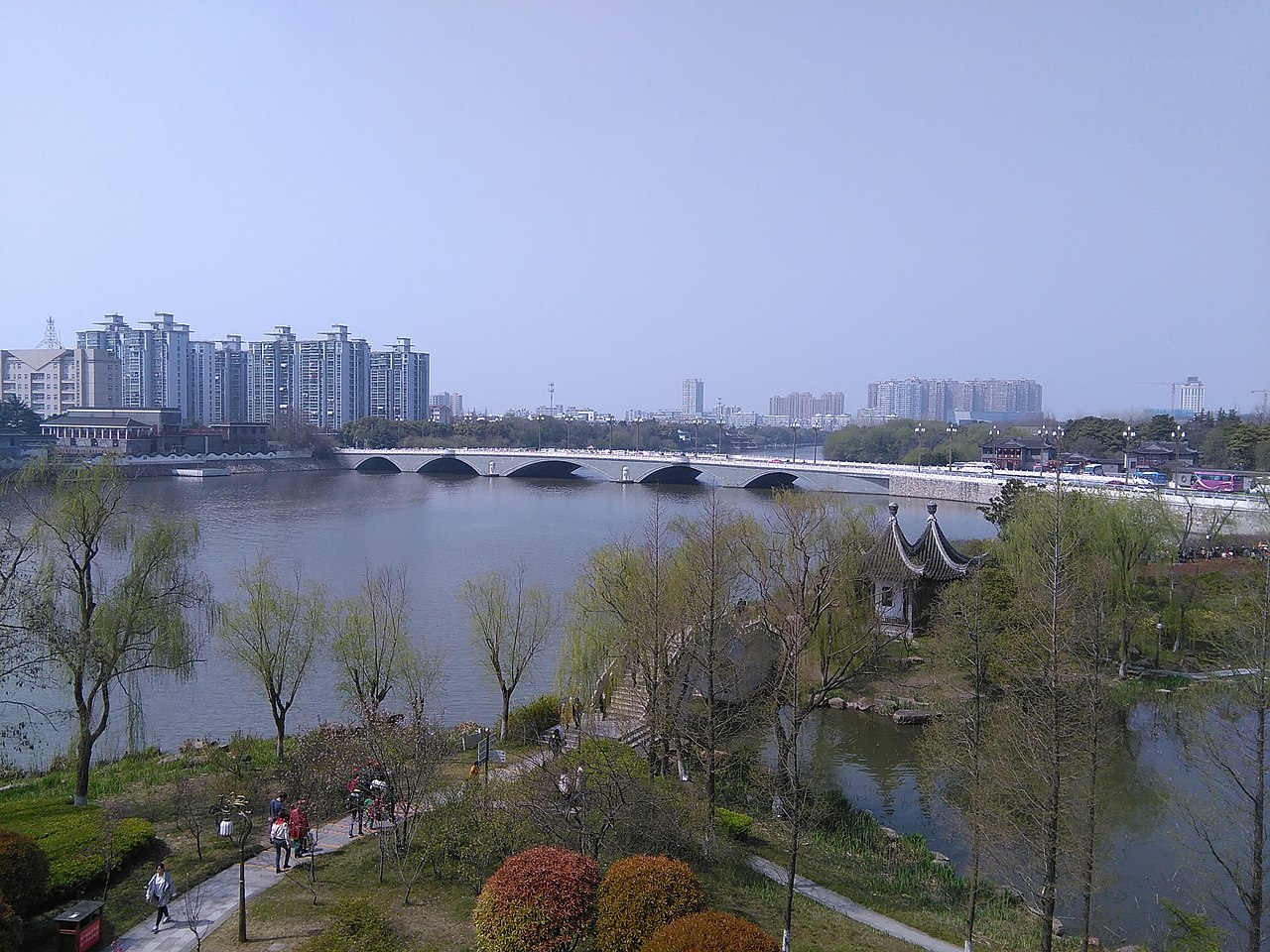
Taizhou lies at the confluence of the Yangtze River and the Jinghang Canal (Grand Canal of China), in the south-central Jiangsu Province, which is on the north bank of lower reaches of the Yangtze River, the south end of Jianghuai Plain. Its latitude ranges from about 32° 02′ — 33°11′ N and longitude 119° 38′ — 120° 32′ E, with a total area of 5,793 square kilometres (2,237 sq mi).
Neighbouring areas: Yangzhou to the west, Nantong to the east, and Yancheng to the north.
Climate
As with the rest of central and southern Jiangsu, Taizhou has a humid subtropical climate (Köppen Cfa), influenced by the East Asian Monsoon, with cold, damp, but comparatively dry, winters, and hot, humid summers with copious rain. The normal monthly mean temperature ranges from 2.4 °C (36.3 °F) in January to 27.5 °C (81.5 °F) in July, while the annual mean is 15.36 °C (59.6 °F). Nearly half of the mean annual rainfall of 1,037 mm (40.8 in) is distributed June to August.
Economy
Taizhou is a center for flour mills, textile works, fishing net manufacturing, and other industries based on local agriculture.
In the past 20 years, the economic growth has remained stable with an average annual growth rate exceeding 10%. It is one of the central cities inside the Yangtse River Delta with its developed industry, convenient transportation and prosperous commerce. In 2024, the GDP reached RMB 702.09 billion yuan, the GDP per capita RMB 156,351 yuan, equals to 21,954 dollars, the fiscal revenue RMB 37.5 billion yuan, the total amount of bank deposits RMB 688 billion yuan. Five county-level cities or districts are ranked among the "China's Top 100 Counties with Greatest Comprehensive Power". It boasts numbers of large-sized enterprises or groups, such as Chunlan Group Corp.
Taizhou was among the first few cities in Jiangsu to be recognized as having a famous cultural history. In 1990, Heheng village in Jiangyan County was awarded Global 500 Roll of Honor by the United Nations Environment Programme (UNEP) because of its success in protecting the environment while increasing the grain yield and its wide use of marsh biogas ponds.
Taizhou's China Medical City (CMC) is a specialized development zone located south of downtown Hailing district; it has attracted major international and domestic corporations who have established facilities here since its establishment in 2010. To date, more than 800 pharmaceutical enterprises have located businesses and incubation centers in CMC. Pharma companies include AstraZeneca, Takeda Pharmaceutical, Boehringer-Ingelheim, CSPC Pharmaceutical Group and Neptunus Pharmaceutical, as well as Yangtze River Pharmaceutical Company.
Transportation
The G2 Beijing–Shanghai Expressway and Jiangsu Provincial Highway 29 (S29 Yancheng-Jingjiang Expressway; 盐靖高速公路) pass through the city from north to south, and Jiangsu Provincial Highway 28 (S28 Qidong-Yangzhou Expressway; 启扬高速公路) from west to east.
Taizhou Municipality has two Yangtze River crossings, the Taizhou Yangtze River Bridge from Gaogang District to Yangzhong and the Jiangyin Yangtze River Bridge from Jingjiang to Jiangyin.
Take buses from Shanghai or Nanjing through the G2 Beijing–Shanghai Expressway, which passes south of the city center.
Take trains from Beijing through Xinyi–Changxing railway or Nanjing through Nanjing–Qidong railway
Companies headquartered in Taizhou
Oberon Dishwashing Equipment Manufacturing Co. Ltd
Tourism

Qintong Boat Festival is held in Qingming (around April 4–6) every year. During the festival boats from nearby villages and towns converge on Xique Lake for a few days of rejoicing. Theatrical performances, dragon and lion dances, and other folk dances are staged right on board the boats.
The lake located in Qingtong town, 15 kilometres (9 miles) north of Jiangyan city. The water comes from the Nanhu (南湖), Xique (喜鹊湖), and Beihu (北湖) rivers. It is part of Qintong Swamp.
Père David's Deer Reserve, Jiangyan (麋鹿故乡园)
Heheng Agricultural Tour, Shengao, Jiangyan
Mei Lanfang Garden, opposite of 'Old Street'
Kaynak: Wikipedia – Taizhou, Jiangsu · CC BY-SA 4.0

İdari bölümler
Taizhou şehri, üç semt ile üç ilçe düzeyi şehre ayrılmaktadır.
Kaynak: Wikipedia – Taizhou, Jiangsu · CC BY-SA 4.0