
Interested in working with us in the future?
Follow to see new jobs and posts in your feed.
No news yet.

History

The archipelago was inhabited 6,000 years ago, during the Neolithic by people of the Hemudu culture. During the Spring and Autumn period, Zhoushan was called Yongdong, referring to its location east of the Yong River. At the time, it belonged to the state of Yue. The fishermen and sailors who inhabited the islands often engaged in piracy and became recruits for uprisings against the central authorities. At the time of the Eastern Jin, the Zhoushan Islands served as the base for Sun En's rebellion. Sun En, an adherent of the Taoist sect the Way of the Five Pecks of Rice, launched his rebellion around the year 400 and was defeated by Jin forces in 402. Today's Zhoushan was first created as Wengshan County in Ming Prefecture in 738 under the Tang.
In 863, the Japanese Buddhist monk Egaku (慧萼) and a Putuoshan local Zhang-shi (张氏) placed a statue of Guanyin at Chaoyin Cave (潮音洞) that would later become a popular tourist and pilgrim destination. In 1073, under the Song, it was renamed Changguo County; this was upgraded to a prefecture in the early Yuan dynasty. During the Ming dynasty, especially between the years 1530 and 1560, Japanese and Chinese pirates used Zhoushan as one of their principal bases from which they launched attacks as far as Nanjing; "the whole Chinese coast from northern Shandong to western Guangdong was ravaged to a distance of sixty miles inland."
After suppression of the pirates, Zhoushan became an important commercial port of entry. Under the early Qing dynasty, it played a similar role to Xiamen and Guangzhou as a frequent port of call for Western traders. Changguo Prefecture became Dinghai County within Zhejiang Province in 1688 under the Qing. The restriction of all European trade to the port of Guangzhou in 1760 forced Westerners to leave Zhoushan. One of the requests of Lord Macartney's embassy to the Qianlong Emperor in 1793 was an acquisition of "a small unfortified island near Zhoushan for the residence of English traders, storage of goods, and outfitting of ships." The Qianlong Emperor denied this request together with all the rest.
Administrative divisions
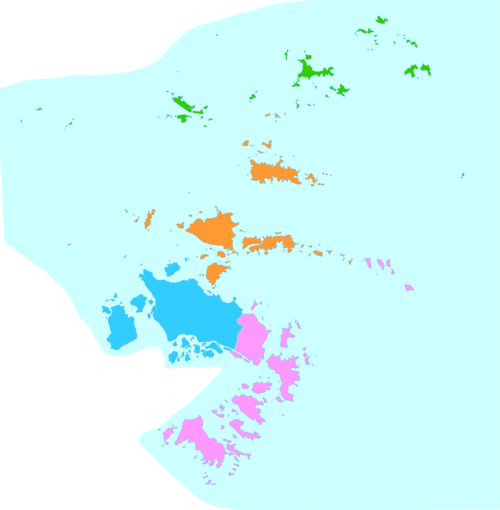
Zhoushan administers two districts and two counties. The city currently consists of 36 township-level divisions, including 17 towns, 5 townships and 14 subdistricts. Detailed divisions are listed as follows.
Dinghai District (13 divisions, including 10 sub-districts and 3 towns)
Sub-district: Jiefang (解放), Changguo (昌国), Huannan (環南), Chengdong (城東), Yancang (盐倉), Lincheng (临城), Qiandao (千島), Xiaosha (小沙), Ma'ao (馬岙), Cengang (岑港)
Town: Baiquan (白泉), Jintang (金塘), Ganlan (干𬒗)
Putuo District (9 divisions, including 4 sub-districts and 5 towns)
Sub-district: Shenjiamen (沈家门), Donggang (东港), Zhanmao (展茅), Zhujiajian (朱家尖)
Town: Putuoshan (普陀山), Dongji (东极), Taohua (桃花), Xiazhi (蝦峙), Liuheng (六橫)
Daishan County (7 divisions, including 6 towns and 1 township)
Town: Gaoting (高亭), Qushan (衢山), Changtu (長涂), Dongsha (東沙), Daidong (岱東), Daixi (岱西)
Shengsi County (7 divisions, including 3 towns and 4 townships)
Town: Caiyuan (菜園), Yangshan (洋山), Shengshan (嵊山)
Township: Wulong (五龍), Huanglong (黃龍), Gouqi (枸杞), Huaniao (花鳥)
In particular, Qiandao and Lincheng sub-districts of Dinghai District are governed by a special new town administration committee of Zhoushan.
Geography

The Zhoushan Archipelago, comprising 1,390 islands and 3,306 reefs, is outside of Hangzhou Bay. It is the largest archipelago of China. Among these islands, 103 are inhabited all year round, 58 are larger than 1 square kilometer (0.39 sq mi), and only 12 have populations over 10,000. Below is a list of major inhabited islands.
(DH = Dinghai District, PT = Putuo District, DS = Daishan County, SS = Shengsi County)
There are six major islands (over 50 km2 (19 sq mi)):
Zhoushan Island (舟山岛), 502.65 km2 (194.07 sq mi), 635,595 (DH/PT)
Daishan Island (岱山岛), 119.32 km2 (46.07 sq mi), 111,765 (DS)
Liuheng Island (六横岛), 109.40 km2 (42.24 sq mi), 59,102 (PT)
Jintang Island (金塘岛), 82.11 km2 (31.70 sq mi), 37,321 (DH)
Zhujiajian Island (朱家尖岛), 75.84 km2 (29.28 sq mi), 27,981 (PT)
Qushan Island (衢山岛/大衢岛), 73.57 km2 (28.41 sq mi), 53,016 (DS)
There are 11 middle-size islands (between 10 and 50 km2 (3.9 and 19.3 sq mi)):
Taohua Island (桃花岛), 44.43 km2 (17.15 sq mi), 10,867 (PT)
Greater Changtu Island (大长涂山), 40.62 km2 (15.68 sq mi), 1,750 (DS)
Xiushan Island (秀山岛), 26.33 km2 (10.17 sq mi), 10,106 (DS)
Sijiao Island (泗礁山), 25.88 km2 (9.99 sq mi), 39,008 (SS)
Xiazhi Island (虾峙岛), 18.59 km2 (7.18 sq mi), 11,247 (PT)
Dengbu Island (登步岛), 16.72 km2 (6.46 sq mi), 2,479 (PT)
Mount Putuo (普陀山), 16.06 km2 (6.20 sq mi), 10,337 (PT)
Cezi Island (册子岛), 14.97 km2 (5.78 sq mi), 6,334 (DH)
Changbai Island (长白岛), 14.16 km2 (5.47 sq mi), 3,066 (DH)
Lesser Changtu Island (小长涂山), 13.33 km2 (5.15 sq mi), 19,750 (DS)
Dayu Island (大鱼山), 11.03 km2 (4.26 sq mi), 788 (DS)
Zhoushan includes 20,800 km2 (8,031 sq mi) of marine territory, but only 1,440.12 km2 (556 sq mi) of land, 183.19 km2 (71 sq mi) of which are submerged during high tides. It is 182 km (113 mi) east-west and 169 km (105 mi) north-south and although heavily populated now has few farms.
Climate
Zhoushan has a four-season, monsoon-influenced humid subtropical climate (Köppen Cfa), with cool, damp winters, and hot, humid summers. Conditions, especially during summer, are generally moderated by the surrounding waters of the East China Sea, bringing a January average of 6.2 °C (43.2 °F) and August average of 27.8 °C (82.0 °F), with an annual mean of 17.1 °C (62.8 °F). The highest temperature on record was 42.3 °C (108.1 °F) on 8 August 2013, which is 1.7 °C higher than the second highest temperature. Precipitation is significant throughout the year, with the greatest rainfall during summer. With 1,823.7 hours of bright sunshine annually, ranging from 30% sunshine in June to 53% in July and August, the second half of the year is sunnier.
Demographics
According to the report from the Sixth National Population Census of the People's Republic of China, the total population of Zhoushan Municipality is 1,121,261 with 588,414 males and 532,847 females as of 1 November 2010, among which an overwhelmingly majority is Han Chinese (1,109,813). The number of households is about 454,800. For an administrative division distribution, Dinghai District has a population of 464,184, Putuo District has a population of 378,805, Daishan County has a population of 202,164 and Shengsi County has a population of 76,108. In terms of education attainment, about 10 percent of the total population (115,286) has received higher education, while a population of 77,577 is illiterate or semiliterate. In terms of age distribution, there is a child (aged 0–14) population of 114,265 and a senior population of 176,331.
Economy
Traditionally Zhoushan had relied heavily on the primary sector, especially fishing, given Zhoushan is the largest fishery in China. Nowadays with the development of the secondary and tertiary sectors, Zhoushan's economic base has been largely diversified. Ship building and repairing, shipping, light industry, tourism and service industry grow to be the major contributors of local economic output. In 2016, the entire municipality achieved a total Gross Domestic Product (GDP) of 122.85 billion yuan (approximately 16,013 US dollars per capita), with an increase of 11.3% from the previous year. The city continuously ranked 3rd among 11 municipalities of Zhejiang Province. However, since Zhoushan has a significantly smaller population compared with other municipalities, the absolute figure of total GDP still ranked the last place in the province. The structure of three sectors of industry is 10.6 : 39.8 : 49.6. In 2012, Zhoushan Port alone processed 290,990 kilotons of cargo. If combined with Ningbo Port (Ningbo and Zhoushan Ports are essentially one port with shared infrastructure, harbor basin and administrative collaboration), the entire greater port handled approximately 744,000 kilotons of cargo, surpassing Shanghai Port to be world's new busiest port in terms of cargo tonnage.
In 2012, Zhoushan's per capita disposable income of urban residents reached 34,224 yuan, with a 12.2% increase from the previous year (an increase of 10.3% considering the price and inflation factors). On the other hand, Zhoushan's per capital net income of rural residents reached 18,601 yuan, with a 12.9% increase from the previous year (an increase of 11.0% considering the price and inflation factors). The Engel's Coefficients for urban and rural residents are 35.9% and 38.1% respectively. The average housing building areas are 32.39 and 49.10 square meters for urban and rural residents respectively.
Transportation

Zhoushan is served by different modes of transportation, including air, highway and water. The transportation condition in Zhoushan has been improved largely during recent years, especially after the opening of Zhoushan Trans-Oceanic Bridges in 2009, which established a stable corridor connecting to the continent and converted Zhoushan into a peninsula per se. Due to geographical isolation, Zhoushan is the only one of the municipalities in Zhejiang Province which is not served with rail transportation.
Air transportation
Although named after Mt. Putuo, Zhoushan Putuoshan International Airport is located on Zhujiajian Island, and is a domestic hub with scheduled passenger flights to several cities in China, including Shanghai, Beijing, Guangzhou, Shenzhen, Xiamen, Fuzhou, Hefei, Lianyungang, Jieyang and Jinjiang. The construction of the airport began in March 1997 and completed in August 1997 with an investment of 410 million RMB yuan, and is rated as a 4D airport. As of 2016, Zhoushan Airport is the 86th largest civic airport in Mainland China in terms of passengers handled with a total of 800.9 thousand users. Expansion including a new terminal and 2,500 by 23 meters (8,202 by 75 ft) taxiway is under construction.
Road transportation
Zhoushan Trans-Oceanic Bridges (舟山跨海大桥 or 舟山大陆连岛工程), the indispensable component of Yongzhou Expressway (甬舟高速) (numbered G9211 in the National Trunk Highway System), consist of five consecutive bridges which connect Zhoushan to the mainland, Zhenhai District of Ningbo to be specific. These five bridges are Cengang Bridge (岑港大桥), Xiangjiaomen Bridge (响礁门大桥), Taoyaomen Bridge (桃夭门大桥), Xihoumen Bridge (西堠门大桥) and Jintang Bridge (金塘大桥). The painstaking huge project, started in 1999 and completed in 2010, is the largest bridge group in China. Xihoumen Bridge, in particular, is the world's second-longest suspension bridge in terms of the length of the central span.
Energy
There exist 2 power connections: HVDC Zhoushan, the first HVDC built in China and Zhoushan Island Overhead Powerline Tie with the tallest electricity pylons in the world, as well as the world's longest span.
Tourism

Zhoushan has two national-level scenic areas, Mount Putuo and the Shengsi Islands, and two provincial-level scenic areas, Taohua Island and Daishan. Its connection to the continental part of the Yangtze Delta has supported tourism in the area. In 2021, Zhoushan received 27.71 million visitors (25 times the population), including 310,500 from outside China. The tourism industry is an important sector of the local economy; it generated 26.68 billion yuan in 2012.
Mount Putuo National Scenic Area
Mount Putuo National Scenic Area (普陀山国家级重点风景名胜区) comprises two parts: Mount Putuo and Zhujiajian Eastern Coast. The scenic area has a total area of 41.85 square kilometers (16.16 sq mi).
On a visit in the early 1830s, missionary Karl Gützlaff noted that the island of "Poo-to" boasted two large and 60 small temples, attended by 2,000 monks,
To every person who visits this island, it appears at first like a fairy land, so romantic is everything which meets the eye. Those large inscriptions hewn in solid granite, the many temples which appear in every direction, the highly picturesque scenery itself, with its many-peaked, riven, and detached rocks, and above all a stately mausoleum, the largest which I have ever seen, containing the bones and ashes of thousands of priests, quite bewilder the imagination.
Mount Putuo (普陀山), also named Mount Meicen (梅岑山) and Mount Baihua (白华山), is considered the bodhimanda of Avalokitesvara (Guanyin), a revered Bodhisattva in many parts of East Asia. It is one of the four sacred mountains in Chinese Buddhism, the others being Mount Wutai, Mount Jiuhua, and Mount Emei. However, different from other three sacred mountains which are mountains with heights of more than 1,000 meters (3,300 ft), Mount Putuo is actually a small island with a total area of 12.5 km2 (4.8 sq mi), the highest point of which is Peak Foding (291.3 m or 956 ft above sea level). Mount Putuo features three grand temples (Puji Temple, Fayu Temple, and Huiji Temple), three treasures (Tahoto Pagoda, Yangzhi Guanyin Stele, and Nine-Dragon Caisson), three rocks (Rock Pantuo, Heart Rock, and Rock Ergui Tingfa), three caves (Cave Chaoyang, Cave Chaoyin and Cave Fanyin), 88 nunneries and 128 huts, and twelve scenes. Mount Putuo was praised in various historic records. It is often titled as Bulguksa Among Seas and Skies (海天佛国), or Sacred Ground on the Southern Seas (南海圣境). Mount Putuo is always mentioned in the same breath with the West Lake in Hangzhou, another national scenic area of Zhejiang. West Lake is considered to be the foremost place that combines mountain and lake views, whereas Mount Putuo is deemed as the top place where integrates mountain and sea views (以山而兼湖之胜,则推西湖;以山而兼海之胜,当推普陀).
Other attractions
Dongji Islands (东极岛), formerly known as Zhongjieshan Chain of Islands (中街山列岛), is a group of islands located at the eastmost end of the Zhoushan Archipelago, extending far into the East China Sea. It is famous for well-preserved original fishing villages, and unpolluted natural seascapes.
Shenjiamen Fishing Port (沈家门渔港) is the traditional center of Zhoushan Fishery and the largest fishing port of China. Its seafront promenade of open-air seafood restaurants is widely appreciated for fresh seafood served, wonderful views of the port and plenty of strolling musicians.
Opium War Memorial (Zhushan Park) (鸦片战争遗址公园(竹山公园)) is an urban park at the southwestern corner of Dinghai county town in memory of the battle fought between Zhoushaners and the British around 1840, notably the heroic deeds of three generals, Ge Yunfei, Wang Xipeng and Zheng Guohong.
Education

Zhoushan City has 111 licensed kindergartens, 62 primary schools, 34 middle schools, 16 high schools, 7 vocational schools, and 3 higher-educational level colleges and universities. Zhoushan High School, Dinghai First High School, Putuo High School, Daishan High School, and Shengsi High School are province level key public high schools. Putuo No.2 Middle School is one of the noted secondary schools in the Putuo District. Nanhai Experimental School, located at Lincheng Sub-District of Dinghai and established in 2001, is a major private school. Zhejiang Ocean University and Zhejiang University (Zhoushan Campus) are two well-known universities in the city.
Twin towns – sister cities

City of Greater Geraldton, Western Australia, Australia
Ganghwa County, Incheon Metropolitan City, South Korea
Gokseong County, South Jeolla Province, South Korea
Sacheon City, South Gyeongsang Province, South Korea
Kaynak: Wikipedia – Zhoushan · CC BY-SA 4.0

İdari bölümler
Zhoushan şehri iki semt ile iki ilçeye ayrılmaktadır.
Kaynak: Wikipedia – Zhoushan · CC BY-SA 4.0