
Interested in working with us in the future?
Follow to see new jobs and posts in your feed.
No news yet.
Names
Zhangjiakou is the atonal pinyin romanization of the Chinese name written 張家口 in traditional characters and 张家口 in simplified ones, meaning "pass of the Zhang family". It is written Zhāngjiākǒu in tonal pinyin and was formerly romanized as Chang-chia-k'ou in Wade–Giles and as Changchiakow in Postal Map romanization. The name is a clipping of Zhangjiakoubu
(张家口堡; 張家口堡; Zhāngjiākǒubǔ), "earthwork fortress of the Zhang family", named in honor of the Ming-era official Zhang Wen (张文; 張文; Zhāng Wén) who directed its construction from 1429. During China's Republican Era, the town was also known in Chinese as Zhangyuan (张垣; 張垣; Zhāngyuán), "the Zhang Wall".
Until the mid-20th century, Zhangjiakou was more often known to Europeans as Kalgan from its classical Mongolian name Qaɣalɣan (ᠬᠠᠭᠠᠯᠭᠠᠨ), meaning barrier or beam gate, but actually a shortened form of the full name Čiɣulaltu Qaɣalɣa (ᠴᠢᠭᠤᠯᠠᠯᠲᠤ ᠬᠠᠭᠠᠯᠭᠠ), "assembly" or "meeting gate" from its importance along Sino-Mongolian trade routes. The modern Mongolian forms of these names are Haalgan (Хаалган) and Chuulalt Haalga (Чуулалт Хаалга). The Manchu form of the name was Imiyangga Jase (ᡳᠮᡳᠶᠠᠩᡤᠠ ᠵᠠᠰᡝ).
During the Ming dynasty, when the city was a major military outpost against the Northern Yuan, it was also known as Wucheng (武城, Wǔchéng), "Martial" or "War Town". Because of its strategic position above and northwest of Beijing, Zhangjiakou has been nicknamed "Beijing's Northern Door".
History

Pre-Qin era
There are many paleolithic remains in sites like Nihewan, Xiaochangliang, and Maquangou located in Guyuan county, which indicated human activities dating back possibly 2 million years ago.
Around 2500 BC, the legendary ancestors of Chinese people, Huangdi, Yandi, and Chiyou used to live in the area of Zhuolu Town, and later fought the Battle of Zhuolu and Battle of Banquan, amalgamating different tribes into a single Huaxia tribe, thus beginning Chinese history.
During Spring and Autumn period, Xiongnu and Donghu people inhabited the northern area while Yan State (since around 11th century BC) and Dai state (since 7th century BC) occupied the southern area. In 475 BC, Dai was occupied by Zhao Wuxu of Zhao State. In 300 BC, King Wuling of Zhao established Dai Commandery, managing the area of ancient Dai state with its administrative center in Dai, currently Daiwangcheng, Yu County. During the same period of time, King Zhao of Yan sent General Qin Kai who was once captured by Donghu people and thus became familiar with their tactics to defeat Donghu. Following that, Yan State built Great Wall in its border extending from Zaoyang (currently northeast of Xuanhua) to Xiangping (currently north of Liaoyang). In 283 BC, King Zhao established Shanggu Commandery. In 265 BC, Li Mu, a famous general of Zhao, commanded and deployed troops in Dai to protect against Xiongnu. After arriving in Dai, initially Li Mu banned any counterattack against Xiongnu to preserve the strength for years, which however incurred the discontent of King of Zhao. As a result, Li Mu was sacked. Following Zhao troops' defeat later, King of Zhao reinstated Li Mu. Viewing Zhao troops as cowards, Xiongnu grew arrogant and underestimated Zhao's strength. Finally, Li Mu led troops and ambushed Xiongnu, causing hundreds of thousands of casualties and great damage of Xiongnu, thus ensuring decades of peace in Zhao's borderlands.
Tourism

Lying in between the Mongolian Plateau and the North China Plain, Zhangjiakou has a somewhat rugged topography characterized by high mountains, deep valleys, and rocky pathways. As a result, it serves as a perfect natural screen for Beijing, which has made it a strategic priority militarily since ancient times. It is called "The Gateway to Beijing" and "The Mountain City beyond the Great Wall". The grand Yan Mountain, the towering Taihang Mountain, the vast grasslands, and the meandering Sangyang River converge here. The city government has regarded tourism as a major driving force of the city's economy and continues to develop the industry.
As a place where water resources for Beijing is located, ecological and sustainable development have been emphasized by local government. Due to its less impact on environment than heavy industry, tourism figures significantly in local policies of development. Possessing diverse landforms, such as plains, hills, mountains, basins and grasslands, Zhangjiakou is an ideal place for holidays, entertainment sightseeing for middle class citizens and can provide tourists with a variety of experiences. In the area, there are significant differences in different seasons. In winter, tourists can ski in Chongli Mountains; in spring, they can visit historical sites; in summer, visitors can sleep in Mongolian yurts on Zhangbei Grassland, where annual musical events were held and taste fresh mutton; while in autumn, visitors can taste Huailai wine and take a bath in nearby hot springs.
In today's Zhangbei county a major attraction are the ruins and museum of the former Yuan capital Zhongdu.
Geography
Zhangjiakou is located in the northwest part of Hebei province, and is defined by mostly rough terrain created by the Yin Mountains, with elevations increasing from southeast to northwest. The east of the prefecture marks the Yan Mountains The bordering prefectures in the province are Chengde to the northeast and Baoding to the south. It also borders Shanxi to the west and southwest and Inner Mongolia to the northwest. The prefecture's latitude ranges from 39° 30' to 42° 10' N, or 289.2 kilometres (179.7 mi), while its longitude spans 113° 50' to 116° 30' E, or 216.2 kilometres (134.3 mi).
Zhangjiakou City is divided into three topographical regions: plateau, mountains, and basin. The former has elevations generally above 1,400 metres (4,600 ft), and consists of all of Guyuan and Kangbao Counties as well as part of Shangyi and Zhangbei Counties. This area is part of the southern end of the Inner Mongolia Plateau (内蒙古高原) and accounts for one-third of the prefecture's area. The basin area has elevations of 500 to 1,000 metres (1,600 to 3,300 ft) and supports a few rivers.
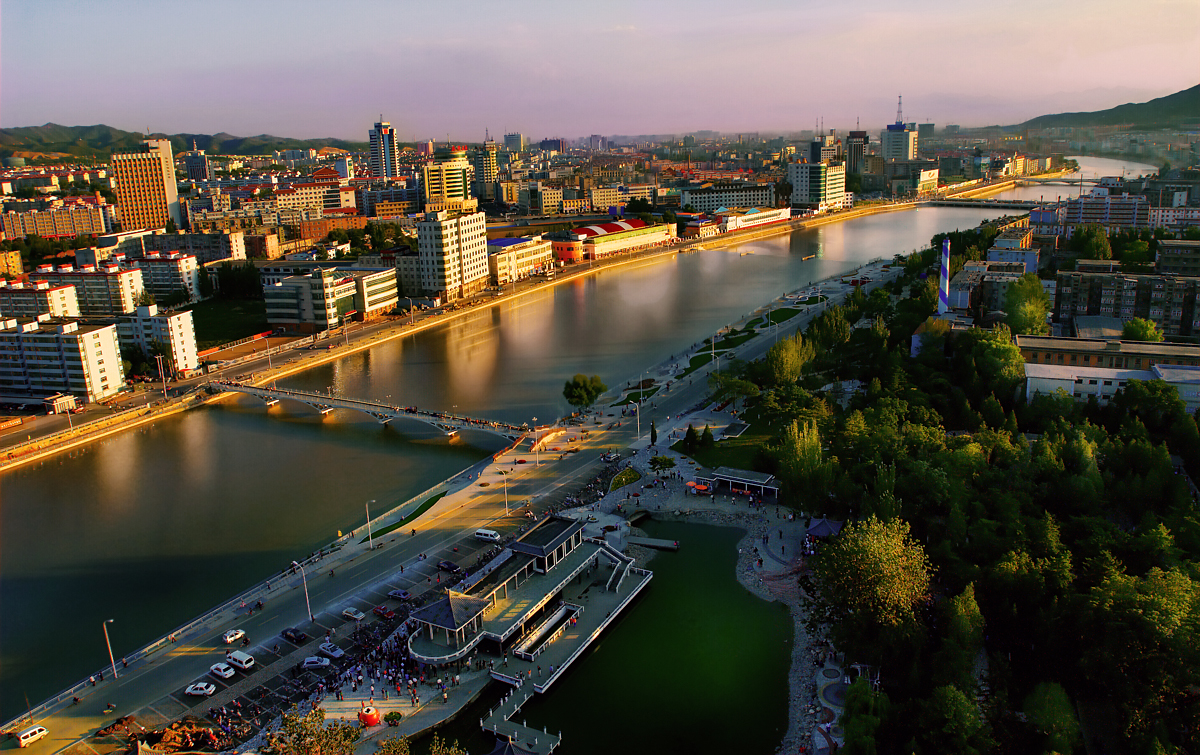
The urban area of Zhangjiakou is surrounded by mountains on three sides. The Qingshui River passes through the city, dividing the city into two districts, Qiaodong District and Qiaoxi District.
Climate
Zhangjiakou has a monsoon-influenced, continental semi-arid climate (Köppen BSk), with long, cold, dry, and windy winters due to the Siberian anticyclone, and hot, humid summers driven by the East Asian monsoon; in between spring and autumn are dry and brief. Conditions are much cooler than in Beijing due in part to the elevation. The monthly 24-hour average temperature ranges from −8.1 °C (17.4 °F) in January to 24.2 °C (75.6 °F) in July, and the annual mean is 9.2 °C (48.6 °F).
Economy

The vicinity of Zhangjiakou is rich in coal and iron ore, making it an ideal location for developing iron and steel industry. Apart from metallurgy, the city is home to one of China's most important grape wine industries, with the Great Wall Wine Company being located in Shacheng, Huailai County.
Due to its comparatively late implementation Reform and Opening policies, the scale of foreign investment in Zhangjiakou is not quite large. Currently, there are approximately 130 foreign companies settled. The amount of investment
reached 820 million US dollars. The largest one is Zhangjiakou Volvo Motor Company with investment amounting to 3.1 billion RMB, and value of output exceeding 1 billion RMB. In 2022, Volvo Cars' powertrain plant at Zhangjiakou was transferred to Aurobay, a joint venture between Volvo Cars and Geely.
Due to several factors including the hosting of 2022 Winter Olympic Games with its concomitant expansion of infrastructure, the opening of high-speed railway in December 2019, the national strategy of coordinated development of Beijing-Tianjin-Hebei, the ratification of building a national demonstration zone of renewable energy by State Council of the People's Republic of China, Zhangjiakou economy is expected to undergo unprecedented advance in the coming years.
Transportation
The city lies in the northwestern corner of the province and is linked to Datong in Shanxi by the Xuanda Expressway and to Beijing by means of the Jingzhang Expressway.
Zhangjiakou is further linked by a freeway to Inner Mongolia which opened on September 7, 2005.
A heavy-haul railway is under construction, to transport coal from Zhangjiakou to Tangshan. Construction is expected to finish in 2015; the railway is planned to carry 200 million tons of coal per year. Another heavy-haul railway, Junggar-Zhangjiakou, is expected to connect to it.
Beijing-Zhangjiakou Intercity Railway opened in December 2019, shortening the traveling time from Beijing to Zhangjiakou from 3 hours 7 minutes to 47 minutes .
Flights to Guangzhou, Shanghai, Shenzhen, Shijiazhuang, and Xiamen are available at Zhangjiakou Ningyuan Airport.
Military
Zhangjiakou is headquarters of the 65th Group Army of the People's Liberation Army, one of the three group armies that comprise the Beijing Military Region responsible for defending China's capital.
Education
Zhangjiakou is home to Hebei North University. The university has been improving its international network and many foreign students are now studying there. It is most popular amongst foreign students due to its faculty of medicine and MBBS program. Another university Hebei University of Architecture is located in Qiaodong District. Zhangjiakou No.1 Middle School is the most famous secondary school in Zhangjiakou. Beijing No.101 Middle School was a branch of Zhangjiakou No.1 Middle School in the past.
Sports
Zhangjiakou hosted Freestyle and Nordic skiing and snowboarding excluding big air for the 2022 Winter Olympics. The events were held in a venue in Taizicheng, a village in Chongli District. The ski resort earned over 1.54 billion yuan (US$237.77 million) in tourism during the 2015–16 snow season for a 31.6% growth over the previous season. The snow season lasted for five months from November, during which Chongli has hosted thirty-six competitions and activities, such as Far East Cup and Children Skiing International Festival. A total of twenty-three skiing camps were set up, attracting the participation of 3,800 youths.
Kuyangshu Nordic Center and Biathlon Center – cross-country skiing, Nordic combined (cross-country skiing) 15,000
Kuyangshu Ski Jumping Field – ski jumping, Nordic combined (ski jumping) 10,000
Genting Snow Park – snowboarding (slopestyle, halfpipe), freestyle skiing 5,000
Thaiwoo Ski Resort – snowboarding (cross), freestyle skiing 10,000
Wanlong Ski Resort – snowboarding (parallel slalom) 5,000
Kaynak: Wikipedia – Zhangjiakou · CC BY-SA 4.0

Coğrafya
Zhangjiakou, güneyde Baoding, kuzeydoğuda Chengde il düzeyi şehirleri ile doğuda Pekin ve batıda Shanxi eyaleti ve İç Moğolistan Özerk Bölgesi ile komşudur.
İdari bölümler

Zhangjiakou şehri, dört semt ile 13 ilçeye ayrılmaktadır.
Ekonomi
Zhangjiakou'nun çevresi, kömür ve demir cevheri bakımından zengin olup bu durum şehirde demir ve çelik sanayiinin geliştirilmesi için uygun bir yer haline getirmektedir. Metalurji ile birlikte şehir Çin'in en önemli üzüm şarap sektörlerinden birine ev sahipliği yapmaktadır. Şarap üreticisi Great Wall Wine'nin merkezi Huailai ilçesinin Shacheng kasabasında yer almaktadır.
Kaynak: Wikipedia – Zhangjiakou · CC BY-SA 4.0