

Interested in working with us in the future?
Follow to see new jobs and posts in your feed.
No news yet.
Name
Xiamen had always been known as Tong'an County since antiquity until Republic of China Era of the 20th century, followed by administrative zoning restructures and naming changes.
Tong'an County first appeared in Han dynasty records. Xiamen Island was described as Jiahe Islet of Tong'an County during the Song dynasty (960–1279). It received its present name from the Xiamen Defense Castle erected on the island by Zhou Dexing in 1387 during the Ming dynasty to meet the needs of coastal defense. The name was formerly written using, Chinese: 下門; lit. 'Lower Gate', and then changed into Chinese: 廈門; lit. 'Mansion Gate' or "Gate of China".
After the fall of the Ming dynasty, Zheng Chenggong, or Koxinga, a Ming loyalist and general, occupied Xiamen island as an anti-Qing base. In 1650, the seventh year of Emperor Shunzhi of the Qing dynasty, Zheng set a military base in Xiamen island and changed its name into Chinese: 思明州; pinyin: Sīmíng zhōu; Pe̍h-ōe-jī: Su-bêng chiu; lit. 'Think Ming (dynasty) Prefecture', meaning "Remembering the Ming".
When its port prospered under the Qing, especially during the reign of Emperor Kangxi, the island's name was changed to Chinese: 廈門; pinyin: Xiàmén; Pe̍h-ōe-jī: Ē-mn̂g / Ē͘-mûi; Tâi-lô: Ē-mn̂g again.
The island's name of 思明 was in return restored after the Xinhai Revolution that inaugurated the republic in 1912.
The island's name of 廈門 was restored in 1933, along with Xiamen being administratively planned as a city, the first of its kind in Fujian province. 思明 continues to be used as the name of one of its districts.
Xiamen is the atonal pinyin romanization of the characters' pronunciation in Mandarin. It has also been romanized as Hiamen. The older English name "Amoy" was based on the same name's pronunciation in the Zhangzhou dialect of Hokkien, Ē͘-mûi.
Geography

Xiamen is a sub-provincial city in southeastern Fujian whose urban core grew up from the port of Xiamen on southern Xiamen Island, now located within Siming District. It now also includes Gulangyu Island and the rugged coast of the mainland from the northeast bank of the Jiulong River in the west to the islands of Xiang'an in the east. Xiamen Island lies about one degree north of the Tropic of Cancer. It is divided between Huli District in the north and Siming District in the south. Siming also includes Gulangyu. Its mainland territory is divided among Haicang, Jimei, Tong'an, and Xiang'an districts.
In the 19th century, Xiamen's harbor on Yundang Bay was considered one of the world's great natural harbors. Land reclamation has since been used to fill in the mouth of this inlet, turning it into Siming District's Yundang Lake. The municipal government is located on other reclaimed land beside it.
The nearest point of Liehyu in the Kinmen Islands, Republic of China (Taiwan), lies only 6 kilometers (4 mi) off Xiamen Island.
Xiamen Island is the fourth largest island in Fujian province. It became a peninsula after the completion of the seawall in 1955. Xiamen waters include Xiamen Port, Outer Harbor Area, Maluan Bay, Tongan Bay, Jiulong River's estuary area and the waterway on the east side. Outside the Xiamen Port, Big Kinmen, Little Kinmen, Dadan, Erdan and other island are arranged in a horizontal line. Inside, it has Xiamen Island, Gulangyu Island and other island barriers, making it a good natural port protected from storms.
Climate
Xiamen has a monsoonal humid subtropical climate (Köppen Cfa), characterised by long, hot and humid summers (but moderate compared to much of the rest of the province) and short, mild and dry winters. The warmest month is July, with a 24-hour average of 28.3 °C (82.9 °F), and the coolest month is January, averaging 13.1 °C (55.6 °F); the annual mean is 21.1 °C (70.0 °F). Extremes since 1951 have ranged from 0.1 °C (32 °F) on 24 January 2016 to 39.6 °C (103 °F) on 9 August 2019. Spring, both by humidity and percentage of sunshine, is the dampest season but typhoons in late summer and early autumn can make the latter period wetter overall. Summer and autumn are marked by comparatively sunny conditions, while autumn is warm and dry. The annual rainfall is 1,301 millimeters (51 in). With monthly percent possible sunshine ranging from 29% in March to 58% in July, the city receives 1,893 hours of bright sunshine annually. Frost occurs very rarely, and the last snowfall in the city took place in January 1893, when snow also fell at Guangzhou, Macau, in the inland parts of Hong Kong and in the hills of Taipei.
History

The area of Xiamen was largely bypassed by the Qin and Han conquests and colonization of Guangdong, which passed west of Fujian down the Lingqu Canal between the Xiang and Li rivers. It was first organized as Tong'an County in AD 282 under the Jin, but it lost this status soon afterwards. Tong'an County was again established in 933 under the Later Tang.
The settlement on the southeastern shore of Xiamen Island (now part of Siming District) developed as a seaport under the Song, although legal foreign trade was restricted to nearby Quanzhou, which administered the area. In 1387, attacks by the "Japanese" or "dwarf" pirates—many of them actually disaffected Chinese—prompted the Ming to protect the harbor with the fortress that gave Xiamen its name. The Portuguese first reached Xiamen in 1541. After the fall of the Ming to the Qing in 1644, Southern Ming loyalists including Koxinga used Xiamen as a base from which to launch attacks against the invading Qing-aligned Han Bannermen from 1650 to 1660. In 1661, Koxinga drove the Dutch from Taiwan and moved his operations there. His base on Xiamen fell to a combined Qing and Dutch invasion in 1663. The East India Company traded extensively with the port, constructing a factory there in 1678. It was raised to the status of a subprefecture in 1680, but the taxes and other restrictions placed on traders compelled the British to relocate to Canton and Fuzhou the next year. Trade resumed in 1685 and continued until the imposition of the Canton System. However, despite the Canton system which restricted Western trade to the port of Guangzhou, the Spanish were still allowed to trade in Xiamen. However, the Spanish rarely used this privilege as Chinese traders would ship their goods from Xiamen to Manila and vice versa, which was more profitable for both sides.
Demographics
A large number of the populace are migrants.
In 1910, Xue Zidao (薛子道), a 9-year-old boy was reported to have fathered a child with Li Fuzhen (李福珍), an 8-year-old girl. These are considered the youngest recorded parents in combined age. According to a 1957 Ripley's publication, the family name was Hsi and they were farmers.
According to the 2020 Census, Xiamen has a population of 5,163,970 inhabitants. According to the 2010 Census, Xiamen has a population of 3,531,347 inhabitants, almost 1.8 times the population counted for the last census in 2000 (which was of 2,053,070 inhabitants). The annual average population growth was of 5.57% for the period 2000–2010. This masks the population explosion in Jimei District, however, which quadrupled since the prior census; Huli District's population more than doubled. The resident population was 1,967,800 in 2013 yearend, and with a population of 3.73 million (those residing at least half a year). The total resident population is said to be 4,255,000 in December 2014, without specifying what counts as a resident.
By the end of 2025, the resident population of Xiamen has reached 5.365 million, the majority being Han people. There are also some ethnic minorities such as She and Hui.
Languages
As with all of China, the official language is Mandarin. Migrants of non-Hokkien ancestry usually speak Mandarin and/or their ancestral tongues.
The indigenous language is Hokkien, a subgroup of Southern Min, with the Tong'an dialect being the most populous and prevalent. The Xiamen dialect is mostly confined to the southwest quarter of Xiamen Island, while the Zhangzhou dialect is spoken in a section of Haicang District.
The English words "Amoy", "tea" (Chinese: 茶; Pe̍h-ōe-jī: tê), "cumshaw" (感謝; kám-siā), "pekoe" (白毫; pe̍h-hô), kowtow (磕頭; khàu-thâu), and "ketchup" (鮭汁; koê-chiap) are derived from the local Hokkien.
Administration

Xiamen is a sub-provincial city of Fujian with direct jurisdiction over 6 districts.
In May 2003, Gulangyu and Kaiyuan districts were merged into Siming District; Xinglin District (杏林区) was merged into Jimei District; and Xiang'an District was created out of a section of Tong'an District.
Economy

Xiamen has a diverse and well-developed economy. It is the first to refer to the business environment indexes of the World Bank with the aim of creating world's first-rated business environment. In 2018, its business environment ranked 2nd among 22 cities across the country that was evaluated by the National Development and Reform Commission. Its measures in areas such as dealing with construction permits, getting electricity, and trading across borders take the lead in the country.
Its social credit system has been improved. In 2018, its overall credit index ranked 2nd among 36 provincial capitals and sub-provincial cities and above.
The Siming and Huli districts form its Special Economic Zone.
Xiamen focuses on the development of five major industries – electronic information, equipment manufacturing, tourism and culture, modern logistics, and financial services.
Xiamen's GDP has grown at an average annual rate of 15.4 percent since China's reform and opening-up four decades ago. In 2018, per capita GDP: 118,015 yuan ($17,105); per capita disposable income: 50,948 yuan; public financial budget revenue: 128.3 billion yuan; 1,626 hi-tech enterprises, accounting for 44 percent of the total number of Fujian province; 600.5 billion yuan of total foreign trade value; degree of dependence on foreign trade has reached 125 percent.
By the end of 2018, Xiamen brought in a total of 14,818 foreign-invested projects; contractual foreign investments: $66 billion, actual foreign investments: $37.9 billion; 62 overseas Fortune 500 companies invested in 112 projects in Xiamen.
Xiamen is also the host of the China International Fair for Investment and Trade held annually in early September to attract foreign direct investment into mainland China.
Xiamen also hold Straits Forum annually. The 2019 edition kicked off in the coastal city from 15 to 21 June. More than 10,000 people attended the annual forum this year.
Transportation

Local transportation
The Gaoji Causeway, five main road bridges (the Jimei, Xiamen, Xiang'an, Xinglin, and Haicang Bridges), and two undersea tunnels (Xiang'an Tunnel and Haicang Tunnel) link Xiamen Island with the mainland.
The main forms of public transportation in Xiamen are buses, bus rapid transit (BRT), and the subway. People now can use Alipay, a mobile payment application by Alibaba, to pay for the city's bus, subway, and BRT.
Taxis can be easily hailed in most areas of the city. Bicycles are commonly used by residents, especially on Xiamen Island. Unlike many Chinese cities, motorcycles, mopeds, tricycles, and wooden handcarts are not permitted in Xiamen Island (Siming and Huli). The city has upheld a ban on these vehicles since the 1990s. Electric bikes are permitted with proper licensing and obedience of traffic laws. On the small island of Gulangyu off Xiamen Island, automobiles are also banned.
Railway
Xiamen is a railway hub city in southeast coast of China and has two stations, Xiamen Railway Station and Xiamen North Railway Station. Passengers can buy the tickets on www.12306.cn.
Xiamen is served by the Yingtan–Xiamen railway, Fuzhou–Xiamen railway, Longyan–Xiamen railway and the Xiamen–Shenzhen railway, which are connected to China's national railway network and make it possible for passengers to arrive in Shanghai in five hours, Shenzhen in three-hour, and Fuzhou in two hours, and the Fuzhou–Xiamen high-speed railway between Fuzhou and Xiamen was opened to traffic on 28 September 2023.
The Xiamen Railway Station on the island of Xiamen is connected to the mainland by a railway bridge. It is 10 km from Xiamen Gaoqi International Airport, 23 km from Xiamen North railway station and 7 km from Nanputuo Temple. First opened in 1957, it underwent major reconstruction and expansion in March 2014 and was put into service again on 4 February 2015.
Tourism

Xiamen and its surrounding countryside is known for its scenery and tree-lined beaches. The Xiamen's Botanical Garden is a showcase of this. The Buddhist Nanputuo Temple, dating back to the Tang dynasty, is a national treasure. Xiamen is also well known as a continuing frontline in the Chinese Civil War, with the nearby Kinmen Islands (Quemoy), Republic of China (Taiwan).The Water Garden Expo Park has a total area of about 6.76 km2 (2.61 sq mi), with a land area of 3.03 km2 or 1.17 sq mi consisting of five exhibition park islands, four ecological landscapes, islands, and two peninsulas, including the main pavilion, Chinese Education Park, Marine Culture Island, Spa Island, and other functional areas and related facilities.
Gulangyu Island
Gulangyu, a former treaty port enclave, has views of the city and many Victorian-style buildings.
It was included on the UNESCO World Heritage list in July 2017.
Sunlight rock
Sunlight Rock (日光岩), nicknamed as Huang Rock, lies on the top of Longtou Mountain in south-central Gulangyu Island. Two rocks, leaning against each other, are the highest on the island which stand at 92.7 meters above sea level.
There is a saying that goes "if you haven't ascended Sunlight Rock, you haven't really been to Xiamen".
Kulangsu Historic International Settlement
Kulangsu is an example of the cultural fusion that emerged from international exchanges, which remain legible in its urban fabric. Buildings here have a mixture of different architectural styles including Traditional Southern Fujian Style, Western Classical Revival Style and Veranda Colonial Style. An example of the fusion of various stylistic influences is a new architectural movement, the Amoy Deco Style, a synthesis of the Modernist style of the early 20th century and Art Deco.
Yundang Lake
Yundang Lake (筼筜湖) is originally called Yundang Harbor, which was named after a bamboo's name that have grown in forests there.
Culture

Xiamen is known for its music, puppet shows, Gezai Opera, and temple celebration events.
Gongfu tea
Xiamen is one of the origins of gongfu (kung fu) tea ceremony with a profound tea culture. The essence of Xiamen tea culture is tea ceremony, which involves five elements: tea leaves, water, tea set, fire and environment. Xiamen people mostly drink Oolong tea and especially love Anxi Tieguanyin, which is known as the highest grade of tea.
Xiamen people usually start their day by making a cup of kungfu tea.
Jianggu
Jianggu (讲古场) is a kind of storytelling in Minnan (southern Fujian province) dialect and can be seen in Minnan, Taiwan and Chinese inhabited areas in Southeast Asia.
The performer usually tells stories with vivid and funny slang, proverbs or doggerel, using a dramatic tone, strong facial expressions and body language to attract the audience. It is a popular traditional Chinese folk entertainment performance.
Mid-Autumn mooncake gambling
Mid-Autumn mooncake gambling (中秋博饼), betting on moon cakes, is a folk game played around the Mid-Autumn Festival. It originated in Xiamen and then traveled to the neighboring Zhangzhou, Quanzhou and Kinmen (Quemoy).
It is a game played with six dice. Just throw the dice into a bowl and the different pips you get stand for different ranks of awards you will win.
The gambling game has six ranks of awards, which were given the names of winners in ancient imperial examinations: zhuangyuan, bangyan, tanhua, jinshi, juren and xiucai.These are also known as "One Show", "Two Lifts", and "Three Reds".
Sending off the Wang Boat
The celebration called "Song Wang Chuan" (送王船) is a very important and longstanding traditional festival held in coastal villages in Fujian province, Taiwan and oversea Minnan communities to avert calamities and pray for divine blessings.
Also known as "Shao Wang Chuan" (烧王船) or "Ji Wang Chuan" (祭王船), this festival originated from a religious tradition that ancient voyagers released little boats or decorated ships to send off calamities or plague while invoking for the blessings of various Wang Ye like Zheng Chenggong, an admiral of the Ming dynasty (1368–1644) and the Taoist ritual "Hai Jiao". During the celebration, the local community would also incorporate a variety of folk performances into the traditional religious festival.
Colleges and universities

Xiamen is one of the top 40 cities in the world by scientific research as tracked by the Nature Index.
Public universities
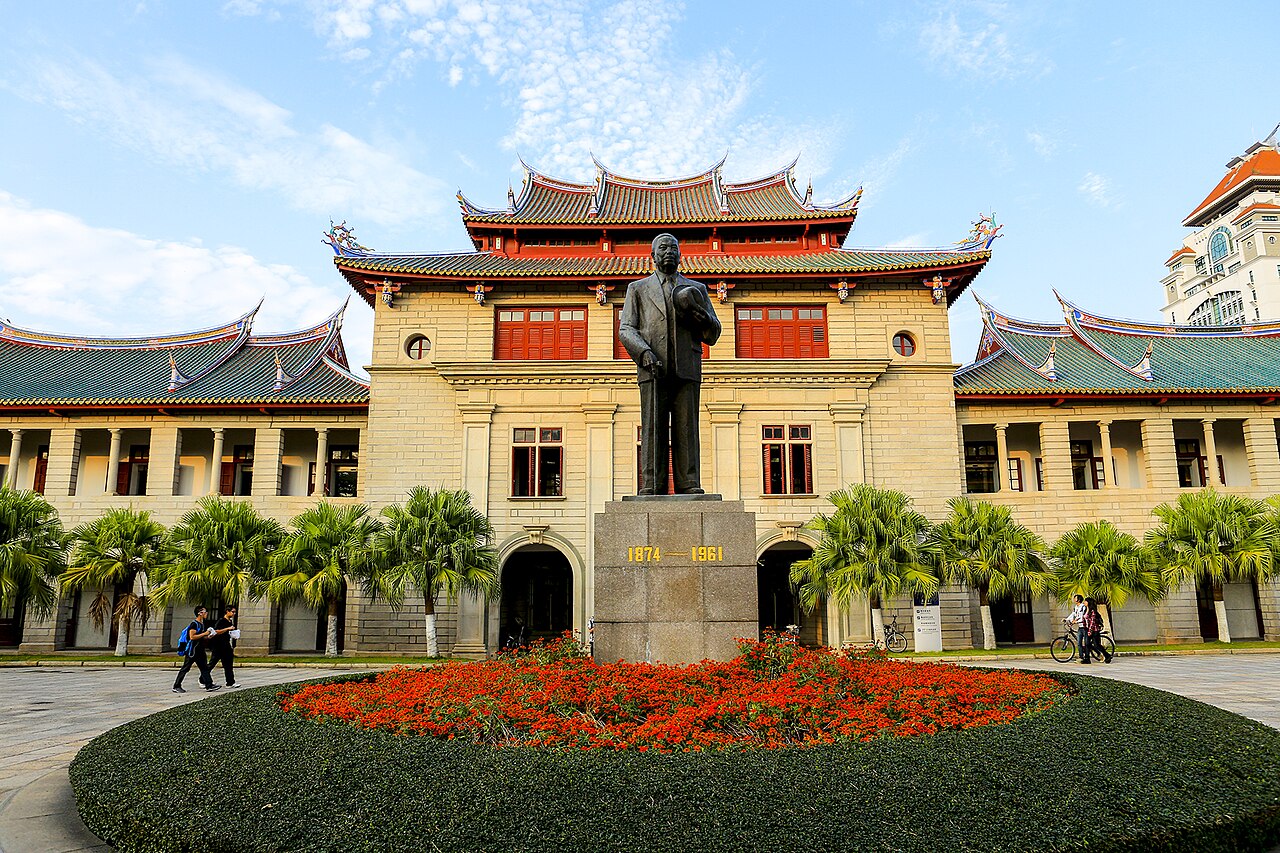
The first two universities below were founded by Tan Kah Kee.
Xiamen University (厦门大学) (founded 1921, Project 985, Project 211, powered by the Ministry of Education of the People's Republic of China): The school has cooperated with over 300 overseas universities and made substantive exchanges with 47 foreign universities that rank among the top 200 in the world. The university vigorously promotes the campaign of teaching Chinese as a foreign language worldwide by co-establishing 15 Confucius Institutes with universities in North America, Europe, and Africa.
Jimei University (集美大学)(powered by the Fujian Provincial Department of Education): The university enrolls students from all over the country as well as from overseas; about 600 overseas students are now studying at Jimei.
Jimei University Chengyi College (集美大学诚毅学院)(independent college)
Huaqiao University (华侨大学): 4,627 international students from over 50 countries and regions including Hong Kong, Macao and Taiwan are now studying at Huaqiao University. The school is one of the top destinations for overseas students in China.
Chinese Language and Culture College of Huaqiao University (华侨大学华文学院)(secondary school of Huaqiao University)
Xiamen University of Technology (厦门理工学院): Attracting international students from more than 10 countries to study.
Xiamen Medical College (厦门医学院): The college has established friendly cooperation ties with National Taiwan Ocean University, National Yang-Ming University, National Taipei University of Nursing and Health Sciences, Tzu Chi University of Science and Technology, Fooyin University, China University of Science and Technology, Central Taiwan University of Sciences and Technology, South Korea's Catholic University of Deagu, Gimcheon College, Daejeon University, Daegu Haany University, and Germany's Cologne University of Applied Sciences. They have conducted international cooperation in running joint schools and research programs while encouraging exchange visits of scholars.
Military
Xiamen functions as the headquarters of the 73rd Group Army of the People's Liberation Army, one of the three group armies under then Nanjing Military Region, now the Eastern Theater Command which is responsible for the defense of the eastern China, including any military action in the Taiwan Strait.
International relations
Consulates
Singapore, Philippines and Thailand maintain consulates in Xiamen.
Kaynak: Wikipedia – Xiamen · CC BY-SA 4.0

İdari yapı

Eyalete bağlı şehir statüsündeki Xiamen 6 ilçeyi yönetmektedir. (区 qu). Aşağıdaki veriler 2010 Sayım sonuçlarını yansıtmaktadır.
Siming ve Huli ilçeleri birlikte Özel Ekonomik Bölge statüsündedirler. Mayıs 2003'te, Gulangyu Adası (Kó-lōng-sū) ve Kaiyuan ilçesi birleşerek Siming ilçesini oluşturmuşlardır. Xinglin ilçesi (杏林区) Jimei ilçesi ile birleşmiştir ve Xiang'an ilçesi Tong'an ilçesinin bir bölümümden oluşturulmuştur.
Kaynak: Wikipedia – Şiamen · CC BY-SA 4.0