
Interested in working with us in the future?
Follow to see new jobs and posts in your feed.
No news yet.
History

The area of Anshan has been inhabited since prehistoric times. It has been a site of iron mining and metallurgy for over 2,000 years. The area remained of little significance, a small city in Liaodong province, overshadowed by neighbouring Liaoyang city, until the mid-20th Century.
In 1587, Anshan was fortified by the Ming Dynasty to combat the growing power of the Manchu. The city was burnt down during the Boxer Rebellion, and was destroyed again in the Russo-Japanese War (1904–1905). As a result of this war, Japan had gained influence in Liaoning and was engaged in industrialising the region. Anshan lay beside the new South Manchuria Railway line that ran from the port of Dalian to the major city of Shenyang.
As part of the economic privileges that Japan forced China to cede in 1915, Japan obtained concessions in Anshan.
From 1918 to 1945, Anshan was under Japanese colonial control and was a centre for modern iron and steel production. After the Mukden Incident in 1931, Japan occupied the northeast of China. The mills were turned into a Japanese-owned monopoly. In 1933, the site was expanded to include steel production and the company was renamed Showa Steel Works. Anshan became part of the Japanese puppet state of Manchukuo. In 1937, Puyi officially designated Anshan as a city. During Japanese colonial control, Anshan was ethnically separated, with Japanese living east of its railway line and Chinese living west of it. Schools in the city were also segregated.
Additional industries developed around the iron and steel mills. Anshan grew significantly in size around this new industrial site, becoming one of, if not the largest producers of iron and steel in Asia. It was therefore of strategic importance in the Pacific War, and was subject to several attacks by B-29 Superfortress strategic bombers of the USAAF. The Japanese Army detached the 1st Chutai (unit) of the 104th Sentai (squadron) of the Imperial Japanese Army Air Force, to Anshan, with other air squadrons for industrial defence purposes. Although this unit was equipped with modern Nakajima Ki-84 Ia (Manshu Type) Hayate "Frank" fighters, manufactured by Manshūkoku Hikōki Seizo KK, the plant suffered heavy damage from the air raids, losing up to 30% of its capacity.
Geography
Located north of the Liao River plains, Anshan has wide flat lands in the west and central regions that develop into hilly and mountainous terrain on the southeastern fringes, which is bounded by the Qian Mountains and contains the famous Qianshan National Park. The region is rich in minerals including iron ore, coal, magnesite, talcum and jade. The plains of western Anshan have large flat fertile fields ideal for agriculture, with 24,480 hectares (60,500 acres) of arable land accounting for 26.4% of its total land area. One such agricultural product that Anshan has become renowned for is the Nanguo pears (Chinese: 南果梨, Pyrus ussuriensis c.v. Nanguo), nicknamed the "king of pears". Anshan was used as a travel post with motels during the Ming Dynasty (Chinese: 明朝) for travellers who passed by on work duty.
Climate
Anshan has a monsoon-influenced humid continental climate (Köppen Dwa) characterised by hot, humid summers, due to the monsoon, and rather long, cold, and arid winters, due to the Siberian anticyclone. The four seasons here are distinctive. Nearly half of the annual rainfall occurs in July and August. The monthly 24-hour average temperatures ranges from −7.6 °C (18.3 °F) in January to 25.9 °C (78.6 °F) in July, while the annual mean is 10.6 °C (51.1 °F). Sunshine is generous and amounts to 2,595.4 hours annually, while relative humidity averages 55%, ranging from 44% in April to 71% in July and August. Extreme temperatures have ranged from −26.9 °C (−16.4 °F) up to 38.2 °C (100.8 °F).
Administrative divisions

Anshan is divided into four districts, one city, one county and one autonomous county.
Economy

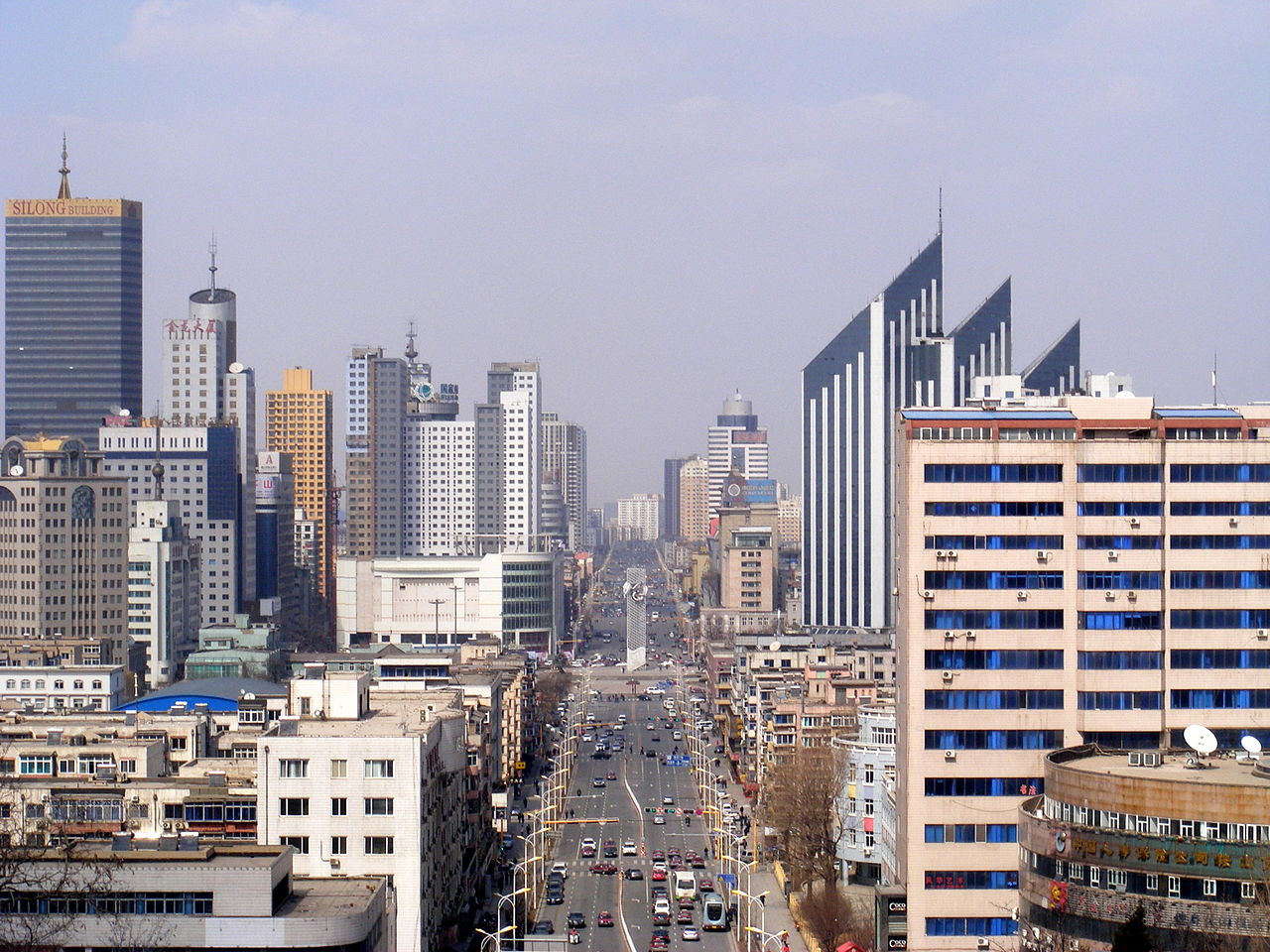
The north east of China is a major industrial zone and Anshan is one of the key sites of the north east. Anshan is in the midst of a at least a quarter of China's iron and coal resources. The city is renowned as "China's capital of iron and steel". Prior to the development of the Iron and Steel industries, Anshan was a relatively small city of little importance. As the steel mills expanded, so to did the city. Spin off industries developed alongside the steel plant making the area a centre of heavy industry.
As a joint Sino-Japanese venture, Anshan Zhenzing Iron Ore Company Unlimited was started in Anshan in 1918. When Japan occupied Northeast China in 1931, these mills were turned into a Japanese owned monopoly. Anshan subsequently became part of the Japanese puppet state of Manchukuo and additional industries developed around the iron and steel mills. Due to its mills, the city became a significant strategic industrial hub during World War II and as such, was subject to constant Allied bombing during the war.
Total production of processed iron in Manchuria reached 1,000,000 tonnes in 1931–32, of which almost half was made by Shōwa Steel in Anshan. Iron production grew to 7,000,000 tonnes in 1938 and by 1941, Shōwa Steel Works had a total capacity production of 1,750,000 tonnes of iron bars and 1,000,000 tonnes of processed steel. By 1942, Anshan's Shōwa Steel Works total production capacity reached 3,600,000 tonnes, making it one of the major iron and steel centers in the world.
In 1945, the steel plant was looted by Soviet forces. The Republic of China government partially repaired the site, but it was destroyed again during the Chinese Civil War that saw the CCP forces victorious. The mills were once again repaired and Anshan Iron and Steel Company (Angang) was founded in 1948. From then to 2001, the company produced 290 million tons of steel, 284 million tons of pig iron and 192 million tons of rolled steel. Until the opening of a new steel plant in Shanghai, Angang was the largest steel producer in China. Today, Angang consists of three steelworks with 13 rolling mills plus supporting plants which produce coke, refractory materials and machinery for the steel plants. The company has an annual production capacity of 10 million tons of pig iron, 10 million tons of steel and 9.5 million tons of rolled steel. A quarter of China's total iron ore reserves, about 10 billion tons, are located in Anshan, ensuring that the city will remain an important steel producer well into the future.
Demographics
Out of the 3,584,000 people living in Anshan prefecture, 519,400 are ethnic Manchu, a holdover from northeast China's historical rule by the ethnic group. They are mainly in or around the Xiuyan Man regional ethnic autonomy area which is within Anshan's borders. During the last years of the Qing dynasty, large numbers of Han people migrated to the north east in search of work. This pattern continued into the 20th century. The development of Anshan as a large industrial center during and after World War II caused the city's population to increase rapidly, and the new arrivals began to significantly outnumber the local Man people. As of the last census data, Anshan was home to 48 Chinese ethnic groups. The Han people make up the lion's share at 3,020,500 people. Next, after the Han and Man people, come the Hui and the Chaoxian with 23,400 and 10,000 people respectively. The Hui population is widely dispersed but the Chaoxian population is mostly concentrated in Teixi (West district) and Qianshan district.
Anshan has a population of 3.65 million at the 2010 census. As the city has expanded, the area between Anshan and the neighbouring city of Liaoyang has become urbanised, with little or no farmland visible on route between them. According to the 2010 census, the conurbation of urban Anshan and urban Liaoyang districts contains 2.17 million inhabitants.
The city of Anshan can be divided into districts. The East district, Tiedong has a population of 452,900. The western district, Tiexi has 311,600 people. These two districts are demarcated by the railway lines that run north to south through the city. The north western portion of the city is dominated by the large steel works of Angang. The district of Lishan houses 425,600 people and the suburbs of Qianshan district have 366,200 soles. Within Anshan prefecture lies the subordinate city of Haicheng which accounts for 1,181,100 people. The neighbouring subordinate town of Tai'an has 354,700 people.
Transportation
Anshan has no river or sea port. The nearby military airport, Anshan Teng'ao Airport (AOG), also accepts commercial domestic flights. Currently there are five routes in operation, Anshan–Beijing, Shanghai, Guangzhou, Chengdu and Nanjing, with one flight each per day throughout the year. Anshan Teng'ao Airport is 15 km (9 mi) southwest of the city centre. In addition to the small terminal building at the airport, there is also a city terminal situated just off Qianshan Road in Tiexi district. Passengers may buy tickets and check-in at the city terminal, from which they are taken by coach to the main airport terminal. The nearest other major commercial airports are Shenyang Taoxian International Airport (SHE), about 90 km (56 mi) to the north and Dalian Zhoushuizi International Airport about 270 km (170 mi) to the south.
The city is beside the Shenyang–Dalian Expressway (part of the G15 Shenyang–Haikou Expressway), a privately funded eight-lane tolled highway, and was the first road of its kind in mainland China. The Liaozhong Ring Expressway (G91) passes just a few kilometers north of Anshan city. It connects east to Benxi and west onto the Jingshen Expressway (G1). The Panhai and Danxi Expressways (together forming the G16) pass through Anshan's counties of Haicheng and Xiuyan, connecting them to Yingkou and Panjin in the west and Dandong to the east.
Anshan is connected to the Chinese rail network with rail routes to Beijing, Dalian, and to the northeastern provinces of Jilin and Heilongjiang as well as to eastern Inner Mongolia, and even a direct, albeit slow, train to Hong Kong. As of December 2012, the new Harbin–Dalian High-Speed Railway serves Anshan West Railway Station and Haicheng West Railway Station. It connects south to Dalian and north east to Shenyang, Changchun and Harbin. This line was hailed as the world's first alpine high-speed rail line. In summer it runs at its full speed of 300 km/h but in winter speeds are restricted to 200 km/h. High-speed services also run via Anshan to Beijing. Tai'an county of Anshan is served by another high-speed rail line linking Shenyang to Beijing.
Tourist attractions

In recent years, Anshan has been trying to throw off its image as a heavy industrial town along with the dirt and pollution that goes with such industry. It has remodeled itself as a tourist destination.
Foremost among the attractions in Anshan is Qianshan National Park which is about 18 km (11 mi), by road, to the southeast of the city. Qianshan, literally 'Thousand Mountains', is an abbreviation of 'Thousand lotus flower mountains'. The peaks were said to resemble the petals of the lotus flower which had been dropped to earth by a goddess. The park area of 44 km2 (17 sq mi), is filled with both Buddhist and Taoist temples, monasteries and nunneries. It is one of few locations where both religions are found sharing the same site. Cars are not allowed within the park.
One of the mountains in the park is believed to resemble Maitreya Buddha. It is claimed to be the largest naturally occurring image of Maitreya in the world. Several temples have been built on the peaks of the overlooking hills. Near the Buddha is a bird park.
Another major tourist location is "219 Park". The name of the park commemorates the liberation of Anshan by the People's Liberation Army on February 19, 1948. The park contains the Dongshan (East Mountain) scenic area as well as numerous lakes.
Of particular note is the Jade Buddha Palace. This large Buddhist temple complex of 22,104 square metres, houses the world's largest statue of Buddha made of Jade (It is called jade in Chinese, but in English it is Serpentine). It is a single piece of jade stone measuring 6.88 metres in width, 4.10 metres front to back and 7.95 metres high. The jade stone weighs 260.76 tons. The front of the stone has been carved with an image of Sakyamuni (aka. Gautama) Buddha. On the back of the stone Guanyin (aka. Avalokitesvara) Buddha has been carved. The jade stone was found in 1960 in Xiuyan County. It was declared a treasure of the State and listed as a protected property by Chinese Premier Zhou Enlai. Anshan city government commissioned the carving which took a team of 120 sculptures 18 months to complete. The temple complex was opened on September 3, 1996. The building that houses the Jade Buddha statue is 33 metres tall, representing the 33 layers of heaven in Buddhism. It claims to be one of the tallest two-story buildings of traditional Chinese architectural style in China.
Education system
The city contains two large universities:
University of Science and Technology Liaoning
Kaynak: Wikipedia – Anshan · CC BY-SA 4.0