

Interested in working with us in the future?
Follow to see new jobs and posts in your feed.
No news yet.

Etymology
The two Chinese characters in the city's name are 上 (Pinyin: shàng; Wugniu: zaon, "upon") and 海 (hǎi; he, "sea"), together meaning "On the Sea". The earliest occurrence of this name is the 11th-century Song dynasty, when there was a river confluence and a town with this name in the area. Others contend that the city is referenced in historical records dating back 2150 years, and that its ancient name, "Hu", suggests it was a fishing village. In 1280 it was renamed "Shanghai", which translates to "Above the Sea". The name's interpretation was disputed, but Chinese historians concluded that during the Tang dynasty, the area of modern-day Shanghai was under sea level, so the land appeared to be "on the sea". The name was also used to refer to Shanghai county (上海县; 上海縣; Shànghǎi Xiàn; zaon-he-yoe), which today has been reorganised into Minhang district.
Shanghai is officially abbreviated 沪 (Traditional: 滬, Hù; wu) in Chinese, a contraction of 沪渎 (滬瀆, Hù Dú; wu-doq, "Fishing Weir Ditch"), a 4th- or 5th-century Jin name for the mouth of Suzhou Creek when it was the main conduit into the ocean. This character appears on motor vehicle license plates issued in the municipality.
Alternative names
申 (Shēn; sén) or 申城 (Shēnchéng; sén-zen, "Shen City") was an early name originating from Lord Chunshen, a 3rd-century BC nobleman and prime minister of the state of Chu, whose fief included modern Shanghai. 华亭 (華亭, Huátíng; gho-din) was another early name for Shanghai. In AD 751, Huating County was established as the first county-level administration within modern-day Shanghai by Zhao Juzhen, the governor of Wu Commandery. governed by master Wu
魔都 (Módū; mo-tú, "monster/fiend/magical city"), is a contemporary nickname for Shanghai. The name was first mentioned in Mato (1924) by Japanese novelist Shōfu Muramatsu. The city has various English nicknames including the "New York of China", in reference to its status as a cosmopolitan megalopolis and financial hub, the "Pearl of the Orient", and the "Paris of the East".
History

Antiquity
The western part of modern-day Shanghai was inhabited 6,000 years ago. During the Spring and Autumn period (approximately 771 to 476 BC), it belonged to the Kingdom of Wu, which was conquered by the Kingdom of Yue, which in turn was conquered by the Kingdom of Chu. During the Warring States period (475 BC), Shanghai was part of the fief of Lord Chunshen of Chu, one of the Four Lords of the Warring States. Local legends claim he ordered the excavation of the Huangpu River, an important river in the area. Its former or poetic name, the Chunshen River, gave Shanghai its nickname of "Shēn". Fishermen living in the Shanghai area then created a fish tool called the hù, which lent its name to the outlet of Suzhou Creek north of the Old City and became a common nickname and abbreviation for the city.
Imperial era
During the Tang and Song dynasties, Qinglong Town (青龙镇; 青龍鎮; Wugniu: chín-lon-tsen) in modern Qingpu District was a major trading port. Established in 746, it developed into what was historically called a "giant town of the Southeast". The port experienced thriving trade with provinces along the Yangtze and the Chinese coast, as well as foreign countries such as Japan and Silla. By the end of the Song dynasty, the centre of trading had moved downstream of the Wusong River to Shanghai. Its status was upgraded from a village to a market town in 1074; in 1172, a second sea wall was built to stabilize the ocean coastline, supplementing an earlier dike. From the Yuan dynasty in 1292 until Shanghai officially became a municipality in 1927, central Shanghai was administered as a county under Songjiang Prefecture, which had its seat in the present-day Songjiang District.
Shanghai's first city wall was built in 1554 to protect the town from raids by Japanese pirates. It was 10 meters (33 ft) high and 5 kilometers (3.1 mi) in circumference. A City God Temple was built in 1602 during the Wanli reign. This honour was usually reserved for prefectural capitals and not normally given to a county seat like Shanghai. Scholars theorized that this reflected the town's economic importance.
Geography

Shanghai is located on the Yangtze Estuary of China's east coast, with the Yangtze River to the north, Hangzhou Bay to the south, and the East China Sea to the east. The land is formed by the Yangtze's natural deposition and modern land reclamation projects. It has sandy soil, and skyscrapers have to be built with deep concrete piles to avoid sinking into the soft ground. The provincial-level Municipality of Shanghai administers the estuary and many of its surrounding islands. It borders the provinces of Zhejiang to the south and Jiangsu to the west and north. The municipality's northernmost point is on Chongming Island, the second-largest island in mainland China after its expansion during the 20th century.
Shanghai is located on an alluvial plain and the vast majority of its 6,340.5-square-kilometre (2,448.1-square-mile) land area is flat, with an average elevation of four metres (13 feet). Tidal flat ecosystems exist around the estuary, but they have been reclaimed for agricultural purposes. The city's few hills, such as She Shan, lie to the southwest; its highest point is the peak of Dajinshan Island (103 metres or 338 feet) in Hangzhou Bay. Shanghai has rivers, canals, streams, and lakes, and it is known for its rich water resources as part of the Lake Tai drainage basin.
Downtown Shanghai is bisected by the Huangpu River, a man-made tributary of the Yangtze created by order of Lord Chunshen during the Warring States period. The historic centre of the city was located on the west bank of the Huangpu (Puxi), near the mouth of Suzhou Creek, connecting it with Lake Tai and the Grand Canal. The central financial district, Lujiazui, was established on the east bank of the Huangpu (Pudong). Along Shanghai's eastern shore, the destruction of local wetlands due to the construction of Pudong International Airport has been partially offset by the protection and expansion of a nearby shoal, Jiuduansha, as a nature preserve.
Cityscape

The Bund, located by the bank of the Huangpu River, is home to a row of early 20th-century architecture, ranging in style from the neoclassical HSBC Building to the Art Deco Sassoon House (now part of the Peace Hotel). The area has been revitalized several times: the first was in 1986, with a new promenade by the Dutch architect Paulus Snoeren. The second was before the 2010 Expo, which includes restoration of the century-old Waibaidu Bridge and reconfiguration of traffic flow.
Much of the city’s development attests to the imperial presence of Western powers, namely Britain, France and the United States.Shanghai's construction boom during the 1920s and 1930s caused the city to have several Art Deco buildings. László Hudec, a Hungarian-Slovak who lived in the city between 1918 and 1947, designed Art Deco buildings such as the Park Hotel, the Grand Cinema, and the Paramount. Other prominent Art Deco-style architects are Clement Palmer and Arthur Turner, who designed the Peace Hotel, the Metropole Hotel, and the Broadway Mansions; and Austrian architect C.H. Gonda, who designed the Capitol Theatre. One common architectural element is the shikumen (石库门; 石庫門; Wugniu: zaq-khu-men, "stone storage door") residence, typically two- or three-story gray brick houses with the front yard protected by a heavy wooden door in a stylistic stone arch. Each residence is connected and arranged in straight alleys known as longtangs (弄堂; lon-daon). Shanghai also has Soviet neoclassical architecture or Stalinist architecture: most were erected between the founding of the People's Republic in 1949 and the Sino-Soviet Split in the late 1960s when Soviet personnel came to China to aid in the development of a communist state. An example of Soviet neoclassical architecture in Shanghai is the Shanghai Exhibition Center.
Politics

Structure
Like all governing institutions in mainland China, Shanghai has a parallel party-government system, in which the CCP Committee Secretary, officially termed the Chinese Communist Party Shanghai Municipal Committee Secretary, outranks the Mayor. The CCP committee acts as the top policy-formulation body, and typically composed of 12 members (including the secretary); it has control over the Shanghai Municipal People's Government.
Political power in Shanghai has been a stepping stone to higher positions in the central government. Since Jiang Zemin became the General Secretary of the Chinese Communist Party in June 1989, several former Shanghai party secretaries and deputy party secretaries were elevated to the Politburo Standing Committee, the de facto highest decision-making body in China. Officials with ties to the Shanghai administration collectively form a powerful faction in the central government known as the Shanghai Clique, which has often been viewed as competing against the rival Youth League Faction over personnel appointments and policy decisions.
Administrative divisions
Shanghai is one of the four municipalities under the direct administration of the Central People's Government, and is divided into 16 districts. These are further divided to 108 subdistricts, 106 towns and 2 townships.
When the Shanghai Municipal People's Government was founded in 1949, the land area governed was 663.5 square kilometres (256.2 sq mi), largely located within the present-day Outer Ring Expressway. In 1958, ten counties were reassigned under Shanghai from Jiangsu. District reorganizations saw several counties in the suburbs become districts between 1988 and 2015, and Chongming was the last county to be retitled as a district in 2015.
Shanghai also administers several enclaves in Jiangsu and Anhui provinces. Local residents hold Shanghai household registration and enjoy benefits identical to Shanghai residents.
Economy

The city is a global centre for finance and innovation, and a national centre for commerce, trade, and transportation, with the world's busiest container port—the Port of Shanghai. As of 2022, the Greater Shanghai metropolitan area, which includes Suzhou, Wuxi, Nantong, Ningbo, Jiaxing, Zhoushan, and Huzhou, was estimated to produce a gross metropolitan product (nominal) of nearly 13 trillion RMB ($1.9 trillion). As of 2020, the economy of Shanghai was estimated to be $1 trillion (PPP), ranking the most productive metro area of China and among the top ten largest metropolitan economies in the world. Shanghai's six largest industries—retail, finance, IT, real estate, machine manufacturing, and automotive manufacturing—comprise about half the city's GDP.
As of 2025, Shanghai had a GDP of CN¥5.67 trillion ($814 billion in nominal; $1.66 trillion in PPP) that makes up 4% of China's GDP, and a GDP per capita of CN¥228,280 (US$32,840 in nominal; US$66,944 in PPP). In 2022, the average annual disposable income of Shanghai's residents was CN¥79,610 (US$11,836) per capita, while the average annual salary of people employed in urban units in Shanghai was CN¥212,476 (US$31,589), making it one of the wealthiest cities in China, but also the most expensive city in mainland China to live in according to a 2023 study by the Economist Intelligence Unit. According to Julius Baer's Global Wealth and Lifestyle Report, Shanghai was the most expensive city in the world for living a luxurious lifestyle in 2021.
In 2023, the city's imports and exports reached CN¥7.73 trillion (US$1.07 trillion), accounting for 18.5% of the national total. In 2022, Shanghai was ranked fifth-highest in the number of billionaires by Forbes. Shanghai's nominal GDP was projected to reach US$1.3 trillion in 2035 (ranking first in China), making it one of the world's top 5 major cities in terms of GRP according to a study by Oxford Economics. As of August 2024, Shanghai ranked 4th in the world and 2nd in Greater China (after Beijing) by the largest number of the Fortune Global 500 companies.
Demographics

As of 2023, Shanghai had a population of 24,874,500, including 14,801,700 (59.5%) hukou holders (registered locally). As of 2022, 89.3% of Shanghai's population lives in urban areas, and 10.7% live in rural areas. Based on the population of its total administrative area, Shanghai is the second largest of the four municipalities of China, behind Chongqing, but is generally considered the largest Chinese city because the urban population of Chongqing is much smaller. According to the OECD, Shanghai's metropolitan area has an estimated population of 34 million.
According to the Shanghai Municipal Statistics Bureau, about 157,900 residents in Shanghai are foreigners, including 28,900 Japanese, 21,900 Americans, and 20,800 Koreans. The actual number of foreign citizens in the city is probably much higher. Shanghai is also a domestic immigration city—40.3% (9.8 million) of the city's residents are from other regions of China.
Shanghai has a life expectancy of 83.18 years for the city's registered population, the highest life expectancy of all cities in mainland China. This has also caused the city to experience population aging—in 2021, 17.4% (4.3 million) of the city's registered population was aged 65 or above. In 2017, the Chinese government implemented population controls for Shanghai, resulting in a population decline of 10,000 people by the end of the year.
Religion
Due to its cosmopolitan history, Shanghai has a blend of religious heritage; religious buildings and institutions are scattered around the city. According to a 2012 survey, 13.1% of the city's population belongs to organised religions, including Buddhists with 10.4%, Protestants with 1.9%, Catholics with 0.7%, and other faiths with 0.1%. The remaining 86.9% of the population could be either atheists or involved in worship of nature deities and ancestors or folk religious sects.
Education and research

Shanghai is an international centre of research and development and as of 2025, it was ranked second globally (after Beijing) by scientific research outputs, as tracked by the Nature Index. When compared to other countries, Shanghai ranked higher than France and nearly on par with Japan, securing sixth place globally after China, the US, Germany, the United Kingdom, and Japan, according to the Nature Index for 2025. For instance, Shanghai's share of the 2024 Nature Index is 3,153.61, with a count of 6,680, while Japan's share is 3,185.39, with 5,555 counts.
As of 2023, Shanghai had 68 universities and colleges, ranking first in East China region as a city with most higher education institutions. The city government's education agency is the Shanghai Municipal Education Commission.
Shanghai has 15 universities listed in 147 Double First-Class Universities, ranking second nationwide among Chinese cities (after Beijing). According to the U.S. News & World Report Best Global University Ranking for 2026–27, Shanghai had the second highest concentration of universities among all major cities in the world (after Beijing) included in the ranking, totaling 24, with two in the top 50, four in the top 250, and six in the global top 500. In the 2025 Academic Ranking of World Universities, Shanghai had two in the top 40, three in the top 150 and nine in the top 500. Some of these universities were selected as "985 universities" or "211 universities" since the 90s by the Chinese government to build world-class universities.
Shanghai has two members (Fudan University and Shanghai Jiao Tong University) in the C9 League, an alliance of elite Chinese universities offering comprehensive and leading education. These two universities are consistently ranked in the Asia top 10 and global top 50. As of 2025, Fudan University and Shanghai Jiao Tong University were ranked in the global top 35 research comprehensive universities based on aggregate performance from three widely observed university rankings (THE+ARWU+QS).
Transport

Public
Shanghai has a public transportation system comprising metros, buses, ferries, and taxis, which can be accessed using a Shanghai Public Transport Card.
Shanghai's rapid transit system, the Shanghai Metro, incorporates subway and light metro lines and extends to each core urban district as well as neighboring suburban districts. As of 2025, there are 19 metro lines (excluding the Shanghai maglev train and Jinshan railway), 508 stations, and 808 kilometres (502 mi) of lines in operation, making it the longest network in the world. On 8 March 2019, it set the city's daily metro ridership record with 13.3 million. Opened in 2004, the Shanghai maglev train is the first and the fastest commercial high-speed maglev in the world, with a maximum operation speed of 430 kilometres per hour (270 mph).
The first tram line in Shanghai was opened in 1908. By 1925, there were 328 tramcars and 14 routes operated by Chinese, French, and British companies collaboratively, all of which were nationalized in 1949. Since the 1960s, tram lines were either dismantled or replaced by trolleybus or motorbus lines; the last tram line was demolished in 1975. Shanghai reintroduced trams in 2010 with the rubber-tyred Zhangjiang Tram. In 2018, the steel wheeled Songjiang Tram started operating in Songjiang District.
Shanghai has the world's most extensive bus network, including the world's oldest continuously operating trolleybus system, with 1,575 lines covering a total length of 8,997 kilometres (5,590 mi) by 2019. The system is operated by multiple companies. As of 2024, 30,900 taxis were in operation in Shanghai, which carried 134 million passengers that year.
Roads and expressways
Shanghai is a major hub of China's expressway network. Many national expressways pass through or end in Shanghai, including Jinghu Expressway, Hurong Expressway, Shenhai Expressway, Hushaan Expressway, Huyu Expressway, Hukun Expressway, and Shanghai Ring Expressway. There are also numerous municipal expressways prefixed with the letter S. As of 2019, Shanghai has 12 bridges and 14 tunnels crossing the Huangpu River.
Culture

The culture of Shanghai was formed by a combination of the Wuyue culture and the "East Meets West" Haipai culture. Wuyue culture's influence is manifested in Shanghainese language—which comprises dialectal elements from Jiaxing, Suzhou, and Ningbo—and Shanghai cuisine, which was influenced by those of Jiangsu and Zhejiang. Haipai culture emerged after Shanghai became a prosperous port in the early 20th century, with foreigners from Europe, America, Japan, and India moving into the city. The culture fuses elements of Western cultures with the local Wuyue culture, and its influence extends to the city's literature, fashion, architecture, music, and cuisine. The term Haipai was coined by Beijing writers in 1920 to criticize Shanghai scholars for admiring capitalism and Western culture. In the early 21st century, Shanghai has been recognized as a new influence and inspiration for cyberpunk culture. The city is recognized by UNESCO as a "City of Design" since February 2010.
Museums
Cultural curation in Shanghai has grown since 2013, with several new museums having been opened in the city. This is in part due to the city's 2018 development plans, which aim to make Shanghai "an excellent global city". The Shanghai Museum has one of the largest collections of Chinese artifacts in the world, including a large collection of ancient Chinese bronzes and ceramics. The China Art Museum is one of the largest museums in Asia and displays an animated replica of the 12th century painting Along the River During the Qingming Festival. The Shanghai Natural History Museum and the Shanghai Science and Technology Museum are natural history and science museums. There are numerous smaller, specialist museums housed in archeological and historical sites, such as the Songze Museum, the Site of the First National Congress of the Chinese Communist Party, the site of the former Provisional Government of the Republic of Korea, the Shanghai Jewish Refugees Museum, and the Shanghai Post Office Museum (located in the General Post Office Building).
Sports

Shanghai has several football teams, including two in the Chinese Super League: Shanghai Shenhua and Shanghai Port. Shanghai's top-tier basketball team, the Shanghai Sharks of the Chinese Basketball Association, developed Yao Ming before he entered the NBA. Shanghai's baseball team, the Shanghai Golden Eagles, plays in the China Baseball League. Professional athletes from Shanghai include 110 metres hurdles runner Liu Xiang, table tennis player Wang Liqin, and badminton player Wang Yihan.
The Shanghai Cricket Club dates back to 1858, when the first recorded cricket match was played between a team of British Naval officers and a Shanghai 11. The Shanghai cricket team played various international matches between 1866 and 1948 as China's de facto China national cricket team. After going dormant in 1949 after the founding of the PRC, the club was re-established in 1994 by expatriates living in the city and has since grown to over 300 members.
Shanghai hosts several international sports events. Since 2004, it has hosted the Chinese Grand Prix, a round of the Formula One World Championship, at the Shanghai International Circuit. The city also hosts the Shanghai Masters tennis tournament, which is part of ATP World Tour Masters 1000, as well as golf tournaments including the BMW Masters and WGC-HSBC Champions. In 2023, Shanghai hosted 118 sports events, with 190,000 participants and 1.29 million spectators, driving a consumption of CN¥3.713 billion (US$510.83 million).
Environment

Parks and resorts
Shanghai has an extensive public park system; by 2022, the city had 670 parks, of which 281 had free admission, and the per capita park area was 9 square metres (97 sq ft). The largest park in Shanghai is Century Park in Pudong.
The People's Square park, located in the heart of downtown Shanghai, is known for its proximity to other major landmarks in the city. Fuxing Park, located in the former French Concession, features formal French-style gardens and is surrounded by high-end bars and cafes. Lu Xun Park in Hongkou is named after writer Lu Xun, whose tomb is located within the park. Zhongshan Park, in western central Shanghai, contains a monument of Chopin, the tallest statue dedicated to the composer in the world. The park features sakura and peony gardens and a 150-year-old platanus.
Shanghai Botanical Garden is located 12 kilometres (7.5 mi) southwest of the city centre and established in 1978. In 2011, the largest botanical garden in Shanghai—Shanghai Chen Shan Botanical Garden—opened in Songjiang District. The Shanghai Disney Resort opened in 2016, featuring a castle that is the biggest among Disney's resorts.
Air pollution
Air pollution in Shanghai is not as severe as in many other Chinese cities, but is still considered substantial by world standards. During the 2013 Eastern China smog, air pollution rates reached between 23 and 31 times the international standard. On 6 December 2013, levels of PM2.5 particulate matter in Shanghai rose above 600 micrograms per cubic meter and in the surrounding area, above 700 micrograms per cubic meter. Levels of PM2.5 in Putuo District reached 726 micrograms per cubic meter. The following month, Yang Xiong, the mayor of Shanghai, announced three measures to manage the air pollution in Shanghai: implementing the 2013 air-cleaning program, establishing a linkage mechanism with the three surrounding provinces, and improving the city's early-warning systems. That year, China's cabinet announced that a CN¥10 billion (US$1.7 billion) fund will be set up to help companies meet the new environmental standards. From 2013 to 2018, more than 3,000 treatment facilities for industrial waste gases were installed, and the city's annual smoke, nitrogen oxide, and sulfur dioxide emissions decreased by 65%, 54%, and 95%, respectively.
Media

Media in Shanghai covers newspapers, publishers, broadcast, television, and the Internet, with some media having influence over the country. Concerning foreign publications in Shanghai, Hartmut Walravens of the IFLA Newspapers Section said that when the Japanese controlled Shanghai in the 1940s "it was very difficult to publish good papers – one either had to concentrate on emigration problems, or cooperate like the Chronicle."
As of March 2020, newspapers publishing in Shanghai include:
Newspapers formerly published in Shanghai include:
The city's main broadcaster is Shanghai Media Group.
International relations

The city is the seat of the New Development Bank, a multilateral development bank established by the BRICS states.
Twin towns – sister cities
Shanghai is twinned with 68 cities from the following 57 countries:
Consulates and consulates general
As of September 2020, Shanghai hosts 71 consulates general and 5 consulates, excluding Hong Kong and Macao trade offices.
Places of interest
In 2017, the number of domestic tourists to the city increased by 7.5% to 318 million, while the number of overseas tourists increased by 2.2% to 8.73 million. In 2017, Shanghai was the highest earning tourist city in the world. According to the International Congress and Convention Association, Shanghai hosted 82 international meetings in 2018, a 34% increase from 61 in 2017. As of 2023, it had 57 five-star hotels, 52 four star hotels, 1,942 travel agencies, 144 rated tourist attractions, and 34 red tourist attractions. In 2023, Shanghai had 3.64 million tourists, a 4.8-fold growth compared to 2022. It generated CN¥177.12 billion (US$24.53 billion) in value, a 98.5% increase from the previous year. The number of foreign tourists reached 2.41 million, with a 5.2-fold increase.
Kaynak: Wikipedia – Shanghai · CC BY-SA 4.0
İsim
Çincede "Şanghay" ismi 上 (shàng/zan; "üstünde") ile 海 (hǎi/hae; "deniz") karakterlerinden oluşur. Bu iki karakter bir arada "denizin üstünde" anlamını oluşturur.
Şanghay'nın ismi Çincede resmî olarak "沪" (Hù/Vu2) şeklinde kısaltılır. Bu, Jin Hanedanı (4-5. yüzyıl) döneminde Suzhou Deresi ağzının denize doğru gitmek için kullanılan ana yol olduğu zamanlarda bu dere ağzına verilen "沪渎" (Hù Dú/Vu Doh, "Zıpkın Hendeği") isminin kaynaşık halidir. Bu kısaltma, günümüzde Şanghay Belediyesi'ne kayıtlı olan tüm motorlu araçlara dağıtılan araba plakalarında çıkar.
申 (Shēn) ya da 申城 (Shēnchéng, "Shen Şehri"), M.Ö. 3. yüzyılda günümüz Şanghay'ın yurtluk olarak dahil olduğu Chu devletinin bir asilzadesi ve devlet başkanı olan Chunshen Jun (春申君)'den kaynaklanan ve o dönemde Şanghay için kullanılan bir isimdir. Şanghay merkezli spor takımları ve gazeteler bunu kendi isimlerinde kullanırlar, ör. Şanghay Şenhua ZÇ ve Shen Bao.
İngilizcede Şanghay'a çeşitli takma isimleri verilmiştir, ör. "Pearl of the Orient" (Doğu'nun İncisi) ve "Paris of the East" (Doğu'nun Paris'i).
Tarih

Antik tarih
Günümüz Şanghay'ın batı kısmında 6000 yıl öncesine kadar insanların yaşadığı bilinmektedir. İlkbahar ve Sonbahar Dönemi (yaklaşık M.Ö. 771 ila 476) boyunca Wu Krallığı'na aitti; bu sonra Yue Krallığı tarafından fethedildi, Yue de sonradan Chu Krallığı tarafından fethedildi. Savaşan Devletler Çağı (M.Ö. 475) sırasında Şanghay, Savaşan Devletlerin Dört Efendisi'nin biri olan Chu Devleti asilzadesi Chunshen Jun'un yurtluğuna aitti. O, Huangpu Irmağı'nın kazısını emretti. Irmağa o dönemde verilen "Chunshen Irmağı" ismi, Şanghay'ın "Shēn" ismiyle bilinmesine yol verdi. Sonra, Şanghay civarlarında yaşayan balıkçılar "hù" adında bir balıkçılık aracı yarattı; bu isim, Eski Şehir'in kuzeyindeki Suzhou Deresi'nin çıkışından kaynaklanır ve şehrin tümü için yaygın bir takma ismi ve kısaltma haline geldi.
İmparatorluk tarihi
Tang ile Song hanedanlıkları boyunca, günümüz Qingpu semtindeki Qinglong Kasabası (青龙镇) büyük bir ticaret limanıydı. 746 yılında kurulan bu kasabada 13 tane tapınak ve 7 tane pagoda vardı; "Güneydoğu'daki büyük kasaba" olarak bilinirdi. Song Hanedanı alimi ve sanatçısı Mi Fu, kasabanın başkanı olarak görev yaptı. Liman, Yangtze ve Çin sahillerindeki eyaletlerin yanı sıra Japonya ve Silla gibi yabancı ülkelerle gelişen ticaret yaşadı.
Song Hanedanı'nın sonunda, bölgedeki ticaretin merkezi Wusong Nehri'nin akış aşağısından Şanghay'a geçmişti. Eskiden sadece bir köy olan Şanghay'ın statüsü 1074 yılında pazar kasabası seviyesine yüksetildi. Deniz kıyısını dengede tutmak için Şanghay'ın önceden var olan bir hendeğe ek olarak 1172 yılında ikinci bir deniz duvarı dikildi. 1292 yılı Yuan Hanedanı döneminden ta 1927'de Şanghay'ın resmen belediye olarak tanınmasına kadar Şanghay'ın merkezi, merkezi günümüz Songjiang Semti'nde bulunan Songjiang Prefektörlüğü'nün bir kontluğu olarak idare edilirdi.
Şehir manzarası
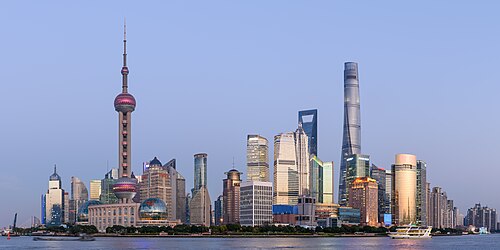
Şehir mimarisi
Şangay, çeşitli mimari tarzlardan oluşan zengin bir bina ve yapı koleksiyonuna sahiptir. Huangpu Irmağı kıyısında yer alan Bund, neoklasik tarzındaki HSBC Binası ve Art Deco tarzındaki Sassoon Evi (günümüz Peace Hotel'e ait) gibi erken 20. yüzyıl mimarisinin birçok farklı örneğine ev sahipliği yapmaktadır. Başta eski Fransız İmtiyaz Bölgesi olmak üzere eski yabancı imtiyaz bölgelerindeki birçok alan da iyi korunmuştur. Şanghay aynı zamanda birçok mimari açıdan farklı ve hatta eksantrik binaya da ev sahipliği yapıyor, ör. Şanghay Müzesi, Büyük Şanghay Tiyatrosu, Oriental Art Center ve Doğu'nun İncisi Kulesi. Şanghay Eski Şehri büyük oranda kentsel dönüşümün etkilerine maruz kalmış olsa da, geleneksel mimari ve tasarımın bazı unsurlarını yine muhafaza edebilmiştir, ör. özenle biçimlenmiş Jiangnan tarzındaki Yu Bahçesi.
Şanghay, şehrin 1920'ler ve 30'lardaki inşaat patlamasının sonucu olarak Dünya'daki en fazla Art Deco binasını barındarın şehirlerin arasındadır. Şanghay'da çalışmış en ünlü mimarlardan biri, 1918 ile 1947 yılları arasında şehirde yaşamış Slovakya Macarı László Hudec'tir. Şanghay Park Hotel, Grand Cinema ve Paramount binaları, Hudec'in en kayda değer Art Deco binalarıdır. Şehrin Art Deco tarzında katkıda bulunmuş diğer mimarlar, birlikte Peace Hotel, Metropole Hotel ve Broadway Mansions binalarını tasarlamış Clement Parker ile Arthur Turner, ve Capitol Theater'ı tasarlamış Avusturyalı mimar GH Gonda. Bund'da birkaç kez restorasyon çalışmaları yer almıştır: ilk olarak 1986 yılında, Hollandalı mimar Paulus Snoeren yeni bir kordon boyunu tasarladı; ayrıca Expo 2010'un öncesinde, yüz yıllık geçmişi olan Waibaidu Köprüsü restore edildi ve trafık akışı yeniden yapılandırıldı.
Şanghay'a özgü bir kültürel unsur shikumen (石库门, "taş ambar kapısı") konutları, yani ön avlusu özel bir tarzla biçimlenmiş bir taş kemerin altında konulmuş bir tahta kapıyla kaplanmış iki ya da üç katlı gri tuğla evleridir. Her konut, longtang (弄堂) olarak bilinen düz bir geçide bağlıdır. Bu tür evler, Batı tarzı sıra evlere benzer, ancak her evin önünde dikili yüksek ve ağır tuğla duvar ve kemerlerle farklılık gösterirler. Shikumen, Batı mimarisine ait unsurların geleneksel Çin Jiangnan mimarisi ve toplumsal davranışlarıyla bir karışımıdır. Neredeyse tüm geleneksel Çin konutlarında olduğu gibi, dışarıdan gelen gürültüyü azaltan bir avlusu vardır. Avluda bitki yetiştirilebilir; bu avlular ayrıca odalara güneş ışığının ulaşmasını ve odaların havalanmasını sağlar.
Politika

İdari yapılanma
Şanghay, Çin Halk Cumhuriyeti Hükûmeti'nin doğrudan yönetimi altındaki dört belediyeden biri olup, 16 tane farklı ilçe düzeyi semte bölünür.
Ekonomi

Şanghay, Çin'in patlayan ekonomisinin pek büyük başarıların elde edindiği bir yerdir. Finans ve inovasyonun küresel bir merkezi ve iş, ticaret ve ulaşımın ulusal bir merkezidir. Şanghay Limanı, Dünya'nın en işlek konteyner limanıdır. 2018 yılı itibarıyla Şanghay'nın 3,27 trilyon RMB (494 bilyon ABD$)'lik GSYİH'sı var; bu, Çin GSYİH'sının %3,63'ünü oluşturur. Şanghay'daki kişi başına GSYİH ise 135.212 RMB (20.245 ABD$). Şanghay'nın en büyük altı endüstrisi – yani perakendecilik, finans, bilgi teknolojisi, gayrimenkul, makine imalatı ve otomotiv imalatı – şehir GSYİH'sının yaklaşık yarısını oluşturur. 2018 yılı itibarıyla Şanghay sakinlerinin kişi başına ortalama harcanabilir geliri 64.183 RMB (9.695 ABD$); böylece Şanghay, Çin'in en zengin şehirlerinden biridir. Bununla birlikte, Economist Intelligence Unit'in yürüttüğü çalışmaya göre Şanghay, yaşam açısından Çin anakarasının en pahalı şehridir.
İmalat
Çin'in ana sanayi merkezlerinden biri olan Şanghay, yerli imalatta ve ağır sanayide anahtar rol oynar. Şanghay Hongqiao Ekonomik ve Teknolojik Kalkınma Bölgesi, Jinqiao İhracat Ekonomik İşleme Bölgesi, Minhang Ekonomik ve Teknolojik Kalkınma Bölgesi ve Şanghay Caohejing Yüksek Teknoloji Geliştirme Bölgesi dahil olmak üzere çeşitli sanayi bölgeleri, Şanghay'ın ikincil sektör belkemiğidir. Şanghay Çin'in en büyük çelik üreticisi Baosteel Group, Çin'in en büyük gemi yapımı üssü Hudong-Zhonghua Shipbuilding Group ve Çin'in en eski gemi yapımcılarından biri olan Jiangnan Tersanesi'ne ev sahipliği yapar. Otomobil imalatı başka bir önemli sektördür. Şanghay merkezli SAIC Motor, Çin'deki en büyük üç otomotiv şirketinden biridir ve Volkswagen ve General Motors ile stratejik ortaklıkları vardır.
Demografi
2018 yılı itibarıyla Şanghay'nın toplam 24.237.800 kişilik nüfusu var; bunların %59,7'si (14.551.300 insan) yerel hukou sahibi, yani oturumu Şanghay'a kayıtlı olan Çin vatandaşlarıdır. 2010 yılı millî nüfus sayımına göre, Şanghay nüfusunun %89,3'ü kentsel alanlarda, %10,7'si ise kırsal alanlarda yaşamaktadır. Toplam idari alanının nüfusu açısından Şanghay, Çin'deki doğrudan yönetilen şehirlerin arasında Çongçing'den sonra en büyük ikinci belediyedir, ancak Çongçing'de kentsel alanlarda yaşayan nüfusun çok daha az olmasından ötürü Şanghay yine genel olarak Çin'in en büyük şehri olarak sayılır. OECD verilerine göre, Şanghay'ın Metropoliten alanı tahminen 34 milyon kişi barındırmaktadır.
Şanghay Belediye İstastistik Bürosu'na göre, Şanghay'da yaklaşık 157.900 yabancı uyruklu sakin var; bunların arasındaki en büyük grupları Japonlar (28.900 kişi), Amerikalıler (21.900 kişi) ve Koreliler (20.800 kişi) teşkil eder. Diğer kaynaklarca bu yabancı nüfusun sayısı çok daha yüksek olduğu tahmin edilmektedir. Şanghay ayrıca yurt içinde göç eden vatandaşların en büyük varış noktalarından biridir: Şanghay sakinlerinin %40,3'ü (9,8 milyon insan), Çin'in diğer bölgelerinden gelmiş insanlardır.
Şanghay'daki kayıtlı sakin nüfusu arasındaki beklenen yaşam süresi 83,6 yıl olup, Çin anakarasındaki tüm şehirlerin arasındaki en yüksek beklenen yaşam süresidir. Bu ancak nüfusun yaşlanmasına da yol vermiştir: 2017'de şehirdeki kayıtlı nüfusun %33,1'i (4,8 milyon kişi) 60 yaş ve üzerindeydi. 2017'de Çin Hükûmeti, Şanghay'a nüfus kontrolleri uyguladı; bu, yıl sonuna kadar nüfusun 10.000 kişi azalmasına neden oldu.
Dil
Yerel Şanghay halkı arasında konuşulan dil, Wu Çincesinin Taihu Wu alt grubunun bir lehçesi olan Şanghaycadır. Bu, Wu Çincesi ile karşılıklı olarak anlaşılmayan resmî millî lehçe Putonghuadan farklıdır. Çağdaş Şanghayca, başta Suzhou lehçesi, Ningbo lehçesi ve Songjiang Prefektörlüğü'nün yerel lehçesi olmak üzere Taihu Wunun diğer lehçelerine dayalı olarak gelişmiştir.
Eğitim

Şanghay, Çin'de yüksekeğitimin önemli bir merkezidir. 2018 yılı sonu itibarıyla Şanghay'da 64 tane yükseköğretim kuruluşu, 913 tane ortaokul ve lise, 721 tane ilkokul ve 30 tane özel okul var. Çin'in en prestijli üniversitelerin birkaç tanesi Şanghay'da bulunur; ör. Fudan Üniversitesi, Şanghay Jiao Tong Üniversitesi, Tongji Üniversitesi ve Doğu Çin Normal Üniversitesi. Bu üniversiteler hepsi Çin Hükûmeti'nin birinci sınıf, küresel üniversiteler inşa etmek amacıyla kurduğu "985 Nolu Proje" (985工程 Jiǔbāwǔ gōngchéng) üyeleridir. 2002 yılında Fudan Üniversitesi, Washington Üniversitesi (St. Louis) ile beraber bir ortak EMBA programı kurdu; bu, sürekli olarak Dünya'nın en iyi EMBA programlarından biri olarak seçilmiştir. Şehir hükûmetine ait eğitim ajansı Şanghay Belediye Eğitim Komisyonu'dur.
Şanghay'da zorunlu eğitimin ilk dokuz senesi, yani beş sene ilköğretim ve dört sene ortaeğitim, ücretsizdir, okullardaki gayri safi kayıt oranı da %99,9'dur. Şehrin zorunlu eğitim sistemi, Dünya'daki en iyi sistemlerden biridir: 2009 ve 2012 yıllarında, 15 yaşındaki Şanghaylı öğrenciler, OECD'nin küresel olarak akademik performans konusunda yürüttüğü Uluslararası Öğrenci Değerlendirme Programı (PISA) çalışması kapsamında gözlemlenen tüm ders konuları (matematik, okuma ve fen)ndaki ilk sırayı kazandı. Ortaokulun hemen sonrasındaki üç senelik lise eğitimi ücretlidir; öğrencilerin seçim sürecinde Lise Giriş Sınavı kullanılır ve liselere %98 oranında gayri safi kayıt oranı vardır. Tüm liselerin arasında, öğretim kalitesi en iyi olan dört okul, toplu olarak Şanghay'ın "Dört Okul" ("四校")'u unvanıyla bilinir; bu okullar Şanghay Lisesi, Doğu Çin Normal Üniversitesine Bağlı 2 Nolu Lise, Fudan Üniversitesine Bağlı Lise ve Şanghay Jiao Tong Üniversitesine Bağlı Lise'dir. Ekim 2019 itibarıyla, şehirdeki gaokao sınavları "3+3 sistemi" olarak bilinen bir sisteme göre düzenlenir; bunun kapsamında tüm genel lise öğrencileri üç tane zorunlu ders (Çince, İngilizce ve matematik) ve altı farklı seçenek (fizik, kimya, biyoloji, tarih, coğrafya ve siyaset)ten üç tane seçmeli ders görürler.
Ulaşım

Şanghay'da metro, otobüs, feribot ve taksiden oluşan geniş çaplı bir kamu ulaşım sistemi mevcuttur. Tüm bu hizmetler Şanghay Kamu Ulaşım Kartı (交通一卡通, Jiāotōng yī kǎtōng) kullanarak erişilebilir.
Şanghay'da iki tane sivil havalimanı mevcuttur: Şanghay–Hongqiao ile Şanghay–Pudong uluslararası havalimanları. Pudong Havalimanı, Asya'nın en işlek havalimanlarından biridir ve burada iç ve bölgesel hatlara ek olarak çok sayıda kıtalararası uçuş hattı da mevcuttur. Şanghay Maglev Treni, Pudong Havalimanı ile Şanghay metrosunun bir durağı olan Longyang Lu arasında yüksek hızlı tren hizmeti sunup, havalimanı ile şehir merkezi arasındaki ulaşım süresini büyük oranda azaltır. Hongqiao Havalimanı'ndan da çok sayıda yerel ve kısa mesafeli uluslararası varış noktasına hizmet sunulmaktadır, bu havalimanı da metro ve demiryolu ile ulaşılabilir.
Kültür

Şanghay kültürü, Şanghay'ın etrafındaki bölgelere ait Wuyue kültürü (吴越文化) ve "Doğu Batı ile buluşuyor" ruhunu taşıyan Haipai (海派) kültürünün birleşimidir. Wuyue kültürünün Şanghay kültürü üzerinde birçok farklı etkisi olmuştur: Şanghay yerlileri arasında konuşulan Şanghayca dili, Şanghay'a yakın Jiaxing, Suzhou ve Ningbo lehçelerinin etkisi altında gelişti; Şanghay mutfağı da Jiangsu ve Zhejiang mutfaklarından etkilenmiştir. 20. yüzyılın başlarında Şanghay, müreffeh bir liman kenti olduktan sonra, Avrupa, Amerika, Japonya ve Hindistan'dan çok sayıda yabancının şehre taşınmasıyla Haipai kültürü ortaya çıktı. Haipai kültürü, Batı kültürlerine ait unsurları yerel Wuyue kültürüyle birleştirir, bu kültürün etkisi de şehrin edebiyatı, modası, mimarisi, müziği ve yeme ve içme alışkanlıklarına kadar uzanır. Özgün olarak Şanghay'daki bir resim okuluna atfen kullanılan "Haipai" terimi, 1920'de kapitalizm ve Batı kültürünü takdir eden bazı Şanghaylı alimleri eleştirmek için bir grup Pekinli yazar tarafından türetildi. Şanghay, son seneler içerisinde siberpunk kültürünün yeni bir etkisi ve ilham kaynağı olarak tanınmıştır. Doğu'nun İncisi Kulesi gibi fütüristik binalar ve neon ışıklı Yükseltilmiş Yan'an Yolu (延安高架路), Şanghay'ın bu siberpunk imajını arttırmış örneklerin arasındadır.
2013 yılından beri Şanghay'da birçok yeni müzenin halka açılmasıyla kültür küratörlüğünde büyük bir patlama yer almıştır. Bu kısmen şehri bir "mükemmel küresel şehir"e dönüştürme amacını taşıyan en son şehir geliştirme planlarından dolayıdır. Bu nedenle Şanghay, hem bölgesel hem de ulusal önem taşıyan çok sayıda müze barındırmaktadır. Şanghay Müzesi, antik Çin bronzlarının geniş bir koleksiyonu dahil olmak üzere Dünya'daki tarihi Çin eserlerinden oluşan en iyi koleksiyonlardan birine sahiptir. Expo 2010 Dünya Fuarı'ndaki eski Çin Pavyonu'nda bulunan Çin Sanat Müzesi, Asya'daki en büyük sanat müzesidir. Şanghay Çağdaş Sanat Müzesi, Londra Tate Modern müzesine benzer şekilde galeriye dönüştürülmüş eski bir elektrik santralinde kurulmuştur. Şanghay Doğa Tarihi Müzesi ile Şanghay Bilim ve Teknoloji Müzesi, Çin'in önemli doğa tarihi ve bilim müzelerinin arasındadır. Buna ek olarak, önemli arkeolojik ve tarihi yerlerde ev sahipliği yapılan küçük ve daha spesifik alanlarla ilgili birçok çeşitli müze mevcuttur; ör. Songze Müzesi, Çin Komünist Partisi Birinci Ulusal Kongresi Müzesi, Kore Cumhuriyeti Geçici Hükümeti Sitesi, eski Ohel Moşe Sinagogu (günümüz Şanghay Yahudi Mülteciler Müzesi) ve Genel Postane Binası (Şanghay Posta Müzesi). Bu örneklerin haricinde çok sayıda diğer sanat galerisi vardır; Bund yakınlarında Rockbund Sanat Müzesi ve MOCA Shanghai, diğer sanat galeri örnekleridir; üstelik M50 Yaratıcı Parkı ve Tianzifang'da halka açık yüzlerce sanat galerisi ve atölye vardır. Şanghay ayrıca Çin'in en büyük akvaryumlarından biri olan Şanghay Okyanus Akvaryumu'na ev sahipliği yapmaktadır.
Spor
Şanghay'da birçok farklı stadyum vardır; ör. Hongkou Stadyumu, Şanghay Stadyumu ve Yuanshen Spor Merkezi Stadyumu. Şanghay'da Çin Süper Ligi'nde oynayan iki futbol takımı var: Şanghay Lüdi Şenhua ZÇ ve Shanghai SIPG FC. Her sene erkekler tenisinde yılın en iyi 8 ismi Şanghay Masters turnuvasına katılmaktadır. Snooker âleminde ise 2007 yılından beri her sene Şanghay Ustalar turnuvası düzenlenmektedir; ayrıca "Çin Açık" snooker turnuvası 1999 ve 2002 yıllarında Şanghay'da yer aldı. Motor sporlarına gelince, Çin Grand Prix, 2004'ten beri Formula 1'in bir yarışı olarak Şanghay Uluslararası Pisti'nde yer almaktadır.
Uluslararası ilişkiler
Şanghay, Dünya'nın önemli ekonomik ve ticari merkezlerinden biri olup, birçok yabancı ülkenin diplomatik temsilciliğine ev sahipliği yapmaktadır. Bunun dışında Şanghay şehri, çeşitli Avrasya ülkelerinin siyaset, ekonomi ve güvenlik dallarında işbirliğine girdiği Şanghay İşbirliği Örgütü'nun kuruluşuyla uluslararası siyasete kendi damgasını vurmuş oldu.
Şanghay, aşağıdaki bölgeler, şehirler ve kontluklarla kardeş şehir anlaşmasına girmiştir.
Çekya başkenti Prag, 2017 yılında Şanghay ile kardeş şehir anlaşmasına girdi. Prag Şehir Konseyi, Ocak 2020'de Tayvan başkenti Taipei ile de bir kardeş şehir anlaşmasını imzaladı. Çin Hükûmeti, bunun Tek Çin politikasına aykırı olduğu ve Çin'in toprak bütünlüğüne ihlâl ettiği kanaatinde olduğu için Şanghay, buna karşılık olarak Prag ile olan kardeş şehir ilişkisini sonlandırmaya karar verdi.
Kaynak: Wikipedia – Şanghay · CC BY-SA 4.0