

Anderson
Anderson es una ciudad en la sede del Condado de Madison, Indiana, Estados Unidos.
Government administration · United States · 0 followers
Overview
Anderson es una ciudad en la sede del Condado de Madison, Indiana, Estados Unidos. Su área metropolitana abarca todo el condado de Madison. Anderson es la sede de la Iglesia de Dios (Anderson) y de la Universidad de Anderson, que está afiliada a esa denominación. Algunos sitios de interés son el Teatro Paramount y la Casa Gruenewald. La población era 59 734 en el censo de 2000. Se encuentra a orillas del río Blanco, que hace parte de la cuenca del Misisipi.
Interested in working with us in the future?
Follow to see new jobs and posts in your feed.
No news yet.
About

Anderson es una ciudad en la sede del Condado de Madison, Indiana, Estados Unidos. Su área metropolitana abarca todo el condado de Madison. Anderson es la sede de la Iglesia de Dios (Anderson) y de la Universidad de Anderson, que está afiliada a esa denominación. Algunos sitios de interés son el Teatro Paramount y la Casa Gruenewald. La población era 59 734 en el censo de 2000. Se encuentra a orillas del río Blanco, que hace parte de la cuenca del Misisipi.
Kaynak: Wikipedia · CC BY-SA 4.0
Historia

Antes de la organización del condado de Madison, William Conner ingresó al terreno en el que se encuentra Anderson. Más tarde, Conner vendió el terreno a John y Sarah Berry, quienes donaron 13 ha de su terreno al condado de Madison con la condición de que la sede del condado se trasladara de Pendleton a Anderson. John Berry presentó el primer plano de Anderson el 7 de noviembre de 1827. En 1828, la sede de la justicia se trasladó de Pendleton a Anderson.
La ciudad lleva el nombre del jefe William "Adam" Anderson, cuya madre era una india lenape de Delaware y cuyo padre era de ascendencia sueca. El nombre del jefe Anderson en Lenape era Kikthawenund, que significa "ramas crujientes". La aldea de Delaware era conocida como la ciudad de Anderson, aunque los misioneros moravos la llamaban "La ciudad pagana a cuatro millas de distancia". Anderson también era conocido como Andersonton antes de ser organizado formalmente como Anderson.
La introducción de mejoras internas por la Mammoth Internal Improvement Act provocó un crecimiento de la población en 1837. En diciembre de 1838, Anderson se incorporó como una ciudad con 350 habitantes. Se planeó que el Indian Central Canal, una rama del Canal Wabash y Erie, pasara por Anderson. El trabajo continuó en el canal durante 1838 y principios de 1839, pero el estado pronto suspendió los trabajos en el canal después del Pánico de 1837. La ciudad se convirtió nuevamente en una aldea adormecida hasta 1849 cuando se incorporó por segunda vez como ciudad. Muchas nuevas empresas comerciales ubicadas alrededor de Courthouse Square.
Esta incorporación duró poco y Anderson volvió una vez más al estado de aldea en 1852. Sin embargo, con la finalización del ferrocarril Indianapolis Bellefontaine Railroad, así como su estación en 1852, Anderson cobró vida. La tercera incorporación de Anderson como ciudad ocurrió el 9 de junio de 1853. La población siguió aumentando. El 28 de agosto de 1865, con una población de casi 1300 personas, Anderson se incorporó como ciudad.
Economía
Cuando General Motors cerró sus operaciones en Anderson, la ciudad sufrió un gran golpe económico ya que GM era el mayor empleador en Anderson. Sin embargo, en 2007, Anderson ocupó el puesto 98 en la lista de Forbes de los 100 mejores lugares para empresas entre las áreas metropolitanas más pequeñas de Estados Unidos. Sin embargo, una evaluación más reciente (2014) de Anderson de Indiana Business Review fue mixta y señaló que "las tendencias a largo plazo son negativas", citando "una tendencia a la baja a largo plazo en el empleo del área" y "una aceleración en el número de cupones para alimentos destinatarios ". El desempleo más reciente se ha reducido, pero las mejoras aún están por detrás del resto del estado.
Para 2013, el ingreso medio estimado del hogar fue de 33.574 dólares (en comparación con el promedio del estado de Indiana de 48.248 dólares). El ingreso monetario per cápita fue de 18.216 dólares (promedio estatal per cápita de 24.635 ). Se estimó que el 25,8% de la población de la ciudad vivía por debajo del nivel de pobreza, frente a una estimación estatal del 15,4% El condado de Madison, del cual Anderson es la sede, tiene casi tres veces más beneficiarios de cupones de alimentos per cápita que Indiana en su conjunto.
En febrero de 2019, los diez empleadores más grandes en el condado de Madison eranː
Geografía
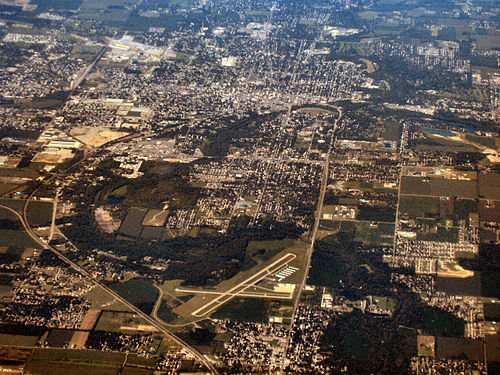
Anderson está ubicada en partes de seis municipios: Anderson, Union, Richland, Lafayette, Adams y Fall Creek. Según el censo de 2010, Anderson tiene un área total de 107,43 km², de los cuales 107,15 km² (o 99,74%) son tierra y 0,28 km² (o 0,26%) son agua.
Kaynak: Wikipedia – Anderson (Indiana) · CC BY-SA 4.0
History
Prior to the organization of Madison County, William Conner entered the land upon which Anderson is located. Conner later sold the ground to John and Sarah Berry, who donated 32 acres (13 ha) of their land to Madison County on the condition that the county seat be moved from Pendleton to Anderson. John Berry laid out the first plat of Anderson on November 7, 1827. In 1828 the seat of justice was moved from Pendleton to Anderson.
The city is named for Chief William "Adam" Anderson, whose mother was Lenape and whose father was of Swedish descent. Chief Anderson's name in Lenape was Kikthawenund, meaning "creaking boughs". The Lenape village was known as "Anderson's Town", though the Moravian missionaries called it "The Heathen Town Four Miles Away". Anderson was also known as "Andersonton" before being formally organized as Anderson.
Introduction of internal improvements by the Mammoth Internal Improvement Act caused a growth in the population in 1837. In December 1838, Anderson was incorporated as a town with 350 inhabitants. The Central Canal, a branch of the Wabash and Erie Canal, was planned to come through Anderson. Work continued on the canal during 1838 and the beginning of 1839, but the work was soon suspended by the state following effects of the Panic of 1837. The town again became a sleepy village until 1849, when it was incorporated a second time as a town. Many new commercial ventures located around the courthouse square.
This incorporation was short-lived, and Anderson once again went back to village status in 1852. However, with the completion of the Indianapolis Bellefontaine Railroad, as well as their station in 1852, Anderson burst to life. The third incorporation of Anderson as a town occurred on June 9, 1853. The population continued to increase. On August 28, 1865, with a population of nearly 1,300 people, Anderson was incorporated as a city.
Geography
Anderson is located in south-central Madison County at 40°06′00″N 85°40′53″W. The city of Anderson occupies all of Anderson Township except for the much smaller communities of Country Club Heights, Edgewood, River Forest, and Woodlawn Heights, as well as small parts of five other townships: Lafayette, Richland, Union, Adams, and Fall Creek.
Indiana State Road 32 (14th Street) crosses the city center, leading east-northeast 19 miles (31 km) to Muncie and west-southwest the same distance to Noblesville. State Road 9 (Scatterfield Road) crosses the east side of the city, leading north 11 miles (18 km) to Alexandria and southwest 10 miles (16 km) to Pendleton. Interstate 69 crosses the southeast corner of the city, with access from Exit 226 (SR 9/SR 109). I-69 leads southwest 40 miles (64 km) to Indianapolis and northeast 83 miles (134 km) to Fort Wayne.
According to the U.S. Census Bureau, Anderson has a total area of 41.7 square miles (108.00 km2), of which 41.6 square miles (108 km2) are land and 0.1 square miles (0.3 km2), or 0.27%, are water. The White River flows east to west through the northern part of the city.
Demographics
2020 census
As of the 2020 census, Anderson had a population of 54,788. The median age was 39.9 years. 21.6% of residents were under the age of 18 and 19.1% of residents were 65 years of age or older. For every 100 females there were 92.8 males, and for every 100 females age 18 and over there were 89.3 males age 18 and over.
97.9% of residents lived in urban areas, while 2.1% lived in rural areas.
There were 23,484 households in Anderson, of which 26.1% had children under the age of 18 living in them. Of all households, 32.3% were married-couple households, 22.8% were households with a male householder and no spouse or partner present, and 35.5% were households with a female householder and no spouse or partner present. About 36.3% of all households were made up of individuals and 15.3% had someone living alone who was 65 years of age or older.
There were 27,250 housing units, of which 13.8% were vacant. The homeowner vacancy rate was 2.3% and the rental vacancy rate was 11.1%.
2010 census
As of the 2010 census, there were people, households, and families living in the city. The population density was 1,356.8 inhabitants per square mile (523.9/km2). There were housing units at an average density of 675.7 per square mile (260.9/km2). The racial makeup of the city was 78.8% White, 15.2% African American, 0.3% Native American, 0.5% Asian, 2.6% from other races, and 2.6% from two or more races. Hispanic or Latino of any race were 4.8% of the population.
Of the extant households 28.8% had children under the age of 18 living with them, 35.8% were married couples living together, 17.1% had a female householder with no husband present, 5.5% had a male householder with no wife present, and 41.6% were non-families. 34.5% of all households were made up of individuals, and 13.8% had someone living alone who was 65 years of age or older. The average household size was 2.28 and the average family size was 2.91.
Government
The city government consists of a mayor and a city council. The mayor is elected in citywide vote. The city council consists of nine members. Six are elected from individual districts. Three members are elected at large.
Economy
When General Motors closed its operations in Anderson, the city was dealt a major economic blow, as GM was the biggest employer in Anderson. Nevertheless, in 2007, Anderson was ranked 98th in the Forbes List for 100 Best Places for Businesses among Smaller U.S. Metro areas. However, a more recent (2014) appraisal of Anderson from the Indiana Business Review was mixed, noting that "long-term trends are negative", citing "a long-term downward trend in area employment" and "acceleration in the number of food stamp recipients". More recent unemployment has been reduced, but improvements still lag behind the rest of the state.
For 2013, estimated household median income was $33,574 (vs. Indiana state median of $48,248). Per capita money income was $18,216 (Indiana per capita of $24,635). 25.8% of the city's population was estimated at living below poverty level, vs. a statewide estimation of 15.4%. Madison County, of which Anderson is the seat, has nearly three times as many food stamps recipients per capita as does Indiana as a whole.
As of February 2019, the ten largest employers in Madison County were:
Points of interest

Anderson Center for the Arts (listed on the National Register of Historic Places)
Anderson Speedway, home of the Pay Less Little 500 and Redbud 400
Downtown Historic District (NRHP-listed)
Mounds State Park (NRHP-listed), adjacent to the eastern border of the city
Additional locations on the National Register of Historic Places:
Education
The majority of the municipality is in the Anderson Community School Corporation, which includes one high school, Anderson High School which serves grades 9 – 12; one junior high school, Highland Middle School (formerly Highland High School) which serves grades 6 – 8, six elementary schools (Eastside, Edgewood, Valley Grove, 10th Street, Erskine, Anderson Elementary) which serve k -5, a kindergarten center (Killbuck), and a preschool (Southview). Until 1997, Anderson had three high schools: Highland, Madison Heights and Anderson. In 1997 Madison Heights was closed and Anderson High School moved into that facility. Beginning in the fall of 2010, Highland High School closed and was converted into a junior high school, consolidating all students in grades 9-12 into Anderson High School.
Small portions of the city limits are in the South Madison Community School Corporation.
Anderson also has a charter school (non-traditional, tuition-free public school) called Anderson Preparatory Academy. Currently, Anderson Preparatory Academy features grades K-12. Anderson Preparatory Academy is a college preparatory, military-based academy. All cadets in grades 6-8 are members of the Civil Air Patrol. High school cadets are all members of the Air Force JROTC program. Original plans called to only offer grades 6–9, then add on another upper grade each year before extending the lower years.
Anderson University is within the city, as are a campus of the Ivy Tech Community College of Indiana and a campus of the Purdue Polytechnic Institute.
The city has a lending library, the Anderson Public Library.
Kaynak: Wikipedia – Anderson, Indiana · CC BY-SA 4.0