

Barcelona
Barcelona es una ciudad de España, capital de Cataluña, de la provincia de Barcelona y de la comarca del Barcelonés.
Government administration · Spain · 0 followers
Overview
Barcelona es una ciudad de España, capital de Cataluña, de la provincia de Barcelona y de la comarca del Barcelonés. Con una población de 1 731 649 habitantes, es la segunda ciudad más poblada de España y de la península ibérica después de Madrid, y la décima de la Unión Europea. Su ámbito metropolitano cuenta con una población de 5 797 356 habitantes según Eurostat, siendo así la tercera aglomeración urbana de mayor población y la más densamente poblada de la Unión Europea.
Interested in working with us in the future?
Follow to see new jobs and posts in your feed.
No news yet.
About

Barcelona es una ciudad de España, capital de Cataluña, de la provincia de Barcelona y de la comarca del Barcelonés. Con una población de 1 731 649 habitantes, es la segunda ciudad más poblada de España y de la península ibérica después de Madrid, y la décima de la Unión Europea. Su ámbito metropolitano cuenta con una población de 5 797 356 habitantes según Eurostat, siendo así la tercera aglomeración urbana de mayor población y la más densamente poblada de la Unión Europea.
Kaynak: Wikipedia · CC BY-SA 4.0
Toponimia

El origen del nombre de Barcelona es desconocido y existen diversas teorías y leyendas que intentan explicarlo. Se sabe que había una ciudad ibérica original, de la tribu de los layetanos. Posteriormente, fue conquistada por Cneo Cornelio Escipión Calvo, y más adelante fue convertida en una colonia romana, puesta bajo la protección de Cayo Julio César y de Octavio Augusto, que recibió el nombre de Colonia Iulia Augusta Paterna Faventia Barcino. El nombre evolucionó durante la Edad Media, cuando se conoció la ciudad con los nombres de Barchinona, Barcalona, Barchelona y Barchenona.
Evidencia arqueológica en forma de monedas encontradas al pie del Montjuïc y acuñadas en el siglo III a. C. muestra el nombre Bárkeno escrito en una antigua lengua ibérica hablada por los Layetani. Podemos concluir que los layetani o laietani - un antiguo pueblo íbero prerromano que habitó la zona que ocupa hoy en día la ciudad de Barcelona- llamaban el lugar Bàrkeno.
Una de las leyendas sobre el origen de Barcelona alude a una hipotética fundación por el general cartaginés Amílcar Barca tras conquistar el enclave ibérico después de su desembarco en Iberia, mientras que otra versión se le atribuye a su hijo Aníbal, que ocupó el territorio durante la segunda guerra púnica en su avance a los Pirineos.
Sin embargo, no existen pruebas documentales de esta vinculación entre los nombres de la familia cartaginesa Barca y la ciudad conocida como Barcelona. Hay otras explicaciones para el nombre de la ciudad, como la que sostiene que proviene del período fenicio, teoría sostenida por la inscripción en escritura ibérica (Barkeno) encontrada en una moneda.
También existe una leyenda que da una explicación mitológica al nombre de la ciudad. Según esta leyenda, Hércules se unió a los argonautas tras acabar con su cuarto trabajo para ayudarles a buscar el Vellocino de Oro, pero al pasar cerca de la actual costa catalana, una tormenta dispersó las embarcaciones que formaban la expedición, y al terminar faltaba la novena. Hércules la buscó y finalmente encontró los restos del naufragio de la Barca Nona (la novena embarcación) al lado del actual Montjuic. Los tripulantes habían encontrado tan acogedor el paraje que, ayudados por Hermes (dios del comercio y las artes), decidieron fundar una ciudad a la que dieron el nombre de Barcanona.
Símbolos

El escudo de Barcelona aparece por primera vez, en la misma disposición que la actual, en 1329. El escudo se divide en cuatro cuarteles donde aparecen, en el primero y el cuarto, la cruz de San Jorge en gules sobre plata, y en el segundo y tercer cuartel con los cuatro palos de gules sobre oro (escudo de la familia real de Aragón o de la Casa de Barcelona).
También se han encontrado numerosas variantes con una, dos, tres, o incluso cinco barras verticales en cada cuartel. El escudo va encabezado por una corona, símbolo de la soberanía de los monarcas de la Corona de Aragón, siendo el Palacio Real Mayor de Barcelona la residencia de los reyes de la Corona de Aragón. La bandera de Barcelona deriva directamente del escudo, así que tiene la misma composición, aunque sin la corona.
Durante la dictadura franquista, se cargó dos palos de gules en cada cuartel, siguiendo representaciones anteriores de algunas versiones medievales e incluso de los siglos XIX e inicios del XX, y que fueron criticados por algunos sectores de la población[¿quién?] por simplificar el señal real y lo atribuyeron a una intención asimiladora hacia la bandera de España. En 1996 se inició un proceso que perduró varios años para oficializar convenientemente los símbolos, pero sin restituir el original, sino que se oficializó un logotipo inspirado en ese escudo. La Sociedad Catalana de Genealogía, Heráldica, Sigilografía, Vexilología y Nobiliaria inició un contencioso denunciando que el proceso no había seguido el procedimiento acorde a la ley para oficializar símbolos, que ganó, y obligó al ayuntamiento a oficializar los símbolos acordes a la heráldica y vexilología.[cita requerida] También utiliza un isotipo derivado directamente del escudo histórico.
Geografía

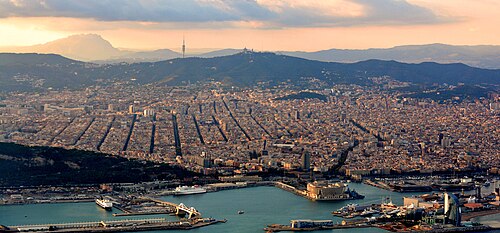
La ciudad de Barcelona se encuentra en la costa mediterránea de la península ibérica, justo en el centro de los deltas fluviales de los ríos Llobregat al suroeste y Besós al noreste. Su término municipal limita, de sur a noreste y en sentido horario, con los municipios de: El Prat de Llobregat, Hospitalet de Llobregat, Esplugas de Llobregat, San Justo Desvern, San Feliú de Llobregat, Molins de Rey, San Cugat del Vallés, Sardañola del Vallés, Moncada y Reixach, Santa Coloma de Gramanet y San Adrián de Besós. Los dos primeros y los dos últimos son los municipios con los que la ciudad mantiene un contacto más estrecho, con una densa malla urbana continua que los une, por el contrario San Cugat del Vallés y Sardañola del Vallés quedan muy separados de Barcelona, ya que la cordillera Litoral y el parque natural de la sierra de Collserola actúan como barreras naturales.
Barcelona tiene una pequeña parte de su término municipal en la vertiente del Llobregat de la sierra de Collserola. Se trata de Vallvidrera y de Les Planes, que se encuentran algo internadas dentro del parque natural de Collserola. También forma parte de su término municipal Santa Cruz de Olorde, cabalgando entre el Vallés Occidental y el Bajo Llobregat.
De este modo, Barcelona es la capital de la comarca del Barcelonés, la cual está formada por los municipios de Barcelona, Hospitalet de Llobregat, Badalona, Santa Coloma de Gramanet y San Adrián de Besós. Esta comarca limita al norte con el Vallés Occidental, al noreste con las comarcas del Vallés Oriental y del Maresme, al este y sureste con el mar Mediterráneo y al oeste con la comarca del Bajo Llobregat.
Topografía
Ubicada en la costa del mar Mediterráneo, Barcelona se asienta en una llanura —el llano de Barcelona— de ligera pendiente formada entre los deltas fluviales de los ríos Llobregat, al sudoeste, y Besós, al noreste. Limita por el sudeste con la línea de costa, y en el noroeste con la sierra de Collserola (con la cima del Tibidabo de 516 m s. n. m. como punto más alto), que sigue paralela a la línea de costa, encajonando la ciudad en un perímetro muy delimitado.
Historia

Edad Antigua
Los primeros rastros encontrados de población en el área de la ciudad se remontan al Neolítico (5500 a. C.), tal como indican los yacimientos encontrados alrededor del barrio del Raval ricos en enterramientos. Asimismo se han encontrado restos neolíticos en otros puntos del plano de Barcelona como la Sagrera. Sin embargo, los primeros pobladores destacados no aparecen hasta los siglos VII a. C.-VI a. C. Estos fueron los layetanos, un pueblo íbero. Después de la primera guerra púnica, para intentar compensar las consecuencias de la derrota, los cartagineses iniciaron una política de expansión en la península ibérica. Según una leyenda, la ciudad fue fundada en el año 230 a. C. por Amílcar Barca, padre de Aníbal. De acuerdo con la misma, el nombre de Barcelona deriva del linaje cartaginés Barca. Sin embargo, no hay pruebas de la presencia cartaginesa en el llano de Barcelona.
Durante el inicio la segunda guerra púnica, Aníbal Barca ocupó la población en el transcurso de su marcha hacia los Pirineos. Sin embargo, los romanos lograron conquistar la ciudad en el año 218 a. C. La ciudad fue rebautizada como Barcino (COLONIA IVLIA AVGVSTA FAVENTIA PATERNA BARCINO) entre el 15 a. C. y 10 a. C., una vez los romanos se establecieron definitivamente. En el mapamundi de Claudio Ptolomeo aparece con el nombre Barcino. Barcino tomó forma de castrum o fortificación militar en sus primeros tiempos, aunque el comercio fue reorientando la importancia de la ciudad; en el siglo I fue amurallada por orden del emperador romano Claudio y ya en el siglo II contaba con una población de entre 4000 y 8000 habitantes.
Edad Media
Tras su llegada en el siglo V, los visigodos la convirtieron durante pocos años en capital de los territorios hispanos, traspasando después el poder hasta Toledo. En el siglo VIII fue conquistada por Al-Hurr, pero retornada al territorio cristiano por Ludovico Pío del Imperio carolingio en 801, incorporándola a la Marca Hispánica. Los ataques musulmanes no cesaron, y en 985 las tropas de Almanzor destruyeron prácticamente toda la ciudad. Borrell II inició la reconstrucción dando paso al floreciente periodo condal. Durante este período la ciudad destacó entre las tierras catalanas y el conjunto del dominio de la Corona de Aragón, y fue, junto con otros puertos de la Corona, como Tortosa, Palma de Mallorca, Nápoles o Valencia, de donde partieron numerosas tropas y recursos hacia la empresa de tomar nuevas posesiones. La ciudad floreció y llegaría a ser una de las principales del Mediterráneo occidental en los siglos XIII y XIV. La ciudad destacaba en el plano comercial, aunque por debajo de Génova y Venecia, que dominaban el comercio en el Mediterráneo y entre Europa y Asia.
Demografía

Barcelona cuenta con una población de 1 731 649 habitantes (INE 2025).
Vivienda
Según el Censo de Población y Viviendas de 2021 del INE, en el municipio había 808 751 viviendas: 671 177 (83,0 %) principales y 137 574 (17,0 %) no principales. Según el consumo eléctrico, 55 772 (6,9 %) eran de uso esporádico y 75 488 (9,3 %) estaban vacías. El 61,0 % de las viviendas principales estaba en propiedad y el 31,1 % en alquiler. Según la estadística experimental del INE, en mayo de 2026 había 8231 viviendas turísticas en el municipio, con un total de 38 864 plazas (4,72 plazas por vivienda).
Había un total de 671 177 hogares, de los cuales 207 973 (31,0 %) eran unipersonales. El 63,3 % de los hogares estaba formado por una familia y el 5,4 % eran hogares multipersonales sin familia.
Economía

Históricamente la economía de Barcelona se ha basado en el comercio, que gracias a su enclave geográfico estratégico le ha permitido siempre una intensa actividad comercial con Francia y el resto de España, además de con todos los territorios del Mediterráneo, especialmente a través de su puerto. Esta actividad fue el principal motor de la ciudad hasta la revolución industrial. Este fue uno de los primeros territorios en iniciar la industrialización en la Europa continental, a partir de la industria textil desde mediados de 1780, pero en realidad cobrando impulso a mediados del siglo XIX, cuando se convirtió en un importante centro para la producción de textiles y maquinaria.
Desde entonces, la fabricación ha jugado un papel importante en su historia especialmente en el sector textil en un primer período, con un gran parón debido a la gran crisis y destrucción que produjo la guerra civil, y a la autarquía impuesta luego por la dictadura franquista. Pero cuando el régimen empezó a abrirse a los mercados europeos, se recuperó con fuerza la industria automovilística, editorial, química, farmacéutica, logística y electrónica, hasta convertir la provincia de Barcelona en la principal zona industrial del país. Pero el crecimiento y prosperidad de la ciudad de Barcelona fue expulsando las zonas industriales fuera de sus límites debido al aumento del precio del suelo industrial. Debido a este hecho la economía de la ciudad se ha ido centrando paulatinamente en los servicios, que actualmente ocupan al 85,7 % de los trabajadores de la ciudad. Parte de estos trabajadores se dedican al comercio, la restauración, y también al turismo, que desde los años 1990 ha crecido enormemente en la ciudad, llegando a recibir en 2009 hasta 6,5 millones de visitantes, convirtiéndose así en uno de los puntales económicos de Barcelona.
Administración y política

Barcelona, como capital de Cataluña, tiene una fuerte presencia de administraciones políticas, con diferentes niveles de responsabilidad y competencias:
La Administración General del Estado se ocupa de cuestiones estatales como son la justicia, agencia tributaria, salvamento marítimo, correos y la gestión de puertos, aeropuertos y trenes de Rodalies, entre otras. Estas competencias son coordinadas por la delegación del Gobierno en Cataluña, en representación del Gobierno de la Nación.
La Generalidad de Cataluña es el gobierno autonómico de Cataluña, por lo que tiene las sedes de sus instituciones en Barcelona, como son el Parlamento de Cataluña (situado en el parque de la Ciudadela), el Palacio de la Generalidad (sede de la Presidencia de la Generalidad, ubicado en la plaza de San Jaime) y el complejo del distrito administrativo (en el barrio de la Marina de Port). La Generalidad tiene amplias competencias sobre la gestión de la ciudad, desde educación, asuntos sociales, políticas económicas y comercio, entre otras. También es responsable de la construcción de grandes equipamientos como hospitales, escuelas, universidades o residencias para la tercera edad.
La Diputación de Barcelona es el organismo público con menores competencias en la ciudad, con funciones de coordinación entre municipios y gestión de subvenciones en la provincia de Barcelona. Actualmente preside el patronato que gestiona el mantenimiento del parque de la sierra de Collserola. También gestiona algunos otros parques, edificios públicos, museos y es titular de una amplia red de bibliotecas públicas gestionada conjuntamente con los ayuntamientos.
El Ayuntamiento de Barcelona es el organismo con mayores competencias y funcionarios públicos en la ciudad, ya que regula la vida diaria de los ciudadanos y gestiona importantes cuestiones políticas como la planificación urbanística, el transporte público, la recaudación de impuestos municipales, los cuerpos de emergencias locales, el mantenimiento de la vía pública y de los jardines. También es el responsable de la construcción de equipamientos municipales como guarderías, polideportivos, bibliotecas, residencias para la tercera edad y viviendas de protección oficial, entre otros.
Servicios

Educación
La ciudad de Barcelona tenía en el curso 2024-2025 un total de 356 710 estudiantes; aproximadamente un 20 % de la población residente de la ciudad. Estos estudiantes están repartidos entre los diferentes niveles educativos de la siguiente forma: 49 932 en educación infantil, 82 467 en primaria, 2 295 en educación especial y 86 921 en secundaria (ESO y Bachillerato). En cuanto a estudios superiores, en el curso 2024-2025 había 34 890 alumnos en formación profesional y 100 205 alumnos en las universidades situadas dentro del término municipal de la ciudad.
Las universidades que se encuentran dentro de la ciudad de Barcelona son las siguientes:
Seguridad ciudadana y emergencias
La seguridad ciudadana en la ciudad de Barcelona es competencia de la Generalidad de Cataluña y del Ayuntamiento de Barcelona, ejercida mediante los Mozos de Escuadra y la Guardia Urbana de Barcelona, respectivamente. La Guardia Urbana ejerce también de manera exclusiva las competencias en seguridad vial y vela por el cumplimiento de las ordenanzas municipales. Previamente al año 2008, la seguridad ciudadana también era competencia de la Policía Nacional, sin embargo actualmente solo ejerce la expedición de documentación y asuntos de inmigración (en Barcelona).
La coordinación entre las fuerzas y cuerpos de seguridad y el ayuntamiento se planifica mediante la Junta Local de Seguridad, una reunión bianual conformada por las autoridades locales, autonómicas, estatales, policiales y judiciales.
Barcelona es el único municipio de Cataluña con cuerpo de bomberos propio, los Bomberos de Barcelona, por lo que los Bomberos de la Generalidad únicamente actúan en la ciudad para proporcionar asistencia en grandes catástrofes.Las emergencias médicas son atendidas por el Sistema de Emergencias Médicas (SEM) de la Generalidad.Los servicios de rescate marítimo en las playas dentro del término municipal se coordinan mediante el Centro de Salvamento Marítimo de Barcelona (CCS) y son prestados principalmente por la Sociedad de Salvamento y Seguridad Marítima, la Guardia Civil y los Bomberos de Barcelona, ocasionalmente con colaboración de los Mozos de Escuadra y la Guardia Urbana.
Patrimonio

Barcelona ofrece al visitante la posibilidad de recorrer a pie desde las ruinas romanas y la ciudad medieval hasta los barrios del modernismo catalán, con sus edificios característicos, sus manzanas cuadradas de cantos seccionados, sus calles arboladas y sus anchas avenidas. La ciudad antigua es prácticamente llana, mientras que los barrios nuevos, a medida que se acercan a la cordillera litoral, adquieren más pendiente.
Arquitectura religiosa
En Barcelona existen numerosos edificios de índole religiosa, especialmente iglesias católicas, entre las que destacan:
Templo Expiatorio de la Sagrada Familia: es el edificio más reconocido de la ciudad, y símbolo de la misma. Diseñada por Antoni Gaudí, es Patrimonio de la Humanidad y una obra emblemática del modernismo catalán. Con su finalización, prevista para 2026 (cumpliéndose el centenario de la muerte de Gaudí), el templo se convertirá en la iglesia más alta del mundo, con 172,5 m de altura.[cita requerida]
Catedral de la Santa Cruz y Santa Eulalia: si bien la actual catedral de Barcelona empezó a construirse en el siglo XIII siguiendo el estilo gótico, su fachada no se terminó hasta bien entrado el siglo XIX, esta vez mediante el estilo neogótico.
Basílica de Santa María del Mar: construida entre 1329 y 1383, es conocida por su imponente estructura y su elegancia sobria. También se la conoce como la «Catedral del Mar» debido a la participación activa de la comunidad marinera en su construcción.
Basílica de Santa María del Pino: situada en el Barrio Gótico, cerca de la plaza del Pino, esta iglesia es un impresionante ejemplo de arquitectura gótica catalana.
Templo Expiatorio del Sagrado Corazón: la construcción de este templo comenzó en 1902 y fue diseñado por el arquitecto Enric Sagnier, aunque posteriormente su hijo Josep Maria Sagnier también contribuyó a su finalización. El templo ofrece vistas panorámicas de la ciudad de Barcelona desde su ubicación elevada en el Tibidabo. Los visitantes pueden acceder a la iglesia y explorar la zona circundante, que incluye un parque de atracciones.
Cultura

Idiomas
Actualmente en el área metropolitana de Barcelona, debido a la gran inmigración recibida durante los últimos 20 años de todas las partes del mundo, se hablan gran cantidad de lenguas. Algunos estudios hablan de más de 200 lenguas diferentes, pero la inmensa mayoría de la población habla castellano y catalán. Según las encuestas, en Cataluña saben hablar correctamente en castellano un 99,7 % de los residentes y en catalán un 78,3 %. En cuanto a la escritura, en castellano es del 95,6 % y en catalán del 61,8 %.
El dialecto o variante del catalán que se habla en esta zona es el catalán central, el cual se caracteriza por el uso de:
Artículos definidos: el, la, els, les. Personales: en, na, el, la.
Verbos incoativos con incremento en -eix.
Palabras propias: ànec, sorra, ocell, etc.
Sistema vocálico tónico de siete sonidos y átono de tres.
Museos
Existen numerosos museos y fundaciones tanto públicos como privados, como el Centro de Cultura Contemporánea de Barcelona, el Museo de la Música o el Museo del Chocolate.
Los más importantes han sido los dedicados a artistas concretos, como la fundación Joan Miró, la fundación Antoni Tàpies, o el museo Picasso, gracias a sus fondos propios conseguidos con donaciones y compras de las obras de estos autores, aunque el más concurrido sin duda es el museo del Fútbol Club Barcelona, situado en el Camp Nou. También nos encontramos con Museo Can Framis, Museo de Pintura Contemporánea de Barcelona, museo de la Fundación Vila Casas También existen importantes museos creados por las administraciones, como el MACBA y el Museo de Historia de Barcelona, o por la sociedad civil, como el CosmoCaixa, el CaixaForum, el Museo de la Pedrera, sufragados por la obra social de las cajas de ahorros.
Con la llegada del siglo XXI, los tres niveles de la administración han empezado una política de unificación de pequeños museos y colecciones para crear museos de mayor envergadura, con mayores fondos y con más atractivo. El más claro ejemplo de esta política hasta la fecha es el Museo Nacional de Arte de Cataluña (MNAC), fruto de la fusión entre el Museo de Arte Moderno, el Museo de Arte de Cataluña y otros fondos de la biblioteca general de Historia del Arte, así como fondos de numismática, grabados y fotografía, dando fruto al museo con la mejor colección de arte románico de Europa y una de las mejores de gótico.
Localidades hermanadas
Barcelona mantiene una relación de hermanamiento con las siguientes ciudades:
Por otro lado, desde mediados de los noventa, Barcelona ha optado por minimizar los nuevos acuerdos de hermanamiento y poner énfasis en la firma de convenios de amistad y cooperación, con objetivos concretos y medibles. Las siguientes ciudades cuentan o han contado con dichos convenios de colaboración:
Kaynak: Wikipedia – Barcelona · CC BY-SA 4.0
Tarih

Barselona söylentiye göre MÖ 3. yüzyılda Kartacalılar tarafından eski bir İberya kenti üzerine kurulmuştur. Kentin adı, eski İberce Barkeno sözcüğünden gelir. Latince kaynaklarda ise Barcino, Barcilonum ve Barcenona olarak anılır.
MÖ 218'de Romalılar tarafından fethedildi ve MÖ I. yüzyılda sömürge statüsü aldı. Kent Roma döneminde Colonia Faventia Julia Augusta Pia Barcino adını almış, Magriplilerce de Barcaluna olarak adlandırılmıştır. 415'te Vizigotların işgal ettiği kent, 717 dolaylarında Endülüs Emevi Devletinin topraklarına katıldı. 801'de Karolenj Hanedanı'ndan I. Louis (Dindar Louis) kenti Endülüs devletinden alarak kendi topraklarına kattı. Barselona kontları bu dönemde özerkleştiler ve 10.-11. yüzyıllarda Katalonya'nın geri kalan bölgelerini de denetimleri altına aldılar. 1137'de Katalonya ve Aragon'un birleşmesiyle kentte ticaretle uğraşan varlıklı sınıfların siyasi gücü arttı. Kısa sürede Barselona, Akdeniz ticaretinde Cenova ve Venedik'le boy ölçüşür hale geldi.
14. yüzyılda veba salgınları nüfusu önemli ölçüde azaltınca kent bir duraklama dönemine girdi. Napoli'nin 1442'de Barselona'nın yerine Katalonya-Aragon monarşisinin merkezi olması kentin önemini daha da azalttı. 16. yüzyılda Osmanlı İmparatorluğu'nun Akdeniz'de artan gücü ve Amerika'nın keşfi de Barselona'nın Akdeniz ticaretindeki konumunu gölgeledi. 1615'ten sonraki dönemde Madrid'deki yöneticilerle ilişkiler bozuldu ve Katalonya'nın Amerikan kolonileriyle ticaret yapması tümüyle engellendi. 1705'te İspanya Veraset Savaşı sırasında Avusturyalı arşidük III. Karl Barselona'da krallığını ilan etti. Ama V. Felipe savaşı kazanınca kent 1714'te ele geçirildi ve özerkliğine son verildi.
1808-13 arasında Napolyon'un egemenliği altında kalan kent, bundan sonraki dönemde hızla sanayileşmeye başladı. Buhar gücüyle çalışan ilk dokuma fabrikası 1832'de açıldı. Kısa sürede Barselona, İspanya Krallığı'nın en önemli kenti haline geldi. İşçi sayısının hızla artmasıyla siyasi ve toplumsal çatışmalar da baş gösterdi. Bunların en önemlileri 1835'te 11 manastırın tahrip olmasına ve 1909'da 60'tan fazla kiliseyle dinsel yapının bütünüyle yakılmasına yol açan olaylardı.
Coğrafya ve İklim
Barselona İber Yarımadası'nın kuzeydoğu kıyısında yer alır. Güneydoğu yönünde Akdeniz'e doğru inen hafif eğimli bir arazi üstünde kurulmuştur. Kuzeydoğuda Besôs, güneybatıda Llobregat nehirlerinin arasında kalan verimli ovada yer alır. Kuzeybatıdan, en yüksek tepesi Tibidabo (532 m) olan dağlarla çevrilidir. Akdeniz ikliminin hüküm sürdüğü Barselona'da iklim yumuşaktır.
Kentin Yapısı

Barselona kent planı düzenli ve uyumludur. Ticaret ve yerleşme alanları eski kentin merkeziyle çevresinde yoğunlaşmıştır. Sanayi bölgeleri bunların dışından çevreye doğru yayılır. Eski kentin ana ekseni, kuzeyde büyük ticaret merkezi Plaza de Cataluña, güneyde ise Paseo Marítimo ve kıyı şeridi arasında uzanan bir dizi bulvardan oluşan Ramblas'tır. Geniş kaldırımları, ağaçlar altındaki bankları ve kitap, gazete, el sanatı ürünleri, özellikle de başta kuşlar olmak üzere ev hayvanları ve çiçek satılan küçük dükkanlarıyla Ramblas sevilen bir gezinti alanıdır.
Yeni kent Ensanche (Uzantı), birbirini dikine kesen geniş caddeleriyle kuzeye doğru uzanır. Eski kenti ve Ramblas'ın batısını yarım daire biçiminde çevreleyen Rondas'ın kuzey ucunda Üniversite Meydanı yer alır. Bu meydan geçen geniş Jose Antonio caddesinin her iki başında birer boğa güreşi arenası vardır. Kentteki öbür ana cadde kuzeydoğu-güneybatı doğrultusunda uzanan Avinguda Diagonal'dır (1979'a kadar Avenida del Generalismo Franco).
Demografi
Barselona'nın nüfusu 20. yüzyılın ilk yarısında yavaş bir artış hızı göstermiştir. 1950'lerden 1980'lerin başlarına kadar İspanya'nın daha az gelişmiş yörelerinde gelen göçle nüfusu hızla artmış, 1980'ler ve 1990'lar boyunca yüksek yaşam standartları nedeniyle nüfus artışı yavaşlamaya başlamıştır.
Barselona kentinin nüfusu 2006 yılı itibarıyla 1.673.075, metropoliten alanının nüfusu 3.218.071'tür. Nüfusun üçte ikiye yakını Katalonya doğumludur.
Resmi dil olan İspanyolca Berselona'nın hemen hemen her yerinde anlaşılır. Bununla birlikte Barselona'nın yerel dili olan Katalanca nüfusun ezici bir kesimi tarafından konuşulur. Yine nüfusun büyük bir kısmı Katolik Hristiyandır, bununla birlikte Evanjelist, Ortodoks, Müslüman, Yahudi ve Budist azınlıklar da yaşar. İspanya'daki en büyük Yahudi nüfusa ev sahipliği yapar.
Ekonomi
Katalonya'daki sanayi kuruluşlarının dörtte üçü Barselona ve çevresindedir. Buradaki üretim, toplam ülke üretiminin önemli bir kısmını oluşturur. 18. yüzyılın ikinci yarısından başlayarak en önemli sanayi kolu olan dokumacılık, sonraları yerini metalurji ve makine sanayilerine bırakmıştır. Ama Avrupa Birliği'ne üye olması dokumacılığın modernleşmesine ivme kazandırmıştır. Başlıca imalat ürünleri otomobil, ağır makineler, kimyasal maddeler, ilaç, kozmetik ve deri ürünleridir. Barselona, borsası ve kentteki yerli ve yabancı bankacılık kuruluşlarıyla önemli bir finans merkezidir.
Deniz taşımacılığı da kent ekonomisinde önemli yer tutar. Yüzden fazla denizcilik şirketinin gemileri kenti dünya limanlarına bağlar. Bunların yanı sıra turizm de Barselona'nın önde gelen gelir kaynakları arasındadır.
Kültür ve Eğitim

Barselona, bütün İspanya için bir kültür merkezi olmasının yanı sıra, Katalan dili ve kültürünün zenginleştirdiği özgün bir tarihsel geleneğe de sahiptir. Katalonya'nın siyasi ve toplumsal tarihinde belirleyici olan Katalan kültürü kapalı ve yerel bir kimliğe bürünmemiş, tersine dünyadaki öbür akımlarla, özellikle Avrupa'ya açılarak gelişmiştir.
1450'de kurulmuş olan Barselona Üniversitesi ve 1968'de kurulan Özerk Barselona Üniversitesi kentin önde gelen bilim ve araştırma kurumlarındandır. Kentte büyük önem taşıyan müzeler arasında romanesk ve gotik ressamların yapıtlarını barındıran Katalonya Güzel Sanatlar Müzesi, 12-18. yüzyıl heykellerinin sergilendiği Federico Marés Müzesi ve gençliğinde dokuz yıl burada yaşamış olan Pablo Picasso'nun pek çok yapıtının bulunduğu Picasso Müzesi, Deniz Müzesi ve Joan Miró Vakfı önemli yer tutar.
Ünlü ressam Picasso da 1895-1900 yıllarında Barselona'da yaşamıştır ve 1900 yılında ayrıldığı Barselona'ya 1901 yılında dönen Picasso 1904 yılına kadar tekrar Barselona'da yaşamış ve "Mavi Dönemim" dediği ürünlerini yaratmış, fakat 1904 yılından sonra Fransa'ya yerleşmiştir. 1973 yılında Fransa'da ölmüştür. Museo Picasso (Picasso Müzesi), 1981 yılında eşinin de Picasso'nun yaptığı seramik çalışmalarını bağışlamasıyla bugünkü halini almıştır. Ünlü ressamın 2.500'den fazla eserini bu şehirde özellikle de Museo Picasso'da görmek mümkündür.
1847'de kurulan Teatro del Liceo kent opera ve balesinin barındırır. Kentte saygın bir senfoni orkestrası da vardır. Geleneksel Katalan halk oyunları yörenin önemli sanat gösterilerindendir. Kentte 130 sinema ve 14 tiyatrodan başka eğlence parkları bulunur.
Spor
Barselona, uzun spor geleneğine sahip bir şehir olarak 1992 Yaz Olimpiyatları ile İspanya'da düzenlenen 1982 FIFA Dünya Kupası'na iki stadyumuyla ev sahipliği yapmıştır. Şehir, 1899'da kurulan, dünyanın en çok tanınan futbol takımı ve dünyanın en zengin ikinci futbol kulübü olan Barcelona Futbol Kulübü'nün (FC Barcelona) evidir. FC Barcelona'nın ayrıca basketbol (Barcelona (basketbol takımı)), hentbol (FC Barcelona (hentbol)), rink hokey (FC Barcelona Hoquei) ve buz hokeyi (FC Barcelona (buz hokeyi)), futsal (FC Barcelona Futsal) ve ragbi (FC Barcelona (ragbi)) takımları da vardır. Kentin diğer önemli futbol takımı Espanyol'dur.
Yapılar
Kentin en eski yerleşim alanı, küçük bir tepe olan Monte Taber'dir. Roma dönemi surlarının kalıntıları buradaki bazı sokaklarda hala görülür. Eski kentin ortasındaki Barselona Katedrali'nin yapımına 1289'da kuzey cephesi ile başlanmış büyük bölümü 14. yüzyılda yapılmasına karşın ancak 15. yüzyıl sonlarında tamamlanmıştır. Batı cephesi ise 19. yüzyılda eklenmiştir. Geç gotik kiliselerde görülen mekansal bütünlük endişesi bu yapıda da kendini gösterir. Neflerin genişliği, yüksekliği, geniş aralıklı taşıyıcı ayakların inceliği ve transeptin ana nefe göre çok az dışarı taşması ile iç mekan bütün uzunluğu ve genişliğiyle tek bir hacim olarak kavranmaktadır. İç payandalar arasında şapeller yer alır. Bezemelerde zarif, gösterişli ve egzotik bir üslup egemendir; ışık kullanımı ise kısıtlıdır. Katedralin yakınlarındaki Plaza del Rey'de, büyük bölümü 14. yüzyılda inşa edilen Barselona kontlarının sarayı Palacio Real Mayor ve Aragon krallık arşivinin korunduğu 16. yüzyıl sarayı yer alır. Plaza de San Jaime'de 15. ve 16. yüzyıllrda inşa edilen Kongre Sarayı ve gotik Belediye Meclisi Binası vardır. Puerta de la Paz'daki 65 m'lik Kristof Kolomb Anıtı ve hemen yakınında bugün deniz müzesi olarak kullanılan 14. yüzyıl tersanesi Reales Atarazanas, kentin ilgi çekici yapılarındandır.
Barselona'nın belki de en önemli mimari yapısı ve kentin simgesi olan devasa Sagrada Familia Kilisesi'nin yapımına 1882 yılında mimar Villar başladı. Bir yıl sonra ünlü Katalan mimar Antoni Gaudi görevi devraldı. Gaudi'nin ömrü ancak kilisenin ön cephesi ve planlanan on sekiz kuleden sekizini tamamlamak için yetti. Gotik tarzın örneği olan ünlü kilise hâlâ tamamlanamadığı için 'Bitmeyen Kilise' olarak da bilinir. Kilisenin 2026-2028 yılında tamamlanması bekleniyor.
Kente damgasını vuran yerlerden birisi de Akdeniz'in en hareketli limanı olan Barcelona Limanıdır. Bu limana yılda 700.000'den fazla gemi uğradığı söylenir. Limana çıkan ana yollardan biri, ünlü kâşif Kristof Kolomb Anıtı'na gider.
Ulaşım
Kentteki ulaşım otobüs, troleybüs, metro ve banliyö trenleri ile sağlanır. Tramvaylar 1971'de kaldırılmıştır. 1970'lerde hızlı ulaşıma olanak veren çevre yolları ve Tibidabo Tepesinin altından geçen tünellerle kentin çevredeki tepelerin ötesine doğru genişlemesi sağlanmıştır.
1747'de inşa edilen dalgakıran 17. yüzyılda bir liman haline gelmiştir. Sonraları genişletilen Barselona limanı giderek bugünkü dev boyutlarına ulaşmıştır.
Havalimanları
Barcelona Uluslararası Havalimanı, kentin 10 km dışında, Llobregat Ovası'nda kurulmuştur. Şehir merkezinden 17 km uzaklıkta yer alan havalimanı, yıllık 35 milyonun üzerindeki yolcu trafiğiyle İspanya'nın ikinci, Akdeniz kıyısındaki en büyük havalimanıdır. Havalimanı çoğunlukla İspanya içine ve Avrupa'ya yapılan seferlerde kullanılır, bunun dışında havalimanını, Latin Amerika, Asya ve ABD'deki destinasyonlara uçan havayolları da kullanır.
Barselona'ya 20 km uzaklıktaki Sabadell Havalimanı ise adını aldığı Sabadell kasabasının yakınındadır ve uçuş eğitimi ile özel uçaklar için kullanılır. Barselona'dan 90 km uzakta bulunan, Fransa sınırı yakınındaki Girona-Costa Brava Havalimanı düşük maliyetli havayolları tarafından tercih edilir.
Kaynak: Wikipedia – Barselona · CC BY-SA 4.0
Names
The name Barcelona comes from the ancient Iberian Baŕkeno, attested in an ancient coin inscription found on the right side of the coin in Iberian script as , in Ancient Greek sources as Βαρκινών, Barkinṓn; and in Latin as Barcino, Barcilonum and Barcenona.
Other sources suggest that the city may have been named after the Carthaginian general Hamilcar Barca, who was supposed to have founded the city in the 3rd century BC, but there is no evidence that its name in antiquity, Barcino, was connected with the Barcid family of Hamilcar. During the Middle Ages, the city was variously known as Barchinona, Barçalona, Barchelonaa, and Barchenona.
An abbreviated form sometimes used by locals for the city is Barna. Barça is only applied to the local football club FC Barcelona, not to the city. Another common abbreviation is 'BCN', which is also the IATA airport code of the Barcelona-El Prat Airport.
The city is referred to as the Ciutat Comtal in Catalan and Ciudad Condal in Spanish (i.e., "Comital City" or "City of Counts"), owing to its past as the seat of the Count of Barcelona.
History
Legendary founding
The origin of the earliest settlement at the site of present-day Barcelona is unclear. The ruins of an early settlement have been found, including different tombs and dwellings dating to earlier than 5000 BC. In Greek mythology, the founding of Barcelona had been attributed to the mythological Hercules.
Punic Barcelona
According to tradition, Barcelona was founded by Punic (Phoenician) settlers, who had trading posts along the Catalonian coast. In particular, some historians attribute the foundation of the city directly to the historical Carthaginian general, Hamilcar Barca, father of Hannibal, who supposedly named the city Barcino after his family in the 3rd century BC, but this theory has been questioned. Iberia and Barcelona was controlled by the Carthaginian Empire and was an important location for trade due to its proximity to Punic Ibiza. Archeological evidence in the form of coins from the 3rd century BC have been found on the hills at the foot of Montjuïc with the name Bárkeno written in the Iberian script in the Iberian language. Thus, some have argued that the Laietani, an ancient Iberian (pre-Roman) people of the Iberian peninsula, who inhabited the area occupied by the city of Barcelona around 3–2 BC after the Punic withdrawal from Iberia, called the area Bàrkeno, which means "The Place of the Plains" (Barrke = plains/terrace).
Roman Barcelona
In about 15 BC, the Romans redrew the town as a castrum (Roman military camp) centred on the "Mons Taber", a little hill near the Generalitat (Catalan Government) and city hall buildings. The Roman Forum, at the crossing of the Cardo Maximus and Decumanus Maximus, was approximately placed where current Plaça de Sant Jaume is. Thus, the political centre of the city, Catalonia, and its domains has remained in the same place for over 2,000 years.
Under the Romans, it was a colony with the surname of Faventia, or, in full, Colonia Faventia Julia Augusta Pia Barcino or Colonia Julia Augusta Faventia Paterna Barcino. Pomponius Mela mentions it among the small towns of the district, probably as it was eclipsed by its neighbour Tarraco (modern Tarragona), but it may be gathered from later writers that it gradually grew in wealth and consequence, favoured as it was with a beautiful situation and an excellent harbour. It enjoyed immunity from imperial burdens. The city minted its own coins; some from the era of Galba survive.
Geography

Location
Barcelona is located on the northeast coast of the Iberian Peninsula, facing the Mediterranean Sea, on a plain approximately 5 km (3 mi) wide limited by the mountain range of Collserola, the Llobregat river to the southwest and the Besòs river to the north. This plain covers an area of 170 km2 (66 sq mi), of which 101 km2 (39.0 sq mi) are occupied by the city itself. It is 120 km (75 mi) south of the Pyrenees and the Catalan border with France.
Tibidabo, 512 m (1,680 ft) high, offers striking views over the city and is topped by the 288.4 m (946.2 ft) Torre de Collserola, a telecommunications tower that is visible from most of the city. Barcelona is peppered with small hills, most of them urbanized, that gave their name to the neighbourhoods built upon them, such as Carmel (267 m or 876 ft), Putxet (es) (181 m or 594 ft) and Rovira (261 m or 856 ft). The escarpment of Montjuïc (173 m or 568 ft), situated to the southeast, overlooks the harbour and is topped by Montjuïc Castle, a fortress built in the 17–18th centuries to control the city as a replacement for the Ciutadella. Today, the fortress is a museum and Montjuïc is home to several sporting and cultural venues, as well as Barcelona's biggest park and gardens.
The city borders on the municipalities of Santa Coloma de Gramenet and Sant Adrià de Besòs to the north; the Mediterranean Sea to the east; El Prat de Llobregat and L'Hospitalet de Llobregat to the south; and Sant Feliu de Llobregat, Sant Just Desvern, Esplugues de Llobregat, Sant Cugat del Vallès, and Montcada i Reixac to the west. The municipality includes two small sparsely-inhabited exclaves to the north-west.
Climate
According to the Köppen climate classification, Barcelona has a hot summer Mediterranean climate (Csa), with mild winters and warm to hot summers, while the rainiest seasons are autumn and spring. The rainfall pattern is characterized by a short (3 months) dry season in summer, as well as less winter rainfall than in a typical Mediterranean climate. However, both June and August are wetter than February, which is unusual for the Mediterranean climate. This subtype, labelled as "Portuguese" by the French geographer George Viers after the climate classification of Emmanuel de Martonne and found in the NW Mediterranean area (e.g. Marseille), can be seen as transitional to the humid subtropical climate (Cfa) found in inland areas.
Demographics

As of 2025, the population is 1,713,247, of which 47.9% are males, and 52.1% are females. Minors make up 13.8% of the population, and seniors make up 21.0%.
The city is the main component of an administrative area of Greater Barcelona, with a population of 3,218,071 in an area of 636 km2 (246 sq mi) (density 5,060 inhabitants/km2). The population of the urban area was 4,840,000. It is the central nucleus of the Barcelona metropolitan area, which relies on a population of 5,474,482.
In 1900, Barcelona had a population of 533,000, which grew steadily but slowly until 1950, when it started absorbing a high number of people from other less-industrialized parts of Spain. Barcelona's population peaked in 1979 at 1,906,998, and fell throughout the 1980s and 1990s as more people sought a higher quality of life in outlying cities in the Barcelona Metropolitan Area. After bottoming out in 2000 with 1,496,266 residents, the city's population began to rise again as younger people started to return, causing a great increase in housing prices.
Languages spoken
Catalan is the "own language" of Catalonia and Barcelona, and therefore its the main language used by the City Council, in schools and it dominates the linguistic landscape. All toponymy of Barcelona, including the stops of the metro system, are exclusively in the Catalan language. Despite this, Spanish is the most spoken language in Barcelona (according to the linguistic census held by the Government of Catalonia in 2013) and it is understood almost universally. Catalan is also very commonly spoken in the city: it is understood by 95% of the population, while 72.3% can speak it, 79% can read it, and 53% can write it. Knowledge of Catalan has increased significantly in recent decades thanks to a language immersion educational system.
After Catalan and Spanish, the most spoken languages in Barcelona are those from North Africa, such as Amazigh and Arabic, followed by Bengali, Urdu, Punjabi, Mandarin Chinese, Romanian, English, Russian and Quechua, according to data collected by the University of Barcelona. Within Barcelona's Chinese community, varieties of Wu Chinese are also widely spoken by migrants of Qingtianese and Wenzhounese origin alongside Mandarin Chinese.
Administration

As the capital of the autonomous community of Catalonia, Barcelona is the seat of the Catalan government, known as the Generalitat de Catalunya; of particular note are the executive branch, the parliament, and the High Court of Justice of Catalonia. The city is also the capital of the Province of Barcelona and the Barcelonès comarca (district).
Barcelona is governed by a city council formed by 41 city councillors, elected for a four-year term by universal suffrage. As one of the two biggest cities in Spain, Barcelona is subject to a special law articulated through the Carta Municipal (Municipal Law). A first version of this law was passed in 1960 and amended later, but the current version was approved in March 2006. According to this law, Barcelona's city council is organized in two levels: a political one, with elected city councillors, and one executive, which administers the programs and executes the decisions taken on the political level. This law also gives the local government a special relationship with the central government and it also gives the mayor wider prerogatives by the means of municipal executive commissions. It expands the powers of the city council in areas like telecommunications, city traffic, road safety and public safety. It also gives a special economic regime to the city's treasury and it gives the council a veto in matters that will be decided by the central government, but that will need a favourable report from the council.
The Comissió de Govern (Government Commission) is the executive branch, formed by 24 councillors, led by the Mayor, with 5 lieutenant-mayors and 17 city councillors, each in charge of an area of government, and 5 non-elected councillors. The plenary, formed by the 41 city councillors, has advisory, planning, regulatory, and fiscal executive functions. The six Commissions del Consell Municipal (City council commissions) have executive and controlling functions in the field of their jurisdiction. They are composed by a number of councillors proportional to the number of councillors each political party has in the plenary. The city council has jurisdiction in the fields of city planning, transportation, municipal taxes, public highways security through the Guàrdia Urbana (the municipal police), city maintenance, gardens, parks and environment, facilities (like schools, nurseries, sports centres, libraries, and so on), culture, sports, youth and social welfare. Some of these competencies are not exclusive, but shared with the Generalitat de Catalunya or the central Spanish government. In some fields with shared responsibility (such as public health, education or social services), there is a shared Agency or Consortium between the city and the Generalitat to plan and manage services.
Culture

Barcelona's cultural roots go back 2000 years. Since the arrival of democracy, the Catalan language (very much repressed during the dictatorship of Franco) has been promoted, both by recovering works from the past and by stimulating the creation of new works. Barcelona is designated as a world-class city by the Globalization and World Cities Study Group and Network. It has also been part of the UNESCO Creative Cities Network as a City of Literature since 2015.
Entertainment and performing arts
Barcelona has many venues for live music and theatre, including the world-renowned Gran Teatre del Liceu opera house, the Teatre Nacional de Catalunya, the Teatre Lliure and the Palau de la Música Catalana concert hall. Barcelona also is home to the Barcelona Symphony and Catalonia National Orchestra (Orquestra Simfònica de Barcelona i Nacional de Catalunya, usually known as OBC), the largest symphonic orchestra in Catalonia. In 1999, the OBC inaugurated its new venue in the brand-new Auditorium (L'Auditori). It performs around 75 concerts per season and its current director is Eiji Oue. It is home to the Barcelona Guitar Orchestra, directed by Sergi Vicente. The major thoroughfare of La Rambla is home to mime artists and street performers. Yearly, two major pop music festivals take place in the city, the Sónar Festival and the Primavera Sound Festival. The city also has a thriving alternative music scene, with groups such as The Pinker Tones receiving international attention. Barcelona is an international hub of highly active and diverse nightlife with bars, dance bars and nightclubs staying open well past midnight.
Media
El Periódico de Catalunya, La Vanguardia and Ara are Barcelona's three major daily newspapers (the first two with Catalan and Spanish editions, Ara only in Catalan) while Sport and El Mundo Deportivo (both in Spanish) are the city's two major sports daily newspapers, published by the same companies. The city is also served by a number of smaller publications such as Ara and El Punt Avui (in Catalan), by nationwide newspapers with special Barcelona editions such as El País (in Spanish, with an online version in Catalan) and El Mundo (in Spanish), and by several free newspapers like 20 minutos and Què (all bilingual).
Sights

The Barri Gòtic (Catalan for "Gothic Quarter") is the centre of the old city of Barcelona. Many of the buildings date from medieval times, some from as far back as the Roman settlement of Barcelona. Catalan modernista architecture (related to the movement known as Art Nouveau in the rest of Europe) developed between 1885 and 1950 and left an important legacy in Barcelona. Several of these buildings are World Heritage Sites. Especially remarkable is the work of architect Antoni Gaudí, which can be seen throughout the city. His best-known work is the immense but still unfinished church of the Sagrada Família, which has been under construction since 1882 and is still financed by private donations. As of 2015, completion is planned for 2026.
Barcelona was also home to Mies van der Rohe's Barcelona Pavilion. Designed in 1929 for the International Exposition for Germany, it was an iconic building that came to symbolize modern architecture as the embodiment of van der Rohe's aphorisms "less is more" and "God is in the details". The Barcelona pavilion was intended as a temporary structure and was torn down in 1930 less than a year after it was constructed. A modern re-creation by Spanish architects now stands in Barcelona, however, constructed in 1986.
Barcelona won the 1999 RIBA Royal Gold Medal for its architecture, the first (and as of 2015, only) time that the winner has been a city rather than an individual architect. Barcelona is the home of many points of interest declared World Heritage Sites by UNESCO:
Historic buildings and monuments
Minor basilica of Sagrada Família, the symbol of Barcelona.
Palau de la Música Catalana and Hospital de Sant Pau, designed by Lluís Domènech i Montaner, included in the UNESCO Heritage List in 1997.
Works by Antoni Gaudí, including Park Güell, Palau Güell, Casa Milà (La Pedrera), Casa Vicens, Sagrada Família (Nativity façade and crypt), Casa Batlló, crypt in Church of Colònia Güell. The first three works were inscribed as a World Heritage Site in 1984. The other four were added as extensions to the site in 2005.
Economy

The Barcelona metropolitan area comprises over 66% of the people of Catalonia, one of the richer regions in Europe and the fourth richest region per capita in Spain, with a GDP per capita amounting to €28,400 (16% more than the EU average). The greater Barcelona metropolitan area had a GDP amounting to $177 billion (equivalent to $34,821 in per capita terms, 44% more than the EU average), making it the 4th most economically powerful city by gross GDP in the European Union, and 35th in the world in 2009. Barcelona city had a very high GDP of €80,894 per head in 2004, according to Eurostat. Furthermore, Barcelona was Europe's fourth best business city and fastest improving European city, with growth improved by 17% per year as of 2009.
Barcelona was the 24th most "livable city" in the world in 2015 according to lifestyle magazine Monocle. Similarly, according to Innovation Analysts 2thinknow, Barcelona occupies 13th place in the world on Innovation Cities™ Global Index. At the same time it is according to the Global Wealth and Lifestyle Report 2020 one of the most affordable cities in the world for a luxury lifestyle.
Barcelona has a long-standing mercantile tradition. Less well known is that the city industrialized early, taking off in 1833, when Catalonia's already sophisticated textile industry began to use steam power. It became the first and most important industrial city in the Mediterranean basin. Since then, manufacturing has played a large role in its history.
Borsa de Barcelona (Barcelona Stock Exchange) is the main stock exchange in the northeastern part of the Iberian Peninsula.
Barcelona was recognized as the Southern European City of the Future for 2014/15, based on its economic potential, by FDi Magazine in their bi-annual rankings.
Trade fair and exhibitions
It also has several congress halls, notably Fira de Barcelona – the second largest trade fair and exhibition centre in Europe, that host a quickly growing number of national and international events each year (at present above 50). The total exhibition floor space of Fira de Barcelona venues is 405,000 m2 (41 ha), not counting Gran Via centre on the Plaza de Europa. However, the Eurozone crisis and deep cuts in business travel affected the council's positioning of the city as a convention centre.
Education

Barcelona has a well-developed higher education system of public universities. Most prominent among these are the University of Barcelona (established in 1450) and the more modern Pompeu Fabra University. Barcelona is also home to the Polytechnic University of Catalonia, and in the private sector the EADA Business School (founded in 1957), which became the first Barcelona institution to run manager training programmes for the business community. IESE Business School, as well as the largest private educational institution, the Ramon Llull University, which encompasses schools and institutes such as the ESADE Business School. The Autonomous University of Barcelona, another public university, is located in Bellaterra, a town in the Metropolitan Area. Toulouse Business School and the Open University of Catalonia (a private Internet-centred open university) are also based in Barcelona.
The city has a network of public schools, from nurseries to high schools, under the responsibility of a consortium led by city council (though the curriculum is the responsibility of the Generalitat de Catalunya). There are also many private schools, some of them Roman Catholic. Most such schools receive a public subsidy on a per-student basis, are subject to inspection by the public authorities, and are required to follow the same curricular guidelines as public schools, though they charge tuition. Known as escoles concertades, they are distinct from schools whose funding is entirely private (escoles privades).
The language of instruction at public schools and escoles concertades is Catalan, as stipulated by the 2009 Catalan Education Act. Spanish may be used as a language of instruction by teachers of Spanish literature or language, and foreign languages by teachers of those languages. An experimental partial immersion programme adopted by some schools allows for the teaching of a foreign language (English, generally) across the curriculum, though this is limited to a maximum of 30% of the school day. No public school or escola concertada in Barcelona may offer 50% or full immersion programmes in a foreign language, nor does any public school or escola concertada offer International Baccalaureate programmes.
Transport

Air
Barcelona is served by Barcelona-El Prat Airport, about 17 km (11 mi) south-west of the centre of Barcelona. It is the second-largest airport in Spain, and the largest on the Mediterranean coast, which handled more than 50.17 million passengers in 2018, showing an annual upward trend. It is a main hub for Vueling Airlines and Ryanair, and also a focus for Iberia and Air Europa. The airport mainly serves domestic and European destinations, although some airlines offer destinations in Latin America, Asia and the United States. The airport is connected to the city by highway, metro (Airport T1 and Airport T2 stations), commuter train (Barcelona Airport railway station) and scheduled bus service. A new terminal (T1) has been built, and entered service on 17 June 2009.
Some low-cost airlines, also use Girona-Costa Brava Airport, about 90 km (56 mi) to the north, Reus Airport, 77 km (48 mi) to the south, or Lleida-Alguaire Airport, about 150 km (93 mi) to the west, of the city. Sabadell Airport is a smaller airport in the nearby town of Sabadell, devoted to pilot training, aerotaxi and private flights.
The city has several heliports, mainly at the top of hospitals or tall buildings. However, only one heliport is public, the Port of Barcelona Heliport.
Seaport
The Port of Barcelona has a 2000-year-old history and a great contemporary commercial importance. It is Europe's ninth largest container port, with a trade volume of 1.72 million TEU's in 2013. The port is managed by the Port Authority of Barcelona. Its 10 km2 (4 sq mi) are divided into three zones: Port Vell (the old port), the commercial port and the logistics port (Barcelona Free Port). The port is undergoing an enlargement that will double its size thanks to diverting the mouth of the Llobregat river 2 km (1 mi) to the south.
The Barcelona harbour is the leading European cruiser port and a very important Mediterranean turnaround base. In 2013, 3.6 million pleasure cruise passengers used the Port of Barcelona.
International relations
Twin towns – sister cities
Suspended twin towns / sister cities agreements
Saint Petersburg, Russia (1985, suspended in 2022)
Tel Aviv, Israel (1998, suspended in 2023 until Israel agrees to a ceasefire in Gaza)
Kaynak: Wikipedia – Barcelona · CC BY-SA 4.0