


Baton Rouge
Baton Rouge es la capital y segunda ciudad más poblada del estado estadounidense de Luisiana —por detrás de Nueva Orleans—.
Government administration · United States · 0 followers
Overview
Baton Rouge es la capital y segunda ciudad más poblada del estado estadounidense de Luisiana —por detrás de Nueva Orleans—. Se encuentra ubicada sobre la orilla oriental del río Misisipi, a pocos kilómetros de su desembocadura en el golfo de México, que forma el delta del Misisipi. Cuenta con una población de 227.470 habs. y su área metropolitana alcanza los 750 000. De 2005 a 2007, fue la más poblada del estado, ya que se redujo significativamente la población de Nueva Orleans debido a la catástrofe del huracán Katrina.
Interested in working with us in the future?
Follow to see new jobs and posts in your feed.
No news yet.
About

Baton Rouge es la capital y segunda ciudad más poblada del estado estadounidense de Luisiana —por detrás de Nueva Orleans—. Se encuentra ubicada sobre la orilla oriental del río Misisipi, a pocos kilómetros de su desembocadura en el golfo de México, que forma el delta del Misisipi. Cuenta con una población de 227.470 habs. y su área metropolitana alcanza los 750 000. De 2005 a 2007, fue la más poblada del estado, ya que se redujo significativamente la población de Nueva Orleans debido a la catástrofe del huracán Katrina.
Kaynak: Wikipedia · CC BY-SA 4.0
Historia

El período francés (1699-1763)
El nombre francés Bâton-Rouge significa «bastón rojo» en español, tal nombre deriva de una facción de la tribu de los nechas o natchez que tenía como emblema una especie de tótem que fue llamado (debido a su aspecto) «bastón rojo» por los españoles y los franceses. En 1699, Sieur d'Iberville lideró una exploración que partió con 200 Francocanadienses en las partes altas del río Misisipi. El 17 de marzo de dicho año, en un escarpado en el banco este del río (izquierda), vieron un tronco de ciprés manchado con sangre de animal y con cabezas de pescado, que fue entendido por ellos como una marca de los límites entre los territorios de caza de dos grupos de indígenas locales de la tribu Houma. El escarpado (por consenso entre los historiadores) se encuentra localizado en lo que ahora es el campus de la Universidad del Sur, al norte de la ciudad, habiendo sido erigida una escultura conmemorativa, realizada por Frank Hayden cerca de dicho lugar.
El primer establecimienro real en la presente Baton Rouge se dio en el año 1718, cuando Bernard Diron Dartaguette recibió una concesión del gobierno colonial de Nueva Orleans. Los registros indican que dos blancos y 25 negros (algunos de los cuales pudieron ser esclavos) vivían en dicha concesión. En el año nuevo de 1722, el primer asentamiento masivo fue celebrado en un pequeño salón de Dartaguette's por el Padre Pierre François-Xavier de Charlevoix, un misionero y profesor Jesuita que se encontraba en camino hacia Nueva Orleans, viniendo desde Quebec en camino por los Grandes Lagos y bajando por el río Misisipi. Para 1727, el asentamiento de Dartaguette se había desvanecido; y la razón de su desaparición es desconocida. Como la ubicación no tenía particular importancia para los franceses, ignoraron el lugar; en este período de menos de una década fue la suma total del tiempo en que Baton Rouge estuvo bajo dominio francés.
Geografía y clima

Baton Rouge se encuentra localizada en las coordenadas 30°27′29″N 91°8′25″O (30.458090, -91.140229).
Acorde a la Oficina del Censo de los Estados Unidos, la ciudad tiene un área total de 204,8 km², de los cuales 199 km² son tierra y 5,7 km² (2,81%) agua.
Baton Rouge conjuntamente con Tallahassee y Austin es una de las ciudades capitales de estados que se ubican más al sur de los Estados Unidos.
Clima
Como en Nueva Orleans, el clima en Baton Rouge es húmedo-subtropical, con un suave, corto, lluvioso y algo caliente invierno y un largo, caliente, húmedo, y a veces lluvioso verano. La proximidad a la costa expone a toda al área metropolitana a frecuentes huracanes. No suele nevar, si bien en los inviernos de 2008 (11 de diciembre), 2009 (4 de diciembre) y 2010 (12 de febrero) se han producido nevadas. El huracán Gustav ha sido el peor huracán, en la historia reciente, de los que han afectado al área de Baton Rouge, con vientos de más de 140 km/h.
Desastres
Baton Rouge raramente sufre de desastres naturales. Los terremotos son muy raros. El río Misisipi es una pequeña amenaza para la mayoría de las secciones pobladas de la ciudad, pues la ciudad está construida sobre escarpados naturales que miran por encima del río. Como sea, las áreas cercanas al río Amite y al río Comité son de fácil inundación si el agua se eleva demasiado a consecuencia de las lluvias. Baton Rouge es rara vez visitada por los tornados, y el surgimiento de tormentas es imposible por encontrarse a cierta distancia de la costa.
Las tormentas tropicales (y, ocasionalmente, huracanes) llegan al área de Baton Rouge con fuerza regular, pero el daño masivo de huracanes es usualmente raro por la situación de la ciudad algo alejada de la franja costera (comparativamente con Nueva Orleans), pero un huracán poderoso puede causar daños en el área.
Barrios

Baton Rouge tiene varios barrios dentro y fuera de los límites de la ciudad:
Cultura
El Baton Rouge River Center es un centro cultural donde se realizan convenciones y espectáculos artísticos y deportivos.
Los LSU Tigers son el equipo deportivo de la Universidad Estatal de Luisiana. En fútbol americano universitario han ganado 11 campeonatos de la Southeastern Conference, seis Sugar Bowl y tres campeonatos nacionales.
Medios de comunicación
El gran Baton Rouge se encuentra bien servido por televisión y radio. La cobertura es la 93.ª más grande en Estados Unidos, cubriendo 322.540 personas o el 0,29 % de la población de Estados Unidos.
Televisión
KPBN 11, KZUP 19, WBTR 41, operan estaciones independientes en el área, el canal WLFT 30 porvee mayormente programación religiosa. Otros canales solamente con estaciones de cable incluyen: Metro 21, Cox 4, y Catholic Life Channel 15.
Periódicos
El periódico de mayor circulación es el Baton Rouge Advocate, que se publica desde 1925. Otras alternativas son las publicaciones semanales que incluyen: 225, LSU Daily Reveille, Tiger Weekly, y Greater Baton Rouge Business Report.
Radio
Country: WYPY-FM (100.7), WYNK-FM (101.5), WTGE-FM (107.3)
Góspel/Cristiana: WJFM-FM (88.5), WPAE-FM (89.7), KPAE-FM (91.5), WXOK-AM (1460), WPFC-AM (1550)
Hits: KRDJ-FM (93.7), WFMF-FM (102.5), WCDV-FM (103.3)
Rock: KRVE-FM (96.1), WDGL-FM (98.1), WNXX-FM (104.5), KNXX-FM (104.9)
Entrevistas: WJBO-AM (1150), WIBR-AM (1300), WYNK-AM (1380)
Urbano/Urbano Contemporáneo: WEMX-FM (94.1), KQXL-FM (106.5)
Contemporánea: (KGLA-AM) (1540) Radio Tropical Caliente
Infraestructura
Salud y medicina
Baton Rouge tiene los siguientes hospitales:
Hospital de Rehabilitación Benton - 7660 Convention Street
Centro Médico General de Baton Rouge - 3600 Florida Boulevard
Centro Médico General de Baton Rouge Bluebonnet - 8585 Picardy Avenue
Centro Médico Earl K. Long (LSUMC) - 5825 Airline Highway
Hospital de Rehabilitación Healthsouth - 8595 United Plaza Boulevard
Centro de Cirugía Healthsouth - 5222 Brittany Drive
Centro Médico Regional Our Lady Lake - 5000 Hennessy Boulevard
Hospital de Rehabilitación Sage - 8225 Summa Avenue
Hospital Para Niños Saint Jude - 7777 Hennessy Boulevard
Centro Para el Tratamiento de Cáncer Mary Bird Perkins - 4950 Essen Lane
Centro Médico Ochsner - 1700 Medical Center Drive
Hospital de Cirugías "Vista" - 9032 Perkins Road
Hospital Para Mujeres - 9050 Airline Highway
Escuelas
El Sistema de Escuelas de East Baton Rouge Parish gestiona las escuelas públicas de la ciudad de Baton Rouge, con alrededor de 90 escuelas: 56 escuelas elementales, 16 escuelas medias y 18 escuelas preparatorias (high schools).
Existen algunas instituciones de educación superior en la ciudad, tales como
Escuela Central General de Enfermería de Baton Rouge
Escuela Central General de Radiología Tecnológica de Baton Rouge
Colegio Técnico de Luisiana (Campus de Baton Rouge)
Universidad de Phoenix (Campus de Baton Rouge)
Transporte
Baton Rouge está conectada con las siguientes rutas: Interestatal 10 (por el puente Horace Wilkinson), Interestatal 12, Interestatal 110 (Luisiana) (vía Rápida Martin Luther King), autopista Airline (US 61), bulevard Florida (US 190) (por el puente Huey P. Long), calle Plank (LA 67), Nicholson Drive (LA 30), autopista Jefferson (LA 73), carretera de Luisiana 1 (LA 1) y la autopista Scotland/Baker/Zachary (LA 19). Las rutas de negocios US 61/190 corren al oeste a través del bulevard Florida desde la autopista Airline hasta el centro de la ciudad en la calle River Road. Las rutas también corren a través de las calles River y Chippewa y la autopista Scenic desde Chippewa hacia la Airline. US 190 se junta con la US 61 en la autopista Airline desde el bulevard Florida hacia la autopista Scenic, donde las dos carreteras se unen. La US 190 continua al oeste hacia la Airline hasta el puente Huey P. Long desde donde la US 61 se desvía hacia la autopista Scenic.
Habitantes ilustres
Seimone Augustus, baloncestista, guardia del equipo Minnesota Lynx (n. 1984)
James H. Brown, exsenador del estado, secretario de estado, y comisionado estatl de inversiones (n. 1940)
Billy Cannon, ganador en 1959 del Trofeo Heisman (n. 1937)
David Dellucci, beisbolista, jardinero de los Philadelphia Phillies (n. 1973)
Donna Douglas, actriz de The Beverly Hillbillies (n. 1933)
Warrick Dunn, jugador de fútbol americano, corredor de los Atlanta Falcons (n. 1975)
Jeff Fortenberry, representante del Partido Republicano por Nebraska en el Congreso (n. 1960)
Steve Garbade, compositor, violonchelista y diseñador de sonido (n. 1979)
Clark Gaudin, abogado y primer respresentante Republicanos estatal del East Baton Rouge Parish desde su reconstrucción(n. 1931)
Randall Gay, futbolista americano, esquinero de los New England Patriots (n. 1982)
Darryl Hamilton, beisbolista, jardinero de varios equipos (n. 1964)
Randy Jackson, músico, productor de discos y jurado del concurso American Idol (n. 1956)
Louis E. Jenkins, exrepresentante del estado de Luisiana y 3 veces candidato al Senado de Estados Unidos (n. 1947)
Chris Thomas King, cantante de blues y actor (n. 1962)
Stephan Kinsella, abogado de propiedad intelectual, propulso de la teoría legal Libertaria (n. 1965)
Stefan LeFors, futbolista americano, mariscal de campo de los Carolina Panthers (n. 1981)
John A. Lejeune, General de los Marine Corps (n. 1942)
Master P, músico de Hip hop, artista y fundador y dueño de No Limit Records (n. 1967)
Jonathan Papelbon, besibolista, lanzador de los Boston Red Sox (n. 1980)
Carly Patterson, medallista de oro Olímpico (n. 1988)
Bob Pettit, miembro del paseo de la Fama del Basketball (n. 1932)
Andy Pettitte, beisbolista, lanzador de los New York Yankees (n. 1972)
Bobby Phills, exjugador profesional de baloncesto (f. 2000)
Kaynak: Wikipedia – Baton Rouge · CC BY-SA 4.0
History
Pre-history
Human habitation in the Baton Rouge area has been dated to 12000–6500 BC, based on evidence found along the Mississippi, Comite, and Amite rivers. Earthwork mounds were built by hunter-gatherer societies in the Middle Archaic period, from roughly the fourth millennium BC. The speakers of the Proto-Muskogean language divided into its descendant languages by about 1000 BC; and a cultural boundary between either side of Mobile Bay and the Black Warrior River began to appear between about 1200 BC and 500 BC—a period called the Middle "Gulf Formational Stage". The Eastern Muskogean language began to diversify internally in the first half of the first millennium AD.
The early Muskogean societies were the bearers of the Mississippian culture, which formed around 800 AD and extended in a vast network across the Mississippi and Ohio valleys, with numerous chiefdoms in the Southeast, as well. By the time the Spanish made their first forays inland from the shores of the Gulf of Mexico in the early 16th century, by some evidence many political centers of the Mississippians were already in decline, or abandoned. At the time, this region appeared to have been occupied by a collection of moderately sized native chiefdoms, interspersed with autonomous villages and tribal groups. Other evidence indicates these Mississippian settlements were thriving at the time of the first Spanish contact. Later Spanish expeditions encountered the remains of groups who had lost many people and been disrupted in the aftermath of infectious diseases, chronic among Europeans, unknowingly introduced by the first expedition.
Colonial period
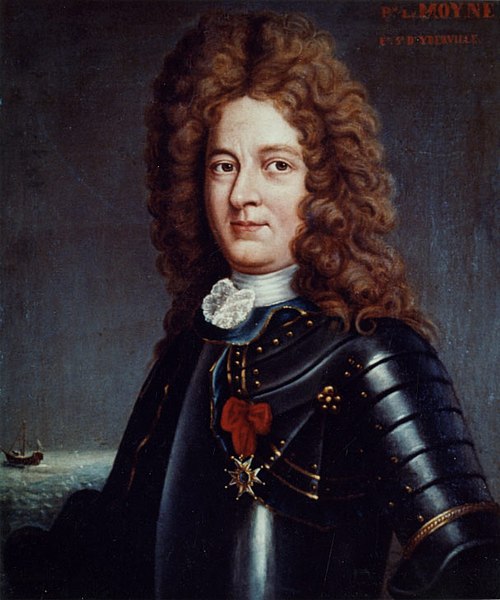
French explorer Pierre Le Moyne d'Iberville led an exploration party up the Mississippi River in 1698. The explorers saw a red pole marking the boundary between the Houma and Bayagoula tribal hunting grounds. The French name le bâton rouge ("the red stick") is the translation of a native term rendered as Istrouma, possibly a corruption of the Choctaw iti humma ("red pole"); André-Joseph Pénicaut—a carpenter traveling with d'Iberville—published the first full-length account of the expedition in 1723. According to Pénicaut:
Geography

The city of Baton Rouge lies on the banks of the Mississippi River in southeastern Louisiana's Florida Parishes region. The city is about 79 miles (127 km) from New Orleans, 126 miles (203 km) from Alexandria, 56 miles (90 km) from Lafayette and 250 miles (400 km) from Shreveport. It is also 173 miles (278 km) from Jackson, Mississippi and 272 miles (438 km) from Houston, Texas. Baton Rouge lies on a low elevation of 17 meters or 56 feet to a little over 19 meters or 62 feet above sea level.
Baton Rouge is the capital of Louisiana and the parish seat of East Baton Rouge Parish. According to the United States Census Bureau, the city has an area of 79.15 square miles (205.0 km2), of which 76.95 square miles (199.3 km2) are land and 2.2 square miles (5.7 km2) (2.81%) are covered by water.
Baton Rouge is on the first set of bluffs north of the Mississippi River Delta's coastal plains. Because of its prominent location along the river and on the bluffs, which prevents flooding, the French built a fort in the city in 1719. Baton Rouge is the third-southernmost capital city in the continental United States, after Austin, Texas, and Tallahassee, Florida. It is the cultural and economic center of the Greater Baton Rouge metropolitan area.
Climate
Baton Rouge has a humid subtropical climate (Köppen Cfa). It has mild winters, hot and humid summers, moderate to heavy rainfall, and the possibility of damaging winds and tornadoes yearlong. The area's average precipitation is 61.94 inches (141.1 cm) of rain and 0.1 inches (0.25 cm) of snow annually. With ample precipitation, Baton Rouge is fifth on the list of wettest cities in the United States. Snow in the Baton Rouge area is usually rare, although it snowed in three consecutive years at the first decade of the 21st century: December 11, 2008, December 4, 2009, and February 12, 2010. In 2017, Baton Rouge received snow again. In January 2025, Baton Rouge as well as all of southern Louisiana received record snowfall in a once-in-a-lifetime blizzard. The yearly average temperature for Baton Rouge is 68.4 °F (20.2 °C). The average temperature for January is 51.7 °F (10.9 °C) and July is 83.0 °F (28.3 °C). The area is usually free from extremes in temperature, with some cold winter fronts, but those are usually brief.
Demographics

Prior to colonization, Native Americans were once the primary residents of present-day Baton Rouge. With the coming of European colonization, and the migration of American settlers after the Louisiana Purchase, European and African-descended peoples became the predominant groups in the area by birth rates and immigration to a 1860 population of 5,428. Since reaching its first historic high of 220,394 residents at the 1980 U.S. census, the city's population has expanded and contracted twice: from 219,531 in 1990, to 227,818 in 2000—the second historic high—and 229,493, the city-proper's third historic high in 2010, to 227,470 at the 2020 United States census. The black population gradually increased in Baton Rouge after the Civil War.
Including the consolidated city–parish of Baton Rouge in 2019 (East Baton Rouge Parish), the American Community Survey estimated 443,763 people lived in the area. In 2020, the U.S. Census Bureau determined 456,781 people lived in the consolidated city–parish. The metropolitan population of Baton Rouge increased to 3.6% as a result of suburbanization in 2019, to an estimated 854,884. In 2020, the metropolitan statistical area's population increased to 870,569 residents, reflecting southern Louisiana's population growth in contrast with northern Louisiana's stagnation and decline.
In 2019, the city of Baton Rouge had a population density of 2,982.5 people per square mile.
Racial and ethnic composition
With the population growth of European and African-descended peoples in present-day Baton Rouge, as well as the Indian Removal Act, the Native American population declined to one of the smallest minority groups in the area. With the increase among people of color during the 20th century, Baton Rouge has also declined as a predominantly non-Hispanic white city, hastened by suburbanization, aging out, and white flight. In 1970, non-Hispanic whites were 70.5% of the population. In 2020, they were 34.2% of the total population.
Economy

Baton Rouge enjoys a strong economy that has helped the city be ranked as one of the "Top 10 Places for Young Adults" in 2010 by portfolio.com and one of the top 20 cities in North America for economic strength by the Brookings Institution. In 2009, the city was ranked by CNN as the 9th-best place in the country to start a new business. Lamar Advertising Company has its headquarters in Baton Rouge. Other notable companies headquartered in the city include BBQGuys, Marucci Sports, Piccadilly Restaurants, and Raising Cane's Chicken Fingers. Notable corporations which have established offices or distribution centers in the Baton Rouge area have included Amazon in 2021, and Microsoft. Chicago Bridge & Iron Company had an office in Baton Rouge before being sold in 2017. In 2023, Aldi established a presence in Baton Rouge.
Baton Rouge is the farthest inland port on the Mississippi River that can accommodate ocean-going tankers and cargo carriers. The ships transfer their cargo (grain, oil, cars, containers) at Baton Rouge onto rails and pipelines (to travel east–west) or barges (to travel north). Deep-draft vessels cannot pass the Old Huey Long Bridge because the clearance is insufficient. In addition, the river depth decreases significantly just to the north, near Port Hudson.
Baton Rouge's largest industry is petrochemical production and manufacturing. ExxonMobil's Baton Rouge Refinery complex is the fifth-largest oil refinery in the country; it is the world's tenth largest. Baton Rouge also has rail, highway, pipeline, and deep-water access. Dow Chemical Company has a large plant in Iberville Parish near Plaquemine, 17 miles (27 km) south of Baton Rouge. Shaw Construction, Turner, and Harmony all started with performing construction work at these plants.
In addition to being the state capital and parish seat, the city is the home of Louisiana State University, which employs over 5,000 academic staff. One of the largest single employers in Baton Rouge is the state government, which consolidated all branches of state government downtown at the Capitol Park complex.
Culture and arts

Baton Rouge is a culturally distinct area of Louisiana, where Cajun and Creole Catholic culture from Greater New Orleans and Acadiana is syncretized with the African American Baptist culture of the Florida Parishes and South Mississippi. The city of Baton Rouge is a "college town" with Baton Rouge Community College, Louisiana State University, Franciscan Missionaries of Our Lady University, and Southern University located throughout the city limits; the students of Louisiana State University alone make up 20% of the city population. In a sizable international population of over 11,300 as of 2008, the largest groups were people of Hispanic and Latino, or Vietnamese descent. This contributes to Baton Rouge's unique culture and diversity.
Arts and theater
Baton Rouge has an expanding visual arts scene, which is centered downtown. Professional performing arts organizations include Theatre Baton Rouge, the Baton Rouge Symphony Orchestra, Baton Rouge Ballet Theatre, Opera Louisiane and Playmakers—a professional Children's Theatre. This increasing collection of venues includes the Shaw Center for the Arts. Opened in 2005, the facility houses the Brunner Gallery, LSU Museum of Art; the Manship Theatre; a contemporary art gallery; traveling exhibits; and several eateries. Another prominent facility is the Louisiana Art and Science Museum, which contains the Irene W. Pennington Planetarium, traveling art exhibits, space displays, and an ancient Egyptian section. Several smaller art galleries, including the Baton Rouge Gallery, offering a range of local art, are scattered throughout the city.
The city has several designated arts and cultural districts, the most prominent of which are the Mid-City Cultural District and the Perkins Road Arts District. These districts provide tax incentives, mostly in the form of exempting state tax on purchases, to promote cultural activity in these areas. Located in a Qualified Census Tract the North Baton Rouge community of Scotlandville was designated a Cultural District in 2020.
Sports

College sports play a major role in the culture of Baton Rouge. The LSU Tigers and the Southern University Jaguars are NCAA Division I athletic programs with the LSU Tigers football and Southern Jaguars football teams being the local college American football teams. College baseball, basketball, and gymnastics are also popular.
Much of the city's sport's attention is focused on the professional teams in Greater New Orleans. Baton Rouge has had multiple minor-league baseball teams (the Baton Rouge Red Sticks), soccer teams (Baton Rouge Bombers), indoor football teams, a basketball team, and a hockey team (Baton Rouge Kingfish).
Following a successful round of exhibition games, the Federal Prospects Hockey League announced that Baton Rouge would be awarded a franchise, beginning play in 2023. The Baton Rouge Zydeco play their home games at the River Center.
The city is home to many alternative or less known leagues. For Australian rules football, the city has the Baton Rouge Tigers which began play in 2004 and competes in the USAFL. The Baton Rouge Rugby Football Club began playing in 1977 and has won numerous conference championships. Currently, the team competes in the Deep South Rugby Football Union. Baton Rouge is also home to Red Stick Roller Derby, a WFTDA Division 3 roller derby league.
The Baton Rouge Rougarou, a college summer league baseball team in the Texas Collegiate League play home games at Pete Goldsby Field in the north of the city.
Soccer for the city currently consists of Louisiana Parish AC of USL League Two. The team plays at various home fields including LSU recreation fields on campus and BREC Memorial Stadium near the Rougarou's home field.
Parks and recreation

Baton Rouge has an extensive park collection presided over by the Recreation and Park Commission for the Parish of East Baton Rouge (BREC). The largest park is City Park near the Louisiana State University flagship campus. Another notable park is Highland Road Community Park, spanning over 144 acres (58 ha). The Baton Rouge Zoo is also run through BREC and includes over 1,800 species.
National protected areas
The city is home to 7 national protected areas, and at least 15 places on the National Register of Historic Places: Atchafalaya National Heritage Area, Baton Rouge National Cemetery, Independence Park Botanic Gardens, Laurens Henry Cohn Sr. Memorial Plant Arboretum, LSU Hilltop Arboretum, Magnolia Cemetery, and Port Hudson National Cemetery.
Among its protected areas, the Atchafalaya National Heritage Area extends the length of the Atchafalaya Basin from the area of Ferriday in the north to the river's mouth beyond Morgan City; the designation provides a framework for the promotion and interpretation of the area's cultural and historic character, and the preservation of the natural and built environment. The Cohn Arboretum previously served as the site for the Cohn family's home; its land was donated in 1965 and the arboretum opened in 1980. LSU's arboretum was originally developed in 1929 and donated to the university in 1981.
Government

The city of Baton Rouge and the Parish of East Baton Rouge have been run by a consolidated government since 1947. It combined the Baton Rouge municipal government with the rural areas of the parish, allowing people outside the limits of the city of Baton Rouge to use city services. Though the city and parish have a consolidated government, this differs slightly from a traditional consolidated city-county government.
The cities of Zachary, Baker, Central, and St. George operate their own city governments within East Baton Rouge Parish. Under this system, Baton Rouge has the uncommon office of "mayor-president", which consolidates the executive offices of "mayor of Baton Rouge" and "president of East Baton Rouge Parish". Though Zachary, Baker, and Central each have their own mayors, citizens living in these municipalities are still a part of the constituency who can vote and run in elections for mayor-president and metropolitan council.
The mayor-president's duties include setting the agenda for the government and managing the government's day-to-day functions. They are also responsible for supervising departments, as well as appointing the department heads. The mayor does not set the city's public policy because that is the Metropolitan Council's role, but the mayor-president does have some influence on the policy through appointments and relationships with council members.
The current mayor-president of Baton Rouge is Republican Sid Edwards.
Metropolitan council
When the city and parish combined government, the city and parish councils consolidated to form the East Baton Rouge Parish Metropolitan Council. The Metropolitan Council is the legislative branch of the Baton Rouge government. Its 12 district council members are elected from single-member districts. They elect from among themselves the mayor-president pro tempore. The mayor-president pro tempore presides over the council's meetings and assumes the role of the mayor-president if the mayor-president is unable to serve. The council members serve four-year terms and can hold office for three terms.
Education

Baton Rouge is home to many universities. Louisiana State University and Agricultural and Mechanical College, generally known as Louisiana State University or LSU, is a public university that is the flagship campus of the Louisiana State University System. LSU is Louisiana's largest university, with over 30,000 students and 1,300 full-time faculty members. Southern University and A&M College, generally known as Southern University or SU, is the flagship institution of the Southern University System, the nation's only historically black land-grant university system. SU is the largest HBCU and second-oldest public university in Louisiana.
Virginia College opened in October 2010 and offers students training in areas such as cosmetology, business, health, and medical billing. Franciscan Missionaries of Our Lady University is an independent Catholic institution also in the Baton Rouge medical district that has programs in nursing, health sciences, humanities, behavioral sciences, and arts and sciences. It has an associated hospital, Our Lady of the Lake Regional Medical Center. Tulane University planned to open a satellite medical school at Baton Rouge General's Mid City Campus in 2011.
Southeastern Louisiana University School of Nursing is located in the medical district on Essen Lane in Baton Rouge. Southeastern offers traditional baccalaureate and master's degree programs, as well as LPN and RN to BSN articulation. Baton Rouge Community College is an open-admission, two-year post-secondary public community college, established on June 28, 1995. The college settled into a permanent location in 1998. The college's enrollment is more than 8,000 students. The Pennington Biomedical Research Center houses 48 laboratories and 19 core research facilities.
Primary and secondary schools
East Baton Rouge Parish Public Schools operates primary and secondary schools serving the city. The city of Baton Rouge is also home to 27 charter schools with a total enrollment of an estimated 11,000 students as of 2020. One of the latest includes the Mentorship Academy in downtown Baton Rouge, which leverages its location downtown to establish internship opportunities with local businesses as well as provide a high-tech classroom environment to focus on a digital animation curriculum.
Media

The major daily newspaper for the Greater Baton Rouge metropolitan area is The Advocate, publishing since 1925. Until 1991, Baton Rouge also had an evening newspaper, The State-Times—at that time, the morning paper was known as The Morning Advocate. Other publications include: Baton Rouge Parents Magazine, Pink & Blue Magazine, The Daily Reveille, The Southern Review, 225 magazine, DIG, Greater Baton Rouge Business Report, inRegister magazine, 10/12 magazine, Country Roads magazine, 225Alive, Healthcare Journal of Baton Rouge, Southern University Digest, and The South Baton Rouge Journal.
Other newspapers in East Baton Rouge Parish include the Central City News and The Zachary Post. The Greater Baton Rouge area is well served by television and radio. The market is the 95th-largest designated market area in the U.S. Major television network affiliates serving the area include:
Baton Rouge also offer local government-access television-only channels on Cox Cable channel 21.
Infrastructure
Health and medicine
Baton Rouge is served by several hospitals and clinics:
Baton Rouge General Medical Center – Mid-City Campus
Baton Rouge General Medical Center – Bluebonnet Campus
Our Lady of the Lake Regional Medical Center
Our Lady of the Lake Children's Hospital
Communication
Most of the Baton Rouge area's high-speed internet, broadband, and fiber optic communications are provided by REV (formerly EATEL), AT&T Inc., Charter Communications, or Cox Communications. In 2006, Cox Communications linked its Lafayette, Baton Rouge, and New Orleans markets with fiber-optic infrastructure. Other providers soon followed suit, and fiber optics have thus far proven reliable in all hurricanes since they were installed, even when mobile and broadband services are disrupted during storms. In 2001, the Supermike computer at Louisiana State University was ranked as the number-one computer cluster in the world, and remains one of the top 500 computing sites in the world.
Military installations
Baton Rouge is home station to the Louisiana Army National Guard 769th Engineer Battalion, which had units deployed to Iraq and Afghanistan. The armory near LSU has three company-sized units: 769th HSC (headquarters support company); 769th FSC (forward support company); and the 927th Sapper Company. Other units of the battalion are located at Napoleonville (928th Sapper Company); Baker, Louisiana (926th MAC mobility augmentation company); and Gonzales, Louisiana (922nd Horizontal Construction Company).
The 769th Engineer Battalion is part of the 225th Engineer Brigade, headquartered in Pineville, Louisiana, at Louisiana National Guard Training Center Pineville. Four engineer battalions and an independent bridging company are in the 225th Engineer Brigade, making it the largest engineer group in the US Army Corps of Engineers.
Baton Rouge is also home to 3rd Battalion, 23rd Marine Regiment (3/23), a reserve infantry battalion in the United States Marine Corps located throughout the Midwestern United States consisting of about 800 marines and sailors. The battalion was first formed in 1943 for service in the Pacific Theater of Operations during World War II, taking part in a number of significant battles including those at Saipan and Iwo Jima before being deactivated at the end of the war. In the early 1960s, the unit was reactivated as a reserve battalion. The battalion is headquartered in Saint Louis, Missouri, with outlying units throughout the Midwestern United States. 3/23 falls under the command of the 23rd Marine Regiment and the 4th Marine Division.
Transportation

Interstates
Baton Rouge has three interstate highways: I-10, I-12 (Republic of West Florida Parkway), and I-110 (Martin Luther King Jr. Expressway).
Interstate 10 enters the city from the Horace Wilkinson Bridge over the Mississippi River, curving at an interchange with Interstate 110 southeast, crossing the LSU lakes and Garden District before reaching an interchange with I-12 (referred to as the 10/12 split). It curves further southeast toward New Orleans as it crosses Essen Lane near the Medical District. It passes Bluebonnet Blvd and the Mall of Louisiana at exit 162, and leaves Baton Rouge after interchanges with Siegen Lane and Highland Road.
Interstate 12 (The Republic of West Florida Parkway) begins in the city at the I-10/I-12 split east of College Drive, and proceeds eastward, crossing Essen Lane, Airline Hwy, Sherwood Forest Blvd, Millerville Road, and O'neal Lane before leaving the city when crossing the Amite River.
Interstate 110 (The Martin Luther King Jr. Expressway) stretches 8 miles in a north–south direction from the east end of the Horace Wilkinson Bridge to Scenic Highway in Scotlandville, Louisiana. It passes through downtown, North Baton Rouge, and Baton Rouge Metro Airport before ending at Scenic Highway.
U.S. highways and major roads
Baton Rouge has two U.S. highways, along with their business counterparts: Airline Highway (US 61) and Florida Boulevard.
U.S. 190 enters the city from the Huey P. Long Bridge, beginning a concurrency with U.S. 61 after an interchange with Scenic Highway, near Scotlandville. Its name is Airline Highway from this interchange to the interchange with Florida Blvd. At this interchange, U.S. 190 turns east to follow Florida Blvd through Northeast Baton Rouge, exiting the city at the Amite River.
U.S. 61 enters Baton Rouge as Scenic Highway until it reaches Airline Highway (U.S. 190). It becomes concurrent with U.S. 190 until Florida Blvd, where it continues south, still called Airline Highway. It passes through Goodwood and Broadmoor before an interchange with I-12. It continues southeast past Bluebonnet Blvd/Coursey Blvd, Jefferson Hwy, and Sherwood Forest Blvd/Siegen Lane before exiting the city at Bayou Manchac.
Sister cities
Cairo, Cairo Governorate, Egypt (since 1951)
Rouen, Seine-Maritime, France (since 1963)
Ciudad Obregón, Sonora, Mexico (since 1977)
Port-au-Prince, Ouest, Haiti (since 1978)
Liège, Liège Province, Belgium (since 1985)
Aix-en-Provence, Bouches-du-Rhône, France (since 1987)
Malatya, Malatya Province, Turkey (since 2009)
Places of interest
Baton Rouge's many architectural points of interest range from antebellum to modern. The neo-gothic Old Louisiana State Capitol was built in the 1850s as the first statehouse in Baton Rouge. It was later replaced by the 450-ft-tall, art deco New Louisiana State Capitol, the tallest building in the South when it was completed. Several plantation homes in the area, such as Magnolia Mound Plantation House, Myrtles Plantation, and Nottoway Plantation, showcase antebellum-era architecture.
Louisiana State University has more than 250 buildings in Italian Renaissance style, one of the nation's largest college stadiums, and many live oaks. The downtown has several examples of modern and contemporary buildings, including the Capitol Park Museum.
A number of structures, including the Baton Rouge River Center, Louisiana State Library, LSU Student Union, Louisiana Naval Museum, Bluebonnet Swamp Interpretive Center, Louisiana Arts and Sciences Center, Louisiana State Archive and Research Library, and the Pennington Biomedical Research Center, were designed by local architect John Desmond. The Pentagon Barracks Museum and Visitors Center is within the barracks complex and the Yazoo and Mississippi Valley Railroad Company Depot houses the Louisiana Art and Science Museum.
Museums around town offer a variety of genres. The Capitol Park Museum and the Old Louisiana State Capitol Museum display information on state history and have many interactive exhibits. The Shaw Center for the Arts and the Louisiana Art and Science Museum showcase varied arts. LASM also includes science exhibits and a planetarium. Other museums include the LSU Museum of Natural Science and the USS Kidd. The Odell S. Williams Now And Then African-American Museum chronicles the progression and growth of African-Americans.