


Overview
Bilbao es un municipio situado en el norte de España y una villa de dicho municipio, capital de la provincia y territorio histórico de Vizcaya, en la comunidad autónoma del País Vasco. La villa de Bilbao es la capital y única localidad del municipio, y, con una población de 351 124 habitantes, es la urbe más poblada de la comunidad autónoma, siendo la cabecera del área metropolitana de Bilbao, una conurbación de más de 1 000 000 de habitantes que se extiende a lo largo de la ría de Bilbao o del Nervión.
Interested in working with us in the future?
Follow to see new jobs and posts in your feed.
No news yet.
About

Bilbao es un municipio situado en el norte de España y una villa de dicho municipio, capital de la provincia y territorio histórico de Vizcaya, en la comunidad autónoma del País Vasco. La villa de Bilbao es la capital y única localidad del municipio, y, con una población de 351 124 habitantes, es la urbe más poblada de la comunidad autónoma, siendo la cabecera del área metropolitana de Bilbao, una conurbación de más de 1 000 000 de habitantes que se extiende a lo largo de la ría de Bilbao o del Nervión.
Kaynak: Wikipedia · CC BY-SA 4.0
Toponimia
El nombre oficial del municipio, establecido por el consistorio, es «Bilbao» tanto en castellano como en euskera. No obstante, la Real Academia de la Lengua Vasca dictaminó, en un informe solicitado por el propio Ayuntamiento de Bilbao, que el topónimo normativo en euskera es Bilbo y así aparece en su Norma Académica número 145 Bizkaiko herri-izendegia. Este último se encuentra documentado en abundantes documentos y obras literarias en euskera. En cambio «Bilbao» aparece en euskera una única vez, en Los refranes de Garibay del siglo XVI y XVII, ante lo cual la Real Academia de la Lengua Vasca presenta dudas sobre si en aquel tiempo se utilizaba habitualmente en euskera Bilbao o solo se trata de un uso buscado para ese refrán. En todo caso, a la hora de declinarse en euskera únicamente debe utilizarse Bilbo.
No existe un consenso entre los historiadores acerca del origen del nombre de la villa. El ingeniero Evaristo de Churruca asegura que es costumbre vasca denominar un lugar según su ubicación, por lo que Bilbao resultaría de la unión de las palabras euskéricas «río» y «ensenada»: Bil-Ibaia-Bao. Del mismo modo, el historiador Javier Tusell argumenta que es una evolución de «bello vado». Por otro lado, el escritor Esteban Calle Iturrino afirmó que el nombre deriva de las dos poblaciones que existían a ambas orillas de la ría, más que de la ría en sí. La primera —donde se asienta el actual Casco Viejo— se llamaría Billa, que en euskera significa «pila», haciendo referencia a su forma de pila o montón. La segunda, ubicada en los terrenos del actual barrio de Bilbao la Vieja y de tradición ferrera, se llamaría vaho: «vapor», «exhalación». De la unificación de estas palabras surgiría el topónimo, que antaño también se nombró de forma escrita como Bilvao y Biluao, tal como se registra en su Carta Puebla y posteriores transcripciones de esta.
Símbolos

Los títulos, la bandera y el escudo son sus símbolos tradicionales y forman parte de su patrimonio histórico, siendo empleados a imagen de otras ciudades, en actos protocolarios, para la identificación y adorno de lugares específicos o para la validación de documentos.
Bilbao ostenta la categoría histórica de villa, con los títulos de «Muy Noble y Muy Leal e Invicta». Fueron los Reyes Católicos quienes concedieron el 20 de septiembre de 1475 el título de «Noble Villa» según las costumbres de la época, mientras que Felipe III de España, por carta de 1603, dio a la Villa los dictados y título de «Muy Noble y Muy Leal». Tras el episodio del sitio de Bilbao durante la primera guerra carlista, la Reina Gobernadora, en nombre de su hija, la reina Isabel II, otorgó el 25 de diciembre de 1836 a la villa el título de «Invicta».
Su escudo de armas es blasonado de la siguiente manera:
Está caracterizado por el empleo de figuras alusivas al entorno de la iglesia de San Antón y al río Nervión; los dos lobos pasantes es un emblema derivado de la señal de la casa de Haro, fundadora de la ciudad, y que aparece también en el antiguo escudo de Vizcaya, reproducido en las armerías de muchas familias y de otros municipios vizcaínos. El emblema figura en el primer grabado de Bilbao, realizado por el belga Franz Hohemberg en 1554. Desde el siglo XIX, suele representarse en un escudo de contorno ovalado acompañado con sus ornamentos de la misma época. Estos elementos figuran en otros emblemas populares de la ciudad, como el de su club de fútbol, el Athletic Club. También aparecen en las armas de la ciudad chilena de Constitución, en recuerdo a su fundación con el nombre de Nuevo Bilbao a finales del siglo XVIII.
El escudo se cambió por el pleno del ayuntamiento de Bilbao el 24 de noviembre de 2016. El 19 de junio de 2018 el Boletín Oficial de Vizcaya publicó el acuerdo por el que se había aprobado el escudo de Bilbao y posteriormente, el 30 de mayo de 2018, el pleno de las Juntas Generales de Vizcaya ratificaron el actual escudo municipal de Bilbao.
Geografía

El término municipal se ubica en el extremo septentrional de la península ibérica, a unos 14 km del golfo de Vizcaya. Se extiende por un área de 40,65 km², a una altitud media oficial de 19 m sobre el nivel del mar, aunque existen mediciones entre los 6 y los 32 m. Es además el núcleo de la comarca del Gran Bilbao.
Orografía
Se encuentra en el denominado umbral vasco, esto es, el descenso de altitud entre los Pirineos y la cordillera Cantábrica. En la composición del suelo predominan los materiales mesozoicos —calizas, areniscas y margas— sedimentados sobre un primitivo zócalo paleozoico. En el relieve de la provincia destacan los pliegues con orientación NO-SE y ONO-ESE. El pliegue principal, que constituye el eje de toda la provincia es el anticlinal de Bilbao, que se extiende entre los municipios de Elorrio hasta Galdames. Ya dentro de su municipio, encontramos dos pliegues secundarios, uno en el Sur, en el que destacan los montes Cobetas, Restalecu, Pagasarri y Arraiz, y otro en el noreste, formado por los montes Archanda, Avril, Banderas, Pikota, San Bernabé y Cabras. El punto de mayor altitud de la villa es el monte Ganeta, de 689 m sobre el nivel del mar, seguido por el Pagasarri, de 673, ambos en el límite con Alonsótegui.
Hidrología
El sistema fluvial principal de la urbe es también la arteria hidrológica de Vizcaya. Lo constituyen los ríos Nervión e Ibaizábal, que en su paso por el municipio de Basauri se unen formando un estuario que recibe los nombres de «ría de Bilbao», «del Nervión», «del Ibaizábal» o «del Nervión-Ibaizábal». Este estuario tiene una longitud de 15 km y un caudal bajo —con una media de 25 m³/s—. Su principal afluente es el río Cadagua, que nace en el municipio burgalés de Valle de Mena y tiene una cuenca de 642 km², buena parte de los cuales están en la provincia vecina. Este río también sirve como límite entre Bilbao y Baracaldo. Finalmente, soterrado bajo Recalde y Abando, se encuentra el arroyo Helguera, que sirvió como desagüe de residuos hasta su recanalización en 2006.
Historia
Asentamientos prefundacionales
Se encontraron restos de un antiguo asentamiento en la cima del monte Malmasín que datan del siglo XIII a. C. o siglo II a. C. Asimismo se hallaron restos de enterramientos en los montes Avril y Archanda de 6000 años de antigüedad. Algunos autores también identifican a Bilbao con Amanun Portus, citado por Plinio, o con Flaviobriga, por Claudio Ptolomeo. Por otro lado, existen unas ruinas de murallas, descubiertas en las profundidades de la iglesia de San Antón que datan del siglo XI o XII.
De la fundación al Consulado
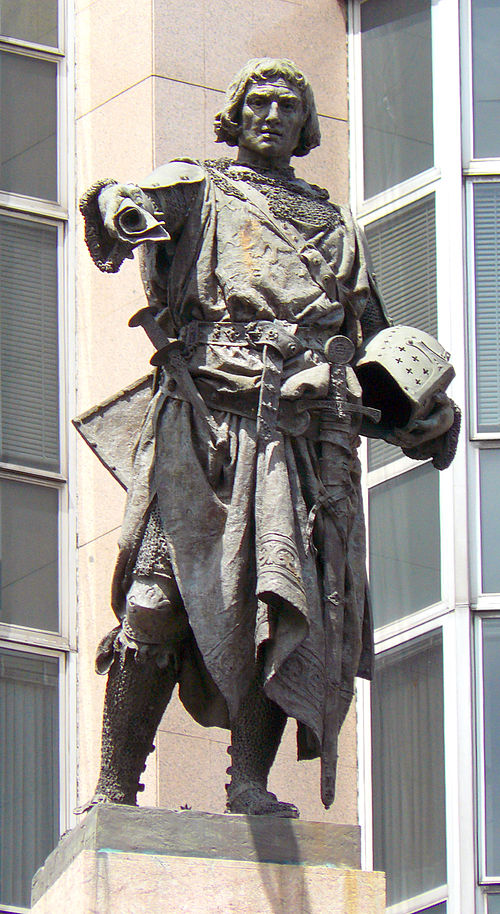
Fue una de las primeras villas que nacieron de un gran impulso fundacional llevado a cabo por los señores de Vizcaya durante el siglo XIV que creó el 70 % de las villas vizcaínas, entre ellas Plencia —1299-, Portugalete —1322—, Ondárroa —1327—, Lequeitio —1335—, Munguía y Larrabezúa —1376—. Don Diego López de Haro V fundó la villa de Bilbao mediante una carta fundacional, o Carta Puebla, fechada en Valladolid el 15 de junio de 1300 y confirmada por el rey Fernando IV de Castilla en Burgos el 4 de enero de 1301. El señor de Vizcaya estableció la nueva villa en la orilla derecha de la ría de Bilbao, en terrenos de la anteiglesia de Begoña y le otorgó el Fuero de Logroño, conjunto de derechos y privilegios, que posteriormente resultarían fundamentales en su desarrollo. Y así, en la carta fundacional de Bilbao proclama:
«En el nombre de Dios y de la virgen bienaventurada Santa María: Sepan por esta carta quantos la vieren y oyeren como yo Diego López de Haro, señor de Vizcaya en uno con mio fijo Don Lope Díaz y con placer de todos los Vizcaynos, fago en Bilvao de parte de Begoña nuevamente población y villa qual dicen el puerto de Bilvao...».
En 1310 María Díaz de Haro, sobrina de Don Diego y nueva Señora de Vizcaya concede una nueva carta de poblamiento que amplía aún más los privilegios comerciales de la Villa, convirtiéndola en paso obligatorio de todo el comercio de Castilla hacia el mar. Así, esta segunda Carta Puebla establecía que el camino de Orduña a Bermeo, por entonces la ruta comercial más importante del señorío, pasara por Bilbao (Puente de San Antón) en vez de por Echévarri, dando acceso directo al mar a las mercancías, fortaleciendo el poderío comercial de Bilbao en detrimento de Bermeo que hasta entonces había sido la Villa más próspera. Además, también le concedió la exclusiva del comercio entre Las Arenas y Bilbao. En 1372 el futuro Juan I de Castilla extendió aún más los privilegios dejando francas las salidas y entradas de mercancías desde y hacia la Villa y concentrando también el transporte de hierro (no será hasta mediados del siglo XVII cuando el transporte de lanas se desvía de Santander a Bilbao).
Demografía

Bilbao cuenta con una población de 351 124 habitantes (INE 2025).
Los primeros datos verosímiles sobre su población son posteriores a 1550. Se sabe que en 1530 Vizcaya sumaba unos 65 000 habitantes, cifra que pudo haber mermado con las pestes que azotaron Bilbao y otras villas del Señorío en 1517, 1530, 1564-68 y 1597-1601, siendo esta última especialmente devastadora. Esta tendencia de situaciones adversas para el crecimiento demográfico se mantuvo hasta el siglo XIX. A partir de entonces, la urbe experimentó un crecimiento exponencial hasta principios de la década de 1980, en la que, tras alcanzar su pico máximo con 433 115 habitantes, se desanexionaron el municipio de Erandio y el Valle de Asúa, lo que supuso la correspondiente pérdida de sus pobladores.
Pirámide de población
La estructura de la población es típica en el régimen demográfico moderno, con una evolución hacia un envejecimiento de la población y una disminución de la natalidad anual.
Población extranjera
El 1 de enero de 2016, el número de personas extranjeras fue de 25 695 personas. Bolivia sigue siendo la principal nacionalidad de población extranjera de Bilbao y supone un 10,9 % de la población extranjera total. Como sucediera el año anterior, las siguientes nacionalidades más presentes son Marruecos (10,2 %) y Rumanía (9,6 %). El cambio llegó en la población China (7,5 %) que adelantó a Colombia (6 %) en términos relativos. También Paraguay (5,6 %) presenta un aumento en su presencia, como Nicaragua (4,3 %) y Nigeria (3,3 %). El resto de nacionalidades, en ningún caso, superan el 3 % de la población total.
Proyecciones demográficas
El Ayuntamiento de Bilbao elaboró un estudio en 2013 en el que proyectaba varios datos demográficos sobre la ciudad a corto y largo plazo. Según el estudio, Bilbao contaría con 322 360 habitantes en 2030, un 7,9 % menos. Todos los distritos verían su población reducida excepto Ibaiondo.
Economía

Bilbao ha sido el núcleo económico del País Vasco desde los tiempos del Consulado, principalmente gracias al comercio en su puerto de productos castellanos, mas no fue hasta el siglo XIX cuando experimentó un desarrollo notable, basado en la explotación de minas férreas y la industria siderúrgica, que promovieron el tráfico marítimo, la actividad portuaria y la construcción de barcos. Durante estos años también hace su aparición el Banco de Bilbao, fundado en Bilbao en 1857; el Banco de Vizcaya se crea posteriormente en 1901, también en Bilbao. Ambas entidades se fusionaron en 1988, dando paso a la corporación BBV, y posteriormente en 1999, esta entidad se fusionó a su vez con el grupo bancario Argentaria, dando lugar al banco actual (2009) denominado BBVA. Las cajas de ahorro que se crearon a nivel local, Caja de Ahorros Municipal de Bilbao (1907), y provincial, Caja de Ahorros Provincial de Vizcaya (1921), se fusionarían después en 1990 y formarían la Bilbao Bizkaia Kutxa o BBK. La Cámara de Comercio, Industria y Navegación de Bilbao se creó en 1886 y la Bolsa de Bilbao se puso en marcha el 21 de julio de 1890.
Puerto
Su puerto estuvo emplazado en lo que ahora es el Arenal, a pocos metros del Casco Viejo, hasta los últimos años del siglo XIX. En 1902 se construyó el Puerto exterior en la desembocadura de la ría en el municipio de Santurce y posteriores ampliaciones derivaron en el denominado «Superpuerto», que en los años 1970 reemplazó al ubicado en los muelles, con excepción a los ubicados en el barrio de Zorroza, todavía en actividad, dejando el Canal de Deusto solo para barcos de recreo.
En la actualidad, posee un puerto comercial de primer orden y se encuentra entre los cinco más importantes de España. En 2007 tuvo un tráfico de 40 millones de toneladas, siendo Rusia y Brasil los principales destinos. En el primer semestre de 2008 transportó más de 67 000 pasajeros y recibió 2779 buques. Esta actividad remitió 419 millones de euros al PIB vasco y genera casi 9500 puestos de trabajo.
Administración y política

La villa de Bilbao es la capital de la provincia de Vizcaya y por lo tanto se encuentran en ella los entes administrativos de ámbito provincial, tanto dependiente del gobierno autonómico como del Estado. Por parte de la comunidad autónoma del País Vasco hay una delegación provincial de cada una de las Consejerías de Gobierno, coordinadas por un delegado; por parte del Gobierno de España se sitúa la Subdelegación, dependiendo del delegado del Gobierno en la comunidad autónoma. También se asienta en la ciudad la Diputación Foral de Vizcaya.
Gobierno municipal
La administración política se realiza a través de su ayuntamiento de gestión democrática cuyos componentes se eligen cada cuatro años por sufragio universal. El censo electoral está compuesto por todos los residentes empadronados en la villa mayores de 18 años y nacionales de España y de los otros países miembros de la Unión Europea. Según lo dispuesto en la Ley del Régimen Electoral General, que establece el número de concejales elegibles en función de la población del municipio, la corporación municipal está formada por 29 concejales. Se compone de un órgano Ejecutivo municipal y un Pleno municipal con funciones legislativas. El primero lo integran el alcalde y la denominada Junta de Gobierno de la villa de Bilbao. Esta Junta «colabora de forma colegiada en la función de dirección política que al alcalde corresponde y ejerce las funciones ejecutivas y administrativas que le atribuyen las leyes». El número de miembros de la Junta no puede superar al tercio de los miembros del Pleno —por lo que se compone de un máximo de nueve personas— y el alcalde puede nombrarlos y separarlos libremente.
Por su parte, el pleno municipal es el «órgano de máxima representación política de la ciudadanía en el gobierno municipal, apareciendo configurado como órgano de debate y de adopción de las grandes decisiones estratégicas a través de la aprobación de los reglamentos de naturaleza orgánica y otras normas generales, de los presupuestos municipales, de los planes de ordenación urbanística, de las formas de gestión de los servicios, etc., y de control y fiscalización de los órganos de gobierno». Se compone de 29 ediles y la presidencia recae en el alcalde, si bien puede delegar esta función cuando lo considere oportuno. Están constituidos en partidos políticos, los cuales se reparten de la siguiente manera: Partido Nacionalista Vasco, 13 ediles; la coalición Euskal Herria Bildu, 4 concejales; el Partido Socialista de Euskadi-Euskadiko Ezkerra, 4 concejales; Partido Popular, 4 concejales; Udalberri, 2 concejales y Ganemos Bilbao, 2 concejales. Tras el pacto de gobierno que alcanzaron el Partido Nacionalista Vasco y el Partido Socialista de Euskadi-Euskadiko Ezkerra (PSOE), fue elegido como alcalde Juan Mari Aburto.
Patrimonio

Arquitectura civil
La casa consistorial de Bilbao o casa de la villa de Bilbao es el principal edificio en el que se asienta su ayuntamiento. Inaugurado el 17 de abril de 1892, obra del arquitecto municipal Joaquín Rucoba, quien lo diseñó con un estilo ecléctico. Para adornar el exterior, Rucoba se inspiró en la arquitectura pública de la Tercera República francesa. El edificio consta de un eje principal, en el que se ubica el balcón principal y tres arcos con ocho columnas, coronado por un campanario. La arcada comprende dos niveles; en el superior se encuentran bajorrelieves de cinco personajes destacados de la historia bilbaína: su fundador, Diego López V de Haro, el cardenal Antonio Javier Gardoqui, el almirante Juan Martínez de Recalde, Tristán de Leguizamón y el economista Nicolás de Arriquibar. Cuatro esculturas flanquean el edificio, dos maceros y dos heraldos. En la escalinata principal, destacan dos esculturas que representan la ley y la justicia. La tradición cuenta que el quinto escalón de esta escalinata hace de referencia a la altura oficial de la urbe, 8,804 m s. n. m.
El Palacio Euskalduna (Euskalduna Jauregia en euskera) se encuentra junto a su ría, ocupando parte de los terrenos sobre los que se levantaron los Astilleros Euskalduna. El proyecto fue diseñado por los arquitectos Federico Soriano y Dolores Palacios. El edificio es utilizado para la realización de todo tipo de congresos así como actividades musicales. Fue iniciada su construcción en 1994 y fue inaugurado en febrero de 1999. La superficie total del proyecto supera 2,5 ha necesarios para albergar una Sala Principal para 2200 localidades, tres salas menores, ocho salas de ensayo, siete salas para conferencias e instalaciones complementarias. Junto al Palacio Euskalduna hay varias obras de arte urbano, como el conocido bosque de árboles, que se trata de unas farolas en forma de árbol colocadas en grupos, que forman una especie de bosque de árboles.
Servicios

Energía
Aquí tiene su sede la empresa eléctrica Iberdrola que se creó en 1992 al fusionarse las empresas Iberduero e Hidroeléctrica Española, que se ocupa tanto de la producción como de la distribución de electricidad.
En su entorno, concretamente en Santurce, hay una central térmica de 935 MW, otra de ciclo combinado de 400 MW, y existe una central de ciclo combinado de 800 MW instalada en la localidad de Ciérvana llamada Bahía de Bizkaia Electricidad. La electricidad producida en estas centrales eléctricas es evacuada a la subestación eléctrica de Güeñes por parte de la empresa Red Eléctrica, empresa que se ocupa en toda España del transporte de la energía eléctrica entre las centrales eléctricas y las áreas de consumo.
Existe otra central de ciclo combinado instalada en la localidad de Amorebieta, de 750 MW, llamada Bizkaia Energia, cuya energía es evacuada a través de la subestación de Gatica, que se construyó para conectar, así mismo, la fallida Central nuclear de Lemóniz.
El suministro de todos los combustibles derivados del petróleo que se consumen en toda su área metropolitana, tanto en forma líquida (gasolina y gasóleo) como gas butano, proceden de la refinería de petróleo que la empresa Petronor tiene en la costa vizcaína, concretamente en los municipios de Musques y Abanto y Ciérvana. Petronor se fundó en Bilbao en 1968, y los socios que componían la empresa en 2008 eran: Repsol S.A. (85,98 %) y la Bilbao Bizkaia Kutxa (14,02 %).
Petronor, es la mayor refinería española con una capacidad de tratamiento de once millones de toneladas al año. Sus instalaciones están unidas por oleoductos a los atraques portuarios de Punta Lucero, distantes 5 km, y a la cercana terminal que la Compañía Logística de Hidrocarburos (CLH) tiene en Santurce, a través de la cual se conecta con la red española de oleoductos y a diversas industrias del entorno, y con camiones cisterna se suministran los productos a todo el País Vasco.
Cultura

Si bien en la capital se reproducen una gran mayoría de los elementos fundamentales de la cultura vasca como el uso de la txapela, existen sin embargo ciertas particularidades que definen rasgos propiamente bilbaínos. Entre estas particularidades se encuentran palabras típicas como sinsorgo, coitao, ganorabako, sirris o mocordo; además de las bilbainadas, un género musical.
En la cultura popular española, se definió un perfil jocoso de sus habitantes empleado básicamente en chistes. Algunos de estos estereotipos los representan como seres toscos, arrogantes, exagerados y en ocasiones con fuerzas u otras capacidades sobrehumanas, capaces de ingerir enormes cantidades de chuletones o bebidas alcohólicas y pagar grandes sumas de dinero, incluso de manera altruista. También se presentan las figuras del chiquitero —bebedor de chiquitos, pequeños vasos de vino— y del chirene, un personaje cómico y socarrón. Sin embargo, estas expresiones culturales están cayendo progresivamente en desuso a raíz de la modernización urbana y el papel de los medios de comunicación.
Museos
Su oferta museística comprende más de una decena de instituciones que abarcan distintas ramas del arte, las ciencias y el deporte.
Destaca el reconocido Museo Guggenheim Bilbao, de la Fundación Solomon R. Guggenheim, inaugurado el 19 de octubre de 1997 y obra del arquitecto canadiense Frank Gehry. Su colección permanente se basa en las artes visuales posteriores a la segunda mitad del siglo XX y de la actualidad, con autores como Richard Serra y Jeff Koons, aunque en distintas exposiciones temporales se exhibieron obras de temática más variada, como un análisis del arte ruso o grabados de Alberto Durero.
Otra importante pinacoteca es el Museo de Bellas Artes creado en 1908, que recoge obras realizadas desde el siglo XII hasta la actualidad. Su repertorio anterior a 1900 se centra principalmente en artistas españoles y flamencos (El Greco, Zurbarán, Murillo, Goya, Van Dyck) y así mismo alberga el repertorio más nutrido de arte vasco, con obras desde el siglo XIX hasta la actualidad. Cuenta además con un llamativo repertorio de vanguardias internacionales, desde el postimpresionismo de Paul Gauguin hasta el pop art y la figuración expresionista de Francis Bacon.
Kaynak: Wikipedia – Bilbao · CC BY-SA 4.0
Coğrafi konum

Bilbao, İspanya'nın kuzey kıyılarında Atlantik Okyanusu'nun Biskay Körfezi sahilinde Bask Bölgesi'nin kuzeydoğusunda konumlanmıştır. Şehir Nervion Nehri boyunca yerleşmiştir. Bu nehrin kıyısında Sanayi Devrimi sırasında bölgeye refah getiren sayısız fabrika ve iş yeri de bulunmaktadır. Bilbao aynı zamanda, bu nehrin gelgit ile çok derin ve bir fiyord gibi çok kara içerisine girmiş olan "Ria de Bilbao" körfezi üzerinde bir liman şehridir.
Bilbao şehrinin bazı önemli İspanya şehirlerinde uzaklıkları şu listeden incelenebilir:
Demografi
Bilbao belediye sınırları içinde nüfus (2010 tahmini) itibarıyla 353.187 kişi olup nüfus yoğunluğu 8688,5 kişi/km² olur. Böylelikle Zaragoza, nüfus itibarıyla şehir sıralamasında Bask bölgesinde 1. sırayı; tüm İspanya'da 11. sırayı alır.
Fakat esas şehir yanındaki varoşları ile "Büyük Bilbao" oluşur ve Büyük Bilbao'ya resmen "comark" olma statüsü verilmiştir. Bask Bölgesi'nin nüfusunun yaklaşık yarısının yaşadığı "Büyük Bilbao", ekonomik ve endüstri açısından bölgenin en aktif kısmıdır. Büyük Bilbao'nın nüfusu 875,552 kişi olarak tahmin edilmektedir. Büyük Bilbao bu nüfusuyla İspanya'da bulunan büyük metropoliten şehirler arasında 5. sırayı almaktadır.
Bilbao belediye sınırları içinde nüfusun gelişmesi şu gösterimde izlenebilir:
Kaynak: INE - Instituto Nacional de Estadística, İspanya
Kardeş şehirler
Bilbao'nun şu kardeş şehirleri bulunmaktadır:
Kaynak: Wikipedia – Bilbao · CC BY-SA 4.0
Toponymy and symbols
The official name of the town is Bilbao, as known in most languages of the world. Euskaltzaindia, the official regulatory institution of the Basque language, has agreed that between the two possible names existing in Basque, Bilbao and Bilbo, the historical name is Bilbo, while Bilbao is the official name. Although the term Bilbo does not appear in old documents, in the play The Merry Wives of Windsor by William Shakespeare, there is a reference to swords presumably made of Biscayan iron which he calls "bilboes", suggesting that it is a word used since at least the sixteenth century.
There is no consensus among historians about the origin of the name. Generally accepted accounts state that prior to the 12th century, the independent rulers of the territory, named Lords of Zubialdea, were also known as Lords of Bilbao la Vieja ("Old Bilbao"). The symbols of their patrimony are the tower and church used in the shield of Bilbao to this day. One possible origin was suggested by the engineer Evaristo de Churruca. He said that it was a Basque custom to name a place after its location. For Bilbao this would be the result of the union of the Basque words for river and cove: Bil-Ibaia-Bao. The historian José Tussel Gómez argues that it is just a natural evolution of the Spanish words bello vado, beautiful ford. On the other hand, according to the writer Esteban Calle Iturrino, the name derives from the two settlements that existed on both banks of the estuary, rather than from the estuary itself. The first, where the present Casco Viejo is located, would be called billa, which means stacking in Basque, after the configuration of the buildings. The second, on the left bank, where now Bilbao La Vieja is located, would be called vaho, Spanish for mist or steam. From the union of these two derives the name Bilbao, which was also written as Bilvao and Biluao, as documented in its municipal charter. An -ao ending is also present in nearby Sestao and Ugao, that could be explained from Basque aho, "mouth".
History

Prehistory
Remains of an ancient settlement were found on the top of Mount Malmasín, dating from around the 3rd or 2nd century BC. Burial sites were also found on mounts Avril and Artxanda, dated 6,000 years old. Some authors identify the old settlement of Bilbao as Amanun Portus, cited by Pliny the Elder, or with Flaviobriga, by Ptolemy.
Medieval Bilbao
Ancient walls, which date from around the 11th century, have been discovered below the Church of San Antón. Bilbao was founded at the very end of the thirteenth century, kick-starting a period in the fourteenth century, during which approximately three-quarters of the Biscayan cities were developed, among them Portugalete in 1323, Ondarroa in 1327, Lekeitio in 1335, and Mungia and Larrabetzu in 1376. Diego López V de Haro, then third Lord of Biscay, founded Bilbao through a municipal charter dated in Valladolid on 15 June 1300 and confirmed by King Ferdinand IV of Castile in Burgos, on 4 January 1301. Diego López established the new town on the right bank of the Nervión river, on the grounds of the elizate of Begoña and granted it the fuero of Logroño, a compilation of rights and privileges that would prove fundamental to its later development.
In 1310 María Díaz I de Haro, niece of Diego López V and Lady of Biscay, grants a new municipal charter to the city, which extends its commercial privileges even further, transforming the city in a mandatory stop for all the trade coming from Castile towards the sea. This second charter established that the road from Orduña to Bermeo, at the time the most important trade route in the lordship, had to traverse the San Antón Bridge in Bilbao instead of the pass in Etxebarri, as it did until then. This strengthened the position of Bilbao as a trading post, in detriment of Bermeo, city which until then had acted as the main port of the territory. In addition, Bilbao was granted exclusive rights to all trade between the city and Las Arenas. In 1372, John I of Castile strengthened even more the city's position by naming Bilbao a free port and granting it special privileges concerning the trade of iron. This caused Bilbao to become an important port, particularly due to its trade with Flanders and Great Britain.
Geography

Bilbao is located near the northern edge of the Iberian Peninsula, about 16 kilometres (10 mi) from the Bay of Biscay. It covers an area of 40.65 square kilometres (15.70 sq mi), of which 17.35 square kilometres (6.70 sq mi) are urban and the remaining 23.30 square kilometres (9.00 sq mi) consist of the surrounding mountains. The official average altitude is 19 metres (62 ft), although there are measurements between 6 metres (20 ft) and 32 metres (105 ft). It is also the core of the comarca of Greater Bilbao. It is surrounded by the municipalities of Derio, Etxebarri, Galdakao, Loiu, Sondika, and Zamudio to the north; Arrigorriaga and Basauri to the west; Alonsotegi to the south; and Barakaldo and Erandio to the east.
Bilbao is located on the Basque threshold, the range between the larger Cantabrian Mountains and the Pyrenees. The soil is predominantly composed of mesozoic materials (limestone, sandstone, and marl) sedimented over a primitive paleozoic base. The relief of the province is dominated by NW-SE and WNW-ESE oriented folds. The main fold is the anticline of Bilbao which runs from the municipality of Elorrio to Galdames. Inside Bilbao there are two secondary folds, one in the northeast, composed of Mounts Artxanda, Avril, Banderas, Pikota, San Bernabé, and Cabras; and other in the south, composed of Mounts Kobetas, Restaleku, Pagasarri and Arraiz. The highest point in the municipality is Mount Ganeta, of 689 metres (2,260 ft), followed by Mount Pagasarri, of 673 metres (2,208 ft), both on the border with Alonsotegi.
Hydrology
The main river system of Bilbao is also the hydrological artery of Biscay. The rivers Nervión and Ibaizabal converge in Basauri and form an estuary named variously "estuary of Bilbao", "of the Nervión", "of the Ibaizabal", or "of the Nervión-Ibaizabal". The estuary runs for 15 kilometres (9.3 mi) and with a low flow (with an average of 25 m3 (883 cu ft) per second). Its main tributary is the river Cadagua, which rises in the Mena valley and has a basin of 642 square kilometres (248 sq mi), mostly lying in the neighbouring province of Burgos. This river is also the natural border between Bilbao and Barakaldo.
Demographics
According to INE, the population of Bilbao is 347,342 people as of 2024, distributed on a land area of 40.59 km2 (16 sq mi), making Bilbao the largest city by population of the Basque Autonomous Community and of the Basque Country as a whole. Bilbao makes the main component of the Bilbao metropolitan area, with a population of 1,037,847 people.
The first credible data on the population of Bilbao are post-1550. It is known that in 1530 Biscay had approximately 65,000 inhabitants, a number that could have been reduced by plagues that struck the city in 1517, 1530, 1564–68, and 1597–1601, the last being especially devastating. This trend for periodic reverses in population growth was maintained until the nineteenth century. Since then, Bilbao has experienced an exponential growth in population thanks to industrialisation. After a peak of 433,115 inhabitants in 1982, the municipalities of the Txorierri valley were removed from Bilbao, with the corresponding loss of their population.
Spanish is the most spoken language in the city, followed by the Basque language. According to the city government of Bilbao, at least 51% of the population can speak "some Basque", while 29% consider themselves to be fluent.
Migration
Out of the 355,731 people residing in Bilbao in 2009, only 114,220 (32.1%) were born inside the municipality. Of the remainder, 114,908 were born in other Biscayan towns, while 9,545 were born in the other two Basque provinces, and 85,789 came from the rest of Spain (mainly Castile-León and Galicia).
As of 2024, the foreign-born population of the city is 56,629, equal to 16.3% of the total population. As of 2007, there are 127 different nationalities registered in Bilbao, although 60 of them represent fewer than 10 people each. As of 2024, the largest foreign communities are Colombians and Moroccans, with 9,743 and 5,196 respectively. Other nationalities with more than 1,000 inhabitants are Bolivians (4,309), Venezuelans (4,244), Nicaraguans (3,645), Paraguayans (2,657), Ecuadorians (1,939) and Romanians (1,797).
Government
The city of Bilbao is the capital of the province of Biscay and as such it is home of the administrative entities that pertain to the provincial administration, both from the autonomous and central governments. Settled in the city are the provincial delegations of the different departments of the Basque autonomous government, each coordinated by a representative. In addition, the Government of Spain has the official Government Subdelegation in the city.
Municipal government
Bilbao is a municipality and has a mayor-council government system. The municipal government is elected for four-year terms by universal suffrage and it is divided into two branches, executive and legislative. The legislative side consists of a municipal plenum composed of 29 councillors. These councillors represent the different political parties elected in the local elections, for which can vote all residents registered in the city who are citizens of Spain or of any member state of the European Union. The executive branch is composed of the mayor and a board of governors. The number of members of the board cannot be more than a third the number of members of the legislative plenum and the mayor can appoint them at his or her own discretion.
Since 1892 the seat of the government has been the Bilbao City Hall, located on the centric Ernesto Erkoreka Plaza and by the Estuary of Bilbao. It is the fourth city hall building to have been used since the year 1300. The first three city halls were located by the San Antón Church but were destroyed due to floodings. The current building was designed by the Spanish architect Joaquín Rucoba in Baroque style and was built in the former site of the San Agustín Monastery, which was destroyed during the First Carlist War. Since the Spanish transition to democracy, the city has been governed by the Basque Nationalist Party, often with support of the Socialist Party of the Basque Country. Iñaki Azkuna served as mayor from 1999 until his passing in 2014, when he was replaced by Ibon Areso. Azkuna was awarded the World Mayor prize in 2012. Since the 2019 municipal election, the councillors of the plenum have the following political distribution: 14 seats for the Basque Nationalist Party, 5 seats for the Socialist Party of the Basque Country, 4 seats for the EH Bildu coalition, 3 seats for Udalberri and 3 seats for the People's Party. The mayor is Juan Mari Aburto, chosen with 19 votes from the Basque Nationalist Party and the Socialist party.
Economy

The Bilbao metropolitan area comprises about 47% of the total population of the Basque autonomous community, out of which a 15% is registered in the municipality of Bilbao. The comarca of Greater Bilbao, in which the city occupies a central position, has a GDP per capita of €30,860, higher than the Spanish and European Union averages. The Bilbao metropolitan area has a nominal GDP amounting to $36,9 billion. Bilbao has been the economic centre of the Basque autonomous community since the original establishment of the Consulate of the Sea in the city in the 16th century, mostly thanks to the commerce in Castilian products on the town's port. It was in the 19th century when the city experienced its biggest economic development, mainly based on the exploitation of the nearby iron mines and siderurgy, both of which promoted maritime traffic and port activity and eventually the development of a very important shipbuilding industry.
Banking
Banking became an important sector with the establishment of the Bank of Bilbao (Spanish: Banco de Bilbao) in 1857 and the Bank of Biscay (Spanish: Banco de Vizcaya) in 1901. These two entities merged in 1988 creating the BBV, which finally merged with Argentaria bank in 1999, creating the current multinational corporation, the BBVA. The savings banks that were established locally, the Municipal Savings Bank of Bilbao (Spanish: Caja de Ahorros Municipal de Bilbao) in 1907 and the Provincial Savings Bank of Biscay (Spanish: Caja de Ahorros Provincial de Vizcaya) in 1921, would merge in 1990 to form the Bilbao Bizkaia Kutxa (BBK), which would merge again in 2012 with other Basque financial entities (Kutxa and Caja Vital Kutxa) to form Kutxabank. There is also the Chamber of Commerce, Industry and Navigation of Bilbao and the Stock Exchange Market of Bilbao, founded in 1890.
Cityscape

Urban planning
In its beginnings, Bilbao only had three streets (Somera, Artecalle, and Tendería) surrounded by walls located where Ronda street now stands. Inside this enclosure, there was a small hermitage dedicated to the Apostle Saint James (the current St. James' Cathedral), which pilgrims visited on their way to Santiago de Compostela. In the fifteenth century, four more streets were built, forming the original Zazpikaleak or "Seven Streets". In 1571, after several floods and a major fire in 1569, the walls were demolished in order to allow the expansion of the town.
In 1861, engineer Amado Lázaro projected an ensanche inside the then-municipality of Abando with wide avenues and regular buildings, that took into account the hygienic ideas of the time. The project was mostly based on Barcelona's Eixample, designed by Ildefons Cerdà. However, the project was dropped by the Bilbao City Council after considering it "utopian and excessive" because of its high cost, though of great quality. Furthermore, Lázaro had calculated the demographic growth of the town was based on the previous three centuries, a provision that eventually would not conform to reality.
The next large urban change in Bilbao would come in 1876, when the capital annexed (in several stages) the neighbouring municipality of Abando. The new ensanche project was planned by a team made of architect Severino de Achúcarro and engineers Pablo de Alzola (elected Mayor that same year), and Ernesto de Hoffmeyer. Unlike Lázaro's, this project was significantly smaller, compassing 1.58 km2 (0.61 sq mi) against the original 2.54 km2 (0.98 sq mi). It also featured a not so strict grid pattern, a park to separate the industrial and residential areas and the Gran Vía de Don Diego López de Haro, the main thoroughfare, where many relevant buildings were located, such as the Biscay provincial government hall or the BBVA Tower. By the end of the 1890s, this widening was half completed and already filled, so a new extension was planned by Federico Ugalde.
Culture

Bilbao was appointed a "City of Design" by UNESCO in 2014 and has been part of the Creative Cities Network since then.
Theatres
The main hall of the city is the Arriaga Theatre, reopened in 1985 as a municipal venue with a varied repertoire that includes dancing, opera, live music and theatre. Also very active are the Campos Elíseos Theatre and the Euskalduna Concert Hall. Other important venues include La Fundición, dedicated to contemporary dances and theatre; the Pabellón 6, the Sala BBK and the Azkuna Zentroa.
Museums
Bilbao has more than a dozen museums covering a range of fields including art, science, and sport, which have played a central role in Bilbao being named one of the most creative cities in the world.
The Guggenheim Museum Bilbao, part of the Solomon R. Guggenheim Foundation, was inaugurated on 19 October 1997 and is work of the Canadian architect Frank Gehry. The museum's permanent collection is centred in the visual arts of the second half of the 20th century and the present, with relevant artworks from Richard Serra and Jeff Koons, although including as well temporary exhibitions with a more varied nature, like Russian art or engravings from Albrecht Dürer.
Another important museum is the Bilbao Fine Arts Museum, first established in 1908 and housing a notable collection of Spanish and European work from the 12th century to present times. The collection from before the 20th century is centred mainly around Spanish and Flemish artists such as El Greco, Francisco de Zurbarán, Bartolomé Esteban Murillo, Francisco Goya and Anthony van Dyck. The museum also holds one of the best collections of Basque art, with works from the 19th century to present times. It has an eye-catching collection of avant-garde art, from the Post-Impressionism of Paul Gauguin to pop art and the expressionism of Francis Bacon.
Transport

Roads and highways
Bilbao is a relevant transport hub for northern Spain. Bilbao is connected to three major motorways and a series of minor roads of national and provincial level. The city lies on two international roads, the European route E70 that follows the coast of the Bay of Biscay and the cities of Santander and Gijón to the west and with Eibar, San Sebastián and Bordeaux to the east. The European route E80 connects the city with inner Spain to the south, including Burgos and Salamanca and continuing to Lisbon, and Toulouse to the north. The AP-68 motorway (European road E-804) starts in the city, joining with Vitoria-Gasteiz, Logroño and ending in Zaragoza.
The city is connected with the regions of Cantabria, Asturias and Galicia via the A-8 motorway and with Durango, Eibar, San Sebastián and the French border via the AP-8 motorway, which is a toll road. The AP-68 toll motorway to the south is the main road connecting Bilbao with southern Spain and the Mediterranean coast, connecting in Miranda de Ebro with the A-1 to Madrid and in Zaragoza with the AP-2 to Barcelona.
Minor roads passing through Bilbao or starting in the city itself include the national road N-634 which connects San Sebastián with Santiago de Compostela and runs parallel to the A-8 and AP-8 motorways. The regional road BI-631 connects Bilbao with Bermeo, while the BI-626 joins the city with Balmaseda. The city is circled by the BI-625 and N-637 roads, which form a half-ring to the east, and the N-634 and A-8 to the west.
The city's main arteries the Gran Vía de Don Diego López de Haro, which crosses the financial and business district of Abando and connecting it with the Casco Viejo to the east and the San Mamés area to the west. The Sabino Arana Avenue and Juan Antonio Zunzunegui Avenue provide a direct route between the central districts and the motorways while Autonomía Street joins the southern districts on an east-west direction. The city has 14 bridges connecting opposite sides of the Estuary of Bilbao and the Kadagua river, including the La Salve and Euskalduna bridges, as well a series of tunnels under the Mount Artxanda.
Infrastructure

Healthcare
The public healthcare system is served and managed by the Basque healthcare system (Osakidetza), which has a network of medical centres established across the city. The most relevant hospital of the city is the Basurto Hospital, located in the Basurto-Zorroza district. It was opened in 1908 after ten years of construction, and it was built due to the fast increase of population in the late 19th century. Its design was based on the Eppendorf Hospital of Hamburg, in (Germany), one of the most modern at the time. In 2008 the hospital was named the best hospital in customer support in Spain.
However, the two largest hospitals that provide healthcare services to the inhabitants of the city are located outside of the city limits: the University Hospital of Gurutzeta/Cruces in neighbouring Barakaldo and the Galdakao-Usansolo Hospital in Galdakao. Other minor public hospitals located in the city include the Santa Marina Hospital and the Hospital of Urduliz, located in the metropolitan area.
Utilities
The headquarters of Iberdrola, a multinational electric utility company are located in Bilbao. The company was created in 1992 after the merging of Iberduero and Hidroeléctrica Española and it is in charge of production and distribution of electricity. There are two thermal power stations located in the city's surroundings, one in Santurtzi and the other in Zierbena. The electricity produced in both these stations is then transferred to the electrical substation of Güeñes by the company Red Eléctrica de España, which is the company responsible of moving electricity from the production stations to the final consumers. There is a combined cycle power station in the municipality of Amorebieta called Bizkaia Energia, whose energy is transferred to the substation of Gatika.
The supply of all oil-based fuels distributed in the whole metropolitan area (gasoline, diesel fuel and butane) are produced in the oil refinery owned by Petronor in the municipalities of Muskiz and Abanto Zierbena. Petronor is a large oil company founded in Bilbao in 1968 and it currently comprises two partners, Repsol (85.98%) and Kutxabank (14.02%).
Education

The Basque Country has a bilingual education system, with students able to choose between four linguistic models: A, B, D, and X, which differ in the prevalence of Basque or Spanish as the spoken and written language used in classes. In Bilbao, there is a prevalence of model D (where Basque is the vehicle language and Spanish is taught as a subject) in Primary School, while Compulsory Secondary Education students favour model B (where some subjects are in Basque and other in Spanish). Finally, 67% of Baccalaureate students choose model A (in which Spanish is the vehicle language and Basque is a subject). English is the most widespread foreign language taught, being the option for 97% of pre-university students.
Higher education
Two universities are seated in Bilbao. The older is the University of Deusto, founded by the Society of Jesus in 1886. It took its name from the then independent municipality of Deusto, annexed to Bilbao in 1925. It was the only higher education institute in the borough until the establishment in 1968 of the University of Bilbao, later to become the University of the Basque Country in 1980. This public university, which has a presence in the three provinces of the autonomous community, has its main Biscayan campus in the municipality of Leioa, although the Technical and Business faculties are based in Bilbao. Since 2014, Mondragon University has also a presence in the city through the innovation and entrepreneurial centre Bilbao Innovation Factory. In 2015, the offer of higher education in the city was expanded with the foundation of Dantzerti, the Higher School of Dramatic Arts and Dance of the Basque Country.
Sport

As in the rest of Spain, football is the most popular competitive sport, followed by basketball. Some people are interested in basque sports, one of the oldest sports in Spain. One could enjoy a Basque pelota match in Bizkaia Frontoia, Bilbao. In addition, Bilbao offers many outdoor activities owing to its location by the sea amid the hilly countryside. Hiking and rock climbing in the nearby mountains are very popular. Watersports, especially surfing, are practised on the beaches of nearby Sopelana and Mundaka.
Clubs
The main football club is Athletic Club, commonly known as Athletic Bilbao in English. It plays at the new San Mamés stadium, which opened in 2013 and seats 53,332 spectators.
Athletic Bilbao was one of the founding members of the Spanish football league, La Liga, and has played in the Primera División (First Division) ever since – winning it on eight occasions. Its red and white striped flag can be seen throughout the city. Athletic is noted for its Basque policy, in place since 1911, with only players born in or having a clear connection to the Basque region being allowed to represent the club.
The main basketball club is Bilbao Basket, which plays in the Spanish top division Liga ACB and their home venue is the Bilbao Arena. The main achievements of the clubs were being the runner-up of the Liga ACB during the 2010–2011 season, losing the final series 3–0 against FC Barcelona Bàsquet; as well as the runner-up of the EuroCup Basketball in the 2012–2013 edition, where they lost to the Russian team Lokomotiv Kuban.
Places of interest
The first notion of Bilbao as a tourist destination came with the inauguration of the railway between Bilbao and the coastal neighbourhood of Las Arenas, in the municipality of Getxo in 1872. The connection made Bilbao a minor beach destination.
The real tourist surge though would come much later with the inauguration of the Guggenheim Museum Bilbao in 1997. Thereafter tourist arrivals registered a continued upward trend, reaching over 932,000 visitors in 2018. The trend was exponential considering that in 1995, Bilbao only counted 25,000 tourists. Bilbao also hosts 31% of the total Basque Country visitors, being the top destination of this autonomous community, outranking San Sebastián. The majority of tourists are domestic visitors, coming from Madrid and Catalonia. International travellers are predominantly French, crossing the border just to the east. The others arrive from the United Kingdom, Germany, and Italy. Tourism generates about €300 million yearly for the Biscayan GDP. Bilbao also draws business tourism, having been equipped with facilities like the Euskalduna Conference Centre and Concert Hall, and the Bilbao Exhibition Centre, in nearby Barakaldo.
Kaynak: Wikipedia – Bilbao · CC BY-SA 4.0