
Білгород-Дністровська міська громада
Білгород-Дністровська міська громада — територіальна громада України, в Білгород-Дністровському районі Одеської області з адміністративним центром у місті Білгород-Дністровський.
Government administration · Ukraine · 0 followers
Overview
Білгород-Дністровська міська громада — територіальна громада України, в Білгород-Дністровському районі Одеської області з адміністративним центром у місті Білгород-Дністровський.
Interested in working with us in the future?
Follow to see new jobs and posts in your feed.
No news yet.
About
Білгород-Дністровська міська громада — територіальна громада України, в Білгород-Дністровському районі Одеської області з адміністративним центром у місті Білгород-Дністровський.
Kaynak: Wikipedia · CC BY-SA 4.0
Населені пункти
До складу громади увійшло м. Білгород-Дністровський.
Посилання
Білгород-Дністровська територіальна громада [Архівовано 14 лютого 2022 у Wayback Machine.]
Білгород-Дністровська міська громада // Облікова картка на офіційному вебсайті Верховної Ради України.
Kaynak: Wikipedia – Білгород-Дністровська міська громада · CC BY-SA 4.0
Name
The city of Bilhorod-Dnistrovskyi is also referred to by alternative transliterations from Ukrainian as Bilhorod-Dnistrovsky. Dnistrovskyi was added to differentiate it from Belgorod (in Ukrainian Bilhorod), a city in Russia, when both were a part of the Soviet Union.
Ophiussa (Οφιούσσα), Phoenician colony (meaning "city of snakes" in Greek)
Tyras (Τύρας), Ancient Greek colony (also the Greek name for the River Dniester)
Asprokastron (Ἀσπρόκαστρον, "White Castle"), Greek name in Antiquity and the Middle Ages. Name attested from 944 to 1484 AD.
Maurokastron (Μαυρόκαστρον, "Black Castle"), Greek name of a Roman/Byzantine fort in late antiquity on a site directly opposite Asprokastron, but usually taken together.
Album Castrum ("White Castle"), Latin name
Cetatea Albă ("White Citadel"), Romanian name
Moncastro, Italian corruption of Maurokastron used by Genoese traders and during Genoese rule (14th–15th centuries)
Akkerman, Ottoman Turkish ("White Castle") and Russian name until 1944
Belgorod-Dnestrovskiy, Russian (Белгород-Днестровский, "White city on the Dniester")
Weißenburg, ("White Castle"), German name
During the reign of Burebista, the city was known as Tyras and was incorporated into the Dacian kingdom. The town became part of the Principality of Moldavia in 1359. The fortress was enlarged and rebuilt in 1407 under Alexander the Good and in 1440 under Stephen II of Moldavia. It fell to Ottoman conquest on 5 August 1487.
The city became part of Romania from 1918 to 1940, and once again between 1941 and 1944 and is known in Romanian as Cetatea Albă with other languages using the Turkish name, Akkerman, or variations of the Turkish name. Since 1944 the city has been known as "Bilhorod-Dnistrovskyi" (Білгород-Дністровський), while on Soviet geography maps it is often translated into its Russian equivalent of "Belgorod-Dnestrovskiy" (Белгород-Днестровский), literally "white city on the Dniester".
History

Ancient and medieval period
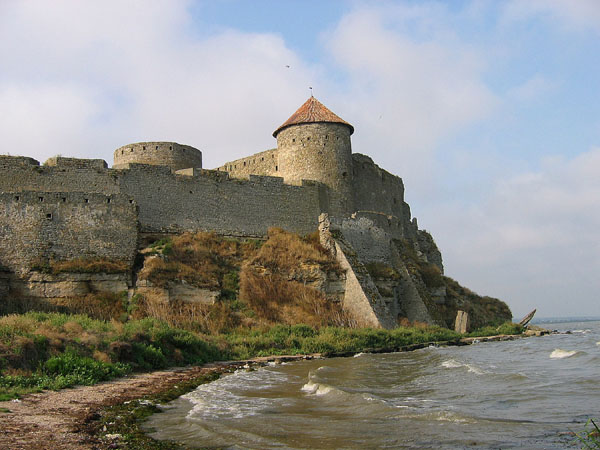
In the 6th century BC, Milesian colonists founded a settlement named Tyras on the future location of Bilhorod-Dnistrovskyi, which later came under Roman and Byzantine rule. In Late Antiquity, the Byzantines built a fortress and named it Asprokastron ("White Castle" - a meaning kept in several languages), but it passed out of their control in the 7th-15th centuries under control of Bulgaria, the cities called Belgorod (white city), as it was the border of the Bulgarian empire.
Slavic tribes of Tiverians and Ulichs inhabited the region during the period of Kyivan Rus'. Between the 12th and 14th centuries the city was used as a haven by princes of Galicia. In the 13th century the site was controlled by the Cumans, and became a center of Genoese commercial activity from c. 1290 on. Briefly held by the Second Bulgarian Empire in the early 14th century, by the middle of the century it was a Genoese colony. Sfântul Ioan cel Nou (Saint John the New), the patron saint of Moldavia, was martyred in the city in 1330 during a Tatar incursion. In 1391, Cetatea Albă was the last city on the right bank of the Dnister to be incorporated into the newly established Principality of Moldova, and for the next century was its second major city, the major port and an important fortress.
In 1420, the citadel was attacked for the first time by the Ottomans, but defended successfully by Moldavian Prince Alexander the Kind.
In the 15th century, the port saw much commercial traffic as well as being frequently used for passenger traffic between central Europe and Constantinople. Among the travellers who passed through the town was John VIII Palaiologos.
Ottoman rule
In 1484, along with Kiliia, Cetatea Albă was the last of the Black Sea ports to be conquered by the Ottomans. The Moldavian prince Stephen the Great was unable to aid in its defence, being under threat of a Polish invasion. The citadel surrendered when the Ottomans claimed to have reached an agreement with Prince Stephen, and promised safe passage to the inhabitants and their belongings; however, most of the city-dwellers were slaughtered. Later, attempts by Stephen the Great to restore his rule over the area were unsuccessful. Cetatea Albă was subsequently a base from which the Ottomans were able to attack Moldavia proper. In 1485, Tatars setting out from this city founded Pazardzhik in Bulgaria. In 1570 (Hijri 977) the town of Akkerman was inhabited by Muslims, Christians and Jews. It had 55 Muslim households in 25 neighbourhoods and 113 Non-Muslim households in 9 neighbourhoods and it was a "has" of the Sultan, a land property that was directly owned by the Sultan. The castle of Akkerman also had a Jewish congregation and a Roma congregation.
Demographics
In 1919, an US officer estimated the population to 35,000, of which he believed 8,000 were Romanian, 8,000 were Jewish, and 5,000 were German. Additional populations included Turks, Greeks, Bulgarians and Russians. According to the 1930 Romanian census, the population of the broader Cetatea Alba County consisted of around 30% Russians, 30% Ukrainians and smaller Romanian and Jewish communities.
According to the 2001 Ukrainian census, the majority of the city's population are Ukrainians (62.88%). Other communities include Russians (28.25%), Bulgarians (3.72%), Moldovans (1.89%), Gagauz (0.41%) and Romanians (0.02%). The language situation is notably different, with self-identified Russian-speakers representing a majority (54.52%), followed by speakers of Ukrainian (42.08%), Bulgarian (1.66%), Moldovan (Romanian) (0.67%) and Gagauz (0.19%).
Geography
Climate
Bilhorod-Dnistrovskyi has a humid continental climate (Köppen: Dfb bordering on Dfa).