
Interested in working with us in the future?
Follow to see new jobs and posts in your feed.
No news yet.

Tarihçe

Yerleşimin kuruluşu kesin olarak bilinmemektedir. Bitlis şehrinde yerleşimin Bitlis Kalesi'nin inşasıyla birlikte başladığı değerlendirilmektedir. Kalenin, Büyük İskender'in komutanı Badlis tarafından MÖ 312 tarihinde inşa ettirildiği ve adına ithafen yerleşime adının verildiği rivayet edilmektedir. Evliya Çelebi de kale adını "İskenderi Bedlis" olarak tanımlamış ve bu adın İskender ve Bedlis adındaki komutanından geldiğini ifade etmiştir. İskender'in ölümünden sonra Seleukos İmparatorluğu'nun hakimiyetinde kalmıştır. Sasani-Roma mücadelesinde sınır hattındaki konumuyla sık sık el değiştirmiş, Roma hakimiyetindeyken 395 yılında yaşanan bölünmeyle Doğu Roma hakimiyetinde kalmıştır. 641 yılında İyaz bin Ganm komutasındaki Râşidîn Halifeliği kuvvetlerince ele geçirilmiştir. Bundan sonraki süreçte Bizans-Arap çekişmesine sahne olan yerleşim Muhammed bin Mervân komutasındaki Emevi kuvvetlerince ele geçirilmiştir. Emeviler'den sonra Abbâsîler'in zayıflamasının ardından Hamdânîler ve sonrasında Mervânîler'in hakimiyetine girmiştir. 11. yüzyıl ortalarından itibaren Selçuklu akınlarına uğrayan yerleşim 1085 yılı Mayıs ayında Fahrüddevlet Şah tarafından Selçuklu hakimiyetine katılmıştır. Selçuklu idaresine girilmesiyle Dilmaçoğlu Mehmed Bey'e ikta olarak verilmiş ve Dilmaçoğulları Beyliğinin merkezi olmuştur. Dilmaçoğulları'nın zayıflamasıyla Ahlatşahlar, Artuklular ve yeniden Ahlatşahlar egemenliğinden sonra Bitlis şehri 1207 yılında Eyyûbîler'in hakimiyetine girmiştir. 1229 yılında Harezmşah hükümdarı Celâleddin Harezmşah Doğu Anadolu'da ilerlemeye başlamış ancak 1230 yılında Yassıçemen Muharebesi'nden galip çıkan Anadolu Selçukluları Bitlis'i ele geçirmiştir. 1231 yılında Moğollar şehri ele geçirerek kalesini yıkmış ancak ertesi yıl Anadolu Selçukluları yeniden şehri ele geçirerek kaleyi tamir etmiştir. 14. yüzyılda Şerefoğulları Ailesinin idaresindeki şehir Karakoyunlular, 1467 yılında da Akkoyunluların hakimiyetine girmiştir. Akkoyunlulardan sonra Safevi hakimiyetine giren yerleşim, 1514 yılındaki Çaldıran Muharebesi'nden sonra Bitlis Emiri Osmanlılara tabi olmuştur.
Turizm ve gezilecek yerler
Bitlis'te turizm potansiyeline sahip başlıca yerler Nemrut Gölü, Ahlat Selçuklu Mezarlığı, Ahlat Müzesi, Süphan Dağı, Güroymak Kaplıcaları ve Nazik Gölü'dür.
Kaynak: İngilizce Vikipedi, «Bitlis» maddesi (Tourism bölümü), Türkçeye makine çevirisi. CC BY-SA.
Coğrafya
Bitlis şehir merkezinin rakımı (deniz seviyesinden yüksekliği) yaklaşık 1.605 metredir.
Eğitim

Bitlis'te Bitlis Eren Üniversitesi adında bir üniversite bulunmaktadır. 17 lise, 34 ortaokul ve 84 ilkokul bulunmaktadır.
Yerel yönetim
2014 yerel yönetim seçimlerini BDP'nin adayı Hüseyin Olan kazandı. 26 Kasım 2016 tarihinde İçişleri Bakanlığınca görevden uzaklaştırılan Bitlis Belediye Başkanı Hüseyin Olan'ın yerine, 27 Kasım'da Bitlis Valisi olan Ahmet Çınar başkanvekili olarak atandı.
31 Mart 2024 yerel seçimlerini AK Parti adayı Nesrullah Tanğlay kazanmış olup, geçerli oyların %38,23'ünü almıştır.
Kaynak: Wikipedia – Bitlis · CC BY-SA 4.0
History

Ancient Bitlis
The origin of the name Bitlis is not known. A popular folk etymology explanation, without historical basis, is that it is derived from "Lis/Batlis", the name of a general said to have built Bitlis castle by the order of Alexander the Great. To Armenians, it was known as Balalesa or Baghaghesh, and later Baghesh. According to one popular Armenian folk story, on a cold, wintry day a donkey escaped from its stable and wandered down to the Jlifat valley below. The donkey became trapped in the snow and froze to death. It was only discovered a week later, once the snow had melted; thus, it received the name Pagh Esh, or "Cold Donkey."
Baghesh was one of the most important cities of the Kingdom of Armenia's province of Aghdznik', and it served as the primary fortress of the province's canton of Salnodzor. Some medieval Armenian writers, such as Anania Shirakatsi and Vardan Areveltsi, later mention it as a part of the canton of Bznunik'. The fortress guarded the Baghesh Pass, which linked the southern reaches of the Armenian plateau to northern Mesopotamia.
Medieval Bitlis
Under the Byzantine Empire, the town was known as Balaleison. The Arabs conquered Baghesh at the end of the seventh century and it eventually became the capital of the Zurārid emirs of Arzan. Because it was on an important trade route, it prospered greatly.
The next two centuries, however, marked a turbulent period in the town's history. After Bugha al-Kabir's destructive 852-855 campaign in Armenia, the Shaybanid emirs wrested control of Baghesh from the Zurārids; thereafter, in the first quarter of the tenth century, it was taken by the Kaysite emirs of Manzikert. In his 929-30 campaign against the Kaysites, the Byzantine general John Curcuas was able to capture and annex Baghesh. Following the devastation of the Arab emirs in the second half of the tenth century, a great number of Kurds settled in Baghesh and at the end of the tenth century, the city fell into the hands of the Kurdish Marwanid dynasty after breaking from Buyid rule. At the end of the eleventh century, with the collapse of Byzantine power after the Battle of Manzikert, Bitlis fell under the control of Togan Arslan, a subject of the Shah Arman (Also called Ahlatshah) dynasty based in Akhlat' after brief Dilmachoglu rule. It was also ruled by Ayyubid (1207–1231), Khwarezm Shahs (shortly rule in 1230), Sultanate of Rûm (1231–1243) and Ilkhanate (1243–1335).
Tourism
The main places with tourism potential in Bitlis are Lake Nemrut, Ahlat Seljuk Cemetery, Ahlat Museum, Mount Süphan, Güroymak Hot Springs and Lake Nazik.
Description

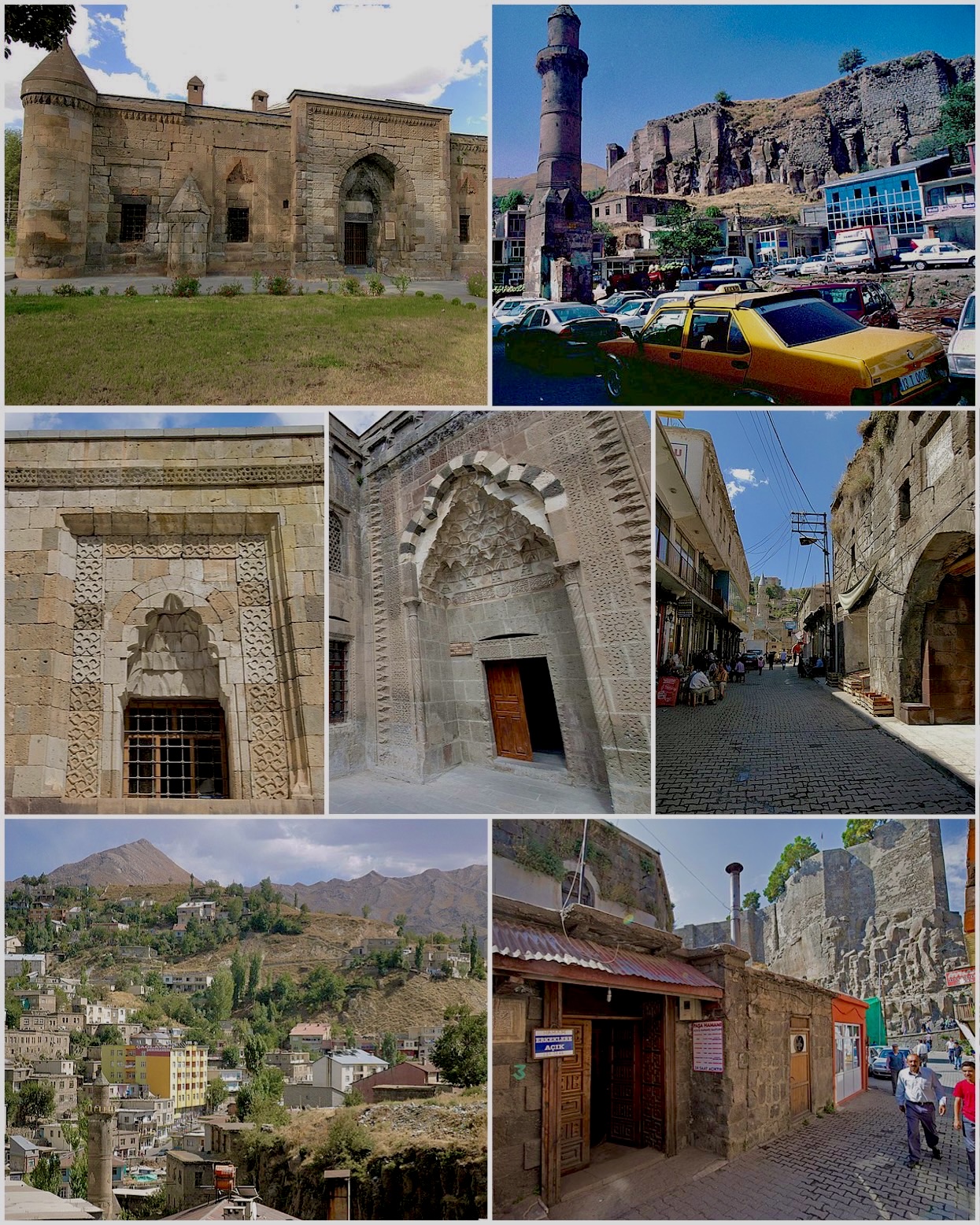
Bitlis preserves more medieval and traditional architecture than any other town in eastern Turkey. They are of a high quality and are mostly constructed from locally quarried light-brown stone, sometimes called Ahlat stone.
The town contains a large number of late-medieval Islamic buildings in the form of mosques, madrassas, and tombs. Also commercial buildings such as "Han's Caravanserais. Commissioned mostly by its local Kurdish rulers, the architectural style of these buildings is very conservative and similar to much earlier Seljuq-period structures. Important monuments include the 12th-century Ulu Mosque with its 15th-century minaret, and the Gokmeydani Medresesi and Sherefiye Mosque from the sixteenth century. Until 1915 there were five Armenian monasteries and several churches in Bitlis – only a 19th-century Armenian church survives, now used as a warehouse.
Bitlis is also notable for its many old houses. These are built of cut stone and are often large and impressive structures. Most have two stories, but three stories are also found. Ground floors were generally intended for storage and stables, with the residential quarters on the upper floors. Ground floor rooms have few windows, upper floors are well lit. Roofs are flat and covered with beaten clay. Unlike traditional houses in nearby Erzurum or Van, Bitlis houses do not have bay windows and balconies.
Demographics
On the eve of the First World War, the town had about 30,000 inhabitants: two-thirds Kurds and one-third Armenians. All Armenians were massacred by the Turkish regular army led by Djevdet Bey as part of the Armenian genocide.
The demographic composition of Bitlis has been shaped by the predominantly Kurdish settlement of the region. Sociolinguistic research on language demographics in Turkey has identified Bitlis as one of the provinces with a strong Kurdish-speaking majority, with Kurmanji (Northern Kurdish) as the principal language of the population.
Climate
Bitlis has a Mediterranean-influenced humid continental climate (Köppen: Dsa, Trewartha: Dca). Bitlis has hot, dry summers and cold, very snowy winters. Highest snow depth recorded in Bitlis is 343 cm (135 inches).
Economy
Historically, Bitlis produced wheat, which the British, in 1920, described as being "particularly excellent." However, poor trade routes in the area during the early 20th century meant that the wheat was mainly produced and used by locals. During this time, the British stated that the people of Bitlis were unable to use all of the wheat they produced, and most was "left to rot in the underground storehouses."
Notable individuals
Badh ibn Dustak (died 991) Kurdish tribal leader
Idris Bitlisi (1457-1520) Ottomon civil servant
Hosam al-Din Ali Bitlisi (died 1494/5) Kurdish Sufi author
Sharafkhan Bidlisi (1543-1603) Kurdish noble and writer
Grace Knapp (1870-1953) American missionary who witnessed the Armenian genocide in eastern Turkey
Said Nursi (1878-1960) Kurdish Sunni Muslim Nur movement tariqa sheikh.
Levon Aghababyan (1887-1915) Armenian mathematician
Ihsan Nuri (1892-1976) Kurdish soldier and politician, former officer of the Ottoman and Turkish Army, and one of the leaders of the Ararat rebellion as the generalissimo of the Kurdish National Forces.
Paul Paul (1894-1979) Armenian politician
Roger Tatarian (1917-1995) Armenian journalist
Fuat Sezgin (1924-2018) Historian of Science, Orientalist.
Kâmran İnan (Hizan, Bitlis, 1929) Turkish politician, diplomat, and scholar was from Bitlis.
Salih Mirzabeyoğlu, (1950-2018), the Kurdish poet and the leader of Islamic fundamentalism group of İBDA-C.
Tekin Bingöl (born 1955) Turkish politician
Ersin Ayrłksa (1956-) Turkish alpine skier
Metin Yüksel (1958-1979) Kurdish-Turkish political and social Islamist activist
Hüseyin Olan (born 1959) Turkish politician
Onur Akın, (born 1967), the most popular protest music and Turkish folk music artist.
Deniz Baykara (born 1984) Turkish footballer
Nurcihan Ekinci (born 1988) Turkish Para Taekwondo practitioner
Ayetullah Aslanhan (born 2001) Turkish long-distance runner
Mayors of Bitlis
1977-1980 and 1984-1994 Ahmet Muzaffer Geylani CHP, SODEP, SHP, ANAP
1994-2004 Yaşar Burhan Refah Party, FP, Saadet Party
Kaynak: Wikipedia – Bitlis · CC BY-SA 4.0