


Boston
Boston es la capital y ciudad más poblada del estado de Massachusetts, y una de las ciudades más antiguas de los Estados Unidos.
Government administration · United States · 0 followers
Overview
Boston es la capital y ciudad más poblada del estado de Massachusetts, y una de las ciudades más antiguas de los Estados Unidos. Al tratarse de la ciudad más poblada de Nueva Inglaterra, Boston es considerada el centro económico y cultural de la región y es referida en ocasiones como la «Capital de Nueva Inglaterra» de manera no oficial. En 2008 la ciudad contaba con una población de 645 169 habitantes, lo que la convierte en la vigésima primera ciudad más poblada del país. Boston es, también, el centro neurálgico de un área metropolitana muy poblada y extensa denominada Gran Boston, con una población de 4,5 millones de habitantes, la décima mayor área metropolitana de la nación. El Gran Boston, como región a la que se desplazan multitud de trabajadores, incluye siete condados de Massachusetts, todo Rhode Island y partes de Nuevo Hampshire; con lo que suma un total de 7,5 millones de habitantes, por lo que esta área estadística combinada es la quinta de los Estados Unidos por población.
Interested in working with us in the future?
Follow to see new jobs and posts in your feed.
No news yet.
About

Boston es la capital y ciudad más poblada del estado de Massachusetts, y una de las ciudades más antiguas de los Estados Unidos. Al tratarse de la ciudad más poblada de Nueva Inglaterra, Boston es considerada el centro económico y cultural de la región y es referida en ocasiones como la «Capital de Nueva Inglaterra» de manera no oficial. En 2008 la ciudad contaba con una población de 645 169 habitantes, lo que la convierte en la vigésima primera ciudad más poblada del país. Boston es, también, el centro neurálgico de un área metropolitana muy poblada y extensa denominada Gran Boston, con una población de 4,5 millones de habitantes, la décima mayor área metropolitana de la nación. El Gran Boston, como región a la que se desplazan multitud de trabajadores, incluye siete condados de Massachusetts, todo Rhode Island y partes de Nuevo Hampshire; con lo que suma un total de 7,5 millones de habitantes, por lo que esta área estadística combinada es la quinta de los Estados Unidos por población.
Kaynak: Wikipedia · CC BY-SA 4.0
Historia
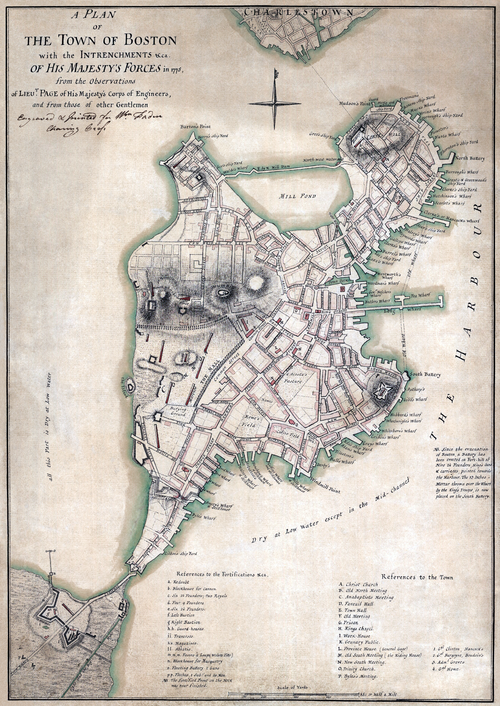
Boston fue fundada el 7 de septiembre de 1630 por puritanos procedentes de Inglaterra, conocidos como los peregrinos patriarcas, en la península de Shawmut, así nombrada por los amerindios que la habitaban. Los puritanos de la colonia de la bahía de Massachusetts son confundidos a veces con los Padres Peregrinos, que fundaron la colonia de Plymouth diez años antes en lo que hoy son los condados de Bristol, Plymouth y Barnstable, en Massachusetts. Los dos grupos, que difieren en sus prácticas religiosas, son históricamente diferentes. Las colonias no se unieron hasta la formación de la provincia de la bahía de Massachusetts en 1691.
La península de Shawmut se conectaba con el continente por un estrecho istmo, bordeado por aguas de la bahía de Massachusetts y la bahía Back (Back Bay), estuario del río Charles. Se han excavado varios sitios arqueológicos prehistóricos de los nativos americanos en la ciudad que muestran que la península ya era habitada antes del 5000 a. C.
Los primeros pobladores europeos bautizaron esta área con el nombre de Trimountaine (tres montañas), pero luego fue rebautizada en homenaje al pueblo inglés de Boston, Lincolnshire, del cual muchos peregrinos colonizadores eran originarios. El primer gobernador de la Colonia de la bahía de Massachusetts, John Winthrop, proclamó un famoso discurso titulado «Un modelo de caridad cristiana», pero conocido popularmente como «La ciudad sobre la colina» (City on a Hill) que daba la sensación de que Boston tenía un convenio especial con Dios (Winthrop también promovió y firmó el Acuerdo de Cambridge que fue determinante para la creación de la ciudad).
La ética puritana moldeó una sociedad estable y estructurada en Boston. Por ejemplo, poco después de su asentamiento, los puritanos fundaron la primera escuela pública de los Estados Unidos, la Boston Latin School en 1635. Entre 1636 y 1698, seis importantes epidemias de viruela provocaron un considerable número de fallecimientos en Boston. La ciudad era la más poblada en la Norteamérica británica hasta que Filadelfia experimentó su explosión demográfica a mediados del siglo XVIII.
Geografía

Debido a su temprana fundación, la ciudad de Boston es muy compacta. Según la Oficina del Censo de Estados Unidos, la ciudad tiene una superficie total de 232.1 km², siendo 125.4 km² de tierra firme (54 %) y 106.7 km² (46 %) de agua. Boston es la cuarta ciudad más densamente poblada del país entre aquellas que son cabeceras de alguna gran área metropolitana. De las ciudades estadounidenses con más de seiscientos mil habitantes, solo San Francisco es menor en área terrestre. Boston está rodeada por la región del «Greater Boston» (Gran Boston) y por las ciudades de Winthrop, Revere, Chelsea, Everet, Somerville, Cambridge, Watertown, Newton, Brookline, Needham, Dedham, Canton, Milton y Quincy. El río Charles separa la ciudad propiamente dicha de Boston de las ciudades de Cambridge y Watertown, y del barrio de Charlestown, que sí pertenece a Boston. Al Este se encuentra el puerto de Boston y el Área Nacional de Recreación de las Islas del puerto de Boston. El río Neponset forma los límites entre los barrios sureños de Boston y las ciudades de Quincy y Milton. El río Mystic separa Charlestown de Chelsea y Everett; Chelsea Creek y el puerto de Boston hace lo propio entre el este de la ciudad y su centro. La altura oficial de Boston, medida en el Aeropuerto Internacional Logan, es de 5.8 metros sobre el nivel del mar. El punto más alto es Bellevue Hill, a 101 metros sobre el nivel del mar; mientras que el más bajo se encuentra al nivel del mar.
Gran parte de la bahía Back y los barrios del South End están construidos sobre tierra ganada al mar utilizando material de relleno para crear la nueva tierra. Solo la colina Beacon Hill, la más pequeña de las tres colinas originales en Boston, sigue parcialmente intacta. El área del centro y sus alrededores inmediatos consisten en edificios de baja altura de ladrillo o piedra y edificios antiguos de estilo federal. Varios de esos edificios se mezclan con otros modernos, especialmente en las zonas del distrito financiero, Government Center, South Boston y bahía Back, que incluye varios edificios notables como la Biblioteca Pública de Boston, el Centro de Ciencia Cristiano, Copley Square, Newbury Street y los dos edificios más altos de Nueva Inglaterra, la torre John Hancock y el Prudential Center.
Demografía

Según el censo estadounidense de 2000, en la ciudad de Boston residían 589 141 habitantes, y había 239 528 hogares y 115 212 familias. La densidad de población era de 4697 hab./km². De las grandes ciudades estadounidenses, solo Nueva York, San Francisco y Chicago tenían una densidad de población mayor que Boston. Había 251 935 unidades de vivienda en una densidad media de 2009 viviendas/km². El censo elaborado en 2008 reveló que la población de la ciudad era de 609 023 habitantes; es decir, un 3.4 % más que en el censo de 2000. Durante los días de la semana, la población de Boston puede aumentar durante el día a cerca de 1.2 millones. Esta fluctuación de la población es provocada por cientos de miles de residentes suburbanos que viajan a la ciudad en relación con el trabajo, educación, salud y eventos especiales.
En la ciudad, la población se repartió por edades de la siguiente manera: con un 19.8 % menores de dieciocho años; el 16.2 % de dieciocho a veinticuatro; el 35.8 % de veinticinco a cuarenta y cuatro; el 17.8 % de cuarenta y cinco a sesenta y cuatro; y el 10.4 % contaba con sesenta y cinco años o más. La media de edad fue de treinta y un años. Por cada 100 mujeres, había 92.8 hombres. Por cada 100 mujeres mayores de dieciocho años, había 90.2 hombres. El censo reveló, también, que había 239 528 hogares, de los cuales el 22.7 % tenían hijos menores de dieciocho años que vivían con ellos; el 27.4 % eran parejas casadas que viven juntas; el 16.4 % contaba con una mujer de familia sin marido presente; y el 51.9 % no eran familias. El 37.1 % de todos los hogares se componían de familias y en el 9.1% había alguien que vivía solo/a de sesenta y cinco años o más. El tamaño medio del hogar era de 2.31 personas y el tamaño promedio de la familia era de 3.17 personas.
La media de los ingresos de un hogar en Boston era de 39 629 dólares, y la renta media para una familia era de 44 151 dólares. Los hombres tenían un ingreso medio de 37 435 dólares frente a los 32 421 dólares de las mujeres. La renta per cápita para la ciudad fue de 23 353 dólares. El 19.5 % de la población y el 15.3 % de las familias se encontraban por debajo del umbral de pobreza. De la población total, el 25.6 % de los menores de dieciocho años y el 18.2% de las personas mayores de sesenta y cinco años vivían por debajo de dicho umbral.
Economía

Los institutos y universidades de Boston tienen un gran impacto en la economía de la ciudad y de la región. No solo son una de las principales fuentes de empleo, sino que también atraen industrias de alta tecnología A la ciudad y a la región circundante. El área de Boston es la sede de empresas de tecnología como EMC Corporation y Analog Devices, y de empresas de comercio electrónico como Vistaprint y CSN Stores. Boston es también un importante centro de empresas de biotecnología, entre las que se incluyen Millennium Pharmaceuticals, Merck & Co., Millipore, Genzyme y Biogen Idec. Según un informe de 2003 por la Autoridad de Reurbanización de Boston, los estudiantes matriculados en los institutos y universidades de Boston contribuyen con cuatro mil ochocientos millones de dólares anuales a la economía de la ciudad. Boston también recibe la mayor cantidad absoluta de la financiación anual de los Institutos Nacionales de la Salud de todas las ciudades en los Estados Unidos.
El turismo comprende una gran parte de la economía de Boston. En 2004, los turistas gastaron siete mil novecientos millones y convirtieron a la ciudad uno de los diez destinos turísticos más populares del país. Algunas de las otras industrias importantes son los servicios financieros, especialmente los fondos comunes de inversión y seguros. Fidelity Investments, una empresa de inversión establecida en Boston, ayudó a popularizar el fondo mutuo en los años 1980 y ha hecho de Boston una de las principales ciudades financieras en los Estados Unidos. La ciudad también es la sede regional de grandes bancos como el Banco de América y Santander Bank (anteriormente Sovereign Bank), y es un centro de capital riesgo. State Street Corporation, empresa especializada en la gestión de activos y servicios de custodia, tiene su sede en la ciudad. Boston es también un centro de impresión y edición; Houghton Mifflin Harcourt tiene su sede en Boston, junto con Bedford-St. Martin's Press, Beacon Press y Little, Brown and Company. La ciudad cuenta con cuatro grandes centros de convenciones; el Hynes Convention Center en la bahía Back, el Bayside Expo Center en Dorchester, y el World Trade Center, el Boston Convention y el Exhibition Center en South Boston. Debido a la situación de Boston como capital del estado y casa regional de las agencias federales, la ley y el gobierno son otro componente importante de la economía de la ciudad.
Gobierno

Boston tiene un sistema de consejo de gobierno en el que el alcalde está investido con amplios poderes ejecutivos. El alcalde es elegido para un mandato de cuatro años mediante escrutinio uninominal mayoritario. La actual alcaldesa de Boston es Michelle Wu. Los integrantes del Ayuntamiento de Boston son elegidos cada dos años. Hay nueve escaños de distrito, cada uno de ellos elegido por los residentes de ese distrito a través de voto, y cuatro escaños en general. Cada votante dispone de un máximo de cuatro votos y no se permite entregar más de un voto por candidato. Los candidatos con mayor votación de los cuatro totales son elegidos. El presidente del concejo municipal es elegido por los consejeros dentro de sí mismos. El comité escolar de las Escuelas Públicas de Boston es nombrado por el alcalde. La Autoridad de Reurbanización de Boston y de la Junta de Apelaciones de Zonificación (un cuerpo de siete personas nombradas por el alcalde) comparten la responsabilidad de la planificación del uso del suelo.
Además del gobierno de la ciudad, numerosas comisiones y autoridades estatales —incluidos los del Departamento de Conservación y Recreación de Massachusetts, la Comisión de Salud Pública de Boston y la Autoridad Portuaria de Massachusetts (conocida como Massport)— desempeñan un papel importante en la vida de los bostonianos. Como capital de Massachusetts, Boston juega un papel relevante en la política estatal. La ciudad tiene varias propiedades relacionadas con el Gobierno de los Estados Unidos, incluyendo el Edificio de la Oficina Federal John F. Kennedy y el Edificio Federal Thomas P. O'Neill. Boston también es la sede de la Corte de Apelaciones de Estados Unidos para el Primer Circuito y el Tribunal de Distrito de los Estados Unidos para el Distrito de Massachusetts; Boston es sede del Banco de la Reserva Federal de Boston (el primer distrito de la Reserva Federal). La ciudad está en el Octavo y Noveno distrito del Congreso.
Cultura

La cultura de Boston está muy relacionada con Nueva Inglaterra, incluyendo un acento del este de la región conocido como acento de Boston, además de tener su propio argot. La ciudad ha sido y sigue siendo un importante destino de los inmigrantes irlandeses, quienes influyen en gran medida en la política de Boston y las instituciones religiosas y, por consiguiente, en el resto de Massachusetts.
Los bostonianos suelen ser considerados como personas con una fuerte identidad cultural, tal vez como resultado de su reputación intelectual; mucha de la cultura de Boston se ha originado en sus universidades. Mark Twain escribió una vez: «En Nueva York se preguntan “¿cuánto dinero tiene?”, en Filadelfia se preguntan, “¿quiénes fueron sus padres?”, en Boston se preguntan, “¿cuánto sabe?”».
Artes escénicas
El Theater District, al sur de Boston Common, contiene una serie de teatros ornamentados, incluidos la Casa de la Ópera de Boston, el Teatro Cutler Majestic y el Citi Performing Arts Center. Las compañías profesionales de teatro más destacadas están ubicadas en el American Repertory Theater en Cambridge, y en el Huntington Theatre, pero las pequeñas compañías y teatros se encuentran dispersos por toda la ciudad, incluido el Boston Center for the Arts y el Calderwood Pavilion en el barrio de South End. El Boston Ballet es la compañía de danza clásica más importante de la ciudad y actúa regularmente en el Wang Center for the Performing Arts. Numerosos artistas callejeros se dan cita en el Quincy Market y alrededores, cerca de Faneuil Hall. Cada verano, el Commonwealth Shakespeare Company actúa en el Boston Common.
En el panorama musical de la ciudad, la Orquesta Sinfónica de Boston juega un papel muy importante, además de la Boston Pops Orchestra, la Boston Symphony Chamber Players, la Filarmónica de Boston, la Sociedad de Música de Cámara de Boston, la Ópera Lírica de Boston, el Proyecto de la Orquesta Moderna de Boston, la Opera Boston, la Celebrity Series of Boston y la Sociedad Handel & Haydn (la compañía coral más antigua del país). Las salas de mayor importancia son el Jordan Hall, el Symphony Hall y el Berklee Performance Center, además de salas en cada uno de los colegios y universidades. Boston cuenta con varias escuelas importantes de música, incluyendo el New England Conservatory (música clásica), el Conservatorio de Boston (música clásica, danza y teatros musicales) y el Berklee College of Music (jazz y una variedad de estilos de música contemporánea). Cada dos años, la ciudad acoge el Festival de Música Antigua de Boston, un encuentro internacional de personas interesadas en la historia musical.
Referencias literarias y cinematográficas

En la ciudad se desarrolla La letra escarlata de Nathaniel Hawthorne, Las bostonianas de Henry James, la serie Cheers y los films: El estrangulador de Boston (1968) y Good Will Hunting (1997).
Gastronomía
La cocina en Boston, es similar a la del resto de la cocina de Nueva Inglaterra, poniendo gran énfasis en los mariscos y productos lácteos. Sus platos más conocidos, son la sopa de almejas de Nueva Inglaterra, fish and chips (normalmente con bacalao o bacalao fresco), baked beans, langostas, almejas al vapor y almejas fritas.
Boston cuenta con muchos restaurantes, incluyendo los que integran diversas cocinas étnicas. Desde la década de 1980, Boston ha sido sometida a un inesperado renacimiento en su vida culinaria, encabezada por cocineros de prestigio nacional como Jasper White, Ming Tsai y Todd English. Sus respectivos restaurantes, Summer Shack, Blue Ginger y Olives, han realzado las opciones de foodie en Boston.
La Unión Oyster House es el restaurante más antiguo de los Estados Unidos en funcionamiento, ya que abrió sus puertas por primera vez en 1826. Su menú incluye ostras en media concha servidas directamente desde una barra de ostras, sopa de almejas de Nueva Inglaterra, y otros platos de mariscos. Quincy Market, parte de Faneuil Hall Marketplace, tiene una variedad de restaurantes y tiendas de alimentación. Chinatown tiene una variedad de restaurantes asiáticos, panaderías y tiendas. Además de dim sum, existen varios restaurantes japoneses, coreanos y tailandeses en el barrio.
En el North End se encuentran numerosos restaurantes italianos, pizzerías y panaderías, y en Newbury Street varias cafeterías étnicas. Copley Plaza alberga una multitud de restaurantes, incluyendo un food court en el Prudential Center, que es también la sede de Legal Sea Foods, una cadena de marisquerías de Nueva Inglaterra.
Educación

La reputación de Boston como «la Atenas de América» deriva en gran parte en la enseñanza y las actividades de investigación de más de cien colegios y universidades ubicados en la Greater Boston Area, con más de doscientos cincuenta mil estudiantes en Boston y Cambridge únicamente. La Universidad de Boston es la cuarta mayor universidad privada del país y la cuarta fuente de empleo de la ciudad. Además, cuenta con un campus a lo largo del río Charles en la Commonwealth Avenue y un campus médico en el South End. La Universidad Northeastern, otra gran universidad privada, se encuentra en la zona de Fenway, y es especialmente conocida por sus escuelas de Ciencias de la Salud y Empresariales y su programa de educación cooperativa. El Wheelock College, Massachusetts College of Art and Design, Simmons College, Emmanuel College, Massachusetts College of Pharmacy & Health Sciences y Wentworth Institute of Technology, miembros fundadores de los Colleges of the Fenway, son adyacentes a la Universidad Northeastern. La Universidad de Suffolk, una pequeña universidad privada conocida por su escuela de derecho, tiene un campus en Beacon Hill. La New England School of Law, una pequeña escuela privada de derecho, fue originalmente establecido como la única escuela de derecho femenina de América. El Emerson College, una pequeña universidad privada con una fuerte reputación en los campos de artes escénicas, periodismo, letras y cine, se encuentra en Boston Common. El Boston College, cuyo campus estaba localizado en South Boston, se trasladó hacia el oeste. Su campus principal en Chestnut Hill es uno de los primeros ejemplos de arquitectura gótica colegial en América del Norte.
Boston también cuenta con varios conservatorios y escuelas de arte, como el Instituto de Arte de Boston, el Colegio de Arte de Massachusetts, la Escuela de Arte y Diseño de Nueva Inglaterra y el Conservatorio de Nueva Inglaterra (el conservatorio independiente más antiguo del país). Otros conservatorios son el Conservatorio de Boston, la Escuela del Museo de Bellas Artes y el Berklee College of Music. Boston tiene una gran universidad pública, la Universidad de Massachusetts en Boston, situada en Columbia Point en Dorchester, mientras que Roxbury Community College y Bunker Hill Community College son los dos únicos colegios comunitarios de la ciudad.
Sanidad

El Área médica y académica de Longwood es una región de Boston con una concentración de instalaciones de investigación y médicas, incluyendo el Centro Médico Beth Israel Deaconess, el Hospital de Brigham y las Mujeres de Boston, el Hospital Infantil de Boston, el Instituto de Cáncer Dana-Farber, la Escuela Médica de Harvard, la Escuela de Salud Pública de Harvard, la Escuela de Odontología de Harvard y el Massachusetts College of Pharmacy and Health Sciences. El Hospital General de Massachusetts está cerca del barrio de Beacon Hill, y del Massachusetts Eye and Ear Infirmary y del Centro de Rehabilitación Spaulding. El Centro Médico St. Elizabeth está en el Brighton Center del barrio de Brighton de Boston, y el Hospital Bautista de Nueva Inglaterra en Mission Hill. Boston cuenta con un centro médico para veteranos de guerra en los barrios de Jamaica Plain y West Roxbury. La Comisión de Salud Pública de Boston, una agencia del gobierno de Massachusetts, supervisa la salud de los residentes de Boston.
La mayoría de las principales instalaciones médicas de Boston están asociadas con universidades. Las instalaciones en el Área médica y académica de Longwood y en el Hospital General de Massachusetts son centros médicos de investigación afiliados con la Escuela Médica de Harvard. El Centro Médico de Tufts (antes conocido como Centro Médico de Tufts-Nueva Inglaterra), ubicado en la zona sur del barrio de Chinatown, está afiliado con la Escuela de Medicina de la Universidad Tufts. El Centro Médico de Boston, situado en el barrio South End, es la principal instalación de enseñanza de la Escuela de Medicina de la Universidad de Boston, y es el mayor departamento de urgencias del área de Boston. El centro se formó por la fusión del Hospital de la Universidad de Boston y el Hospital de la Ciudad de Boston, el cual fue el primer hospital municipal en los Estados Unidos.
Servicios públicos

Los servicios de abastecimiento de agua y desechos de aguas residuales los gestiona la Comisión de Agua y Alcantarillado de Boston. La Comisión, a su vez, contrata los servicios de la Autoridad de Recursos de Agua de Massachusetts para realizar estos fines. Las aguas de la ciudad proceden de los embalses Quabbin y Wachusett, que están a unos ciento cinco y cincuenta y seis kilómetros al oeste de la ciudad, respectivamente. NSTAR era el distribuidor exclusivo de energía eléctrica en Boston, aunque debido a la desregulación, los clientes ahora pueden elegir la compañía eléctrica que deseen. La compañía National Grid plc es la encargada de suministrar gas natural a la ciudad (originariamente conocida como KeySpan, la compañía sucesora de Boston Gas); solo los clientes comerciales e industriales pueden escoger entre suministro de gas natural alternativo.
Verizon, sucesor de New England Telephone, NYNEX, Bell Atlantic, y antes, Bell System, es el principal proveedor de servicio telefónico por cable de la zona. El servicio telefónico está, también, disponible mediante varias compañías nacionales de telefonía móvil. La televisión por cable la suministra Comcast y RCN, con acceso a Internet de banda ancha proporcionados por las mismas empresas en ciertas zonas. Existen varios proveedores de DSL para abastecer de servicios de Internet de banda ancha a través de líneas telefónicas de Verizon. Galaxy Internet Services (GIS) despliega sus servicios de Internet de banda ancha WiFi en varias zonas de la ciudad. Las autoridades de Boston están realizado esfuerzos para incrementar el acceso a Internet en la ciudad de Boston como una de muchas ciudades estadounidenses que compiten para ser un futuro banco de pruebas de la fibra de alta velocidad a Internet de Google. La ciudad ha sido calificada por estas autoridades como «lista para Google» y se han creado foros públicos para ayudar a impulsar la iniciativa en favor de Boston.
Transporte

El Aeropuerto Internacional Logan, situado en el barrio de Boston Este, acapara la mayoría de los servicios aéreos de Boston. Alrededor de la ciudad hay tres aeropuertos de aviación general: el Aeropuerto Municipal Beverly, al norte; Hanscom Field en Bedford, al oeste; y el Aeropuerto Memorial Norwood, al sur. El Aeropuerto T. F. Green sirve a Providence, Rhode Island; el Aeropuerto Internacional Bradley a Hartford, Connecticut y Springfield, Massachusetts; y el Aeropuerto Mánchester-Boston sirve tanto a la localidad de Mánchester, Nuevo Hampshire, como al área de Boston.
Las calles del centro de Boston no se organizaron de forma cuadriculada, sino que, desde comienzos del siglo XVII, crecieron a la manera de un organismo, de forma serpenteante. El sistema de planificación se fue creando a medida que se necesitaba y los muelles y vertederos fueron ampliando el área de la pequeña península de Boston. Se introdujeron rotondas, se cambiaron y perdieron nombres de calles y se añadieron carriles aparentemente al azar. Por otra parte, las calles de la bahía Back, Boston Este, South End y Boston Sur sí siguieron un trazado hipodámico.
Boston está en el término oriental de la Interestatal 90, donde discurre por Massachusetts a lo largo del tramo conocido como Massachusetts Turnpike. Originariamente conocida como la Autopista Circunferencial, la Ruta 128 lleva a la Interestatal 95 hacia un tramo de su ruta oeste y norte de la ciudad. La U.S. Route 1 (carretera federal) y la Interestatal 93 discurren simultáneamente de norte a sur a través de la ciudad, desde Charlestown a Dorchester, donde se une la Ruta 3 en el puente Zakim, en el río Charles. El tramo elevado de la Arteria Central, que canaliza esas rutas a través del centro de Boston, fue reemplazado por el túnel O'Neill durante el Big Dig, completado a comienzos de 2006.
Ciudades hermanadas
Boston tiene ocho ciudades hermanadas oficiales. La fecha de la columna indica el año en que se estableció la relación. Kioto fue la primera ciudad hermanada de Boston.
Boston también tiene una amistad menos formal o una relación de colaboración con otras cuatro ciudades.
Lecturas adicionales
Black Mass (2015), Dick Lehr y Gerard O'Neill, Editorial Stella Maris. ISBN 978-84-16541-03-4
Boston: A to Z (2000), Thomas H. O'Connor, ISBN 0-674-00310-1
Built in Boston: City and Suburb, 1800–2000 (2000), Douglass Shand-Tucci, ISBN 1-55849-201-1
Lost Boston (1999), Mariner Books, ISBN 0-395-96610-8
Boston: A Topographical History, Tercera edición ampliada (2000), Belknap Press, ISBN 0-674-00268-7
When in Boston: A Time Line & Almanac (2004), Northeastern, ISBN 1-55553-620-4
Gaining Ground: A History of Landmaking in Boston (2003), Nancy S. Seasholes, ISBN 0-262-19494-5
Boston's Secret Spaces: 50 Hidden Corners In and Around the Hub, (2009), Globe Pequot; primera edición ISBN 0-7627-5062-6
AIA Guide to Boston, 3rd Edition: Contemporary Landmarks, Urban Design, Parks, Historic Buildings and Neighborhoods, (2008), Michael Southworth y Susan Southworth, GPP Travel, ISBN 0-7627-4337-9
Boston: A Pictorial Celebration (2006), Jonathan M. Beagle, Elan Penn (fotógrafo), ISBN 1-4027-1977-9
City in Time: Boston (2008), Jeffrey Hantover, Gilbert King (fotógrafo), ISBN 1-4027-3300-3
Mapping Boston (2001), Alex Krieger (editor), David Cobb (editor), Amy Turner (editor), Norman B. Leventhal (prefacio) MIT Press, ISBN 0-262-61173-2
Boston Beheld: Antique Town and Country Views (2008), D. Brenton Simons, University Press of New England, ISBN 1-58465-740-5
Boston (2010) por Jordan Worek; fotografías por Bill Horsman, Firefly Books, ISBN 1-55407-591-2
Kaynak: Wikipedia – Boston · CC BY-SA 4.0
Tarihçe
Yerli dönem
Avrupa kolonizasyonu öncesinde günümüz Boston çevresindeki bölgede yerli Massachusettler yaşıyordu. Yerleşim yerleri küçük ve mevsimlik topluluklardan oluşuyordu. Bölgede yaşayan insanlar büyük olasılıkla Charles Nehri (Kinobequin, Yerli halk tarafından "kıvrımlı" anlamına gelir) boyunca iç kesimlerdeki kışlık evleri ile kıyıdaki yaz toplulukları arasında taşınıp dururdu. Avlanma İç kesimlerde çıplak ağaç mevsimlerinde daha kolaydı. Balık sürülerinden ve kabuklu su ürünlerinin yataklarından en kolay yazın faydalanılırdı.
Yılın ılıman döneminde kötü kokulu çamurluklarla çevrili Shawmut yarımadasına, Avrupalıların gelişinden önce çevreye göre daha az yerleşilmişti. Yine de arkeolojik kazılar, Boylston Caddesi'ndeki New England'daki en eski balık bentlerinden birini ortaya çıkardı. Yerli insanlar, Batı yarımküre'ye Avrupalıların gelişi'inden 7.000 yıl önce balıkları tuzağa düşürmek için bu benti inşa etmişlerdi.
Avrupalılar tarafından Kuruluşu
Boston olacak olan yerde yaşayan ilk Avrupalı, Cambridge-eğitimli piskoposluk din adamı William Blaxton idi.
1630'da kendi Püriten sömürgeciler tarafından Boston'un kurulmasından doğrudan sorumluydu. Bu, Blaxton'ın liderlerinden birisi olan Isaac Johnson'ı başarısız kolonisi Charlestown‘dan Back Bay’e geçmeye davet etmesi ve yarımadayı paylaşmasından sonra gerçekleşti. Eylül 1630'da Püritenler tarafından Boston kurulmuştu.
"Boston" adı
30 Eylül 1630'da ölmeden önce, Johnson’ın Charlestown topluluğunun lideri olarak son resmi eylemlerinden biri, nehrin karşısındaki yeni yerleşimine "Boston" adını vermekti. Yerleşime, karısı (Arbellanın adaşı) ve John Cotton (Cotton Mather'in büyükbabası) ile birlikte New England'a göç ettikleri Lincolnshire'daki memleketi‘nin adını verdi. İngiliz şehrinin adı nihayetinde, Johnson ile birlikte göç edene kadar John Cotton’un kilisesinde bölge papazı olarak görev yaptığı şehrin koruyucu azizi, Aziz Botolph’ den türetilmiştir. İlk kaynaklarda Lincolnshire Boston "Aziz Botolph'un şehri" olarak biliniyordu, daha sonra ad "Boston"‘a dönüştü. Bu yeniden adlandırmadan önce, yarımadadaki yerleşim, Blaxton tarafından "Shawmut" ve davet ettiği Püriten yerleşimciler tarafından ise "Trimountain" olarak biliniyordu.
Nüfus yapısı
İç nüfusu sadece 580.000 civarında olmakla beraber, Boston Metropolitan Bölgesi 6 milyona yaklaşan nüfusuyla Amerika Birleşik Devletlerinin 10 büyük nüfus merkezinden biridir. Nüfusunun %55'i beyaz ırktan, %25'i de siyahi ırktan oluşur.
Şehrin önemi
Boston günümüzde bir eğitim, sağlık, finans ve teknoloji merkezidir. M.I.T., Harvard Üniversitesi, Tufts Üniversitesi, Massachusetts Üniversitesi, Northeastern Üniversitesi, Boston Koleji, Wellesley Koleji ve Boston Üniversitesi gibi dünyaca ünlü eğitim kurumları Boston ve civarında yer alırlar. Beth Israel Deaconess Tıp Merkezi, Brigham ve Kadın Hastanesi, Massachusetts Genel Hastanesi, Boston Çocuk Hastanesi, Dana-Farber Kanser Enstitüsü ve Harvard Tıp Fakültesi bütün dünyadan hastaların tedavi amacıyla geldikleri ünlü tıp merkezleridir. Ayrıca şehir Fidelity Investments, Putnam Investments ve Wellington Management gibi dünyaca ünlü yatırım fonlarının merkezlerini barındırmaktadır.
Spor
Şehri, NBA'da Boston Celtics temsil eder.
Şehri, NHL'de Boston Bruins temsil eder.
Şehri, MLB'de Boston Red Sox temsil eder.
Kardeş kentler
Boston'un resmen 12 tane kardeş şehri vardır:
Kaynak: Wikipedia – Boston · CC BY-SA 4.0
Etymology
Isaac Johnson—in one of his last official acts as leader of the Charlestown community before his death on September 30, 1630—named the new settlement across the river "Boston" after Johnson's hometown of Boston, Lincolnshire, from where he, his wife (namesake of the Arbella), and John Cotton (grandfather of Cotton Mather) emigrated. The name of the English town derives from its patron saint, St. Botolph, in whose church Cotton served as the rector until he and Johnson emigrated to New England. In early sources, Lincolnshire's Boston was known as "St. Botolph's town", which was later abbreviated as "Boston". Before this renaming, the settlement on the peninsula was known as "Shawmut" by William Blaxton and "Tremontaine" by the Puritan settlers he invited.
History

Indigenous era
Before European colonization, the region surrounding present-day Boston was inhabited by the Massachusett people, who established small, seasonal communities in present-day Boston. In 1630, settlers led by John Winthrop arrived and found Shawmut Peninsula nearly empty of Native people. Most had died of European diseases borne by earlier settlers and traders. Archaeological excavations have unearthed one of the oldest fishweirs in New England, located on Boylston Street, which Native people constructed as early as 7,000 years before European arrival in the Western Hemisphere.
European settlement
The first European to live in what would become Boston was a University of Cambridge-educated Anglican cleric named William Blaxton. He was most directly responsible for the foundation of Boston by Puritan colonists in 1630, after Blaxton invited one of their leaders, Isaac Johnson, to cross Back Bay from the failing colony of Charlestown and share the peninsula with him. In September 1630 Puritans made the crossing to present-day Boston.
Puritan influence on Boston began even before the settlement was founded with the 1629 Cambridge Agreement, which created the Massachusetts Bay Colony and was signed by the colony's first governor, John Winthrop. Puritan ethics and their focus on education also influenced the city's early history. In 1635, America's first public school, Boston Latin School, was founded in Boston.
Boston was the largest town in the Thirteen Colonies until Philadelphia outgrew it in the mid-18th century. Boston's oceanfront location made it a lively port, and the town engaged in shipping and fishing during the colonial era. Boston was a primary stop on the Caribbean trade route and imported large amounts of molasses, which led to the creation of Boston baked beans.
Boston's economy stagnated in the decades prior to the American Revolution. By the mid-18th century, New York City and Philadelphia both surpassed Boston in wealth. During this period, Boston encountered financial difficulties even as other New England cities were growing rapidly.
Geography

Boston has an area of 89.63 sq mi (232.1 km2). Of this area, 48.4 sq mi (125.4 km2), or 54%, of it is land and 41.2 sq mi (106.7 km2), or 46%, of it is water. The city's elevation, as measured at Logan International Airport, is 19 ft (5.8 m) above sea level. The highest point in Boston is Bellevue Hill at 330 ft (100 m) above sea level, and the lowest point is at sea level. The city is adjacent to Boston Harbor, an arm of Massachusetts Bay, and by extension, the Atlantic Ocean.
Boston is surrounded by the Greater Boston metropolitan region. It is bordered to the east by the town of Winthrop and the Boston Harbor Islands, to the northeast by the cities of Revere, Chelsea and Everett, to the north by the cities of Somerville and Cambridge, to the northwest by Watertown, to the west by the city of Newton and town of Brookline, to the southwest by the town of Dedham and small portions of Needham and Canton, and to the southeast by the town of Milton, and the city of Quincy.
The Charles River separates Boston's Allston-Brighton, Fenway-Kenmore and Back Bay neighborhoods from Watertown and Cambridge, and most of Boston from its own Charlestown neighborhood. The Neponset River forms the boundary between Boston's southern neighborhoods and Quincy and Milton. The Mystic River separates Charlestown from Chelsea and Everett, and Chelsea Creek and Boston Harbor separate East Boston from Downtown, the North End, and the Seaport.
Neighborhoods
Boston is sometimes called a "city of neighborhoods" because of the profusion of diverse subsections. The city government's Office of Neighborhood Services has designated 23 neighborhoods:
More than two-thirds of inner Boston's modern land area did not exist when the city was founded. Instead, it was created via the gradual filling in of the surrounding tidal areas over the centuries. This was accomplished using earth from the leveling or lowering of Boston's three original hills, the "Trimountain", after which Tremont Street is named, and with gravel brought by train from Needham to fill the Back Bay.
Demographics

In the 2020 census, Boston was estimated to have 691,531 residents living in 266,724 households—a 12% population increase over 2010. Boston is the third-most densely populated large U.S. city of over half a million residents, and the most densely populated state capital. Some 1.2 million persons may be within Boston's boundaries during work hours, and as many as 2 million during special events. This fluctuation of people is caused by hundreds of thousands of suburban residents who travel to the city for work, education, health care, and special events.
In 2011, 21.9% of the population was aged 19 and under, 14.3% was from 20 to 24, 33.2% from 25 to 44, 20.4% from 45 to 64, and 10.1% was 65 years of age or older. The median age was 30.8 years. For every 100 females, there were 92.0 males. For every 100 females age 18 and over, there were 89.9 males. There were 252,699 households, of which 20.4% had children under the age of 18 living in them, 25.5% were married couples living together, 16.3% had a female householder with no husband present, and 54.0% were non-families. 37.1% of all households were made up of individuals, and 9.0% had someone living alone who was 65 years of age or older. The average household size was 2.26 and the average family size was 3.08.
In 2024, the median household income in Boston was $97,791, while the median income for a family was $110,710. In 2011, full-time year-round male workers had a median income of $52,544 versus $46,540 for full-time year-round female workers. The per capita income for the city was $33,158. 21.4% of the population and 16.0% of families were below the poverty line. Of the total population, 28.8% of those under the age of 18 and 20.4% of those 65 and older were living below the poverty line. Boston has a significant racial wealth gap with White Bostonians having a median net worth of $247,500 compared to an $8 median net worth for non-immigrant Black residents and $0 for Dominican immigrant residents.
Economy
A global city, Boston is ranked among the top 30 most economically powerful cities in the world. Encompassing $610 billion, the Greater Boston metropolitan area has the eighth-largest economy in the country and 16th-largest in the world.
Boston's colleges and universities exert a significant impact on the regional economy. Boston attracts more than 350,000 college students from around the world, who contribute more than US$4.8 billion annually to the city's economy. The area's schools are major employers and attract industries to the city and surrounding region. The city is home to a number of technology companies and is a hub for biotechnology, with the Milken Institute rating Boston as the top life sciences cluster in the country. Boston receives the highest absolute amount of annual funding from the National Institutes of Health of all cities in the United States.
Boston is considered highly innovative for a variety of reasons, including the presence of academia, access to venture capital, and the presence of many high-tech companies. The Route 128 corridor and Greater Boston continue to be a major center for venture capital investment, and high technology remains an important sector with nearly 5,000 startup companies. In the late 2010s to the 2020s, the city has been a center of artificial intelligence.
Tourism composes a large part of Boston's economy, with 21.2 million domestic and international visitors spending $8.3 billion in 2011. Excluding visitors from Canada and Mexico, over 1.4 million international tourists visited Boston in 2014, with those from China and the United Kingdom leading the list. Boston's status as a state capital as well as the regional home of federal agencies has rendered law and government to be another major component of the city's economy. Boston is a major seaport along the East Coast of the United States and the oldest continuously operated industrial and fishing port in the Western Hemisphere.
Education

Primary and secondary
Boston Public Schools enroll 57,000 students attending 145 schools, including Boston Latin Academy, John D. O'Bryant School of Math & Science, and the Boston Latin School. The Boston Latin School was established in 1635 and is the oldest public high school in the US. Boston also operates the United States' second-oldest public high school and its oldest public elementary school. The system's students are 40% Hispanic or Latino, 35% Black or African American, 13% White, and 9% Asian.
There are private, parochial, and charter schools. Approximately 3,300 minority students attend participating suburban schools through the Metropolitan Educational Opportunity Council. In September 2019, the city began Boston Saves, a program that provides every child enrolled in the city's kindergarten system a savings account, containing $50 to be used toward college or career training.
Colleges and universities
Several of the highest-ranked universities in the world are near Boston. Three universities with a major presence in the city, Harvard, MIT, and Tufts, are just outside of Boston in the cities of Cambridge and Somerville, known as the Brainpower Triangle. Harvard is the nation's oldest institute of higher education and is centered across the Charles River in Cambridge, though the majority of its land holdings and a substantial amount of its educational activities are in Boston. Its business school and athletics facilities are in Boston's Allston neighborhood, and its medical, dental, and public health schools are located in the Longwood area. The Massachusetts Institute of Technology (MIT) originated in Boston and was long known as "Boston Tech"; it moved across the river to Cambridge in 1916. Tufts University's main campus is north of the city in Somerville and Medford, though its medical and dental schools are located in Boston's Chinatown at Tufts Medical Center.
Government

Boston has a strong mayor–council government system in which the mayor, elected every fourth year, has extensive executive power. Michelle Wu became mayor in November 2021, succeeding Kim Janey who became the Acting Mayor in March 2021 following Marty Walsh's confirmation to the position of Secretary of Labor in the Biden/Harris Administration. Walsh's predecessor Thomas Menino's twenty-year tenure was the longest in Boston's history.
The Boston City Council is elected every two years. There are nine district seats, and four citywide "at-large" seats. The School Committee, which oversees the Boston Public Schools, is appointed by the mayor. Boston uses an algorithm called CityScore to measure the effectiveness of city services. This score is available on a public online dashboard and allows city managers in police, fire, schools, emergency management services, and 3-1-1 to take action and make adjustments in areas of concern.
In addition to city government, numerous commissions and state authorities, including the Massachusetts Department of Conservation and Recreation, the Boston Public Health Commission, the Massachusetts Water Resources Authority (MWRA), and the Massachusetts Port Authority (Massport), play a role in the life of Bostonians. As the capital of Massachusetts, Boston plays a major role in state politics.
Boston has several federal facilities, including the John F. Kennedy Federal Office Building, the Thomas P. O'Neill Jr. Federal Building, the John W. McCormack Post Office and Courthouse, and the Federal Reserve Bank of Boston. The United States Court of Appeals for the First Circuit and the United States District Court for the District of Massachusetts are housed in The John Joseph Moakley United States Courthouse.
Federally, Boston is split between two congressional districts. Three-fourths of Boston is in the 7th district and is represented by Ayanna Pressley. The remaining southern fourth is in the 8th district and is represented by Stephen Lynch. Both are Democrats; a Republican has not represented a significant portion of Boston in over a century. The state's senior member of the United States Senate is Democrat Elizabeth Warren, first elected in 2012. The state's junior member of the United States Senate is Democrat Ed Markey, who was elected in 2013 to succeed John Kerry after Kerry's appointment and confirmation as the United States Secretary of State.
Public safety

Boston included $414 million in spending on the Boston Police Department in the fiscal 2021 budget. This is the second largest allocation of funding by the city after the allocation to Boston Public Schools.
Like many major American cities, Boston has experienced a great reduction in violent crime since the early 1990s. Boston's low crime rate since the 1990s has been credited to the Boston Police Department's collaboration with neighborhood groups and church parishes to prevent youths from joining gangs, as well as involvement from the United States Attorney and District Attorney's offices. This helped lead in part to what has been touted as the "Boston Miracle". Murders in Boston dropped from 152 in 1990, a murder rate of 26.5 per 100,000 people, to 31—not one of them a juvenile—in 1999, for a murder rate of 5.26 per 100,000.
According to the Uniform Crime Reporting (UCR) program in 2022, Boston had 3,955 reported violent crimes, which include homicide, rape, robbery, and aggravated assault, and 11,514 reported property crimes, which include arson, burglary, larceny-theft, and motor vehicle theft. With a violent crime rate of 608.7 per 100,000 people, the city's violent crime rate is higher than Massachusetts' rate of 322 per 100,000 people and the national rate of 380.7 per 100,000 people. While Boston's property crime rate, at 1,772.0 per 100,000 people, is higher than Massachusetts' property crime rate of 1,070.1 per 100,000 people, it is lower than the national property crime rate of 1,954.4 per 100,000 people.
Culture

Boston shares many cultural roots with greater New England, including a dialect of the non-rhotic Eastern New England accent known as the Boston accent and a regional cuisine with a large emphasis on seafood, salt, and dairy products. Boston also has its own collection of neologisms known as Boston slang and sardonic humor.
In the early 1800s, William Tudor wrote that Boston was "'perhaps the most perfect and certainly the best-regulated democracy that ever existed. There is something so impossible in the immortal fame of Athens, that the very name makes everything modern shrink from comparison; but since the days of that glorious city I know of none that has approached so near in some points, distant as it may still be from that illustrious model.' From this, Boston has been called the "Athens of America" (also a nickname of Philadelphia) for its literary culture, earning a reputation as "the intellectual capital of the United States".
In the 19th century, Ralph Waldo Emerson, Henry David Thoreau, Nathaniel Hawthorne, Margaret Fuller, James Russell Lowell, and Henry Wadsworth Longfellow wrote in Boston. Some consider the Old Corner Bookstore to be the "cradle of American literature", the place where these writers met and where The Atlantic Monthly was first published. In 1852, the Boston Public Library was founded as the first free library in the United States. Boston's literary culture continues today thanks to the city's many universities and the Boston Book Festival.
Music is afforded a high degree of civic support in Boston. The Boston Symphony Orchestra is one of the "Big Five", a group of the greatest American orchestras, and the classical music magazine Gramophone called it one of the "world's best" orchestras. Symphony Hall (west of Back Bay) is home to the Boston Symphony Orchestra and the related Boston Youth Symphony Orchestra, which is the largest youth orchestra in the nation, and to the Boston Pops Orchestra. Other concerts are held at the New England Conservatory's Jordan Hall. The Boston Ballet performs at the Boston Opera House. Other performing-arts organizations in the city include the Boston Lyric Opera Company, Opera Boston, Boston Baroque (the first permanent Baroque orchestra in the US), and the Handel and Haydn Society (one of the oldest choral companies in the United States).
Sports

Boston has teams in the four major North American men's professional sports leagues as well as Major League Soccer. As of 2024, the city has won 40 championships in these leagues. During a 23-year stretch from 2001 to 2024, the city's professional sports teams have won thirteen championships: Patriots (2001, 2003, 2004, 2014, 2016 and 2018), Red Sox (2004, 2007, 2013, and 2018), Celtics (2008, 2024), and Bruins (2011).
The Boston Red Sox, a founding member of the American League of Major League Baseball in 1901, play their home games at Fenway Park, near Kenmore Square, in the city's Fenway section. Built in 1912, it is the oldest sports arena or stadium in active use in the United States among the four major professional American sports leagues, Major League Baseball, the National Football League, National Basketball Association, and the National Hockey League. Boston was the site of the first game of the first modern World Series, in 1903. The series was played between the AL Champion Boston Americans and the NL champion Pittsburgh Pirates.
Persistent reports that the team was known in 1903 as the "Boston Pilgrims" appear to be unfounded. Boston's first professional baseball team was the Red Stockings, one of the charter members of the National Association in 1871, and of the National League in 1876. The team played under that name until 1883, under the name Beaneaters until 1911, and under the name Braves from 1912 until they moved to Milwaukee after the 1952 season. Since 1966 they have played in Atlanta as the Atlanta Braves.
TD Garden, formerly called the FleetCenter and built to replace the since-demolished Boston Garden, is above North Station and is the home of two major league teams: the Boston Bruins of the National Hockey League and the Boston Celtics of the National Basketball Association. The Bruins were the first American member of the National Hockey League and an Original Six franchise. The Boston Celtics were founding members of the Basketball Association of America, one of the two leagues that merged to form the NBA. The Celtics have won eighteen championships, the most of any NBA team.
Parks and recreation

Boston Common, near the Financial District and Beacon Hill, is the oldest public park in the United States. Along with the adjacent Boston Public Garden, it is part of the Emerald Necklace, a string of parks designed by Frederick Law Olmsted to run through the city. The Emerald Necklace includes the Back Bay Fens, Arnold Arboretum, Jamaica Pond, Boston's largest body of freshwater, and Franklin Park, the city's largest park and home of the Franklin Park Zoo.
Another major park is the Esplanade, along the banks of the Charles River. The Hatch Shell, an outdoor concert venue, is adjacent to the Charles River Esplanade. Other parks are scattered throughout the city, with major parks and beaches near Castle Island and the south end, in Charlestown and along the Dorchester, South Boston, and East Boston shorelines.
Media
Newspapers
The Boston Globe is the oldest and largest daily newspaper in the city and is generally acknowledged as its paper of record. Boston is served by other publications such as the Boston Herald, Boston magazine, the Boston Business Journal, and the luxury magazine Boston Common. The Christian Science Monitor, headquartered in Boston, was formerly a worldwide daily newspaper but ended publication of daily print editions in 2009, switching to continuous online and weekly magazine format publications. The Boston Globe also releases a teen publication to the city's public high schools, called Teens in Print or T.i.P., which is written by the city's teens and delivered quarterly within the school year. The Improper Bostonian, a glossy lifestyle magazine, was published from 1991 to April 2019.
Boston's black community is served by the Bay State Banner, a newspaper focused on the issues of interest to black Bostonians. The Bay State Banner has operated since 1965.
The city's growing Latino population has given rise to a number of local and regional Spanish-language newspapers. These include El Planeta (owned by the former publisher of the Boston Phoenix), El Mundo, and La Semana. Siglo21, with its main offices in nearby Lawrence, is also widely distributed.
LGBT publications serve Boston's large LGBT (lesbian, gay, bisexual, and transgender) population such as The Rainbow Times, the only minority and lesbian-owned LGBT news magazine. Founded in 2006, The Rainbow Times is now based out of Boston, but serves all of New England.
Radio and television
Boston is the largest broadcasting market in New England, with the radio market being the ninth largest in the United States. Several major AM stations include talk radio WRKO, sports/talk station WEEI, and news radio WBZ (AM). WBZ is a 50,000 watt "clear channel" station whose nighttime broadcasts are heard hundreds of miles from Boston. A variety of commercial FM radio formats serve the area, as do NPR stations WBUR and WGBH. College and university radio stations include WERS (Emerson), WHRB (Harvard), WUMB (UMass Boston), WMBR (MIT), WZBC (Boston College), WMFO (Tufts University), WBRS (Brandeis University), WRBB (Northeastern University) and WMLN-FM (Curry College).
Infrastructure

Healthcare
Many of Boston's medical facilities are associated with universities. The Longwood Medical and Academic Area, adjacent to the Fenway, district, is home to a large number of medical and research facilities, including Beth Israel Deaconess Medical Center, Brigham and Women's Hospital, Boston Children's Hospital, Dana–Farber Cancer Institute, and Joslin Diabetes Center. Prominent medical facilities, including Massachusetts General Hospital, Massachusetts Eye and Ear Infirmary and Spaulding Rehabilitation Hospital are in the Beacon Hill area. Many of the facilities in Longwood and near Massachusetts General Hospital are affiliated with Harvard Medical School.
Tufts Medical Center (formerly Tufts-New England Medical Center), in the southern portion of the Chinatown neighborhood, is affiliated with Tufts University School of Medicine. Boston Medical Center, in the South End neighborhood, is the region's largest safety-net hospital and trauma center. Formed by the merger of Boston City Hospital, the first municipal hospital in the United States, and Boston University Hospital, Boston Medical Center now serves as the primary teaching facility for the Boston University School of Medicine. Boston Medical Center – Brighton (formerly St. Elizabeth's Medical Center) is located in the Brighton neighborhood. New England Baptist Hospital is in Mission Hill. The city has Veterans Affairs medical centers in the Jamaica Plain and West Roxbury neighborhoods.
Transportation
Logan International Airport, in East Boston and operated by the Massachusetts Port Authority (Massport), is Boston's principal airport. Nearby general aviation airports are Beverly Regional Airport and Lawrence Municipal Airport to the north, Hanscom Field to the west, and Norwood Memorial Airport to the south. Massport also operates several major facilities within the Port of Boston, including a cruise ship terminal and facilities to handle bulk and container cargo in South Boston, and other facilities in Charlestown and East Boston.
International relations
The City of Boston has eleven official sister cities:
Boston has formal partnership relationships through a Memorandum Of Understanding with five additional cities or regions:
Kaynak: Wikipedia – Boston · CC BY-SA 4.0