
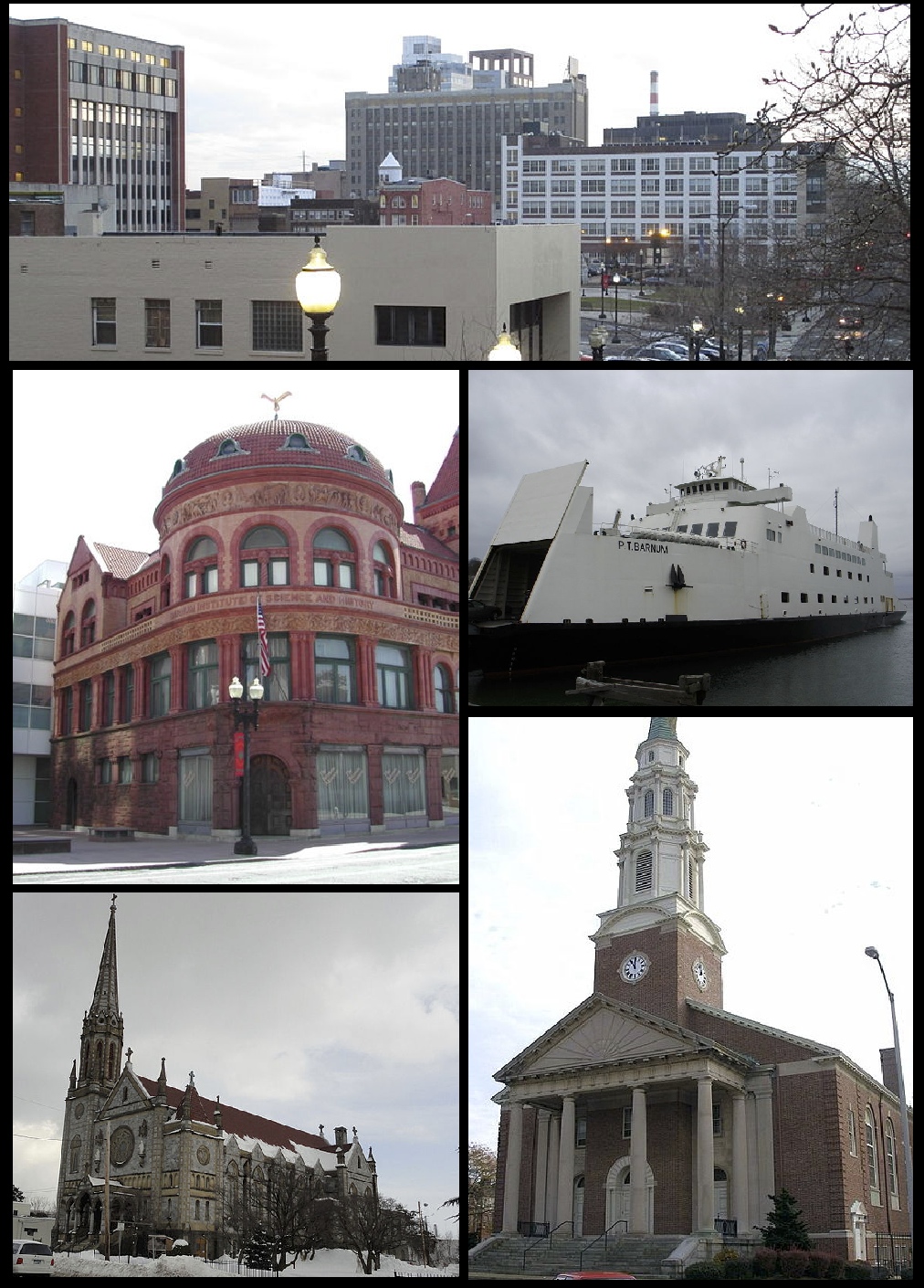

Bridgeport
Bridgeport es la ciudad más poblada del estado estadounidense de Connecticut y la quinta mayor en Nueva Inglaterra.
Government administration · United States · 0 followers
Overview
Bridgeport es la ciudad más poblada del estado estadounidense de Connecticut y la quinta mayor en Nueva Inglaterra. Situada en el condado de Fairfield, la ciudad tiene una población estimada de 148,654 habitantes y es el corazón del área de Greater Bridgeport, que está considerada parte del área de mercado de trabajo de la ciudad de Nueva York. Unos de los tres puertos del estado está en la costa del Long Island Sound, sobre el río Pequonnock.
Interested in working with us in the future?
Follow to see new jobs and posts in your feed.
No news yet.
About

Bridgeport es la ciudad más poblada del estado estadounidense de Connecticut y la quinta mayor en Nueva Inglaterra. Situada en el condado de Fairfield, la ciudad tiene una población estimada de 148,654 habitantes y es el corazón del área de Greater Bridgeport, que está considerada parte del área de mercado de trabajo de la ciudad de Nueva York. Unos de los tres puertos del estado está en la costa del Long Island Sound, sobre el río Pequonnock.
Kaynak: Wikipedia · CC BY-SA 4.0
Historia

Los primeros años
Los primeros años de Bridgeport estuvieron marcados por una dependencia de la pesca y la agricultura, como otras muchas ciudades en Nueva Inglaterra. La situación de la ciudad en el profundo puerto de Newfield fomentó un bum en la construcción naval y la caza de ballenas a mediados del siglo XIX, especialmente después de la apertura de la línea del ferrocarril a la ciudad en 1840. La ciudad pronto se industrializó a finales del siglo XIX y se convirtió en un centro industrial de producción de productos como la famosa fresadora de Bridgeport, accesorios de latón, carruajes, máquinas de coser, sujetadores, sillas de montar y munición.
La visita de Abraham Lincoln
El sábado, 10 de marzo de 1860, Abraham Lincoln habló en el Washington Hall, un auditorio que entonces era el juzgado del condado de Fairfield (ahora McLevy Hall), en la esquina de las calles State y Broad. No solo estaba de bote en bote el salón más grande de la ciudad, sino que una gran multitud tuvo que quedarse fuera. Él recibió una increíble ovación antes de coger el tren a las 9:07 esa noche de vuelta a Manhattan. Ahora hay una placa conmemorativa en Bridgeport donde él dio el discurso. (En 2006, justo al cruzar la calle, en Polea Dot Playhouse, el presidente George W. Bush dio un discurso ante un pequeño y selecto grupo de empresarios y funcionarios sobre la reforma de la asistencia sanitaria.)
Historia posterior
La ciudad entró al nuevo siglo con 102 000 habitantes en 1910. Bridgeport de repente creció por 50 000 personas en para 1916 durante La Guerra Mundial. El nuevo complejo de Remington, 13 edificios, 5 pisos cada uno conectado por un pasillo, era la fábrica más grande del mundo en ese entonces, con 16,000 empleados y protegido por la Guardia nacional. En 1930, Bridgeport fue un próspero centro industrial con más de 500 fábricas y una población inmigrante en auge, como ingleses, portugueses, italianos, polkas, rusos, griegos, judíos, irlandeses etc. En 1930, 30% de la ciudad eran inmigrantes y 40% eran hijos de emigrantes. El oeste de la ciudad era el barrio húngaro conocido como "Hunktown". Los italianos se establecieron por la avenida Madison en El lado norte de Bridgeport. El principal complejo de la ciudad durante la II Guerra Mundial también fue el de Remington Arms, en la avenida Barnum, una de las principales fábricas de armas de Estados Unidos. Aquí murieron más de 30 personas; una de esas muertes fue una bomba que estalló en la planta principal, causando la muerte de siete obreros en 1942. También durante una huelga, dos trabajadores portugueses murieron por unos guardias, que le fracturaron el cráneo a uno de ellos y el otro fue tirado al horno de fundición vivo.
Geografía y clima
Bridgeport está situada en Long Island Sound, en la boca del río Pequonnock.
De acuerdo con la oficina del Censo de Estados Unidos, la ciudad tiene un área total de 50,2 km², de los cuales 41,4 km² son tierra y 8,8 km² (17,53%) es agua.
Bridgeport se encuentra dentro del cinturón climático Continental Húmedo, con tiempo templado a ocasionalmente caliente y veranos húmedos e inviernos fríos y nevados. Los extremos estacionales son un tanto moderados en Long Island Sound. Las aguas adyacentes están en Bridgeport varios grados más frías en verano y en invierno más suave con menos nieve que en otras ubicaciones más alejadas de la costa. La ciudad recibe 1120 milímetros de precipitación y sobre 85 cm de nieve de promedio al año. El récord del invierno más nevado fue 1996 ya que Bridgeport recibió 195,1 cm de nieve.
Demografía

En el censo de 2020, Bridgeport tenía una población de 148.333. Era un 42% de hispanos o latinos de cualquier raza, 37% afroamericanos, 19% blancos no hispanos, y 5% asiáticos. De grupos hispanos en Bridgeport, 22% de la población de Bridgeport (31,900 en el 2013) era de origen puertorriqueño, la séptima población puertorriqueña séptima más grande de los Estados Unidos.
En términos de grupos hispanos, en la encuesta de 2020; fueron contados 28.944 personas de origen puertorriqueña, 8.479 de origen mexicana, 8,458 de origen sudamericana, 6.701 de origen centroamericana, 5.248 de origen dominicana, 1.271 de origen cubana, y 1,814 personas de cualquier otro país hispanohablante incluyendo España fueron contados en Bridgeport en la encuesta federal del American Community Survey de 2020.
Había 50.307 viviendas de las cuales el 34,3% tenían niños por debajo de los 18 años viviendo con ellos, 35% de parejas jóvenes casadas, 24% tenía una propietaria femenina sin marido, y 34,9% no eran familias. 29% de las viviendas estaban constituidas por individuos y 11,3% por alguien de 65 años o mayor viviendo sólo. El promedio del tamaño de las casas era de 2,70 y la media del tamaño de la familia era de 3,34.
A partir del censo del año 2000, había 139.529 habitantes, 50.307 casas, y 32.749 familias residiendo en la ciudad. La densidad de población era de 3,367,0/km². Había 54.367 viviendas en una densidad media de 1.312,0/km². La composición racial de la ciudad era de 45,02% de blancos, 30,76% de Afroamericanos, 0,48% de nativos americanos, 3,25% de asiáticos, 0,11% de isleños del Pacífico, 14,81% de otras razas, y 5,57% de dos o más razas. El 31,88% de la población eran de raza hispana o latina. En la ciudad la población se dividía con un 28,4% en menores de 18 años, 11,2% de los 18 a los 24, 30,5% de 25 a 44, 18,4% de 45 a 64, y 11,5% de mayores de 65 años. La Edad Media era de 31 años. Por cada 100 mujeres había 91,2 hombres. Por cada 100 mujeres de menos de 18 años, había 86,3 hombres.
Educación
En Bridgeport se encuentra la Universidad de Bridgeport y la Housatonic Community College.
El sistema de colegios públicos de la ciudad se compone de 30 colegios de educación primaria, 3 de educación global, 2 de programas alternativos y una escuela de formación profesional de acuicultura. El sistema tiene sobre 23.000 estudiantes lo que hace que Bridgeport sea el segundo sistema escolar más grande de Connecticut. Este sistema escolar emplea a más de 1700 profesionales.
La ciudad ha empezado una gran renovación escolar y un programa de construcción, con planes para nuevas escuelas y modernización de los edificios existentes.
Institutos
Bassick High School, sede del Business Magnet
Central High School establecido en 1876, sede del Central Magnet, es el instituto más grande de todos
Warren Harding High School que es sede del Programa Internacional de Bachillerato así como también del Programa Magnet de Salud que está asociado al Hospital de Bridgeport St. Vincent’s Medical Center al norte de Bridgeport.
El Colegio Regional Vocacional de Acuicultura de Bridgeport está situado cerca de la histórica Captain's Cove (Cala del Capitán) y está abierto a estudiantes de las ciudades de los alrededores. Es una de las primeras escuelas especializadas en estudios marinos y de acuicultura.
Bullard Havens Technical High School es un instituto de formación profesional. (Público)
Kolbe Cathedral High School: instituto exclusivamente Católico de Bridgeport
La Academia Bridge: Instituto de Educación Secundaria de Bridgeport
Bridgeport tiene también varios colegios Católicos. San Ambrose, el más grande de todos, San Rafael, San Agustín y San Pedro.
Economía
Después de la pérdida de industria, Bridgeport a finales del siglo ha estado recuperándose.
Gobierno y política

Bridgeport es famosa por haber tenido un alcalde socialista durante 24 años; Jasper McLevy sirvió como alcalde desde 1933 hasta 1957. Los alcaldes más recientes, incluido Joseph Ganim, han sido acusados de corrupción, reflejando un patrón similar a otros centros urbanos de Connecticut. En junio de 2006, el alcalde John M. Fabrizi admitió haber tomado cocaína desde que empezara su mandato, pero dijo que llevaba un año sin ingerir dicha droga.
Es muy conocido en Connecticut su estatus como una ciudad posindustrial luchadora marcada por la pobreza, destacando notablemente sus vecinos de la Gold Coast (Costa del Oro).
Cultura

Cultura popular
La ciudad fue mencionada al principio de la novela de Mark Twain "Un yanqui de Connecticut en la corte del Rey Arturo":
Artes interpretativas
Bridgeport ha organizado tres veces el Gathering of the Vibes, un festival de un fin de semana de arte, música y campin que ofrece algunos de los mejores nombres de talento festival. En 1999, 2000 y de nuevo en 2007, miles de personas han venido de todas partes del mundo a acampar al parque Seaside y disfrutar del talento de Buddy Guy, Bob Weir and Ratdog, el Deep Banana Blackout de Bridgeport, Les Claypool, Assembly of Dust, Dirty Dozen Brass Band, Los Lobos y muchos más.
Estadios y Teatros
La Total Mortgage Arena - es la sede de los Bridgeport Islanders, el equipo experimental de Los New York Islanders National Hockey League. También es la sede temporal de los Westchester Knicks de White Plains (el equipo experimental de los NY Knicks de la National Basketball Association). Un estadio de 10 000 asientos en el centro de la ciudad, es también utilizado para los partidos amistosos de hockey de la liga mayor.
Kaynak: Wikipedia – Bridgeport · CC BY-SA 4.0
History

Bridgeport was inhabited by the Paugussett Native American tribe during the start of European colonization. The earliest European communal settlement was in the historical Stratfield district, along US Route 1, known in colonial times as the King's Highway. Close by, Mount Grove Cemetery was laid out on what was a native village that extended past the 1650s. It is also an ancient Paugussett burial ground.
The burgeoning farming community grew and became a center of trade, shipbuilding, and whaling. The town was incorporated to subsidize the Housatonic Railroad and rapidly industrialized following the rail line's connection to the New York and New Haven railroad. The town was given its name because of the need for bridges over the Pequonnock River that provided a navigable port at the mouth of the river. Manufacturing was the mainstay of the local economy until the 1970s.
Colonial history
The first documented European settlement within the present city limits of Bridgeport took place in 1644, centered at Black Rock Harbor and along North Avenue between Park and Briarwood Avenues. The place was called Pequonnock (Quiripi for "Cleared Land"), after a band of the Paugussett, an Algonquian-speaking Native American people who occupied this area. One of their sacred sites was Golden Hill, which overlooked the harbor and was the location of natural springs and their planting fields. (It has since been blasted through for construction of an expressway.) The Golden Hill Indians were granted a reservation here by the Colony of Connecticut in 1639; it lasted until 1802. (One of the tribes acquired land for a small reservation in the late 19th century that was recognized by the state. It is retained in the Town of Trumbull.)
In 1639, Roger Ludlow, deputy governor of the English Connecticut Colony was ordered by the colony's General Assembly in Hartford to establish two plantations, one at Cupheg the mouth of the Housatonic River (today Stratford), and one at the harbor at the mouth of the Pequonnock River, today's Bridgeport Harbor. Ludlow disobeyed orders and instead established a settlement in Unconway (today's Fairfield), probably due to fears of the large Paugussett settlement at Golden Hill, which was a sacred site of theirs, so it is believed that they perhaps instead settled in sparsely populated land surrounding the village. In 1659, the general court in Hartford established the official borders of the Paugussett Reservation.
Geography

Bridgeport lies along Long Island Sound at the mouth of the Pequonnock River.
Neighborhoods
Bridgeport has many distinct neighborhoods, divided into five geographic areas: Downtown, the East Side, the North End, the South End, and the West Side.
Climate
Under the Köppen climate classification, Bridgeport straddles the humid subtropical climate (Cfa) and humid continental climate (Dfa) zones with long, hot summers, and cool to cold winters, with precipitation spread fairly evenly throughout the year. Bridgeport, like the rest of coastal Connecticut, lies in the broad transition zone between the colder continental climates of the northern United States and southern Canada to the north, and the warmer temperate and subtropical climates of the middle and south Atlantic states to the south.
The warm/hot season in Bridgeport is from mid-April through early November. Late day thundershowers are common in the hottest months (June, July, August, September), despite the mostly sunny skies. The cool/cold season is from late November though mid-March. Winter weather is far more variable than summer weather along the Connecticut coast, ranging from sunny days with higher temperatures to cold and blustery conditions with occasional snow. Like much of the Connecticut coast and nearby Long Island, NY, most of the winter precipitation is rain or a mix and rain and wet snow in Bridgeport. Bridgeport averages about 29 inches (75 cm) of snow annually, compared to inland areas like Hartford and Albany which average 45–60 inches (110–150 cm) of snow annually.
Although infrequent, tropical cyclones (hurricanes/tropical storms) have struck Connecticut and the Bridgeport metropolitan area. Hurricane landfalls have occurred along the Connecticut coast in 1903, 1938, 1944, 1954 (Carol), 1960 (Donna), Hurricane Gloria in 1985, and Hurricane Sandy in 2012.
Demographics

As of the 2010 census, there were 144,229 people living in the city. The racial makeup of the city residents was 39.6% White; 34.6% Black or African American; 3.4% Asian; and 4.3% from two or more races. A total of 38.2% of the population were Hispanic or Latino of any race.
There were 50,307 households, out of which 34.3% had children under the age of 18 living with them, 35.0% were married couples living together, 24.0% had a female householder with no husband present, and 34.9% were non-families. 29.0% of all households were made up of individuals, and 11.3% had someone living alone who was 65 years of age or older. The average household size was 2.70 and the average family size was 3.34.
In the city, the population was spread out, with 28.4% under the age of 18, 11.2% from 18 to 24, 30.5% from 25 to 44, 18.4% from 45 to 64, and 11.5% who were 65 years of age or older. The median age was 31 years. For every 100 females, there were 91.2 males. For every 100 females age 18 and over, there were 86.3 males.
The median income for a household in the city was $34,658, and the median income for a family was $39,571. Males had a median income of $32,430 versus $26,966 for females. The per capita income for the city was $16,306. About 16.2% of families and 18.4% of the population were below the poverty line, including 24.8% of those under age 18 and 13.2% of those age 65 or over.
According to the 2020 five-year community survey, 48.2% of Bridgeport's population speaks a different primary language at home other than English, 33.8% percent of the city's total population speaks Spanish at home, and 22.5% speak English less than very well.
Bridgeport has the largest percentage and population of Hispanic Americans in the state of Connecticut. The city is known for having one of the largest communities of Puerto Ricans in the United States; Bridgeport has the 7th largest Puerto Rican population in the United States, with 30,250 people claiming Puerto Rican heritage in 1990, that number has grown to about 31,900 (22.10% of the population) in 2013. 45,270 people (31%) of Bridgeport's population is foreign born in 2010. Other than Puerto Ricans, 5.4% of Bridgeport's population was noted under Mexican in 2013, a number that has grown to 5.8% (8,479 people) in the 2020 five-year American Community Survey, meaning Bridgeport has the largest Mexican population in New England. Dominicans are 5,248 (3.53%) of Bridgeport's population. The total Latino Central American population (Guatemalans, Salvadorians, Nicaraguans, Hondurans, Costa Ricans, Panamanians) is 6,701 people total in the city (4.507%). 8,454 South Americans (5.697%); 4,020 Equadorians, 2,326 Colombians, Peruvians, and then populations from every Latin American nation except Bolivia can be found, with the smallest group being Paraguayans at 16 people according to the census.
Economy

Since the decline of its industrial sector beginning in the middle of the 20th century, Bridgeport has gradually adjusted to a service-based economy.
As late as 1985, the city was still home to company plants such as General Electric, with 1,900 employees, and Remington Products, with 900, both of which are now closed. Bryant Electric didn't close its plant until 1988. The last major factory to close was the Sikorsky helicopter plant in 2015.
Various famous industrial companies, that were founded and based in Bridgeport, such as ACME Sheer, Fortune 1000 Hubbell Incorporated, etc. are now based in suburban Shelton, two towns away. Subway, which started out in Bridgeport in 1965, is now based in Milford.
Though a level of industrial activity continues, healthcare, finance, and education have become the centerpieces of Bridgeport's economy.
The two largest employers in the city are Bridgeport's primary hospitals, Bridgeport Hospital and St. Vincent's Medical Center. Park City Hospital in the South End closed in 1993 and was reopened in 2010 as elderly and homeless housing units.
In April 2022, M&T Bank of Buffalo, New York, merged with Bridgeport-based People's United Financial. The combined company is now the 11th largest bank in the United States, and gave M&T a foothold in the New England market, in total serving 12 states. Although M&T laid off Bridgeport employees (which made national headlines), the company as part of this effort made Bridgeport Center the regional M&T headquarters of New England.
Top employers
Top employers in Bridgeport according to the city's 2020 Comprehensive Annual Financial Report:
Arts and culture

Theater and music
Venues for live theater and music events include:
Downtown Cabaret Theatre – cabaret, children's theater, concerts
The Stress Factory (300 seats) – comedy club with national and local acts
Klein Memorial Auditorium (1,400 seats) – home to the Greater Bridgeport Symphony, touring shows and concerts
Total Mortgage Arena – sporting events venue, but also hosts large concerts
Hartford HealthCare Amphitheater - outdoor concert venue
Music festivals and concert series
Bridgeport was the annual home to Gathering of the Vibes, a weekend-long arts, music and camping festival, until it ended in 2015.
Beginning in 2022, Bridgeport played host to the Sound on Sound Music Festival, at Seaside Park. Past performers included; John Mayer, Red Hot Chili Peppers, Dave Matthews Band, Hozier, and The Roots. The festival was rebranded in 2024 to Soundside Music Festival.
The 2025 Soundside Music Festival was cancelled.
The Greater Bridgeport Symphony, established in 1945, performs at Bridgeport's 1,400-seat Klein Memorial Auditorium. Gustav Meier directed the orchestra from 1972 to 2013.
Museums and zoos
The Discovery Science Center and Planetarium emphasizes exhibits on science, with the state's only Challenger Center, affiliated with the national space program. Opened in 1962 and run by SHU as of 2020.
The Housatonic Museum of Art at Housatonic Community College has the largest collection of art of any two-year college in the nation. Founded in 1967 by collage art director Bob Chernow. Shows both western and non-western art from different eras, including sculptures.
The Barnum Museum celebrates the showman, circuses and Bridgeport history. Currently under renovation, a room is open to visitors every Thursday.
The Beardsley Zoo, opened 1922, is the state's largest zoo.
The Greater Bridgeport metropolitan area is home to the Maritime Aquarium in Norwalk, 30 minutes from downtown Bridgeport. One of the two aquariums in Connecticut, the aquarium focuses on Long Island Sound as well as creatures and conservation efforts from around the world.
Sports

Total Mortgage Arena serves as the city's sports and hospitality center. Seating 10,000, the Arena serves as the home rink of the Bridgeport Islanders American Hockey League team, the farm team of the New York Islanders of the National Hockey League. Starting in 2024, it also serves as the home of the New York Sirens of the Professional Women's Hockey League.
The arena served as the temporary home of the Westchester Knicks of the NBA G League (the farm team for the NBA New York Knicks) from 2021 to 2023 when the team's home stadium, Westchester County Center in White Plains, New York iwas being used as a vaccination clinic.
For college teams, Total Mortgage serves as the home court of Fairfield University's basketball team.
The Ballpark at Harbor Yard served as a minor-league baseball stadium from 1998 to 2017. It was built in 1998 to serve as the homefield of the Bridgeport Bluefish. From 2001 to 2003 it was the homefield for the Bridgeport Barrage, a Major League Lacrosse team. It is downtown on a former brownfield site. It is visually prominent to commuters on I-95 or on passing trains. On August 8, 2017, Mayor Joe Ganim announced that the Bluefish would be ending their 20-year stint at the ballpark at the end of the 2017 season. The ballpark was converted into an amphitheatre. The Bluefish played their final home game at the park on September 17, 2017, losing by a score of 9–2 to the Somerset Patriots.
Kennedy Stadium serves as a community sports facility. In the late 1960s and early 1970s, it was the home of an Atlantic Coast Football League minor league football team, the Bridgeport Jets, a New York Jets farm team also known locally as the Hi-Ho Jets due to their sponsorship by the (Hi-Ho) D'Addario construction company.
Fairfield University is in the neighboring town of Fairfield, and many of the athletic teams play on campus. Only the men's and women's basketball teams play in Bridgeport.
Parks and recreation

The city has 1,300 acres of public space, with a pocket park in nearly every neighborhood. Bridgeport's public park system led to its official nickname, "the Park City". The city's first public park was the westerly portion of McLevy Green, first set aside as a public square in 1806; the Clinton Park Militia Grounds (1666) and Old Mill Green (1717) were set aside earlier as public commons by the towns of Fairfield and Stratford, respectively. Washington Park in 1850 was located in the center of East Bridgeport. As the city rapidly grew in population, residents recognized the need for more public parks and by 1864, Barnum, Nathaniel Wheeler and Colonel William Noble donated approximately 44 acres (18 ha) to create Seaside Park, now increased by acquisition and landfill to 375 acres (152 ha). In 1878, over 100 acres (40 ha) of land bordering the Pequonnock River was added as Beardsley Park. Frederick Law Olmsted, who designed New York City's Central Park, designed both Seaside and Beardsley Parks. Over time, more parks were added including 35-acre (14 ha) Beechwood Park and Pleasure Beach, home to an amusement park for many years. Went Field on the West End, between Wordin Avenue and Norman Street, used to be the winter headquarters of Barnum's circus.
Architecture

Bridgeport was largely bypassed by Fortune 500 companies moving to Fairfield County in the second half of the 20th century, due to the city's growing reputation for having a rough industrial character, thus was also largely bypassed by the skyscraper construction boom of the 1970s and 1980s, resulting in fewer modern skyscrapers than other cities The tallest building in Bridgeport is currently the Richard Meier-designed 16-story, 248-foot (76 m) Bridgeport Center, which was completed in 1989 and which surpassed the 18-story Park City Plaza, which was completed in 1973.
Bridgeport in the early 20th century banned further construction of the triple decker, very common in the Hollow, Madison Avenue, in the East Side with other working class housing styles and Victorian mansions, the West Side with Queen Ann multifamily homes, parts of Black Rock, and the East End neighborhood.
Government

The city is governed by the mayor-council system. Twenty members of the city council are elected from districts. Each district elects two members. The mayor is elected at-large by the entire city.
Bridgeport is notable for having had a socialist mayor for 24 years, Jasper McLevy, who served from 1933 to 1957.
The city's current mayor, Joseph P. Ganim, is a convicted felon who was sentenced to nine years in prison after conviction in 2003 of 16 federal counts including racketeering, extortion, conspiracy, bribery, mail fraud, and filing false tax returns arising from Ganim's "role in a six-year scheme to shake down city contractors…".
In June 2006, Mayor John M. Fabrizi admitted that he had used cocaine while in office.
Bridgeport is recognized for its polarizing political culture. Mayor Ganim has served the city seven terms since first taking office in 1991. After his release from prison in 2015, Ganim announced his mayoral campaign to serve a sixth term in office. His campaign ran on a theme of providing him with a "second-chance," as he was renowned for his work of escaping the city from bankruptcy and build its economy from a post-industrial standpoint.
In a divisive primary election between him, the city's mayor at the time, Bill Finch, and University of Bridgeport professor and real estate developer, Mary-Jane Foster, Ganim was able to receive the endorsement of the politically volatile Democratic Town Committee, paving the way to his victory for being reelected mayor at the end of year.
Bridgeport's Democratic Town Committee has the authority to nominate and endorse Democratic candidates running for local office, and they have the resources to outperform challenger slates that may compete with them. The chairman is former state representative and local restaurateur, Mario Testa.
Education
Higher education
Bridgeport is home to the University of Bridgeport, Housatonic Community College, Saint Vincent's College, and the Yeshiva Gedola of Bridgeport. The Yeshiva Gedola is the home of the Bridgeport Community Kollel, a rabbinic fellowship program.
The University of Bridgeport's Ernest C. Trefz School of Business offers undergraduate and graduate programs.
Sacred Heart University is located in the neighboring suburb of Fairfield on the town line, with its campus extending into the North End of Bridgeport on Park Avenue. Many of its students live in the city's North End. It is the second largest Catholic University in New England (behind Boston College).
Sacred Heart has campuses in nearby Stamford, as well as Griswold, CT and Dingle, Ireland, as well as St. Vincent's College in Bridgeport. The University of Bridgeport has secondary campuses in Waterbury and Stamford.
The Greater Bridgeport Area (made up of the surrounding towns) is home to Fairfield University in neighboring Fairfield, and Western Connecticut State University in Danbury.
Public education
The city's public school system has 30 elementary schools, three comprehensive high schools, two alternative programs and an interdistrict vocational aquaculture school. The system has about 20,800 students, making the Bridgeport Public Schools the second largest school system in Connecticut after Hartford. It is ranked #158 out of the 164 Connecticut school districts. The school system employs a professional staff of more than 1,700.
The city has started a large school renovation and construction program, with plans for new schools and modernization of existing buildings.
Bassick High School was established in 1929. It serves students residing south of Route 1, in the Black Rock, the Hollow, Downtown, West End and South End neighborhoods. 1181 Fairfield Avenue, Bridgeport, CT 06605.
Media
Radio
WZKZ AM 1450; 1,000 watts. (formerly WJBX-AM, and before that, WNAB-AM) Spanish Format station better known as Radio Cumbre.
WICC-AM 600; 1,000 watts (daytime), 500 watts (nighttime) – WICC began broadcasting on November 21, 1926, when a previous radio station, WCWS, was given a new name, WICC. The last three letters standing for Industrial Capitol of Connecticut. The Bridgeport Broadcasting Company Inc. was the new station's owner. Back then, the station was powered at 500 watts. From 1951 to 1956 one of the station's radio hosts was Bob Crane, who later went on to play Col. Robert Hogan on the Hogan's Heroes television comedy series. WICC's transmitter is located on Pleasure Beach in Bridgeport on a peninsula extending into Long Island Sound.
WEBE-FM 107.9; 50,000 watts. WEBE108 is Connecticut's Best Music Variety! The station is owned by Connoisseur Media. Licensed to Westport, CT with studios in Milford and WEBE's transmitter is located in Shelton. Besides a standard analog transmission, WEBE broadcasts over one HD Radio channel, and is available online.
WEZN-FM 99.9; 27,500 watts. (formerly WJZZ-FM) Star 99.9 is Today's Best Mix! The station is owned by Connoisseur Media. Licensed to Bridgeport, CT with studios in Milford and WEZN's transmitter is located in Shelton.
Newspapers
Elsolnews.com, a community Spanish-language weekly newspaper covering news and events, based in Stamford.
HaitianVoice.com, a Bridgeport-based newspaper covering local news in English, Haitian Creole and French.
Brazil News covers stories from Bridgeport in Portuguese.
Connecticut Post – Formerly the Bridgeport Post and Bridgeport Telegram, which covers Bridgeport and the surrounding area. The newspaper is printed daily. It is owned by Hearst Connecticut Media.
Television
Bridgeport was NBC's pioneer UHF TV test site from December 29, 1949, to August 23, 1952; the equipment from the "Operation Bridgeport" tests was later deployed commercially at KPTV in Portland, Oregon (1952–1957). While Bridgeport is primarily served by New York City or New Haven-Hartford stations, some local UHF broadcasters operate today:
Infrastructure

Airports
Sikorsky Memorial Airport in neighboring Stratford is owned by the City of Bridgeport. It once provided regional flights to major cities, but commercial operations at the airport were terminated in November 1999.
Roads
Bridgeport has several major roadways. Interstate 95 and the Route 8/Route 25 Connector meet in Downtown Bridgeport. I-95 runs east–west near the coast heading towards New York City to the southwest and Providence to the northeast. Routes 8 and 25 run north–south across the city, with the two routes splitting just north of the city. Route 8 continues towards Waterbury and Torrington and Route 25 continues towards the Danbury area. Both Routes 8 and 25 connect to the Merritt Parkway in the adjacent town of Trumbull.
Other major surface arteries are U.S. 1 (the Boston Post Road), which runs east–west north of Downtown, and Main Street, which runs north–south towards Trumbull center. The city also has several secondary state highways, namely, Route 127 (East Main Street), Route 130 (Connecticut Avenue, Stratford Avenue, Fairfield Avenue and Water Street), and the Huntington Turnpike.
Railroad and ferries
The Bridgeport Traction Company provided streetcar service in the region until 1937. The Housatonic Railroad carried passengers North through the Pequonnock and Housatonic Valleys before 1933.
The city is connected to nearby New York City by both Amtrak and Metro-North commuter trains, which serve Bridgeport's Metro-North station. Many residents commute to New York jobs on these trains, and the city to some extent is developing as an outpost of New York–based workers seeking cheaper rents and larger living spaces. Connecting service is also available to Waterbury via Metro-North, and New Haven via Amtrak and Metro-North. Shoreline East service links Old Saybrook and New London with New Haven, which extends to Bridgeport and Stamford during weekday rush hours only.