
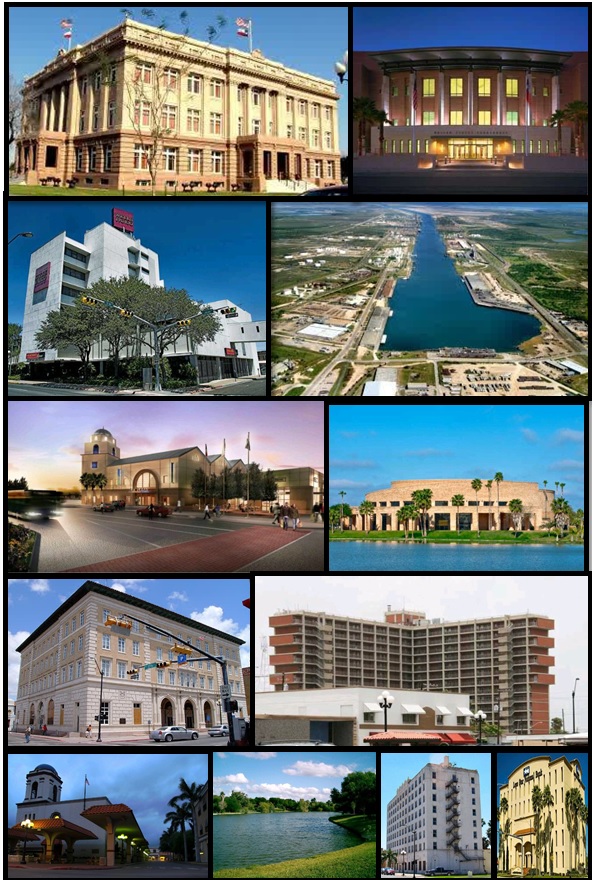
Brownsville
Brownsville es una ciudad ubicada en el condado de Cameron en el estado estadounidense de Texas.
Government administration · United States · 0 followers
Overview
Brownsville es una ciudad ubicada en el condado de Cameron en el estado estadounidense de Texas. En el Censo de 2016 tenía una población de 479.743 habitantes y una densidad poblacional de 662 personas por km². Se encuentra en el extremo sur del estado, junto al río Bravo, que a la vez colinda con la ciudad fronteriza de Matamoros, Tamaulipas, México, cerca de su desembocadura en el golfo de México.
Interested in working with us in the future?
Follow to see new jobs and posts in your feed.
No news yet.
About

Brownsville es una ciudad ubicada en el condado de Cameron en el estado estadounidense de Texas. En el Censo de 2016 tenía una población de 479.743 habitantes y una densidad poblacional de 662 personas por km². Se encuentra en el extremo sur del estado, junto al río Bravo, que a la vez colinda con la ciudad fronteriza de Matamoros, Tamaulipas, México, cerca de su desembocadura en el golfo de México.
Kaynak: Wikipedia · CC BY-SA 4.0
Historia
Brownsville fue fundada por Charles Stillman el 13 de enero de 1849. Stillman fue quien recibió el territorio lindante a Fort Brown como pago por sus servicios de transporte de tropas a través del Río Grande en la guerra de Estados Unidos y México. Más tarde adquirió el territorio a los hijos del propietario legal y procedió a venderlo por parcelas. Las calles llevaban inicialmente los nombres propios de su padre, madre y el mismo, aunque quien puso las placas les añadió "Santo". El 3 de abril de 1984, una masacre deja como saldo a 17 víctimas en los miembros de la secta Children Of The Fold.
Geografía
Brownsville se encuentra ubicada en las coordenadas 26°1′6″N 97°27′14″O. Según la Oficina del Censo de los Estados Unidos, Brownsville tiene una superficie total de 378,87 km², de la cual 342,73 km² corresponden a tierra firme y (9,54%) 36,13 km² es agua.
Demografía
Según el censo de 2010, había 175 023 personas residiendo en Brownsville. La densidad de población era de 461,97 hab./km². De los 175 023 habitantes, Brownsville estaba compuesto por el 87,98 % blancos, el 0,41 % eran afroamericanos, el 0,35 % eran amerindios, el 0,68 % eran asiáticos, el 0,02 % eran isleños del Pacífico, el 9,10 % eran de otras razas y el 1,46 % pertenecían a dos o más razas. Del total de la población el 93,19 % eran hispanos o latinos de cualquier raza.
Gobierno
Brownsville tiene un estilo de Cabildo-Director del Gobierno. El alcalde y seis Miembros de un Cabildo de la Ciudad, dos En-Grande y cuatro Distrito, sirve tambaleó cuatro términos de año. Cada dos años, tres asientos del Cabildo se votan para, uno En-Grande y dos Distritos. Las elecciones generales se convocan el primer sábado de mayo en años numerados impares, organizadas por la Oficina del Secretario de la Ciudad. Esto implica administrando los papeles de appropiate para un candidato para ser incluidos en la votación. El Secretario de la Ciudad es también responsable de llevar registro en los candidatos, principalmente sus Informes de Finanzas de Campaña. La Oficina del Secretario de la Ciudad cuenta los votos y declara a un ganador. En Texas, las elecciones locales son independientes y por tanto los candidatos se presentan sin afiliación política. Bajo este sistema, no es infrecuente que varios candidatos se apoyen unos a otros aunque sostengan políticas distintas. Para presentarse en elecciones independientes, no hace falta que el interesado sea respaldado por un partido político y puede nominarse a sí mismo. La Oficina del Secretario de la Ciudad entonces verificará que el interesado cumple los requisitos para tomar un cargo político. Un candidato para la oficina local debe recibir una mayoría del voto. Si no la consigue, la Oficina de Secretario de Ciudad pondrá la fecha como necesitado. En el caso de que un Miembro del Cabildo o el alcalde dimita de su cargo, habrá una elección especial para llenar el puesto.
Educación
Tiene el campus Brownsville de la Universidad de Texas de El Valle del Río Grande (anteriormente la Universidad de Texas en Brownsville).
El Distrito Escolar Independiente de Brownsville gestiona escuelas públicas.
Kaynak: Wikipedia – Brownsville · CC BY-SA 4.0
History

Founding
In 1781, Spanish government officials granted José Salvador de la Garza 59 leagues of land (408 sq mi). He used the land to construct a ranch several miles northwest of the area. During the early 1800s, Brownsville was known to residents as los tejidos (English: "pasturelands"). Settler presence grew around 1836 when Texas colonial rule declared its independence from Mexico. On February 4, 1846, United States President James K. Polk instructed American General Zachary Taylor and his troops, including 2nd LT. Ulysses S. Grant, to begin moving south towards what was still remembered as los tejidos. Once Taylor arrived, he built Fort Texas. It was later renamed Fort Brown for Major Jacob Brown, one of two American soldiers who died during the siege of Fort Texas.
Charles Stillman arrived in Matamoros in 1828 from Connecticut to help his father in the cotton trade. Brownsville became part of Texas after the signing of the Treaty of Guadalupe Hidalgo in 1848. During that year, Stillman formed a partnership with Samuel Belden and Simon Mussina to form the Brownsville Town Company. They reportedly sold lots valued at $1,500 following displacement of prior residents. Brownsville was originally established as a U.S. recognized city in late 1848 following Stillman's colonization efforts, and was made the county seat of Cameron County on January 13, 1849. The state originally incorporated the city on January 24, 1850. This was repealed on April 1, 1852, because of a land-ownership dispute between Stillman and its former owners (including Juan Cortina, a Mexican rancher). The state reincorporated the city on February 7, 1853; this remains in effect. The issue of ownership was not decided until 1879, when the United States Supreme Court ruled in favor of Stillman.
Mexican–American War
On April 25, 1846, Captain Seth B. Thornton received reports of Mexican troops crossing the Rio Grande. Thornton and 63 U.S. dragoons moved to Rancho de Carricitos and discovered several houses in the area. Mexican General Anastasio Torrejón crossed the Rio Grande the previous day. He commanded 1,600 cavalry and infantry troops to surround Thornton's troops in fractions. Due to heavy force from Torrejón's troops, Thornton's troops surrendered. Eleven American casualties were reported; 45 troops and Thornton were held as prisoners. Reports of the incident were sent to President James K. Polk, who announced, "American blood has been spilled upon the American territory." On May 13, the United States Congress declared war against Mexico.
Geography and climate

Brownsville is one of the southernmost cities in the contiguous United States; only a handful of municipalities in Florida's Miami-Dade and Monroe Counties (plus Everglades City, Collier County) are located farther south than Brownsville. The city has a total area of 84.867 sq mi (220 km2), of which 81.528 sq mi (211 km2) are land and 3.339 sq mi (9 km2) are water, according to the United States Census Bureau of 2017.
Brownsville is situated at the intersection of several different climates zones, such as the subtropics, the Chihuahuan Desert, the Gulf Coastal Plain, and the southern reach of the American Great Plains, thus attracting high numbers of migratory birds, and creating a unique biome for many species of plants and animals. Its idiosyncratic network of resacas (English: oxbow lakes), distributaries of the Rio Grande, provide habitat for numerous nesting and breeding birds, typically during the spring and fall migrations. Brownsville's vegetation is classified as grassland.
Metropolitan area
Brownsville is in one metropolitan statistical area as defined by the United States Census Bureau. The Brownsville–Harlingen–Raymondville combined statistical area consists of Cameron County and Willacy County. It includes the Brownsville metropolitan area and the micropolitan area of Raymondville. The city of Raymondville is the county seat of Willacy County. The Brownsville-Harlingen-Raymondville combined statistical area is home to 445,309 people (2017 estimated), making it the 106th-largest combined statistical area in the United States. Based on the Uniform Crime Report conducted by the Federal Bureau of Investigation in 2013, the Brownsville metropolitan area ranked last on its list of the "Most Dangerous Cities" in Texas, with "240 incidents of violent crime per 100,000 people" and a murder rate of 1.4. Robbery crimes make up 25% of overall crime in the city, with a rate of 58.1 per 100,000 residents.
Demographics
Brownsville is the 18th-most populous city in Texas. It ranks as one of the top U.S. cities in terms of the percentage of Hispanic residents. According to the Pew Research Center, its metropolitan area holds the 26th-largest Hispanic population with roughly 373,000 (88.7%) sharing this distinction. Of that percentage, 96.7% are Mexican and 0.8% are Puerto Rican.
2020 census
As of the 2020 census, Brownsville had a population of 186,738. The median age was 32.9 years. 28.8% of residents were under the age of 18 and 13.3% of residents were 65 years of age or older. For every 100 females there were 91.6 males, and for every 100 females age 18 and over there were 86.8 males age 18 and over.
97.8% of residents lived in urban areas, while 2.2% lived in rural areas.
There were 57,460 households in Brownsville, of which 45.0% had children under the age of 18 living in them. Of all households, 49.0% were married-couple households, 14.4% were households with a male householder and no spouse or partner present, and 31.7% were households with a female householder and no spouse or partner present. About 18.3% of all households were made up of individuals and 8.7% had someone living alone who was 65 years of age or older.
There were 63,191 housing units, of which 9.1% were vacant. Among occupied housing units, 60.1% were owner-occupied and 39.9% were renter-occupied. The homeowner vacancy rate was 1.2% and the rental vacancy rate was 7.5%.
The ancestry of Brownsville was 0.9% German, 0.6% English, 0.5 Irish, 0.4% French, 0.4% Italian, and 0.2% Dutch.
Approximately 25.9% of the population were foreign born, with 35.7% of those being U.S. citizens and 64.3% of those not U.S. citizens.
The median household income was $47,435, with families having $50,127, married couples having $59,604, and non-families had $18,322. A total of 22.0% of the population were in poverty, with 36.4% of people under 18, 21.2% of people between the ages of 18 and 64, and 28.2% of people 65 or older were in poverty.
Economy

Brownsville's economic activity is derived from the service and manufacturing industries. Government and the University of Texas Rio Grande Valley are both large contributors to the local economy. Other prominent industries in Brownsville include education and aerospace and space transportation. During the first decade of the 1900s, the city's population increased after a boom in the agriculture industry. Brownsville's subtropical climate has made it a commercial hub for the citrus industry.
The Port of Brownsville produces significant revenue for the city of Brownsville. The port, located 2 mi (3.2 km) from the city, provides a link between the road networks of nearby Mexico and the Gulf Intracoastal Waterway of Texas. The port has become an important economic hub for South Texas, where shipments arrive from other parts of the United States, Mexico, and other foreign countries. The port also participates in ship recycling; it has five of the country's eight ship-recycling companies. It received a $1.8 million grant from the United States Department of Commerce to support business and infrastructure development. The grant is expected to create 700 jobs and generate $3 million in private investments.
International trade
Brownsville's economy is based mainly on its international trade with Mexico under the North American Free Trade Agreement (NAFTA). Due to Matamoros' maquiladora (English: textile factory) boom, Brownsville experienced growth in the air cargo industry during the late 1980s. It is home to one of the fastest-growing manufacturing sectors in the United States. Brownsville has been recognized as having one of the best pro-business climates in the United States, and the city has been ranked among the least-expensive places to live in the country. President Barack Obama signed a bill in 2016 allowing for the deepening of the Brownsville Ship Channel from 42 ft (13 m) to 52 ft (16 m).
Parks and recreation

Brownsville has 37 parks connected by a 1,200-acre (1.9 sq mi) system of parkland and 32 mi (51 km) of bike lanes. The city also has three gymnasiums, two public pools, and 55 athletic fields.
Brownsville's proximity to the coast has allowed the city to register several locations under the list of protected areas of the United States. Resaca de la Palma State Park is one of six nature preserves (and three state parks) that are part of the World Birding Center. It is also the largest nature preserve of the park system, with approximately 1,200 acres (490 ha) of native semitropical brushland. The area was part of the Battle of Resaca de la Palma. The National Park Service lists the site of the Battle of Palo Alto as a National Historic Park. The agency purchased 300 acres (120 ha) of the site's land, with two-thirds belonging to private landowners. It is native to the Prosopis glandulosa (honey mesquite) bush, Opuntia engelmannii (prickly pear), and Yucca treculeana (yucca).
The city encompasses two national wildlife refuges. Located in northeast Cameron County, Laguna Atascosa National Wildlife Refuge protects several endangered species, including the Texas ocelot (Leopardus pardalis albescens), a rare wild cat, and the Aplomado falcon (Falco femoralis). The refuge measures 65,096-acre (263.43 km2). The Lower Rio Grande Valley National Wildlife Refuge is located in northwest Cameron County and measures 90,788-acre (36,741 ha). The refuge contains trails that are connected to the Great Texas Coastal Birding Trail. The Boca Chica State Park and Brazos Island State Park are state parks that were transferred by separate lease agreements to the Lower Rio Grande Valley refuge center in 2007. They measure 10,680-acre (43.2 km2) and 217-acre (0.88 km2), respectively. Laguna Madre is located on the eastern side of the county. It is a long, shallow, hypersaline lagoon, and is one of the most protected lagoon ecosystems in the United States.
Government

Brownsville has a council–manager government. The mayor and a six-member city commission are selected in nonpartisan elections. Four members are elected from geographic districts; the remaining two members are elected at-large. Since Brownsville is the county seat of Cameron County, many county offices are in Brownsville. The city's public library system has two branches. The primary law enforcement agency for the city is the Brownsville Police Department. The Brownsville Fire Department has nine stations around the city; its central office is located on the eastern side of the city.
Most of Brownsville is represented by two county commissioners of the five-member Commissioners' Court (one member, the County Judge, represents all of Cameron County). County offices are partisan; the Democratic and Republican Parties hold primaries in March of the year that their office term expires.
The City of Brownsville falls under two Texas House of Representatives districts. Each representative has a two-year term and is elected in the same manner as other partisan elected officials. The elected representatives include, District 37: Alex Dominguez (D) (since 2019), and District 38: Erin Gámez (D) (since 2021). Brownsville is represented by Texas Senatorial District 27, the incumbent senator is Morgan LaMantia (D) (since 2023). This city is represented by Texas's 34th congressional district. The incumbent Representative is Vicente Gonzalez (D) (since 2023).
The city holds several federal office buildings. The United States Postal Service operates post offices in Brownsville. Downtown Brownsville is served by the Old Federal Courthouse; it is now used as a City Hall. The National Weather Service operates an office and a Nexrad weather radar site in east Brownsville. They provide forecasts and radar coverage for Deep South Texas and the adjacent coastal waters. Other federal building located within the city limits of Brownsville include: Social Security Administration and the Reynaldo G. Garza – Filemon B. Vela United States Courthouse. Military buildings and battle sites include the Brownsville Armed Forces Reserve Center (AFRC) host units from the United States Army Reserve and the Texas Army National Guard, and the Reserve Officers' Training Corps (ROTC).
Education

Primary and secondary education
Brownsville Independent School District (BISD) serves most of the city. Enrollment in the 2018–2019 school year was 44,402 students, 95% of whom are economically disadvantaged. Enrollment at BISD reached a high of 49,991 students in 2010–2011, and has declined an average of 1,000 students per year since 2014–2015. It is the 17th largest school district in Texas. There are seven high schools within the district: Homer Hanna, Gladys Porter, James Pace, Simon Rivera, Lopez, BECHS, and Veterans Memorial.
A portion of northern Brownsville is served by the Los Fresnos Consolidated Independent School District. South Texas Independent School District, a magnet school district, operates a medical academy in northern Brownsville. There are several private parochial elementary and middle schools located throughout the community. The Roman Catholic Diocese of Brownsville operates Catholic schools in the Rio Grande Valley, including Brownsville.
Colleges and universities
Six colleges and universities are located within the Brownsville boundaries. The University of Texas Rio Grande Valley, part of the University of Texas system, was founded in 2014 after the merger of the University of Texas at Brownsville and University of Texas–Pan American. It is the 10th-largest university in Texas, having 25,137 undergraduates, 3,068 graduate students, and 439 professionals enrolled in 2018. In 2017, The Hispanic Outlook in Higher Education ranked the university third in the country in awarding bachelor's degrees to Hispanic students.
Texas Southmost College is a community college located near the southern border of Brownsville. As of 2018, it had a total enrollment of 7,132. Students usually transfer to the neighboring University of Texas Rio Grande Valley. The city operates three vocational schools. These include the South Texas Vocational Technical Institute, Brightwood College campus (formerly known as Kaplan College), and Southern Careers Institute.
Infrastructure

Major highways
Brownsville is served by Interstate 69E, sharing its alignment with U.S. Route 77. The highway connects to the cities of Kingsville and Corpus Christi. U.S. Route 77 was a proposed part of the North American Free Trade Agreement's completed Interstate 69 corridor. Other highways that serve the Brownsville area are U.S. Route 83, U.S. Route 281, State Highway 4 and State Highway 48. Interstate 169/State Highway 550 is a toll road that connects North Brownsville to the Port of Brownsville; it forms a loop around the outer city limits of Brownsville. An interchange in nearby Olmito carries traffic from Interstate 69E onto the highway.
Mass transit
Established in mid-Brownsville in 1978, the Brownsville Urban System (BUS), currently known as the Brownsville Metro, consists of three hubs that run 13 routes covering a large portion of Brownsville. The system provides 11 paratransit vans to disabled passengers, complying with the standards for the Americans with Disabilities Act. It is the only mass transit system in its county and one of the largest in the Rio Grande Valley. Annual ridership for 2015 was 1,384,474.
Intercity transit
The Brownsville/South Padre Island International Airport (BRO) provides passengers with daily nonstop service to American Eagle hubs Dallas/Fort Worth International Airport, United Express to George Bush Intercontinental Airport in Houston, and World Atlantic Airlines, which operates charter and on-demand flights to Miami International Airport. The airport received a $12.7 million grant from the Federal Aviation Administration for the construction of a new 85,000 ft2 (7,900 m2) terminal facility. The project is expected to commence construction by late 2018.
Bike share and trails
The City of Brownsville currently has 64 mi (103 km) of hike and bike trails and on-street bike lanes. In 2016, a bike-share program was established in Brownsville in collaboration with the University of Texas Rio Grande Valley. Six bike stations were installed. The contract was renewed with another company to provide a "dockless ride-share program" in late 2018.
Arts and culture

Brownsville is known for its strong Mexican culture. Charro Days is a two-nation fiesta celebration held in Brownsville in cooperation with Matamoros, Mexico. It is accompanied with El Grito, a joyous shout originating in Mexican culture. Musicians and actors of Mexican heritage make appearances. Sombrero Festival is a continuation of Charro Days. It is a three-day event consisting of performances from tejano, corrido and other traditional Mexican artists as well as a variety of contests. In 2016, a Mexican art gallery donated a statue called Mr. Charro that was unveiled at a park.
The city hosts the Latin Jazz Festival every year around early October in Downtown Brownsville. It is a three-day celebration of local Latin jazz performers, art and dance. The festival began in 1997, founded by American musician Tito Puente. Brownsville has a growing number of arts galleries, including the Puente Art Studio, the Flower Shop Art Studio & Residency, the first live-in art residency in the region, the B&E Art Studio, and the Rusteberg Art Gallery. The Brownsville Museum of Fine Arts features exhibitions of Egyptian and Astronomical art. It was formerly known as the Brownsville Art League, formed by a group of eight women. The museum underwent a renovation in 1960, featuring a 4,000 ft2 (370 m2) studio. In 2002, it changed its name to its current name and underwent another renovation. According to the Association of Art Museum Directors, women account for 38% of leadership positions.
Brownsville also has several museums dedicated to historic artifacts and military equipment. The Historic Brownsville Museum opened to the public in 1986. The building was used as a Spanish Colonial Revival passenger depot and was later abandoned. It features Spanish architecture and education programs. Several renovations were made over time, including the addition of a Spanish-style fountain, a courtyard and an engine building. The Commemorative Air Force Museum houses World War II aircraft and holds tours on the early events of wars in Asia and Europe. It also documents the stories of pilots who were part of the 201st Mexican Fighter Squadron.
Media
The Brownsville Herald is the city's major daily newspaper. It has a circulation of 15,880 with 16,409 on Sundays. Other newspapers that share content within Brownsville include The Monitor (headquartered in McAllen), the Valley Morning Star (headquartered in Harlingen) and The Rider, the official weekly campus paper of the University of Texas Rio Grande Valley.
Radio
KBNR (88.3) – Spanish-language Christian
KESO (92.7) – Classic Hits (70s/80s Hits)
KJAV (104.9) – Adult Contemporary/Spanish AC Hits
Television
Brownsville has three licensed broadcast full power television stations:
KVEO-TV (Channel 23; DT 24) – NBC affiliate
KNWS-LD (Channel 64; DT 27) – Azteca America affiliate
KXFX-CD (Channel 67; DT 20) – Fox affiliate
In literature in the arts
Brownsville: Stories is a short story collection by Oscar Casares, the stories are loosely set in Brownsville.
"Brownsville Girl" by Bob Dylan and Sam Shepard was a song on Dylan's 1986 album Knocked Out Loaded.
"It's All Here In Brownsville", the final track of Full Force Galesburg by the Mountain Goats.
Owing to its location on the 28th Parallel Brownsville is listed (as "Brownsville in the Cameron") as a potential site for the story's moon launch in Jules Verne's 1865 book "From the Earth to the Moon"
Sister city
Heroica Matamoros, Tamaulipas, Mexico (Since 1995)
Kaynak: Wikipedia – Brownsville, Texas · CC BY-SA 4.0