
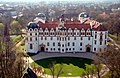

Celle
Celle [ˈtsɛlə] ist eine große selbständige Stadt mit 66.930 Einwohnern und Kreisstadt des Landkreises Celle in Niedersachsen.
Government administration · Germany · 0 followers
Overview
Celle [ˈtsɛlə] ist eine große selbständige Stadt mit 66.930 Einwohnern und Kreisstadt des Landkreises Celle in Niedersachsen. Die Mittelstadt gilt als südliches Tor zur Lüneburger Heide und ist ein Ort mit einer pittoresken Altstadt mit über 400 Fachwerkhäusern und einem Schloss im Stil der Renaissance und des Barocks.
Interested in working with us in the future?
Follow to see new jobs and posts in your feed.
No news yet.
About

Celle [ˈtsɛlə] ist eine große selbständige Stadt mit 66.930 Einwohnern und Kreisstadt des Landkreises Celle in Niedersachsen. Die Mittelstadt gilt als südliches Tor zur Lüneburger Heide und ist ein Ort mit einer pittoresken Altstadt mit über 400 Fachwerkhäusern und einem Schloss im Stil der Renaissance und des Barocks.
Kaynak: Wikipedia · CC BY-SA 4.0
Geografie

Celle liegt im Urstromtal der Aller, einem Nebenfluss der Weser. Zur niedersächsischen Landeshauptstadt Hannover im Südwesten sind es rund 40 km, Braunschweig liegt 55 km südöstlich und nach Hamburg im Norden sind es 120 km. Celle ist nach Lüneburg die zweitgrößte Stadt zwischen Hannover und Hamburg.
Die Fläche des Stadtgebiets beträgt 176,02 Quadratkilometer. Innerhalb des Stadtgebiets münden im Osten der Fluss Lachte und im Westen der Fluss Fuhse in die Aller.
* Entfernungen sind gerundete Straßenkilometer bis zum Ortszentrum.
Stadtgliederung
Die Stadt Celle ist eine Einheitsgemeinde und gliedert sich in folgende Stadtteile (Zahlen vom 31. Dezember 2021) auf, die Ortschaften nach dem Niedersächsischen Kommunalverfassungsgesetz bilden:
Nachbargemeinden
Folgende Gemeinden grenzen an die Stadt Celle. Sie werden im Uhrzeigersinn beginnend im Norden genannt und gehören alle zum Landkreis Celle: Stadt Bergen, Eschede, Beedenbostel und Lachendorf (beide Samtgemeinde Lachendorf), Wienhausen (Samtgemeinde Flotwedel), Nienhagen und Adelheidsdorf (beide Samtgemeinde Wathlingen), Hambühren und Winsen (Aller).
Klima
Der Jahresniederschlag beträgt 692 mm. Er liegt im mittleren Drittel der in Deutschland erfassten Werte. An 39 % der Messstationen des Deutschen Wetterdienstes werden niedrigere Werte registriert. Der trockenste Monat ist der Februar, die meisten Niederschläge fallen im August, und zwar 1,5-mal mehr als im Februar. Sie sind fast gleichmäßig übers Jahr verteilt. An nur 1 % der Messstationen werden niedrigere jahreszeitliche Schwankungen registriert.
Die Jahresmitteltemperatur beträgt 8,9 °C. Die wärmsten Monate sind Juli mit durchschnittlich 17,5 °C und August mit 17,1 °C und die kältesten Januar mit 0,6 °C und Februar mit 1,1 °C.
Geschichte

Mittelalter
Celle wird als Kellu („Siedlung am Fluss“) 993 erstmals urkundlich in der Grenzbeschreibung des Bistums Hildesheim erwähnt. Der Ort lag im Bereich des heutigen Stadtteils Altencelle an der Brunonenburg und der Aller. Er erlebte einen wirtschaftlichen Aufschwung als Zoll- und Umschlagplatz für die Handelsschiffe auf dem Fluss. Im 11. Jahrhundert verfügte der Ort über das Münzrecht. Eine Münze ist im Münzfund von Sandur auf den Färöern enthalten. 1249 wird „Kellu“ oder „Tsellis“ erstmals als Stadt genannt. 1292 forderte Herzog Otto der Strenge die Bewohner auf, in das etwa 3 km nordwestlich gelegene neue Celle zu ziehen. Es hatte sich als Handelsort an einer Furt durch die Aller gebildet. Dort befand sich bereits im 12. Jahrhundert ein befestigter Turm, der später zum Schloss Celle ausgebaut wurde.
1301 wurde das Stadtrecht gewährt. Zur gleichen Zeit begann der Bau der Stadtkirche.
Im Jahre 1378 wurde Celle mit Herzog Albrecht Residenz der Herzöge von Sachsen-Wittenberg. In dieser Zeit wird die Entstehung der Stadtbefestigung von Celle mit einer Stadtmauer angenommen. Ab 1433 residierten die Fürsten von Lüneburg im Celler Schloss. 1453 gründete Herzog Friedrich der Fromme vor den Toren der Stadt ein Franziskaner-Kloster. Am 3. Oktober 1453 genehmigte Papst Nikolaus V. die Verlegung des Konvents in die Stadt. Im Jahr 1464 ermöglichte das Kornschifffahrtsmonopol einen wirtschaftlichen Aufschwung der Stadt.
16. bis 18. Jahrhundert
1524 wurde die Reformation durch Herzog Ernst I. (den Bekenner) von Braunschweig-Lüneburg in Celle eingeführt. Celle war damit die erste Stadt nach Wittenberg, die sich vollständig der Reformation anschloss.
Im Jahre 1570 erbaute sein Sohn Herzog Wilhelm die Schlosskapelle, die 1585 eingeweiht wurde.
1660 errichtete Herzog Christian Ludwig von Celle in Altenhagen einen Reiherpfahl mit Inschrift, der an die Reiherbeize mit Edelfalken erinnert. Im Jahre 1660 zählte man in Celle 3750 Einwohner. Von 1665 bis 1705 erlebte Celle eine kulturelle Blüte als Residenz unter Herzog Georg Wilhelm mit einem Aus- und Umbau des noch mittelalterlich geprägten Schlosses zum vierflügeligen Barockschloss. Kulturell einflussreich war Georg Wilhelms französische Gattin, Eleonore d’Olbreuse, die hugenottische Glaubensgenossen und italienische Baumeister nach Celle holte und auch am Vertrag von Celle mitwirkte. In dieser Zeit wurden der Französische und der Italienische Garten angelegt und das barocke Schlosstheater errichtet. Die Hugenotten erhielten im Jahr 1700 eine eigene Kirche, heute eine der wenigen erhaltenen Hugenottenkirchen in Nordwestdeutschland. Etwa 300 Hugenotten ließen sich in Celle nieder, und nicht wenige arbeiteten im Schloss als Köche oder Diener, und einige eröffneten in der Stadt Handwerksbetriebe als Schneider, Tischler, Handschuh- oder Perückenmacher. Sie machten französische Mode in Celle bekannt und sorgten für einen nicht geringen wirtschaftlichen Aufschwung der Stadt. Da innerhalb der Stadtmauern kein Platz für so viele Neubürger war, plante man ab 1680 eine Stadterweiterung, die sich westlich der Altstadt auf rund 75 Hektar Fläche über etwa 1,5 Kilometer Länge erstrecken sollte. Es kam in den Folgejahrzehnten allerdings nur ansatzweise zur Ausführung dieser „Westceller Vorstadt“ im heutigen Ortsteil Neuenhäusen im Bereich der heutigen Straßenzüge Trift/Bahnhofstraße, mit den rechtwinkligen Querstraßen Breite Straße, Hugenottenstraße, Emigrantenstraße und Jägerstraße. Typische Barockbauten dieser Zeit in der Westceller Vorstadt sind die Hofbeamtenhäuser an der Trift und Bahnhofstraße; architekturgeschichtlich herausragend ist die schlossartige Anlage des Zuchthauses nach Plänen des Oberhofbaumeisters Johann Caspar Borchmann (Trift 14, erbaut ab 1711, heute JVA Celle).
Religion

Celle ist Sitz des gleichnamigen Kirchenkreises Celle im Sprengel Lüneburg der Evangelisch-lutherischen Landeskirche Hannovers.
In Celle befinden sich folgende evangelisch-lutherische Kirchen: Bonifatiuskirche (Klein Hehlen), Christuskirche (Westercelle), St. Cyriacus (Groß Hehlen), St. Georg-Kirche (Blumlage), Gertrudenkirche (Altencelle), Johanneskirche (Wietzenbruch), Kreuzkirche (Neuenhäusen), Stadtkirche St. Marien (Altstadt), Markuskirche (Garßen), das Matthäusgemeindezentrum (Vorwerk), die Neuenhäuser Kirche (Neuenhäusen), Neustädter Kirche (Neustadt) und die Pauluskirche (Heese).
Katholische Kirchen sind St. Hedwig (Heese), St. Johannes der Täufer (Vorwerk) und St. Ludwig (Neuenhäusen). Diese sind Teil des römisch-katholischen Bistums Hildesheim.
Die heute evangelisch-reformierte Kirche an der Hannoverschen Straße (Neuenhäusen) wurde 1700 für die aus Frankreich geflüchteten Hugenotten gebaut.
Die nach Plänen des Architekten Fritz Höger 1921–1922 erbaute Martin-Luther-Kirche an der Hannoverschen Straße (Neuenhäusen) gehört der evangelisch-lutherischen Concordiagemeinde, einer freien altlutherischen Gemeinde. Mit dieser in Kirchgemeinschaft befindet sich die Christusgemeinde der Selbständigen Ev. Luth. Kirche.
Weitere Freikirchen im Rahmen der Deutschen Evangelischen Allianz: Evangelisch-Freikirchliche Gemeinde (Baptisten), Freie evangelische Gemeinde, Ecclesia Christengemeinde (ECG), Christuszentrum, Siebenten-Tags-Adventisten, Gemeinde in der Nachfolge.
Eine Neuapostolische Kirche liegt in der Jägerstraße (Neuenhäusen).
Die Synagoge der jüdischen Gemeinde liegt etwas außerhalb der Altstadt am Platz Im Kreise.
Seit 2008 befindet sich das „Zentrum der Eziden in Niedersachsen“ im Ortsteil Scheuen. Am anderen Ende im Süden der Stadt liegt in Westercelle das Ezidische Kulturzentrum Celle. Die Anzahl der in Celle lebenden Jesiden wird Ende der 2010er Jahre auf rund 3000 und damit mehr als 4 % der Bevölkerung geschätzt.
Politik

Bei Bundestagswahlen gehört die Stadt Celle zum Wahlkreis Celle–Uelzen. 1983, 1987, 1990 und 1994 erhielt Klaus-Jürgen Hedrich (CDU) die meisten Stimmen und damit das Direktmandat. 1998, 2002 und 2005 erhielt Peter Struck (SPD) die meisten Stimmen. 2009, 2013, 2017 und 2021 erhielt Henning Otte (CDU) das Direktmandat.
Bei Landtagswahlen bildet Celle mit den beiden Umlandgemeinden Hambühren und Wietze den Landtagswahlkreis Celle. 1994, 1998 und 2003 gewann Otto Stumpf (CDU) das Direktmandat, 2008, 2013 und knapp auch 2017 erhielt Thomas Adasch (CDU) die meisten Stimmen.
Rat
Der Rat der Stadt Celle besteht aus 42 gewählten Mitgliedern. Dies ist die gemäß § 46 NKomVG festgelegte Anzahl für eine Stadt mit einer Einwohnerzahl zwischen 50.001 und 75.000. Die Ratsmitglieder werden durch eine Kommunalwahl für jeweils fünf Jahre gewählt. Stimmberechtigt im Rat ist außerdem der hauptamtliche Oberbürgermeister.
Bei der letzten Kommunalwahl 2021 ergab sich folgende Sitzverteilung:
Die vergangenen vier Kommunalwahlen führten zu folgenden Ergebnissen (Stimmenanteile) und daraus sich ergebender Verteilung der 42 Sitze:
Oberbürgermeister
1945–1946: Walther Hörstmann (1898–1977)
1948–1952: Franz-Georg Guizetti (CDU) (1901–1982)
1952–1964: Wilhelm Heinichen (1883–1967)
1964–1973: Kurt Blanke (DP, CDU) (1900–1997)
1973–1986: Helmuth Hörstmann (CDU) (1909–1993)
Hoheitszeichen
Die Stadt Celle führt ein Dienstsiegel, ein großes und ein kleines Wappen sowie eine Flagge.
Flagge
Die Stadtflagge ist geteilt in zwei gleich großen Bahnen in den Stadtfarben Blau und Weiß. Sie kann zusätzlich das Stadtwappen enthalten.
Dienstsiegel
Die Stadt Celle führt ein Dienstsiegel, welches das Siegelbild des ältesten Stadtsiegels von 1288 mit der Umschrift „Stadt Celle“ zeigt. Es stellt ein zwischen zwei Mauertürmen liegendes Torgebäude dar, in dessen offenem Torbogen unter einer Helmzier auf einem nach links schräg gelehnten Schild der herzoglich-lüneburgische Löwe angebracht ist.
Kultur und Sehenswürdigkeiten

Die Stadt Celle gehört dem Lüneburgischen Landschaftsverband an.
Museen
Das Bomann-Museum gegenüber dem Schloss zeigt Sammlungen zur Volkskunde Niedersachsens, zur Stadtgeschichte und zur hannoverschen Landesgeschichte. Es beherbergt ein vollständiges niedersächsisches Bauernhaus. Eine Ausstellung umfasst Funde zur Ur- und Frühgeschichte. Das Museum besitzt Werke des Künstlers Eberhard Schlotter. Gezeigt wird auch die Sammlung Tansey, eine der größeren bekannten deutschen Sammlungen von Miniaturen. An das Bomann-Museum ist zudem das Kunstmuseum Celle mit der Sammlung Robert Simon angegliedert; hier ist auch das erste 24-Stunden-Kunstmuseum der Welt zu finden.
Das Residenzmuseum im Celler Schloss zeigt in den barocken Räumen unter anderem Stuckdecken italienischer Meister sowie eine Ausstellung, die das Fürstenhaus der Welfen dokumentiert. Daneben ist eine Sammlung von „Celler Silber“ (eine Schenkung der Familie Tansey) zu sehen.
Mit der Geschichte der Garnison Celle von 1866 bis heute befasst sich das Celler Garnison-Museum, während das Schützenmuseum am Kleinen Plan dem Celler Schützenwesen gewidmet ist. Das bis Ende Februar 2013 bestehende Deutsche Stickmuster-Museum im Rokoko-Palais im Prinzengarten dokumentierte vier Jahrhunderte Frauengeschichte am Beispiel der Stickmusterkultur. Das Wirken des Celler „Neues Bauen“-Architekten Otto Haesler zeigt das Otto-Haesler-Museum. Im 1607 erbauten Treppenspeicher (der ursprünglich in Paulmannshavekost stand und 1931 hierher versetzt wurde) befindet sich das Max-Böcker-Museum. Hier sowie in der 1677 erbauten Orangerie des Instituts für Bienenkunde ist eine Ausstellung zum Imkereiwesen zu sehen.
Theater
Das Schlosstheater Celle wurde 1674 gegründet und gilt damit als das älteste noch bespielte Theater Deutschlands sowie als das älteste Barocktheater Europas. Es verfügt über eine Hauptbühne und zwei Studiobühnen (Malersaal und Turmbühne) sowie auswärts der im Januar 2015 neu eröffneten Spielstätte HALLE 19 auf dem Gelände der CD-Kaserne. Seit 1950 ganzjährig mit einem festen Ensemble bespielt und von 1956/57 bis 1972 von Hannes Razum geleitet, ist es zu bundesweiter Bedeutung gelangt.
Wirtschaft und Infrastruktur

Wirtschaft
In Celle sind industrielle Betriebe des Maschinenbaus, der Tiefbohr- und Erdöl-/Erdgas-Technik (Baker Hughes, Halliburton, ITAG, Bohrmeisterschule), der Elektronik, der Nahrungsmittelherstellung und der Metall-, Holz- und Kunststoffverarbeitung beheimatet. Hinzu kommen Druckfarbenherstellung (hubergroup Deutschland GmbH [ehemals Hostmann-Steinberg GmbH]), Papierverarbeitung (Werner Achilles Glanzfolien-Kaschieranstalt GmbH) sowie der Musikinstrumentenbau (u. a. Moeck). In der Erdölförderbranche waren 2015 etwa 9600 Menschen beschäftigt.
Bedeutender Wirtschaftszweig ist auch der Fremdenverkehr. Das Niedersächsische Landgestüt, das die Zucht des Hannoveraner Pferdes betreibt, ist in Celle beheimatet.
Im Dienstleistungssektor sind vor allem Verwaltungs- und Justizeinrichtungen von Bedeutung, so beheimatet Celle das Oberlandesgericht Celle, das Landesjustizprüfungsamt des Niedersächsischen Justizministeriums und das Landessozialgericht Niedersachsen-Bremen. Darüber hinaus spielen auch Land- und Forstwirtschaft noch eine Rolle.
Seit dem Jahr 2015 betreibt die Technische Universität Clausthal am Standort Celle das heutige Forschungszentrum „Drilling Simulator Celle – Deutsches Zentrum für Hochleistungsbohrtechnik und Automatisierung“.
Nahrungsmittel
Celle ist Standort der Knäckebrotfabrik der Barilla Wasa Deutschland. Der hochprozentige Kräuterlikör der Marke „Ratzeputz“ der Firma „C. W. Baland & Langebartels Peter Weidmann Erben GmbH“ wurde früher direkt in der Celler Altstadt und wird heute im Industriegebiet Westercelle hergestellt. Dort entsteht auch das von der Brauerei Carl Betz gebraute „Celler Bier“ in sechs verschiedenen Sorten. Der Kräuterlikör „Alter Provisor“ aus Celle wurde bis zu ihrer Schließung 2014 in der Rats-Apotheke im Celler Stadtzentrum produziert, eine ehemalige Apothekenmitarbeiterin führt Herstellung und Verkauf nach dem geheimen Originalrezept seitdem in einem liebevoll restaurierten Fachwerkhaus in der Bergstraße weiter.
Kaynak: Wikipedia – Celle · CC BY-SA 4.0
Geography

The town of Celle lies in the glacial valley of the Aller, about 40 kilometres (25 mi) northeast of Hanover, 60 kilometres (37 mi) northwest of Brunswick and 120 kilometres (75 mi) south of Hamburg. With 71,000 inhabitants it is, next to Lüneburg, the largest Lower Saxon town between Hanover and Hamburg.
Expansion
The town covers an area of 176.05 square kilometres (67.97 mi2). Flowing from the northeast, the Lachte discharges into the Aller within the town, as does the Fuhse flowing from the southeast. The Aller heads westwards towards Verden an der Aller, where it joins the Weser.
Climate
Celle's annual precipitation is 692 millimetres (27.2 in), which puts it in the middle third of locations in Germany. 39% of the Deutscher Wetterdienst's weather stations record lower values. The wettest month is August, which has 1.5 times the amount of precipitation as February, the driest month. Monthly precipitation varies only slightly and is very evenly spread throughout the year. Only 1% of German weather stations show a lower annual variation.
The Celle weather station has recorded the following extreme values:
Its highest temperature was 37.5 °C (99.5 °F) on 9 August 1992.
Its lowest temperature was −26.8 °C (−16.2 °F) on 27 January 1942.
Its greatest annual precipitation was 982.7 mm (38.69 in) in 2002.
Its least annual precipitation was 350.1 mm (13.78 in) in 1959.
The longest annual sunshine was 1,959.6 hours in 2003.
The shortest annual sunshine was 1,260.5 hours in 1970.
Subdivisions
The town of Celle has the following 17 boroughs or Stadtteile, some of which were previously independent villages (population as at 1 January 2005): Altencelle (4,998), Altenhagen (922), Blumlage/Altstadt (8,526), Bostel (455), Boye (832), Garßen (2,978), Groß Hehlen (2,773), Hehlentor (7,974), Hustedt (736), Klein Hehlen (5,782), Lachtehausen (639), Neuenhäusen (8,082), Neustadt/Heese (10,887), Scheuen (1,165), Vorwerk (2,842), Westercelle (7,183) and Wietzenbruch (4,805).
History

Middle Ages
Celle was first mentioned in a document of A.D. 985 as Kiellu (which means Fischbucht or fishing bay). It was granted the right to mint and circulate its own coins under the minting rights during the 11th century and several coins were found in the Sandur hoard in the Faroes. In 1292 Duke Otto II the Strict (1277–1330), a Welf who ruled the Principality of Lüneburg from 1277 to 1330, left Altencelle, where there had been defences in the form of a circular rampart (the Ringwall von Burg) since the 10th century, and founded a rectangular settlement by the existing castle (Burg) 4 kilometres (2.5 mi) to the northwest. In 1301 he granted Celle its town privileges and in 1308 started construction on the town church.
In 1378 Celle became the Residenz of the dukes of Saxe-Wittenberg and in 1433 the princes of Lüneburg took up residence in the castle (Schloss). The ducal palace was situated on a triangle between the Aller and its tributary, the Fuhse. A moat connecting the rivers was built in 1433, turning the town centre into an island. In 1452 Duke Frederick the Pious of Lüneburg founded a Franciscan monastery. In 1464 the grain shipping monopoly generated an economic upturn for the town.
Early modern period
In 1524 the Reformation was introduced into Celle. In 1570 Duke William the Younger built the castle chapel, which was consecrated in 1585.
In 1660 Celle had 3,750 inhabitants. From 1665 to 1705 Celle experienced a cultural boom as a Residenz under Duke George William. This has been put down in particular to his French wife, Eleonore d'Olbreuse, who brought fellow Huguenot Christians and Italian architects to Celle. During this time the French and Italian Gardens were laid out and the baroque castle theatre built. Because of the persecution of Huguenots under Louis XIV many French Huguenots sought refuge in Germany, especially in Berlin and in the towns of Celle, Neuwied and Hanau. About 300 Huguenots settled in Celle, where a new residential area was laid out for them in the southwest of the centre. Its main street, Hugenottenstrasse, is still a sightworthy historical street with well-preserved wooden houses built at the beginning of the 18th century. Many French refugees worked in the castle as cooks and servants, but some of them opened shops in Celle as tailors, carpenters, joiners, confectioners, wig makers and glovers, thus introducing some French cuisine, fashion and lifestyle into the town. Some years later protestant refugees from Austria sought refuge in Celle as well. Emigrantenstraße is another historical street, which was laid out for the Austrians.
Government
For the purposes of Bundestag elections the town of Celle belongs to the constituency of Celle-Uelzen. In 1983, 1987, 1990 and 1994 Klaus-Jürgen Hedrich (CDU) won the direct vote. In 1998, 2002 and 2005 Peter Struck (SPD) won the majority of votes. In 2009 Henning Otte (CDU) received the direct mandate.
For Lower Saxony State Parliament (Landtag) elections Celle forms the constituency of Celle-Stadt with its surrounding area. In 2003 the CDU won the majority of votes.
Town council
The town council has 42 elected members as well as the directly elected mayor (Oberbürgermeister). Since the local elections of 11 September 2016, it has consisted of ten parties or voting groups:
Die Linke/Alliance for Social Justice (Bündnis Soziale Gerechtigkeit) – Celle (BSG-CE) − 2 seats
Mayors (Oberbürgermeister)
1945–1946: Walther Hörstmann (1898–1977)
1952–1964: Wilhelm Heinichen (1883–1967)
1973–1985: Helmuth Hörstmann (1909–1993)
Coat of arms
Blazoning: Azure, a castle, triple-towered, embattled above the port, all argent, masoned sable, the port sable, the towers roofed gules. The port charged with a lion rampant azure surrounded by seven hearts gules on an inescutcheon bendwise or.
The helmet on the full coat of arms is described as follows: On the shield is a blue and white wreathed helmet with a mantling, blue on the outside and white on the inside. The crest consists of two sickles leaning outwards with red handles. The sickles have their points upwards, blades inward-facing and are decorated with peacock's eyes on the outside edges.
Flag
The town flag is divided into two equal stripes in the town colours of blue and white. It may also contain the town coat of arms.
Official seal
The town of Celle has an official seal whose design is based on the oldest town seal of 1288 with the circumscription Stadt Celle. It depicts a gatehouse between two castle towers. In the open gateway under a decorative helmet there is a shield tilting to the left charged with the lion of the Dukes of Lüneburg.
Main sights

The buildings in Celle's old town centre date back to the 16th century, among them numerous (and some 480 restored) half-timber houses with wood carvings, making Celle an important city for tourism in the southern Lüneburg Heath region. One of the most famous houses is Hoppenerhaus dating from 1532. The Old Latin School was built in 1602. The most impressive building in Celle is the ducal palace, Schloss Celle, which was built in 1530 in a well-kept park at the site of the former castle. It was enlarged in a baroque style in the 17th century, and a renaissance chapel and a special theatre which is the oldest theatre in Germany were added in 1674. The Old City Hall which is famous for its sandstone carvings was built 1561-1579 in a Renaissance style. Another major attraction is the Stadtkirche (town church) with its white tower, from where the town trumpeter blows a fanfare twice a day (an old tradition that was revived as a tourist attraction). Originally it was a small gothic chapel built in 1380, but it was enlarged from 1675 to 1698 and transformed into a baroque church with impressive stucco ornaments.
Hugenottenstrasse is a historical street with well-preserved wooden houses built at the beginning of the 18th century. It was the main street of a residential area specially laid out for French Huguenots who sought refuge in Celle because of the Persecution of Huguenots under Louis XV in the 17th century. The oldest house dates from 1693. On the corner of Emigrantenstraße, another historical street which was laid out for Austrian refugees at the beginning of the 18th century, Neuhäuser Kirche, a Lutheran church was founded in 1710. It was enlarged from 1852 to 1866. Its steeple dates from the same period.
Even a large prison (Justizvollzugsanstalt, JVA) was built in a baroque style in the west of the city centre from 1710 to 1731. It was the only historical building of Celle which was damaged during the air raid on 8 April 1945. It was repaired after the war. Sometimes tourists walking from the railway station to the centre mistake it for a castle because of its typical baroque architecture.
Events
The Congress Union Celle is an event centre for conferences and exhibitions as well as stage, music and festive events.
The CD-Kaserne ("Cambridge Dragoons (CD) Barracks") is a municipal youth and cultural centre with exhibition rooms covering the subject areas of music, film, art and society.
Also located there is the Bunte Haus which is a charitable cultural centre. It focuses on projects and events dealing with social questions covering aspects of culture, social work and civic education. Its workers are volunteers.
Celle also hosts a Christmas market every year in the old town centre.
Sports
The Celler Oilers are an ice hockey team that play in the Regionalliga or regional league. From 1968 to the mid-1970s Celle's football club, TuS Celle, played in the German second division (then called the Regionalliga or "regional league"). After two bankruptcies and relegation, it was promoted to the Lower Saxony league for the 2004–2005 season and, since 2005 has played in the Northeast Lower Saxony league (Oberliga Niedersachsen Nordost), which is fifth tier of the German football league system.
The handball club, SV Garßen-Celle, has fielded a women's team that had played in the women's Second Division North since the mid-1990s. In 2009 it came first and was promoted to the First Division.
Since 1983 the Celle Wasa Run (Celler Wasa-Lauf) has taken place every year on the second Sunday of March in Celle's town centre. This has become one of the biggest running events in Germany for distances less than a marathon and is divided into runs of several distances: a children's run of 2.5 km (1.6 mi) and runs of 5, 10, 15 and 20 km (12.4 mi) distance. For several years there has also been a hiking (Wandern) event over 11 km (7 mi) along the Aller as well as Walking and Nordic Walking events. 2004 saw a record number of participants with 11,232 men and women taking part.
Celle is one of five centres for the Lower Saxony Rowing Club. The Celle Sprint Regatta takes place annually in October on the Upper Aller at the Ziegeninsel and is hosted by the Hermann Billung Celle, Celler Ruderverein and Ruderclub Ernestinum-Hölty Celle rowing clubs.
The Celle Triathlon always takes place in August. This was originally organised by the Celle branch of the German Alpine Club (Deutscher Alpenverein), but for several years has been run by SV Altencelle.
Since 2001 Celle has played host to the In-Line Skating and Handbike Marathon from Hanover to Celle. This is one of the biggest races of its kind in Germany. In 2007 the European Masters speed skating championship took place as part of this event.
Economy and Infrastructure

Economy
Tourism is a large contributor to Celle's economy, especially in the summer months during jazz, wine, and other festivals, which attract thousands of visitors.
The town is not really known for heavy industry, but many businesses which have started up in Celle and some, such as Rosa Graf Cosmetics, have reached the world market. Celle does have some links to the oil industry, though, particularly firms engineering parts for drilling; notably Baker Hughes (INTEQ and Hughes Christensen divisions; oil and gas industry service companies specialising in MWD, Wireline, Drill-bits, Drilling Applications Engineering, etc.), Cameron (global provider of pressure control, processing, flow control and compression systems as well as project management and aftermarket services for the oil and gas and process industries), and ITAG (drilling contractors and manufacturing plant). Halliburton, founded in 1919, is one of the world's largest providers of products and services to the energy industry and has an office in Celle. There is also a school for advance drilling techniques.
Other light industries include electronics, food manufacture, and metal, wood and plastic processing. In addition there an ink manufacturer (formerly Hostmann-Steinberg now hubergroup), paper factory (Werner Achilles Glanzfolien-Kaschieranstalt) and musical instruments makers (including Moeck). Celle is also home to Germany's Bee institute which carries out scientific studies on the bee species as well as keeping its own bee hives.
Celle is also known as a town of civil servants, due to the large number of government officials and lawyers who work there providing important administrative and judicial services to the region. Agriculture and forestry also play a role.
Foodstuffs
Celle is the base for a crispbread factory, Barilla Wasa Deutschland. Regional and to some extent national suppliers are the high-alcohol drink manufactures of the Ratzeputz and Alter Provisor brands. Originally made in Celle's Altstadt, the herb-based spirit Ratzeputz is now distilled on the Westercelle industrial estate, Alter Provisor is still produced and sold in the Altstadt. Celler Bier is also established here with its six varieties of beer. Another Celle speciality is Rohe Roulade, which initially gained fame in the Gasthaus Krohne (now Dackel's Krohne) in the district of Blumlage and is now offered in many of Celle's restaurants and pubs.
Around Celle
Celle is known for being an entry point for tourists to the Lüneburg Heath. Bergen-Belsen concentration camp, where Anne Frank died in 1945, is located in the district of Celle; today, a memorial and exhibition centre mark the camp site.
Kaynak: Wikipedia – Celle · CC BY-SA 4.0