
Чернігівська міська громада
Чернігівська міська територіальна громада — територіальна громада в Україні, у Чернігівському районі Чернігівської області.
Government administration · Ukraine · 0 followers
Overview
Чернігівська міська територіальна громада — територіальна громада в Україні, у Чернігівському районі Чернігівської області. Адміністративний центр місто — Чернігів.
Interested in working with us in the future?
Follow to see new jobs and posts in your feed.
No news yet.
About
Чернігівська міська територіальна громада — територіальна громада в Україні, у Чернігівському районі Чернігівської області. Адміністративний центр місто — Чернігів.
Kaynak: Wikipedia · CC BY-SA 4.0
Населенні пункти
До складу громади увійшло місто Чернігів.
Kaynak: Wikipedia – Чернігівська міська громада · CC BY-SA 4.0
Names and etymology
The name Chernihiv/Chernigov is a compound name, which begins with the Slavic root Cherni-/Cherno-, which means 'black'. Scholars vary with interpretations of the second part of the name (-hiv/-gov, -говъ) though scholars such as Dr. Martin Dimnik, Professor of Medieval History at University of Toronto, connect Chernihov with the worship of "the black god" Chernibog.
The city of Chernihiv is also historically known by different names in other languages – Polish: Czernihów; Yiddish: טשערניגאָב (Tshernigov).
History

Early history
Chernihiv was first mentioned (as Черниговъ) in the Rus'–Byzantine Treaty (907), but the time of its establishment is unknown. Artifacts from the Khazar Khaganate uncovered by archaeological excavations at a settlement there indicate that it seems to have existed at least as early as the 9th century. Towards the end of the 10th century, the city probably had its own rulers. It was there that the Black Grave, one of the largest and earliest royal mounds in Eastern Europe, was excavated in the 19th century.
During the late 11th - early 12th century Chernihiv hegumen Daniel travelled to the Holy Land, leaving an eyewitness account of his trip. Parts of a lost chronicle created in the city have been preserved in later documents.
The city was second in wealth and importance in the southern portion of the Kievan Rus'. From the early 11th century on, it was the seat of the powerful Principality of Chernigov, whose rulers at times vied for power with Kievan Grand Princes, and often overthrew them and took the primary seat in Kiev for themselves.
The principality was the largest in Kievan Rus and included not only the Severian towns but even such remote regions as Murom, Ryazan and Tmutarakan. The golden age of Chernigov, when the city population peaked at 25,000, lasted until 1239 when the city was sacked by the hordes of Batu Khan, and entered a long period of relative obscurity.
The area fell under the Grand Duchy of Lithuania in 1353. The city was burned again by Crimean khan Meñli I Giray in 1482 and 1497 and in the 15th to 17th centuries changed hands several times between Lithuania, Muscovy (1408–1420 and from 1503), and the Polish-Lithuanian Commonwealth (1618–1648), where it was granted Magdeburg rights in 1623 and in 1635 became a seat of Chernihiv Voivodeship in the Lesser Poland Province.
Demographics
Ethnic groups
Distribution of the population by ethnicity according to the 2001 census:
Language
Distribution of the population by native language according to the 2001 census:
Despite considering Ukrainian a native language, many still didn't use it in daily life, as Russian remained the primary language for communication in Chernihiv. A 2017 survey that asked what language do participants use at home revealed that only Ukrainian was spoken only by 18% of the city's population, both Ukrainian and Russian were at 28%, while Russian was the most at 53%.
The 2022 Russian invasion caused a new wave of Ukrainization in Chernihiv, with more and more people switching to Ukrainian in their private lives. According to a survey conducted by the International Republican Institute between April and May 2023, 53% of the city's population spoke Ukrainian at home, and 41% spoke Russian.
Geography
Chernihiv stands on the upper right bank of Desna River 150 km (93 mi) to the north-northeast of Kyiv. The city's territory forms a part of the Dnieper Lowland.
The area was served by Chernihiv Shestovytsia Airport prior to 2002, and during the Cold War it was the site of Chernihiv air base.
Desna River
The city of Chernihiv is crossed by Desna River, a major left tributary of the Dnieper River. "Desna" means "right hand" in the Old East Slavic language. It is 1,130 km (700 mi) long, and has a drainage basin that covers 88,900 km2 (34,300 sq mi).
In Ukraine, the river's width ranges from 60 to 250 m (200 to 820 ft), with its average depth being 3 m (9.8 ft). The mean annual discharge at its mouth is 360 m3/s (13,000 cu ft/s). The river freezes over from early December to early April and is navigable from Novhorod-Siverskyi to its mouth, for about 535 km (332 mi).
Stryzhen River
Right trubutary of the Desna river. 32.5 km (20.2 mi) long with a 168 km2 (65 sq mi) basin. This river flows into the Desna river just behind the historical center of Chernihiv.
Snov River
The Snov River, right tributary of the Desna River (Dnieper basin) has its mouth 12 km to the east of Chernihiv. The length of the river is 253 km (157 mi). The area of its drainage basin is 8,700 km2 (3,400 sq mi). The Snov freezes in November – late January and stays icebound until March – early April. Part of the river forms the Russia–Ukraine border.
According to Ruthenian chronicles, in 1068, a battle took place at the Snov River between Duke of Chernihiv Sviatoslav Yaroslavich and Cumans led by Duke Sharukan.
Climate
Chernihiv has a humid continental climate (Köppen Dfb) with cold, cloudy and snowy winters, and warm, sunny summers. The average annual temperature for Chernihiv is 7.0 °C (44.6 °F), ranging from a low of −5.6 °C (21.9 °F) in January to a high of 19.5 °C (67.1 °F) in July. Precipitation is well distributed throughout the year though precipitation is higher during the summer months and lower during the winter months. The record high was 41.1 °C (106.0 °F) and the record low was −36.0 °C (−32.8 °F).
Architecture

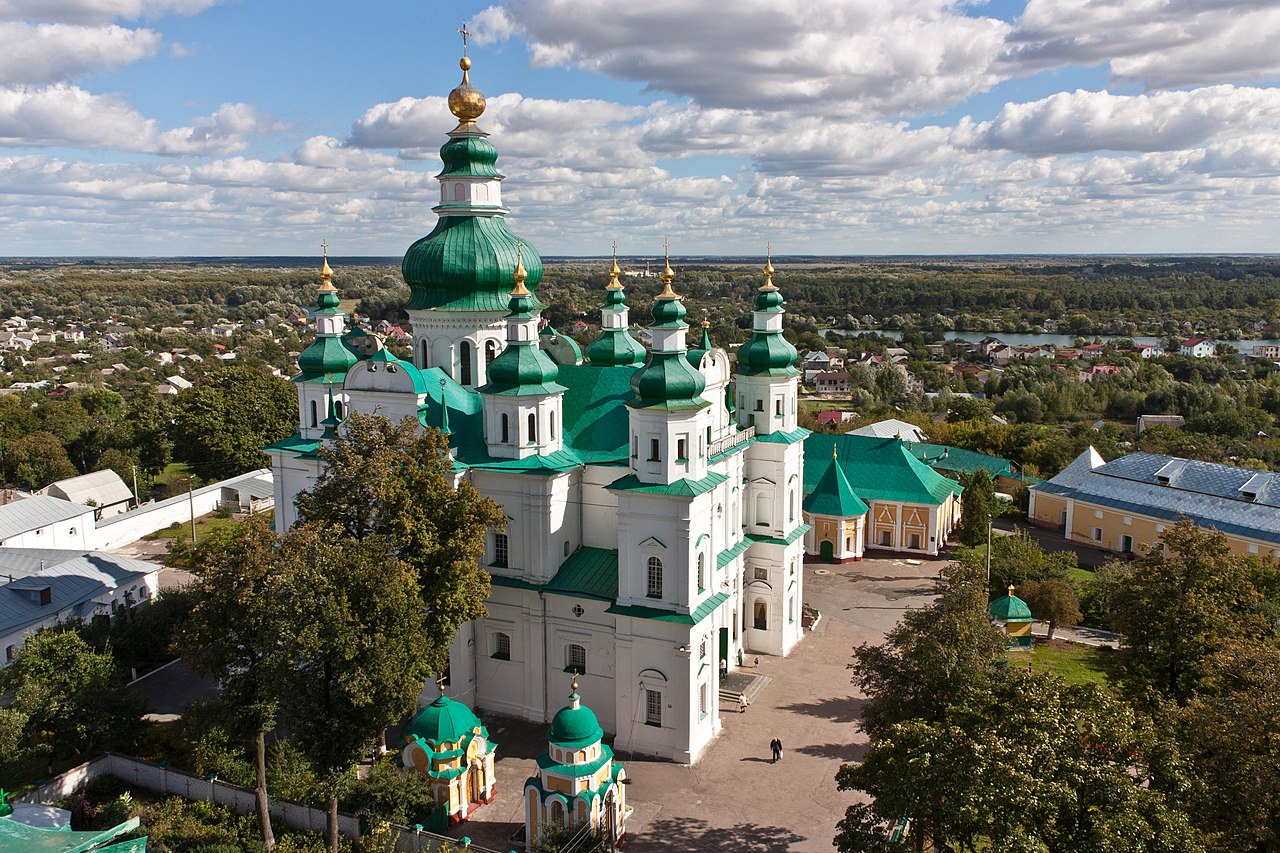
Chernihiv's architectural monuments chronicle the two most flourishing periods in the city's history – those of Kievan Rus' (11th and 12th centuries) and of the Cossack Hetmanate (late 17th and early 18th centuries).
The oldest church in the city and one of the oldest churches in Ukraine is the 5-domed Transfiguration Cathedral, commissioned in the early 1030s by Mstislav the Bold and completed several decades later by his brother, Yaroslav the Wise. The Cathedral of Sts Boris and Gleb, dating from the mid-12th century, was much rebuilt in succeeding periods, before being restored to its original shape in the 20th century. Likewise built in brick, it has a single dome and six pillars.
The crowning achievement of Chernihiv masters was the exquisite Piatnytska Church, constructed at the turn of the 12th and 13th centuries. This graceful building was seriously damaged in the Second World War; its original medieval outlook was reconstructed to a design by Pyotr Baranovsky.
The historic center of Chernihiv has been on the UNESCO World Heritage Tentative List since 1989, but currently the creation of a renewed nomination is underway.
The earliest residential buildings in the downtown date from the late 17th century, a period when a Cossack regiment was deployed there. Two most representative residences are those of Polkovnyk Lyzohub (1690s) and Polkovnyk Polubotok (18th century). The former mansion, popularly known as the Mazepa House, used to contain the regiment's chancellery. One of the most profusely decorated Cossack structures is undoubtedly the ecclesiastical collegium, surmounted by a bell-tower (1702). The archbishop's residence was constructed nearby in the 1780s. St. Catherine Church (1715), with its 5 gilded pear domes, traditional for Ukrainian architecture, is thought to have been intended as a memorial to the regiment's exploits during the storm of Azov in 1696.
Economy
Industry
Cheksil, one of the largest enterprises in the Ukrainian textile industry, is based in Chernihiv. The first stage of the plant was put into operation in 1963. The city also has the Chernihiv Musical Instrument Factory established in 1933. In 1995 a manufacturer of goods for animals, called COLLAR Company, was established by Yuri Sinitsa.
Education

Chernihiv has the Chernihiv Polytechnic National University and Taras Shevchenko National University "Chernihiv College".
Transport

Train
Chernihiv has a train station with bus station called Chernihiv Ovruch railway. Narrow gauge railway of 76 versts was laid from the Kruty station of the Moscow Kyiv-Voronezh railway towards Chernihiv. In 1893, on the left bank of the Desna River, in the area of a modern automobile bridge, a railway station was built along the Kyiv highway. Passengers were delivered here from the city and back by horse transport.
In 1925, traffic was opened on the Nizhyn to Chernigiv section of the Southwest Railway. But rail transport in Chernihiv was postponed until 1928. The bridge over the Desna River was not ready and trains still arrived on the left bank, where the old narrow-gauge railway station was located, and passengers got to Chernihiv by road bridge. According to 2006 data, the volume of freight traffic is 84,737 wagons per year. Over 4.5 million passengers are transported each year.
However, the condition of the rolling stock and the quality of the services provided do not meet modern requirements. Since the introduction of the new high-speed train timetable, the trailed wagons of the 93/94 Chernihiv – Odesa train were canceled. As of 2015, regular trains from Minsk to Odesa, and from St. Petersburg to Kyiv to Kharkiv run through Chernihiv, and there are direct connections with Moscow. Trains to Crimea (Simferopol, Feodosia) were canceled on 27 December 2014 due to Russia's annexation of Crimea.
Air transport
The area was served by Chernihiv Shestovytsia Airport, and during the Cold War it was the site of Chernihiv air base. The close airport is in Kyiv at the Boryspil Airport located 143.1 kilometres (89 miles) away, and the smaller, municipally owned Zhuliany Airport located 158.7 km (98.6 mi) away on the southern outskirts of the city of Kyiv.
Bus and trolleybus
A popular transport to Chernihiv from Kyiv is marshrutka from Chernihivska and Lisova metro stations, which go to the centre of Chernihiv, often to Peremohy Avenue. Buses to Novhorod-Siverskyi leave hourly from Chernihiv's Central bus station, located near the Chernihiv train station.
Sports and facilities

FC Desna Chernhiv
The main Football club of Chernihiv is called FC Desna Chernihiv, the original name of the club was "Avanhard Chernihiv" during its first year of existence. Between 1961 and 1970 the club was called Desna. In 1972 it was replaced with SC Chernihiv (team of the SKA Kyiv) that played in Chernihiv for the next couple of years. In 1977 Desna was revived now in place of the amateur club "Khimik Cherhihiv" that won regional competitions. On 27 May 2018, the team got promoted to the Ukrainian Premier League for the first time in their history.
The original team colours were blue shirts, blue shorts, blue socks. The team got into the Quarterfinals of the Ukrainian Cup in the season 2017–18 against Dynamo Kyiv. The club and during the season 2019–20 got again into the Quarterfinals of the Ukrainian Cup for the second time of the history of the club. In Premier League in the season 2019–20, Desna got into the play-offs for the Championship round table and qualified mathematically at least for the Europa League third qualifying round, for the first time in the history of the Club since 1960.
FC Chernihiv
FC Chernihiv is another club in the city of Chernihiv, founded in 2003, which they play in Chernihiv Arena, they won the Chernihiv Oblast Football Championship. The club in 2020, got a certificate for vistup to participate for the Ukrainian Second League for the season 2020–21. For the first time in the entire history, the place will be represented in professional football by two teams, one of which is FC Desna Chernihiv. In 2022 the club was admitted into the Ukrainian First League for the season 2022–23, keeping high the name of the city in the sport sphere.
WFC Lehenda-ShVSM Chernihiv
WFC Lehenda-ShVSM Chernihiv is Ukrainian professional women's football club from Chernihiv. The team won 6 times the Top Division, four times the Women's Cup and been in both competition second only behind Zhytlobud-1 Kharkiv. The club won also the Italy Women's Cup in 2007. In the 2001–02, 2003–04, 2006–07 seasons they played in the UEFA Women's Cup.
Kaynak: Wikipedia – Chernihiv · CC BY-SA 4.0