

Chapel Hill
Chapel Hill es una localidad en Carolina del Norte y sede de la Universidad de Carolina del Norte en Chapel Hill (UNC), la universidad estatal más antigua de los EE.
Government administration · United States · 0 followers
Overview
Chapel Hill es una localidad en Carolina del Norte y sede de la Universidad de Carolina del Norte en Chapel Hill (UNC), la universidad estatal más antigua de los EE. UU. Según el censo del año 2020, tenía una población de 61,960 habitantes, por lo que Chapel Hill era la 17.ª municipalidad más populosa en el estado.
Interested in working with us in the future?
Follow to see new jobs and posts in your feed.
No news yet.
About

Chapel Hill es una localidad en Carolina del Norte y sede de la Universidad de Carolina del Norte en Chapel Hill (UNC), la universidad estatal más antigua de los EE. UU. Según el censo del año 2020, tenía una población de 61,960 habitantes, por lo que Chapel Hill era la 17.ª municipalidad más populosa en el estado.
Kaynak: Wikipedia · CC BY-SA 4.0
Geografía
Chapel Hill se ubica en la esquina sureste del condado de Orange, con fronteras municipales ligeramente dentro del condado de Durham al este y con el condado de Chatham en el sur. Tiene un término compartido al oeste con la ciudad de Carrboro, y al este con la ciudad de Durham.
Según el United States Census Bureau, la ciudad tiene un área total de 51.3 km² (19.8 mi²). 51.2 km² (19.8 mi²) de las cuales son tierra y 0.2 km² (0.1 mi²) de ellas (0.35%) son agua.
Historia
Chapel Hill, (La colina de la capilla), o por lo menos el centro de ciudad, se asienta de hecho sobre una colina —colina originalmente llamada de "La Capilla de Nueva Esperanza" por la capilla que hubo allí una vez—. El "The Carolina Inn" (mesón de Carolina), ocupa actualmente el sitio de la capilla original. En 1819, la ciudad fue fundada para servir a la universidad de Carolina del Norte y se desarrolló alrededor de ella. La ciudad fue reconocida en 1851, y su calle principal, calle de Franklin, fue nombrada en memoria de Benjamin Franklin.
En 1968, solamente un año después de que sus escuelas se integraran completamente, Chapel Hill se convirtió en el primer municipio predominantemente blanco en el país en elegir a un alcalde afrodescendiente, Howard Lee. Lee sirvió a partir de 1969 hasta 1975 y, entre otras cosas, ayudó a establecer la Chapel Hill Transit, y el sistema de autobús de la ciudad. Unos 30 años más tarde, en el 2002, la legislación fue aprobada para hacer los autobuses locales gratis para los residentes y los visitantes, conduciendo a un aumento en impuestos; los autobuses se financian a través de los impuestos de Chapel Hill y de Carrboro así como abonos de los estudiantes de la "UNC".
En 1993, el puelo celebró su bicentenario y fundó el Museo de Chapel Hill (Chapel Hill Museum). Este recurso comunal, conteniendo la personalidad y los personajes del pueblo, incluyó entre sus exposiciones Alexander Julian, History of the Chapel Hill Fire Department, Chapel Hill's 1914 Fire Truck, The James Taylor Story, Farmer/James Pottery y The Paul Green Legacy.
Residentes notables

Bunny Hearn, pitcher en la "major league baseball"
Floyd Council, cantante de blues, el "Floyd" en Pink Floyd
Charles Kuralt, editor de The Daily Tar Heel
John Reid Edwards, senador de los Estados Unidos, en 2004 candidato a Vicepresidente y en 2008 candidato Presidencial
Jack Hogan, actor, reconocido por su papel como "Private William Kirby" en la serie de televisión Combat!, 1962-1967
Frank Porter Graham, senador de los Estados Unidos y rector de la Universidad de Carolina del Norte en Chapel Hill
Dean Smith, antiguo entrenador de baloncesto
Kent Williams, pintor, dibujante y artista de cómics
Terry Sanford, senador de los Estados Unidos y gobernador de Carolina del Norte
William Carter Love - U.S. Representative de Carolina del Norte
Cam Cameron, entrenador jefe, Miami Dolphins
Puntos de interés
North Carolina Collection Gallery, UNC campus
Kaynak: Wikipedia – Chapel Hill (Carolina del Norte) · CC BY-SA 4.0
History
Pre-establishment and colonial era
The area was the home place of early settler William Barbee of Middlesex County, Virginia, whose 1753 grant of 585 acres on the north and south side of "Lick Branch" from John Carteret, 2nd Earl Granville was the first of two land grants in what is now the Chapel Hill-Durham area. Though William Barbee died shortly after settling there in 1758, one of his eight children, Christopher Barbee, became an important contributor to his father's adopted community and to the fledgling University of North Carolina. In 1792, he offered the trustees of UNC 221 acres on which the university is now built, making him the university's largest donor.
Chapel Hill has developed along a hill; the crest was the original site of a small Anglican "chapel of ease", built in 1752, known as New Hope Chapel. The Carolina Inn now occupies this site. In 1819, the town was founded by the NC General Assembly to serve the University of North Carolina and developed around it. The town was chartered in 1851, and its main street, Franklin Street, was named in memory of Benjamin Franklin.
Antebellum
Of Chapel Hill during slavery, Kemp Plummer Battle wrote,
The government of the village of Chapel Hill was primitive. All white males between 21 and 50 years of age were distributed into classes and in turn patrolled the streets at night. Slaves were liable to a whipping of ten lashes, or a fine of one dollar, for being absent from home without a written permit from the owner. Nor could a slave hire his own time.
Civil War
Four in ten Chapel Hillians were enslaved at the start of the Civil War, and about half of the town was Black. In April 1865, as the war ended, the 9th Michigan Cavalry rode into Chapel Hill and occupied the university and the town for more than two weeks.
Reconstruction
In 1869, in the lead-up to the Kirk-Holden War, Governor William Holden sent a detective into Chapel Hill to investigate the presence of the Ku Klux Klan, whose members had been riding through Chapel Hill and nearby towns committing crimes and terrorizing the populace. Once in Chapel Hill, the detective was tied to the town pump by a group of men and given sixty lashes.
Geography and climate
Chapel Hill is located in the southeast corner of Orange County, with a small part extending east into Durham County. It is bounded on the west by the town of Carrboro and on the northeast by the city of Durham. However, most of Chapel Hill's borders are adjacent to unincorporated portions of Orange and Durham Counties rather than shared with another municipality. According to the United States Census Bureau, it has a total area of 21.75 square miles (56.3 km2), of which 21.60 square miles (55.9 km2) is land and 0.15 square miles (0.39 km2) (0.69%) is water.
Demographics
2020 census
As of the 2020 census, Chapel Hill had a population of 61,960. There were 22,118 households and 10,552 families residing in the town. The median age was 26.5 years. 16.0% of residents were under the age of 18 and 12.6% were 65 years of age or older. For every 100 females, there were 86.5 males, and for every 100 females age 18 and over, there were 83.3 males age 18 and over.
According to the 2020 census, 100.0% of residents lived in urban areas and 0.0% lived in rural areas.
Of the 22,118 households, 25.7% had children under the age of 18 living in them. Of all households, 39.2% were married-couple households, 21.5% were households with a male householder and no spouse or partner present, and 33.7% were households with a female householder and no spouse or partner present. About 32.4% of all households were made up of individuals, and 10.4% had someone living alone who was 65 years of age or older.
There were 23,713 housing units, of which 6.7% were vacant. The homeowner vacancy rate was 1.2% and the rental vacancy rate was 5.1%.
Demographic estimates
Chapel Hill is largely known for hosting the University of North Carolina at Chapel Hill. The proportion of alumni staying in the same metro area coming from a public four-year institution is 47%, whereas the proportion of alumni staying in the same state is 68%. This data explains many of the unique demographic qualities of this town.
The demographic structure of Chapel Hill is further defined by its role within the Research Triangle region. While the university attracts a continuous flow of young adults, the broader metro area is a powerful magnet for retaining and attracting skilled workers in science and technology fields. This creates a dynamic where Chapel Hill serves as an initial feeder for future professionals, with many graduates subsequently migrating to other parts of the Triangle for employment, contributing to the regions overall gain even as the town itself experiences a constant cycle of student in- and out-migration.
Government

Chapel Hill uses a council–manager form of government. The community elects a mayor and eight council members. Mayors serve two-year terms, and council members serve staggered four-year terms, all elected by the town at large; town elections are held in November of odd-numbered years. Mayor Jessica Anderson, a former council member, succeeded four-term mayor Pam Hemminger in 2023. In 2015, Hemminger defeated incumbent Mark Kleinschmidt, who had been elected in 2009 as the first openly gay mayor of Chapel Hill, succeeding outgoing four-term mayor Kevin Foy.
The town adopted its flag in 1990. According to flag designer Spring Davis, the blue represents the town and the University of North Carolina (whose colors are Carolina blue and white); the green represents "environmental awareness"; and the "townscape" in the inverted chevron represents "a sense of home, friends, and community."
The town's seal, has, since the 1930s, depicted Athena, the Greek goddess of wisdom and protector of cities. Having gone through several revisions, the seal was most recently updated in 2005 to a visually simpler version. The town introduced a new simplified logo in January 2026.
Education

Chapel Hill-Carrboro City Schools covers most of Chapel Hill and all of Carrboro, along with portions of unincorporated Orange County. East Chapel Hill High School, Carrboro High School, and Chapel Hill High School have all received national recognition for excellence, with Newsweek in 2008 ranking East Chapel Hill High as the 88th-best high school in the nation, and the highest-ranked standard public high school in North Carolina.
The small portion of Chapel Hill located in Durham County is part of Durham Public Schools.
There are several private K-12 schools in Chapel Hill, including Emerson Waldorf School.
Founded in 1789, the University of North Carolina at Chapel Hill is a public research university and is the flagship of the University of North Carolina System.
The state's main youth orchestra, Piedmont Youth Orchestra, is based in Chapel Hill.
The town also operates its own library system. Since 2024, its director is Atlas Logan.
Culture

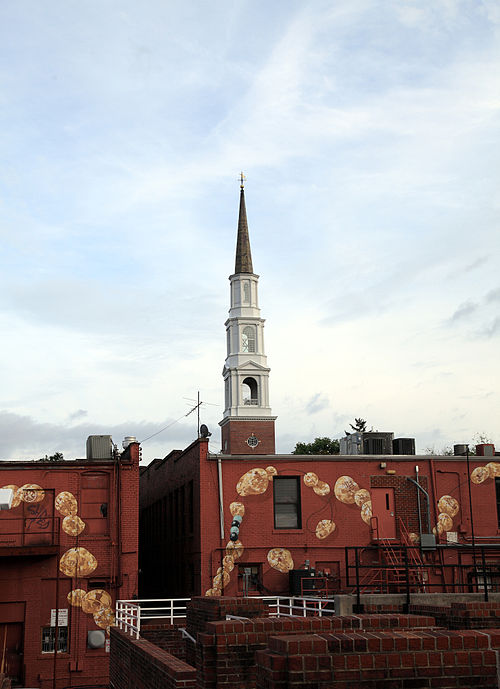
Though Chapel Hill is a principal town of a large metropolitan area, it retains a relatively small-town feel. Combined with its close neighbor, the Chapel Hill-Carrboro area has roughly 85,000 residents. Many large murals can be seen painted on the buildings. Most of these murals were painted by UNC alumnus Michael Brown. Also, for more than 30 years, Chapel Hill has sponsored the annual street fair, Festifall, in October. The fair offer booths to artists, craftsmakers, nonprofits, and food vendors. Performance space is also available for musicians, martial artists, and other groups. The fair is attended by tens of thousands each year.
The Morehead Planetarium and Science Center was the first planetarium built on a U.S. college campus. When it opened in 1949, it was one of six planetariums in the nation and has remained an important town landmark. During the Mercury, Gemini, and Apollo programs, astronauts were trained there. One of the town's hallmark features is the giant sundial, located in the green square in front of the planetarium on Franklin Street.
Influences of the university are seen throughout the town, even in the fire departments. Each fire station in Chapel Hill has a fire engine (numbers 31, 32, 33, 34, and 35) that is Carolina blue. These engines are also decorated with different UNC decals, including a firefighter Rameses.
Chapel Hill also has some new urbanist village communities, such as Meadowmont Village and Southern Village. Meadowmont and Southern Village both have shopping centers, green space where concerts, movies, and other outdoor events have taken place, community pools, and schools. Also, a traditional-style mall with a mix of national and local retailers is located at University Place.
Food
Described as one of America's Foodiest Small Towns by Bon Appétit, it has nationally noted restaurants such as Mama Dip's (Food Network's $40 A Day With Rachael Ray), Sunrise Biscuit Kitchen (The Splendid Table), caffè Driade (Food Network's $40 A Day With Rachael Ray), Lantern Restaurant (Food & Wine, Southern Living), and Vimala's Curryblossom Cafe.
Transit
Bus
Chapel Hill has no-fee intracity bus service via Chapel Hill Transit. Park & Ride lots provide financial support for the service, and fees are collected through UNC Parking. The connecting services are fee-based, but subsidized for UNC students, staff, and faculty. Go Triangle provides connection to the rest of the Triangle (Raleigh, Durham, and Hillsborough), of which the Hillsborough service is operated by Chapel Hill Transit, and supplemented mid-day by a county shuttle.
Light rail
The Canceled Durham–Orange Light Rail line was a project which, would have run between Chapel Hill and Durham, entered planning and engineering phases in August 2017. The project was discontinued in April 2019.
Sister cities
Puerto Baquerizo Moreno, San Cristóbal (Galápagos, Ecuador)
Kaynak: Wikipedia – Chapel Hill, North Carolina · CC BY-SA 4.0