


Chattanooga
Chattanooga es una ciudad del estado estadounidense de Tennessee, y la sede del condado de Hamilton.
Government administration · United States · 0 followers
Overview
Chattanooga es una ciudad del estado estadounidense de Tennessee, y la sede del condado de Hamilton. Situada al sureste del estado, cerca de la frontera con el estado de Georgia, es la cuarta más poblada –tras Memphis, Nashville y Knoxville–.
Interested in working with us in the future?
Follow to see new jobs and posts in your feed.
No news yet.
About

Chattanooga es una ciudad del estado estadounidense de Tennessee, y la sede del condado de Hamilton. Situada al sureste del estado, cerca de la frontera con el estado de Georgia, es la cuarta más poblada –tras Memphis, Nashville y Knoxville–.
Kaynak: Wikipedia · CC BY-SA 4.0
Historia

Los primeros habitantes del área de Chattanooga fueron indios nativos americanos, indígenas que se establecieron en el paleolítico superior. Ocuparon aquellos territorios en los periodos Arcaico, Woodland, Mississipiano, Muskogi y Cherokee. El nombre de «Chattanooga» proviene del dialecto indígena muskogi cvto (chatta), que significa ‘roca’, y se puede referir a una montaña de las proximidades.
La ciudad es muy conocida gracias al tema de 1941 que interpretaba la Big Band de Glenn Miller, «Chattanooga Choo Choo». También se la conoce por ser la cuna de Bessie Smith, conocida como la "emperatriz del blues", la cantante de blues más popular de los años 20 y 30 y la más influyente en los cantantes que la siguieron. También son de Chattanooga el actor Samuel L. Jackson y el músico y artista Usher.
Geografía
La ciudad se encuentra situada en las coordenadas 35°2′58.92″N 85°18′34.2″O, al sur del estado, junto a la frontera con Georgia. Según la Oficina del Censo de los Estados Unidos el área total de la ciudad es de 370.8 km², de los cuales 350.2 km² son de tierra y 20.6 km² de agua (el 5.56 %). El río Tennessee circunda el centro histórico de la ciudad al noreste, norte y al oeste.
Demografía
Según el censo del año 2000, la ciudad contaba con 155 554 habitantes, 65 499 viviendas y 39 626 familias. La densidad de población era de 444.2 hab/km². El 59.71 % de la población era de raza blanca. el 36.06 % afroamericanos y el resto de otras etnias.
Economía

Empresas notables en la ciudad son Access America Transport, BlueCross BlueShield of Tennessee, CBL & Associates, The Chattanooga Bakery, Chattem, the world's first Coca-Cola bottling plant, Coker Tire, U.S. Xpress Inc., Covenant Transport, Double Cola, CraftWorks Restaurants & Breweries, Luken Communications, Miller & Martin, la National Model Railroad Association, PepsiCo Reliance Partners, Republic Parking System, Rock/Creek, Tricycle Inc., y Unum. La ciudad también alberga grandes sucursales de Cigna, AT&T, T-Mobile USA, and UBS. McKee Foods Corporation, el fabricante de los pasteles Little Debbie, es una empresa familiar con oficinas en la cercana Collegedale, Tennessee.
En 2008, Volkswagen anunció la apertura de una fábrica en Chattanooga, inaugurada en 2011.
Mundial de futbol de 2026
Chattanooga fue el lugar de concentración de la selección española de futbol en las primeras fases del mundial 2026.
History
Early history
The first inhabitants of the Chattanooga area were Native Americans. Sites dating back to the Upper Paleolithic period (c. 10,000 BCE) show continuous human occupation through the Archaic, Woodland, Mississippian/Muskogean/Yuchi (900–1714 CE), and Cherokee (1776–1838) periods. The Chickamauga Mound near the mouth of the Chickamauga Creek is the oldest (c. 750 CE) remaining visible art in Chattanooga.
The Citico town and mound site was the most significant Mississippian/Muscogee landmark in Chattanooga up to 1915. The first part of the name "Chattanooga" derives from the Muskogean word cvto /chắtȯ/ – 'rock'. The latter may be derived from a regional suffix -nuga meaning dwelling or dwelling place. It is also believed to be derived from the Creek Indian word Chat-to-to-noog-gee, meaning 'rock rising to a point', which is speculated to be a reference to Lookout Mountain.
The earliest Cherokee occupation of the area dates from 1776, when Dragging Canoe separated himself from the main tribe to establish resistance to European settlement during the Cherokee–American wars. In 1816 John Ross, who later became Principal Chief, established Ross's Landing. Located along what is now Broad Street, it became one of the centers of Cherokee Nation settlement, which also extended into Georgia and Alabama.
In 1838, the U.S. government forced the Cherokees, along with other Native Americans, to relocate to the area designated as Indian Territory, in what is now the state of Oklahoma. Their journey west became known as the "Trail of Tears" for their exile and fatalities along the way. The U.S. Army used Ross's Landing as the site of one of three large internment camps, or "emigration depots", where Native Americans were held before the journey on the Trail of Tears.
In 1839, the community of Ross's Landing incorporated as the city of Chattanooga. The city grew quickly, initially benefiting from a location well-suited for river commerce. With the arrival of the railroad in 1850, Chattanooga became a boom town. The city was known as the site "where cotton meets corn," referring to its location along the cultural boundary between the mountain communities of southern Appalachia and the cotton-growing states to the south.
Geography

According to the United States Census Bureau, the city has a total area of 150.080 square miles (388.71 km2), of which 142.352 square miles (368.69 km2) is land and 7.728 square miles (20.02 km2) (5.15%) is water.
The most prominent natural features in and around Chattanooga are the Tennessee River and the surrounding mountains. The Tennessee River is impounded by the Chickamauga Dam north of the downtown area. The city is nestled between the southwestern Ridge-and-valley Appalachians and the foot of Walden's Ridge; the river separates the ridge from the western side of downtown. Several miles east, the city is bisected by Missionary Ridge. The downtown area sits at an elevation of approximately 676 feet (206 m), one of the lowest elevations in East Tennessee.
Cityscape
Downtown Chattanooga has a wide variety of entertainment, dining, cultural and architectural attractions, including the Tennessee Aquarium, opened in 1992; the Creative Discovery Museum, opened in 1995; and the historic Walnut Street Bridge, which was reopened in 1993, but was closed again for renovation in March, 2025. The downtown footprint is bounded by interstate highway I-24 on the south to Frazier Avenue in the Northshore, as well as US highway 27 in the west to Central Avenue in the east.
The modern downtown skyline is dominated by the Aquarium, the 21 story Republic Centre (Chattanooga's tallest building), John C. Portman Jr.'s the Westin (Gold Building), the James Building (Chattanooga's first skyscraper), and The Block, a climbing gym with 5,000 square feet of functional climbing space. Chattanooga has buildings with historical significance, such as The Read House Hotel (the longest continuously operating hotel in the Southeastern United States), the Chattanooga Choo-Choo Hotel (a converted railroad terminal), the Maclellan Building, the Dome Building (once the home to the Chattanooga Times), and the Tivoli Theatre. The BlueCross BlueShield of Tennessee headquarters, atop Cameron Hill, is the second-largest LEED Gold-certified corporate campus in the nation.
Demographics
According to realtor website Zillow, the average price of a home as of December 31, 2025, in Chattanooga is $313,143.
As of the 2024 American Community Survey, there are 82,182 estimated households in Chattanooga with an average of 2.25 persons per household. The city has a median household income of $66,060. Approximately 23.0% of the city's population lives at or below the poverty line. Chattanooga has an estimated 61.5% employment rate, with 33.7% of the population holding a bachelor's degree or higher and 89.8% holding a high school diploma. The median age in the city was 42.3 years. There were 89,451 housing units at an average density of 628.38 per square mile (242.6/km2). According to PODS’ 2025 Moving Trends Report, Chattanooga ranked 11th among U.S. cities with the highest number of move-ins.
The top five reported languages (people were allowed to report up to two languages, thus the figures will generally add to more than 100%) were English (86.7%), Spanish (8.2%), Indo-European (3.5%), Asian and Pacific Islander (1.3%), and Other (0.3%).
2024 estimate
As of the 2024 estimate, there were 191,496 people, 82,182 households, and _ families residing in the city. The population density was 1,345.23 inhabitants per square mile (519.4/km2). There were 89,451 housing units at an average density of 628.38 per square mile (242.6/km2). The racial makeup of the city was 58.4% White (55.8% NH White), 28.6% African American, 0.2% Native American, 2.4% Asian, 0.1% Pacific Islander, _% from some other races and 6.9% from two or more races. Hispanic or Latino people of any race were 9.3% of the population.
2020 census
As of the 2020 census, there was a population of 181,099, with 76,816 households and 43,105 families residing in the city. The population density was 1,272.17 inhabitants per square mile (491.2/km2). There were 85,266 housing units at an average density of 598.97 per square mile (231.3/km2).
Economy
Chattanooga's economy includes a diversified and growing mix of manufacturing and service industries.
Notable Chattanooga businesses include Access America Transport, BlueCross BlueShield of Tennessee, CBL & Associates, The Chattanooga Bakery, Sanofi, the world's first Coca-Cola bottling plant, Coker Tire, U.S. Xpress, Covenant Logistics, Double Cola, CraftWorks Restaurants & Breweries, Luken Communications, Miller & Martin, the National Model Railroad Association, PepsiCo, Reliance Partners, Republic Parking System, Tricycle Inc., and Unum. The city also hosts large branch offices of Cigna, AT&T, T-Mobile USA, and UBS. McKee Foods Corporation, the maker of nationally known Little Debbie brand snack cakes, is a privately held, family-run company headquartered in nearby Collegedale, Tennessee.
Notable companies that have manufacturing or distribution facilities in the city include Amazon.com, BASF, DuPont, Invista, Komatsu, PepsiCo, Rock-Tenn, Plantronics, Domtar, Norfolk Southern, Ferrara Candy Company (manufacturer of Brach's candies), Alco Chemical, Colonial Pipeline, and Buzzi Unicem. The William Wrigley Jr. Company has a prominent presence in Chattanooga, the sole site of production of Altoids breath mint products since 2005.
In a seminal event for Chattanooga, Volkswagen announced in July 2008 the construction of its first U.S. auto plant in over three decades, the Volkswagen Chattanooga Assembly Plant. In May 2011, Volkswagen Group of America inaugurated its plant. The $1 billion plant, opened in May 2011, served as the group's North American manufacturing headquarters. The plant, which initially employed 2,700 people, later increasing to 4,700, manufactures the Passat and the Atlas. It also has a full research and development center in downtown Chattanooga, employing some 200 engineers, the first of its kind in the South. The plant was the first new Volkswagen plant in the United States since the 1988 closure of Volkswagen Westmoreland Assembly near New Stanton, Pennsylvania. In 2019, Volkswagen Chattanooga announced plans to expand its Chattanooga-based plant to construct electric vehicles. The expansion is expected to create one thousand new jobs and $800 million in investments.
Culture and tourism

Attractions
Chattanooga touts many attractions, including the Tennessee Aquarium, caverns, and new waterfront attractions along and across the Tennessee River. In the downtown area is the Chattanooga Choo Choo Hotel, housed in the renovated Terminal Station. Also downtown are the Creative Discovery Museum, a hands-on children's museum dedicated to science, art, and music; an IMAX 3D Theatre, and the newly expanded Hunter Museum of American Art. The Tennessee Riverwalk, an approximately 13-mile-long (21 km) trail running alongside the river, is another attraction for both tourists and residents alike.
Across the river from downtown is the North Shore district, roughly bounded by the Olgiati Bridge to the west and Veterans Bridge to the east. The newly renovated area draws locals and tourists to locally owned independent boutique stores and restaurants, plus attractions along the Chattanooga Riverpark system, including Coolidge Park and Renaissance Park.
The Chattanooga Zoo at Warner Park is at 301 North Holtzclaw Avenue, a short distance from the downtown area. Hours of operation are from 9 a.m. to 5 p.m. every day. In 1937, the first small exhibit was "established with the construction of a 4x6' cage for two Rhesus Monkeys." The Zoo has since grown, as in 2017, "the Zoo kicked off the year with the announcement of the Kits and Cubs Program, which is a unique early childhood learning program designed specifically for the youngest of animal lovers." And in May 2017, "the Zoo broke ground to expand the Corcovado Jungle exhibit adding six new outdoor and six new indoor exhibits to house small South American monkeys and mammals in June."
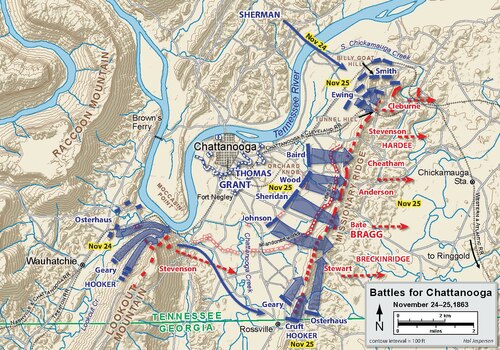
Parks and natural scenic areas provide other attractions. Ruby Falls on Lookout Mountain at 1720 S. Scenic Highway in Chattanooga is a park with a diverse ecosystem including a large waterfall underground in a cave, a historic castle, scenic overlooks of the Cumberland Plateau and Tennessee River. Craven's House, also on Lookout Mountain, is the oldest surviving structure on Lookout Mountain and was a major focal point during the Civil War. The Cravens House property is part of the Chickamauga & Chattanooga National Military Park. The Lookout Mountain Incline Railway is a steep funicular railway that rises from the St. Elmo Historic District to the top of the mountain, where passengers can visit the National Park Service's Point Park and the Battles for Chattanooga Museum. Formerly known as Confederama, the museum includes a diorama that details the Battle of Chattanooga. From the military park, visitors can enjoy panoramic views of Moccasin Bend and the Chattanooga skyline from the mountain's famous "point" or from vantage points along the well-marked trail system.
Sports

Chattanooga is home to several professional, semi-professional and collegiate sports teams, including the Chattanooga Red Wolves SC (soccer), Chattanooga FC (soccer) and the Chattanooga Lookouts (minor league baseball). The city also hosts annual sporting events such as the Volkswagen USA Cycling Professional Road & Time Trial National Championships, the Ironman Triathlon, and the Head of the Hooch Regatta, which is held on the first weekend of November.
A number of pro wrestling events, as well as other events, such as circuses, concerts, ice shows, monster truck rallies, and rodeos, have been held in Chattanooga since the late 1980s, all at UTC's McKenzie Arena, also known as "The Roundhouse" because of its round shape and the impact of the railroad industry on Chattanooga.
College sports
Chattanooga was the home of the NCAA Division I Football Championship game, which was held at Finley Stadium in Chattanooga, from 1997 to 2009.
The University of Tennessee at Chattanooga (UTC) Mocs compete in NCAA Division I and the Southern Conference. UTC's athletic programs include football at the FCS level, women's soccer, volleyball, and cross country in the fall; men's and women's basketball, Wrestling, and indoor track & field in the winter; and softball and outdoor track & field in the spring. Men's and women's golf and men's and women's tennis play in the fall and spring.
Minor League Baseball
The Chattanooga Lookouts, a Class AA Southern League baseball team affiliated with the Cincinnati Reds, play at Erlanger Park. The franchise traces it lineage back to 1885 with the Chattanooga Lookouts who were charter members on the original Southern League until folding in 1886. Chattanooga has won the Southern League championship three times: first in 1988 as the Double-A affiliate of the Cincinnati Reds and again in 2015 and 2017 as affiliates of the Minnesota Twins.
Media and communications

The city of Chattanooga is served by numerous local, regional, and national media outlets which reach approximately one million people in four states: Tennessee, Georgia, Alabama, and North Carolina.
Newspapers
The Chattanooga Times Free Press, the area's only daily newspaper, is published every morning. It was formed in 1999 from the merger of two papers that had been bitter rivals for half a century, the Times and the News-Free Press. The Times was owned and published by Adolph Ochs, who later bought The New York Times. The Times was the morning paper and had a generally more liberal editorial page. The News-Free Press, whose name was the result of an earlier merger, was an afternoon daily and its editorials were more conservative than those in the Times. On August 27, 1966, the News-Free Press became the first newspaper in the nation to dissolve a joint operating agreement. In 1999, the Free Press, which had changed its name from News-Free Press in 1993, was bought by an Arkansas company, WEHCO Media, publisher of the Arkansas Democrat-Gazette, which then bought The Times from the Ochs heirs. The Times Free Press is the only newspaper in the United States to have two editorial pages, reflecting opposite ends of the political spectrum. The Times's editorial page, which is liberal, is on the left page and the Free Press's editorial page, which is conservative, is on the right.
The Chattanooga Pulse is a free weekly alternative newspaper, published every Wednesday, that focuses primarily on arts, music, film and culture. It was formed in 2003 by Zachary Cooper and Michael Kull, running independently until 2008, when the paper was purchased by Brewer Media Group, which also owns and operates five radio stations in the city.
Enigma is a free monthly pop culture and entertainment magazine. Founded as a weekly newspaper in 1995 by David Weinthal, Enigma lays claim to being Chattanooga's oldest alternative newspaper, even though it had ceased physical publication from 2013 until it resumed as a monthly magazine in 2015.
Law and government
The mayor is Tim Kelly, who was elected in April 2021.
The city operates under a charter granted by the state legislature in 1852; the charter has been subsequently amended.
The city operates under a strong mayor system, which changed from a commission form of government with members voted at-large. In 1987 twelve African American city residents filed a complaint, Brown v. Board of Commissioners of the City of Chattanooga, alleging that the commission-style government violated their civil rights, including the Voting Rights Act of 1965, by diluting the minority black vote. In 1989 U.S. District Judge R. Allan Edgar ruled in their favor, compelling the city to abandon the at-large voting system that it had used for the 'commission' form of government, established single-member geographical districts to proportionally represent both majority and minority elements of the population according to the city's racial demographics, eliminated voting privileges for non-resident property owners, and created the city's mayor-council form of government. The Chattanooga City Council has nine members, of whom four are African American. The strong-mayor system began in 1991 after a 1990 citywide election that used the new court-ordered district system.
The city's legislative branch is represented by members from nine districts, elected from single-member districts in partisan elections. The council members are Chip Henderson (District 1), Jenny Hill (District 2), Jeff Davis (District 3), Cody Harvey (District 4), Dennis Clark (District 5), Jenni Berz (District 6), Raquetta Dotley (District 7), Marvene Noel (District 8), and Ron Elliott (District 9).
Chattanooga's delegation to the Tennessee House of Representatives includes Greg Martin (R), District 26; Michele Reneau (R), District 27; Yusuf Hakeem (D), District 28; Greg Vital(R), District 29; and Esther Helton (R), District 30. In the Tennessee Senate, Chattanooga is divided between Districts 10 and 11 with Todd Gardenhire (R) and Bo Watson (R) representing each district respectively.
Education

Primary and secondary education
Most of Chattanooga's primary and secondary education is funded by the government. The public schools in Chattanooga, as well as Hamilton County, have fallen under the purview of the Hamilton County Schools since the 1997 merger of the urban Chattanooga City Schools system and the mostly rural Hamilton County Schools system. The Howard School was the first public school in the area, established in 1865 after the Civil War. Tyner High School (now Tyner Academy) was the first secondary school built east of Missionary Ridge in 1907. It is now the home of Tyner Middle Academy. The Chattanooga School for the Arts and Sciences, the STEM School Of Chattanooga and the Chattanooga High School Center for Creative Arts are additional public magnet schools.
The city is home to several well-known private and parochial secondary schools, including Baylor School, Boyd-Buchanan School, Chattanooga Christian School, Girls Preparatory School, McCallie School, and Notre Dame High School. The Siskin Children's Institute in Chattanooga is a specialized institution in the field of early childhood special education.
Higher education
A wide variety of higher education institutions can be found in Chattanooga and nearby. The University of Tennessee at Chattanooga, commonly called UTC, is the second largest campus of the University of Tennessee System, with a student population of over 12,060 as of 2025–'26 school year. Chattanooga State Community College is a two-year community college with a total undergraduate enrollment of roughly 7,623 students in 2024-'25. Chattanooga is also home to a branch of the University of Tennessee College of Medicine, which provides medical education to third- and fourth-year medical students, residents, and other medical professionals in southeast Tennessee through an affiliation with Erlanger Health System. Richmont Graduate University is a Christian graduate school located in Chattanooga with a CACREP accredited clinical mental health counseling program as well as other ministry related degrees and a student population close to 300.
Health care
Chattanooga has three hospital systems: Erlanger Health System, Parkridge Hospital System, and CHI Memorial Hospital System.
Founded in 1889, Erlanger is the seventh largest public healthcare system in the United States with more than half a million patient visits a year. Erlanger Hospital is a non-profit academic teaching center affiliated with the University of Tennessee's College of Medicine. Erlanger is also the area's primary trauma center, a Level-One Trauma Center for adults, and the only provider of tertiary care for the residents of southeastern Tennessee, north Georgia, northeastern Alabama, and western North Carolina. In 2008, Erlanger was named one of the nation's "100 Top teaching hospitals for cardiovascular care" by Thomson Reuters. Erlanger has been operated by the Chattanooga-Hamilton County Hospital Authority since 1976.
Parkridge Hospital is located east of downtown in the Glenwood district and is run by Tri-Star Healthcare. Tri-Star also operates Parkridge East Medical Center in nearby East Ridge.
Memorial Hospital, which is operated by Denver-based Catholic Health Initiatives, is located downtown. In 2004, Memorial was named one of the "100 Top Teaching Hospitals" by Thomson Reuters.
Transportation

Considered to be the gateway to the Deep South, along with the Midwest and the Northeast for motorists from states such as Alabama, Florida, and Georgia, Chattanooga is ranked as having some of the worst traffic congestion of cities its size, due primarily to unusually high volumes of truck traffic combined with the area's geography. A 2015 study by Cambridge Systematics found that 80% of trucks that pass through Chattanooga are destined for a different location, the highest share of any metropolitan area in the country.
Highways
Interstate 75 (I-75) connects Chattanooga with Knoxville to the northeast and Atlanta to the south. Interstate 24 (I-24), which to Nashville to the northwest, passes through the central part of the city and reaches its eastern terminus at the 75/24 Split with I-75. The northern terminus of Interstate 59 (I-59) is about 10 miles (16 km) southwest of downtown Chattanooga in Dade County, Georgia, and connects the city to Birmingham to the southwest. A controlled-access segment of U.S. Route 27 (US 27) begins at an interchange with I-24 in downtown Chattanooga, and ends in northern Hamilton County, connecting the city with the cities of Red Bank, Soddy Daisy, Dayton, and Dunlap to the north. State Route 153 (SR 153), some of which is controlled-access, is a major route which connects I-75 to US 27 in the eastern and northern parts of the city. A short controlled-access portion of SR 319, known as DuPont Parkway, connects downtown Chattanooga to the Hixson area.
In addition to US 27, several other US Highways pass through Chattanooga as surface streets, and many share concurrencies. They include U.S. Routes 11, 41, 64, 72, 76, and 127, the last three of which have termini in Chattanooga. US 11 and 64 form a concurrency as Brainerd Road and Lee Highway, and connect Chattanooga to Collegedale and Cleveland to the northeast. US 41/76 (Ringgold Road) connects the city to Ringgold, Georgia, to the southeast, and a surface-street section of US 27 (Rossville Boulevard) connects to Rossville, Fort Oglethorpe, and LaFayette, all in Georgia, to the south. Beginning in downtown and continuing for several miles to the southwest, US Routes 11, 41, 64, and 72 run together as Cummings Highway, before US 11 splits off, heading toward Trenton, Georgia. The remaining three routes continue toward Jasper, where US 72 splits off headed towards Huntsville, Alabama. US 127 (Signal Mountain Boulevard) begins in North Chattanooga at an interchange with US 27, and connects the city to Signal Mountain and Dunlap to the northwest.
Sister cities
In January 2007, all of the cities above (with the exceptions of Wolfsburg, Tōno, Accra and Trostyanets) and the former sister cities of Swindon and Ascoli Piceno had a tree native to each locale planted at Coolidge Park's Peace Grove, which was established to replace a 100-year-old Slippery elm tree which was damaged in a lightning storm in August 2006. Wolfsburg and Tōno were added in September 2011 and January 2018, respectively. The Peace Grove has nine trees: a linden tree, which represents Hamm; a Chinese elm, which represents Wuxi; a Mediterranean cedar, which represents Givatayim; a white birch, which represents Nizhny Tagil; a ginkgo tree, which represents Gangneung; an English elm, which represents Swindon; a European hornbeam, which represents Ascoli Piceno; an oak tree, which represents Wolfsburg; and a cherry tree, which represents Tōno.
Friendship cities
Chattanooga has friendly relations with:
Swindon, South West England, United Kingdom (2006)