
Cleveland
Cleveland, oficialmente City of Cleveland, es una ciudad del estado estadounidense de Ohio y es la sede del condado de Cuyahoga.
Government administration · United States · 0 followers
Overview
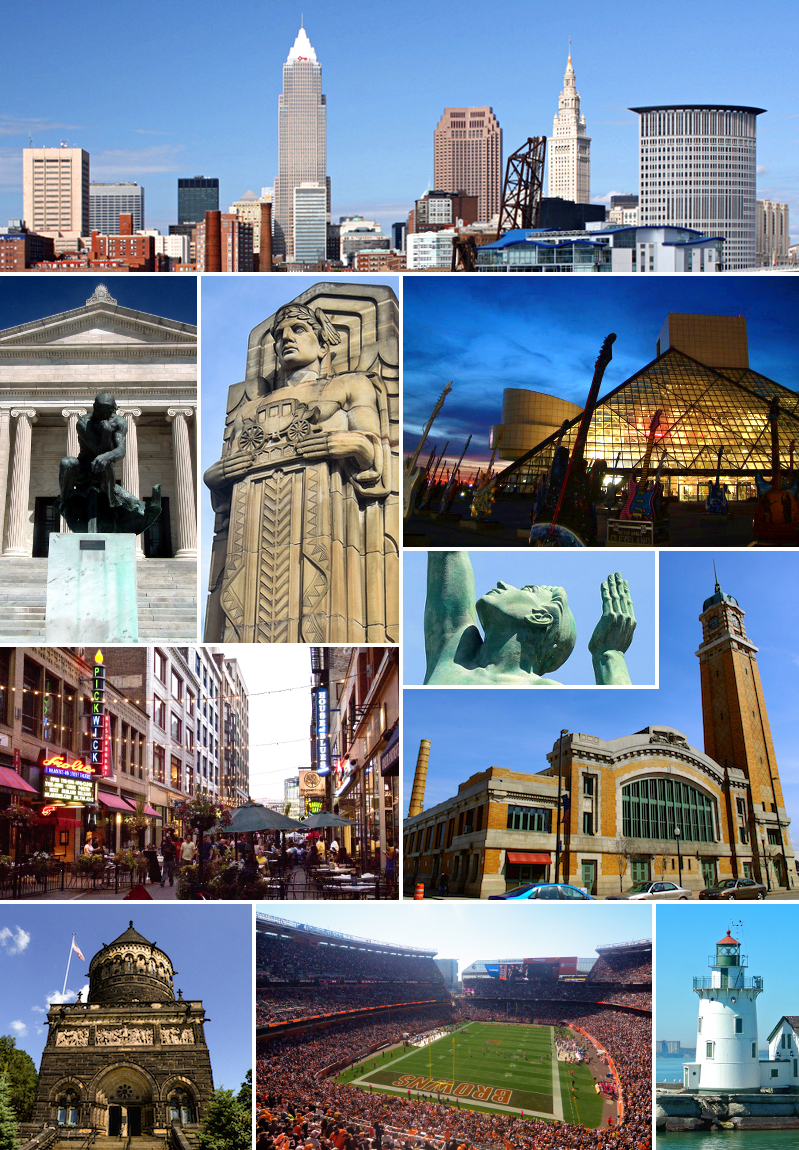
Cleveland, oficialmente City of Cleveland, es una ciudad del estado estadounidense de Ohio y es la sede del condado de Cuyahoga. Se halla en la parte noreste del estado, en la ribera sur del lago Erie, al otro lado de la frontera lacustre de Estados Unidos con Canadá y a unos 97 km al oeste de Pensilvania. Cleveland es además la mayor ciudad del lago Erie, una de las principales ciudades de la región de los Grandes Lagos, y la 54.ª ciudad más grande de Estados Unidos, con una población de 372 624 habitantes en 2020. La ciudad ancla tanto el área estadística metropolitana (MSA) del Gran Cleveland como el área estadística combinada (CSA) más grande de Cleveland-Akron-Canton. La CSA es la más poblada de Ohio y la 17 más grande del país, con una población de 3,63 millones en 2020, mientras que la MSA ocupa el puesto 34 con 2,09 millones.
Interested in working with us in the future?
Follow to see new jobs and posts in your feed.
No news yet.
About

Cleveland, oficialmente City of Cleveland, es una ciudad del estado estadounidense de Ohio y es la sede del condado de Cuyahoga. Se halla en la parte noreste del estado, en la ribera sur del lago Erie, al otro lado de la frontera lacustre de Estados Unidos con Canadá y a unos 97 km al oeste de Pensilvania. Cleveland es además la mayor ciudad del lago Erie, una de las principales ciudades de la región de los Grandes Lagos, y la 54.ª ciudad más grande de Estados Unidos, con una población de 372 624 habitantes en 2020. La ciudad ancla tanto el área estadística metropolitana (MSA) del Gran Cleveland como el área estadística combinada (CSA) más grande de Cleveland-Akron-Canton. La CSA es la más poblada de Ohio y la 17 más grande del país, con una población de 3,63 millones en 2020, mientras que la MSA ocupa el puesto 34 con 2,09 millones.
Kaynak: Wikipedia · CC BY-SA 4.0
Historia

Cleveland fue fundada el 22 de julio de 1796 por topógrafos de Connecticut Land Company cuando dividieron la Reserva Occidental de Connecticut en municipios y una ciudad capital. Llamaron al nuevo asentamiento "Cleaveland" en honor a su líder, el general Moses Cleaveland, un veterano de la Guerra de Independencia. Cleaveland supervisó el diseño al estilo de Nueva Inglaterra del plan para lo que se convertiría en el centro de la ciudad moderno, centrado en Public Square, antes de regresar a Connecticut, para nunca más visitar Ohio.
El primer colono europeo permanente en Cleaveland fue Lorenzo Carter, quien construyó una cabaña a orillas del río Cuyahoga. La comunidad emergente sirvió como un importante puesto de abastecimiento estadunidense durante la batalla del Lago Erie en la guerra anglo-estadounidense de 1812. Los lugareños adoptaron al comodoro Oliver Hazard Perry como un héroe cívico y erigieron un monumento en su honor décadas después. En gran parte gracias a los esfuerzos del primer abogado del acuerdo, Alfred Kelley, el pueblo de Cleaveland se incorporó el 23 de diciembre de 1814.
A pesar de las tierras bajas pantanosas cercanas y los duros inviernos, la ubicación frente al mar de la ciudad resultó ser una ventaja, ya que le dio acceso al comercio de los Grandes Lagos. Creció rápidamente después de la finalización en 1832 del Canal de Ohio y Erie. Este enlace clave entre el río Ohio y los Grandes Lagos lo conectó con el Océano Atlántico a través del canal Erie y el río Hudson, y más tarde a través de la vía marítima del San Lorenzo. Sus productos podrían llegar a los mercados del Golfo de México a través del río Misisipi. El crecimiento de la ciudad continuó con conexiones ferroviarias adicionales.
En 1831, el periódico The Cleveland Advertiser modificó la ortografía del nombre de la ciudad. Para encajar el nombre en la cabecera del periódico, los editores eliminaron la primera "a", reduciendo el nombre de la ciudad a Cleveland, que finalmente se convirtió en la ortografía oficial. En 1836, Cleveland, entonces limitada a la orilla este del río Cuyahoga, se incorporó oficialmente como ciudad y John W. Willey fue elegido su primer alcalde. Ese mismo año, casi estalló en una guerra abierta con la vecina Ohio City por un puente que conectaba las dos comunidades. La Ohio City siguió siendo un municipio independiente hasta su anexión por Cleveland en 1854.
Geografía y clima

Según la Oficina del Censo de los Estados Unidos, la ciudad tiene una superficie total de 213,6 km², de los cuales 201,24 km² es tierra y 12,35 km² es agua. La orilla del lago Erie tiene 173 m sobre el nivel del mar ; sin embargo, la ciudad se encuentra en una serie de acantilados irregulares que se encuentran aproximadamente paralelos al lago. En Cleveland, estos acantilados están cortados principalmente por el río Cuyahoga, Big Creek y Euclid Creek.
La tierra se eleva rápidamente desde la elevación de la orilla del lago de 569 pies. Plaza Pública, a menos de 2 km tierra adentro, se encuentra a una altitud de 198 m, y el aeropuerto de Hopkins, 8 km tierra adentro desde el lago, está a una altitud de 241 m
Cleveland limita con varios suburbios de tranvías e interiores. Al oeste, limita con Lakewood, Rocky River y Fairview Park, y al este, limita con Shaker Heights, Cleveland Heights, South Euclid y East Cleveland. Al suroeste, limita con Linndale, Brooklyn, Parma y Brook Park. Al sur, la ciudad también limita con Newburgh Heights, Cuyahoga Heights y Brooklyn Heights y al sureste limita con Warrensville Heights, Maple Heights y Garfield Heights. Al noreste, a lo largo de la orilla del lago Erie, Cleveland limita con Bratenahl y Euclid.
Arquitectura

La arquitectura del centro de Cleveland es diversa. Muchos de los edificios gubernamentales y cívicos de la ciudad, incluidos el Ayuntamiento, el Palacio de Justicia del Condado de Cuyahoga, la Biblioteca Pública de Cleveland y el Auditorio Público, están agrupados alrededor de The Mall de Cleveland y comparten una arquitectura neoclásica común. Fueron construidos a principios del siglo XX como resultado del Plan de Grupo de 1903. Constituyen uno de los ejemplos más completos de diseño City Beautiful en Estados Unidos.
Completada en 1927 y dedicada en 1930 como parte del complejo de la Terminal Union de Cleveland, el rascacielos histórico Terminal Tower fue el edificio más alto de América del Norte fuera de la ciudad de Nueva York hasta 1964 y el edificio más alto de Cleveland hasta 1991. Es un prototipo de rascacielos Beaux-Arts. Los dos rascacielos más recientemente construidos en Public Square, Key Tower (actualmente el edificio más alto de Ohio) y 200 Public Square, combinan elementos de la arquitectura art déco con diseños posmodernos. Los tesoros arquitectónicos de Cleveland también incluyen el Cleveland Trust Company Building, completado en 1907 y renovado en 2015 como un supermercado Heinen's en el centro, y Cleveland Arcade (a veces llamado Old Arcade), una galería de cinco pisos construida en 1890 y renovada en 2001 como Hotel Hyatt Regency.
Yendo hacia el este desde Public Square a través de University Circle está Euclid Avenue, que antiguamente fue conocida por su prestigio y su elegancia como calle residencial. A fines de la década de 1880, el escritor Bayard Taylor la describió como "la calle más hermosa del mundo". Conocida como Millionaires' Row" (lit, 'La fila de los millonarios"') era mundialmente conocida como el lugar de residencia de figuras tan importantes como John D. Rockefeller, Mark Hanna y John Hay.
Demografía
Según el censo del 2000 residían en la ciudad 478 403 personas, 190 638 hogares, y 111 904 familias. La densidad de población era de 2 380,9/km². Había 215 856 hogares con una densidad media de 1074 hab./km². El mapa racial de la ciudad era 41,49 % blancos, 50,99 % negros o afroamericanos, 0,30 % americanos nativos, 1,35 % asiáticos, 0,04 % isleños del Pacífico, 3.59 % de otras razas, y 2,24 % de dos o más razas. El 7,26 % de la población era hispanos o Latino de cualquier raza. Los grupos étnicos incluyen alemanes (9,2 %), irlandeses (8,2 %), polacos (4,8 %), italianos (4,6 %) e ingleses (2,8 %). Hay también otras comunidades sustanciales de húngaros, griegos, árabes, ucranianos, rumanos, checos, eslovacos, lituanos, croatas, serbios, eslovenos, montenegrinos y albaneses.
Había 190 638 hogares de los cuales el 29,9 % tenían hijos menores de 18 años viviendo con ellos, el 28,5 % eran parejas casadas viviendo juntas, el 24,8 % tenían un dueño de la casa que era una mujer sin marido y el 41,3 % no eran familias. El 35,2 % de todos los hogares eran de solteros y el 11,1 % tenían alguien viviendo solo que era mayor de 65 años. El tamaño medio de la familia era de 3,19. La población estaba repartida con el 28,5 % menores de 18 años, el 9.5 % entre 18 y 24, el 30,4 % entre 25 y 44, el 19,0 % entre 45 y 64, y el 12,5 % de más de 65 años. La mediana de edad era de 33 años. Por cada 100 mujeres había 90 hombres. Por cada 100 mujeres de más de 18 años, había 85,2 hombres.
Los ingresos medios para un hogar en la ciudad eran de 25 928 dólares, y los ingresos medios para una familia eran 30 286 dólares. Los hombres tenían una media de ingresos de 30 610 dólares contra los 24 214 de las mujeres. La renta per cápita para la ciudad era de 14 291 dólares. El 26,3 % de la población y el 22,9 % de las familias estaban por debajo de la línea de pobreza. Entre la población total, el 37,6 % de estos menores de 18 y el 16,8 % de estos de 65 o más estaban viviendo por debajo de la línea de la pobreza.
Gobierno y política
La posición de Cleveland como un centro manufacturero le estableció como un caldo de cultivo de actividades sindicales a principios de su historia. Esto contribuyó a un progresismo político que ha influenciado la política de Cleveland hasta hoy en día. Mientras otras partes de Ohio, particularmente Cincinnati y la porción del sur del estado, han apoyado históricamente el Partido Republicano, Cleveland comúnmente produce el apoyo más fuerte en el estado para los Demócratas; los dos representantes de Cleveland en la Cámara de Representantes son Demócratas: Dennis Kucinich y Stephanie Tubbs Jones. Durante las elecciones presidenciales de 2004, aunque George W. Bush ganó en Ohio, John Kerry ganó en el condado de Cuyahoga, lo que le dio el apoyo más fuerte en el estado.
La ciudad de Cleveland opera con una forma de gobierno alcalde-consejo. El alcalde es el jefe ejecutivo de la ciudad, y el cargo está actualmente ocupado por Frank G. Jackson.
Economía

La ubicación de Cleveland en el río Cuyahoga y el lago Erie ha sido clave para su crecimiento. El canal de Ohio y Erie, junto con los enlaces ferroviarios, ayudaron a la ciudad a convertirse en un importante centro de negocios. El acero y muchos otros productos manufacturados surgieron como industrias líderes. Desde entonces, la ciudad ha diversificado su economía además de su sector manufacturero.
Fundado en 1914, el Banco de la Reserva Federal de Cleveland es uno de los 12 Bancos del Sistema de la Reserva Federal de Estados Unidos. Su edificio del centro, ubicado en East 6th Street y Superior Avenue, fue terminado en 1923 por el estudio de arquitectura Walker and Weeks. La sede del Cuarto Distrito del Sistema de la Reserva Federal, el banco emplea a 1000 personas y mantiene sucursales en Cincinnati y Pittsburg.
Cleveland y el condado de Cuyahoga albergan las sedes corporativas de las empresas incluidas en la lista Fortune 500, como Progressive, Sherwin-Williams, Parker-Hannifin, KeyCorp y Travel Centers of America. Otras grandes empresas con sede en la ciudad y el condado incluyen Aleris, American Greetings, Applied Industrial Technologies, Cleveland-Cliffs, Eaton, Forest City Realty Trust, Heinen's Fine Foods, Hyster-Yale Materials Handling, Lincoln Electric, Medical Mutual of Ohio, Moen Incorporated, NACCO Industries, Nordson Corporation, OM Group, Swagelok, Things Remembered, Third Federal S&L, TransDigm Group y Vitamix. La NASA mantiene una instalación en Cleveland, el Centro de Investigación Glenn. Jones Day, uno de los bufetes de abogados más grandes del país, fue fundado en Cleveland en 1893. La Bolsa de Valores de Cleveland se estableció en 1899 y duró 50 años hasta su fusión con la Bolsa de Valores del Medio Oeste en 1949.
La Clínica Cleveland es el empleador privado más grande en la ciudad de Cleveland y el estado de Ohio, con una fuerza laboral de más de 50 000 a a 2019. Lleva la distinción de estar entre los mejores hospitales de Estados Unidos con las calificaciones más altas publicadas en US News & World Report. El sector de la salud de Cleveland también incluye el Centro Médico de los Hospitales Universitarios de Cleveland, el centro médico MetroHealth y la compañía de seguros Medical Mutual of Ohio. Cleveland también se destaca en los campos de la Biotecnología y la investigación sobre las pilas de combustible, dirigida por la Universidad Case Western Reserve, la Clínica Cleveland y los Hospitales Universitarios de Cleveland. La ciudad se encuentra entre los principales receptores de inversiones para nuevas empresas e investigación en biotecnología.
Educación
Cleveland es sede de múltiples de colleges y universidades. La más prominente entre estas es la Case Western Reserve University, una célebre institución de investigación y enseñanza situada en University Circle. Case es una universidad privada, la universidad más valorada en Ohio y la número 37 en los Estados Unidos según U.S. News & World Report, y es sede de varios programas de graduación altamente valorados. La University Circle es también la sede del Cleveland Institute of Art, el Cleveland Institute of Music, y el Ohio College of Podiatric Medicine. Cleveland State University, situada en el centro de Cleveland, es la universidad pública de la ciudad. Además de CSU, el centro alberga el campus metropolitano del Cuyahoga Community College, la institución de educación superior del condado, así como la Myers University, una escuela privada que se centra en la educación para los negocios.
El Distrito Escolar Metropolitano de Cleveland gestiona escuelas públicas.
Transporte

La ciudad cuenta con dos aeropuertos. El aeropuerto Internacional Hopkins es la instalación más grande de la ciudad y un importante aeropuerto internacional que sirve como uno de los tres principales enlaces aéreos para Continental Airlines. Tiene la distinción de haber sido el primer aeropuerto con conexión rápida hacia el centro de la ciudad, creado en 1968. En 1930, el aeropuerto fue el lugar del primer sistema de iluminado del campo de aviación y de la primera torre de control de tráfico aéreo. Además del Hopkins, Cleveland está servido con el aeropuerto Burke Lakefront, en la orilla norte del centro entre el lago Erie y la carretera de la orilla. Burke es principalmente un aeropuerto de negocios y trabajo, aunque permitió servicios aéreos comerciales a principios de los años 1990.
Cleveland actualmente tiene una red de buses y metro públicos. Consiste en dos líneas de metro, conocidas como las líneas verde y azul, y una línea de ferrocarril, la línea roja.
Tres autopistas interestatales de dos dígitos sirven a Cleveland directamente. La Interstate 71 comienza justo al suroeste del centro y es la principal ruta desde el centro de Cleveland hasta el aeropuerto. La Intersate 71 pasa por el sureste de las afueras y finalmente conecta Cleveland con Columbus. La Interstate 77 empieza en el centro de Cleveland y avanza hacia el sur a través de los barrios periféricos del sur. La Interstate 77 es la que tiene menos tráfico de las tres, aunque conecta Cleveland con Akron. La Interstate 90 conecta las dos partes de Cleveland, y es el final norte para la Interstate 71 y la Interstate 77.
El condado Cuyahoga, que es el más poblado de Ohio según el censo de 2010, y cuyo centro administrativo es Cleveland, se conecta con este a través de la Ruta 82 al cruzar por el puente de alto nivel Brecksville -Northfield. El atractivo puente, diseñado por Alfred M. Pelgate, mide 344 m de alto y se extiende a través del río de Cuyahoga.
Personajes ilustres
Yvette Nicole Brown, actriz (Drake & Josh, Community)
Trent Reznor, cantante y compositor de Nine Inch Nails
Anthony Russo y Joe Russo, directores de cine y TV
Kaynak: Wikipedia – Cleveland · CC BY-SA 4.0
Coğrafya
Amerika Birleşik Devletleri Nüfus Bürosu'na göre şehrin toplam alanı 8.247 milkare (21.359,63 km2) ve bunun 7.770 milkare (20.124,21 km2) kara ve 4,77 milkare (12,35 km2) sulak alandır. Erie Gölü kıyısı deniz seviyesinin üzerinde 569 fit (173 m); ancak şehir göle aşağı yukarı paralel uzanan bir dizi düzensiz uçurumun üzerindedir. Cleveland'da bu kayalıklar esas olarak Cuyahoga Nehri, Big Creek ve Euclid Creek tarafından kesilir.
Kara 569 fitlik göl kıyısı yüksekliğinden hızla yükselir. İç kısımdaki bir mil (1,6 km)'den daha az olan Public Square 650 fit (198 m) yüksekliğinde ve Hopkins Havaalanı, 5 mil (8 km), gölden içeride ve 791 fit (241 m) yüksekliktedir.
Cleveland birkaç iç çember ve tramvay banliyö ile sınır komşusudur. Batıda Lakewood, Rocky River ve Fairview Park ile ve doğuda Shaker Heights, Cleveland Heights, Güney Euclid ve Doğu Cleveland sınırlanır. Güneybatıda Linndale, Brooklyn, Parma ve Brook Park ile sınır komşusudur. Güneyde şehir aynı zamanda Newburgh Heights, Cuyahoga Heights ve Brooklyn Heights ile ve güneydoğuda Warrensville Heights, Maple Heights ve Garfield Heights da sınır komşusudur. Kuzeydoğuda, Erie Gölü kıyısı boyunca Cleveland Bratenahl ve Euclid ile sınırlanır.
Mimari
Cleveland'ın şehir merkezi mimarisi çeşitlidir. Belediye Binası, Cuyahoga İlçe Mahkemesi, Cleveland Halk Kütüphanesi ve Halk Oditoryumu dahil olmak üzere şehrin hükûmet ve sivil binalarının çoğu açık Cleveland Alışveriş Merkezi etrafında kümelenmiştir ve ortak bir mimariyi paylaşırlar. Bu binalar 20. yüzyılın başlarında inşa edilmiş 1903 Grup Planı'nın sonucudur. Birleşik Devletler'indeki City Beautiful tasarımının en eksiksiz örneklerinden birini oluştururlar.
1927'de tamamlanan ve 1930'da Cleveland Union Terminal kompleksinin bir parçası olarak ithaf edilen Terminal Kulesi 1964'e kadar New York City dışında Kuzey Amerika'daki en yüksek bina ve 1991'e kadar şehrin en yüksek binasıydı. Prototip bir Güzel Sanatlar gökdelenidir. Public Square'deki iki yeni gökdelen Key Kulesi (şu anda Ohio'daki en yüksek binadır) ve 200 Public Square, Art Deco mimarisinin unsurlarını postmodern tasarımlarla birleştirir. Cleveland'ın mimari hazineleri arasında 1907'de tamamlanan ve 2015'te şehir merkezinde Heinen's süpermarketi ve Cleveland Arcade olarak yenilenen Cleveland Trust Şirket Binası (bazen Eski Çarşı olarak da adlandırılır), 1890'da beş katlı bir arcade inşa edilen ve 2001'de Hyatt Regency Oteli olarak yenilenen binalar vardır.
Demografi

Cleveland daha da büyük şehirleşmiş alan olan "Cleveland-Akron-Canton "Birlesik Istatistiksel Bölgesi" içindedir ve bu istaistiksel bölgenin 2012'de nüfusu 3,497,711, ABD Birleşik İstatistiksel Bölgeleri arasında 15. sıradadır.
Etnik
2019 nüfus sayımı tahmini itibarıyla, şehrin ırksal bileşimi % 40,0 beyaz, % 48,8 Afrikalı Amerikalı, % 0,5 Yerli Amerikalı, %2,6 Asyalı ve %4,4 iki veya daha fazla ırktır. Hispanikler veya Latinler nüfusun % 11.9'unu oluşturuyordu.
Dil
(2010 (2010) itibarıyla), 5 yaş ve üzeri Cleveland sakinlerinin % 88,4'ü (337,658) evde ana dil olarak İngilizce konuşurken, % 7,1'i (27,262) İspanyolca konuştu, %0,6 (2,200) Arapça ve % 0,5 (1,960) Çince. Ayrıca %0,9 (3,364) bir Slav dili (1,279 - Lehçe, 679 Sırp-Hırvat dili ve 485 Rusça). Toplamda Cleveland'ın 5 yaş ve üstü nüfusunun % 11,6'sı (44,148) İngilizce dışında bir dil konuşuyordu.
Göçmenlik
1920'de Cleveland, %30'luk yabancı doğumlu bir nüfusa sahipti ve 1870'te bu oran %42 idi. Bugün Cleveland'ın yabancı doğumlu nüfusu bir zamanlar olduğu kadar büyük olmasa da Cleveland Cultural Gardens'ta yansıtıldığı gibi şehrin çeşitli etnik toplulukları arasında kimlik duygusu güçlüdür. Cleveland'da en yüksek yabancı doğumlu mahalleler Asiatown/Goodrich – Kirtland Park (%32,7), Clark – Fulton (%26,7), West Boulevard (%18,5), Brooklyn Center (%17,3), Downtown (%17,2)), University Circle (%15.9, Little Italy'de %20) ve Jefferson (%14.3).
Ekonomi
Cleveland'ın Cuyahoga Nehri ve Erie Gölü üzerindeki konumu büyümesinin anahtarı olmuştur. Ohio ve Erie Kanalı, demiryolu bağlantılarıyla birlikte şehrin önemli bir iş merkezi haline gelmesine yardımcı oldu. Çelik ve diğer birçok mamul mal, önde gelen endüstriler olarak ortaya çıktı. Şehir, o zamandan beri imalat sektörünün yanı sıra ekonomisini de çeşitlendirdi.
1914'te kurulan Cleveland Federal Rezerv Bankası, 12 ABD Federal Rezerv Bankası'ndan biridir. Doğu 6. Cadde ve Superior Avenue üzerinde bulunan şehir merkezi binası, 1923 yılında Cleveland mimarlık firması Walker and Weeks tarafından tamamlandı. Federal Rezerv Sisteminin Dördüncü Bölgesinin genel merkezi olan banka 1000 kişiyi istihdam etmekte ve Cincinnati ve Pittsburgh'da şubeleri bulunmaktadır. CEO ve başkan Loretta Mester'dır.
Şehir aynı zamanda Aleris, American Greetings, Applied Industrial Technologies, Cleveland-Cliffs, Inc., Eaton, Forest City Enterprises, Heinen's Fine Foods, Hyster-Yale Materials Handling, KeyCorp, Lincoln Electric, Medical Mutual of Ohio, NACCO Industries, Nordson, OM Group, Parker-Hannifin, PolyOne, Progressive, RPM International, Sherwin-Williams Company, Steris, Swagelok, Things Remembered, Third Federal S&L, TransDigm Group, Amerika Seyahat Merkezleri ve Vitamix gibi birçok büyük şirketin şirket genel merkezine ev sahipliği yapar. NASA'nın Glenn Araştırma Merkezi olarak Cleveland'da bir tesisi vardır. ABD'nin en büyük hukuk firmalarından biri olan Jones Day Cleveland'da kuruldu.
Cleveland Clinic, 50,000'den fazla iş gücüyle Cleveland şehri ve Ohio eyaletindeki en büyük özel işverendir. Amerika'nın en iyi hastaneleri arasında U.S. News & World Report'a göre en yüksek değerlendirmelere sahip olma özelliğini taşır. Cleveland'ın sağlık hizmetleri sektöründe ayrıca Cleveland Üniversite Hastaneleri, MetroHealth tıp merkezi ve Medical Mutual of Ohio sigorta şirketi bulunmaktadır.
Eğitim

İlk ve orta öğretim
Cleveland Metropolitan Okul Bölgesi, Ohio eyaletinin en büyük ikinci K – 12 bölgesidir. Ohio'da bir okul kurulu atayan belediye başkanının doğrudan kontrolü altındaki tek bölgedir. Shaker Square mahallesinin bitişiğindeki Cleveland'ın yaklaşık 1 milkare (2,6 km2) kadarı Shaker Heights City Okul Bölgesi'nin parçasıdır. 1920'lerden beri Shaker okul bölgesinin bir parçası olan bölge, bu Cleveland sakinlerinin Shaker sakinleriyle aynı okul vergilerini ödemelerine ve Shaker okul yönetim kurulu seçimlerinde oy kullanmalarına izin verir.
Cleveland'daki uygun özel ve sınırlı okullar arasında Benedictine Lisesi, Birchwood Okulu, Cleveland Merkez Katolik Lisesi, Eleanor Gerson Okulu, Montessori Lisesi Üniversite Çevresindeki Okul, St. Ignatius Lisesi, St. Joseph Akademisi, Villa Angela-St. Joseph Lisesi, Kentsel Toplum Okulu, St. Martin de Porres ve The Bridge Avenue Okulu sayılabilir.
Yüksek öğrenim
Cleveland bir dizi kolej ve üniversiteye ev sahipliği yapar. Bunların arasında en önemlisi, Üniversite Çevresinde dünyaca ünlü bir araştırma ve öğretim kurumu olan Case Western Reserve Üniversitesi'dir. Birkaç önde gelen lisansüstü programla sahip özel bir üniversite olan CWRU, U.S. News & World Report'ta 2020 yılında ABD'de 40. sırada yer aldı. Üniversite Çevresi ayrıca Cleveland Institute of Art ve Cleveland Institute of Music'i de içerir. Downtown Cleveland'da bulunan Cleveland Eyalet Üniversitesi (CSU), şehrin dört yıllık devlet üniversitesidir. CSU'ya ek olarak şehir merkezi, ilçenin iki yıllık yüksek öğretim kurumu olan Cuyahoga Community College büyükşehir kampüsüne ev sahipliği yapar. Ohio Technical College'da Cleveland'dadır. Cleveland'ın banliyö üniversiteleri ve kolejleri arasında Berea'da Baldwin Wallace Üniversitesi, University Heights'da John Carroll Üniversitesi, Güney Öklid'de Notre Dame College ve Pepper Pike'da Ursuline College vardır.
Kültür

Gösteri sanatları
Cleveland, New York City'nin Lincoln Center arkasında Amerika Birleşik Devletleri'nin ikinci en büyük sahne sanatları merkezi olan Playhouse Square'e ev sahipliği yapar. Playhouse Meydanındaki State, Palace, Allen, Hanna ve Ohio Cleveland Tiyatro Bölgesi olarak bilinen yerdeki tiyatrolardır. Merkez, yıl boyunca Broadway müzikalleri, özel konserler, konuşma toplantıları ve diğer etkinliklere ev sahipliği yapar. Yerleşik sahne sanatları şirketleri arasında Cleveland Balesi, Cleveland Uluslararası Film Festivali, Cleveland Oyun Evi, Cleveland Eyalet Üniversitesi Tiyatro ve Dans Bölümü, DANCECleveland, Great Lakes Tiyatro Festivali ve Tri-C Caz Festivali vardır. tiyatro ve vodvilde güçlü geleneklere sahip bir şehir olan Cleveland, en ünlü komedyen Bob Hope gibi pek çok tanınmış sanatçı çıkardı.
Cleveland, Playhouse Meydanı'nın dışında 1920'lerde kurulan, ülkenin en eski Afrika kökenli Amerikalı tiyatrosu olan Karamu House'a ev sahipliği yapar. Batı Yakası'nda, Detroit-Shoreway'deki Gordon Meydanı Sanat Bölgesi, Capitol Tiyatrosu, Yakın Batı Tiyatrosu ve bir Off-Off-Broadway Playhouse, Cleveland Halk Tiyatrosu vardır. Cleveland'ın tramvay banliyöleri Cleveland Heights ve Lakewood, sırasıyla Dobama Theatre ve Beck Center for the Arts'a ev sahipliği yapar.
Cleveland, dünyanın en iyi orkestralarından biri olarak kabul edilen ve genellikle ülkenin en iyisi olarak anılan Cleveland Orkestrası'na ev sahipliği yapar. Amerika Birleşik Devletleri'ndeki "Big Five" büyük orkestralarından biridir. Cleveland Orkestrası kışın University Circle'daki Severance Hall'da ve yazın Cuyahoga Falls'daki Blossom Muzik Merkezi' inde çalar. Şehir aynı zamanda Cleveland Pops Orkestrası, Cleveland Gençlik Orkestrası, Çağdaş Gençlik Orkestrası, Cleveland Gençlik Rüzgar Senfonisi ve Geçmişte sık sık The Cleveland Orchestra'ya yer veren bienal Cleveland Uluslararası Piyano Yarışması'nın yuvasıdır.
Sağlık

Cleveland, birçoğu University Circle'da bulunan bir dizi önde gelen hastane sistemine ev sahipliği yapar. Bunlardan en önemlisi, şu anda Hırvatistan doğumlu başkan ve CEO Tomislav Mihaljeviç tarafından yönetilen dünyaca ünlü Cleveland Clinic'tir. Şehirdeki bir diğer büyük ve önemli hastane, Üniversite Hastaneleri ve onun Rainbow Bebek ve Çocuk Hastanesi'dir. Şehrin Batı Yakası'nda, şehirdeki iki Birinci Seviye travma merkezinden birini işleten ve Greater Cleveland'da çeşitli konumlara sahip MetroHealth System'in ana kampüsü bulunur. Cleveland'ın Global Center for Health Innovation, dünya çapındaki sağlık şirketleri için 235.000 fitkare (21.800 m2) sergileme alanıyla açıldı. Cleveland'daki üniversitelerin ve diğer tıp merkezlerinin yakınlığından yararlanmak için Veterans Administration bölgenin VA hastanesini banliyöden Brecksville University Circle'daki yeni bir tesise taşıdı. 1865 yılında kurulan St. Vincent Charity Tıp Merkezi şehrin en eski hastanesidir.
2020 Amerika Birleşik Devletleri'nde COVID-19 salgını sırasında, Ohio Valisi Mike DeWine, Ohio'daki eyaletindeki Covid-19 virüsü en erken durumlarının Büyük Cleveland Metropolitan Bölgesi'nde, özellikle Cuyahoga ilçesinde olacağını raporladı. Yanıt olarak Cleveland Clinic, COVID-19 için ücretsiz test yapmak ve virüsün metropol ve eyalette yayılmasını durdurmak için Üniversite Hastaneleri ile tarihi bir ortaklık kurdu.
Kaynak: Wikipedia – Cleveland · CC BY-SA 4.0
History

Founding
Cleveland was established on July 22, 1796, by surveyors of the Connecticut Land Company when they laid out Connecticut's Western Reserve into townships and a capital city. They named the settlement "Cleaveland" after their leader, General Moses Cleaveland, a veteran of the American Revolutionary War. Cleaveland oversaw the New England–style design of the plan for what would become the modern downtown area, centered on Public Square. The town's name was often shortened to "Cleveland", including by Cleaveland's original surveyors. A myth emerged that the spelling was altered by The Cleveland Advertiser to fit the name on the newspaper's masthead.
The first permanent European settler in Cleveland was Lorenzo Carter, who arrived in May 1797 and built a cabin on the banks of the Cuyahoga River. The emerging community served as an important supply post for the U.S. during the Battle of Lake Erie in the War of 1812. Largely through the efforts of the settlement's first lawyer, Alfred Kelley, the village of Cleveland was incorporated on December 23, 1814.
Despite the nearby swampy lowlands and harsh winters, the town's waterfront on Lake Erie was advantageous, giving it access to Great Lakes trade. It grew rapidly after the 1832 completion of the Ohio and Erie Canal, which linked the Ohio River and the Great Lakes to the Atlantic Ocean via the Erie Canal and Hudson River, and later via the Saint Lawrence Seaway. The town's growth continued with added railroad links. In 1836, Cleveland, then only on the eastern banks of the Cuyahoga, was incorporated as a city; John W. Willey was elected its first mayor. The neighboring municipality of Ohio City was a major rival to Cleveland until its annexation by the city in 1854.
Mid to late 19th century
A center of abolitionist activity, Cleveland (code-named "Station Hope") was a major stop on the Underground Railroad for escaped African American slaves en route to Canada. The city served as an important center for the Union during the American Civil War, creating a large manufacturing industry within the city and unprecedented growth. Its geographic location as a transportation hub on the Great Lakes contributed to its development as an industrial and commercial center. In 1870, John D. Rockefeller founded Standard Oil in Cleveland; in 1885, he moved its headquarters to New York City.
Geography
Cleveland has a total area of 82.47 square miles (213.6 km2), of which 77.70 square miles (201.2 km2) is land and 4.77 square miles (12.4 km2) is water. The shore of Lake Erie is 569 feet (173 m) above sea level; the city lies on a series of irregular bluffs lying roughly parallel to the lake. In Cleveland, these bluffs are cut principally by the Cuyahoga River, Big Creek, and Euclid Creek.
The land rises quickly from the lake shore elevation of 569 feet. Public Square, less than one mile (1.6 km) inland, sits at an elevation of 650 feet (198 m), and Hopkins Airport, five miles (8.0 km) inland from the lake, is at an elevation of 791 feet (241 m).
Cleveland borders several inner-ring and streetcar suburbs. To the west, it borders Lakewood and Fairview Park, and to the east, it borders Shaker Heights, Cleveland Heights, South Euclid, and East Cleveland. To the southwest, it borders Linndale, Brooklyn, Parma, and Brook Park. To the south, the city borders Newburgh Heights, Cuyahoga Heights, and Brooklyn Heights and to the southeast, it borders Warrensville Heights, Maple Heights, and Garfield Heights. To the northeast, along the shore of Lake Erie, Cleveland borders Bratenahl and Euclid.
Architecture
Many of Cleveland's government and civic buildings, including City Hall, the Cuyahoga County Courthouse, the Cleveland Public Library, and Public Auditorium, are clustered around the open Cleveland Mall and share a common neoclassical architecture. They were built in the early 20th century as the result of the 1903 Group Plan. They constitute one of the most complete examples of City Beautiful design. Completed in 1927 and dedicated in 1930 as part of the Cleveland Union Terminal complex, the Terminal Tower is a prototypical Beaux-Arts skyscraper. It was the tallest building in North America outside New York City until 1964 and the tallest in the city until 1991. Key Tower (the tallest building in Ohio) and 200 Public Square combine elements of Art Deco architecture with postmodern designs.
Demographics
Cleveland has seen a population decline since the late 20th century. In 1950, the city's population was 914,808. By 1980, this number had fallen to 573,822. According to the 2020 census, there were 372,624 people and 170,549 households in Cleveland. The population density was 4,901.51 inhabitants per square mile (1,892.5/km2). The median household income was $30,907 and the per capita income was $21,223. 32.7% of the population was living below the poverty line. Of the city's population over the age of 25, 17.5% held a bachelor's degree or higher, and 80.8% had a high school diploma or equivalent. The median age was 36.6 years.
As of 2020, the racial and ethnic composition of the city was 47.5% African American, 32.1% non-Hispanic white, 13.1% Hispanic or Latino, 2.8% Asian, 0.2% Native American, and 3.8% from two or more races. 85.3% of Clevelanders age five and older spoke only English at home, while 14.7% spoke a language other than English, including Spanish, Arabic, Chinese, Hungarian, Albanian, and various Slavic languages (Russian, Polish, Serbian, Croatian, and Slovene). The city's spoken accent is an advanced form of Inland Northern American English, similar to other Great Lakes cities, but distinctive from the rest of Ohio.
Ethnicity
In the 19th and early 20th centuries, Cleveland saw a massive influx of immigrants from Ireland, Italy, and the Austro-Hungarian, German, Russian, and Ottoman empires, most of whom were attracted by manufacturing jobs. As a result, Cleveland and Cuyahoga County today have substantial communities of Irish (especially in West Park), Italians (especially in Little Italy), Germans, and several Central-Eastern European ethnicities, including Czechs, Hungarians, Lithuanians, Poles, Romanians, Russians, Rusyns, Slovaks, Ukrainians, and ex-Yugoslav groups, such as Slovenes, Croats and Serbs. The presence of Hungarians within Cleveland proper was, at one time, so great that the city boasted the highest concentration of Hungarians in the world outside of Budapest. Cleveland has a long-established Jewish community, historically centered on the East Side neighborhoods of Glenville and Kinsman, but now mostly concentrated in East Side suburbs such as Cleveland Heights and Beachwood, location of the Maltz Museum of Jewish Heritage.
Economy
Cleveland's location on the Cuyahoga River and Lake Erie has been key to its growth as a major commercial center. Steel and many other manufactured goods emerged as leading industries. The city has since diversified its economy in addition to its manufacturing sector.
Established in 1914, the Federal Reserve Bank of Cleveland is one of 12 U.S. Federal Reserve Banks. Its downtown building, located on East 6th Street and Superior Avenue, was completed in 1923 by the Cleveland architectural firm Walker and Weeks. The headquarters of the Federal Reserve System's Fourth District, the bank employs 1,000 people and maintains branch offices in Cincinnati and Pittsburgh.
Cleveland is home to nine Fortune 500 companies and 18 Fortune 1000 companies based on Fortune's 2026 list. The nine Fortune 500 companies are: Cleveland-Cliffs, Progressive, Sherwin-Williams, Goodyear, Parker-Hannifin, First Energy, KeyCorp, Avery Dennison, and TransDigm Group. Other large companies based in the city and the county include Aleris, American Greetings, Applied Industrial Technologies, Eaton, Forest City Realty Trust, Heinen's Fine Foods, Hyster-Yale Materials Handling, Lincoln Electric, Medical Mutual of Ohio, Moen Incorporated, NACCO Industries, Nordson Corporation, OM Group, Swagelok, Kirby Company, Things Remembered, Third Federal S&L, and Vitamix. NASA maintains the Glenn Research Center in Cleveland. Jones Day, one of the largest law firms in the U.S., was founded in Cleveland in 1893. CrossCountry Mortgage, one of the United States' largest nonbank mortgage lenders is based in Cleveland.
Healthcare
Healthcare plays a major role in Cleveland's economy. The city's "Big Three" hospital systems are the Cleveland Clinic, University Hospitals, and MetroHealth. The Cleveland Clinic is the largest private employer in the state of Ohio, with a workforce of over 60,000 as of 2025. It carries the distinction of being one of the best hospital systems in the world. The clinic is led by Croatian-born president and CEO Tomislav Mihaljevic and it is affiliated with Case Western Reserve University School of Medicine.
Arts and culture

Theater and performing arts
Cleveland's Playhouse Square is the second largest performing arts center in the U.S. behind New York City's Lincoln Center. It includes the State, Palace, Allen, Hanna, and Ohio theaters. The theaters host Broadway musicals, special concerts, speaking engagements, and other events throughout the year. Playhouse Square's resident performing arts companies include Cleveland Ballet, the Cleveland International Film Festival, the Cleveland Play House, Cleveland State University Department of Theatre and Dance, DANCECleveland, the Great Lakes Theater Festival, and the Tri-C Jazz Fest. A city with strong traditions in theater and vaudeville, Cleveland has produced many renowned performers, most prominently comedian Bob Hope.
Outside Playhouse Square is Karamu House, the oldest African American theater in the nation, established in 1915. On the West Side, the Gordon Square Arts District in the Detroit–Shoreway neighborhood is the location of the Capitol Theatre, the Near West Theatre, and an Off-Off-Broadway playhouse, the Cleveland Public Theatre. The Dobama Theatre and the Beck Center for the Arts are based in Cleveland's streetcar suburbs of Cleveland Heights and Lakewood respectively.
Music
The Cleveland Orchestra is widely considered one of the world's finest orchestras, and often referred to as the finest in the nation. It is one of the "Big Five" major orchestras in the U.S. The orchestra plays at Severance Hall in University Circle during the winter and at Blossom Music Center in Cuyahoga Falls during the summer. The city is also home to the Cleveland Pops Orchestra, Apollo's Fire Baroque Orchestra, the Cleveland Youth Orchestra, the Contemporary Youth Orchestra, the Cleveland Youth Wind Symphony, and the biennial Cleveland International Piano Competition which has, in the past, often featured the Cleveland Orchestra.
Sports

Cleveland's major professional sports teams are the Cleveland Guardians (Major League Baseball), the Cleveland Browns (National Football League), and the Cleveland Cavaliers (National Basketball Association), with the Cleveland Sirens (Women's National Basketball Association) beginning play in 2028. Other professional teams include the Cleveland Monsters (American Hockey League), the Cleveland Charge (NBA G League), the Cleveland Crunch (Major League Indoor Soccer), Cleveland SC (National Premier Soccer League), and the Cleveland Fusion (Women's Football Alliance). Local sporting venues include Progressive Field, Huntington Bank Field, Rocket Arena, the Wolstein Center, and Public Auditorium.
Professional
The Cleveland Guardians – known as the Indians from 1915 to 2021 – won the World Series in 1920 and 1948. They also won the American League pennant, making the World Series in the 1954, 1995, 1997, and 2016 seasons. Between 1995 and 2001, the team sold out 455 consecutive games, a Major League Baseball record that stood until 2008.
Historically, the Browns have been among the most successful franchises in American football history, winning eight titles during a short period of time – 1946, 1947, 1948, 1949, 1950, 1954, 1955, and 1964. The Browns have never played in a Super Bowl, getting close five times by making it to the NFL/AFC Championship Game in 1968, 1969, 1986, 1987, and 1989. Former owner Art Modell's relocation of the Browns after the 1995 season caused tremendous heartbreak and resentment among local fans. After a series of lawsuits, a compromise was reached between Modell, Cleveland mayor Michael R. White, and NFL and Commissioner Paul Tagliabue to bring back the Browns beginning in the 1999 season, retaining all team history. In Cleveland's earlier football history, the Cleveland Bulldogs won the NFL Championship in 1924, and the Cleveland Rams won the NFL Championship in 1945 before relocating to Los Angeles.
Parks and recreation

Known locally as the "Emerald Necklace", the Olmsted-inspired Cleveland Metroparks encircle Cleveland and Cuyahoga County. The city proper encompasses the Metroparks' Brookside and Lakefront Reservations, as well as significant parts of the Rocky River, Washington, and Euclid Creek Reservations. The Lakefront Reservation, which provides public access to Lake Erie, consists of four parks: Edgewater Park, Whiskey Island–Wendy Park, East 55th Street Marina, and Gordon Park.
Three more parks fall under the jurisdiction of the Euclid Creek Reservation: Euclid Beach, Villa Angela, and Wildwood Marina. Further south, bike and hiking trails in the Brecksville and Bedford Reservations, along with Garfield Park, provide access to trails in the Cuyahoga Valley National Park. Also included in the Metroparks system is the Cleveland Metroparks Zoo, established in 1882. Located in Big Creek Valley, the zoo has one of the largest collections of primates in North America.
In addition to the Metroparks, the Cleveland Public Parks District oversees the city's neighborhood parks, the largest of which is the historic Rockefeller Park. The latter is notable for its late 19th century landmark bridges, the Rockefeller Park Greenhouse, and the Cleveland Cultural Gardens, which celebrate the city's ethnic diversity. Just outside of Rockefeller Park, the Cleveland Botanical Garden in University Circle, established in 1930, is the oldest civic garden center in the nation. In addition, the Greater Cleveland Aquarium, located in the historic FirstEnergy Powerhouse in the Flats, is the only independent, free-standing aquarium in the state of Ohio.
Government and politics

Government and courts
Cleveland operates on a mayor–council (strong mayor) form of government, in which the mayor is the chief executive and the city council serves as the legislative branch. City council members are elected from 15 wards to four-year terms. From 1924 to 1931, the city briefly experimented with a council–manager government under William R. Hopkins and Daniel E. Morgan before returning to the mayor–council system.
Cleveland is served by Cleveland Municipal Court, the first municipal court in the state. The city also anchors the U.S. District Court for the Northern District of Ohio, based at the Carl B. Stokes U.S. Courthouse and the historic Howard M. Metzenbaum U.S. Courthouse. The Chief Judge for the Northern District is Sara Elizabeth Lioi and the Clerk of Court is Sandy Opacich. The U.S. Attorney is David Toepfer and the U.S. Marshal is Peter Elliott.
Politics
The office of the mayor has been held by Justin Bibb since 2022. Previous mayors include progressive Democrat Tom L. Johnson, World War I-era War Secretary and BakerHostetler founder Newton D. Baker, U.S. Supreme Court Justice Harold Hitz Burton, two-term Ohio Governor and Senator Frank J. Lausche, former U.S. Health, Education, and Welfare Secretary Anthony J. Celebrezze, two-term Ohio Governor and Senator George Voinovich, former U.S. Congressman Dennis Kucinich, and Carl B. Stokes, the first African American mayor of a major U.S. city. Frank G. Jackson was the city's longest-serving mayor.
The President of Cleveland City Council is Blaine Griffin, the council Majority Leader is Jasmin Santana, and the Majority Whip is Charles Slife. Patricia Britt serves as the Clerk of Council.
Cleveland is a major stronghold for the Democratic Party in Ohio. Although local elections are nonpartisan, Democrats still dominate every level of government. Politically, Cleveland and several of its neighboring suburbs comprise Ohio's 11th congressional district. The district is represented by Shontel Brown, one of five Democrats representing the state of Ohio in the U.S. House of Representatives.
Public safety

Cleveland's Department of Public Safety includes the Division of Police, the Division of Fire, the Division of Emergency Medical Service, and the Division of Animal Care and Control. The director of Public Safety has been Wayne Drummond since 2024.
Police and law enforcement
Like in other major American cities, crime in Cleveland is concentrated in areas with higher rates of poverty and lower access to jobs. In recent decades, the rate of crime in the city, although higher than the national average, experienced a significant decline, following a nationwide trend in falling crime rates. However, as in other major U.S. cities, crime in Cleveland saw an abrupt rise in 2020–21.
Cleveland's law enforcement agency is the Cleveland Division of Police, established in 1866. The division had roughly 1,100 sworn officers as of 2024, covering five police districts. The district system was introduced in the 1930s by Cleveland Public Safety Director Eliot Ness (of the Untouchables), who later ran for mayor of Cleveland in 1947. The Chief of Police is Dorothy A. Todd. In addition, the Cuyahoga County Sheriff's Office is based in Downtown Cleveland at the Justice Center Complex.
Fire department
Cleveland is served by the firefighters of the Cleveland Division of Fire, established in 1863. The fire department operates out of 22 active fire stations throughout the city in five battalions. Each Battalion is commanded by a Battalion Chief, who reports to an on-duty Assistant Chief.
The Division of Fire operates a fire apparatus fleet of twenty-two engine companies, eight ladder companies, three tower companies, two task force rescue squad companies, hazardous materials ("haz-mat") unit, and numerous other special, support, and reserve units. The interim Chief of Department is Vince DiTeodoro.
Emergency medical service
Cleveland EMS is operated by the city as its own municipal third-service EMS division. Cleveland EMS is the primary provider of Advanced Life Support and ambulance transport within the city of Cleveland, while Cleveland Fire assists by providing fire response medical care. Although a merger between the fire and EMS departments was proposed in the past, the idea was subsequently abandoned. The EMS Commissioner is Orlando Wheeler.
Education
Primary and secondary
Cleveland is served by the Cleveland Metropolitan School District. It is the only K–12 district in Ohio under the direct control of the mayor, who appoints a school board. Approximately 1 square mile (2.6 km2) of Cleveland's Buckeye–Shaker neighborhood is part of the Shaker Heights City School District. The area, which has been a part of the Shaker school district since the 1920s, permits these Cleveland residents to pay the same school taxes as the Shaker residents, as well as vote in the Shaker school board elections.
There are several private and parochial schools in Cleveland. These include Benedictine High School, Cleveland Central Catholic High School, Eleanor Gerson School, St. Ignatius High School, St. Joseph Academy, Villa Angela-St. Joseph High School, and St. Martin de Porres.
Colleges and universities
Cleveland is home to a number of colleges and universities. Most prominent among them is Case Western Reserve University (CWRU), a widely recognized research and teaching institution based in University Circle with several major graduate programs.
University Circle also contains the Cleveland Institute of Art and the Cleveland Institute of Music. Downtown Cleveland is home to Cleveland State University, a public research university with eight constituent colleges, and the metropolitan campus of Cuyahoga Community College. Ohio Technical College is also based in Cleveland. Cleveland's suburban universities and colleges include Baldwin Wallace University in Berea, John Carroll University in University Heights, and Ursuline College in Pepper Pike.
Public library system
Established in 1869, the Cleveland Public Library is one of the largest public libraries in the nation with a collection of over 11 million physical materials in 2025. It holds the Northeast Ohio Broadcast Archives, and the John G. White Special Collection, with the largest chess library in the world and a rare collection of folklore and books on the Middle East and Eurasia. The library's main building was designed by Walker and Weeks and dedicated in 1925, under head librarian Linda Eastman, the first woman to lead a major library system in the U.S. Between 1904 and 1920, 15 libraries built with funds from Andrew Carnegie were opened in the city. Known as the "People's University", the library presently maintains 27 branches. It serves as the headquarters for the CLEVNET library consortium, which includes 47 public library systems in Northeast Ohio.
Media

Cleveland's primary daily newspaper is The Plain Dealer and its associated online publication, Cleveland.com. Defunct major newspapers include the Cleveland Press and the Cleveland News. Additional publications include Cleveland Magazine, a regional culture magazine published monthly; Crain's Cleveland Business, a weekly business newspaper; and Cleveland Scene, a free alternative weekly paper which absorbed its competitor, the Cleveland Free Times, in 2008. The digital Belt Magazine was founded in Cleveland in 2013. Time magazine was published in Cleveland from 1925 to 1927.
Several ethnic publications are based in Cleveland. These include the Call and Post, a weekly newspaper that primarily serves the city's African American community; the Cleveland Jewish News, a weekly Jewish newspaper; the bi-weekly Russian-language Cleveland Russian Magazine; the Mandarin Erie Chinese Journal; La Gazzetta Italiana in English and Italian; the Ohio Irish American News; and the Spanish language Vocero Latino News.
TV
The Cleveland-area television market is served by 11 full power stations, including WKYC (NBC), WEWS-TV (ABC), WJW (Fox), WDLI-TV (Bounce), WOIO (CBS), WVPX-TV (Ion), WVIZ (PBS), WUAB (MyNetworkTV), WRLM (TCT), WBNX-TV (CW), and WQHS-DT (Univision). As of 2021, the market, which includes the Akron and Canton areas, was the 19th-largest in the country, as measured by Nielsen Media Research.
The Mike Douglas Show, a nationally syndicated daytime talk show, began in Cleveland in 1961 on KYW-TV (now WKYC), while The Morning Exchange on WEWS-TV served as the model for Good Morning America. Tim Conway and Ernie Anderson first established themselves in Cleveland while working together at KYW-TV and later WJW-TV (now WJW). Anderson both created and performed as the immensely popular Cleveland horror host Ghoulardi on WJW-TV's Shock Theater, and was later succeeded by the long-running late night duo Big Chuck and Lil' John. Another Anderson protégé – Ron Sweed – would become a popular Cleveland late night movie host in his own right as "The Ghoul".
Transportation

Transit
Cleveland has a bus and rail mass transit system operated by the Greater Cleveland Regional Transit Authority (RTA). The rail portion is officially called the RTA Rapid Transit, but local residents refer to it as The Rapid. It consists of three light rail lines, known as the Blue, Green, and Waterfront Lines, and a heavy rail line, the Red Line. In 2008, RTA completed the HealthLine, a bus rapid transit line, for which naming rights were purchased by the Cleveland Clinic and University Hospitals. It runs along Euclid Avenue from downtown through University Circle, ending at the Louis Stokes Station at Windermere in East Cleveland. In 1968, Cleveland became the first city in the nation to have a direct rail transit connection linking the city's downtown to its major airport.
Walkability
In 2021, Walk Score ranked Cleveland the 17th most walkable of the 50 largest cities in the U.S., with a Walk Score of 57, a Transit Score of 45, and a Bike Score of 55 (out of a maximum of 100). Cleveland's most walkable areas can be found in the Downtown, Ohio City, Detroit–Shoreway, University Circle, and Buckeye–Shaker neighborhoods. Like other major cities, the urban density of Cleveland reduces the need for private vehicle ownership. In 2016, 23.7% of Cleveland households lacked a car, while the national average was 8.7%. Cleveland averaged 1.19 cars per household in 2016, compared to a national average of 1.8.
Roads
Cleveland's road system consists of numbered streets running roughly north–south, and named avenues, which run roughly east–west. The numbered streets are designated "east" or "west", depending on where they lie in relation to Ontario Street, which bisects Public Square. The two downtown avenues which span the Cuyahoga change names on the west side of the river. Superior Avenue becomes Detroit Avenue on the West Side, and Carnegie Avenue becomes Lorain Avenue. The bridges that make these connections are the Hope Memorial (Lorain–Carnegie) Bridge and the Veterans Memorial (Detroit–Superior) Bridge.
International relations

Cleveland maintains cultural, economic, and educational ties with 28 sister cities around the world. It concluded its first sister city partnership with Lima, Peru, in 1964. In addition, Cleveland hosts the Consulate General of the Republic of Slovenia, which, until Slovene independence in 1991, served as an official consulate for Tito's Yugoslavia. The Cleveland Clinic operates the Cleveland Clinic Abu Dhabi hospital, two outpatient clinics in Toronto, and a hospital campus in London. The Cleveland Council on World Affairs was established in 1923.
Historically, Cleveland industrialist Cyrus S. Eaton, an apprentice of John D. Rockefeller, played a significant role in promoting dialogue between the U.S. and the Soviet Union during the Cold War. In October 1915 at Cleveland's Bohemian National Hall, Czech American and Slovak American representatives signed the Cleveland Agreement, calling for the formation of a joint Czech and Slovak state.
Kaynak: Wikipedia – Cleveland · CC BY-SA 4.0