
Columbia
Columbia es una ciudad ubicada en el condado de Boone en el estado estadounidense de Misuri.
Government administration · United States · 0 followers
Overview
Columbia es una ciudad ubicada en el condado de Boone en el estado estadounidense de Misuri. En el Censo de 2010 tenía una población de 108.500 habitantes y una densidad poblacional de 660,77 personas por km².La Universidad de Misuri se encuentra aquí.
Interested in working with us in the future?
Follow to see new jobs and posts in your feed.
No news yet.
About

Columbia es una ciudad ubicada en el condado de Boone en el estado estadounidense de Misuri. En el Censo de 2010 tenía una población de 108.500 habitantes y una densidad poblacional de 660,77 personas por km².La Universidad de Misuri se encuentra aquí.
Kaynak: Wikipedia · CC BY-SA 4.0
Geografía

Según la Oficina del Censo de los Estados Unidos, Columbia tiene una superficie total de 164.2 km², de la cual 163,37 km² corresponden a tierra firme y (0,51%) 0,83 km² es agua.
Demografía
Según el censo de 2010, había 108500 personas residiendo en Columbia. La densidad de población era de 660,77 hab./km². De los 108500 habitantes, Columbia estaba compuesto por el 79.02% blancos, el 11.26% eran afroamericanos, el 0.33% eran amerindios, el 5.19% eran asiáticos, el 0.06% eran isleños del Pacífico, el 1.06% eran de otras razas y el 3.07% pertenecían a dos o más razas. Del total de la población el 3.44% eran hispanos o latinos de cualquier raza.
Kaynak: Wikipedia – Columbia (Misuri) · CC BY-SA 4.0
Demografi
2010 Sayımı
15 Mart 2010 tarihinde yapılan bir nüfus sayımına göre şehirde 108.500 kişi, 43.065 ev ve 21.418 aile bulunmaktadır. Şehrin nüfus dağılımı ise %79,0 Beyaz, %11,3 Afrikan Amerikan, %0,3 Yerli Amerikan, %5,2 Asyalı, %0,1 Pasifik Adalı, %1,1'i ise diğer gruplardandır.
Kaynak: Wikipedia – Columbia, Missouri · CC BY-SA 4.0
History

Columbia's origins begin with the settlement of American pioneers from Kentucky and Virginia in an early 1800s region known as the Boonslick. Before 1815, settlement in the region was confined to small log forts due to the threat of Native American attack during the War of 1812. When the war ended, settlers came on foot, horseback, and wagon, often moving entire households along the Boone's Lick Road and often bringing enslaved African Americans. By 1818, the increased population clearly would necessitate a new county be created from territorial Howard County. The Moniteau Creek on the west and Cedar Creek on the east were obvious natural boundaries.
Believing it was only a matter of time before a county seat was chosen, the Smithton Land Company was formed to purchase over 2,000 acres (8.1 km2) to establish the village of Smithton (near the present-day intersection of Walnut and Garth). In 1819, Smithton was a small cluster of log cabins in an ancient forest of oak and hickory; chief among them was the cabin of Richard Gentry, a trustee of the Smithton Company, who would become first mayor of Columbia. In 1820, Boone County was formed and named after the recently deceased explorer Daniel Boone. The Missouri Legislature appointed John Gray, Jefferson Fulcher, Absalom Hicks, Lawrence Bass, and David Jackson as commissioners to select and establish a permanent county seat. Smithton never had more than 20 people, and well digging was soon found to be difficult because of the bedrock.
Springs were discovered across the Flat Branch Creek, so in the spring of 1821, Columbia was laid out, and the inhabitants of Smithton moved their cabins to the new town. The first house in Columbia was built by Thomas Duly in 1820 at what became Fifth and Broadway. Columbia's permanence was ensured when it was chosen as county seat in 1821, and Boone's Lick Road was rerouted down Broadway.
Geography
Columbia, in northern mid-Missouri, is 120 miles (190 km) away from both St. Louis and Kansas City, and 29 miles (47 km) north of the state capital of Jefferson City. The city is near the Missouri River, between the Ozark Plateau and the Northern Plains.
According to the United States Census Bureau, the city has a total area of 67.45 square miles (174.69 km2), of which 0.28 sq mi (0.73 km2) is covered by water.
Topography
The city generally slopes from the highest point in the northeast to the lowest point in the southwest towards the Missouri River. Prominent tributaries of the river are Perche Creek, Hinkson Creek, and Flat Branch Creek. Along these and other creeks in the area can be found large valleys, cliffs, and cave systems such as that in Rock Bridge State Park just south of the city. These creeks are largely responsible for numerous stream valleys, giving Columbia hilly terrain similar to the Ozarks while also having prairie flatland typical of northern Missouri. Columbia also operates several greenbelts with trails and parks throughout town.
Animal life
Large mammals found in the city include urbanized coyotes, red foxes, and numerous whitetail deer. Eastern gray squirrels and other rodents are abundant, as are cottontail rabbits and nocturnal opossums and raccoons. Large bird species are abundant in parks and include Canada geese, mallard ducks, and shorebirds, including great egrets and great blue herons. Turkeys are also common in wooded areas and can occasionally be seen on the MKT recreation trail. Populations of bald eagles are found by the Missouri River. The city is on the Mississippi Flyway, used by migrating birds, and has a large variety of small bird species, common to the Eastern U.S. The Eurasian tree sparrow, an introduced species, is limited in North America to the counties surrounding St. Louis. Columbia has large areas of forested and open land, and many of these areas are home to wildlife.
Cityscape

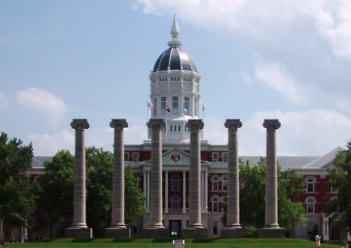
Columbia's most significant and well-known architecture is found in buildings located in its downtown area and on the university campuses. The University of Missouri's Jesse Hall and the neo-Gothic Memorial Union have become icons of the city. The David R. Francis Quadrangle is an example of Thomas Jefferson's academic village concept.
Nine historic districts located within the city are listed on the National Register of Historic Places: Downtown Columbia, the East Campus neighborhood, the West Broadway neighborhood, the Francis Quadrangle, the south campus of Stephens College, the Pierce Pennant Motor Hotel, Maplewood, and the David Guitar House. The downtown skyline is relatively low and is dominated by the 10-story Tiger Hotel and the 15-story Paquin Tower.
Downtown Columbia is an area around one square mile surrounded by the University of Missouri on the south, Stephens College to the east, and Columbia College on the north. The area serves as Columbia's financial and business district.
Since the early 21st century, a large number of high-rise apartment complexes have been built in downtown Columbia. Many of these buildings also offer mixed-use business and retail space on the lower levels. These developments have not been without criticism, with some expressing concern the buildings hurt the historic feel of the area, or that the city does not yet have the infrastructure to support them.
The city's historic residential core lies in a ring around downtown, extending especially to the west along Broadway, and south into the East Campus Neighborhood. The city government recognizes 63 neighborhood associations. The city's most dense commercial areas are primarily along Interstate 70, U.S. Route 63, Stadium Boulevard, Grindstone Parkway, and Downtown.
Demographics
2020 census
The 2020 United States census counted 126,254 people, 49,371 households, and 25,144 families in Columbia. The population density was 1,879.6 inhabitants per square mile (725.7/km2). The 53,746 housing units had an average density of 800.1 per square mile (308.9/km2). The racial makeup (including Hispanics in the racial counts) was 72.49% (91,516) White, 11.91% (15,038) Black or African American, 0.32% (398) Native American, 5.61% (7,084) Asian, 0.07% (89) Pacific Islander, 2.17% (2,734) from other races, and 7.44% (9,395) from two or more races. Hispanic or Latino people of any race were 4.9% (6,195) of the population.
Of the 49,371 households, 24.0% had children under 18, 38.7% were married couples living together, 31.4% had a female householder with no husband present, 34.7% were individuals, and 8.6% had someone living alone who was 65 or older. The average household size was 2.3, and the average family size was 3.0.
The age distribution was 18.2% under 18, 23.8% from 18 to 24, 26.4% from 25 to 44, 18.0% from 45 to 64, and 10.7% who were 65 or older. The median age was 28.8 years. For every 100 females, the city had 93.3 males. For every 100 females 18 and older, there were 89.8 males.
The 2016–2020 five-year American Community Survey estimates show that the median household income was $53,447 (with a margin of error of +/- $2,355) and the median family income $81,392 (+/- $5,687). Males had a median income of $30,578 (+/- $2,131) versus $23,705 (+/- $1,849) for females. The median income for those above 16 was $26,870 (+/- $1,429). Apbout 8.5% of families and 20.2% of the population were below the poverty line, including 15.7% of those under 18 and 5.2% of those 65 or over.
2010 census
As of the census of 2010, 108,500 people, 43,065 households, and 21,418 families resided in the city. The population density was 1,720.0 inhabitants per square mile (664.1/km2). The 46,758 housing units had an average density of 741.2 per square mile (286.2/km2). The racial makeup of the city was 79.0% White, 11.3% African American, 0.3% Native American, 5.2% Asian, 0.1% Pacific Islander, 1.1% from other races, and 3.1% from two or more races. Hispanic or Latino people of any race were 3.4% of the population.
Economy
Columbia's economy is historically dominated by education, healthcare, and insurance. Jobs in government are also common, either in Columbia or a half-hour south in Jefferson City. The Columbia Regional Airport and the Missouri River Port of Rocheport connect the region with trade and transportation.
With a gross metropolitan product of $9.6 billion in 2018, Columbia's economy makes up 3% of the gross state product of Missouri. Columbia's metro area economy is slightly larger than the economy of Rwanda. Insurance corporations headquartered in Columbia include Shelter Insurance and the Columbia Insurance Group. Other organizations include StorageMart, Veterans United Home Loans, MFA Incorporated, the Missouri State High School Activities Association, and MFA Oil. Companies such as Socket, Datastorm Technologies, Inc. (no longer existent), Slackers CDs and Games, Carfax, and MBS Textbook Exchange were all founded in Columbia.
Top employers
According to Columbia's 2022 Annual Comprehensive Financial Report, the top employers in the city are:
The unemployment rate in Columbia has slowly risen since December 2022, to 3.5% as of February 2025.
Culture

The Missouri Theatre Center for the Arts and Jesse Hall auditorium are Columbia's largest fine arts venues. Ragtag Cinema annually hosts the True/False Film Festival.
In 2008, filmmaker Todd Sklar completed the film Box Elder, which was filmed entirely in and around Columbia and the University of Missouri.
The North Village Arts District, located on the north side of downtown, is home to galleries, restaurants, theaters, bars, music venues, and the Mareck Center for Dance.
The University of Missouri's Museum of Art and Archaeology displays 14,000 works of art and archaeological objects in five galleries at no charge to the public.
Libraries include the Columbia Public Library, the University of Missouri Libraries, with over three million volumes in Ellis Library, and the State Historical Society of Missouri.
Music
The "We Always Swing" Jazz Series and the Roots N Blues Festival is held in Columbia. "9th Street Summerfest" (now hosted in Rose Park at Rose Music Hall) closes part of that street several nights each summer to hold outdoor performances and has featured Willie Nelson (2009), Snoop Dogg (2010), The Flaming Lips (2010), Weird Al Yankovic (2013), and others. The "University Concert Series" regularly includes musicians and dancers from various genres, typically in Jesse Hall. Other musical venues in town include the Missouri Theatre, the university's multipurpose Hearnes Center, the university's Mizzou Arena, The Blue Note, and Rose Music Hall. Shelter Gardens, a park on the campus of Shelter Insurance headquarters, also hosts outdoor performances during the summer.
The University of Missouri School of Music attracts hundreds of musicians to Columbia, student performances are held in Whitmore Recital Hall. Among many non-profit organizations for classical music are included the "Odyssey Chamber Music Series", "Missouri Symphony", "Columbia Community Band", and "Columbia Civic Orchestra". Founded in 2006, the "Plowman Chamber Music Competition" is a biennial competition held in March/April of odd-numbered years, considered to be one of the finest, top five chamber music competitions in the nation.
Parks and recreation

Throughout the city are many parks and trails for public usage managed by Columbia Parks and Recreation. Among the more popularly frequented is the MKT which is a spur that connects to the Katy Trail, meeting up just south of Columbia proper. The MKT ranked second in the nation for "Best Urban Trail" in the 2015 USA Today's 10 Best Readers' Choice Awards. This 10-foot wide trail built on the old railbed of the MKT railroad begins in downtown Columbia in Flat Branch Park at 4th and Cherry Streets. The all-weather crushed limestone surface provides opportunities for walking, jogging, running, and bicycling.Stephens Lake Park is the highlight of Columbia's park system and is known for its 11-acre fishing/swimming lake, mature trees, and historical significance in the community. It serves as the center for outdoor winter sports, a variety of community festivals such as the Roots N Blues Festival, and outdoor concert series at the amphitheater. Stephens Lake has reservable shelters, playgrounds, swimming beach and spraygrounds, art sculptures, waterfalls, and walking trails. Rock Bridge Memorial State Park is open year-round giving visitors the chance to scramble, hike, and bicycle through a scenic environment. Rock Bridge State Park contains some of the most popular hiking trails in the state, including the Gans Creek Wild Area.
Columbia is home to Harmony Bends Disc Golf Course, which was named the 2017 Disc Golf Course of the Year by DGCourseReview.com. As of June 2022, Harmony Bends still ranks on DGCourseReview.com as the No. 1 public course, and the #2 overall course in the United States
Media

The city has two daily morning newspapers: the Columbia Missourian and the Columbia Daily Tribune. The Missourian is directed by professional editors and staffed by Missouri School of Journalism students who do reporting, design, copy editing, information graphics, photography, and multimedia. The Missourian publishes the monthly city magazine, Vox Magazine. The University of Missouri has the independent official bi-weekly student newspaper called The Maneater, and the quarterly literary magazine, The Missouri Review. The now-defunct Prysms Weekly was also published in Columbia. In late 2009, KCOU News launched full operations out of KCOU 88.1 FM on the MU Campus. The entirely student-run news organization airs a weekday newscast, The Pulse.
The city has four television channels. Columbia Access Television (CAT or CAT-TV) is the public access channel. CPSTV is the education access channel, managed by Columbia Public Schools as a function of the Columbia Public Schools Community Relations Department. The Government Access channel broadcasts City Council, Planning and Zoning Commission, and Board of Adjustment meetings.
Radio
Columbia has 19 radio stations as well as stations licensed from Jefferson City, Macon, and Lake of the Ozarks.
Government and politics

Columbia's current government was established by a home rule charter adopted by voters on November 11, 1974, which established a council-manager government that invested power in the city council. The city council has seven members: six elected by each of Columbia's six single-member districts or wards and an at-large member, the mayor, who is elected by all city voters. The mayor receives a $9,000 annual stipend, and the six other members receive a $6,000 annual stipend. They are elected to staggered three-year terms. As well as serving as a voting member of the city council, the mayor is recognized as the head of city government for ceremonial purposes. Chief executive authority is invested in a hired city manager, who oversees the government's day-to-day operations.
Columbia is the county seat of Boone County, and houses the county court and government center. The city is in Missouri's 4th congressional district. The 19th Missouri State Senate district covers all of Boone County. There are five Missouri House of Representatives districts (9, 21, 23, 24, and 25) in the city. The Columbia Police Department provides law enforcement across the city, while the Columbia Fire Department provides fire protection. The University of Missouri Police Department also patrols areas on and around the University of Missouri campus and has jurisdiction throughout the state. Additionally, the Boone County Sheriff's Department, the law enforcement agency for the county, regularly patrols the city. The Public Service Joint Communications Center coordinates efforts between the two organizations as well as the Boone County Fire Protection District, which operates Urban Search and Rescue Missouri Task Force 1.
The population generally supports progressive causes, such as recycling programs and the decriminalization of cannabis both for medical and recreational use at the municipal level, though the scope of the latter of the two cannabis ordinances has since been restricted. The city is one of only four in the state to offer medical benefits to same-sex partners of city employees. The new health plan extends health benefits to unmarried heterosexual domestic partners of city employees.
Education
Almost all of the Columbia city limits, and much of the surrounding area, lie within the Columbia Public School District. The district enrolled more than 18,000 students and had a budget of $281 million for the 2019–20 school year.
95.4% of adults age 25 and older in the city have a high school diploma. In 2022, Columbia Public Schools recorded a 67.7% attendance rate, lower than the state average of 76.2%. Last year's graduation rate for the class of 2022 was 90%, while the class of 2021's graduation rate was reported at 89%. According to statewide numbers for 2022, Missouri's overall graduation rate was 91.16%. The Columbia school district operates four public high schools which cover grades 9–12: David H. Hickman High School, Rock Bridge High School, Muriel Battle High School, and Frederick Douglass High School. Rock Bridge is one of two Missouri high schools to receive a silver medal by U.S. News & World Report, putting it in the Top 3% of all high schools in the nation. Hickman has been on Newsweek magazine's list of Top 1,300 schools in the country for the past three years and has more named presidential scholars than any other public high school in the US. There are also several private high schools located in the city, including Christian Fellowship School, Columbia Independent School, Heritage Academy, Christian Chapel Academy, and Tolton High School.
CPS also manages seven middle schools: Jefferson, West, Oakland, Gentry, Smithton, Lange, and John Warner. John Warner Middle School first opened for the 2020/21 school year.
A very small portion of the city limits is in Hallsville R-IV School District. The sole high school of that district is Hallsville High School.
The United States census estimated that 55.3% of adults ages 25 and up in Columbia hold a bachelor's degree or higher. While only 31.2% of Missourians hold a bachelor's degree.
Infrastructure

Transportation
The Columbia Transit provides public bus and para-transit service, and is owned and operated by the city. In 2008, 1,414,400 passengers boarded along the system's six fixed routes and nine University of Missouri shuttle routes, and 27,000 boarded the Para-transit service. The system is constantly experiencing growth in service and technology. A $3.5 million project to renovate and expand the Wabash Station, a rail depot built in 1910 and converted into the city's transit center in the mid-1980s, was completed in summer of 2007. In 2007, a Transit Master Plan was created to address the future transit needs of the city and county with a comprehensive plan to add infrastructure in three key phases. The five to 15-year plan intends to add service along the southwest, southeast and northeast sections of Columbia and develop alternative transportation models for Boone County.
The city is served by Columbia Regional Airport. The closest rail station is Jefferson City station, in the state capital Jefferson City.
Columbia is also known for its MKT Trail, a spur of the Katy Trail State Park, which allows foot and bike traffic across the city, and, conceivably, the state. It consists of a soft gravel surface for running and biking. Columbia also is preparing to embark on construction of several new bike paths and street bike lanes thanks to a $25 million grant from the federal government. The city is also served by United Airlines and American Airlines at the Columbia Regional Airport, the only commercial airport in mid-Missouri.
I-70 (concurrent with US 40) and US 63 are the two main freeways used for travel to and from Columbia. Within the city, there are also three state highways: Routes 763 (Rangeline Street & College Avenue), 163 (Providence Road), and 740 (Stadium Boulevard).
Rail service is provided by the city-owned Columbia Terminal Railroad (COLT), which runs from the north side of Columbia to Centralia and a connection to the Norfolk Southern Railway.
Sister cities
In accordance with the Columbia Sister Cities Program, which operates in conjunction with Sister Cities International, Columbia has been paired with five international sister cities in an attempt to foster cross-cultural understanding:
Kaynak: Wikipedia – Columbia, Missouri · CC BY-SA 4.0