
Davenport
Davenport es una ciudad de los Estados Unidos localizada a orillas del río Misisipi en el condado de Scott, del que es además su sede, en el estado de Iowa.
Government administration · United States · 0 followers
Overview
Davenport es una ciudad de los Estados Unidos localizada a orillas del río Misisipi en el condado de Scott, del que es además su sede, en el estado de Iowa. Según el censo de 2010 tenía una población de 104 564 habitantes. Está ubicada a la orilla derecha del río Misisipi, que la separa de Illinois.
Interested in working with us in the future?
Follow to see new jobs and posts in your feed.
No news yet.
About

Davenport es una ciudad de los Estados Unidos localizada a orillas del río Misisipi en el condado de Scott, del que es además su sede, en el estado de Iowa. Según el censo de 2010 tenía una población de 104 564 habitantes. Está ubicada a la orilla derecha del río Misisipi, que la separa de Illinois.
Kaynak: Wikipedia · CC BY-SA 4.0
Geografía
Según la Oficina del Censo de los Estados Unidos, la localidad tiene un área total de 168,54 km², de los cuales 163,03 km² corresponden a tierra firme y el restante 5,51 km² a agua, que representa el 3,27% de la superficie total de la localidad.
Demografía
Según el censo de 2010, había 104564 personas residiendo en la localidad. La densidad de población era de 591,46 hab./km². Había 44087 viviendas con una densidad media de 261,58 viviendas/km². El 80,66% de los habitantes eran blancos, el 10,79% afroamericanos, el 0,38% amerindios, el 2,18% asiáticos, el 0,05% isleños del Pacífico, el 2,1% de otras razas, y el 3,85% pertenecía a dos o más razas. El 7,28% de la población eran hispanos o latinos de cualquier raza.
Kaynak: Wikipedia – Davenport (Iowa) · CC BY-SA 4.0
History

The land was originally inhabited by the Sauk, Meskwaki, and Ho-Chunk peoples. France laid claim to this territory as part of its New France and Illinois Country in the 18th century. Its traders and missionaries came to the area from Canada (Quebec), but it did not have many settlers here. After losing to Great Britain in the Seven Years' War, France ceded its territory east of the Mississippi River to the British and transferred the lands to the west to Spain.
In 1803, France regained and sold its holdings in North America west of the Mississippi River to the United States under the Louisiana Purchase. Lieutenant Zebulon Pike was the first United States representative to officially visit the Upper Mississippi River area. On August 27, 1805, Pike camped on the present-day site of Davenport.
In 1832, a group of Sauk, Meskwaki, and Kickapoo were defeated by the United States in the Black Hawk War. The United States government concluded the Black Hawk Purchase, sometimes called the Forty-Mile Strip or Scott's Purchase, by which the US acquired lands in what is now eastern Iowa. The purchase was made for $640,000 on September 21, 1832, and contained an area of some 6 million acres (24,000 km2), at a price equivalent to 11 cents/acre ($26/km2). Although named after the defeated chief Black Hawk, he was being held prisoner by the US. Sauk chief Keokuk, who had remained neutral in the war, signed off on the purchase. It was made on the site of present-day Davenport. Army General Winfield Scott and Governor of Illinois, John Reynolds, acted on behalf of the United States, with Antoine Le Claire, a mixed-race (Métis) man, serving as translator. He later was credited with founding Davenport.
Chief Keokuk gave a generous portion of land to Antoine Le Claire's wife, Marguerite, the granddaughter of a Sauk chief. Le Claire built their home on the exact spot where the agreement was signed, as stipulated by Keokuk, or he would have forfeited the land. Le Claire finished the 'Treaty House' in the spring of 1833. He founded Davenport on May 14, 1836, naming it for his friend Colonel George Davenport, who was stationed at Fort Armstrong during the war. The city was incorporated on January 25, 1839. The area was successively governed by the legislatures of the Michigan Territory, the Wisconsin Territory, the Iowa Territory, and finally Iowa.
Geography

According to the United States Census Bureau, the city has a total area of 66.333 square miles (171.80 km2), of which 64.209 square miles (166.30 km2) is land and 2.124 square miles (5.50 km2) (3.2%) is water. Davenport is located approximately 170 miles (270 km) west of Chicago and 170 miles (270 km) east of the Iowa state capital of Des Moines. The city is located about 200 miles (320 km) north of St. Louis, Missouri, and 265 miles (426 km) southeast of Minneapolis, Minnesota. Farmland surrounds Davenport outside the Quad Cities area.
Davenport is located on the banks of the Mississippi River. At this point the river has a maximum depth of around 30 to 40 feet (9.1 to 12.2 m) and is 2,217 feet (676 m) wide where the Centennial Bridge crosses it. The river flows from east to west in this area, as opposed to its usual north to south direction. From the river the city starts to slope north up a hill, which is steep at some points. The streets of the city, especially downtown and in the central part of the town, follow a grid design.
Davenport often makes national headlines when it suffers seasonal flooding by the Mississippi River. It is the largest city bordering the Mississippi that has no permanent flood wall or levee. Davenport residents prefer to maintain open access to the river for parks and vistas rather than have it cut off by dikes and levees. Davenport has adopted ordinances requiring any new construction in the floodplain to be elevated above the 100-year-flood level or protected with walls. As a result, former mayor Phil Yerington said that if they "let Mother Nature take her course, we'll all be better off". An example of a Davenport building that is elevated or flood-proofed is the Figge Art Museum.
Climate
Under the Köppen climate classification, Davenport is considered to have a humid continental climate (Dfa). Summers are very warm to hot with high levels of humidity. Winters have cold temperatures and often high winds, with snow likely from November through February. Average snowfall in Davenport is 30.7 inches (780 mm) per year. January is on average the coldest month, while July is the warmest. The highest temperature recorded in Davenport was 111 °F (44 °C) on July 12, 1936. The lowest temperature, −29 °F (−34 °C), was recorded on January 18, 2009. Substantial weather changes frequently occur at three- to four-day intervals as a result of mid-latitude storm tracks, which is where low and high pressure extratropical disturbances occur. During the summers, farmers experience difficulties while farming such as shallow soil, the humidity, and cold damp winds
Demographics

According to realtor website Zillow, the average price of a home as of December 31, 2025, in Davenport is $179,841.
As of the 2024 American Community Survey, there are 42,463 estimated households in Davenport with an average of 2.30 persons per household. The city has a median household income of $64,686. Approximately 14.9% of the city's population lives at or below the poverty line. Davenport has an estimated 63.1% employment rate, with 29.8% of the population holding a bachelor's degree or higher and 91.0% holding a high school diploma. There were 45,814 housing units at an average density of 713.51 per square mile (275.5/km2).
The median age in the city was 37.3 years.
2024 estimate
As of the 2024 estimate, there were 100,938 people, 42,463 households, and _ families residing in the city. The population density was 1,572.02 inhabitants per square mile (607.0/km2). There were 45,814 housing units at an average density of 713.51 per square mile (275.5/km2). The racial makeup of the county was % White (% NH White), % African American, % Native American, % Asian, % Pacific Islander, _% from some other races and % from two or more races. Hispanic or Latino people of any race were % of the population.
2020 census
As of the 2020 census, there were 101,724 people, 42,679 households, and 24,669 families residing in the city. The population density was 1,594.55 inhabitants per square mile (615.7/km2). There were 46,964 housing units at an average density of 736.17 per square mile (284.2/km2). The racial makeup of the city was 74.06% White, 11.98% African American, 0.43% Native American, 2.20% Asian, 0.04% Pacific Islander, 2.57% from some other races and 8.73% from two or more races. Hispanic or Latino people of any race were 8.83% of the population.
2010 census
As of the 2010 census, there were 99,685 people, 40,620 households and _ families residing in the city. The population density was 1,583.61 inhabitants per square mile (611.4/km2). There were 44,087 housing units at an average density of 700.37 per square mile (270.4/km2). The racial makeup of the city was 80.66% White, 10.79% African American, 0.38% Native American, 2.18% Asian, 0.05% Pacific Islander, 2.10% from some other races and 3.85% from two or more races. Hispanic or Latino people of any race were 7.28% of the population.
Economy
Davenport's biggest labor industry is manufacturing, with over 7,600 jobs in the sector. John Deere is the second largest employer in the Quad Cities, after the Rock Island Arsenal as a whole. Deere, however, is the largest single employer, employing 7,200 workers in the Quad Cities and 948 on its north side Davenport plant. John Deere World Headquarters is located in Moline. Other large employers in Davenport and the Quad Cities include, Genesis Health System with 5,125 employees and 4,900 in Davenport, Trinity Regional Health System with 3,333, regional grocery store Hy-Vee with 3,138 and the Davenport Community School District with 2,237 employees.
Davenport is the headquarters for department store Von Maur, which has 24 stores. Davenport is also the headquarters of Lee Enterprises, which publishes fifty daily newspapers and more than 300 weekly newspapers, shoppers, and specialty publications, along with online sites in 23 states. As of September 2009, the unemployment rate in Davenport and the rest of the Quad Cities, had risen to 8.4%.
The surrounding Quad Cities have major places of employment, including the Rock Island Arsenal, KONE, Inc and Alcoa.
Arts and culture

Landmarks
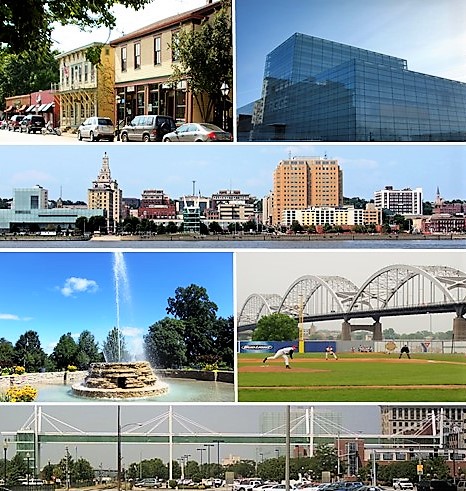
Downtown Davenport has many points of interest including the Davenport Public Library, the Davenport Skybridge, Figge Art Museum, River Music Experience, Putnam Museum, the RiverCenter/Adler Theater, Modern Woodmen Park which is home of the Quad City River Bandits baseball team and the Centennial Bridge. The former Chicago, Milwaukee, St. Paul and Pacific Freight House, now known as The Freight House, is home to several small businesses featuring locally grown items, such as a deli, a grocery hub, and a tap room for a local brewery.
Davenport's cultural and educational institutions include the Figge Art Museum, which houses The National Center for Midwest Art and Design, and was founded in 1925 as the Davenport Municipal Art Gallery. The Putnam Museum, which was founded in 1867 and was one of the first museums west of the Mississippi River. The Quad City Symphony Orchestra, headquartered in downtown Davenport, was founded in 1915. The Davenport Public Library was opened in 1839. The German American Heritage Center is located at the foot of the Centennial Bridge.
Uptown features a few historic landmarks such as the Iowa Soldiers' Orphans' Home which took in homeless children from all of Iowa's ninety-nine counties following the Civil War and Ambrose Hall which was the original building of St. Ambrose University. Aside from landmarks, uptown contains some entertainment venues too, such as the Great Mississippi Valley Fairgrounds, which hosts fairs, stock car racing, and many other events. NorthPark Mall is the city's main shopping mall and has 160 stores. Its companion, SouthPark Mall, is located in Moline. Brady Street Stadium is home to Davenport high school and Saint Ambrose University football games. Davenport has a number of parks, including Credit Island park which has a bike path, baseball diamonds, tennis courts, and fishing along the Mississippi River. Vander Veer Botanical Park has a small botanical garden and also features a walking path, a lagoon, and a large fountain. The Stampe Lilac Garden is located in Duck Creek Park, on Locust St.
Sports
Davenport and the Quad Cities are home to many sports teams. The Quad Cities River Bandits baseball team play games at Downtown Davenport's Modern Woodmen Park. The TaxSlayer Center in Moline is home the Quad City Steamwheelers indoor football team and the Quad City Storm hockey team. Davenport high schools are in the Mississippi Athletic Conference for sports.
Parks and recreation

Davenport has over fifty parks or recreational trails. Major parks include Credit Island, which is a 450-acre (1.8 km2) park in southwest Davenport located alongside the Mississippi River. Fejervary Park contains a pool and has had approximately 20,000 visitors each year since 1996. Junge Park is situated along the Duck Creek Parkway and includes baseball and softball fields, sand volleyball, and basketball courts. LeClaire Park is located right on the banks of the Mississippi River next to Modern Woodmen Park and hosts many summer events including River Roots Live and Ribfest. Bands for the Bix Fest play in the park each July. Vander Veer Botanical Park welcomes approximately 25,000 visitors to continuous floral shows.
The city features two recreational trails for biking or walking. Duck Creek Parkway extends from Emeis Park in west Davenport 8.26 miles (13.29 km) east to Bettendorf along Duck Creek. Riverfront Parkway extends 4.75 miles (7.64 km) along the Mississippi waterfront from Credit Island to Bettendorf. Both these trails continue into Bettendorf. Plans are being discussed to connect the two trails in Riverdale. Three public golf courses are offered in the city. For river-related activities, The Channel Cat boat offers rides across the river and has two stops in Iowa and three stops in Illinois and connects the bike paths that each state has on its river front.
Government

Davenport uses a mayor–council form of local government. As of 2021, city government consists of mayor Mike Matson and a ten-person council. One person is elected from each of the eight wards and two at-large aldermen are elected to represent the whole city. Nonpartisan elections are held in odd-numbered years. The mayor is the top elected individual for the city and presides over city council meetings, voting in case of a tie. The mayor appoints city board members. The city council's job is to make laws and set the city budget. The city administrator, currently Corrin Spiegel, is appointed by the mayor with confirmation by two-thirds of the council. Citywide goals through 2012 include having a financially responsible government, having a growing economy, revitalizing neighborhoods, and upgrading city infrastructure and public facilities. The establishment of Davenport as a political and government unit came in 1839, three years after the city was settled. The city was incorporated as a result of a resolution by Iowa Representative Jonathan W. Parker by special charter in the Iowa Territory on January 25, 1839. Parker was a resident of Davenport and one of six trustees elected to govern the city with Rodolphus Bennet being the first mayor. Activity for the first four months was minimal as the council failed to meet. In 1842, the city charter was amended for the first time. Changes include having six alderman replace the five trustees, dividing the city into three wards, and appointing a city clerk position to replace the recorder. The charter was amended again in 1851 to expand the city area, provide greater detail of the duties of the mayor, city council, and other officials. During the last half of the 19th century, government assumed expanding responsibilities for public welfare and public works improvements.
Education

Davenport public schools serve nearly 14,500 students in the communities of Davenport, Blue Grass, Buffalo, and Walcott. The Davenport Community School District is the fourth-largest school district in Iowa. Davenport has four public high schools: Central, West, Mid City and North and one private high school: Assumption. There are six public intermediate schools and 23 public elementary schools. Sudlow, one of the intermediate schools, was named after Phebe Sudlow, the first female public school superintendent in the United States. She was superintendent for Davenport schools from 1874 to 1878. The high schools are part of the Mississippi Athletic Conference for sports.
The city has four colleges and universities: Saint Ambrose University, established in 1882, is the oldest; Kaplan University, Palmer Chiropractic College, and Hamilton Technical College. Palmer College is the first chiropractic school and the site of the first chiropractic adjustment in the world.
Marycrest International University was a university in Davenport from 1939 to 2002, when it closed. The campus was renovated and adapted to senior citizen housing.
Media

There are two major daily newspapers in Davenport. The Quad-City Times is based out of Davenport and The Dispatch/Rock Island Argus is based out of Moline. An alternative free newspaper, the River Cities' Reader, is published in Davenport. All four major television networks have stations in the area, including KWQC (NBC) and KLJB (Fox) in Davenport. WHBF (CBS) is located in Rock Island and WQAD (ABC) is in Moline.
The Quad Cities ranks as the 97th largest market for television and the 147th largest market for radio. Radio station WOC made its local broadcasting debut on February 18, 1922. It was the second licensed station on the air. In 1933, WOC hired future president Ronald Reagan as a staff announcer.
Infrastructure

Transportation
Three interstate highways serve Davenport: Interstate 80, Interstate 280, and Interstate 74. Interstate 88 serves the Illinois Quad Cities and runs east to Chicago. U.S. Route 6, U.S. Route 61, and U.S. Route 67 also go through Davenport; U.S. 67 crosses over to Illinois via the Rock Island Centennial Bridge. Davenport is connected to the Illinois side of the Quad Cities by a total of three bridges across the Mississippi River. The Government Bridge and the Centennial Bridge connect Downtown Davenport with the Rock Island Arsenal and downtown Rock Island, respectively. The I-280 Bridge connects the western edge of Davenport with the western edge of Rock Island.
Other highways include Iowa Highway 22, which is on the city's southwest side, and Iowa Highway 130, which runs along Northwest Boulevard on Davenport's north edge. For air travel, Davenport Municipal Airport – located adjacent to the city's northern city limits – serves smaller aircraft, and is the home of the annual Quad City Airshow. The Quad City International Airport across the river in Moline, Illinois, is the closest commercial airport. Major railroads include the Iowa Interstate Railroad and the Iowa, Chicago and Eastern. Two national U.S. recreation trails intersect in Davenport: the Mississippi River Trail and the American Discovery Trail.
Amtrak currently does not serve Davenport or the Quad Cities. The closest station currently is about 50 miles (80 km) away in Galesburg, Illinois. In 2008, United States Senators Tom Harkin, Chuck Grassley, Dick Durbin, and Barack Obama sent a letter to Amtrak asking them to begin plans to bring rail service to the Quad Cities. In October 2010, a $230 million federal fund was announced that will bring Amtrak service to the Quad Cities, with a new line running from Moline to Chicago. They had hoped to have the line completed in 2015, and offer two round trips daily to Chicago. Currently the Moline station does not have any Amtrak service. Greyhound Lines/Burlington Trailways bus service has a station in Davenport. The building is shared with the local Davenport Citibus. Davenport does not have any river ports.
Notable people (Davenporters)
Guitarist and vocalist John Kadlecik, who founded The Dark Star Orchestra and toured with the members of The Grateful Dead in the band Furthur, also grew up in Davenport, as well as rapper Dave Blunts. Jazz musician Bix Beiderbecke, after whom the Bix 7 road race and jazz festival are named.
Sports figures born in Davenport include former middleweight and super-middle champion of the world in boxing Michael Nunn, NFL running back Roger Craig, NFL offensive lineman Julian Vandervelde, former NBA guard Ricky Davis, former NBA G-League guard Marlon Stewart, UFC welterweight champion Robbie Lawler, NFL wide receiver Kenny Shedd, and professional wrestler Seth Rollins.
The former mayor of St. Louis, Lyda Krewson.
Actors Stuart Margolin, Lara Flynn Boyle, Sue Lyon, Linnea Quigley, and Greg Stolze, and Jock Mahoney are from Davenport. The artist Isabel Bloom was raised in Davenport; she is the creator of decorative concrete figurines that bear her name.
Other natives include the aviation pioneer Samuel Cody and Otto Frederick Rohwedder the inventor of mass-produced sliced bread.
Ida Henrietta Hyde (1857–1945), physiologist, was born in Davenport.
Film, theater, and literary references
Bix Beiderbecke recorded a song in 1925 called "Davenport Blues".
In the bed department scene of the Marx Brothers 1941 movie "The Big Store" Groucho tells a man to "Just press that button over by the davenport.". The man replies "Where is the davenport?" and Groucho replies "It's in Iowa.".
The 1958 Johnny Cash song, "Big River", also later recorded by Bill Monroe and other artists, mentions "cavortin' in Davenport."
Davenport is one of eight cities listed in the song "Iowa Stubborn" from the 1957 musical The Music Man.
In the film Tommy Boy, Richard Hayden attempts to get directions to a business appointment in Davenport from a service station 22 miles away on the Illinois side of the river, but the employee tells him to get a new map.
Places of interest
Downtown Davenport has many points of interest including the Davenport Public Library, the Davenport Skybridge, Figge Art Museum, River Music Experience, Putnam Museum, the RiverCenter/Adler Theater, Modern Woodmen Park which is home of the Quad City River Bandits baseball team and the Centennial Bridge. The former Chicago, Milwaukee, St. Paul and Pacific Freight House, now known as The Freight House, is home to several small businesses featuring locally grown items, such as a deli, a grocery hub, and a tap room for a local brewery.
Davenport's cultural and educational institutions include the Figge Art Museum, which houses The National Center for Midwest Art and Design, and was founded in 1925 as the Davenport Municipal Art Gallery. The Putnam Museum, which was founded in 1867 and was one of the first museums west of the Mississippi River. The Quad City Symphony Orchestra, headquartered in downtown Davenport, was founded in 1915. The Davenport Public Library was opened in 1839. The German American Heritage Center is located at the foot of the Centennial Bridge.
Uptown features a few historic landmarks such as the Iowa Soldiers' Orphans' Home which took in homeless children from all of Iowa's ninety-nine counties following the Civil War and Ambrose Hall which was the original building of St. Ambrose University. Aside from landmarks, uptown contains some entertainment venues too, such as the Great Mississippi Valley Fairgrounds, which hosts fairs, stock car racing, and many other events. NorthPark Mall is the city's main shopping mall and has 160 stores. Its companion, SouthPark Mall, is located in Moline. Brady Street Stadium is home to Davenport high school and Saint Ambrose University football games. Davenport has a number of parks, including Credit Island park which has a bike path, baseball diamonds, tennis courts, and fishing along the Mississippi River. Vander Veer Botanical Park has a small botanical garden and also features a walking path, a lagoon, and a large fountain. The Stampe Lilac Garden is located in Duck Creek Park, on Locust St.
Kaynak: Wikipedia – Davenport, Iowa · CC BY-SA 4.0