


Des Moines
Des Moines, cuyo nombre proviene del francés y que significa De los Monjes o Monjes, es la capital y la ciudad más extensa del estado de Iowa.
Government administration · United States · 0 followers
Overview
Des Moines, cuyo nombre proviene del francés y que significa De los Monjes o Monjes, es la capital y la ciudad más extensa del estado de Iowa. Así mismo, es la sede del condado de Polk. Según el censo de 2020 tenía una población de 215 133 habs. La ciudad es el centro de un área metropolitana que abarca los condados de Polk, Dallas, Warren, Madison y Guthrie, y ocupa el lugar número 91 de las áreas metropolitanas estadounidenses en población con 562 906 habs. según las estimaciones para 2009 de la Oficina del Censo de los Estados Unidos. Está ubicada a orillas del río homónimo.
Interested in working with us in the future?
Follow to see new jobs and posts in your feed.
No news yet.
About

Des Moines, cuyo nombre proviene del francés y que significa De los Monjes o Monjes, es la capital y la ciudad más extensa del estado de Iowa. Así mismo, es la sede del condado de Polk. Según el censo de 2020 tenía una población de 215 133 habs. La ciudad es el centro de un área metropolitana que abarca los condados de Polk, Dallas, Warren, Madison y Guthrie, y ocupa el lugar número 91 de las áreas metropolitanas estadounidenses en población con 562 906 habs. según las estimaciones para 2009 de la Oficina del Censo de los Estados Unidos. Está ubicada a orillas del río homónimo.
Kaynak: Wikipedia · CC BY-SA 4.0
Historia

Prehistoria
La confluencia de los ríos Des Moines y Raccoon ha atraído a pobladores humanos desde hace 3000 años. Los arqueólogos han identificado varias áreas de ocupación humana en el área de Des Moines datadas entre los años 1300 y 1700 a. C. Además, de 15 a 18 túmulos funerarios indígenas prehistóricos fueron observados por los primeros colonos que se instalaron en Iowa. Ninguno de dichos túmulos sobrevive hoy en día.
Actual
Des Moines fue fundada en mayo de 1843 cuando el capitán James Allen construyó un fuerte donde los ríos Des Moines y Racoon convergen. Allen quiso llamarlo Fuerte Racoon, pero el Departamento de Guerra de los Estados Unidos le obligó a llamarlo Fuerte Des Moines. El nombre original de Des Moines no está claro. Podría hacer referencia al río de Moingonas, llamado así por la tribu nativoamericana que vivía en esa zona. Otros creen que es por los monjes trapenses, algunos de los cuales vivían en cuevas cercanas al río. Otros, sin embargo, conectan Des Moines con De Moyen ("en medio" en francés), dada su localización entre los ríos Misisipi y Misuri.
Los colonos se instalaron cerca del fuerte y, el 25 de mayo de 1846, el fuerte Des Moines se convirtió en el asiento de Polk County. El 22 de septiembre de 1851 fue incorporado como ciudad, y su carta magna fue aprobada el 18 de octubre. En 1857, el nombre "Fuerte Des Moines" fue acortado a "Des Moines" y se convirtió en la capital de Iowa, abandonando a Iowa City como antigua capital. Hacia 1900, Des Moines era la ciudad más poblada con 62.139 habitantes.
En 1907, la ciudad adoptó un Gobierno de Comisión de ciudad conocido como el plan Des Moines, nombrando un alcalde electo y 4 comisionados que eran responsables de trabajos públicos, propiedad pública, seguridad pública y finanzas. Esta forma de gobierno fue abolida en 1950 a favor de un gobierno de gerente de consejo.
Geografía
Según la Oficina del Censo de los Estados Unidos, la localidad tiene un área total de 213,92 km², de los cuales 209,45 km² corresponden a tierra firme y el restante 4,47 km² a agua, que representa el 2,09% de la superficie total de la localidad.
En noviembre de 2005, los votantes de Des Moines aprobaron una medida que permite a la ciudad anexarse ciertas parcelas de tierra en las esquinas sur, noreste y sureste de Des Moines, particularmente áreas que limitan con la carretera estatal 5 y la federal 65, anexión que finalmente tuvo lugar en 2009.
Clima
El clima de Des Moines es continental húmedo, con gran variación estacional de temperaturas. Los veranos son a menudo templados y húmedos con frecuentes tormentas e inviernos que pueden ser muy fríos con frecuentes nevadas y persistente cobertura de nieve. Las siguientes tablas muestran los valores promedio mensuales para clima e indicadores del tiempo en Des Moines:
Área metropolitana
El área metropolitana de Des Moines abarca cinco condados: Polk, Dallas, Warren, Madison y Guthrie. Se estima que en 2009 la población era de 562.906 habitantes según la Oficina del Censo de los Estados Unidos. Antes de que las áreas metropolitanas fuera redefinidas en el 2003, el área metropolitana de Des Moines consistía solamente de los condados Polk, Dallas y Warren.
Suburbios
Los suburbios de Des Moines incluyen las localidades de Altoona, Ankeny, Bondurant, Carlisle, Clive, Grimes, Indianola, Johnston, Norwalk, Pleasant Hill, Polk City, Urbandale, Waukee, West Des Moines y Windsor Heights.
Demografía
Según el censo de 2010, había 203.433 personas residiendo en la localidad. La densidad de población era de 950,98 hab./km². Había 88.729 viviendas con una densidad media de 414,78 viviendas/km². El 76,42% de los habitantes eran blancos, el 10,25% afroamericanos, el 0,5% indígenas, el 4,42% asiáticos, el 0,07% isleños del Pacífico, el 4,99% de otras razas, y el 3,35% pertenecía a dos o más razas. El 11,96% de la población eran hispanos o latinos de cualquier raza.
Según el censo de 2000, había 80.504 hogares de los cuales 29,5% tenían hijos menores de 18 años viviendo con ellos, 43,7% eran parejas casadas viviendo juntos, 12,6% tenían ama de casa sin un esposo presente y 39,5% no eran familias. La distribución por edades era: 24,8% menores de 18 años, 10,6% de 18 a 24 años, 31,8% de 25 a 44, 20,4% de 45 a 64 y 12,4% con 65 años o más. La edad promedio era 34 años. Por cada 100 mujeres había 93,8 hombres. Por cada 100 mujeres de 18 años o más había 90,5 hombres. El ingreso promedio por hogar era 38.408 dólares ($) y por familia era 46.590 $. Los hombres tenían un ingreso promedio de 31.712 $ frente a 25.832 $ para las mujeres. La renta per cápita de la ciudad era 19.467 $. Cerca del 7,9% de las familias y del 11,4% de la población estaban por debajo del umbral de pobreza incluyendo 14,9% de aquellos menores de 18 y 7,6% de aquellos con 65 años o más.
Economía
Des Moines es la sede de 3 importantes empresas americanas: "Principal Financial Group", empresa de servicios financieros; "Meredith Corporation" de publicidad y "Ruan Transportation", una empresa de transportes.
Otras corporaciones importantes como Wells Fargo, Grupo ING o John Deere realizan importantes negocios en o cerca del área metropolitana. La revista Forbes clasificó a Des Moines como el 11º "Mejor Lugar de Negocios" en 2006.
Personas destacadas
Joey Jordison, fallecido exbaterista de Slipknot, guitarrista de Murderdolls.
Paul Gray, fallecido Bajista de Slipknot.
Casey Blake, jugador de béisbol de la MLB.
Shawn Crahan,, percusionista De Slipknot
David Anthony Higgins, actor, conocido por su papel en Malcolm in the Middle.
Stanley B. Prusiner, neurólogo y bioquímico, Premio Nobel de Fisiología y Medicina (1997) por sus estudios sobre los priones.
Brandon Routh, actor, protagonista de Superman Returns.
James Root, guitarrista de Slipknot y exguitarrista de Stone Sour.
Corey Taylor, cantante de las bandas de Slipknot y Stone Sour.
Kaynak: Wikipedia – Des Moines · CC BY-SA 4.0
Kardeş Şehirler
Des Moines'in resmen 5 tane kardeş şehri vardır:
Kaynak: Wikipedia – Des Moines · CC BY-SA 4.0
History
Etymology
Des Moines takes its name from Fort Des Moines (1843–46), which was named for the Des Moines River. This was adopted from the name given by French colonists. Des Moines (pronounced [de mwan] ; formerly [de mwɛn]) translates literally to either "from the monks" or "of the monks" from French.
Moines is an abbreviation used by the French for Moingouena, an Algonquian subgroup. The Native American term is mooyiinkweena, and it was a derogatory name applied to the Moingouenas by the Peorias, another subgroup, meaning shit-face.
Prehistoric inhabitants of early Des Moines
Based on archaeological evidence, the junction of the Des Moines and Raccoon Rivers has attracted humans for at least 7,000 years. Several prehistoric occupation areas have been identified by archaeologists in downtown Des Moines. Discovered in December 2010, the "Palace" is an expansive 7,000-year-old site found during excavations before construction of the new wastewater treatment plant in southeast Des Moines. It contains well-preserved house deposits and numerous graves. More than 6,000 artifacts were found at this site. State of Iowa archaeologist John Doershuk was assisted by University of Iowa archaeologists at this dig.
At least three villages, dating from about AD 1300 to 1700, stood in or near what developed later as downtown Des Moines. In addition, 15 to 18 prehistoric Native American mounds were observed in the area by early settlers. All have been destroyed during development of the city.
Origin of Fort Des Moines
Des Moines traces its origins to May 1843, when Captain James Allen supervised the construction of a fort on the site where the Des Moines and Raccoon Rivers merge. Allen wanted to use the name Fort Raccoon; however, the U.S. War Department preferred Fort Des Moines. The fort was built to control the Sauk and Meskwaki peoples, whom the government had moved to the area from their traditional lands in eastern Iowa. The fort was abandoned in 1846 after the Sauk and Meskwaki were removed from the state and shifted to the Indian Territory.
Geography

According to the United States Census Bureau, the city has an area of 90.65 square miles (234.78 km2), of which 88.93 square miles (230.33 km2) is land and 1.73 square miles (4.48 km2) is covered by water. It is 850 feet (260 m) above sea level at the confluence of the Raccoon and Des Moines Rivers.
In November 2005, Des Moines voters approved a measure that allowed the city to annex parcels of land in the northeast, southeast, and southern corners of Des Moines without agreement by local residents, particularly areas bordering the Iowa Highway 5/U.S. 65 bypass. The annexations became official on June 26, 2009, as 5,174 acres (20.94 km2) and around 868 new residents were added to the city of Des Moines. An additional 759 acres (3.07 km2) were voluntarily annexed to the city over that same period.
Metropolitan area
The Des Moines metropolitan area, officially the Des Moines–West Des Moines, IA Metropolitan Statistical Area (MSA), serves six counties in central Iowa: Polk, Dallas, Warren, Madison, Guthrie, and Jasper. Des Moines is the principal city, with other major cities being West Des Moines and Ankeny. As of 2024, the population is 779,048, being the 78th highest metropolitan area based on population in the United States.
Cityscape
The skyline of Des Moines changed in the 1970s and the 1980s, when several new skyscrapers were built. Additional skyscrapers were built in the 1990s, including Iowa's tallest. Before then, the 19-story Equitable Building, from 1924, was the tallest building in the city and the tallest building in Iowa. The 25-story Financial Center was completed in 1973 and the 36-story Ruan Center was completed in 1974. They were later joined by the 33-story Des Moines Marriott Hotel (1981), the 25-story HUB Tower and 25-story Plaza Building (1985). Iowa's tallest building, Principal Financial Group's 45-story tower at 801 Grand was built in 1991, and the 19-story EMC Insurance Building was erected in 1997.
Demographics

The city has the largest African American population in Iowa.
2020 census
The 2020 United States census counted 214,133 people, 87,958 households, and 48,599 families in Des Moines. The population density was 2,428.4 per square mile (937.6/km2). There were 95,082 housing units at an average density of 1,078.3 per square mile (416.3/km2).
The racial makeup (including Hispanics in the racial counts) was 64.54% (138,200) white or European American (60.99% non-Hispanic white), 11.68% (25,011) black or African-American, 0.69% (1,474) Native American or Alaska Native, 6.76% (14,474) Asian, 0.06% (135) Pacific Islander or Native Hawaiian, 6.62% (14,178) from other races, and 9.65% (20,661) from two or more races.
The racial and ethnic makeup (where Hispanics are excluded from the racial counts and placed in their own category) was 60.99% (130,599) White alone (non-Hispanic), 11.46% (24,538) Black alone (non-Hispanic), 0.28% (597) Native American alone (non-Hispanic), 6.70% (14,348) Asian alone (non-Hispanic), 0.06% (124) Pacific Islander alone (non-Hispanic), 0.38% (817) Other Race alone (non-Hispanic), 4.50% (9,630) Multiracial or Mixed Race (non-Hispanic), and 15.64% (33,480) Hispanic or Latino.
The 2020 census population of the city included 252 people incarcerated in adult correctional facilities and 2,378 people in student housing.
Of the 87,958 households, 28.0% had children under the age of 18; 35.5% were married couples living together; 31.3% had a female householder with no spouse or partner present. 35.3% of households consisted of individuals and 11.0% had someone living alone who was 65 years of age or older. The average household size was 2.5 and the average family size was 3.3. The percent of those with a bachelor's degree or higher was estimated to be 19.9% of the population. Of the population age 25 and over, 86.7% were high school graduates or higher and 27.9% had a bachelor's degree or higher.
Economy
Many insurance companies are headquartered in Des Moines, including the Principal Financial Group, Fidelity & Guaranty Life, Allied Insurance, GuideOne Insurance, Wellmark Blue Cross Blue Shield of Iowa and FBL Financial Group. Iowa has one of the lowest insurance premium taxes in the nation at 1%, and does not charge any premium taxes on qualified life insurance plans, making the state attractive to insurance business. Des Moines has been referred to as the "Hartford of the West" and "Insurance Capital" because of this. Principal is one of two Fortune 500 companies with headquarters in Iowa (the other being Casey's General Stores), ranking 201st on the magazine's list in 2020.
As a center of financial and insurance services, other major corporations headquartered outside of Iowa have a presence in the Des Moines Metro area, including Wells Fargo, Voya Financial, and Electronic Data Systems (EDS). The Meredith Corporation, a leading publishing and marketing company, was also based in Des Moines prior to its acquisition by IAC and merger with Dotdash in 2021. Meredith published Better Homes and Gardens, one of the most widely circulated publications in the United States. Des Moines was also the headquarters of Golf Digest magazine.
Other major employers in Des Moines include UnityPoint Health, Mercy Medical Center, MidAmerican Energy Company, CDS Global, UPS, Firestone, Lumen Technologies, Drake University, Titan Tire, The Des Moines Register, Anderson Erickson, EMCO.
The Brotherhood of American Yeomen, headquartered in Des Moines, went through various mergers before it became AmerUs, which was purchased by Aviva in 2006, for $2.9 billion. In 2017, Kemin Industries opened a state-of-the-art worldwide headquarters building in Des Moines.
Arts and culture

Arts and theater
The City of Des Moines is a cultural center for Iowa and home to several art and history museums and performing arts groups. The Des Moines Performing Arts routinely hosts touring Broadway shows and other live professional theater. The Temple for Performing Arts and Des Moines Playhouse are other venues for live theater, comedy, and performance arts.
The Des Moines Metro Opera has been a cultural resource in Des Moines since 1973. The Opera offers educational and outreach programs and is one of the largest performing arts organizations in the state.
Ballet Des Moines has seen many iterations since its founding in 1965. A professional resident company with more than two dozen professional dancers, an Apprentice and Trainee program, and a newly launched Academy in 2026, BDM has won numerous awards for its education and outreach programming.
The Des Moines Symphony performs frequently at different venues. In addition to performing seven pairs of classical concerts each season, the Symphony also entertains with New Year's Eve Pops and its annual Yankee Doodle Pops concerts.
Jazz in July is an annual event founded in 1969 that performs free jazz shows daily at venues throughout the city during July.
Casey's Center is the Des Moines area's primary venue for sporting events and concerts since its opening in 2005. Named for title sponsor Casey's, Casey's Center holds 16,980 and books large, national touring acts for arena concert performances, while several smaller venues host local, regional, and national bands. It is the home of the Iowa Wolves of the NBA G League, the Iowa Wild of the American Hockey League, and the Iowa Barnstormers of the Indoor Football League.
The Simon Estes Riverfront Amphitheater is an outdoor concert venue on the east bank of the Des Moines River which hosts music events such as the Alive Concert Series.
Sports

Des Moines hosts professional minor league teams in several sports — baseball, basketball, hockey, indoor football, and soccer — and is home to the sports teams of Drake University which play in NCAA Division I.
The Des Moines Menace soccer club, a member of USL League Two, play their home games at Valley Stadium in West Des Moines. Des Moines United FC of the National Premier Soccer League also utilize Valley Stadium.
Des Moines is home to the Iowa Cubs baseball team of the International League. The I-Cubs, which are the Triple-A affiliate of the major league Chicago Cubs, play their home games at Principal Park near the confluence of the Des Moines and Raccoon Rivers.
Casey's Center of the Iowa Events Center is home to the Iowa Barnstormers of the Indoor Football League, the Iowa Wild of the American Hockey League, and the Iowa Wolves of the NBA G League. The Barnstormers relaunched as an af2 club in 2008 before joining a relaunched Arena Football League in 2010 and the Indoor Football League in 2015; the Barnstormers had previously played in the Arena Football League from 1994 to 2000 (featuring future NFL Hall of Famer and Super Bowl MVP quarterback Kurt Warner) before relocating to New York. The Iowa Energy, a D-League team, began play in 2007. They were bought by the Minnesota Timberwolves in 2017 and were renamed the Iowa Wolves to reflect the new ownership. The Wild, the AHL affiliate of the National Hockey League's Minnesota Wild have played at Casey's Center since 2013; previously, the Iowa Chops played four seasons in Des Moines (known as the Iowa Stars for three of those seasons.)
Additionally, the Des Moines Buccaneers of the United States Hockey League play at Buccaneer Arena in suburban Urbandale.
Des Moines is also home to the Drake University Bulldogs, an NCAA Division I member of the Missouri Valley Conference, primarily playing northwest of downtown at the on-campus Drake Stadium and Knapp Center. Drake Stadium is home to the famed Drake Relays each April. In addition to the Drake Relays, Drake Stadium has hosted multiple NCAA Outdoor Track and Field Championships and USA Outdoor Track and Field Championships.
Parks and recreation

Des Moines has 76 city parks and three golf courses, as well as three family aquatic centers, five community centers and three swimming pools. The city has 45 miles (72 km) of trails. The first major park was Greenwood Park. The park commissioners purchased the land on April 21, 1894.
The Principal Riverwalk is a riverwalk park district being constructed along the banks of the Des Moines River in the downtown. Primarily funded by the Principal Financial Group, the Riverwalk is a multi-year jointly funded project also funded by the city and state. Upon completion, it will feature a 1.2-mile (1.9 km) recreational trail connecting the east and west sides of downtown via two pedestrian bridges. A landscaped promenade along the street level is planned. The Riverwalk includes the downtown Brenton Skating Plaza, open from November through March.
Gray's Lake, part of the 167 acres (68 ha) of Gray's Lake Park, features a boat rental facility, fishing pier, floating boardwalks, and a park resource center. Located just south of the downtown, the centerpiece of the park is a lighted 1.9-mile (3.1 km) Kruidenier Trail, encircling it entirely.
From downtown Des Moines primarily along the east bank of the Des Moines River, the Neil Smith and John Pat Dorrian Trails are 28.2-mile (45.4 km) paved recreational trails that connect Gray's Lake northward to the east shore of Saylorville Lake, Big Creek State Park, and the recreational trails of Ankeny including the High Trestle Trail. These trails are near several recreational facilities including the Pete Crivaro Park, Principal Park, the Principal Riverwalk, the Greater Des Moines Botanical Garden, Union Park and its Heritage Carousel of Des Moines, Birdland Park and the Birdland Marina/Boatramp on the Des Moines River, Riverview Park, McHenry Park, and River Drive Park. Although outside of Des Moines, Jester Park has 1,834 acres (742 ha) of land along the western shore of Saylorville Lake and can be reached from the Neil Smith Trail over the Saylorville Dam.
Government

Des Moines operates under a council–manager form of government. The council consists of a mayor who is elected in citywide vote, two at-large members, and four members representing each of the city's four wards. In 2014, Jonathan Gano was appointed as the new Public Works Director. In 2015, Dana Wingert was appointed as Police Chief. In 2018, Steven L. Naber was appointed as the new City Engineer.
A plan to merge the governments of Des Moines and Polk County was rejected by voters during the November 2, 2004, election. The consolidated city-county government would have had a full-time mayor and a 15-member council that would have been divided among the city and its suburbs. Each suburb would still have retained its individual government but with the option to join the consolidated government at any time. Although a full merger was soundly rejected, several city and county departments and programs have been consolidated.
Education
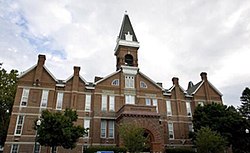
The Des Moines Independent Community School District is the largest community school district in Iowa with 32,062 enrolled students as of the 2012–2013 school year. The district consists of 63 schools: 38 elementary schools, eleven middle schools, five high schools (East, Hoover, Lincoln, North, and Roosevelt), and ten special schools and programs. Small parts of the city are instead served by Carlisle Community Schools, Johnston Community School District, the Southeast Polk Community School District and the Saydel Community School District Grand View Christian School is the only private school in the city, although Des Moines Christian School (in Des Moines from 1947 to 2006) in Urbandale, Dowling Catholic High School in West Des Moines, and Ankeny Christian Academy on the north side of the metro area serve some city residents.
Des Moines is also home to the main campuses of three four-year private colleges: Drake University, Grand View University, and Mercy Health Sciences University. The University of Iowa has a satellite facility in the city's Western Gateway Park, while Iowa State University hosts Master of Business Administration classes downtown. Des Moines Area Community College is the area's community college with campuses in Ankeny, Des Moines, and West Des Moines. Suburban West Des Moines is also home to Des Moines University, an osteopathic medical school.
Media
The Des Moines market, which originally consisted of Polk, Dallas, Story, and Warren counties, was ranked 91st by Arbitron as of the fall of 2007 with a population of 512,000 aged 12 and older. In June 2011 it moved up to 72nd with the addition of Boone, Clarke, Greene, Guthrie, Jasper, Lucas, Madison and Marion counties.
Commercial stations
iHeartMedia owns five radio stations in the area, including WHO 1040 AM, a 50,000-watt AM news/talk station that has the highest ratings in the area and once employed future President Ronald Reagan as a sportscaster. In addition to WHO, iHeartMedia owns KDRB 100.3 FM (adult hits), KKDM 107.5 FM (contemporary hits), KXNO-FM 106.3, and KXNO 1460 AM (sports radio). They also own news/talk station KASI 1430 AM and hot adult contemporary station KCYZ 105.1 FM, both of which broadcast from Ames.
Cumulus Media owns five stations that broadcast from facilities in Urbandale: KBGG 1700 AM (sports), KGGO 94.9 FM (classic rock), KHKI 97.3 FM (country music), KJJY 92.5 FM (country music), and KWQW 98.3 FM (contemporary hits).
Saga Communications owns nine stations in the area: KAZR LAZER 103.3 FM (rock), KAZR-HD2 (oldies), 93.3 KIOA FM (Classic Hits), KIOA-HD2 HITS 99.9FM & 93.3 HD2 (Rhythmic Top 40), KOEZ 104.1 EZ FM (soft adult contemporary), KPSZ HOPE 940 AM (Religious teaching and conservative talk), KRNT 1350 AM (ESPN Radio), KSTZ STAR 102.5 FM (adult contemporary hits), and KSTZ-HD2 The Outlaw (classic country).
Other stations in the Des Moines area include religious stations KWKY 1150 AM, and KPUL 101.7 FM.
Non-commercial stations
Non-commercial radio stations in the Des Moines area include KDPS 88.1 FM, a station operated by the Des Moines Public Schools; KWDM 88.7 FM, a station operated by Valley High School; KJMC 89.3 FM, an urban contemporary station; K213DV 90.5 FM, the contemporary Christian K-Love affiliate for the area; and KDFR 91.3 FM, operated by Family Radio. Iowa Public Radio broadcasts several stations in the Des Moines area, all of which are owned by Iowa State University and operated on campus. WOI 640 AM, the network's flagship station, and WOI-FM 90.1, the network's flagship "Studio One" station, are both based out of Ames and serve as the area's National Public Radio outlets. The network also operates classical stations KICG, KICJ, KICL and KICP. The University of Northwestern – St. Paul operates Contemporary Christian simulcasts of KNWI-FM at 107.1 Osceola/Des Moines, KNWM-FM at 96.1 Madrid/Ames/Des Moines, and K264CD at 100.7 in downtown Des Moines. Low-power FM stations include KFMG-LP 99.1, a community radio station broadcasting from the Hotel Fort Des Moines and also webstreamed.
Infrastructure

Transportation
Des Moines has an extensive skywalk system within its downtown core. With over four miles of enclosed walkway, it is one of the largest of such systems in the United States. The Des Moines Skywalk System has been criticized for hurting street-level business, though a recent initiative has been made to make street-level Skywalk entrances more visible.
Interstate 235 (I-235) cuts through the city, and I-35 and I-80 both pass through the Des Moines metropolitan area, as well as the city of Des Moines. On the northern side of the city of Des Moines and passing through the cities of Altoona, Clive, Johnston, Urbandale and West Des Moines, I-35 and I-80 converge into a long concurrency while I-235 takes a direct route through Des Moines, Windsor Heights, and West Des Moines before meeting up with I-35 and I-80 on the western edge of the metro. The Des Moines Bypass passes south and east of the city. Other routes in and around the city include US 6, US 69, Iowa 28, Iowa 141, Iowa 163, Iowa 330, Iowa 415, and Iowa 160.
Des Moines's public transit system, operated by DART (Des Moines Area Regional Transit), which was the Des Moines Metropolitan Transit Authority until October 2006, consists entirely of buses, including regular in-city routes and express and commuter buses to outlying suburban areas.
Characteristics of household ownership of cars in Des Moines are similar to national averages. In 2015, 8.5 percent of Des Moines households lacked a car, and that number increased to 9.6 percent in 2016. The national average was 8.7 percent in 2016. Des Moines averaged 1.71 cars per household in 2016, compared to a national average of 1.8.
Jefferson Lines and Greyhound Lines run long-distance, intercity bus routes through Des Moines. The bus station is located north of downtown.
Although Des Moines was historically a train hub, it does not have direct passenger train service. For east–west traffic it was served at the Rock Island Depot by the Corn Belt Rocket express from Omaha to the west, to Chicago in the east. The Rock Island also offered the Rocky Mountain Rocket from Colorado Springs in the west, to Chicago, and the Twin Star Rocket to Minneapolis to the north and Dallas and Houston to the south. The last train was an unnamed service ending at Council Bluffs, and it was discontinued on May 31, 1970. Today, this line constitutes the mainline of the Iowa Interstate Railroad.
Sister cities
The Greater Des Moines Sister City Commission, with members from the City of Des Moines and the suburbs of Cumming, Norwalk, Windsor Heights, Johnston, Urbandale, and Ankeny, maintains sister city relationships with:
Pristina, Kosovo (2018) (Kosovo also opened a Consulate in downtown Des Moines in 2015 – List of diplomatic missions of Kosovo)
Places of interest
Arising in the east and facing westward toward downtown, the Iowa State Capitol building with its 275-foot (84 m), 23-karat gold leafed dome towering above the city is a favorite of sightseers. Four smaller domes flank the main dome. The Capitol houses the governor's offices, legislature, and the old Supreme Court Chambers. The ornate interior also features a grand staircase, mural "Westward", five-story law library, scale model of the USS Iowa, and collection of first lady dolls. Guided tours are available.
The Capitol grounds include a World War II memorial with sculpture and Wall of Memories, the 1894 Soldiers and Sailors Monument of the Civil War and memorials honoring those who served in the Spanish–American, Korean, and Vietnam Wars.
The West Capitol Terrace provides the entrance from the west to the state's grandest building, the State Capitol Building. The 10-acre (4 ha) "people's park" at the foot of the Capitol complex includes a promenade and landscaped gardens, in addition to providing public space for rallies and special events. A granite map of Iowa depicting all 99 counties rests at the base of the terrace and has become an attraction for in-state visitors, many of whom walk over the map to find their home county.
Iowa's history lives on in the State of Iowa Historical Museum. This modern granite and glass structure at the foot of the State Capitol Building houses permanent and temporary exhibits exploring the people, places, events, and issues of Iowa's past. The showcase includes native wildlife, American Indian and pioneer artifacts, and political and military items. The museum features a genealogy and Iowa history library, museum gift shop, and cafe.
Terrace Hill, a National Historic Landmark and Iowa Governor's Residence, is among the best examples of American Victorian Second Empire architecture. This opulent 1869 home was built by Iowa's first millionaire, Benjamin F. Allen, and restored to the late 19th century period. It overlooks downtown Des Moines and is situated on 8 acres (3.2 ha) with a re-created Victorian formal garden. Tours are conducted Tuesdays through Saturdays from March through December.
Kaynak: Wikipedia – Des Moines, Iowa · CC BY-SA 4.0