
Duluth
Duluth es una ciudad portuaria en el estado estadounidense de Minnesota y la sede del condado de St.
Government administration · United States · 0 followers
Overview
Duluth es una ciudad portuaria en el estado estadounidense de Minnesota y la sede del condado de St. Louis. Con una población de 86,697, es la cuarta ciudad más grande del estado, y su área metropolitana es la segunda mayor. Lleva el nombre de Daniel Greysolon, el primer explorador europeo conocido de la zona.
Interested in working with us in the future?
Follow to see new jobs and posts in your feed.
No news yet.
About

Duluth es una ciudad portuaria en el estado estadounidense de Minnesota y la sede del condado de St. Louis. Con una población de 86,697, es la cuarta ciudad más grande del estado, y su área metropolitana es la segunda mayor. Lleva el nombre de Daniel Greysolon, el primer explorador europeo conocido de la zona.
Kaynak: Wikipedia · CC BY-SA 4.0
Historia

Los ojibwe, a veces denominados chippewa, son miembros del clan anishinaabe, un grupo de pueblos indígenas relacionados con la cultura, incluidos los ojibwe que residen en lo que ahora son Canadá y Estados Unidos. Los ojibwe han habitado la región del Lago Superior durante más de 500 años. Ya establecidos como comerciantes, después de la llegada de los europeos, los anishinaabe encontraron un nicho como intermediarios entre los comerciantes de pieles franceses y otros pueblos nativos. Pronto se convirtieron en la nación india dominante en la región, expulsando a los Dakota sioux y fox y obteniendo una victoria contra los iroqueses al oeste de Sault Ste. Marie en 1662. A mediados del siglo XVIII, los ojibwe ocuparon todas las orillas del lago Superior. En 1745, adoptaron armas de los británicos para usarlas contra la nación dakota de los sioux, a quienes empujaron más hacia el sur. La Nación ojibwe fue la primera en establecer la agenda con los líderes europeo-canadienses para firmar tratados más detallados antes de que a muchos colonos europeos se les permitiera ir demasiado al oeste.
Los ojibwe son históricamente conocidos por su elaboración de canoas de corteza de abedul, el uso de puntas de flecha de cobre y el cultivo de arroz silvestre. El asentamiento en ojibwe es Onigamiinsing ("en el pequeño porteo"), una referencia al pequeño y fácil transporte a través de Minnesota Point entre el lago Superior y el oeste de la bahía de St. Louis, que forma el puerto de Duluth. Tanto para los ojibwe como para los Dakota, la interacción con los europeos durante el período de contacto giró en torno al comercio de pieles y actividades relacionadas.
Según la historia oral ojibwe, Spirit Island, cerca del vecindario de Spirit Valley, era el "sexto lugar de parada", donde las ramas norte y sur de la nación ojibwe se unieron y procedieron a su "séptimo lugar de parada" cerca de la actual ciudad de La. Pointe, en el estado de Wisconsin. Los "lugares de parada" eran los lugares que ocuparon los nativos americanos durante su migración hacia el oeste cuando los europeos invadieron su territorio.
Geografía

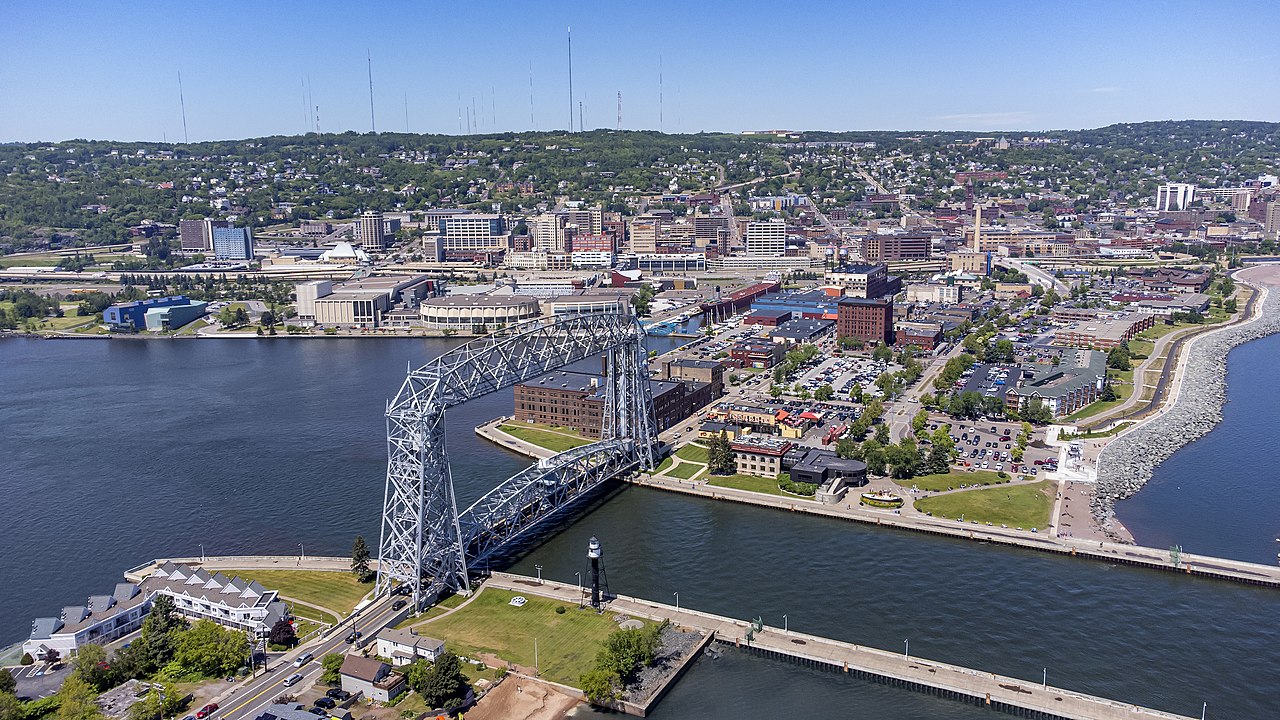
Según la Oficina del Censo de los Estados Unidos, la ciudad tiene un área total de 226,44 km²; 175,58 km² es tierra y 50,87 km² es agua. Es la segunda ciudad más grande de Minnesota por área terrestre, solo superada por Hibbing. De sus 226 km², 176 km², o 77,89%, es tierra y 50 km², o 22,11%, es agua. El canal de Duluth conecta el lago Superior con el puerto de Duluth-Superior y el río Saint Louis. Está atravesado por el puente de elevación aérea, que conecta Canal Park con Minnesota Point (o "Park Point"). Minnesota Point está a unas 11 km largo, y cuando se incluye con Wisconsin Point adyacente, que se extiende 5 km de la ciudad de Superior, Wisconsin, es el bar de boca de bahía de agua dulce más grande del mundo con un total de 16 km.
La topografía de Duluth está dominada por una ladera empinada que asciende desde el lago Superior hasta las elevaciones del interior. A Duluth se le ha llamado "el San Francisco del Medio Oeste", en alusión a la topografía similar del agua a la cima de una colina de San Francisco. Esta similitud fue más evidente antes de la Segunda Guerra Mundial, cuando Duluth tenía una red de tranvías y un ferrocarril inclinado, el 7th Avenue West Incline Railway, que, como los teleféricos de San Francisco, subía una colina empinada. Los dos aeropuertos de Duluth ilustran el cambio de elevación. La estación meteorológica en el aeropuerto Sky Harbor junto al lago en Minnesota Point tiene una elevación de 607 pies (185 m), mientras que el Aeropuerto Internacional de Duluth, en la cima de la colina, tiene 820 pies (249,9 m) más alto a 1427 pies (434,9 m).
Incluso a medida que la ciudad ha crecido, su población ha tendido a abrazar la costa del lago Superior, por lo que Duluth es principalmente una ciudad suroeste-noreste. El considerable desarrollo de la colina le ha dado a Duluth muchas calles empinadas. Algunos vecindarios, como Piedmont Heights y Bayview Heights, están en lo alto de la colina con vistas panorámicas de la ciudad. Skyline Parkway es una carretera escénica que se extiende desde Becks Road sobre el vecindario de Gary-New Duluth cerca del extremo occidental de la ciudad hasta el vecindario de Lester Park en el lado este. Atraviesa casi toda la longitud de Duluth y ofrece vistas del lago Superior, el puente de elevación aérea, el parque Canal y las muchas industrias que habitan el puerto interior más grande.
Economía

Duluth es el principal centro regional de atención médica, educación superior, comercio minorista y servicios comerciales, no solo de su propia área inmediata, sino también de un área más grande que abarca el noreste de Minnesota, el noroeste de Wisconsin y el oeste de la península superior de Míchigan. También es un importante centro de transporte para el transbordo de carbón, taconita, productos agrícolas, acero, piedra caliza y cemento. En los últimos años ha experimentado un fuerte crecimiento en el transbordo de componentes de turbinas eólicas que van y vienen de fabricantes en Europa y Dakota del Norte y de maquinaria industrial de gran tamaño fabricada en todo el mundo y destinada a los proyectos de extracción de petróleo de arenas bituminosas en el norte de Alberta. El Puerto de Duluth maneja un promedio de 35 millones de toneladas cortas de carga y casi 900 visitas de embarcaciones cada año. 90% de los barcos del puerto son "Lakers", barcos que envían mercancías exclusivamente entre los cuatro Grandes Lagos superiores y son demasiado grandes para transitar por el Canal Welland. El 10% son "Salties", barcos que pueden atravesar la vía marítima desde el Océano Atlántico.
Duluth ha atraído a varias nuevas empresas de ingeniería, incluidas TKDA, Barr Engineering, LHB, Enbridge y Lake Superior Consulting, así como nuevas empresas emergentes en varios campos, incluida Loll Designs, una empresa de muebles ecológicos y la microcervecería Bent Paddle. La cadena minorista de ropa femenina Maurices también tiene su sede en Duluth. En 1989, se fundó la marca de ropa de trabajo y accesorios Duluth Trading Company en una barcaza en el distrito marítimo de la ciudad. La empresa trasladó su sede al sur de Wisconsin en 2000.
Duluth es un centro de biología y ciencias acuáticas. La ciudad alberga el Laboratorio de la División de Ecología del Continente Medio de la EPA y la Universidad de Minnesota – Duluth. Estas instituciones han generado muchos negocios de importancia económica y científica que apoyan la economía de Duluth. Una breve lista de estos negocios incluye ERA Laboratories, LimnoLogic, ASci Corporation, Environmental Consulting and Testing y Ecolab.
Arte y cultura

Las atracciones locales incluyen una variedad de artes y literatura. Los museos incluyen el Tweed Museum of Art de la Universidad de Minnesota Duluth y el Karpeles Manuscript Library Museum. El principal centro de arte comunitario es el Duluth Art Institute, con galerías, un estudio de fibra y un cuarto oscuro en el centro de Depot y estudios de cerámica y de usos múltiples en el vecindario de Lincoln Park. Varias galerías de arte locales también se encuentran en el centro y en Canal Park. La Biblioteca Pública de Duluth tiene tres ubicaciones. Duluth también es la sede de una compañía de ballet profesional, el Ballet de Minnesota. Duluth comparte una orquesta sinfónica, la Duluth Superior Symphony Orchestra, con la ciudad de Superior, en Wisconsin. En verano, a menudo se celebran conciertos gratuitos en Chester Park, donde los músicos locales tocan para la multitud. El Bayfront Blues Festival se lleva a cabo a principios de agosto.
Duluth disfruta de varias compañías de teatro locales, como The Duluth Playhouse, uno de los teatros comunitarios operativos más antiguos de los Estados Unidos. Fundadas en 1914, las oficinas principales de Playhouse y dos de sus teatros se encuentran en el histórico Depot Building en Michigan Street. The Playhouse tiene una temporada teatral completa en múltiples escenarios, incluido el Teatro Nor Shor de Duluth a partir de abril de 2018. También cuenta con un reconocido programa educativo.
Desde 2004, Duluth ha celebrado el Orgullo Gay con un desfile el fin de semana del Día del Trabajo. Desde 1998, la ciudad ha celebrado el Festival de Música Homegrown la primera semana de mayo. El festival presenta más de 170 actos musicales locales que se presentan en toda la ciudad. Las rocas de la escuela secundaria Junior Achievement - Battle of the Bands presenta bandas de escuelas intermedias y secundarias desde el centro de Minnesota hasta la frontera entre Canadá y Estados Unidos y el norte de Wisconsin y se lleva a cabo en el DECC a mediados de abril. Duluth también alberga los premios Northeastern Minnesota Book Awards, en honor a los libros sobre la región. Pronto será renovado, el NorShor Theatre será un centro de arte y entretenimiento en el centro de la ciudad que traerá una amplia variedad de artistas locales, regionales y nacionales.
Gobierno y políticas

Duluth está en el 8.º distrito congresional de Minnesota, representado por Pete Stauber del Partido Republicano. Tiene una forma de gobierno de alcalde-consejo. La alcaldesa es Emily Larson, quien asumió el cargo en 2016 como la primera alcaldesa de Duluth. El alcalde con más años de servicio en la historia de Duluth es Samuel F. Snively, quien sirvió de 1921 a 1937. La Administración de la Ciudad hace propuestas de políticas a un Concejo Municipal de nueve miembros. Los cinco distritos representativos de Duluth se dividen en 36 recintos. Cada distrito elige a su propio concejal. También hay cuatro concejales generales, que representan a toda la ciudad. El Ayuntamiento elige un presidente que preside las reuniones.
Duluth es el corazón del séptimo distrito legislativo del estado, representado en el Senado de Minnesota por Jen McEwen y en la Cámara de Representantes de Minnesota por Jennifer Schultz (Distrito 7A) y Liz Olson (Distrito 7B), todas miembros del Partido Demócrata-Agrario-Laborista de Minesota. Este partido ha dominado durante mucho tiempo la política de la ciudad.
Educación

Los colegios y universidades locales incluyen la Universidad de Minnesota Duluth (UMD); el campus de la UMD incluye una escuela de medicina. Los Bulldogs de la UMD ganaron el Campeonato Nacional de Hockey de la División I en 2011, 2018 y 2019. Otras escuelas incluyen The College of St. Scholastica, Lake Superior College y Duluth Business University. La Universidad de Wisconsin-Superior y el Wisconsin Indianhead Technical College se encuentran en las cercanías de la ciudad de Superior.
La mayoría de las escuelas públicas son administradas por las Escuelas Públicas de Duluth. Las escuelas tienen matrícula abierta. ISD 709 (Distrito Escolar Independiente número 709) ahora está llevando a cabo una reconstrucción de todas las escuelas del área bajo un programa llamado "Plan Rojo". Los objetivos del Plan Rojo son la reconstrucción de algunas escuelas antiguas para cumplir con las nuevas pautas educativas y la construcción de cuatro nuevos edificios escolares. Las nuevas escuelas resultarán en la redistribución de distritos de muchos estudiantes. A partir de 2009, el Plan Rojo fue y está siendo impugnado en los tribunales por algunos ciudadanos debido al costo de implementación del plan y debido a la elección del contratista de administración de la construcción.
Varias escuelas autónomas independientes y públicas también sirven a los estudiantes de Duluth. La más grande es Duluth Edison Charter Schools, una escuela pública autónoma que cubre los grados K-8. Marshall School, una escuela preparatoria universitaria privada fundada como Catedral de Duluth en 1904, cubre los grados 4-12. Duluth tiene cuatro escuelas católicas con cobertura hasta el sexto u octavo grado, dos escuelas protestantes, dos escuelas Montessori y otras seis escuelas autónomas y privadas.
Debido a su proximidad a los Grandes Lagos, Duluth es la ubicación del Observatorio de Grandes Lagos. El Observatorio de Grandes Lagos opera el buque de investigación de propiedad universitaria más grande de los Grandes Lagos, el R / V Blue Heron. Construido en 1985 para pescar en los Grandes Bancos, el Blue Heron fue comprado por la Universidad de Minnesota en 1997, navegó desde Portland, Maine, por el St. Lawrence Seaway hasta Duluth, y se convirtió en un buque de investigación limnológica durante el invierno de 1997. –98. El Blue Heron es parte del Sistema de Laboratorio Oceanográfico Nacional de la Universidad, y está disponible para ser fletado por científicos de investigación en cualquiera de los Grandes Lagos.
En la cultura popular
En El gran Gatsby (1925), se dice que el personaje principal fue llevado a Duluth por Dan Cody, el millonario que lo había tomado bajo su protección. Allí, Cody le había comprado al ambicioso joven de 17 años "un abrigo azul, seis pantalones de pato blanco y una gorra de yate".
Minnesota: Land of Plenty (1942) - cortometraje documental de James A. FitzPatrick.
Te gustará mi madre (1972): largometraje filmado en Duluth y sus alrededores, principalmente en Glensheen Historic Estate.
En la serie de televisión Starsky & Hutch (1975-1979), el personaje principal "Hutch" Hutchinson (interpretado por David Soul), es retratado como un nativo de Duluth.
La novela de Gore Vidal Duluth (1983) está ambientada en una versión estilizada de Duluth.
Far North (1988): largometraje filmado en Duluth y sus alrededores.
Iron Will (1994) - Película de Walt Disney Pictures filmada en Duluth en sustitución de Winnipeg de 1917.
La comedia de situación de corta duración The Louie Show (1996) se desarrolló en Duluth. Louie Anderson interpretó al psicoterapeuta Louie Lundgren. La secuencia del título de apertura presentaba edificios del centro de Duluth.
Battleground Minnesota (2005): película documental sobre las elecciones presidenciales de 2004 en Minnesota.
Una serie de novelas de suspenso del autor Brian Freeman (comenzando con Immoral en 2005) con el teniente de policía ficticio Jonathan Stride tiene lugar en Duluth y sus alrededores y presenta ubicaciones reales de la ciudad.
La película estadounidense de comedia deportiva Leatherheads (2008), protagonizada y dirigida por George Clooney, se desarrolló en Duluth pero se filmó en Carolina del Norte y del Sur. La película contó con un equipo de fútbol profesional ficticio, los Duluth Bulldogs.
La primera temporada de la serie de FX TV Fargo (2014) se desarrolla principalmente en Bemidji y Duluth y sus alrededores.
Kaynak: Wikipedia – Duluth (Minnesota) · CC BY-SA 4.0
History
Native history
For both the Ojibwe and the Dakota, interaction with Europeans during the contact period revolved around the fur trade and related activities. In Ojibwe, the area now known as Duluth is called Onigamiinsing or Misaabekong.
According to Ojibwe oral history, Spirit Island, near the Spirit Valley neighborhood, was the "Sixth Stopping Place" where the northern and southern branches of the Ojibwe Nation came together and proceeded to their "Seventh Stopping Place" near the present city of La Pointe, Wisconsin. The "Stopping Places" were places the Native Americans occupied during their westward migration because of their war with the Haudenosaunee and as Europeans overran their territory.
Exploration and fur trade
Several factors brought fur traders to the Great Lakes in the early 17th century. The fashion for beaver hats in Europe generated demand for pelts. The French trade for beavers in the lower St. Lawrence River led to the depletion of the animals in the region by the late 1630s, after which the French searched farther west for new resources and new routes, making alliances with the Native Americans along the way to trap and deliver furs.
Étienne Brûlé is credited with the European discovery of Lake Superior before 1620. Pierre-Esprit Radisson and Médard des Groseilliers explored the Duluth area, Fond du Lac (Bottom of the Lake), in 1654 and again in 1660. The French soon established fur posts near Duluth and in the far north where Grand Portage became a major trading center. The French explorer Daniel Greysolon, Sieur du Lhut, whose name is sometimes anglicized as "DuLuth", explored the St. Louis River in 1679.
After 1792 and the independence of the United States, the North West Company established several posts on Minnesota rivers and lakes, as well as in areas to the west and northwest, for trading with the Ojibwe, the Dakota, and other native tribes. The first post was where Superior, Wisconsin, later developed; known as Fort St. Louis, the post became the headquarters for North West's new Fond du Lac Department. It had stockade walls, two houses of 40 feet (12 m) each, a shed of 60 feet (18 m), a large warehouse, and a canoe yard. Over time, Native American peoples and European Americans settled nearby, and a town gradually developed.
Geography

According to the United States Census Bureau, the city has an area of 80.168 square miles (207.63 km2), of which 71.658 square miles (185.59 km2) is land and 8.510 square miles (22.04 km2) is water. It is Minnesota's second-largest city by land area, surpassed only by Hibbing. Duluth's canal connects Lake Superior to the Duluth–Superior harbor and the Saint Louis River. It is spanned by the Aerial Lift Bridge, which connects Canal Park with Minnesota Point (or "Park Point"). Minnesota Point is about 7 miles (11 km) long and, when included with adjacent Wisconsin Point, which extends 3 miles (4.8 km) from the city of Superior, Wisconsin, is the largest freshwater baymouth bar in the world at a total of 10 miles (16 km).
Duluth's topography is dominated by a steep hillside that climbs from Lake Superior to high inland elevations. Duluth has been called "the San Francisco of the Midwest", alluding to San Francisco's similar water-to-hilltop topography. This similarity was most evident before World War II, when Duluth had a network of streetcars and an inclined railroad, the 7th Avenue West Incline Railway, that, like San Francisco's cable cars, climbed a steep hill. The change in elevation is illustrated by Duluth's two airports. The weather station at the lakeside Sky Harbor Airport on Minnesota Point has an elevation of 607 feet (185 m), while Duluth International Airport, atop the hill, is 820 feet (250 m) higher at 1,427 feet (435 m).
Even as the city has grown, its populace has tended to hug Lake Superior's shoreline, making Duluth a primarily southwest–northeast city. The considerable development on the hill has given Duluth many steep streets. Some neighborhoods, such as Piedmont Heights and Bayview Heights, are atop the hill with scenic views of the city. Skyline Parkway is a scenic roadway that extends from Becks Road above the Gary–New Duluth neighborhood near the western end of the city to the Lester Park neighborhood on the east side. It crosses nearly Duluth's entire length and affords views of Lake Superior, the Aerial Lift Bridge, Canal Park, and the many industries that inhabit the largest inland port.
Demographics
According to the 2023 American Community Survey, there were 38,843 estimated households in Duluth with an average of 2.15 persons per household. The city had a median household income of $61,163. Approximately 17.7% of the city's population lived at or below the poverty line. Duluth had an estimated 68.0% employment rate, with 44.4% of the population holding a bachelor's degree or higher and 95.8% holding a high school diploma.
The ACS 2023 one-year estimate reported that Duluth's residents were 74,622 (85.09%) White, 2,063 (2.35%) African American, 777 (0.89%) Native American, 2,093 (2.39%) Asian, 122 (0.14%) Pacific Islander, 1,355 (1.55%) from some other race, and 6,654 (7.59%) from two or more races. Hispanic or Latino people of any race were 2,424 (2.76%) of the population.
The median age in the city was 37.0 years.
Racial and ethnic composition
Historically, Duluth has been overwhelmingly populated by non-Hispanic whites. Since 1990, it has been home to a small but growing Black, Asian, and Hispanic population.
2020 census
As of the 2020 census, Duluth had a population of 86,697. The median age was 35.7 years. 17.9% of residents were under the age of 18, 5.4% were under 5, and 17.4% were 65 years of age or older. For every 100 females there were 96.7 males, and for every 100 females age 18 and over there were 95.3 males age 18 and over.
96.0% of residents lived in urban areas, while 4.0% lived in rural areas.
There were 37,104 households and 18,700 families in the city, of which 21.7% had children under the age of 18 living in them. Of all households, 35.9% were married-couple households, 23.6% were households with a male householder and no spouse or partner present, and 31.6% were households with a female householder and no spouse or partner present. About 37.5% of all households were made up of individuals and 13.8% had someone living alone who was 65 years of age or older.
Economy
Duluth is the major regional center for health care, higher education, retail, and business services not only of its own immediate area but also of a larger area encompassing northeastern Minnesota, northwestern Wisconsin, and the western Upper Peninsula of Michigan. It is also a major transportation center for the transshipment of coal, taconite, agricultural products, steel, limestone, and cement. In recent years, it has seen strong growth in the transshipment of wind turbine components coming and going from manufacturers in both Europe and North Dakota, as well as of oversized industrial machinery manufactured all around the world and destined for the tar sands oil extraction projects in northern Alberta. The Port of Duluth handles an average of 35 million short tons of cargo and nearly 900 vessel visits each year. 90 percent of the port's vessels are "Lakers", ships that ship goods exclusively among the upper four Great Lakes and are too large to transit the Welland Canal. The rest are "Salties", ships that can traverse the seaway all the way from the Atlantic Ocean.
The Twin Ports has attracted several new engineering firms, including TKDA, Barr Engineering, LHB, Enbridge, and Lake Superior Consulting, as well as new start-ups in various fields including Loll Designs and Epicurean, two sister companies that make eco-friendly furniture and kitchen utensils respectively, and microbrewery Bent Paddle. Women's clothing retail chain Maurices is also headquartered in Duluth, as are luggage manufacturers and suppliers Duluth Pack and Frost River. In 1989, the workwear and accessories brand Duluth Trading Company was founded on a barge in the city's shipping district. The company moved its headquarters to southern Wisconsin in 2000. Supermarket chain Super One Foods is also based in the Twin Ports, with its headquarters in neighboring Hermantown.
Arts and culture
Duluth hosts a variety of museums and cultural institutions. It is the starting point of the North Shore of Lake Superior scenic route that runs from Duluth, at the southwestern end of the lake, to Thunder Bay and Nipigon in the north and Sault Ste. Marie in the east. The route was already a popular tourist destination after 1855, when the Great Lakes lock system first allowed steamboats onto the lake and eastern tourists began to travel onto Lake Superior for recreational purposes. By the mid-1870s, many excursion boats, coastal steamers, and ferries ran along the North Shore, primarily out of Duluth and Thunder Bay. After docking in Duluth, tourists often canoed or were ferried up the North Shore, staying in hunting and fishing camps and later hotels and small cabins.
The Duluth Children's Museum, founded in 1930, is the fifth-oldest of its kind in the U.S. Located in Lincoln Park, it offers interactive exhibits and educational programming, with a collection of over 25,000 artifacts focusing on regional history, including Indigenous and immigrant cultures. Other museums include the Tweed Museum of Art at the University of Minnesota Duluth and the Karpeles Manuscript Library Museum. The Historic Old Central High School, built in 1892 and notable for its 230-foot clock tower modeled after Big Ben, was once home to a local museum. Listed on the National Register of Historic Places, it is an example of Romanesque architecture and was sold to developers in 2022.
The Duluth Art Institute, housed in the Duluth Depot downtown, features galleries, studios, and educational programming. The city is also home to the Minnesota Ballet and Duluth Superior Symphony Orchestra. In the summer, free concerts are held in Chester Park. The Bayfront Blues Festival is held in early August. Several local theater companies operate in Duluth, including the Duluth Playhouse, founded in 1914 and one of the oldest continuously operating community theaters in the U.S. It stages performances across multiple venues, including the restored Nor Shor Theatre, a historic 600-seat movie palace reopened in 2018. The Playhouse also hosts a respected theater education program.
Sports

Duluth has a varied sports history, including hosting two early National Football League teams: the Duluth Kelleys/Eskimos (1923–1925; 1926–1927), the latter inspiring the 2008 film Leatherheads. In baseball, the Duluth–Superior Dukes played at Wade Stadium in the independent Northern League from 1993 to 2002 and won the 1997 championship; an earlier Northern League was also in operation off and on from 1902 to 1971 in the city. Duluth also supports several amateur baseball teams, including the Duluth Xpress, Twin Ports North Stars, and the collegiate summer team Duluth Huskies, who have played at Wade Stadium since 2003. Local high schools also field competitive teams. In boxing, Horton's Gym (later Jungle Boy Boxing Gym) trained notable Minnesota fighters including Zach "Jungle Boy" Walters and Andy Kolle.
Duluth also has a history of hosting arena football teams. The city first had the Duluth-Superior Lumberjacks in the Indoor Football League (1999–2000) and held games at the DECC Arena. The Arena League awarded the city a team, the Duluth Harbor Monsters (2024–2025), as the second of the four original teams over the league's first expansion phase in 2023, also played at the DECC Arena. After coming off their back-to-back Arena League championship seasons, when they also hosted both ArenaMania I and II, that same Harbor Monsters team was rebranded as the Minnesota Monsters as it moved operations from The Arena League to Arena Football One. The Monsters played at AMSOIL Arena in the 2026 season before relocating to the Minneapolis–Saint Paul area.
In hockey, the University of Minnesota Duluth Bulldogs men's and women's teams have earned national acclaim. The men's team, with notable alumni such as Brett Hull and Matt Niskanen, won NCAA national championships in 2011, 2018, and 2019, playing before large crowds at AMSOIL Arena. The women's team has won five NCAA titles (2001–03, 2008, 2010), with memorable wins including a triple-overtime victory in 2010 and a dramatic double-overtime goal in 2003. The city has also hosted multiple Frozen Four tournaments.
Parks and recreation

Duluth has numerous parks, including six parks on Lake Superior: Leif Erikson Park, which includes a lakeside rose garden; Brighton Beach Park; Canal Park on Park Point; the Lakewalk (connecting Canal Park and Leif Erikson Park via the lakeshore); and Lafayette Park on Park Point. The Park Point Recreation Area near the end of Park Point has a community center, numerous pavilions, a swimming beach, sand volleyball court, picnic tables and grills, and a boat launch. Park Point Pine Forest, at the tip of Park Point, is popular for bird-watching in the spring and fall when shorebirds use the area as a resting point during their migration. A shipping schedule of ships entering the harbor is available, as well as five live cams including a cam of the canal, the lift bridge, and the beach.
Other parks include historic Lester Park, one of Duluth's most popular parks. Just upstream from where Amity Creek joins the Lester River, a large, deep pool has formed that attracts cliff diving. Amity Creek is the site of The Seven Bridges Road, a four-mile section of Skyline Parkway where it follows Amity Creek from the top of the bluffs down to Lake Superior. The 400-foot drop has resulted in a long cascade of waterfalls.
Duluth's other parks include Congdon Park, Hartley Park, Chester Park, Bayfront Festival Park, Cascade Park, Enger Park, Lincoln Park, Brewer Park, Fairmount Park, Indian Point Park, Magney–Snively Park, and Fond du Lac Park, as well as some small neighborhood parks and athletic fields. Lester Park, Congdon Park, Hartley Park, and Chester Park have trail systems, and three of these—all but Hartley—also have waterfalls, as does Lincoln Park. Hartley Park also has a nature center. Lester Park and Enger Park have public golf courses. Fairmount Park has the Lake Superior Zoo. Jay Cooke State Park is a Minnesota state park about ten miles (16 km) southwest of Duluth. The park is along the Saint Louis River and is one of Minnesota's 10 most visited state parks.
Government
Duluth is in Minnesota's 8th congressional district, represented by Republican Pete Stauber. It has a mayor–council form of government. The mayor is Roger Reinert, who took office in 2024 after defeating incumbent Emily Larson, the city's first female mayor. The Democratic–Farmer–Labor Party has controlled the mayor's office continuously since 1975. Duluth's longest-serving mayor was Samuel F. Snively, serving from 1921 to 1937. He is remembered for his initiatives creating parks and boulevards, such as the Seven Bridges Road and Skyline Parkway.
Duluth is in Minnesota's 8th Senate District, represented in the Minnesota Senate by Jen McEwen and in the Minnesota House of Representatives by Liish Kozlowski (District 8B) and Peter Johnson (District 8A)—all members of the Democratic–Farmer–Labor Party, which has long dominated the city's (as well as the state's) politics.
Local government
The City Administration makes policy proposals to a nine-member City Council. Duluth's five representational districts are divided into 36 precincts. Each district elects its own councilor. There are also four at-large councilors, representing the entire city. The City Council elects a president who presides over meetings.
The council also oversees the city's financial operations, including the annual budget, and serves as a check against the mayor in a mayor-council government model.
The current president of the council is Lynn Marie Nephew.
Education
Local colleges and universities include the University of Minnesota Duluth (UMD); the UMD campus includes a medical school. The UMD Bulldogs won the Division I National Hockey Championship in 2011, 2018 and 2019. Other schools include The College of St. Scholastica, Lake Superior College, and Duluth Business University. The University of Wisconsin–Superior and Northwood Technical College are in nearby Superior, Wisconsin.
The Duluth Public Schools school district covers the majority of the municipality, and most public schools are administered by Duluth Public Schools. The schools have open enrollment. ISD 709 (Independent School District number 709) is now undertaking a reconstruction of all area schools under a program called the "Red Plan." The Red Plan's goals are the reconstruction of some older schools (to meet new educational guidelines) and the construction of four new school buildings. The new schools will result in the redistricting of many students. As of 2009, the Red Plan was and is being contested in court by some citizens because of the cost of implementing the plan and because of the choice of construction management contractor.
One other school district, the Proctor Public School District, covers a small part of southwest Duluth. Several independent and public charter schools also serve Duluth students. The largest is Duluth Edison Charter Schools, a public charter school covering grades K-8. Marshall School, a private college preparatory school founded as Duluth Cathedral in 1904, covers grades 4–12. Duluth's Catholic school system, Stella Maris Academy, has four campuses providing Catholic education from early childhood to high school. There are also two Protestant schools, two Montessori schools, and six other charter and private schools.
Due to its proximity to the Great Lakes, Duluth is the location for the Large Lakes Observatory. The Large Lakes Observatory operates the largest university-owned research vessel in the Great Lakes, the R/V Blue Heron. Built in 1985 for fishing on the Grand Banks, the Blue Heron was purchased by the University of Minnesota in 1997; sailed from Portland, Maine, up the St. Lawrence Seaway, to Duluth; and converted into a limnological research vessel during the winter of 1997–98. The Blue Heron is part of the University National Oceanographic Laboratory System and is available for charter by research scientists on any of the Great Lakes.
Media
Local newspapers include the monthly BusinessNorth and the twice-weekly Duluth News Tribune. Free newspapers include the Transistor, The Zenith, and The Reader Weekly.
Locally based, nationally distributed magazines include Lake Superior Magazine and New Moon Magazine.
Major television affiliates serving the area include KBJR-TV and KDLH, WDIO-DT, and KQDS-TV.
Most commercial radio stations in the Duluth-Superior market are owned by Midwest Communications or Townsquare Media. Townsquare owns the oldest station in the market, WEBC, which signed on June 1, 1924. Midwest owns KQDS-FM, the market's highest-rated station.
Numerous non-commercial stations can also be heard in the market, including stations affiliated with Wisconsin Public Radio and Minnesota Public Radio.
Infrastructure

Public transportation
The local bus system is run by the Duluth Transit Authority (DTA), which serves Duluth, Hermantown, Proctor, Rice Lake, and Superior, Wisconsin. The DTA runs a system of buses manufactured by Gillig and Proterra, including new hybrids and battery electric busses. Duluth is also served by Skyline Shuttle, with daily service to the Minneapolis-Saint Paul International Airport; Jefferson Lines, with daily service to the Twin Cities; and Indian Trails, with service to Michigan's Upper Peninsula.
Railways
Duluth was connected to Minneapolis by the North Star passenger train from 1978 to 1985. The North Shore Scenic Railroad operated seasonal excursion trains on its line to Two Harbors. The former Duluth, Missabe and Iron Range Railway, now part of the Canadian National Railway, operates taconite-hauling trains in the area. Duluth is also served by the BNSF Railway, the Canadian Pacific Railway, and the Union Pacific Railroad.
A proposal to restore service between the Twin Cities and the Twin Ports via the Northern Lights Express was first made in 2000. Detailed plans and environmental assessments have since been completed, but the project has yet to be fully funded.
Air transport
Duluth International Airport (KDLH) serves the city and surrounding region with daily flights to Minneapolis and Chicago. Nearby municipal airports are Duluth Sky Harbor on Minnesota Point and the Richard I. Bong Airport in Superior. Both the Bong Airport and Bong Bridge are named for famed World War II pilot and highest-scoring American World War II air ace Major Richard Ira "Dick" Bong, a native of nearby Poplar, Wisconsin.
Highways
The Duluth area marks the northern endpoint of Interstate Highway 35, which stretches south to Laredo, Texas. U.S. Highways that serve the area are U.S. Highway 53, which stretches from La Crosse, Wisconsin, to International Falls, and U.S. Highway 2, which stretches from Everett, Washington, to St. Ignace, in the Upper Peninsula of Michigan. The southwestern part of the city has Thompson Hill, where travelers entering Duluth on I-35 can see most of Duluth, including the Aerial Lift Bridge and the waterfront. There are two freeway connections from Duluth to Superior. U.S. 2 provides a connection into Superior via the Richard I. Bong Memorial Bridge; Interstate 535 runs concurrently with U.S. 53 over the John Blatnik Bridge.
Duluth innovations
Notable innovations established in Duluth include:
Duluth pack, patented in 1882, a portage pack used for canoe travel.
Pie à la Mode, invented in 1885, a slice of pie topped with a scoop of ice cream.
Alexander Miles's electric elevator, invented in 1887 as a method of opening and closing elevator doors.
Lark of Duluth, launched as the first airline service in the United States and first heavier-than-air airline in the world, carrying joyriders over the Duluth–Superior harbor from 1913 to 1914.
Lake View Store, the first indoor shopping mall in the United States, opened in Duluth's Morgan Park in 1916.
Pizza rolls, created by Duluth food industry magnate Jeno Paulucci and trademarked in 1967.
Aerostich Roadcrafter suit, the first synthetic textile armored riding suit for motorcyclists, created by Andy Goldfine in 1982.
Cirrus Airframe Parachute System, developed by the Klapmeier brothers and tested by Scott Anderson in 1998 as the first whole-plane parachute recovery system on a line of aircraft.
In popular culture
F. Scott Fitzgerald's The Great Gatsby (1925), a modernist novel set in the Jazz Age, has scenes in Duluth and on the shores of Lake Superior.
You'll Like My Mother (1972) is a horror-thriller film shot in and around Duluth, principally at Glensheen Historic Estate.
Far North (1988) is a comedy-drama film directed by Sam Shepard and starring Jessica Lange shot in and around Duluth.
Iron Will (1994) is a Walt Disney Pictures adventure film with Duluth substituting for 1917 Winnipeg.
The Louie Show (1996), a short-lived CBS television sitcom starring comedian Louie Anderson, is set in Duluth and features downtown Duluth buildings in its opening title sequence.
Leatherheads (2008), a sports comedy film co-starring George Clooney and Renée Zellweger, is set in 1920s Duluth and features a fictitious pro football team partially based on the Duluth Eskimos.
The first season of Fargo (2014), an FX black comedy-crime drama television series inspired by the 1996 film of the same name, is mainly set in and around Duluth and Bemidji.
Girl from the North Country (2017) is a Broadway musical based on the songs of Bob Dylan (who was born in Duluth in 1941) and set in the city during the winter of 1934.
Places of interest
Once a warehouse district, Canal Park has become a hub of restaurants, shops, and recreation. A 2.6-mile (4.2 km) walking path offers views of Lake Superior, Park Point's sand dunes, and the Aerial Lift Bridge, which spans the Duluth Ship Canal. The seven-mile Lakewalk passes landmarks like Leif Erikson Park and the Duluth Rose Garden, ending at Bayfront Festival Park, which hosts concerts and events.
Among Duluth's most visited attractions is the Great Lakes Aquarium, a freshwater-focused facility showcasing ecosystems such as the Amazon River and Great Lakes Basin. Nearby, the Lake Superior Maritime Visitor Center features shipwreck artifacts and interactive exhibits, including a replica ship's pilot house. The wreck of the Thomas Wilson, an early-20th-century whaleback ore boat, lies underwater less than 1 mile (1.6 km) outside the Duluth Ship Canal. The SS William A. Irvin, a retired U.S. Steel flagship, now serves as a floating museum.
The Lake Superior Railroad Museum, in the Duluth Union Depot, houses a collection of locomotives and rolling stock, including the William Crooks and a rare Yellowstone locomotive. From there, the North Shore Scenic Railroad operates heritage excursions to Two Harbors, Minnesota, during the summer and fall. Other notable historic and cultural sites include the Fitger's Brewery Complex, established in the 19th century and now home to shops, restaurants, and a brewery museum; the Glensheen Historic Estate, a 38-room Jacobean mansion on Lake Superior's shore; and the Lake Superior Zoo, which spans 16 acres and features species from around the world.
Duluth's natural attractions are numerous. Enger Tower, atop Enger Hill, provides panoramic views of the region. Hawk Ridge, on Skyline Parkway, is a renowned bird-watching site during the autumn raptor migration. Gichi-Ode' Akiing Park, named for the Ojibwe for "a grand heart place", includes a memorial to Kechewaishke, whose 1849 petition helped preserve Anishinaabe land in the area.
Kaynak: Wikipedia – Duluth, Minnesota · CC BY-SA 4.0