


Düsseldorf
Düsseldorf ist die Landeshauptstadt Nordrhein-Westfalens und der Behördensitz des Regierungsbezirks Düsseldorf.
Government administration · Germany · 0 followers
Overview
Düsseldorf ist die Landeshauptstadt Nordrhein-Westfalens und der Behördensitz des Regierungsbezirks Düsseldorf. Die kreisfreie Großstadt am Rhein ist mit 619.444 Einwohnern am 31. Dezember 2025 die zweitgrößte Stadt des Bundeslandes und die sechstgrößte Stadt in Deutschland.
Interested in working with us in the future?
Follow to see new jobs and posts in your feed.
No news yet.
About

Düsseldorf ist die Landeshauptstadt Nordrhein-Westfalens und der Behördensitz des Regierungsbezirks Düsseldorf. Die kreisfreie Großstadt am Rhein ist mit 619.444 Einwohnern am 31. Dezember 2025 die zweitgrößte Stadt des Bundeslandes und die sechstgrößte Stadt in Deutschland.
Kaynak: Wikipedia · CC BY-SA 4.0
Geographie
Räumliche Lage
Das überwiegend rechtsrheinisch gelegene Düsseldorf befindet sich – mit Ausnahme der Stadtteile Ludenberg, Gerresheim und Hubbelrath – im mittleren Teil des Niederrheinischen Tieflands auf einer von zahlreichen Rheinarmen durchzogenen Niederung. In Nordsüdrichtung durchzieht im Osten als Mittelgebirgsschwelle die Niederterrasse des Rheins das Stadtgebiet, das weitgehend auf dem holozänen Flussbett liegt. Die Stadtteile Oberkassel, Niederkassel, Heerdt und Lörick liegen am linken Rheinufer.
Die Stadt grenzt südwestlich an das Ruhrgebiet. Mit der Stadt Duisburg hat Düsseldorf im Norden eine gemeinsame Grenze. Düsseldorf liegt im Herzen der Metropolregion Rhein-Ruhr sowie im Übergangsbereich zwischen dem Niederrhein und dem Bergischen Land, zu dem die Stadt, historisch betrachtet, gehört.
Der höchstgelegene Punkt im Stadtgebiet, der Sandberg im Stadtteil Hubbelrath, bereits Teil der Mettmanner Lößterrassen und damit des Bergisch-Sauerländischen Unterlandes, misst 165 m ü. NHN, der niedrigste Punkt, die Mündung des Schwarzbachs in den Rhein bei Wittlaer, 28 m ü. NHN.
Klima
Düsseldorf liegt im niederrheinischen Tiefland sowie der Kölner Bucht und gehört zu den wärmsten Gebieten Deutschlands. Die reliefbedingte Öffnung in Richtung Nordsee prägt das Klima ozeanisch; überwiegend westliche Winde tragen atlantische Luftmassen heran und sorgen für milde, schneearme Winter und feuchtwarme Sommer. Im letzten 30-jährigen Klimamittel von 1991 bis 2020 betrug die Jahresmitteltemperatur 11,2 Grad Celsius, der Jahresniederschlag 758 Millimeter und die Zahl der Sonnenstunden 1527. Das jüngere 10-Jahres-Mittel von 2013 bis 2022 weicht davon mit 11,7 Grad Celsius, nur 624 Millimeter, aber zugleich 1670 Sonnenstunden deutlich ab. Im Winter fällt die Temperatur selten unter den Gefrierpunkt, aufkommende Fröste bleiben meist im Bereich knapp unter 0 Grad Celsius. Wegen des milden Klimas werden im Raum Düsseldorf exotische und mediterrane Pflanzen wie Palmen im Freiland kultiviert.
Geschichte

Im Jahr 1288 erhielt der Ort an der Mündung des Flüsschens Düssel in den Rhein das Stadtrecht. Vom Ende des 14. Jahrhunderts bis zum Beginn des 19. Jahrhunderts war die Stadt Regierungssitz von Ländern des Heiligen Römischen Reichs und des Rheinbundes: des Herzogtums Berg, der Herzogtümer Jülich-Berg und Jülich-Kleve-Berg sowie des Großherzogtums Berg, von 1690 bis 1716 auch Residenz des Pfalzgrafen und Kurfürsten Johann Wilhelm von der Pfalz. Durch den Bau einer Kurfürstlichen Gemäldegalerie mit einer international rezipierten Kunstsammlung wurde um 1705 eine bedeutende Kunst- und Ausstellungstradition begründet. Seit 1815 preußisch, wurde die Stadt 1816 Sitz des Regierungsbezirks Düsseldorf. Von 1824 bis 1933 war sie der Parlamentssitz der Rheinprovinz. Im Kaiserreich entwickelte sich Düsseldorf im Zuge der Hochindustrialisierung in Deutschland zum „Schreibtisch des Ruhrgebiets“ und wurde mit dem Überschreiten der Marke von 100.000 Einwohnern im Jahr 1882 zur Großstadt. Bei der Gründung des Landes Nordrhein-Westfalen im Jahr 1946 wurde sie zu dessen Landeshauptstadt bestimmt.
Von den Anfängen bis zur frühneuzeitlichen Stadt
Die mittelalterliche Stadt Düsseldorf wurde im 12./13. Jahrhundert zwar in der Nähe von frühmittelalterlichen Altsiedlungen gegründet, ging anscheinend aber – ähnlich wie beispielsweise auch in Alpen oder Kalkar – nicht unmittelbar aus einer dieser Altsiedlungen hervor. Die Siedlung trug ihren Namen nach dem kleinen Fluss Düssel, der südlich der Straße Altestadt in den Rhein mündet. Der Name „Düssel“ entstand wahrscheinlich aus dem germanischen Begriff thusila und bedeutet „die Rauschende“. Die Landschaft, in der Düsseldorf gegründet wurde, war vor der Entstehung der Grafschaft Berg eine ursprünglich fränkische, zu Ripuarien gehörende Grafschaft, in der neueren Forschung Duisburg-Kaiserswerther Grafschaft genannt, ein Herrschaftsgebiet der Ezzonen, denen als Pfalzgrafen eine hohe Stellung im Herzogtum Lothringen (Niederlothringen) zukam.
Bevölkerung

Demografie
Am 31. Dezember 2022 betrug die „amtliche Einwohnerzahl“ für Düsseldorf basierend auf dem Statistikabzug des Einwohnermelderegisters 653.253 Einwohner. Davon waren 335.490 Frauen (51,4 Prozent) und 317.763 Männer (48,6 Prozent). Der Anteil der deutschen Bevölkerung betrug 489.366 Einwohner d. h. 74,9 Prozent, der Ausländeranteil (Einwohner ohne deutsche Staatsangehörigkeit) betrug demnach 25,1 Prozent, d. h. 163.887 Einwohner. Nach Zählung der Stadt stellten 2006 die Türken mit 15.191 Personen die größte Gruppe der Ausländer, gefolgt von den Griechen mit 10.591 und den Italienern mit 6.890 Personen. Von den außereuropäischen Herkunftsländern stellen die Asiaten (ohne Türken) mit 14.639 die größte Gruppe, darunter Japaner mit 4951, Iraner mit 1419, Chinesen mit 1375 und Koreaner mit 1003 Personen. Stark ansteigend ist die Zahl chinesischer Einwohner der Landeshauptstadt infolge der Ansiedlung von etwa 300 chinesischen Unternehmen (Stand 2011). Zum Stichtag 31. Dezember 2010 hatte Düsseldorf im Vergleich zu den anderen Städten und Gemeinden in Nordrhein-Westfalen den größten Ausländeranteil. Nach Angaben des Statistischen Landesamts hatten 19,3 Prozent der Einwohner Düsseldorfs eine ausländische Staatsbürgerschaft. In Düsseldorf lebten die meisten Japaner (nämlich 59 Prozent aller Japaner in Nordrhein-Westfalen), die meisten Schweden, Ghanaer, Südkoreaner, Iren, Franzosen und Marokkaner des Landes.
Mit Beginn der Industrialisierung im 19. Jahrhundert setzte in Düsseldorf ein starkes Bevölkerungswachstum ein. Lag die Einwohnerzahl der Stadt 1834 bei rund 20.000, so überschritt sie schon 1882 die Grenze von 100.000, wodurch Düsseldorf zur Großstadt wurde. 1905 hatte die Stadt 250.000 Einwohner, bis 1933 verdoppelte sich diese Zahl auf 500.000. Im Jahre 1962 erreichte die Bevölkerungszahl mit 705.391 ihren historischen Höchststand. In den folgenden Jahren sank die Zahl jedoch wieder stark. Dieser Trend konnte auch durch die kommunale Neugliederung in den 1970er Jahren, in deren Folge einige umliegende Gemeinden nach Düsseldorf eingegliedert wurden, nicht gedreht werden. Der Wegzug in die Umlandgemeinden führte dazu, dass sich die Einwohnerzahlen in den 1980er und auch 1990er Jahren bei 570.000 Einwohnern einpendelten. Erst zur Jahrtausendwende kehrte sich der Trend um. So betrug am 30. Juni 2005 die „amtliche Einwohnerzahl“ für Düsseldorf nach Fortschreibung des Landesbetriebs Information und Technik Nordrhein-Westfalen 573.449 (nur Hauptwohnsitze und nach Abgleich mit den anderen Landesämtern).
Politik

An der Spitze der Stadt Düsseldorf standen im 13. Jahrhundert die Schöffen, die bis 1806 die oberste und mächtigste Klasse in der Stadtverwaltung darstellten. Seit 1303 ist ein Bürgermeister genannt, der anfangs ebenso ein Schöffe war. Daneben gab es ab 1358 auch einen Rat, der sich teilweise in einen Alten und einen Jungen Rat aufteilte. Die Mitglieder wurden entweder auf Lebenszeit gewählt (Alter Rat), oder aber auch jährlich bestimmt (Junger Rat). Als herzoglicher Vertreter war ferner ein Schultheiß an der Verwaltung der Stadt beteiligt, der den Titel „Amtmann“ führte. Etwa seit dem 15. Jahrhundert gab es neben den genannten Gremien auch einen Gemeindeausschuss von 12 Personen („Zwölfer“), der an der Wahl des Bürgermeisters teilnahm und zu wichtigen Beschlussfassungen herangezogen wurde, eigentlich aber keine wirkliche Bürgerbeteiligung darstellte. Erst in französischer Zeit gab es einen Munizipalrat, ab 1815 einen Gemeinderat mit 30 Mitgliedern. Seit 1856 waren es die „Stadtverordneten“, später Ratsherren, deren Gesamtzahl sich mehrmals veränderte. Die Leitung der Stadt übernahm in französischer Zeit Maximilian August von Scharfenstein genannt von Pfeil als Maire, der von drei Beigeordneten unterstützt wurde. Seit preußischer Zeit trug das Stadtoberhaupt den Titel Oberbürgermeister. 1856 wurde die Rheinische Städteordnung eingeführt. Während der Zeit der Nationalsozialisten wurde der Oberbürgermeister von der NSDAP eingesetzt.
Nach dem Zweiten Weltkrieg setzte die Militärregierung der Britischen Besatzungszone einen neuen Oberbürgermeister ein und führte 1946 eine Ratsverfassung ein. Demnach gab es einen von den Bürgern gewählten „Rat der Stadt“, dessen Mitglieder man als „Stadtverordnete“ bezeichnete. Der Rat wählte anfangs aus seiner Mitte den Oberbürgermeister als Vorsitzenden und Repräsentanten der Stadt, der sein Amt ehrenamtlich ausübte. Des Weiteren wählte der Rat einen hauptamtlichen Oberstadtdirektor, der die Stadtverwaltung leitet.
Kultur und Sehenswürdigkeiten

Ansehen genießt Düsseldorf zudem hinsichtlich Kultur, Kunst und moderner Architektur. So gibt es neben der großen Kunstsammlung Nordrhein-Westfalen und einer Menge weiterer Museen und Galerien auch die international renommierte Kunstakademie Düsseldorf, die im 19. Jahrhundert die Düsseldorfer Malerschule und im 20. Jahrhundert die Düsseldorfer Photoschule hervorgebracht hat. Bekannte Bühnen sind mit dem Schauspielhaus und dem Kom(m)ödchen in der Stadt vertreten. Zudem sind einige der populären Musiker und Dichter Deutschlands in der Stadt geboren oder waren dort beheimatet. Bedeutende Architekten haben nicht nur im Medienhafen ihre Projekte verwirklicht.
Klassisches und modernes Sprechtheater
Düsseldorf hat eine Theatertradition, die sich bis in das 16. Jahrhundert zurückverfolgen lässt. Die ersten theatralischen Veranstaltungen werden auf das Jahr 1585 datiert. Das heutige Düsseldorfer Schauspielhaus mit seiner modernen geschwungenen Architektur wurde 1970 fertiggestellt. Es ist am Gustaf-Gründgens-Platz, der nach dem ehemaligen Intendanten benannt ist, gelegen. Die größte Düsseldorfer Bühne hat eine große Bekanntheit im deutschsprachigen Raum.
Weitere größere Theater in der nordrhein-westfälischen Metropole sind das Forum Freies Theater, das Bühnenkunst bietet, die Komödie Düsseldorf, ein klassisches Boulevardtheater, das Theater an der Kö, das vor allem Komödien und moderne Theaterstücke zu bieten hat und von der bekannten Theaterfamilie Heinersdorff geführt wird, das Theater an der Luegallee in Oberkassel, das KaBARett FLiN in Grafenberg sowie das Savoy-Theater. Im Juta gastiert häufig das Theater der Klänge. Es ist ein seit 1987 bestehendes Tourneetheater, das unter der Leitung von Jörg Udo Lensing jährlich mit einer Neuproduktion auf zumeist kurze Tourneen geht.
Für Kinder ist das Theateratelier Takelgarn mit Comedy, Kabarett, Figuren- und Kindertheater besonders interessant.
Wirtschaft und Infrastruktur

Die Rheinmetropole gehört zu den fünf wichtigsten, international stark verflochtenen Wirtschaftszentren Deutschlands. Düsseldorf ist eine Messestadt und Sitz vieler börsennotierter Unternehmen, darunter die im DAX notierten Konzerne Henkel, Rheinmetall und die GEA Group. Zudem ist sie der umsatzstärkste deutsche Standort für Wirtschaftsprüfung, Unternehmensberatung und Kleidermode sowie ein wichtiger Finanz- und Börsenplatz. Auch ist sie ein führender Standort des Kunsthandels in Deutschland.
Düsseldorf besitzt mehrere Rheinhäfen. Sein Flughafen ist das interkontinentale Drehkreuz Nordrhein-Westfalens. Die Stadt ist des Weiteren Sitz von 22 Hochschulen, darunter die Heinrich-Heine-Universität und die Kunstakademie Düsseldorf. Überregionale Bekanntheit genießt Düsseldorf außerdem durch seine Altstadt („längste Theke der Welt“), seinen Einkaufsboulevard Königsallee („Kö“), den Düsseldorfer Karneval, den Fußballverein Fortuna Düsseldorf und den Eishockeyverein Düsseldorfer EG. Weitere Anziehungspunkte sind zahlreiche Museen und Galerien sowie die Rheinuferpromenade und der moderne Medienhafen. Das Stadtbild wird auch durch zahlreiche Hochhäuser und Kirchtürme, den 240 Meter hohen Rheinturm, viele Baudenkmäler und sieben Rheinbrücken geprägt. Düsseldorf hat eine große Anzahl ostasiatischer Einwohner, darunter die japanische Gemeinde mit über 8400 Einwohnern, welche die größte japanische Gemeinde Deutschlands und die drittgrößte in Europa nach London und Paris ist. In Düsseldorf befindet sich zudem die einzige Japantown in Deutschland. In nationalen und internationalen Städtevergleichen gilt die Lebensqualität in Düsseldorf als hoch.
Im sogenannten „Zukunftsatlas“ aus dem Jahr 2016 belegte die kreisfreie Stadt Düsseldorf Platz 21 von 402 Landkreisen und kreisfreien Städten in Deutschland und zählt damit zu den Orten mit „sehr hohen Zukunftschancen“. In der Rangliste von 2019 verbesserte sie sich auf Platz 12 von 401.
Kaynak: Wikipedia – Düsseldorf · CC BY-SA 4.0
Tarihçe
1288 yılında, Düssel çayının Ren Nehri'ne döküldüğü yerde bulunan kasaba şehir hakkı aldı ve 14. yüzyıldan 19. yüzyıla kadar Berg Dükalığı'nın yönetim merkezi oldu.
Konum
Ağırlıklı olarak Ren Nehri'nin sağ tarafında bulunan şehir Ludenberg,Gerresheim ve Hubelrath istisna olmak üzere Aşağı Ren Ovası'nın orta kısmında bulunur.
Şehrin en yüksek noktası, Hubbelrath bölgesindeki Sandberg, deniz seviyesinden 165 metre yükseklikte, en alçak nokta ise, Wittlaer yakınlarında Schwarzbach'ın Ren Nehri'ne döküldüğü yer olan yerdir ve deniz seviyesinden 28 metre yüksekliktedir.
Spor
Şehrin en önemli kulüpleri, futbol dalında Fortuna Düsseldorf, buz hokeyi dalında DEG, Amerikan futbolu dalında Düsseldorf Rhein Fire'dır. Yıllarca futbol dalında Bundesliga'da yer alan Fortuna Düsseldorf, 1997-1998 futbol sezonunda küme düştü ve tekrar 2012-2013 futbol sezonunda Bundesliga'ya çıktı.
Buz hokeyi dalında mücadele eden DEG, Metro adlı şirketin sponsor olmasıyla ismini DEG Metrostars olarak değiştirdi. Alman 1. Ligi DEL'de 8 şampiyonluğu bulunan takım, 1992 senesinde Avrupa ikincisi olmuştur.
Rhein Fire, Avrupalı kulüplerin kendi aralarında NFL ortaklığıyla düzenledikleri Amerikan Futbol Ligi-Avrupa (NFL-Europe)'da 1998'de turnuvayı şampiyon olarak tamamladılar. Kulüp şu anda NFL'den kaynaklanan bazı sebeplerden dolayı faal değil.
Eğitim
Heinrich Heine Üniversitesi Düsseldorf, şehrin güney kesimindedir. Yaklaşık 30,000 öğrencisi ve doğa bilimleri, matematik, bilgisayar bilimleri, felsefe, sosyal bilimler, sanat, diller, tıp, eczacılık, ekonomi, hukuk ve diğer alanlarda geniş bir konu yelpazesi vardır.
Clara Schumann Musikschule (müzik okulu)
Joseph Beuys, Paul Klee, Nam June Paik, Gerhard Richter, the Bechers ve Andreas Gursky gibi yüksek profilli sanatçılarla ünlü Kunstakademie Düsseldorf (Güzel Sanatlar Akademisi)
Hochschule Düsseldorf (Uygulamalı Bilimler) üniversitesi)
Max Planck Demir Araştırmaları Enstitüsü GmbH
WHU – Otto Beisheim Yönetim Okulu (Düsseldorf Kampüsü)
Uluslararası ilk ve orta dereceli okullar:
Düsseldorf'taki Uluslararası Japon Okulu
Kaynak: Wikipedia – Düsseldorf · CC BY-SA 4.0
Etymology
The name Düsseldorf is derived from the small river Düssel, which joins the Rhine at the city's location. The suffix -dorf (German for "village") reflects the original character of the settlement as a fishing and farming community on the riverbanks. Thus, the literal meaning of Düsseldorf is "village on the Düssel."
As the settlement expanded and developed into a regional and later international centre, the name remained unchanged. Düsseldorf is unusual among Germany's major cities in having retained the -dorf suffix, which is otherwise mostly associated with small villages.
In the Limburgish language, called Düsseldorfer Platt, the city is called Düsseldörp.
History

Early development
When the Roman Empire was strengthening its position throughout Europe, a few Germanic tribes clung on in marshy territory off the eastern banks of the Rhine. In the 7th and 8th centuries, the odd farming or fishing settlement could be found at the point where the small river Düssel flows into the Rhine. It was from such settlements that the city of Düsseldorf grew.
The first mention of Düsseldorf dates from 1135 to 1159; in 1162 it was referred to as Thusseldorp. Under Emperor Friedrich Barbarossa the small town of Kaiserswerth to the north of Düsseldorf became a well-fortified outpost, where soldiers kept a watchful eye on every movement on the Rhine. Kaiserswerth eventually became a suburb of Düsseldorf in 1929.
Duchy of Berg
In 1186, Düsseldorf came under the rule of the County of Berg, a state of the Holy Roman Empire. Around 1206, the settlement was likely separated from the parish of Bilk and became an independent parish. In 1263, the Count of Berg granted ferry rights to the inhabitants.
14 August 1288 is one of the most important dates in the history of Düsseldorf, the day the sovereign Count Adolf VIII of Berg granted town privileges to the village on the banks of the Düssel. Before this, a bloody struggle for power had taken place between the Archbishop of Cologne and his allies arrayed against the count of Berg and other local powers, culminating in the Battle of Worringen. The Archbishop of Cologne's forces were wiped out by the forces of the count of Berg, who were supported by citizens and farmers of Cologne and Düsseldorf, paving the way for Düsseldorf's elevation to city status, which is commemorated today by a monument on the Burgplatz.
After this battle the relationship between Cologne and Düsseldorf deteriorated, because they were commercial rivals; it is often said that there is a kind of hostility between the citizens of Cologne and Düsseldorf. Today, it finds its expression mainly in a humorous form (especially during the Rhineland Karneval) and in sports.
Geography

Physical geography
Düsseldorf lies at the centre of the Lower Rhine basin, where the delta of the Düssel flows into the Rhine. The city lies on the east side of the Rhine, except District 4 (Oberkassel, Niederkassel, Heerdt and Lörick). Across the Rhine, the city of Neuss stands on the delta of the Erft. Düsseldorf lies southwest of the Ruhr urban area, and in the middle of the Rhine-Ruhr metropolitan region.
Düsseldorf is built entirely on alluvium, mud, sand, clay and occasionally gravel. The highest point in Düsseldorf is the top of Sandberg in the far eastern part of the city (Hubbelrath borough) at 165 metres (541 ft). The lowest point is at the far northern end in Wittlaer borough where the Schwarzbach enters the Rhine, with an average elevation of 28 metres (92 ft).
Adjacent cities and districts
The following districts and cities border Düsseldorf (clockwise starting from the north): the City of Duisburg, the District of Mettmann (Ratingen, Mettmann, Erkrath, Hilden, Langenfeld, and Monheim), and the District of Neuss (Dormagen, Neuss, and Meerbusch).
Climate
The city has an oceanic climate (Köppen: Cfb, mild in relation to East Germany). Like the rest of the lower Rhineland, Düsseldorf experiences moderate winters with little snowfall and mild to warm summers. The average annual temperature is 11.0 °C (52 °F) with an average yearly precipitation of 751 mm (30 in). The dominant wind direction is from the west with velocities in the range of 3–4 m/s (7–9 mph), with gusts of 3.5–4.8 m/s (7.8–10.7 mph). The wind is calm (defined as being under 2 m/s or 4.5 mph) about 35% of the time, more frequently at night and in the winter.
Demographics
With a 2025 population of 619,444 within the city boundaries, Düsseldorf is Germany's seventh largest city. Its population surpassed the threshold of 100,000 inhabitants during the height of industrialisation in 1882, and peaked at just over 705,000 in 1962. The city then began to lose residents, with many moving into neighbouring municipalities. However, since the late 1990s, the city's population has been slowly rising again.
Nationality
According to municipal data, as of 2019, 272,982 people, or 42.6% of Düsseldorf's residents had a migration background. Around 25.5% of the population held foreign citizenship in 2024. At the end of 2023, the largest groups of foreign citizens were Turkish, Ukrainian, Greek, Polish, and Italian nationals. Among these, Turkish citizens formed the largest single group, numbering approximately 12,800 persons. Düsseldorf and its surroundings have the third-largest Japanese community in Europe and the largest in Germany (about 11,000 people). As of 2023, 6,265 Japanese nationals lived in the city proper.
Religion
As early as 2006, 35.5% of Düsseldorf’s population did not belong to any organised religious community. At that time, the non-religious population already formed the largest group in the city, ahead of the Catholic and Protestant churches. At the end of February 2025, the Evangelical Church had 85,269 members, and at the end of 2024 the Roman Catholic Church had 147,648 members, together representing just over one-third of the city’s 658,245 inhabitants. In addition to the major Christian denominations, Düsseldorf is also home to numerous Eastern Orthodox communities and free churches.
Düsseldorf has the third-largest Jewish community in Germany—after Berlin and Munich—with around 7,000 members. The New Synagogue, located on Zietenstraße in Golzheim, was inaugurated in 1958.
Government
Boroughs
Since 1975, Düsseldorf is divided into ten administrative boroughs. Each borough (Stadtbezirk) has its own elected borough council (Bezirksvertretung) and its own borough mayor (Bezirksvorsteher). The borough councils are advisory only. Each borough is further subdivided into quarters (Stadtteile). There are 50 quarters in Düsseldorf.
Mayor
The current mayor of Düsseldorf is Stephan Keller of the Christian Democratic Union (CDU), who was elected in 2020 and reelected in 2025.
The most recent mayoral election was held on 14 September 2025, with a runoff held on 28 September, and the results were as follows:
City council
The Düsseldorf city council (Düsseldorfer Stadtrat) governs the city alongside the mayor. The most recent city council election was held on 14 September 2025, and the results were as follows:
Economy

Düsseldorf is among the leading economic centres of Germany. The city combines a strong service economy with diversified industrial activity. As of 2023, Düsseldorf’s GDP was approximately €62.7 billion, making it the 8th highest among German cities in terms of economic output. In 2024, the city’s unemployment rate averaged 7.7%.
Düsseldorf forms a joint economic region with the neighbouring district of Mettmann. It is the wealthiest economic region in North Rhine-Westphalia. As of 2023, the region had a GDP per capita of around €72,900, with the city of Düsseldorf itself reaching €93,600 per capita, while the district of Mettmann was closer to the state average at €46,300. Productivity, measured as GDP per working hour, was also significantly higher than the state average: employees in the Düsseldorf region generated about €71.3 per hour, compared with €61.2 per hour in North Rhine-Westphalia. The region’s purchasing power is the highest in North Rhine-Westphalia, both per capita and per household.
Düsseldorf has become one of the top telecommunications centres in Germany. With two of the four big German providers of mobile frequencies, D2 Vodafone and E-Plus, Düsseldorf leads the German mobile phone market. There are many foreign information and communication technology companies in Düsseldorf such as
Mitsubishi, Huawei, NTT, Ericsson, Oppo, Epson, Vivo and Xiaomi. There are 18 internet service providers located in the capital of North Rhine-Westphalia. Eurowings, a low-cost carrier wholly owned by the Lufthansa Group, is headquartered in the city.
Many of the internet companies in Düsseldorf have their roots in the world of advertising: there are 400 advertising agencies in Düsseldorf, among them four of the largest in Germany: BBDO Worldwide, Havas Worldwide, Grey Global Group and Publicis. A number of affiliates of foreign agencies deserve mention as well, such as Ogilvy & Mather, Dentsu, Hakuhodo, TBWA, and DDB. There are also about 200 publishing houses in Düsseldorf.
Transport

Air
Düsseldorf Airport, also referred to as Rhein-Ruhr Airport, is located eight kilometres (5 miles) north of the city centre in the district of Lohausen and can easily be reached by train or the S-Bahn urban railway. There is a long-distance train station served by regional and national services, which is linked to the airport by the SkyTrain, an automatic people mover. Another station situated under the terminal building carries the S-Bahn line (S11) to Düsseldorf Central Station, and to Cologne as well as a few selected night services. In September 2026, the U80 and U81 metro lines began service between the city and the airport. The U80 runs from the central station in Düsseldorf, while the U81 runs from Arena Messe Nord.
After those of Frankfurt, Munich and Berlin, Düsseldorf Airport is Germany's fourth largest commercial airport, with 19 million passengers annually (2023).
The airport buildings were partly destroyed by a devastating fire caused by welding works in 1996, killing 17 people. Following this event, it was completely rebuilt and the Skytrain was installed.
Rail
The city is a major hub in the Deutsche Bahn (DB) railway network. More than 1,000 trains stop in Düsseldorf daily. Düsseldorf Central Station at Konrad-Adenauer-Platz is located in Düsseldorf-Stadtmitte. Several Rhein-Ruhr S-Bahn lines connect Düsseldorf to other cities of Rhine-Ruhr.
The following railway lines run through the city:
Cologne–Duisburg (with ICE and EC/IC services)
Troisdorf–Mülheim-Speldorf (freight traffic only)
At Düsseldorf Central Station—the main long-distance station, located at its current site since 1891—these railway lines (except the freight line) are connected with each other, with the city’s light rail system, and with the rest of the public transport network.
On the Cologne–Duisburg line near the airport lies Düsseldorf Airport Station, where, in addition to trains on one S-Bahn line and all seven Regional-Express lines, some of the ICE and EC/IC trains stopping here also call. Passengers and visitors can reach the airport terminals, located about 2.5 kilometers away, via the SkyTrain. There is also a second rail connection to the airport through the underground terminus station Düsseldorf Airport Terminal, served by another S-Bahn line during the day and by extended nighttime services of several Regional-Express and additional S-Bahn lines.
Culture

Düsseldorf is one of Germany’s arts and culture hubs. Elector Jan Wellem and his wife Anna Maria Luisa de' Medici of Tuscany, were patrons of Düsseldorf's first significant cultural activities in the 17th and 18th centuries. In addition to the large North Rhine-Westphalia Art Collection and other museums and galleries, the city is home to the renowned Düsseldorf Art Academy, which produced the Düsseldorf School of Painting in the 19th century and the Düsseldorf School of Photography in the 20th century. Well-known stages such as the Schauspielhaus and the Kom(m)ödchen are represented in the city. Moreover, several of Germany’s popular musicians and poets were born in Düsseldorf or made the city their home. Heinrich Heine; Clara and Robert Schumann; Felix Mendelssohn, and Joseph Beuys are among the most prominent artists related to the city.
Museums and galleries
Düsseldorf is a centre for visual arts, with a long tradition rooted in the Kunstakademie Düsseldorf (Düsseldorf Art Academy), an institution that has shaped several major European art movements, such as the Düsseldorf School of Painting in the 19th century. During the post-war period the academy became internationally influential through the Düsseldorf School of Photography, associated with figures such as Bernd and Hilla Becher, Andreas Gursky, Thomas Struth, and Candida Höfer.
The city hosts numerous museums and galleries covering a broad range of artistic disciplines. The Kunstsammlung Nordrhein-Westfalen (K20 and K21) displays an extensive collection of modern and contemporary art, including works by Pablo Picasso, Paul Klee, Gerhard Richter, and Joseph Beuys. The Museum Kunstpalast, located near the Rhine, houses artworks from the medieval period to the present day and is known for its collection of Baroque painting and glass art. Several smaller institutions contribute to Düsseldorf’s cultural landscape, including the NRW Forum, which focuses on photography, design, and digital culture, and the Kunst im Tunnel (KIT), which exhibits contemporary art in a tunnel space beneath the Rhine promenade. The Hetjens-Museum, dedicated to ceramics, and the Goethe-Museum, located in Schloss Jägerhof, further reflect the city’s diverse museum scene.
Cityscape
Notable buildings
Rheinturm (TV tower), the city's main landmark (1982: 234 m [ 768 ft ], since 2004: 240.50 m [ 789.0 ft ]), the lights of which comprise the world's largest digital clock
Neuer Zollhof in Düsseldorf-Hafen, designed by Frank Gehry
The Colorium, an 18-storey tower designed by Alsop and Partners, also in Düsseldorf-Hafen
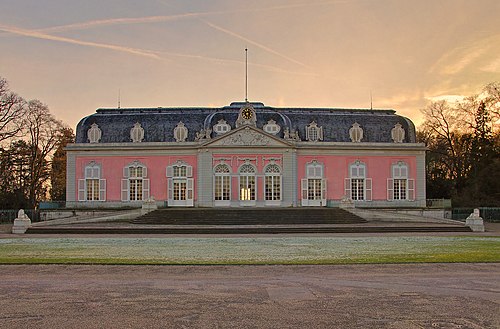
Schloss Benrath (Benrath palace), rococo castle
The Grupello-Haus, probably designed by the Italian architect Matteo Alberti (architect) in 1706 for Duke Johann Wilhelm
Johanneskirche, largest Protestant church in Düsseldorf
Schloss Heltorf, the biggest palace in Düsseldorf, since 1662 homestead of the noble family Grafen von Spee
Schloss Jägerhof, an old hunting lodge at the Hofgarten, today a Goethe Museum
The Wilhelm Marx House of 1922/24: at twelve storeys high, it was Germany's first high-rise building.
The Stahlhof of 1906, the administrative centre of Germany's steel economy until 1945
The Stummhaus of 1925, another early German high-rise building
St. Suitbertus (Düsseldorf-Kaiserswerth)
Hotel Römischer Kaiser, built in 1903–04
Kalkum Castle, a water castle in the district of the same name
DRV Tower, 120-metre-high (394 ft) tower constructed in 1978
GAP 15, an 85-metre-high (279 ft) building constructed in 2005 near Königsallee
ARAG-Tower; at 131 m (430 ft) in height, it is Düsseldorf's highest office building; designed by Sir Norman Foster.
Eight bridges span the Rhine at Düsseldorf; they, too, are city landmarks.
Eastern pylon of Reisholz Rhine Powerline Crossing, an electricity pylon under whose legs runs a rail
Parks and gardens
Botanischer Garten Düsseldorf, a modern botanical garden
Sports

Düsseldorf's main football team Fortuna Düsseldorf won the 1933 German championship, the DFB-Pokal in 1979 and 1980, and were finalists in the European Cup Winners Cup in 1979. They currently play in the 3. Liga after being relegated from the 2. Bundesliga in 2026. They play their matches in the Merkur Spiel-Arena (formerly known as the "ESPRIT Arena" from 2009 to 2018 and as the "LTU Arena" before 2009), a multi-functional stadium with a capacity of 54,500 people. Düsseldorf was one of nine host cities for the 1974 FIFA World Cup, and is one of ten venues that staged the 2024 UEFA European Championship.
Other sports in Düsseldorf are ice hockey (the Düsseldorfer EG which play in the PSD Bank Dome) and American football. The Düsseldorf Panther are one of the most successful teams in Germany with six German Bowl titles and the Eurobowl victory in 1995. In addition the Junior Team are the most successful youth department in Germany with fifteen Junior Bowl victories. Rhine Fire were an established team of the NFL Europe and won the World Bowl two times in 1998 and 2000. The team was revived in 3023, winning the European League of Football in 2023 and 2024.
Borussia Düsseldorf is the most successful table tennis team in Germany with Timo Boll). Other professional clubs are handball (HSG Düsseldorf and Bergischer HC), basketball (Düsseldorf Giants), baseball (Düsseldorf Senators) and dancing (Rot-Weiß Düsseldorf). Düsseldorf also has a cricket team, the Düsseldorf Blackcaps, who play in the regional NRW league.
The Düsseldorf Dragons rugby union team played in the 2. Bundesliga, the second tier of German rugby as of 2017/18.
The Rochusclub has hosted several international tennis tournaments, including the Düsseldorf Grand Prix from 1905 to 1977, the World Team Cup from 1978 until 2012, the ATP Düsseldorf Open in 2013 and 2014, and the WTA Düsseldorf Open from 1969 to 1975.
Education

Heinrich Heine University Düsseldorf is located in the southern part of the city. It has about 30,000 students and a wide range of subjects in natural sciences, mathematics, computer sciences, philosophy, social sciences, arts, languages, medicine, pharmacy, economy and the law. The institution was founded in 1907 as an academy for practical medicine and was elevated to university status in 1965. It has its current name since 1988.
the Clara Schumann Musikschule (music school)
the Kunstakademie Düsseldorf (Academy of Fine Arts) which is famous for high-profile artists like Joseph Beuys, Paul Klee, Nam June Paik, Gerhard Richter, the Bechers, and Andreas Gursky
the Hochschule Düsseldorf (University of Applied Sciences)
the Max Planck Institute for Iron Research
Verwaltungs- und Wirtschafts-Akademie Düsseldorf
WHU – Otto Beisheim School of Management (Düsseldorf Campus)
International primary and secondary schools:
Lycée français international Simone Veil
Japanische Internationale Schule in Düsseldorf
Kaynak: Wikipedia – Düsseldorf · CC BY-SA 4.0