
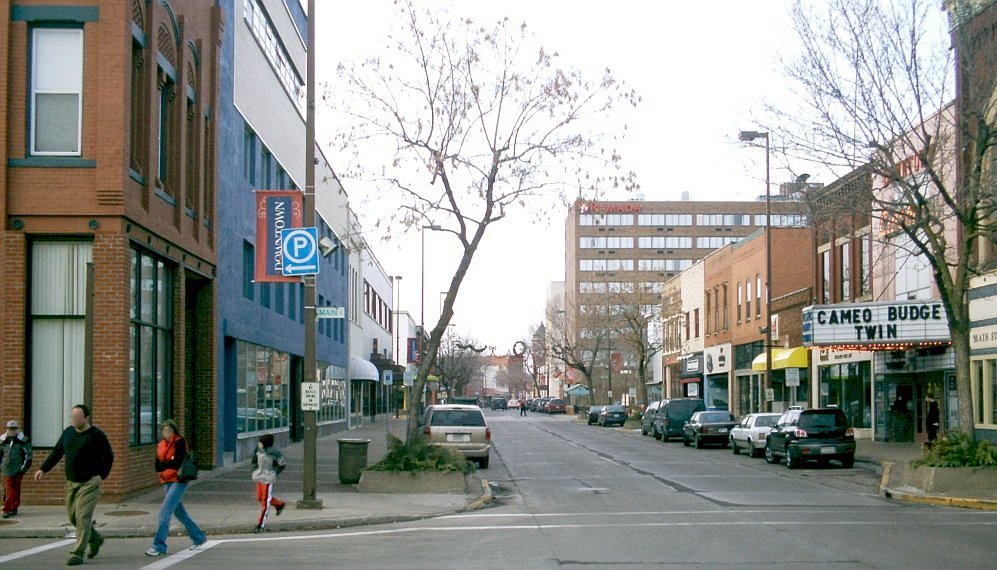

Eau Claire
Eau Claire es una ciudad ubicada en el condado de Eau Claire en la parte oeste-central en el estado estadounidense de Wisconsin.
Government administration · United States · 0 followers
Overview
Eau Claire es una ciudad ubicada en el condado de Eau Claire en la parte oeste-central en el estado estadounidense de Wisconsin. En el Censo de 2010 tenía una población de 65.883 habitantes y una densidad poblacional de 744,94 personas por km². Es la sede de condado de Condado de Eau Claire, aunque una pequeña parte de la ciudad se encuentra en el vecino condado de Chippewa. Eau Claire es la ciudad principal del área metropolitana de Eau Claire.
Interested in working with us in the future?
Follow to see new jobs and posts in your feed.
No news yet.
About

Eau Claire es una ciudad ubicada en el condado de Eau Claire en la parte oeste-central en el estado estadounidense de Wisconsin. En el Censo de 2010 tenía una población de 65.883 habitantes y una densidad poblacional de 744,94 personas por km². Es la sede de condado de Condado de Eau Claire, aunque una pequeña parte de la ciudad se encuentra en el vecino condado de Chippewa. Eau Claire es la ciudad principal del área metropolitana de Eau Claire.
Kaynak: Wikipedia · CC BY-SA 4.0
Origen de nombre
"Eau Claire" es la forma singular del nombre original en francés, "Eaux Claires", que significa "aguas claras", por el río Eau Claire. Según la leyenda local, el río fue llamado así porque los primeros exploradores franceses viajando por la lluvia enturbió río Chippewa, pasaron sobre el río Eau Claire, exclamaron con entusiasmo "Voici l'Eau Claire!" ("Aquí [es] el agua clara!"), el lema de la ciudad, que aparece en el sello de la ciudad.
Geografía
Eau Claire se encuentra ubicada en las coordenadas 44°49′17″N 91°29′41″O. Según la Oficina del Censo de los Estados Unidos, Eau Claire tiene una superficie total de 88.44 km², de la cual 82.99 km² corresponden a tierra firme y (6.16%) 5.45 km² es agua.
La ciudad está situada en la periferia norte de la Zona Driftless.
La ciudad fue fundada cerca de la confluencia de los ríos Eau Claire y Chippewa de tres asentamientos separados. La sección principal del centro de la ciudad está en el sitio de la aldea original. Oeste Eau Claire, fundada en 1856, estaba al otro lado del río cerca de la corte del condado de hoy en día, e incorporado en 1872. Entre una milla y media y dos millas río abajo, el Shaw y Daniel Co. empresa maderera fundada Shawtown, que fue anexionada por la década de 1930. En la década de 1950, toda la ciudad se había extendido lo suficiente hacia el este para colindan Altoona.
El terreno de la ciudad se caracteriza por los valles fluviales, con pendientes pronunciadas que va desde el centro a las secciones del este y sur de la ciudad. Las tierras en las que el área urbana se encuentra actualmente en expansión son cada vez más accidentado.
Hay dos lagos en la ciudad, Dells Pond y Half Moon Lake. Dells Pond es un embalse creado por una presa hidroeléctrica, y se utilizó anteriormente como un conjunto de registros de explotación. Half Moon Lake es una cocha creado como parte del antiguo recorrido del río Chippewa.
Demografía

Población
Según el censo de 2010, había 65.883 personas residiendo en Eau Claire. La densidad de población era de 744,94 hab./km². De los 65.883 habitantes, Eau Claire estaba compuesto por el 91.41% blancos, el 1.14% eran afroamericanos, el 0.53% eran amerindios, el 4.57% eran asiáticos, el 0.04% eran isleños del Pacífico, el 0.54% eran de otras razas y el 1.76% pertenecían a dos o más razas. Del total de la población el 1.92% eran hispanos o latinos de cualquier raza.
En el censo de 2000, había 24.016 casas fuera de las cuales 27.7% tenían niños bajo la edad de 18 que vivían con ellos, el 44,4% son parejas casadas que viven juntas, 9.3% tenían un cabeza de familia femenino sin presencia del marido y 43.5% eran no-familias. 30,0% de todas las casas fueron compuestos de individuos y 10.5% tienen a alguna persona anciana de 65 años de edad o más. El tamaño medio de la casa era 2.38 y el tamaño medio de la familia era 2.99.
En la ciudad separaron la población hacia fuera con 21.6% bajo edad de 18 años, 22.1% a partir 18 a 24, 26.1% a partir 25 a 44, 18.2% de 45 a 64, y el 11,9% tiene más de 65 años de edad o más. La edad media fue de 29 años. Para cada 100 hembras había 90.7 varones. Por cada 100 mujeres mayores de 18 años, había 87,8 hombres.
La renta mediana para una casa en la ciudad era $ 36.399, y la renta mediana para una familia era $ 49.320. Los varones tenían una renta mediana de $ 32.503 contra $ 23.418 para las hembras. El ingreso per cápita para la ciudad era $ 18.230. Cerca de 5.5% de las familias y el 13,6% de la población estaban por debajo de la línea de pobreza, incluyendo 10.4% de los menores de 18 años y 7.4% de esos son mayores de 65 años.
Área Metropolitana
Junto con las comunidades circundantes, el área metropolitana de Eau Claire tiene una población de 114.483 personas, según el censo de 2000. La ciudad constituye el núcleo de la zona metropolitana, que incluye todas las de Eau Claire y Chippewa Condados (compuesto de población de 2000: 148.337). Junto con el Menomonie Área estadística de Micropolitan (que incluye todas las de Dunn County) al oeste, el área metropolitana de Eau Claire, formas Eau la Oficina del Censo de Claire-Menomonie Área Estadística Metropolitana Consolidada, que tenía un consolidado de población de 2000 de 188.195. 2004 las estimaciones de población a cabo los dos condados de Eau Claire-Chippewa población metropolitana caídas en 155.680, y la ampliación del Eau Claire-Menomonie CMSA población en 197.417.
Gobierno

Desde el cambio de un sistema de alcaldes en 1948, Eau Claire ha tenido una forma de la ciudad-gerente del consejo municipal de gobierno. El Eau Claire Ayuntamiento se compone actualmente de cinco miembros elegidos de los distritos, en general de toda la ciudad cinco años, y un presidente de consejo municipal electo que también es elegido en general. La Ciudad de Eau Claire Consejo se reúne en el Ayuntamiento, en el centro de Eau Claire.
Cinco de los miembros del consejo son elegidos en años impares a partir de los cinco distritos diferentes concejales en Eau Claire. Otros cinco miembros del consejo en general son elegidos en años pares por Eau Claire residentes.
Desde Eau Claire no tiene alcalde, Ciudad de Eau Claire Presidentes del Consejo son elegidos en general para servir como jefe del consejo. Ellos son elegidos en años impares.
Economía

La industria maderera hizo que Eau Claire creciera a lo largo del siglo XIX. En su momento, llegó a haber 22 aserraderos operando en la ciudad.
Debido a la pérdida de varios miles de puestos de trabajo en la década de 1990 (por culpa del cierre de la planta local de neumáticos Uniroyal), la economía de la ciudad sufrió un duro golpe, pero se recuperó gracias a la apertura de un cierto número de plantas dedicadas a la construcción de equipos informáticos, tales como Hutchinson Technology. También se abrió aquí IDEXX Computer Systems, una división de los Laboratorios IDEXX.
En Eau Claire tienen su sede varias empresas nacionales y regionales, tales como Cascades Tissues Group, Menards, National Presto Industries, Inc., Midwest Manufacturing, o Erbert y Gerberto.
La atención sanitaria y la educación son también sectores que general muchos empleos en Eau Claire.
Transporte
Aeropuertos
Eau Claire es servida por el Chippewa Valley Regional Airport.
Educación

En Eau Claire hay dos universidades públicas (la Universidad de Wisconsin-Eau Claire y el Chippewa Valley Technical College) y dos universidades privadas (el Immanuel Lutheran College y un campus de la Escuela Universitaria Globo/Minnesota de Negocios).
Eau Claire tiene dos escuelas secundarias públicas en el Eau Claire Distrito Escolar del Área: Memorial High School y North High School. Dos escuelas charter pública existen en Eau Claire: McKinley Charter School, una escuela no tradicional que sirve a 120 estudiantes; y Tecnología Charter School, una escuela no tradicional que sirve 193 estudiantes. Eau Claire también tiene dos escuelas privadas de alta: Católica Regis High School y Emmanuel Lutheran High School.
Televisión
Nielson Investigación de Mercados listas de Eau Claire/La Crosse como la 127 más grande área de mercado de la televisión. Las emisoras que sirve a la zona son:
Escena de la música local
El Valle Chippewa, sobre todo Eau Claire, ha generado un gran número de bandas indie respetada a nivel nacional. Grupos como Bon Iver, Laarks, Megafaun, Peter Wolf Crier y S. Carey han logrado diferentes niveles de éxito nacional e internacional. Otros grupos, tales como Daredevil Christopher Wright, Farms, Papá de Vacaciones, y Rose Adelyn también han recibido atención favorable en el escenario nacional.
Eau Claire, en Wisconsin, tiene también uno de los mejores programas de jazz de Estados Unidos. Su conjunto de jazz superior universitaria ha sido galardonado con la trayectoria y prestigio "DownBeat Premio Magazine" al mejor conjunto de jazz en la universidad de la nación en seis ocasiones, siendo la más reciente en 2010. La comunidad también acoge el Festival de Jazz de Eau Claire, que ha estado en existencia desde 1968.
Los destinos más populares de música en vivo en el Valle Chippewa son: El Teatro del Estado, El Gran Teatro Pequeño, La Casa del Rock, Casa de Té Infinitea, La Ratonera, La Cabaña (UWEC Campus), Higherground (UWEC Campus), Skate América de Hoffy, y el Sarge Boyd Bandshell en Owen Park, donde la Banda Municipal de Eau Claire presenta entretenimiento libre orientado a la familia durante todo el verano.
Recreación
Hay varios parques grandes en la ciudad: el Owen Park, a lo largo del río Chippewa, cuenta con una gran concha acústica donde se celebran conciertos al aire libre durante todo el verano; el Putnam Park, que sigue el curso de Putnam Creek y Little Creek Niagara al este del campus UWEC; el Carson Park, situado en medio de una cocha; y el Parque de Phoenix, levantado en el emplazamiento de la antigua planta de Phoenix de acero, en la confluencia de los ríos Eau Claire y Chippewa. Phoenix Park acoge un mercado semanal de agricultores, así como conciertos al aire libre durante los meses de verano. Riverview Park es también un destino veraniego, con su piscina comunitaria, así como con un embarcadero para barcos locales. Este parque dispone de zonas de pícnic y parrillas, así como de baños públicos.
La Ciudad de Eau Claire también opera la piscina pública de Fairfax, y Hobbs Centro Municipal de Hielo, un centro de hielo cubierta.
Eau Claire está a la cabeza de los Chippewa River Trail, una pista de ciclismo y actividades recreativas que sigue el curso inferior del río Chippewa.
Etymology
Eau Claire took its name from Eau Claire County. "Eau Claire" is the singular form of the original French name, "Eaux Claires", meaning "Clear Waters", for the Eau Claire River. According to local legend, the river was so named because early French explorers journeying down the rain-muddied Chippewa River, came upon the confluence with the Eau Claire River, and excitedly exclaimed the contrast: "Voici l'eau claire!" ("Here is the clear water!"). Now the city motto, this appears on the city seal.
History

The Eau Claire area was first visited by Europeans in the late 17th century. It had been occupied for thousands of years before European fur traders began settling there for trade with local Native American tribes.
The First Treaty of Prairie du Chien, signed in 1825, established the Chippewa River "half a day's march below the falls" as the boundary between the Sioux and Chippewa, and the "Clear Water River, a branch of the Chippewa" as the boundary between the Chippewa and Winnebago.
The first permanent European-American settlers arrived in 1845, and the city was officially incorporated in 1872. Extensive timber was harvested and logging was the major industry during this time; many sawmills were built as part of the lumber industry. Sawmills and other manufacturing made Eau Claire an industrial city by the late 19th century.
The city was founded near the confluence of the Eau Claire and Chippewa rivers as three separate settlements. The main section of downtown is on the site of the original European-American village, where Stephen McCann, in partnership with J. C. Thomas, put up three buildings in 1845. Although these structures were erected primarily to establish a claim to the land site, the McCann family moved into one of them and became the first permanent settlers.
West Eau Claire, founded in 1856, was across the river, near the site of the current county courthouse, and was incorporated in 1872. Between a mile and a half and two miles downstream, the Daniel Shaw & Co. lumber company founded Shawtown, beyond the west end of what is now the Water Street historic district. Shawtown was annexed to the city of Eau Claire by the 1930s. By the 1950s, the entire city had spread far enough to the east to adjoin Altoona.
In 1916, the University of Wisconsin–Eau Claire was founded, which marked the turn from a mostly lumber production based economy into one centered around manufacturing, education, and healthcare.
Geography

Eau Claire is about 90 miles (145 kilometers) east of Minneapolis and St. Paul, Minnesota, on the northern fringes of the Driftless Zone.
According to the United States Census Bureau, the city has an area of 34.14 square miles (88.42 km2), of which 32.04 square miles (82.98 km2) is land and 2.10 square miles (5.44 km2) is water.
The city's terrain is characterized by the river valleys, with steep slopes leading from the center to the eastern and southern sections of the city. The lands into which the urban area is expanding are increasingly hilly.
There are two lakes in the city, Dells Pond and Half Moon Lake. Dells Pond is a reservoir created by a hydroelectric dam, and was formerly used as a holding pool for logs. Half Moon Lake is an oxbow lake created as part of the former course of the Chippewa River.
Climate
In the Köppen climate classification, Eau Claire is classified as a humid continental climate (Dfb bordering on Dfa), usually termed as the subtype of warm, sometimes hot, summer. Its climate is due to its latitude and interior location in North America. The average annual temperature is only 46 °F (8 °C). The extremes exceed 110 °F (43 °C) and −40 °F, which demonstrate the four well-defined seasons of the year. The amount of annual snowfall (47") exceeds the amount of annual rainfall (31"), the total precipitation is greater than other major cities in Wisconsin such as Milwaukee and Madison. July has an average temperature of 71.6 °F (22.0 °C) and January an average of 14.4 °F (−9.8 °C), where temperatures below freezing point can remain for a long duration.
Demographics

2020 census
As of the 2020 census, Eau Claire had a population of 69,421 and a population density of 2,112.8 inhabitants per square mile (815.8/km2). There were 29,987 housing units at an average density of 912.6 units per square mile (352.4 units/km2), 3.7% of which were vacant; the homeowner vacancy rate was 0.8% and the rental vacancy rate was 3.3%.
The median age was 32.8 years. 19.3% of residents were under the age of 18 and 15.5% of residents were 65 years of age or older. For every 100 females there were 94.3 males, and for every 100 females age 18 and over there were 91.8 males age 18 and over.
99.9% of residents lived in urban areas, while 0.1% lived in rural areas.
There were 28,864 households in Eau Claire, of which 24.2% had children under the age of 18 living in them. Of all households, 38.1% were married-couple households, 22.6% were households with a male householder and no spouse or partner present, and 30.0% were households with a female householder and no spouse or partner present. About 34.3% of all households were made up of individuals and 12.1% had someone living alone who was 65 years of age or older.
The 2020 census population of the city included 147 people incarcerated in adult correctional facilities and 3,556 people in student housing.
Of the 69,421 people living in the city, 67,238 were living in Eau Claire County, and 2,183 were living in Chippewa County.
2016–2020 American Community Survey
According to the American Community Survey estimates for 2016–2020, the median income for a household in the city was $59,705, and the median income for a family was $82,851. Male full-time workers had a median income of $48,978 versus $39,147 for female workers. The per capita income for the city was $31,510. About 4.9% of families and 15.5% of the population were below the poverty line, including 11.4% of those under age 18 and 6.7% of those age 65 or over. Of the population age 25 and over, 95.5% were high school graduates or higher and 33.9% had a bachelor's degree or higher.
Economy

Eau Claire styles itself as the "horseradish capital of the world", due to the presence of Silver Spring Foods, the world's largest grower and producer of horseradish. The climate, with its cold winters, is conducive to the horseradish crop. Other significant crops grown in the area are apples, pumpkins and plums.
Menards, a Midwestern chain of home improvement stores owned by Wisconsin native John Menard Jr., is headquartered in Eau Claire. The city is home to Menards General Offices, 2 stores, and the flagship distribution center.
Other companies based in Eau Claire include National Presto Industries and Erbert & Gerbert's.
Oakwood Mall is Eau Claire's main mall. It has been open since 1986 and has 91 stores and services. Downtown Eau Claire and Water Street also include a variety of specialty shops, including bike shops, arcades, record shops, and antique stores.
Arts and culture

Performing arts
Eau Claire has a modest but active theater community. No professional theater groups make their home in the region, but amateur and community theaters have a significant presence; the most visible of these are the Chippewa Valley Theatre Guild (CVTG) and the Eau Claire Children's Theatre (ECCT). In addition, the University of Wisconsin-Eau Claire has a robust theatre program, and traveling professional shows frequently make stops in the city. The Pablo Center at the Confluence and Haas Fine Arts Center are the primary indoor performing arts venues, although both CVTG and ECCT have established their own independent venues, in 2006 and 2010 respectively.
The Pablo Center at the Confluence was opened in downtown Eau Claire on September 22, 2018. It was built to replace UW-Eau Claire's Kjer Theater as the primary venue for performing arts. Facilities include a 1,200-seat theatre, three rehearsal rooms, visual arts galleries, labs for sound and lighting, set and exhibit design, recording arts, multimedia production, and costume design.
Music
Justin Vernon, songwriter and frontman of indie folk band Bon Iver, was born and lives in the city. Eaux Claires was a two-day music festival that took place in the city in the 2010s, founded by Vernon and Aaron Dessner.
The Blugold Marching Band is a notable part of the University of Wisconsin-Eau Claire's music program, as well as a fixture of the Eau Claire community. The 475-member ensemble is the largest marching band in the Midwest. The band has gone on multiple tours across the Midwest, and had many performances on the world stage.
Film
The city has a small but active independent film community and is host to several annual film festivals including Midwest Weirdfest. The 19th century historical drama The Lumber Baron (2019), written and directed by Wisconsin State Representative Karen Hurd was filmed there in 2019, focused on the city's logging history. In 2025, the city endorsed Wisconsin’s state film tax incentives as part of broader efforts to support film and media production.
Sports

Baseball
Eau Claire has four amateur baseball teams. The Eau Claire Express play in the Northwoods League, an NCAA-sanctioned summer baseball league. Its home games are at Carson Park. The Eau Claire Cavaliers also play home games at Carson Park. In addition to the Cavaliers, the Eau Claire Bears and the Eau Claire Rivermen play in the Chippewa River Baseball League.
Three of Eau Claire's high schools have baseball teams. Eau Claire North H.S. won the 2011 and 2019 state championship.
Eau Claire also has a large youth baseball program, including a summer parks and recreation league, Little League (Nationals, American, Lowes Creek and Seymour). Eau Claire Little League teams have twice won the state championship (1998 Eau Claire Americans and 2012 Eau Claire Nationals) and advanced to Regional play in Indianapolis. A Babe Ruth League (13- to 18-year-olds) won state tournaments at ages 13, 14 and 15 in 2012. Those teams all went on to win 3rd place at their regional tournaments.
Football
The Eau Claire Axemen are an indoor American football team in The Arena League and began play in 2025 as an expansion team. The Axemen play their home games at the Sonnentag Event Center.
The Chippewa Valley Predators football team competes in the Northern Elite Football League and plays its home games at Carson Park. The team was established in 2001. The Northern Lights Cowboys compete in the Champions Amateur Football League and play their home games at Carson Park.
As of 2023, the Eau Claire Cowboys football team competes in the Northern Lights Football League and plays its home games at Carson Park It is also home to the two high school football teams along with the university.
Horseshoes
Eau Claire hosted the 2003 World Horseshoe Championship and the 2019 Wisconsin State Horseshoe Tournament.
Parks and recreation

There are several large parks in the city: Owen Park, along the Chippewa River, is home to a large bandshell, where open-air concerts are held throughout the summer; Putnam Park, which follows the course of Putnam Creek and Little Niagara Creek east from the UWEC campus; Carson Park, situated in the middle of an oxbow lake (better known as Halfmoon Lake); and Phoenix Park on the site of the old Phoenix Steel plant at the confluence of the Eau Claire and Chippewa Rivers. Phoenix Park hosts a weekly farmers market and open-air concerts during the summer. Riverview Park is a common summer swimming destination and one of the local boat landings. It has picnicking areas, grills, and public restrooms. There are also two dog parks in Eau Claire: Otter Creek Off-Leash Dog Park and Sundet Off-Leash Dog Park.
The City of Eau Claire also operates Fairfax public pool and Hobbs Municipal Ice Center, an indoor ice center.
Eau Claire is at the head of the Chippewa River State Trail, a biking and recreation trail that follows the lower course of the Chippewa River.
Eau Claire is sometimes called the City of Bridges. There are fourteen road bridges and seven pedestrian bridges over the Eau Claire and Chippewa Rivers. Eau Claire is also home to the Eau Claire Marathon, a Boston Marathon qualifier.
Government
In November 1909 a movement to change the city government from the aldermanic to the commission form was launched by the West Side Boosters, the forerunners of the Water Street, Eau Claire Business Men. The campaign that preceded the February 15 election was heated. Local rallies and mass meetings were held. The 20 members of the common council were about equally split about the change. The final vote was 1,867 for change and 995 against.
Since switching from a mayoral system in 1948, Eau Claire has had a city manager-city council form of government. The city council is a nonpartisan 11-member governing council consisting of five members elected from aldermanic districts in odd-numbered years, five members elected at large in even-numbered years, and an elected city council president, elected at large in odd-numbered years.
The council's legislative meetings are held on the second and fourth Tuesday of each month. Public hearings are held on the Monday evenings before legislative sessions. All meetings are held in the City Council Chambers at City Hall in downtown Eau Claire. Meetings are televised live on public-access television channel 97 and digital cable channel 994 and simulcast on radio station WRFP 101.9 FM.
Eau Claire is represented by Derrick Van Orden in the United States House of Representatives, and by Ron Johnson and Tammy Baldwin in the United States Senate. Jeff Smith represents Eau Claire in the Wisconsin Senate, and Jodi Emerson and Christian Phelps in the Wisconsin State Assembly.
Education

Eau Claire schools are part of the Eau Claire Area School District. The city has two public high schools: Memorial High School and North High School; and two public charter high schools: McKinley Charter School and Technology Charter School. There are 13 elementary schools and three middle schools in the Eau Claire Area School District. In addition, there is the Chippewa Valley Montessori Charter School, which follows the teaching of Maria Montessori. Eau Claire also has two private high schools: Regis High School and Immanuel Lutheran High School.
Eau Claire is home to two public colleges (University of Wisconsin–Eau Claire and the Chippewa Valley Technical College) and a private college (Immanuel Lutheran College).
Eau Claire is home to two libraries: McIntyre Library on the University of Wisconsin-Eau Claire campus and L.E. Phillips Memorial Public Library. L.E. Phillips Memorial Public Library holds many events, such as children's storytimes, book clubs and makerspace labs.
Media
The Eau Claire Leader-Telegram is published five days a week (the Friday edition has extra weekend content), and dates to 1881. Volume One is a biweekly magazine with a circulation of 15,000 and an estimated readership of 45,000.
Television
Nielson Market Research lists Eau Claire/ La Crosse as the 127th largest television market area.
Cable
The primary cable television provider franchise in Eau Claire is currently held by Spectrum (Charter).
Additionally, TDS Telecom holds fiber overbuild rights also offers MVPD service to parts of the city.
Transportation

Airports
Eau Claire is served by the Chippewa Valley Regional Airport (IATA: EAU, ICAO: KEAU).
Intercity bus
Flixbus (Chicago to Minneapolis via I-94)
Greyhound Lines (Chicago to Minneapolis via I-94)
Megabus operated by Wisconsin Coach Lines (Milwaukee to Minneapolis via Green Bay)
Rail
Eau Claire is on freight rail lines owned by the Union Pacific Railroad, formerly owned by the Chicago, St. Paul, Minneapolis and Omaha Railway (Omaha Road), and later part of the Chicago and North Western Railway. C&NW operated passenger trains from Chicago through Eau Claire to the Twin Cities area until 1963, when the Twin Cities 400 ended service. Eau Claire station opened in 1893 and closed with the end of C&NW service. It was demolished in 1987. Passenger rail service to Eau Claire is seen as critical by the Minnesota Department of Transportation and Wisconsin Department of Transportation, and they plan to return trains to the city by 2030. In March 2021, Amtrak unveiled plans to bring a passenger service to Eau Claire as part of a larger route that would connect Eau Claire to Chicago, Milwaukee, Madison and Milwaukee-to-St. Paul.
Healthcare
Mayo Clinic Health System's Eau Claire location, which has a level 2 trauma rating and serves as the regional trauma center, offers a family medicine residency program. It was also named the #4 best hospital in Wisconsin and recognized as a Best Regional Hospital in northwestern Wisconsin. Eau Claire also has one other hospital which has a level 3 trauma rating, Marshfield Medical Center. Both hospitals offer various specialty care units and services.