

El Cajón
El Cajón es una ciudad del condado de San Diego en el estado estadounidense de California fundada en 1912.
Government administration · United States · 0 followers
Overview
El Cajón es una ciudad del condado de San Diego en el estado estadounidense de California fundada en 1912. En el año 2010 tenía una población de 99 478 habitantes y una densidad poblacional de 2 638,67 personas por km². En el censo del año 2000, la ciudad tenía una población estimada de 94 869 personas. El Cajon, sin tilde, es el nombre oficial en inglés de la ciudad, pero es conocida y pronunciada como en español. Era terreno de la Misión San Diego de Alcalá y era usado para la agricultura y de misioneros españoles.
Interested in working with us in the future?
Follow to see new jobs and posts in your feed.
No news yet.
About

El Cajón es una ciudad del condado de San Diego en el estado estadounidense de California fundada en 1912. En el año 2010 tenía una población de 99 478 habitantes y una densidad poblacional de 2 638,67 personas por km². En el censo del año 2000, la ciudad tenía una población estimada de 94 869 personas. El Cajon, sin tilde, es el nombre oficial en inglés de la ciudad, pero es conocida y pronunciada como en español. Era terreno de la Misión San Diego de Alcalá y era usado para la agricultura y de misioneros españoles.
Kaynak: Wikipedia · CC BY-SA 4.0
Geografía
El Cajón se encuentra ubicada en las coordenadas 32°47′54″N 116°57′36″O. Según la Oficina del Censo, la ciudad tiene un área total de 37,7 km² (14,6 mi²), de la cual 37,7 km² (14,6 mi²) es tierra y 0 km² (0 mi²) (0,0%) es agua.
Historia
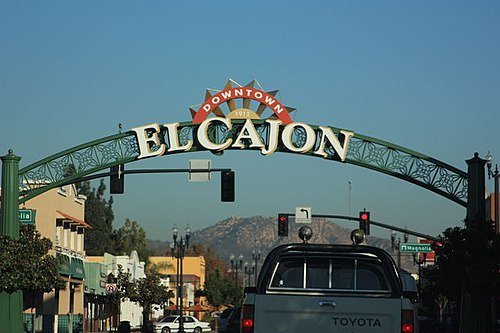
El Cajón fue incorporada como ciudad en 1912.
Demografía
En el censo del año 2000, la ciudad contaba con 94.869 personas, 34.199 hogares, y 23.152 familias. La densidad poblacional era de 2.514 habitantes/km². Había 35.190 casas unifamiliares en una densidad poblacional de 932,5/km². La distribución etnográfica de la ciudad era de 74% blanco, 5,37% afrodescendiente, 0,99% amerindio, 2,79% asiático, 0,37% polinesios, el 10,49% de otras razas, y el 5,99% de dos o más razas. Los hispanos o latinos de cualquier raza formaban el 22,47% de la población.
Los ingresos medios por hogar en la localidad eran de 35.566 $, y los ingresos medios por familia eran 40.045 $. Los hombres tenían unos ingresos medios de 32.498 dólares frente a los 25.320 para las mujeres. La renta per cápita para la localidad era de 16.698 $. Alrededor del 16,7% de la población estaban por debajo del umbral de pobreza.
Ingresos
Según las estimaciones por el San Diego Association of Governments, los ingresos medio per cápita para El Cajón en 2005 fue de 47.885 dólares (sin haberse ajustado a la inflación). Ajustados a la inflación (con dólares de 1999), el promedio era de 38.884 dólares.
Escuelas
El Distrito de la Unión Escolar Cajon Valley gestiona las escuelas primarias y las escuelas intermedias/secundarias en la ciudad.
El Distrito de Escuelas Preparatorias de Grossmont Union gestiona las escuelas preparatorias que sirven a la ciudad.
Residentes famosos
Brian Giles y Marcus Giles, jugador de las grandes ligas
David Jeremiah, ministro Bautista, pastor de Shadow Mountain Community Church.
Katie Wilkins, jugadora del equipo de voleibol de EE. UU.
Heptacampeón de la NASCAR Cup Series Jimmie Johnson nació en El Cajón
Nadador en los Juegos Olímpicos Greg Louganis nació en El Cajón
Tommy Vardell, jugador de la NFL Football para los San Francisco 49ers, Cleveland Browns y Detroit Lions; También jugó para los Stanford Cardinal.
Heather O´Rourke actriz fallecida protagonista de poltergeist 1, 2, 3 y apareció en series televisivas.
Name

El Cajón, Spanish for "The Drawer", was first recorded on September 10, 1821, as an alternative name for sitio rancho Santa Mónica to describe the "boxed-in" nature of the valley in which it sat. The name appeared on maps in 1873 and 1875, shortened to "Cajon", until the modern town developed, in which the post office was named "El Cajon".
In 1905, the name was once again expanded to "El Cajon" under the insistence of California banker and historian Zoeth Skinner Eldredge.
History
During Spanish rule (1769–1821), the government encouraged settlement of territory now known as California by the establishment of large land grants called ranchos, from which the English word ranch is derived. Land grants were made to the Roman Catholic Church, which set up numerous missions throughout the region. In the early 19th century, mission padres' search for pastureland led them to the El Cajon Valley. Surrounding foothills served as a barrier to straying cattle and a watershed to gather the sparse rainfall. For years, the pasturelands of El Cajon supported the cattle herds of the mission and its native Indian converts.
Titles to plots of land were not granted to individuals until the Mexican era (1821–1846). The original intent of the 1834 secularization legislation was to have church property divided among the former mission Indians, but most of the grants were actually made to rich "Californios" of Spanish background who had long been casting envious eyes on the vast holdings of the Roman Catholic missions. In 1845, California Governor Pio Pico confiscated the lands of Mission San Diego de Alcala. He granted 11 square leagues (about 48,800 acres or 19,700 ha) of the El Cajon Valley to Dona Maria Antonio Estudillo, daughter of José Antonio Estudillo, alcalde of San Diego, to repay a $500 government obligation. The grant was originally called Rancho Santa Monica and encompassed present-day El Cajon, Bostonia, Santee, Lakeside, Flinn Springs, and the eastern part of La Mesa. It also contained the 28-acre (11 ha) Rancho Cañada de los Coches grant. Maria Estudillo was the wife of Don Miguel Pedrorena (1808–1850), a native of Madrid, Spain, who had come to California from Peru in 1838 to operate a trading business.
With the cession of California to the United States after the Mexican–American War, the 1848 Treaty of Guadalupe Hidalgo provided that the land grants would be honored. As required by the Land Act of 1851, a claim for Rancho El Cajon was filed by Thomas W. Sutherland, guardian of Pedrorena's heirs (his son, Miguel, and his three daughters, Victoria, Ysabel, and Elenain) with the Public Land Commission in 1852, confirmed by the U.S. Supreme Court, and the grant was patented in 1876. In 1868, Los Angeles land developer Isaac Lankershim bought the bulk of the Pedrorena's Rancho El Cajon holdings and employed Major Levi Chase, a former Union Army officer, as his agent. Chase received from Lankershim 7,624 acres (3,090 ha) known as the Chase Ranch. Lankershim hired Amaziah Lord Knox (1833–1918), a New Englander whom he had met in San Francisco, to manage Rancho El Cajon. In 1876, Knox established a hotel there to serve the growing number of people traveling between San Diego and Julian, where gold had been discovered in 1869. Room and board for a guest and horse cost $1 a night. The area became known as Knox's Corners but was later renamed. By 1878 there were 25 families living in the valley, and a portion of the hotel lobby became the valley post office with Knox as the first postmaster. The San Diego, Cuyamaca and Eastern Railway reached El Cajon in the 1880s.
Geography
According to the United States Census Bureau, the city has a total area of 14.4 square miles (37 km2), all land. It is bordered by San Diego and La Mesa on the west, Spring Valley on the south, Santee on the north, and unincorporated San Diego County on the east. It includes the neighborhoods of Fletcher Hills, Bostonia, and Rancho San Diego.
Climate
Under the Köppen climate classification, El Cajon straddles areas of Mediterranean climate (Csa), hot semi-arid climate (BSh) and cool semi-arid climate (BSk). As a result, it is often described as "arid Mediterranean" and "semiarid steppe". Like most inland areas in Southern California, the climate varies dramatically within a short distance, known as microclimate. El Cajon's climate has greater extremes compared to coastal San Diego. The farther east from the coast, the more arid the climate gets, until one reaches the mountains, where precipitation increases due to orographic uplift.
Temperature variations between night and day tend to be moderate with an average difference of 24 °F (13 °C) during the summer, and an average difference of 26 °F (14 °C) during the winter.
The annual average precipitation at El Cajon is 11.63 inches (295.4 mm). Rainfall is fairly evenly distributed throughout the winter, but rare in summer. The wettest month of the year is February with an average rainfall of 2.61 inches (66 mm).
The record high temperature was 114 °F (45.6 °C) on September 5, 2020, and the record low 19 °F (−7.2 °C) on January 8, 1913. The wettest "rain year" was from July 1940 to June 1941 with 30.08 inches or 764.0 millimeters and the driest from July 1988 to June 1989 with 2.38 inches or 60.5 millimeters. The most rainfall in one month was 11.43 inches or 290.3 millimeters in January 1993, and the most in 24 hours 5.60 inches or 142.2 millimeters on January 27, 1916. A rare snowfall in November 1992 totalled 0.3 inches (0.76 cm). Three inches or 7.6 centimeters of snow covered the ground in January 1882.
Demographics
2022
As of the 2022 American Community Survey estimates, there were 104,417 people and 33,580 households. The population density was 7,196.2 inhabitants per square mile (2,778.5/km2). There were 34,370 housing units at an average density of 2,368.7 per square mile (914.6/km2). The racial makeup of the city was 50.6% White, 15.0% some other race, 5.6% Black or African American, 3.4% Asian, 1.3% Native American or Alaskan Native, and 1.3% Native Hawaiian or Other Pacific Islander, with 22.8% from two or more races. Hispanic or Latino residents of any race were 36.6% of the population.
Of the 33,580 households, 34.2% had children under the age of 18 living with them, 32.9% had seniors 65 years or older living with them, 52.4% were married couples living together, 4.8% were couples cohabitating, 16.8% had a male householder with no partner present, and 26.0% had a female householder with no partner present. The median household size was 3.00 and the median family size was 3.53.
The age distribution was 25.9% under 18, 8.1% from 18 to 24, 25.2% from 25 to 44, 25.6% from 45 to 64, and 15.3% who were 65 or older. The median age was 37.4 years. For every 100 females, there were 88.1 males.
The median income for a household was $66,045, with family households having a median income of $72,704 and non-family households $43,584. The per capita income was $28,221. Out of the 102,390 people with a determined poverty status, 22.7% were below the poverty line. Further, 31.4% of minors and 17.3% of seniors were below the poverty line.
In the survey, residents self-identified with various ethnic ancestries. People of Arab descent made up 5% of the population of the town, followed by German at 6.7%, English at 5.8%, Irish at 4.3%, Italian at 3.0%, American at 2.4%, Sub-Saharan African at 1.9%, Polish at 1.7%, Norwegian at 1.4%, Swedish at 1.0%, French at 0.9%, Dutch at 0.8%, Hungarian at 0.8%, Scottish at 0.6%, Greek at 0.5%, Portuguese at 0.5%, and Czech at 0.5%.
Government
Until 2012, El Cajon was a general law city operating under a council-manager system. In June 2012, the voters adopted a city charter, changing its status to chartered city. El Cajon is governed by a five-member city council, on which the mayor also sits. Starting in 2018, four councilmembers are elected from single-member districts and the mayor is elected at-large.
On October 24, 2013, Mayor Mark Lewis resigned his position after coming under criticism for remarks he made about El Cajon's Chaldo-Assyrian community. Many notable figures including Congressman Juan Vargas and Neighborhood Market Association President Mark Arabo called for his resignation. Lewis resigned shortly after due to health issues. On November 12, the city council appointed Councilman Bill Wells, who had been serving as mayor pro tem. The vote of the council was 4–0; Wells recused himself. He was elected to a full four-year term as mayor in November 2014 and re-elected in November 2018 and November 2022.
In 2025, councilmembers were Gary Kendrick (district 1), Michelle Metschel (district 2), Steve Goble (district 3), and Phil Ortiz (district 4). All council terms end in December 2028 except for Kendrick's, which ends in December 2026.
El Cajon's city manager is Graham Mitchell.
State and federal representation
In the California State Legislature, El Cajon is in the 39th senatorial district, represented by Democrat Akilah Weber Pierson. The northern half of the city is in the 78th Assembly district, represented by Democrat Chris Ward, and the southern half of the city is in the 79th Assembly district, represented by Democrat LaShae Sharp-Collins.
In the United States House of Representatives, El Cajon is in California's 51st congressional district, represented by Democrat Sara Jacobs.
Economy
According to the city's 2025 Annual Comprehensive Financial Report, the top employers in the city are:
The Parkway Plaza shopping mall is located in El Cajon.
Education
Cajon Valley Union School District operates public elementary and middle schools. Grossmont Union High School District operates public high schools.
Private schools
Foothills Christian Schools (Preschool, middle school, and high school campuses)
Colleges
Seminary of Mar Abba the Great of the Chaldean Catholic Church
Places of interest
Annual events
On a Saturday in May, the city celebrates its diversity with a free family-friendly event called "America on Main Street". The festival replaces a previous city-sponsored event called the International Friendship Festival, which ran from 1991 to 2003. Both festivals highlight the city's identity as a "mini-United Nations", with 30% of its population being immigrants from Iraq, Somalia, Syria, Turkey, and other countries.
El Cajon's annual Mother Goose Parade has been held on the Sunday before Thanksgiving every year since 1946. Organizers claim it is the largest parade in San Diego County. It features more than 100 entries, including "motorized floats, marching bands and drill units, equestrians, clowns, performing artists, giant helium balloons, specialty vehicles, and Santa Claus."
Visitor attractions
Visitor attractions in and around El Cajon include the Water Conservation Garden and Butterfly Garden at Cuyamaca College, Sycuan Casino, Summers Past Farms, and the Parkway Plaza Mall.
Downtown El Cajon includes The Magnolia, a City-owned entertainment venue in partnership with Live Nation Entertainment, St. Madeleine Sophie's Center and Garden that serves adults with intellectual and developmental disabilities, and the Olaf Weighost Museum and Western Heritage Center which features items from the 40 years that Olaf Wieghorst lived in El Cajon.
Kaynak: Wikipedia – El Cajon, California · CC BY-SA 4.0