
Flint
Flint es una ciudad estadounidense ubicada en el condado de Genesee del estado de Míchigan.
Government administration · United States · 0 followers
Overview
Flint es una ciudad estadounidense ubicada en el condado de Genesee del estado de Míchigan. Situada a orillas del río Flint y a 106 kilómetros al noroeste de la ciudad de Detroit, es la ciudad más grande de la región de Central Michigan. Según el censo de 2010, Flint tenía una población de 102 434 habitantes, que pasó a 99 002 según estimaciones de 2014 y a 81 252 en 2020, lo que la convierte en la duodécima ciudad más grande de Míchigan. El área metropolitana de la ciudad se encuentra totalmente dentro del condado de Genesee y agrupaba en 2010 a una población de 425 790 personas, la cuarta mayor metrópolis de Míchigan.
Interested in working with us in the future?
Follow to see new jobs and posts in your feed.
No news yet.
About

Flint es una ciudad estadounidense ubicada en el condado de Genesee del estado de Míchigan. Situada a orillas del río Flint y a 106 kilómetros al noroeste de la ciudad de Detroit, es la ciudad más grande de la región de Central Michigan. Según el censo de 2010, Flint tenía una población de 102 434 habitantes, que pasó a 99 002 según estimaciones de 2014 y a 81 252 en 2020, lo que la convierte en la duodécima ciudad más grande de Míchigan. El área metropolitana de la ciudad se encuentra totalmente dentro del condado de Genesee y agrupaba en 2010 a una población de 425 790 personas, la cuarta mayor metrópolis de Míchigan.
Kaynak: Wikipedia · CC BY-SA 4.0
Historia
La región estuvo habitada por varias tribus ojibwa a principios del siglo XIX, con una comunidad particularmente significativa cerca de la actual Montrose. El río Flint tenía varios vados que se convirtieron en puntos de discordia entre tribus rivales, como lo atestigua la presencia de puntas de flecha y túmulos. Parte de la ciudad se extiende en la actualidad sobre los antiguos cementerios de ojibwa.
Siglo XIX
En 1819, Jacob Smith, un comerciante de pieles fundó un puesto comercial en el Grand Traverse del río Flint. En varias ocasiones, Smith intercambió tierras con los ojibwa en nombre del gobierno de Estados Unidos. Smith repartió muchas de sus posesiones entre sus hijos. Como escala ideal entre Detroit y Saginaw, Flint se convirtió en un pueblo pequeño y próspero, que se incorporó en 1855. El censo de 1860 indicó que el condado de Genesee tenía una población de 22 498 habitantes del total de 750 000 de todo Míchigan.
En la segunda mitad del siglo XIX, Flint se convirtió en un centro de la industria maderera de Míchigan. Los ingresos de la madera financiaron el establecimiento de una industria de fabricación de carruajes local. A medida que los carruajes tirados por caballos dieron paso a los automóviles, Flint se convirtió en un actor importante en la naciente industria automotriz. Buick Motor Company, después de un comienzo rudimentario en Detroit, pronto se mudó a Flint. La bujía de CA se originó en Flint. Estos fueron seguidos por varias marcas de automóviles ahora desaparecidas, como Dort, Little, Flint y Mason. La primera planta de fabricación de Chevrolet (y durante muchos años la principal) también estaba en Flint, aunque la sede estaba en Detroit. Durante un breve período, todos los Chevrolet y Buick se construyeron en Flint.
Siglo XX
En 1904, el empresario local William C. Durant fue contratado para administrar Buick, que se convirtió en el mayor fabricante de automóviles en 1908. En 1908, Durant fundó General Motors (GM), presentando documentos de constitución en Nueva Jersey, con sede en Flint. GM trasladó su sede a Detroit a mediados de la década de 1920. Durant perdió el control de GM dos veces durante su vida. En la primera ocasión, se hizo amigo de Louis Chevrolet y fundó Chevrolet, que fue un gran éxito. Usó el capital de este éxito para recomprar el control de las acciones. Más tarde volvió a perder el control decisivo, de forma permanente. Durant experimentó la ruina financiera en el Crac del 29 y posteriormente dirigió una bolera en Flint hasta su muerte en 1947.
Geografía

Flint se encuentra en la región de Flint/Tri-Cities de Míchigan. Flint y el condado de Genesee se pueden clasificar como una subregión de Flint/Tri-Cities. Se encuentra a lo largo del río Flint, que fluye a través de los condados de Lapeer, Genesee y Saginaw y tiene 126 km de largo.
Según la Oficina del Censo de los Estados Unidos, la ciudad tiene una superficie total de 88,22 km², de los cuales 86,56 km² son tierra y 1,66 km², agua. Flint se encuentra justo al noreste de las colinas de Flint. El terreno es bajo y ondulado a lo largo de los lados sur y este, y más plano hacia el noroeste.
Barrios
Justo al norte del centro de la ciudad se encuentra River Village, un ejemplo de gentrificación a través de la vivienda pública de ingresos mixtos. Al este de la I-475 está Central Park y Fairfield Village. Estos son los únicos dos vecindarios entre UM-Flint y Mott Community College y disfrutan de fuertes asociaciones de vecindarios. Central Park puso a prueba un proyecto para convertir el alumbrado público en con lámparas led y está definido por siete calles sin salida.
North Side y 5th Ward son predominantemente afroamericanos, con distritos históricos como Buick City y Civic Park en el norte, y Sugar Hill, Floral Park y Kent y Elm Parks en el sur. Muchos de estos vecindarios fueron los centros originales de los primeros blues de Míchigan. El lado sur en particular también fue un centro para la migración multirracial de Misuri, Kentucky, Tennessee y el sur profundo desde la Segunda Guerra Mundial. Estos vecindarios suelen tener ingresos más bajos, pero han mantenido cierto nivel de estratificación económica. En el East Side quedan Applewood Mott Estate, Mott Community College, el Centro Cultural y East Village, una de las áreas más prósperas de Flint. El vecindario circundante se llama College/Cultural Neighborhood, con una fuerte asociación de vecindario, menor índice de criminalidad y precios de vivienda estables.
Demografía
Según el censo de 2010, había 102 434 personas residiendo en Flint. La densidad de población era de 1.161,46 hab./km². De los 102 434 habitantes de Flint, el 37,42 % eran blancos; el 56,56 %, afroamericanos; el 0,54 %, amerindios; el 0,45 %, asiáticos; el 0,02 %, isleños del Pacífico; el 1,14 %, de otras razas; y el 3,87 % pertenecían a dos o más razas. Del total de la población el 3,88 % eran hispanos o latinos de cualquier raza.
Política
Dado el pobre estado financiero de la ciudad, Michael Brown fue nombrado Regidor de Emergencia el 26 de junio de 2013. Sin embargo Brown dimitió de su cargo en septiembre del mismo año, dimisión que se hizo efectiva al mes siguiente. Darnell Eraley (anterior alcalde de Flint y actualmente gerente de la ciudad de Saginaw) le sucedió desde entonces.
Educación
Universidades
La Universidad de Míchigan-Flint es uno de los tres campus de la Universidad de Míchigan.
Kettering University es una universidad principalmente de ingeniería.
Mott Community College es la universidad pública de la zona.
La Michigan State University College of Human Medicine utiliza el antiguo edificio de Flint Journal para clases.
El área de Flint también están presentes el campus principal de Baker College y campus satétites de Davenport University y Spring Arbor University.
Referencias fílmicas
Bowling for Columbine (2002), de Michael Moore
Fahrenheit 11/9 (2018), de Michael Moore
Kaynak: Wikipedia – Flint (Míchigan) · CC BY-SA 4.0
Demografi
2010 sayımı
15 Mart 2010 tarihinde yapılan nüfus sayımına göre şehrin nüfusunun 124.943 kişiden, 48.744 evden ve 30.270 aileden oluştuğu tespit edilmiştir. Şehirdeki nüfus yoğunluğu 430.0/km²'dir. Şehirde bulunan 755 ev 181.0/km² yer kaplamaktadır. Şehirdeki nüfus dağılımı ise %96,7 Beyaz, %0,5 Afrikan Amerikan, %0,2 Yerli Amerikan, %0,4 Asyalı, %0,1'inin ise de diğer halklardan oluştuğu tespit edilmiştir.
708 evde %39,0 kadar 18 yaşından küçük çocuk bulunmaktadır. %6,6'sı bekar, %2,9'u ise de evlidir. %15,1, 65 yaşından üzeri yaşlılar bulunmaktadır. Şehirdeki nüfusunun %46,3'i erkek ve %53,7'si ise kadındır.
2000 sayımı
1 Nisan 2000 tarihinde yapılan nüfus sayımına göre şehrin nüfusunun 102.434 kişi, 40.472 evden ve 23.949 aileden oluştuğu tespit edilmiştir. Şehrin nüfus yoğunluğu 391.0/km²'dir. Şehirde bulunan 556 ev, 173.4/km² alan kaplamaktadır. Şehirdeki nüfus dağılımı ise %97,18 Beyaz, %0,31 Zenci veya Afrikan Amerikan, %0,94 Yerli Amerikan, %0,31 Asyalı ve %1,25'inin diğer gruplardan oluştuğu tespit edilmiştir.
Kardeş şehirler
Flint şehrinin dört kardeş şehri vardır:
Kielce, Świętokrzyskie Voyvodalığı, Polonya
Kaynak: Wikipedia – Flint, Michigan · CC BY-SA 4.0
History

The region was home to several Ojibwe tribes at the start of the 19th century, with a particularly significant community established near present-day Montrose. The Flint River had several convenient fords which became points of contention among rival tribes, as attested by the presence of nearby arrowheads and burial mounds. Some of the city currently resides atop ancient Ojibwe burial grounds.
19th century: lumber and the beginnings of the automobile industry
In 1819, Jacob Smith, a fur trader on cordial terms with both the local Ojibwe and the territorial government, founded a trading post at the Grand Traverse of the Flint River. On several occasions, Smith negotiated land exchanges with the Ojibwe on behalf of the U.S. government, and he was highly regarded on both sides. Smith apportioned many of his holdings to his children. As the ideal stopover on the overland route between Detroit and Saginaw, Flint grew into a small but prosperous village and incorporated in 1855. The 1860 U.S. census indicated that Genesee County had a population of 22,498 of Michigan's 750,000.
In the latter half of the 19th century, Flint became a center of the Michigan lumber industry. Revenue from lumber funded the establishment of a local carriage-making industry. As horse-drawn carriages gave way to the automobiles, Flint then naturally grew into a major player in the nascent auto industry. Buick Motor Company, after a rudimentary start in Detroit, soon moved to Flint. AC Spark Plug originated in Flint. These were followed by several now-defunct automobile marques such as the Dort, Little, Flint, and Mason brands. Chevrolet's first (and for many years, main) manufacturing facility was also in Flint, although the Chevrolet headquarters were in Detroit. For a brief period, all Chevrolets and Buicks were built in Flint.
The first Ladies' Library Association in Michigan was started in Flint in 1851 in the home of Maria Smith Stockton, daughter of the founder of the community. This library, initially private, is considered the precursor of the current Flint Public Library.
Geography
Flint lies in the Flint/Tri-Cities region of Michigan. Flint and Genesee County can be categorized as a subregion of Flint/Tri-Cities. It is located along the Flint River, which flows through Lapeer, Genesee, and Saginaw counties and is 78.3 mi (126.0 km) long.
According to the United States Census Bureau, the city has a total area of 34.06 square miles (88.21 km2), of which, 33.42 square miles (86.56 km2) is land and 0.64 square miles (1.66 km2) is water. Flint lies just to the northeast of the Flint hills. The terrain is low and rolling along the south and east sides, and flatter to the northwest.
Neighborhoods
Flint has several neighborhoods grouped around the center of the city on the four cardinal sides. The downtown business district is centered on Saginaw Street south of the Flint River. Just west, on opposite sides of the river, are Carriage Town (north) and the Grand Traverse Street District (south). Both neighborhoods boast strong neighborhood associations. These neighborhoods were the center of manufacturing for and profits from the nation's carriage industry until the 1920s and are the site of many well-preserved Victorian homes and the setting of Atwood Stadium.
The University Avenue corridor of Carriage Town is home to the largest concentration of Greek housing in the area. Many fraternity houses from Kettering University and the University of Michigan-Flint are located there.
Just north of downtown is River Village, an example of gentrification via mixed-income public housing. To the east of I-475 is Central Park and Fairfield Village. These are the only two neighborhoods between UM-Flint and Mott Community College and enjoy strong neighborhood associations. Central Park piloted a project to convert street lights to LED and is defined by seven cul-de-sacs.
The North Side and 5th Ward are predominantly African American, with such historic districts as Buick City and Civic Park on the north, and Sugar Hill, Floral Park, and Kent and Elm Parks on the south. Many of these neighborhoods were the original centers of early Michigan blues. The South Side in particular was also a center for multi-racial migration from Missouri, Kentucky, Tennessee, and the Deep South since World War II. These neighborhoods are most often lower income but have maintained some level of economic stratification. The East Side is the site of the Applewood Mott Estate, and Mott Community College, the Cultural Center, and East Village, one of Flint's more prosperous areas. The surrounding neighborhood is called the college/Cultural Neighborhood, with a strong neighborhood association, lower crime rate and stable housing prices.
Demographics
2020 census
As of the 2020 census, Flint had a population of 81,252, with 33,559 households and 18,640 families. The median age was 36.4 years; 25.3% of residents were under the age of 18 and 13.8% were 65 years of age or older. For every 100 females there were 96.5 males, and for every 100 females age 18 and over there were 92.5 males age 18 and over.
The population density was 2,429.78 inhabitants per square mile (938.1/km2). There were 40,578 housing units at an average density of 1,213.46 per square mile (468.5/km2); 17.3% were vacant. The homeowner vacancy rate was 2.0% and the rental vacancy rate was 12.9%.
100.0% of residents lived in urban areas, while 0.0% lived in rural areas.
2010 census
As of the 2010 census, there were 102,434 people, 40,472 households, and 23,949 families residing in the city. The population density was 3,065.05 inhabitants per square mile (1,183.4/km2). There were 51,321 housing units at an average density of 1,535.64 per square mile (592.9/km2). The racial makeup of the city was 37.42% White, 56.56% African American, 0.54% Native American, 0.45% Asian, 0.02% Pacific Islander, 1.14% from some other races and 3.87% from two or more races. Hispanic or Latino people of any race were 3.88% of the population.
There were 40,472 households, of which 34.3% had children under the age of 18 living with them, 23.1% were married couples living together, 29.0% had a female householder with no husband present, 7.1% had a male householder with no wife present, and 40.8% were non-families. 33.9% of all households were made up of individuals, and 9.8% had someone living alone who was 65 years of age or older. The average household size was 2.45 and the average family size was 3.13.
The median age in the city was 33.6 years. 27.3% of residents were under the age of 18; 11.3% were between the ages of 18 and 24; 25.5% were from 25 to 44; 25.1% were from 45 to 64; and 10.7% were 65 years of age or older. The gender makeup of the city was 48.0% male and 52.0% female.
Sports
American football
There is semi-pro football at Atwood Stadium with the Flint Fury. Atwood is an 11,000+ seat stadium in downtown Flint which has hosted many events, including baseball. When artificial turf was installed, it was no longer able to host baseball games. The Flint Fury have been in action since 2003, and are currently a part of the Great Lakes Football League. The team was founded by two of its players; Charles Lawler and Prince Goodson, who both played for the defunct Flint Falcons semi-pro team. The team is now solely owned by Lawler.
The 2009 Heisman Trophy winner Mark Ingram II, born and raised in Grand Blanc, attended his final year of high school at Flint Southwestern Academy. He won the Heisman with 1304 total votes. Ingram attended the University of Alabama and is their first Heisman winner. He was a member of the National Champion 2009 Alabama Crimson Tide football team.
Basketball
Many Flint natives have played basketball in the National Basketball Association (NBA), NCAA Division I or European professional basketball. NBA champion Glen Rice, Eddie Robinson and three-time NBA champion JaVale McGee, and Milwaukee Bucks forward Kyle Kuzma all hail from Flint, as do Morris Peterson, Mateen Cleaves, and Charlie Bell (four of the five starters from Michigan State University's "Flintstones" 2000 National Championship team).
Local teacher and independent film maker Marcus Davenport chronicles Flint's ties to basketball and the basketball culture in his documentary Flint Star: The Motion Picture. Will Ferrell's 2008 movie Semi-Pro is based on the fictional basketball team the "Flint Tropics".
Ice hockey
On January 14, 2015, the Ontario Hockey League's Plymouth Whalers were relocated to Flint after a sale of the team to the owner of Perani Arena for the 2015–16 season. The team changed its name to the Flint Firebirds. In September 2022, the Firebirds announced the Leamington Flyers as an affiliate.
Government
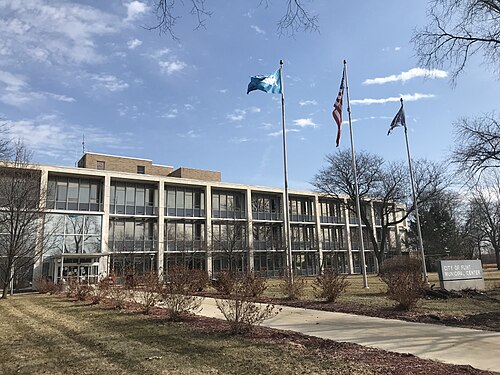
The city levies an income tax of 1 percent on residents and 0.5 percent on nonresidents. The 1974 Charter is the city's current charter that gives the city a strong mayor form of government. It also instituted the appointed independent office of Ombudsman, while the city clerk is solely appointed by the city council. The city council is composed of members elected from the city's nine wards. A Charter Review Commission is currently impaneled to review the charter for a complete overhaul. The city operated under state-led financial receivership from April 30, 2015, to April 10, 2018, which saw the city under an Emergency Manager as the State of Michigan had declared a state of local government financial emergency. The Receivership Transition Advisory Board had the authority to override council decisions related to financial matters. The city has operated under at least four charters (1855, 1888, 1929, 1974).
Law enforcement
Law enforcement in Flint is the responsibility of the Flint Police Department, the Genesee County Sheriff's Office, and the Michigan State Police. Flint has been consistently ranked as one of the most dangerous cities in the United States by multiple sources. From 2007 to 2009, violent crime in Flint was ranked in the top five among U.S. cities with a population of at least 50,000 people. From 2010 to 2012, Flint ranked as the city with the highest violent crime rate among cities with over 100,000 population. In 2015, CQ Press (using FBI statistics) ranked the crime index for Flint as seventh-highest in cities with population greater than 75,000. In 2018, the FBI reported Flint was ranked as America's sixth most violent city among those with population of 50,000 or more in 2017. Violent crimes were up 23% compared to 2016 according to the report.
Politics
Most politicians are affiliated with the Democratic party despite the city's elections being nonpartisan. In 2006, Flint was the tenth most liberal city in the United States, according to a nationwide study by the non-partisan Bay Area Center for Voting Research, which examined the voting patterns of 237 cities with a population over 100,000.
Education

Colleges and universities
Michigan State University College of Human Medicine
Primary and secondary schools
Public K-12 education is provided under the umbrella of the Flint Community Schools. Students attend ten elementary schools, one middle school, and one high school (Flint Southwestern Academy). The city's original high school, Flint Central High School, was closed in 2009 because of a budget deficit and a lack of maintenance on the building by the Flint School District. The building, however, still stands. Flint Northern High School was converted to an alternative education school at the start of the 2013–14 school year and was closed later in 2014. The state-run Michigan School for the Deaf is located in Flint, and Michigan School for the Blind was previously there, having moved from Lansing in 1995.
The Catholic high school is Fr. Luke M. Powers Catholic High School which is part of the Roman Catholic Diocese of Lansing and serves the entire county. The school moved from its location just north of Flint in Mt. Morris Township in 2013 into the former Michigan School for the Deaf building off of Miller Road in Flint, which received a $22 million renovation. The Valley School is a small private K–12 school. Flint also has several charter schools, including International Academy of Flint, Flint Cultural Center Academy and Eagle's Nest Academy.
Libraries
The Flint Public Library holds 454,645 books, 22,355 audio materials, 9,453 video materials, and 2,496 serial subscriptions.
Media

The county's largest newspaper is The Flint Journal, which dates back to 1876. Effective June 2009 the paper ceased to be a daily publication, opting to publish on Thursdays, Fridays and Sundays. The move made Genesee County the largest county in the United States without a daily newspaper. The Flint Journal began publishing a Tuesday edition in March 2010.
The East Village Magazine is a non-profit news magazine providing information about neighborhood issues since 1976. The monthly magazine centers on the East Village neighborhood, outside downtown Flint, but is distributed throughout the city. The Uncommon Sense was a monthly publication featuring investigative journalism, political analysis, satirical cartoons, and articles about Flint music, art, nightlife and culture; it stopped publishing in 2007. In January 2009, Uncommon Sense editors and contributors began publishing Broadside, available exclusively in print. Its last issue was published in April 2014. In early 2009 Flint Comix & Entertainment began circulating around college campuses, and local businesses. This monthly publication features local and nationally recognized comic artists, as well as editorials, and other news.
Two quarterly magazines have appeared in recent years: Innovative Health Magazine and Downtown Flint Revival Magazine. Debuting in 2008, Innovative Health highlights the medical advancements, health services and lifestyles happening in and around Genesee County, while Downtown Flint Revival reports on new developments, building renovations and the many businesses in the Downtown area. A new monthly magazine which began publishing in June 2013 is known as My City Magazine which highlights events, arts and culture in Genesee County.
Online news source FlintBeat.com was launched in 2017 by Flint-area native, Jiquanda Johnson. The hyper local news website focuses on Flint City Hall, solutions journalism and public health in addition to their work covering neighborhoods and telling community stories.
Infrastructure

Bus lines
The city of Flint is served by various bus lines. For travel within and around the city, the Flint Mass Transportation Authority (MTA) provides local bus services. Indian Trails provides inter-city bus service north to Saint Ignace, through Bay City and south to Pontiac, Southfield, and Detroit, and runs services west to Chicago. MTA's main hub is in Downtown Flint, while the Indian Trails station is co-located at the Flint Amtrak station on Dort Highway, just north of I-69.
Major highways
I-75 / US 23 runs north and south through the southwestern part of the city near the General Motors Flint Assembly complex and Bishop International Airport.
I-475 runs north and south through Flint.
M-21 (also known as Corunna Road and Court Street) runs nearly due east and west through Flint, west of I-475
M-54, also known as Dort Highway after Flint automotive pioneer Josiah Dallas Dort, runs north and south through the eastern part of the city.
Railroads
Amtrak provides intercity passenger rail service on the Blue Water line from Chicago to Port Huron at the border to Canada. The Amtrak station is located on Dort Highway, just north of I-69. The station was built in 1989 and replaced an earlier Grand Trunk Western Railroad (GTW) station closer to downtown. Canadian National Railway (GTW's successor) and Lake State Railway provide freight service to Flint, with CN operating from Bristol Yard on the western side of the city and LSRC operating from the former CSX Transportation McGrew Yard to the north. While CSX ceded control of their former Saginaw Subdivision north of Plymouth to LSRC in 2019, they continue to operate trackage rights trains over CN from Flint to Port Huron several times per week as of 2020. Into the late 1940s, the Pere Marquette Railway operated daily passenger trains through a separate station 1+1⁄4 miles away, with trains heading north to Saginaw and Bay City and south to Detroit's Fort Street Union Depot.
Sister cities
Flint has four sister cities, as designated by Sister Cities International:
Kielce, Świętokrzyskie Voivodeship, Poland
Books
The following notable books are set in Flint or relate to the city.
The Watsons Go to Birmingham - 1963 by Christopher Paul Curtis
Bud, Not Buddy by Christopher Paul Curtis
Elijah of Buxton by Christopher Paul Curtis
The Mighty Miss Malone by Christopher Paul Curtis
What the Eyes Don't See by Dr. Mona Hanna-Attisha
Teardown: Memoir of a Vanishing City by Gordon Young
The Poisoned City: Flint's Water and Urban Tragedy by Anna Clark
Haunted Flint by Roxanne Rhoades and Joe Shipping
Rivethead: Tales from the Assembly Line by Ben Hamper
Music

Flint is currently home to an emerging rap scene, pioneered by artists like Rio Da Yung OG, Bfb Da Packman, and YN Jay. Flint rap, greatly influenced by Detroit drill, is characterized by bouncy drums, menacing melodic elements, and commonly a tresillo rhythm in the 808. Many artists use a laidback, almost nonchalant, vocal delivery. Flint rappers have gained notoriety for their outlandish, vulgar, and often comical lyrics.
Flint is the subject of the Sufjan Stevens song "Flint (For the Unemployed and Underpaid)" featured on his album Michigan.
Flint is the main focus for music group King 810 crediting it as "Murder Town" and their life growing up during the increase of crime rates during the 2000s. Also creating the songs "Crow's Feet" and "We Gotta Help Ourselves" to raise money toward the current water crisis happening in the city
Flint was home to MC Breed, the first commercially successful rapper to come from the Midwest.
Flint was where rock band Grand Funk Railroad was formed in 1969.
Kansas City rapper Tech N9ne mentioned its water problems in his song "Poisoning the well"
Flint is likely the subject of "Near DT, MI" by the English rock band Black Midi.
Flint is the hometown of the award-winning Pop/RnB group Ready For The World.
Flint is the hometown of shoegaze band Greet Death.
Film and television
The following films and television shows have taken place or were filmed in Flint.
Television
Nash Bridges (1996-2001): In one of the last episodes of the show, the character Michelle jokes to a man soon to be sent to live in Flint through the witness protection program that the city is similar to Paris. The man, from a foreign country, does not realize she is joking and is looking forward to his arrival in Flint.
The Fitzpatricks (1977–78): A CBS TV drama about an Irish Catholic working-class family living in Flint. The show was filmed in Hollywood but set in Flint. Also, the families were portrayed as steelworkers, not autoworkers.
Flint Town (2018): A Netflix documentary about the struggling urban areas of the city.
TV Nation (1994–1995) was the debut TV series by Michael Moore. Numerous segments were filmed in and around Flint, including one where Moore uses declassified information to find the exact impact point from the nuclear ICBM that targeted the city (ground zero was Chevrolet Assembly, one of the General Motors plants at Bluff & Cadillac Streets). Moore then went to Kazakhstan to try to redirect the ICBM away from Flint.
The Awful Truth (1999–2000) was Michael Moore's second TV show. It featured segments from Flint.
The Flint Police Department has appeared in the 31st season of the reality show Cops, airing in the summer of 2018 and winter of 2019.
Flint Police also appeared in a 2015 episode on TNT's Cold Justice: Sex Crimes, which paid to test old rape kits that resulted in convictions of three people for criminal sexual conduct.
Movies
To Touch a Child (1962): A look into Community Schools, a concept pioneered by Charles Stewart Mott and spread throughout the United States.
With Babies and Banners: Story of the Women's Emergency Brigade (1979): Documentary about the women of the Flint Sit-Down Strike.
Kaynak: Wikipedia – Flint, Michigan · CC BY-SA 4.0