
Interested in working with us in the future?
Follow to see new jobs and posts in your feed.
No news yet.

Boundaries

Germantown stretches for about two miles along Germantown Avenue northwest from Windrim and Roberts Avenues. Germantown has been consistently bounded on the southwest by Wissahickon Avenue, on the southeast by Roberts Avenue, and on the east by Wister Street and Stenton Avenue, but its northwest border has expanded and contracted over the years. When first incorporated as a borough in 1689, Germantown was separated from the rural Germantown Township by Washington Lane; later, the border was expanded to Carpenter and East Gorgas Lanes; it was then rolled back to Washington Lane in 1846, and remained there until the borough was absorbed into Philadelphia in 1854.
Today, the western part of the former borough is the neighborhood known simply as "Germantown", though it is sometimes called "West Germantown", and the eastern part is the neighborhood of 'East Germantown'. While the boundary between the two neighborhoods is not well-defined and has varied over time, currently 'Germantown' usually refers to the part of the former borough that lies west of Germantown Avenue, up through West Johnson Street, and 'East Germantown' to the part that lies east of Germantown Avenue, up through East Upsal Street.
The neighborhood of Mount Airy lies to the northwest, Ogontz and West Oak Lane to the northeast, Logan to the east, Nicetown–Tioga to the south, and East Falls to the southwest.
The majority of Germantown is covered by the 19144 zip code, but the area north of Chew Avenue falls in the 19138 zip code.
History
17th century
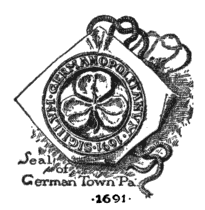
Although the arrival by ship of the Original 13, the later founders of Germantown in Philadelphia on October 6, 1683, was later to provide the date for German-American Day, a holiday in the United States, historical research has shown that nearly all of the first thirteen Quaker and Mennonite families were in fact Dutch rather than Germans. These families, which were mainly Dutch but also included some Swiss, had relocated to Krefeld (near the Dutch border) and Monsheim (in Rhineland-Palatinate) some years prior to their emigration to America to avoid persecution of their Mennonite beliefs in the Dutch Republic and Swiss Confederacy. The town was named Germantown by the group's leader Franz Pastorius, a German preacher from Sommerhausen.
The town's population remained largely Dutch-speaking until 1709, after which a number of the Dutch families set out west and a series of major German emigrations reached Germantown and Pennsylvania as a whole. Their initial leader, Pastorius, later aligned himself with newer German arrivals and as the only university-trained and legal and literary man among the early settlers, chronicled and stressed the town's German origins. Adding to the assimilating of Dutch culture was that the direct vicinity of the settlement was already inhabited by fifty-four German families who had accompanied Johan Printz to the Swedish settlement on the Delaware several years before 1683 and had resettled themselves. Pastorius was the first bailiff. Jacob Telner, Derick Isacks op den Graeff and his brother Abraham Isacks op den Graeff, Reynier Tyson, and Tennis Coender (Thones Kunders) were burgesses, besides six committeemen. They had authority to hold "the general court of the corporation of Germantowne", to make laws for the government of the settlement, and to hold a court of record. This court went into operation in 1690, and continued its services for sixteen years.
Education

Public schools
Germantown is zoned to the School District of Philadelphia. Public schools located in Germantown include the Anna L. Lingelbach School (K–8), the John B. Kelly School (K–6), the John Wister Elementary School (K–6), the Hill Freedman Middle School (6–8), the Theodore Roosevelt Middle School (7–8), the Fitler Academics Plus School (1–8), and the Martin Luther King High School (9–12). The Robert Fulton Elementary School and Germantown High School, a regional public high school located in Germantown, were both closed in 2013.
Charter schools
Mastery Charter Schools operates the Mastery Charter Pickett Campus (7–12, MCPC) in Germantown. The school opened in August 2007. The charter system headquarters is located at Pickett. Germantown Settlement Charter School (5–8), Imani Education Circle Charter school (pre-K to 8), and the Wissahickon Charter School's Awbury Campus (6th–8th) is located in the neighborhood . The Pennsylvania School for the Deaf, a private state-chartered school, occupies the former site of Germantown Academy, which moved to Fort Washington, Pennsylvania, in 1965.
Private schools
Germantown's private schools include the DePaul Catholic School (K–8), Waldorf School of Philadelphia (PreK-8), the High Street Christian Academy (K–4), the Germantown Islamic School, the Green Tree School (special education, ages 6–21), and two Quaker schools: Germantown Friends School and Greene Street Friends School.
Nearby private schools include Mount Airy's Revival Hill Christian High School (9–12), Blair Christian Academy (PreK–12), Islamic Day School of Philadelphia (PreK–5), Project Learn School (K–8), Classroom on Carpenter Lane (K-2), and Holy Cross School (K–8), as well as Chestnut Hill's Springside School (PreK–12), Chestnut Hill Academy (K–12), and Crefeld School (7–12). The William Penn Charter School (commonly known as Penn Charter), the oldest Quaker school in the world, is located in nearby East Falls.
Transportation

The first railroad in Philadelphia was the Philadelphia, Germantown and Norristown Railroad, which linked Germantown to a station at 9th and Green Streets in Center City. It opened in 1832, and was initially powered by horses. The inventor Matthias W. Baldwin built his first commissioned steam locomotive for the new railroad. Nicknamed Old Ironsides, it eventually reached a peak speed of 28 mph.
Today two SEPTA Regional Rail lines connect the neighborhood to Center City: the Chestnut Hill West Line with stops at Queen Lane, Chelten Avenue, and Tulpehocken stations; and the Chestnut Hill East Line with stops at Wister, Germantown, and Washington Lane stations.
The neighborhood is also served by bus routes 18, 23 (formerly a trolley line), 26, 41, 53 (formerly a trolley line), 65, 71 and 81, and K.
Parks and recreation areas

Germantown has numerous parks and recreation areas. These include:
Historic sites

National Historic Landmarks
Cliveden, the estate of Benjamin Chew, an important site during the Battle of Germantown, open to the public
John Johnson House, a site on the Underground Railroad, open to the public
National Register of Historic Places
Other sites listed separately on the NRHP:
Other historic buildings, places, and sites
Boxwood, 156 W. School House Lane, 1897-98
The Francis Strawbridge House, Wissahickon Avenue, Germantown
The Germantown Boys' Club, 23 W. Penn Street, 1898-1909
Germantown High School, 5901-13 and 5915-41 Germantown Avenue
The Jonathan Graham House, 5356 Chew Avenue, Germantown
The King Green House, 5112-14 Germantown Avenue
The Leibert House, 6950 Germantown Avenue, ca.1800-08
The Lutheran Theological Seminary Historic District, Mt. Airy
The Methodist Episcopal Church of the Advocate, 5250 Wayne Avenue, Germantown, Philadelphia, PA
St. Michael's Lutheran Church, 6671 Germantown Avenue, Mt. Airy, ca. 1728-1897
Mitchell, Fletcher, & Co., Inc., 5708 Germantown Avenue, Germantown, ca.1811-1911
The Wachsmuth-Henry House, 4908 Germantown Avenue, ca.1760
Woodside, The Dorfeuille-Hacker Country Seat, 339 E. Wister Street, ca.1797
In popular culture
The 1946 book, Bright April, written and illustrated by Marguerite de Angeli, features scenes of 1940s Germantown while addressing the divisive issue of racial prejudice experienced by African Americans.
The 2015 novel Loving Day is set in Germantown.
Places of interest
Cliveden, the estate of Benjamin Chew, an important site during the Battle of Germantown, open to the public
John Johnson House, a site on the Underground Railroad, open to the public