


Ixelles
Ixelles est l'une des 581 communes belges et une des 19 communes bilingues de la Région de Bruxelles-Capitale.
Government administration · Belgium · 0 followers
Overview
Ixelles est l'une des 581 communes belges et une des 19 communes bilingues de la Région de Bruxelles-Capitale.
Interested in working with us in the future?
Follow to see new jobs and posts in your feed.
No news yet.
About

Ixelles est l'une des 581 communes belges et une des 19 communes bilingues de la Région de Bruxelles-Capitale.
Kaynak: Wikipedia · CC BY-SA 4.0
Toponymie
Le nom provient du nom du hameau d’Elsele, « la demeure aux aulnes » (de else : « aulne » et sele : « demeure » ou « château »), d’après le nombre d’aulnes qu’on y retrouvait parmi les prairies, près des étangs. Ce nom est devenu Elsen et ensuite Elsene en néerlandais, Ixel et ensuite Ixelles en français. Le blason et le logo de la commune représentent d'ailleurs un aulne.
Géographie
Quartiers
Ixelles rassemble des quartiers très différents. On peut citer :
quartier de la porte de Namur et de la Toison d’or, quartier très commerçant pouvant être considéré comme le second centre de Bruxelles, grandes enseignes et commerces de luxe ;
quartier Matongé, qui se caractérise notamment par la présence d’une importante communauté originaire de la République démocratique du Congo, ancienne colonie belge. Par référence à un quartier populaire de la commune de Kalamu (Kinshasa), le quartier où se retrouve cette communauté (autour de la porte de Namur) est connu de tous les Bruxellois sous le nom de Matonge (prononcer « Mato’ngué »). Ce quartier évolue cependant vers une plus grande multiculturalité, avec une présence affirmée de la communauté asiatique, indienne et pakistanaise ;
quartier Saint-Boniface : quartier branché situé au sud de Matonge ;
quartier Fernand Cocq : autour de la place du même nom. Il abrite la maison communale ;
quartier Flagey : autour de l'emblématique Place Flagey. Il englobe la cité de l’Aulne, le quartier Malibran, le quartier Gray et les étangs d’Ixelles, et plusieurs lieux culturels ;
quartier de La Cambre : on y trouve l'École nationale d'arts visuels de La Cambre et le parc de l'Abbaye ;
quartier Châtelain - Bailli - Brugman : quartier chic : artisanat, librairies, épiceries, restaurants... ;
quartier du Luxembourg, quartier européen autour de la place du Luxembourg, avec notamment le Parlement européen et la gare de Bruxelles-Luxembourg ;
quartier du cimetière d’Ixelles - Université libre de Bruxelles : quartier étudiant qui divise la Cité Volta, l'ULB et le quartier de la Petite Suisse, regroupant plusieurs restaurants et snacks ;
quartier Boondael : quartier du sud d'Ixelles, moins urbain. Il comprend la gare de Boendael ou le square du Vieux Tilleul et s'étend jusqu'au bois de la Cambre et Watermael-Boitsfort ;
Histoire

Au Moyen Âge, il y avait deux Ixelles : Ixelles-sous-Bruxelles, qui dépendait du magistrat de Bruxelles, et Ixelles-sous-le-Châtelain, qui faisait partie des possessions du châtelain de Bruxelles. Quand celui-ci fut anobli, Ixelles-sous-le-Châtelain devint Ixelles-le-Vicomte.
Lors de la création de la commune d'Ixelles au XVIIIe siècle, trois hameaux furent réunis pour la former :
Haut-Ixelles ou Ixelles-sous-Bruxelles, Opper-Elsene en néerlandais ;
Bas-Ixelles ou Ixelles-le-Vicomte, Neder-Elsene en néerlandais ;
celui du Tenbosch où se trouvait un petit hameau ;
Ceux-ci furent rapidement rejoints par La Cambre qui avait été d'abord indépendante.
En 1864, une partie du territoire communal, dont l'Avenue Louise, fut annexée à la ville de Bruxelles, coupant la commune en deux parties non contiguës.
La commune d'Ixelles est aujourd'hui très diverse tant culturellement qu'économiquement. En effet, le nord de la commune, traditionnellement plus populaire, abrite des populations de multiples nationalités. En 2022, un peu moins de la moitié (49,3 %) des habitants étaient de nationalité étrangère. Des populations fort aisées résident dans l'ouest de la commune (quartier Châtelain), le sud et les quartiers bordant les étangs d'Ixelles.
Selon les études démographiques, on y retrouve une part croissante de jeunes adultes et de travailleurs internationaux. Ixelles abrite également plusieurs quartiers dits « branchés » de la capitale belge, comme le quartier Flagey ou le quartier du Châtelain, richement dotés en bars, restaurants et activités culturelles.
Sites remarquables

Le site de l'abbaye de la Cambre et son École nationale supérieure des arts visuels, situés sur le territoire de la Ville de Bruxelles
L'ancienne Maison de la radio de style Art déco
De nombreux édifices Art nouveau dont plusieurs de l'architecte Victor Horta
Place Fernand Cocq et l'hôtel communal, ancienne résidence de la cantatrice Maria Malibran et de son mari Charles-Auguste de Bériot.
Cimetière d'Ixelles, monuments funéraires remarquables
Avenue Louis Lepoutre, maison personnelle de Camille Damman, immeuble à appartements de style moderniste, construit par les architectes Raoul J. Brunswyck & O. Wathelet en 1962, le commissariat de l'avenue Louis Lepoutre
Enseignement
La commune d'Ixelles accueille des implantations des trois universités bruxelloises : la Vrije Universiteit Brussel y a son siège dans son campus Etterbeek (bien que situé à Ixelles), campus partagé avec l'université libre de Bruxelles (campus de la Plaine). L'université Saint-Louis - Bruxelles est de surcroît implantée dans la commune, où se situe sa Faculté de traduction et interprétation Marie-Haps.
Parmi les établissements scolaires, citons l'ancien athénée royal et l'athénée royal.
Démographie
Évolution de la population
Les graphiques suivant reprennent sa population résidente au 1er janvier de chaque année
Graphe de l'évolution de la population de la commune.
Source : DGS - Remarque : 1806 jusqu'à 1970 = recensement; 1981 = recensement; depuis 1991 = nombre d'habitants chaque 1er janvier
Vie politique
Résultats des élections communales depuis 1976
(*)1976:PCB,REXN,ULF 1982:PCB,SP,URD 1988:EVA 1994:PLUS,Vl.Blok,VLD,PLI,PH-HP,PLN-NWP 2000:PH-HP,Vl.Blok,AVE,FNB,La GP 2006:XL Citoyen,MAS-LSP,PH-HP 2012:Gauches Communes,Pirates,Égalité 2018:VOLT BE
Économie
Le siège historique de Solvay était à Ixelles, jusqu'en 2011.
Lieux culturels et monuments

Musée Meunier, consacré à Constantin Meunier
Le Flagey : Maison culturelle vouée à la musique et à l’image, située dans l'ancien bâtiment de la radio nationale.
Kings of Comedy Club : comedy club créé en 2012 par Cédric Vantroyen et Gilles Morin. De nombreux humoristes ont fréquenté cette salle de spectacles dont Kyan Khojandi, Mustapha El Atrassi, Blanche Gardin, Yacine Belhousse, Dan Gagnon, Thomas Wiesel, Pierre-Emmanuel Barré, Marina Rollman ou encore Shirley Souagnon. En 2018, les humoristes belges Alex Vizorek et Guillermo Guiz deviennent actionnaires du lieu.
Le 15 mars 1937, le Comité National Belge de la Société des auteurs, compositeurs et éditeurs de musique a inauguré, dans le cimetière, un monument en hommage à Eugène Ysaÿe.
Jumelages
Biarritz (France) depuis le 28 janvier 1958 ;
Kalamu (République démocratique du Congo) depuis le 30 juin 2003 ;
Zababdeh (Palestine) depuis le 27 novembre 2003, ville natale de Naïm Khader ;
Megiddo (Israël) depuis 2012, suspendu le 2 Juillet 2024.
Kaynak: Wikipedia – Ixelles · CC BY-SA 4.0
Geography
Ixelles is located in the south-east of Brussels and is divided into two parts by the Avenue Louise/Louizalaan, which is part of the City of Brussels. The municipality's smaller western part includes the Rue du Bailli/Baljuwstraat and extends roughly from the Avenue Louise to the Avenue Brugmann/Brugmannlaan, whilst its larger eastern part includes campuses of Brussels' two leading universities—the French-speaking Université libre de Bruxelles (ULB) and the Dutch-speaking Vrije Universiteit Brussel (VUB)—along with the Place Eugène Flagey/Eugène Flageyplein. The Bois de la Cambre/Ter Kamerenbos is located just south of Ixelles.
The construction of the Avenue Louise was commissioned in 1847 as a monumental avenue bordered by chestnut trees that would allow easy access from Brussels' city centre to the popular recreational area of the Bois de la Cambre. It was also to be the first Haussmann-esque artery of the city. Originally, fierce resistance to the project was put up by the town of Ixelles—then, as now, a separate municipality (local authority) from the City of Brussels—through whose territory the avenue was to run. After years of fruitless negotiations, Brussels finally annexed the narrow band of land needed for the avenue, in addition to the Bois de la Cambre itself, in 1864. That decision accounts for the unusual shape of today's City of Brussels and for the separation of Ixelles into two separate areas.
History

Medieval origins
The placename was first mentioned in 1210 as Elsela, from the Old Dutch Else(n)lo, meaning alder woods. The origins of the village date from the foundation of La Cambre Abbey. Hendrik I, Duke of Brabant, donated the Pennebeke domain to the Cistercian nun Gisela in 1201. She in turn founded the Abbey, and in 1210, acquired property on which the duke ordered the construction of a mill. The marshlands around the Abbey were later drained and sanitised, which resulted in four springs which served as a source of fish for the Abbey's inhabitants and the neighbouring hamlets. The Abbey was located near the springs of the Maelbeek stream in the Sonian Forest, the remnant of which closest to Brussels became known as the Bois de la Cambre/Ter Kamerenbos in the 19th century. The Abbey was recognised by Jan III van Bethune, the Bishop of Cambrai in 1202, soon after its foundation. The saints Boniface of Brussels and Alice of Schaerbeek were two of its most famous residents in the 13th century.
Around 1300, during the reign of John II, Duke of Brabant, a hostel was built near the Abbey to provide meals to the wood bearers working in the forest. Soon, a hamlet and a couple of chapels were built, including the Church of the Holy Cross, also inaugurated by the Bishop of Cambrai and dedicated to Mary and the Holy Cross in 1459. Initially, these hamlets and provisions were constructed for the labourers who helped drain and sanitise the marshlands. At that time, part of Ixelles was a dependence of Brussels; the other part was the property of the local lord.
Before the Revolution
In 1478, the wars between King Louis XI of France and Maximilian I, Holy Roman Emperor, brought devastation to the Abbey and the surrounding areas. In 1585, during the period of the Habsburg Netherlands, the Spanish burned down most of the buildings to prevent them from being used as a refuge by Calvinists. The Abbey was restored in time for the Joyous Entry of the Archdukes Albert and Isabella in 1599. Further manors and castles (Ermitage, Ten Bosch and Ixelles, for example) were built in Ixelles in the 16th century, gradually transforming the hamlet into a full-fledged village.
Matongé

Ixelles is known throughout Belgium for its large community of people of Sub-Saharan African origin. This population is mainly concentrated near the Namur Gate and the Chaussée d'Ixelles/Elsensesteenweg, and the neighbourhood is nicknamed Matongé or Matongué after the marketplace and commercial district with the same name in Kalamu, Kinshasa (Democratic Republic of the Congo). The core of Matongé was formed in late 1950s by the foundation of Maisaf (an abbreviation of Maison Africaine, meaning "African House"), which served as a centre and residence for university students from the Belgian Congo. After Congolese independence in 1960, the district faced an influx of immigrants from the new state who shaped the neighbourhood in a style to resemble the original Matongé. During the 1960s and into the '70s, the area was a well known meeting place for students and diplomats from Zaire. At the time, they were known locally as Belgicains. Communities from other African countries (mainly from Rwanda, Burundi, Mali, Cameroon, and Senegal) are also present in the district.
Two shopping arcades, the Ixelles Gallery and the Namur Gate Gallery, are located in the heart of Matongé. In the galleries and the adjoining streets, a large number of specialised food shops and suppliers can be found. The area is renowned for its clothes, shoes and material shops, hairdressers and wigmakers, booksellers, jewellers and craft shops, making the area unmissable for many local and even international visitors. Over 45 different nationalities amongst the residents and shopkeepers can be counted, including most African countries. Statistically, many of the shopkeepers are not necessarily local residents. Amongst the visitors and window shoppers to Matongé are many who appreciate African fashion and lifestyle. The pedestrian street Rue Longue Vie/Lange-Levenstraat has many snack-bars where African food is sold. Most of these have been decorated by the Afro-European artist John Bush. Le Soleil d'Afrique has almost become his museum, with not only his original paintings on display, but also other painted surfaces and furniture.
Main sights
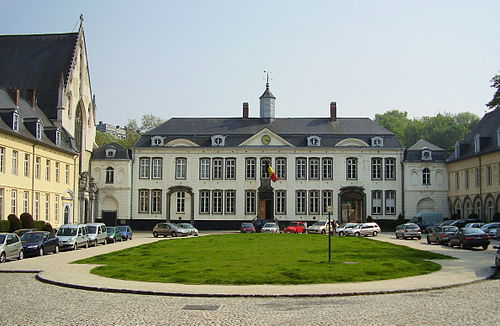
The buildings of La Cambre Abbey, close to the territory of Ixelles, house a renowned school for the visual arts, the National Geographic Institute, and various parish functions.
The Ixelles Ponds and Tenbosch Park are noted parks in the middle of the municipality.
The Flagey Building, also known as the Radio House, a Streamline Moderne building on the Place Eugène Flagey, used to house the Belgian National Institute of Radio Broadcasting (INR/NIR).
The Résidence de la Cambre, the first high-rise building in Brussels, on the Boulevard Général Jacques/Generaal Jacqueslaan, is another notable Art Deco building.
Ixelles was a centre of Art Nouveau architecture in the first decades of the 20th century. Several Art Nouveau houses built by Victor Horta are listed as a UNESCO World Heritage Site, and some of them can be visited.
The three Brussels universities—the Université libre de Bruxelles (ULB), Vrije Universiteit Brussel (VUB) and Saint-Louis University—have campuses in Ixelles. As a result, the south-eastern part of the municipality is home to a large number of students.
Ixelles Cemetery is one of the most important cemeteries in the country as it contains the graves of a number of Belgian personalities. It was there, in 1891, that the French General Georges Boulanger, leader of the right-wing Boulangerists, committed suicide, on the tomb of his mistress, who had died a couple of months earlier.
Ixelles also houses several interesting churches and museums, including the Museum of Ixelles, as well as the Meunier Museum, established in the residence where the artist lived part of his life.
Events
Several fairs are organised in Ixelles, including the Spring Fair on the Place Eugène Flagey, which takes place between the fourth and sixth Sunday after Easter, as well as the Boondael Fair at the end of July.
Brussels Universities Cyclocross is a cyclo-cross race that is regularly held in the adjacent campuses of the Université libre de Bruxelles (ULB) and the Vrije Universiteit Brussel (VUB), located in eastern Ixelles.
Demographics
Migrant communities in Ixelles with over 1,000 people as of 1 January 2020:
Politics
The current city council was elected in the October 2018 elections. The current mayor of Ixelles is Christos Doulkeridis, a member of Ecolo, who is in coalition on the municipal council with PS - sp.a.
International relations
Twin towns and sister cities
Kalamu, municipality in Kinshasa, Democratic Republic of the Congo (since 2003)
Kibbutz Megiddo, Israel (since 2012, suspended in July 2024)
Kaynak: Wikipedia – Ixelles · CC BY-SA 4.0