
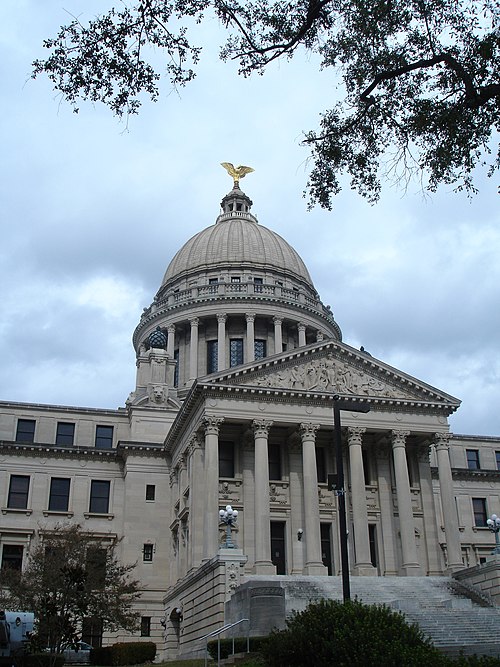
Jackson
Jackson es la capital y la ciudad más poblada del estado de Misisipi, en Estados Unidos.
Government administration · United States · 0 followers
Overview
Jackson es la capital y la ciudad más poblada del estado de Misisipi, en Estados Unidos. Es una de las sedes del condado de Hinds, junto con Raymond. Según el Censo de 2020, la población de la ciudad era de 153 701 habs. Y su área metropolitana de cinco condados tenía una población estimada de 570 000 habs. Se encuentra ubicada en la ribera del río Pearl.
Interested in working with us in the future?
Follow to see new jobs and posts in your feed.
No news yet.
About

Jackson es la capital y la ciudad más poblada del estado de Misisipi, en Estados Unidos. Es una de las sedes del condado de Hinds, junto con Raymond. Según el Censo de 2020, la población de la ciudad era de 153 701 habs. Y su área metropolitana de cinco condados tenía una población estimada de 570 000 habs. Se encuentra ubicada en la ribera del río Pearl.
Kaynak: Wikipedia · CC BY-SA 4.0
Historia
El primer establecimiento fue fundado en 1792 por Louis LeFleur, un comerciante franco-canadiense. A principios del siglo XIX, las autoridades buscaban un lugar para implantar la capital del estado de Misisipi. El lugar del actual Jackson fue escogido en 1821 y bautizado así en honor del séptimo presidente estadounidense Andrew Jackson. Peter Van Dorn trazó los primeros planos.
El ferrocarril llegó a Jackson en 1840 lo que aseguró el desarrollo de la ciudad después de la guerra de Secesión. Fue en el curso de este conflicto cuando la ciudad se convirtió en un importante centro de producción para los estados sudistas. El 14 de mayo de 1863, la batalla de Jackson enfrentó a las tropas del general Ulysses S. Grant a las fuerzas confederadas del general Joseph E. Johnston. La ciudad cayó en manos de los nordistas, lo que abrió el camino hacia el oeste y llevó a una serie de batallas conocidas como la campaña de Vicksburg.
El descubrimiento de yacimientos de gas en la región estimuló el crecimiento económico de la ciudad a partir de los años 1930. La ciudad sirvió de base militar durante la Segunda Guerra Mundial. Jackson registró revueltas durante el movimiento de los derechos civiles en los años 1960.
Geografía y clima
Jackson está localizado en el río Pearl, y servido por el embalse de Ross Barnett, que forma una sección del río Pearl y está localizado al nordeste de Jackson en la frontera entre los condados de Madison y Rankin. En una pequeña porción de la ciudad se sitúa el Tougaloo College en el Condado de Madison, bordeada por el oeste por la I-220 y en el este por la US 51 y la I-55. Una segunda porción de la ciudad está localizada en el Condado Rankin. En el censo del 2000, 183.723 de los 184.256 residentes de la ciudad (el 99,7%) vivieron en el condado de Hinds y 533 (el 0,3%) en el condado de Madison. Aunque ningún residente de Jackson viviera en la parte del condado de Rankin en el 2000, en el 2006 figuraban 72 habitantes.
Según la Oficina del Censo de los Estados Unidos, la ciudad tiene un área total de 276,7 km² (106,8 mi²). 271,7 km² (104,9 mi²) de ellos son tierra y 5,0 km² (1,9 mi²) son agua, lo que supone un 1,8 por ciento del total.
Jackson posee un clima subtropical húmedo, con veranos muy calientes y húmedos e inviernos suaves. La lluvia se extiende regularmente a lo largo del año, y la nieve puede caer durante el invierno, aunque las nevadas fuertes sean relativamente raras. La mayor parte de las precipitaciones de Jackson ocurre durante tormentas. Los truenos se dejan oír durante aproximadamente 70 días al año. Jackson se encuentra en una región propensa a tormentas severas que pueden producir fuertes granizadas, vientos perjudiciales y tornados.
Demografía
Jackson permaneció como una pequeña ciudad durante la mayor parte del siglo XIX. Antes de la guerra civil estadounidense, la población de Jackson era escasa, en particular en contraste con las ciudades de Misisipi localizadas a lo largo del importante foco comercial del río Misisipi. A pesar de la situación de la ciudad como la capital estatal, el censo de 1850 arrojó solo 1.881 residentes, y hacia 1900 la población de Jackson solo había crecido hasta aproximadamente 8.000. Fue durante este período, aproximadamente entre 1890 y 1930, que la ciudad de Meridian se convirtió en la ciudad más grande de Misisipi, aunque hacia 1944, la población de Jackson se hubiera elevado a aproximadamente 70.000 habitantes. Desde ese momento, Jackson ha sido continuamente la ciudad más grande del estado. El crecimiento en gran escala, sin embargo, no vino hasta los años 1970, después de la turbulencia del Movimiento por los Derechos Civiles. El censo 1980 mostró por primera vez más de 200.000 residentes en la ciudad. Desde entonces, Jackson ha experimentado una disminución constante de su población, mientras sus barrios residenciales han evidenciado un repunte.
Según el censo del 2000, había 184.256 personas, 67.841 viviendas, y 44.488 familias residiendo en la ciudad. La densidad de población era de 678,2 hab/km². Había 75 678 unidades de alojamiento con una densidad media de 278,5 hab/km². La composición racial de la ciudad era de un 70,6 % de negros o afroestadounidenses, del 27,8 % de blancos o caucásicos, 0,1 % de nativos americanos, 0,6% de asiáticos, 0,01% de las Islas del Pacífico, 0,2% de otras razas y 0,7% de dos o más razas. El 0,8 % era hispano o latino.
De las 67.841 viviendas, el 39,4% tenía a niños de menos de 18 años de edad viviendo en ellas, el 35,4% tenía parejas casadas que viven juntas, el 25,3% tenía a un cabeza de familia femenino sin el marido presente, y el 34,4% no tenían familias. El 28,9% de todas las casas estaba ocupado por un solo individuo y el 9,0% tenía a alguien viviendo solo con 65 años de edad o más. El tamaño medio de los hogares era de 2,61 miembros y el tamaño medio de familia era 3,24.
Crimen
El 14.º "Ranking de Crimen de la Ciudad: Crimen en los Estados Unidos Metropolitano" (2007) pone a Jackson como la 23.ª ciudad más peligrosa en los Estados Unidos.
Según la Agencia Federal de Investigación, de 2005 a 2008, el crimen violento subió un 238 por ciento en Jackson - desde 1.225 incidentes reportados en 2005 hasta 4.140 en 2008. Además, aunque la población de la ciudad bajó un 3 por ciento de 180.400 en 2005 hasta casi 175.000 en 2008, los delitos contra la propiedad subió más que un 8 por ciento, desde 12.008 incidentes reportados en 2005 a 13.042 en 2008.
Educación
Las Escuelas Públicas de Jackson gestiona escuelas públicas.
Cultura
Jackson es una ciudad famosa por su música —incluyendo el góspel, blues y Rhythm & Blues. Jackson es también la sede del mundialmente famoso estudio de grabación Malaco Records.
Jackson es sede de la "Competición Internacional de Ballet de los Estados Unidos". Fundada en 1978 por Thalia Mara, la primera Competición Internacional de ballet tuvo lugar en 1979
y se unió a las de Varna, Bulgaria (1964); Moscú, Rusia (1969); y Tokio, Japón (1976). El Concurso Internacional de Ballet (IBC) se originó en Varna, Bulgaria en 1964. El concurso finalmente se amplió a giras anuales en Varna, Moscú y Tokio. En 1979 el acontecimiento se trasladó por primera vez a los Estados Unidos en Jackson, donde ahora vuelve cada cuatro años. La rotación está actualmente entre Jackson, Varna (Bulgaria), Helsinki (Finlandia) y Shanghái (China). Estos primeros concursos fueron sancionados por el Comité de Baile Internacional del Instituto de Teatro Internacional de la Unesco. Actualmente, florecen concursos de ballet internacional por todo el mundo, y el IBC de los Estados Unidos en Jackson permanece como uno de los concursos más antiguos y más respetados del mundo. En 1982, el Congreso de los Estados Unidos aprobó una resolución conjunta que designa a Jackson como la sede oficial de la Competición Internacional de Ballet de los Estados Unidos. Jackson sostuvo concursos subsecuentes en 1982, 1986, 1990, 1994, 1998, 2002 y 2006. El siguiente concurso será en 2010. Las competiciones se celebran en el Thalia Mara Hall.
Como capital del estado, en Jackson están ubicadas numerosas organizaciones culturales e instituciones:
Departamento de Archivos e Historia de Misisipi.
Orquesta Sinfónica de Misisipi (MSO), fundada en 1944
Alianza de los Derechos de los Inmigrantes de Misisipi
Museo de Agricultura y Bosques de Misisipi
Kaynak: Wikipedia – Jackson (Misisipi) · CC BY-SA 4.0
History

Founding and antebellum period (to 1860)
The Jackson area was historically populated by the Choctaw, the majority of whom were forcibly removed to Oklahoma following Andrew Jackson's signing of the Indian Removal Act in 1830. However, per the Treaty of Dancing Rabbit Creek, Choctaws could remain in Mississippi where they would be granted citizenship.
Located on the historic Natchez Trace trade route, the Choctaw town that stood where Jackson is today was called Chisha Foka, meaning "Among the post oaks." The city's first European American settler was Louis LeFleur, a French-Canadian trader. The village became known as LeFleur's Bluff. During the late 18th century and early 19th century, this site had a trading post. It was connected to markets in Tennessee. Soldiers returning to Tennessee from the military campaigns near New Orleans in 1815 built a public road that connected Lake Pontchartrain in Louisiana to this district. A United States treaty with the Choctaw, the Treaty of Doak's Stand in 1820, formally opened the area for non-Native American settlers.
LeFleur's Bluff was developed when it was chosen as the site for the new state's capital city. The Mississippi General Assembly decided in 1821 that the state needed a centrally located capital (the legislature was then located in Natchez). They commissioned Thomas Hinds, James Patton, and William Lattimore to look for a suitable site. The absolute center of the state was a swamp, so the group had to widen their search.
After surveying areas north and east of Jackson, they proceeded southwest along the Pearl River until they reached LeFleur's Bluff in today's Hinds County. Their report to the General Assembly stated that this location had beautiful and healthful surroundings, good water, abundant timber, navigable waters, and proximity to the Natchez Trace. The Assembly passed an act on November 28, 1821, authorizing the site as the permanent seat of the government of the state of Mississippi. On the same day, it passed a resolution to instruct the Washington delegation to press Congress for a donation of public lands on the river for improved navigation to the Gulf of Mexico. One Whig politician lamented the new capital as a "serious violation of principle" because it was not at the absolute center of the state.
Geography

The city of Jackson is located primarily in northeastern Hinds County. Jackson also includes around 3,000 acres (12.1 km2) in Rankin County comprising Jackson-Medgar Evers International Airport and a small portion of Madison County. The Pearl River forms most of the eastern border of the city. A small portion of the city containing Tougaloo College is the portion of Jackson that lies in Madison County, bounded on the west by Interstate 220 and on the east by the U.S. Route 51 and Interstate 55. In the 2010 census, only 622 of the city's residents lived in Madison County, and only 1 lived within the city limits in Rankin County. The city is bordered to the north by Ridgeland in Madison County, to the northeast by Ross Barnett Reservoir on the Pearl River, to the east by Flowood and Richland in Rankin County, to the south by Byram in Hinds County, and to the west by Clinton in Hinds County.
According to the United States Census Bureau, the city has a total area of 113.2 square miles (293.3 km2), of which 111.0 square miles (287.6 km2) are land and 2.2 square miles (5.7 km2), or 1.94% of the total, are water.
Cityscape
Downtown Jackson is situated directly on the banks of the Pearl River. The downtown district has direct connections to both Interstate 55 via Pearl Street and Pasagoula Street and Interstate 20 via State Street (US 51). Much of the downtown was constructed before the 1980s and only small additions to the skyline have been made since then.
Geology
For the most part, Jackson is built on acidic, variably drained silt loam soil. Loess forms the topsoil in western sections, where the Loring soil series is common. The Tippo series, also a silt loam, is found in the central flood plain. Farther east, common soil series include Guyton silt loam, Providence silt loam and Smithdale fine sandy loam.
Demographics

Jackson remained a small town for much of the 19th century. Before the American Civil War, Jackson's population remained small, particularly in contrast to the river towns along the commerce-laden Mississippi River. Despite the city's status as the state capital, the 1850 census only counted 1,881 residents, excluding slaves, which were not separately enumerated.
By 1900, the population of Jackson was still less than 8,000. Although it expanded rapidly, during this period Meridian became Mississippi's largest city, based on trade, manufacturing, and access to transportation via railroad and highway.
In the early 20th century, Jackson had its largest rates of growth but ranked second to Meridian in Mississippi. By 1944, Jackson's population had risen to some 70,000 inhabitants, and it became the largest city in the state. For several decades, Jackson had the most thriving business districts and the largest public school system in Mississippi. It achieved its peak population in the 1980 census of more than 200,000 residents in the city. Since 1980, Jackson has declined in population due to several factors while its surrounding suburban population has increased.
Racial and ethnic composition
According to the 2010 census, the racial and ethnic makeup of the city was predominantly Black and African American, and non-Hispanic white; in 2020, they remained the largest racial and ethnic composition for the city. The Hispanic or Latino population is the fastest growing racial and ethnic group in the city.
2020 census
As of the 2020 census, Jackson had a population of 153,701. The median age was 36.4 years. 22.6% of residents were under the age of 18 and 15.1% of residents were 65 years of age or older. For every 100 females there were 88.6 males, and for every 100 females age 18 and over there were 84.3 males age 18 and over.
Economy
Jackson is home to several major industries; these include electrical equipment and machinery, processed food, and primary and fabricated metal products. The surrounding area supports the agricultural development of livestock, soybeans, cotton, and poultry.
According to the city's government, Jackson's top three employers are the University of Mississippi Medical Center, Jackson Public Schools, and Nissan North America as of 2020. Other notable corporations with a large presence in the city and area include C Spire and Amazon in nearby Madison County.
The city is home to Cooperation Jackson, which is an economic development vehicle for worker-owned cooperative business. The organization has led to the creation of several businesses including lawn care provider The Green Team, Freedom Farms (organic farm), The Center for Community Production (print shop), and The Balagoon Center, which is a cooperative business incubator.
Arts and culture

Jackson is home to a number of cultural and artistic attractions, including the following:
Sports teams

The city of Jackson and its metropolitan area are home to professional and collegiate sports teams. The Frontier League baseball team Mississippi Mud Monsters plays in neighboring Pearl, Mississippi, and the Mississippi Brilla soccer team of USL League Two also operates in Clinton, Mississippi.
Government
Municipal government
In 1985, Jackson voters opted to replace the three-person mayor-commissioner system with a city council and mayor. This electoral system enables a wider representation of residents on the city council. City council members are elected from each of the city's seven wards, considered single-member districts. The mayor is elected at-large citywide.
Various powers rest according to the City charter and the Mayor-Council Form of government outline directed by Mississippi law to the city of Jackson. The mayor can appoint heads of city municipal agencies, with approval from the city council, create new agencies if their orders are not vetoed or overturned by the city council, and can hire and fire city contractors.
Jackson's current mayor is John Horhn of the Democratic Party, who was elected on June 3, 2025.
State government
The Mississippi Department of Corrections (MDOC) operates the Jackson Probation & Parole Office in Jackson. The MDOC Central Mississippi Correctional Facility, in unincorporated Rankin County, is located in proximity to Jackson.
Federal representation
The larger portion of Jackson is part of Mississippi's 2nd congressional district. U.S. Representative Bennie Gordon Thompson, a Democrat, has served since 1993. Until 2011 he was Chairman of the Committee on Homeland Security and has been the ranking member since 2011.
The United States Postal Service operates the Jackson Main Post Office and several smaller post offices.
Education

Higher education
Jackson is home to the most collegiate institutions in Mississippi. Jackson State University is the largest collegiate institution in the city, fourth largest in the state, and the only doctoral-granting research institution based in its region.
Colleges and universities
University of Mississippi Medical Center
Mississippi State Univeristy School of Architecture Jackson Center
Public schools
Jackson Public School District (JPS) operates 36 public schools. It is one of the largest school districts in the state with about 17,000 students in twenty-two elementary schools, seven middle schools, and six high schools. Jackson Public Schools is the only urban school district in the state.
As of 2017 the public schools have few children who are middle or upper class, as 99% of the students in JPS qualify for free or reduced school lunches. In 2017 Susan Womack, president of the Parents for Public Schools Jackson (PPSJ) from 2000 to 2012, stated that middle to upper-class families in Jackson tended to leave public school after elementary school, with parents who remained in Jackson enrolling their children in private school, and those who wished to continue enrolling their children in public schools moving to Madison County. The PPSJ decided circa the mid-2000s that it was not feasible to encourage middle and upper-class parents to put their children in JPS schools.
While most of Jackson is in Jackson PSD, there are parts in Hinds County that are instead in Hinds County School District and in the Clinton Public School District. The Hinds County part is zoned to Terry High School in Terry. The portion of Jackson in Madison County is within the Madison County School District. Areas in Rankin County are in the Rankin County School District.
There are state-operated K-12 public schools for special purposes;
Private schools
Christ Missionary & Industrial (CM&I) College High School
Infrastructure
On March 27, 2015, Jackson Mayor Tony Yarber issued a state of emergency for transportation (potholes) and water infrastructure (breaks in water mains). The quality of Jackson's water infrastructure system decreased after the severe winter weather of 2014–2015. Jackson's office estimated the cost to fix the roads and water pipes at $750 million to $1 billion.
After issuing the state of emergency, the City of Jackson filed a letter of intent to Department of Health to borrow $2.5 million to repair broken water pipes. The Jackson City Council must approve the mayor's proposal. Additionally, Mayor Yarber asked for help from both FEMA and the state Governor's office.
Calling for a state of emergency increases the likelihood that the U.S. Department of Transportation would give the city money from a "quick release" funding account.
In late August 2022, the Pearl River overflowed, flooding much of the city and contaminating the water supply. Mayor Lumumba declared a state of emergency and shut down all businesses and schools.
Transportation
In 2015, 11 percent of the city of Jackson households lacked a car, which decreased to 7.6 percent in 2016. The national average was 8.7 percent in 2016. Jackson averaged 1.68 cars per household in 2016, compared to a national average of 1.8.
Jackson has an increasing number of bicycle lanes.
Jackson–Medgar Wiley Evers International Airport, the busiest commercial airport in Mississippi, is located east of city in Rankin County between Flowood and Pearl.
Jackson's Union Station serves Amtrak's daily overnight train, the City of New Orleans from Chicago to New Orleans. The intermodal station also serves Greyhound Lines intercity buses and is the primary station for Jackson's municipal buses.
The city is at the intersection of major Interstate and Federal Highways: north-south I-55, US 49, US 51, east–west I-20 and US 80.
In popular culture
In 2011, the United States Navy named the USS Jackson (LCS-6) in honor of the city.
In 2002, the Subway Lounge (of the Summers Hotel on the Gold Coast) was featured as the subject of the film documentary entitled Last of the Mississippi Jukes.
The popular film The Help (2011), based on the bestselling novel by the same name by Kathryn Stockett, was filmed in Jackson. The city has a two-part, self-guided tour of areas featured in the film and the book.
In the song "Uptown Funk" by Mark Ronson and featuring Bruno Mars Jackson is mentioned in the lines "Julio! Get the Stretch! Ride to Harlem, Hollywood, Jackson, Mississippi."
Get on Up, a movie released in August 2014, had some scenes filmed in Jackson, and nearby Natchez. The movie is based on the life of James Brown.
The movie Speech & Debate, an adaptation of the stage play of the same name of Broadway theatre, was filmed entirely in Jackson.
The Charlie Daniels song "Uneasy Rider" is set in Jackson.
Kaynak: Wikipedia – Jackson, Mississippi · CC BY-SA 4.0