

Jembrana
Kabupaten Jembrana adalah kabupaten yang terletak di ujung Barat pulau Bali, Indonesia.
Government administration · Indonesia · 0 followers
Overview
Kabupaten Jembrana adalah kabupaten yang terletak di ujung Barat pulau Bali, Indonesia. Ibu kotanya berada di Kecamatan Negara. Kabupaten ini berbatasan dengan Kabupaten Tabanan di Timur, Kabupaten Buleleng di Utara, Selat Bali di Barat dan Samudra Hindia di Selatan. Pada tahun 2021, penduduk kabupaten Jembrana berjumlah 321.931 jiwa dan pada akhir tahun 2024 berjumlah 330.221 jiwa.
Interested in working with us in the future?
Follow to see new jobs and posts in your feed.
No news yet.
About

Kabupaten Jembrana adalah kabupaten yang terletak di ujung Barat pulau Bali, Indonesia. Ibu kotanya berada di Kecamatan Negara. Kabupaten ini berbatasan dengan Kabupaten Tabanan di Timur, Kabupaten Buleleng di Utara, Selat Bali di Barat dan Samudra Hindia di Selatan. Pada tahun 2021, penduduk kabupaten Jembrana berjumlah 321.931 jiwa dan pada akhir tahun 2024 berjumlah 330.221 jiwa.
Kaynak: Wikipedia · CC BY-SA 4.0
Sejarah
Berdasarkan bukti-bukti arkeologis dapat diinterprestasikan bahwa munculnya pemukiman di Jembrana sudah sejak 6000 tahun yang lalu. Dari perspektif semiotik, asal-usul nama tempat atau kawasan mengacu nama-nama fauna dan flora. Munculnya nama Jembrana berasal dari kawasan hutan belantara (Jimbar-Wana) yang dihuni raja ular (Naga-Raja). Sifat-sifat mitologis dari penyebutan nama-nama tempat telah menjadi tradisi melalui cerita turun-temurun di kalangan penduduk.
Berdasarkan cerita rakyat dan tradisi lisan (folklore) yang muncul, memberi inspirasi di kalangan pembangun lembaga kekuasaan tradisional (raja dan kerajaan) Raja dan pengikutnya yaitu rakyat yang berasal dari etnik Bali Hindu maupun dari etnik non Bali yang beragama Islam telah membangun kraton sebagai pusat pemerintahan yang diberi nama Puri Gede Jembrana pada awal abad XVII oleh I Gusti Made Yasa (penguasa Brangbang). Raja I yang memerintah di kraton (Puri) Gede Agung Jembrana adalah I Gusti Ngurah Jembrana. Selain kraton, diberikan pula rakyat pengikut (wadwa), busana kerajaan yang dilengkapi barang-barang pusaka berupa tombak dan tulup. Demikian pula keris pusaka yang diberi nama "Ki Tatas" untuk memperbesar kewibawaan kerajaan. Tercatat bahwa ada tiga orang raja yang berkuasa di pusat pemerintahan yaitu di Puri Agung Jembrana.
Sejak kekuasaan kerajaan dipegang oleh Raja Jembrana I Gusti Gede Seloka, Puri baru sebagai pusat pemerintahan dibangun. Puri yang dibangun itu diberi nama Puri Agung Negeri pada awal abad XIX yang kemudian lebih dikenal dengan nama Puri Agung Negara. Patut diketahui bahwa raja-raja yang memerintah di Kerajaan Jembrana berikutnya pun memusatkan birokrasi pemerintahannya di Puri Agung Negara. Patut dicatat pula bahwa ada dua periode birokrasi pemerintahan yang berpusat di Puri Agung Negara.
Geografi

Kabupaten Jembrana adalah satu dari 9 (sembilan) Kabupaten dan Kota yang ada di Provinsi Bali. Kabupaten Jembrana terletak di belahan Barat pulau Bali, membentang dari arah Barat ke Timur pada 8°09'30"–8°28'02" LS dan 114°25'53"–114°56'38" BT. Luas wilayah Kabupaten Jembrana secara keseluruhan adalah 841,80 Km² atau 84.180 Ha.
Batas wilayah
Batas-batas wilayah Kabupaten Jembrana adalah sebagai berikut:
Topografi
Kondisi topografi wilayah Kabupaten Jembrana meliputi daerah pegunungan di bagian utara dan dataran rendah (pesisir pantai) di bagian selatan yang berbatasan dengan Samudera Indonesia. Pada bagian tengah merupakan daerah perkotaan. Berdasarkan tingkat kemiringan lereng, wilayah Kabupaten Jembrana dapat diklasifikasi ke dalam empat (4) kelompok, yaitu:
Wilayah dengan kemiringan lereng 0–2% (datar), tersebar di seluruh kecamatan Kabupaten Jembrana, khususnya di Kecamatan Jembrana dan Kecamatan Negara.
Wilayah dengan kemiringan lereng 2–15% (landai), tersebar hampir di seluruh kecamatan di Kabupaten Jembrana.
Wilayah dengan kemiringan lereng 15–40% (bergelombang/berbukit), tersebar hampir di seluruh kecamatan di Kabupaten Jembrana.
Wilayah dengan kemiringan lereng >40% (curam sampai sangat curam), merupakan bagian terluas dari keseluruhan luas wilayah Kabupaten Jembrana.
Bagian utara wilayah Kabupaten Jembrana mempunyai morfologi dan fisiografi pegunungan yang dibentuk oleh deretan pegunungan Penginuman, Gunung Klatakan, Gunung Bakungan, Gunung Nyangkrut, Gunung Sanggang dan Gunung Batas. Ketinggian tempat bervariasi antara 250–700 m dpl. Sementara itu, bagian selatan wilayah Kabupaten Jembrana topografinya relatif datar hingga bergelombang dengan ketinggian tempat berkisar antara 1–250 m dpl.
Geologi
Secara geologi, Kabupaten Jembrana terdiri dari batuan gunung api yang terdiri dari lava, breksi, tufa, yang diperkirakan berumur kwarter kawah dan daerah dataran yang sebagian daerah persawahan terbentuk dari batuan yang tergabung dan disebut dengan Formasi Palasari yang terdiri dari batu pasir, konglomerat dan batu gamping terumbu dan diperkirakan berumur kwarter, sedangkan untuk daerah pesisir pantai pada umumnya endapan aluvium yang terdiri dari pasir, lanau, lempung dan kerikil, yang dijumpai di sekitar daerah pantai di Pengambengan, Tegalbadeng, Perancak, Yeh Kuning, Mendoyo dan di pantai Gilimanuk.
Pemerintahan

Kepala daerah
Bupati yang menjabat saat ini di kabupaten Jembrana ialah I Made Kembang Hartawan, didampingi wakil bupati I Gede Ngurah Patriana Krisna. Mereka menjadi pemenang pada pemilihan umum bupati Jembrana 2024, dan dilantik pada 27 Februari 2025, untuk periode 2025-2030.
Dewan Perwakilan
Berikut ini adalah komposisi anggota DPRD Kabupaten Jembrana dalam tiga periode terakhir.
Kecamatan
Kabupaten Jembrana terdiri dari 5 kecamatan, 10 kelurahan, dan 41 desa. Pada tahun 2017, jumlah penduduknya mencapai 323.211 jiwa dengan luas wilayah 841,80 km² dan sebaran penduduk 384 jiwa/km².
Daftar kecamatan dan kelurahan di Kabupaten Jembrana, adalah sebagai berikut:
Demografi

Suku bangsa
Provinsi Bali merupakan rumah bagi etnis Bali dan Bali Aga, demikian juga di kabupaten ini. Berdasarkan data Badan Pusat Statistik dalam Sensus Penduduk Indonesia tahun 2010, sebanyak 202.777 jiwa atau 77,50% dari 261.638 jiwa penduduk kabupaten Jembrana adalah suku Bali. Penduduk Jembrana dari suku lainnya, banyak berasal dari suku Jawa, dan sebagian lagi adalah orang Melayu, Bugis, Madura, Sunda, Tionghoa, Sasak, Flores, Batak, dan beberapa suku lainnya.
Berikut adalah banyaknya penduduk Kabupaten Jembrana berdasarkan suku bangsa pada tahun 2010:
Agama
Agama yang dianut penduduk kabupaten Jembrana sangat beragam dengan mayoritas beragama Hindu. Orang Bali kebanyakan beragama Hindu, dan sebagian beragama Islam dan Kristen. Sementara penduduk dari suku Jawa, Melayu, Bugis, Sunda, Sasak umumnya beragama Islam. Sebagian orang Flores, Batak, dan sebagian Tionghoa, beragama Kristen.
Berdasarkan data Kementerian Dalam Negeri tahun 2024, sebanyak 70,81% penduduk Jembrana menganut agama Hindu. Kemudian penduduk yang beragama Islam sebanyak 26,81%. Selebihnya beragama Kristen sebanyak 2,08%, di mana Protestan sebanyak 1,27% dan Katolik sebanyak 0,81%. Penduduk yang beragama Buddha sebanyak 0,30%, dan Konghucu kurang dari 0,01%. Untuk sarana rumah ibadah, terdapat 912 pura , kemudian 63 masjid, 105 mushola, 34 gereja Protestan, 3 gereja Katolik dan 7 vihara.
Pariwisata
Beberapa tempat wisata yang di kabupaten Jembrana:
Pranala luar
(Indonesia) Profil di bali.go.id Diarsipkan 2006-12-16 di Wayback Machine
(Indonesia) Pura Rambut Siwi di pawongan.com
Kaynak: Wikipedia – Kabupaten Jembrana · CC BY-SA 4.0
History
Based on archaeological evidence, it can be interpreted that settlements in Jembrana have existed since 6000 years ago. From a semiotic perspective, the origin of the name of a place or area refers to the names of fauna and flora. The emergence of the name Jembrana comes from the wilderness area (Jimbar-Wana) inhabited by the snake king (Naga-Raja). The mythological nature of the naming of places has become a tradition through stories passed down from generation to generation among the population.
Based on folklore and oral traditions (folklore) that emerged, inspiring the builders of traditional power institutions (kings and kingdoms) The King and his followers, namely the people from the Balinese Hindu ethnic group and from non-Balinese ethnic groups who are Muslim, have built a palace as a center of government named Puri Gede Jembrana in the early 17th century by I Gusti Made Yasa (ruler of Brangbang). The first king who ruled in the palace (Puri) Gede Agung Jembrana was I Gusti Ngurah Jembrana. In addition to the palace, the people were also given followers (wadwa), royal clothing equipped with heirlooms in the form of spears and tulup. Likewise, the heirloom keris named "Ki Tatas" to increase the authority of the kingdom. It is recorded that there were three kings who ruled in the center of government, namely in Puri Agung Jembrana.
Since the power of the kingdom was held by King Jembrana I Gusti Gede Seloka, a new Puri as the center of government was built. The palace that was built was named Puri Agung Negeri in the early 19th century which was later better known as Puri Agung Negara. It is worth noting that the kings who ruled in the Jembrana Kingdom later also centralized their government bureaucracy in Puri Agung Negara. It is also worth noting that there were two periods of government bureaucracy centered in Puri Agung Negara.
Geography

Jembrana Regency is one of 9 (nine) Regencies and Cities in Bali Province. Jembrana Regency is located in the western part of the island of Bali, stretching from West to East at 8°09'30"–8°28'02" LS and 114°25'53"–114°56'38" BT. The total area of Jembrana Regency is 841.80 km2 or 84,180 Ha.
Borders
The boundaries of Jembrana Regency are as follows:
Topography
The topographic conditions of the Jembrana Regency area include mountainous areas in the north and lowlands (coastal) in the south bordering the Indonesian Ocean. The central part is an urban area. Based on the slope gradient, the Jembrana Regency area can be classified into four (4) groups, namely:
Areas with a slope gradient of 0–2% (flat), spread across all sub-districts of Jembrana Regency, especially in Jembrana District and Negara District.
Areas with a slope gradient of 2–15% (gentle), spread across almost all sub-districts in Jembrana Regency.
Areas with a slope gradient of 15–40% (undulating/hilly), spread across almost all sub-districts in Jembrana Regency.
Areas with a slope gradient of >40% (steep to very steep), are the largest part of the total area of Jembrana Regency.
The northern part of Jembrana Regency has a mountainous morphology and physiography formed by the Penginuman mountain range, Mount Klatakan, Mount Bakungan, Mount Nyangkrut, Mount Sanggang and Mount Batas. The altitude varies between 250 and 700 m above sea level. Meanwhile, the southern part of Jembrana Regency has a relatively flat to undulating topography with altitudes ranging from 1–250 m above sea level.
Geology
Geologically, Jembrana Regency consists of volcanic rocks consisting of lava, breccia, tuff, which are estimated to be from the crater quaternary and plain areas, some of which are rice fields formed from rocks that are combined and called the Palasari Formation consisting of sandstone, conglomerate and reef limestone and are estimated to be from the quaternary, while for coastal areas in general alluvium deposits consisting of sand, silt, clay and gravel, which are found around the coastal areas in Pengambengan, Tegalbadeng, Perancak, Yeh Kuning, Mendoyo and on Gilimanuk beach.
Government and politics

The current regent in Jembrana Regency is I Made Kembang Hartawan, accompanied by the vice regent I Gede Ngurah Patriana Krisna. They won the 2024 Jembrana regency election, and were inaugurated on February 20, 2025.
Administrative districts
The Regency is divided into five districts (kecamatan), listed below from west to east with their areas and their populations at the 2010 Census and the 2020 Census, together with the official estimates as at mid 2024. The table also includes the locations of the district administrative centres, the number of administrative villages in each district (totaling 41 rural desa and 10 urban kelurahan), and its postal codes.
Notes: (a) including the small offshore islands of Pulau Buring and Pulau Kalong.
(b) including the kelurahan of Gilimanuk.
(c) comprising 4 kelurahan (Baler Bale Agung, Banjar Tengah, Lelateng and Loloan Barat) and 8 desa.
(d) except four villages with different post codes - Baler Bale Agung (postcode of 62212, with 12,110 inhabitants in mid 2023), Banjar Tengah (postcode 62213, with 6,243 inhabitants), Lelateng (postcode 62214, with 10,963 inhabitants) and Loloan Barat (postcode 62215, with 5,056 inhabitants).
(e) comprising 4 kelurahan (Dauhwaru, Loloan Timur, Pendem and Sangkaragung) and 6 desa.
(f) except the villages of Pendem (62211) and Loloan Timur (62216).
(g) including the kelurahan of Tegal Cangkring.
Jembrana District
The ten villages are Air Kuning, Batu Agung, Buteng, Dangin Tukadaya, Dauhwaru, East Loloan, Pendem, Perancak, Sangkararung, Yehkuning (Yeh Kuning).
Perancak is the place where Nirartha purportedly landed upon arriving in Bali, around 1492. The temple called Pura Gegé Perancak commemorates this event.
Melaya district
Its ten villages are Belimbingsari (or Blimbingsari), Candikusuma, Ekasari, Gilimanuk, Manistutu, Melaya, Nusasari (or Nusa Sari), Tukadaya, Tuwed and Warnasari.
Demographics
Ethnic groups
Bali Province is home to the Balinese and Bali Aga ethnic groups, as is the case in this regency. Based on data from Central Bureau of Statistics in Indonesian Population Census 2010, as many as 202,777 people or 77.50% of the 261,638 people of Jembrana Regency are of the Balinese people. The population of Jembrana from other tribes, many come from the Javanese ethnic, and some are Malays, Bugis, Madurese, Chinese, Sasak, Flores, Batak, and several other ethnic groups.
The following is the population of Jembrana Regency based on ethnicity in 2010:
Religion
The religions practiced by the people of Jembrana Regency are very diverse with the majority being Hindu. The Balinese people are mostly Hindu, and some are Christian and Islam. Meanwhile, the population of the Javanese, Malay, Bugis, Sundanese are generally Islam. Some people of Flores, Batak, and some Chinese are Christian.
Based on data from the Ministry of Home Affairs in 2024, as many as 70.91% of the population of Jembrana adheres to the Hinduism religion. Then the population of Islam is 26.72%. The rest are Christian as many as 2.07%, of which Protestant as many as 1.26% and Catholic as many as 0.81%. The population of Buddhism is 0.29%, and Confucianism is less than 0.01%. For places of worship, there are 912 temples, then 63 mosques, 105 prayer rooms, 34 Protestant churches, 3 Catholic churches and 7 monasteries.
Products and economy
In 2018, Jembrana's agricultural sector produces rice, soybean, banana, coconut, cloves, coffee, cocoa, beef, buffalo, and sea fishing. The manufacturing industry covers copra and coconut cooking oil industry, rice milling unit, fish canning, brick making, fish processing, tempe and tofu making, various chips, powder coffee processing, cag-cag weaving (hand loom).
The main tourism attractions are West Bali National Park, Madewi Beach, Palasari dam, Rambut Siwi temple, and Bunutan agrotourism.
Culture

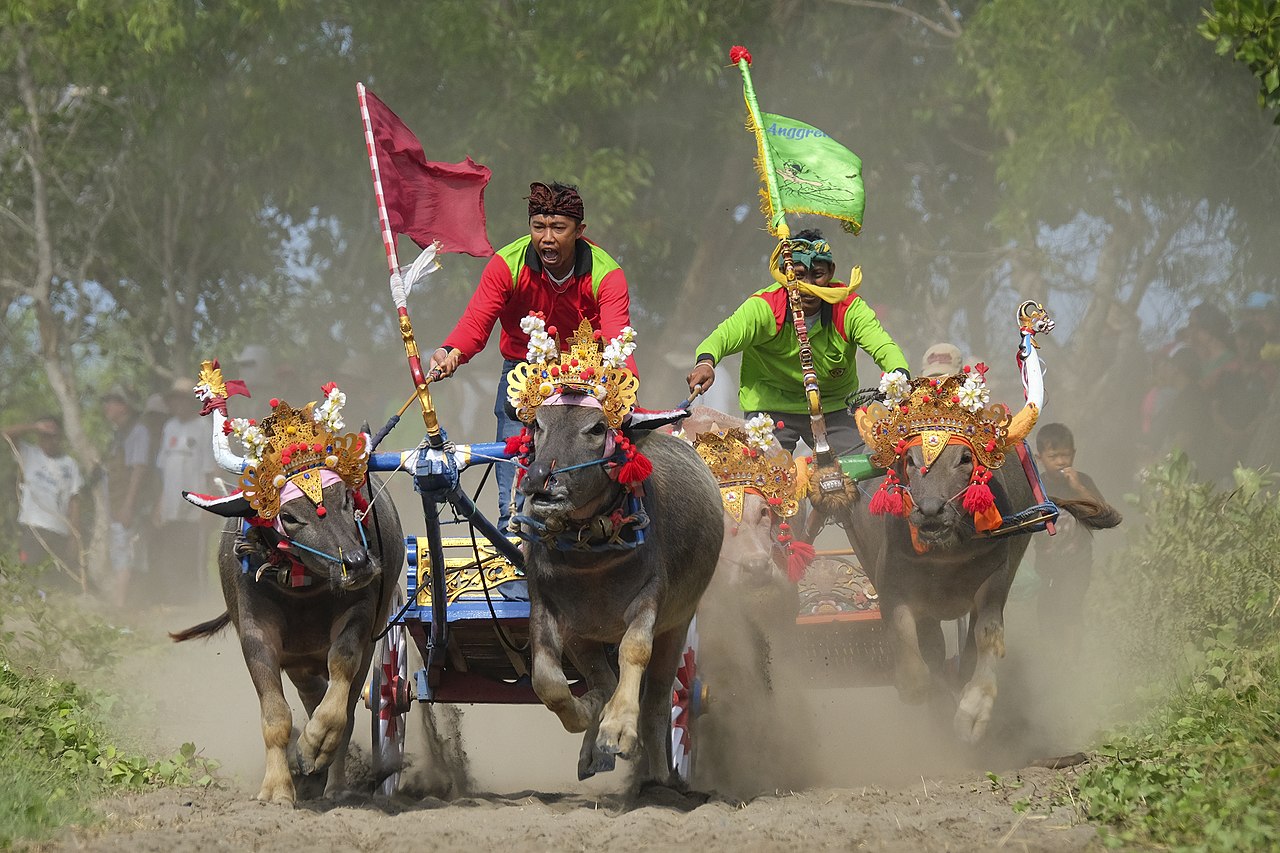
Buffalo racing (makepung lampit)
The word kepung means "to chase", and lampit is "the plow". The tradition of buffalo racing celebrates the rice harvest. It started with farmers racing each other to bring the rice from the fields back to the farm.
The jockeys or sais used to wear a headband (destar), shawl and sling (selempod), and a sword tucked in their belt, all of it as reminders of the dress of ancient Balinese royal warriors. These days there is no sword and they wear long-sleeved batik shirts. Since the 1960s, the races are no longer carried out with plows in wet mud but on paths among the rice fields. This modification occurred at the same time as the formation of the Makepung organisation, with the creation of two groups, namely the Regu Ijo Gading Timur, bearing a red flag; and the Regu Ijo Gading Barat bearing a green flag. The ploughs are gone and the jockeys ride in their stead small, light carts pulled by a pair of buffalos elaborately adorned. To minimize the risks, the race is in a line: the teams start one after the other with an equal distance between each team, and there usually is no overtaking. At the end of the race, the spacing between each team determines the winner: if the gap has widened, the first team wins; if it has reduced, the second team wins. The starting distance between tems is usually 10 m.
The Makepung season generally starts in July and ends in November, across various circuit locations. In Jembrana Regency there are seven circuits: Sangyang Cerik near the village of Tuwed, Tuwed (Melaya district), Delod Berawah (Mendoyo district), Pangkung Dalem (7 km west of Negara), Kaliakah (Negara district), Merta Sari (just south of Negara) and Awen (just south-west of Lelatang, Negara district). The teams run several races until the final governor's cup: "Jembrana Regent's Сup". The races occur generally on Sundays and usually start in the early mornings, around 7:30 am, and last some 5 hours. In Negara, the races are located 10 km south of town, in Perancak, each 28 of the month between July and November, gathering some 250 participants (pepadu) each year.
Tourism
Tourism is the mainstay of the economy of Jembrana Regency.
Some of the tourist attractions in Jembrana Regency:
Other places
Part of West Bali National Park is in the north-west point of this district.
Kaynak: Wikipedia – Jembrana Regency · CC BY-SA 4.0