
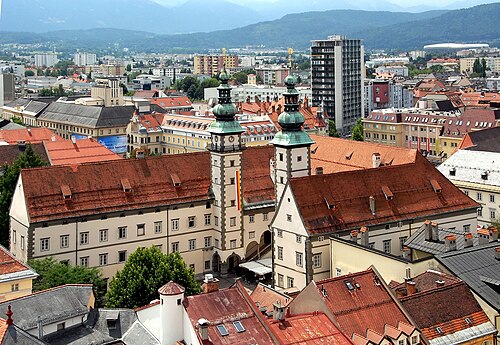

Klagenfurt am Wörthersee
Klagenfurt am Wörthersee ist eine Großstadt im Süden Österreichs sowie die Landeshauptstadt des österreichischen Bundeslandes Kärnten.
Government administration · Austria · 0 followers
Overview
Klagenfurt am Wörthersee ist eine Großstadt im Süden Österreichs sowie die Landeshauptstadt des österreichischen Bundeslandes Kärnten. Mit 105.734 Einwohnern ist sie die größte Stadt Kärntens und die sechstgrößte Stadt der Republik Österreich. Das Stadtgebiet liegt im Zentrum des Klagenfurter Beckens und hat derzeit eine Fläche von 120 km².
Interested in working with us in the future?
Follow to see new jobs and posts in your feed.
No news yet.
About

Klagenfurt am Wörthersee ist eine Großstadt im Süden Österreichs sowie die Landeshauptstadt des österreichischen Bundeslandes Kärnten. Mit 105.734 Einwohnern ist sie die größte Stadt Kärntens und die sechstgrößte Stadt der Republik Österreich. Das Stadtgebiet liegt im Zentrum des Klagenfurter Beckens und hat derzeit eine Fläche von 120 km².
Kaynak: Wikipedia · CC BY-SA 4.0
Geographie

Lage
Klagenfurt liegt auf dem Klagenfurter Feld im Zentrum des Klagenfurter Beckens und erstreckt sich über jeweils rund 15 km in nordsüdlicher und ostwestlicher Richtung. Die Stadt umfasst das gesamte Ostufer des Wörthersees, die Gebiete nördlich davon sind Teil des Feldkirchen-Moosburger Hügellandes und des Glantaler Berglandes. Teile des nördlichen Gemeindebezirks Wölfnitz zählen bereits zum Zollfeld, der Süden von Klagenfurt liegt am Fuß des Sattnitz-Höhenzugs.
Das Stadtzentrum liegt in etwa 450 m Seehöhe; der höchste Punkt innerhalb des Gemeindegebiets ist der Ulrichsberg mit 1022 m ü. A., der tiefste die Gurkerbrücke (420 m) an der Ostgrenze der Stadt.
Jeweils etwa ein Drittel des gut 120 km² großen Gemeindegebiets ist als landwirtschaftliche Fläche (33,4 %) bzw. Wald (32,9 %) ausgewiesen. 19,3 % der Fläche von Klagenfurt wird als Bauland genutzt, 2,2 % sind Gewässer und 1,3 % Gartenanlagen. Die übrigen 10,9 % fallen unter „sonstige Benützungsarten“, wozu unter anderem Verkehrswege, Abbauflächen und Ödland zählen.
Die Adria ist nur ca. 150 Kilometer von Klagenfurt entfernt. Die Stadt Triest ist über die Autobahn in ca. zwei Stunden erreichbar.
Geologie
Das gesamte Klagenfurter Becken wurde in der Eiszeit durch den Draugletscher ausgefüllt. Nach dem Abschmelzen der Eismassen bildeten Schwemmkegel der Glan den aus eiszeitlichen Schottern bestehenden Untergrund des heutigen nördlichen Stadtgebiets und des Zollfeldes. Gleichzeitig entstand auch der Wörthersee, der noch vor rund 4000 Jahren bis in das heutige Stadtzentrum reichte, wo sich durch allmähliche Verlandung ein großes Moorgebiet bildete.
Die Hügel im Norden der Stadt bestehen vorwiegend aus altkristallinen Glimmerschiefern und paläozoischen Phylliten, Grünschiefern und Kalken, der Sattnitz-Höhenzug südlich von Klagenfurt aus Konglomeraten.
Geschichte

Namensherkunft und Gründungssage
Etymologisch hat der Name Klagenfurt einen romanischen Ursprung und ist über Vermittlung des Slowenischen ins Deutsche gelangt. Heinz-Dieter Pohl hat die Bildung des slowenischen Namens Celovec für Klagenfurt, urkundlich erstmals im Jahr 1615 als V Zelovzi belegt, sprachwissenschaftlich rekonstruiert. Ausgangspunkt dafür war ein romanisches l’aquiliu mit der Bedeutung „Platz am Wasser“ – gemeint war aber nicht der Wörthersee, sondern der Fluss Glan.
Die romanische Ausgangsform wurde zunächst zu la quiliu umgeformt und ohne Artikel ins Slawische übernommen. Den Lautgesetzen entsprechend ist daraus cvilj- geworden. Dieses ist mit der bei Flur- und Ortsnamen häufigen Endung -ovec erweitert worden, wodurch Cviljovec entstand. Das ähnlich klingende slowenische Wort cvilja bedeutete so viel wie ‚Wehklage‘.
Im Slowenischen wurde der Name Cviljovec volksetymologisch zum „Ort der Klagen“ umgedeutet, was sich im Deutschen in der Lehnübersetzung Klagenfurt niederschlägt.
Nicht zutreffend sind demnach andere Herleitungen, etwa jene von Eberhard Kranzmayer vertretene von einer Klagefrau cvilja (= Klage), einer der sagenhaften slawischen Furt- und Wasserfrauen, die an Bächen und Quellen ihre Wäsche waschen und Todesfälle beklagen, oder von der Glan, wonach ein Glanfurt der Ursprung des Namens wäre. Dabei wird übersehen, dass es einen Fluss namens Glanfurt tatsächlich gibt, der jedoch bis ins 16. Jahrhundert Lanquart hieß und heute auch Sattnitz (slowenisch: früher: Lank(a)rt, heute: Sotnica, oder gelehrt: Jezernica = Seebach) genannt wird. Er ist der Abfluss des Wörthersees.
Eine noch ältere Herleitung, die aus der Zeit des Humanismus stammt, nennt den lateinischen Namen der römischen Stadt Claudiforum oder Forum Claudii als ursprüngliche Bezeichnung und beruft sich auf römische Quellen. Daraus soll sich der Name Klagenfurt entwickelt haben.
Bevölkerung

Mit dem Stichtag 1. Jänner 2026 hatte die Stadt Klagenfurt am Wörthersee 105.734 Einwohner.
Am 22. Februar 2016 verzeichnete die Stadt erstmals 100.000 Einwohner.
Das Ansinnen der Stadt Klagenfurt, die unmittelbaren Nachbargemeinden Ebenthal in Kärnten und Krumpendorf am Wörthersee einzugemeinden, scheiterte in der Vergangenheit am Widerstand der dort ansässigen Bevölkerung. Durch die von der Stadt Klagenfurt angeregte Eingemeindung zumindest einer der beiden Nachbargemeinden wäre nämlich die Einwohnerzahl der Stadt Klagenfurt am Wörthersee bereits wesentlich früher über 100.000 Einwohner gestiegen.
Bevölkerungsentwicklung
Klagenfurt hatte um das Jahr 1400 rund 3000 Bewohner. Nach dem Ausbau der Stadt im 16. und 17. Jahrhundert waren es um das Jahr 1750 bereits 7500 und um das Jahr 1820 wurde die 10.000-Einwohner-Marke überschritten.
Durch die Bildung politischer Gemeinden im Jahr 1850 kamen die heutigen Vorstädte zu Klagenfurt. Folglich hatte die Stadt bei der Volkszählung im Jahr 1869 bereits über 15.000 Einwohner.
Im 20. Jahrhundert sorgten die Eingemeindungen der Gemeinden Annabichl, St. Peter, St. Ruprecht und St. Martin sowie der Gemeinden Hörtendorf, Viktring, Wölfnitz und St. Peter/Bichl für eine erhebliche Vergrößerung des Stadtgebietes und der Bevölkerungszahl Klagenfurts.
Bevölkerungsstruktur
Der Anteil ausländischer Staatsangehöriger an der Bevölkerung Klagenfurts lag im Jahr 2010 bei rund 10 %, etwa ein Drittel davon (32,8 %) waren Bürger der Europäischen Union.
13.795 Einwohner Klagenfurts wurden nicht in Österreich geboren. Das entspricht einem Anteil von 14,8 %. Der Großteil der im Ausland Geborenen stammt aus den Ländern des ehemaligen Jugoslawien (5.799 Personen oder 6,2 % der Gesamtbevölkerung), die zweitgrößte Gruppe sind Deutsche (2.267 Personen oder 2,4 %).
Laut den Zahlen der Statistik Austria hatten per Stichtag 1. Jänner 2014 von den rund 97.000 Klagenfurtern 12.013 eine nicht-österreichische Staatsbürgerschaft (das entspricht 12,4 % der Klagenfurter Bevölkerung). 16.056 wurden im Ausland geboren (das entspricht einem Anteil von 16,6 % der Bevölkerung Klagenfurts).
Kultur und Sehenswürdigkeiten

Veranstaltungszentrum Klagenfurt (VZK)
Mit dem VZK am Alpen-Adria-Platz 1, geführt von einem non-profit Verein, hat die Stadt Klagenfurt ein unabhängiges Veranstaltungszentrum. Es bietet eine Bühne und Betreuung für Musik, Konzerte, Theater, Tanz, Performance, Literatur, Kabarett und Kleinkunst.
Theater
Das Gebäude des Stadttheaters Klagenfurt wurde im Jahr 1908, zum 60. Regierungsjubiläum von Franz Joseph I., von den Architekten Fellner und Helmer grundrissgleich mit jenen in Gießen und Gablonz erbaut und im Jahr 1910 feierlich eröffnet. Vor allem unter den Direktoren Herbert Wochinz (1968–1992) und Dietmar Pflegerl (1992–2007) hat das Stadttheater an überregionaler Bedeutung gewonnen. Beide Direktoren förderten während ihrer Amtszeit nicht nur die Aufführung klassischer Werke, sondern sorgten auch dafür, dass am Stadttheater Klagenfurt zahlreiche Ur- und Erstaufführungen stattfanden.
Das klagenfurter ensemble ist seit dem Jahr 1979 mit mehreren Produktionen im Jahr aktiv, darunter vor allem Ur- und Erstaufführungen österreichischer Autoren. Es hat seine Bühne im theaterHALLE11 am Messegelände.
Die Kammerlichtspiele – ein ehemaliges Kino in der Innenstadt – bieten ganzjährig ein reichhaltiges Kabarett- und Konzertprogramm. Das Theater KuKuKK zeigt dort seine Produktionen in den Bereichen Schauspiel und Theater für junges Publikum.
Das Jugendstiltheater Klagenfurt ist mit einem Fassungsvermögen von zehn Zusehern die kleinste Theaterbühne Österreichs und wird von VADA (Verein zur Anregung des dramatischen Appetits) mit Theaterstücken und Ausstellungen programmiert.
Slowenischsprachiges Theaterprogramm bietet das iKULT im Volkshaus/Ljudski dom, wo auch das Ensemble Teater Rampa ansässig ist. Im Kulturzentrum VENTIL am Kardinalplatz werden Theaterstücke von teatro zumbayllu (auf Deutsch und Spanisch) und VADA gezeigt. Professionelle Theaterensembles ohne eigene Bühne sind das Theater WalTzwerk (Schauspiel und Theater für junges Publikum) und das Teater Štrik (Figurentheater).
Wirtschaft und Infrastruktur

Arbeitsstätten, Beschäftigte und ansässige Unternehmen
Klagenfurt ist Kärntens wichtigster Wirtschaftsstandort, denn 22 % der Kärntner Gewerbebetriebe sowie 20 % der Kärntner Industriebetriebe befinden sich in der Landeshauptstadt.
Im Jahr 2001 waren in Klagenfurt 63.618 Personen in 6.184 Betrieben angestellt, 33 davon sind mit mehr als 200 Mitarbeitern Großunternehmen. Die Registerzählung der Statistik Austria vom 31. Oktober 2011 weist für die Stadt Klagenfurt eine steigende Zahl an Arbeitsstätten und Beschäftigten aus.
2011 gab es in Klagenfurt 8.832 Arbeitsstätten (Unternehmen) sowie 71.140 Beschäftigte (darunter 65.623 unselbständig Beschäftigte). 10.495 Auspendlern stehen 35.654 Einpendler gegenüber.
Die wesentlichsten Wirtschaftszweige der Stadt sind: die Leuchtmittelindustrie, mittelständische Handels- und Gewerbebetriebe sowie der Tourismus. In Klagenfurt haben sich auch einige internationale Unternehmen, wie z. B. Siemens und Philips, angesiedelt. Ein bedeutendes Unternehmen, das seinen Konzernsitz in Klagenfurt hat, ist die Kärntner Elektrizitätsgesellschaft AG (Kelag).
Ein zentrales Projekt in der Wirtschaftspolitik Kärntens ist seit Jahren der unmittelbar neben der Alpen-Adria-Universität gelegene Lakeside Science & Technology Park. Dieser Technologiepark soll eine enge Kooperation zwischen der Wirtschaft und der Forschung ermöglichen, daher wurde ein Standort in unmittelbarer Nähe zu den in Klagenfurt angesiedelten Hochschulen gewählt (Universität, Fachhochschule).
Er hat das Ziel, das Bundesland Kärnten und seine Hauptstadt Klagenfurt als wichtige Standorte im Bereich der sogenannten Spitzentechnologien zu etablieren. Klagenfurt ist außerdem Standort zweier bekannter Getränkeerzeuger, nämlich des Fruchtsaftherstellers Pago und der Spirituosenfabrik Stroh Austria.
Die Industrie- und Gewerbezone Ost (KIZ Ost) ist ein Wirtschaftsareal im Osten der Stadt. Dort angesiedelt sind das Biomasse-Heizkraftwerk (HKW) Klagenfurt Ost, Unternehmen wie Amazon oder Magna und weitere Logistik- und Produktionsunternehmen. Mit dem KIZ Ost II, ist eine 38 Hektar große Erweiterung des bestehenden Industriegebiets geplant.
Politik

Als Stadtgemeinde und Statutarstadt ist die politische Vertretung von Klagenfurt in einen Gemeinderat (Parlament) und den Stadtsenat (Regierung) unterteilt. Der Gemeinderat wird direkt vom Volk gewählt, die Mitglieder des Stadtsenats werden vom Gemeinderat gewählt, die Anzahl der Sitze ist jedoch durch die durch das Wahlergebnis bestimmten Anteile vorab festgelegt. Der Bürgermeister wird, wie in allen Gemeinden Kärntens, direkt gewählt.
Gemeinderat
Der Gemeinderat von Klagenfurt besteht aus 45 Mitgliedern und setzte sich nach der letzten Gemeinderatswahl im Jahr 2021 wie folgt zusammen:
Stadtsenat
Der Klagenfurter Stadtsenat (die Stadtregierung) besteht aus sieben Mitgliedern; derzeit sind dies:
1. Vizebürgermeister Ronald Rabitsch (SPÖ)
2. Vizebürgermeister Patrick Jonke (FSP)
Bürgermeister
Wie schon zuvor in anderen Städten Kärntens wurde in Klagenfurt im Jahr 1588 das Bürgermeisteramt geschaffen, um den Stadtrichter von seinen Aufgaben zu entlasten.
Erster Bürgermeister der Stadt wurde der Baumeister Christoph Windisch. Bis um die Mitte des 18. Jahrhunderts fanden die Bürgermeisterwahlen jährlich statt. Kaiser Joseph II. hob die städtische Selbstverwaltung auf, das Stadtoberhaupt wurde von nun an auf Lebenszeit ernannt. Ab dem Jahr 1807 gab es einen „geprüften“ Bürgermeister, dessen Posten öffentlich ausgeschrieben wurde. Nach der März-Revolution im Jahr 1848 wurde der Gemeinderat und aus seiner Mitte erstmals im Jahr 1850 der Bürgermeister gewählt.
Seit dem Jahr 1920 fand die Wahl des Gemeinderates und des Stadtoberhauptes nach dem allgemeinen, gleichen und geheimen Wahlrecht statt. In der nationalsozialistischen Zeit wurde der Bürgermeister ernannt. Seit dem Jahr 1945 gibt es die gemeinderechtliche Selbstverwaltung und seit dem März 1991 wird der Bürgermeister von Klagenfurt vom Volk direkt gewählt.
Wappen
Die Fahne zeigt die Stadtfarben Rot-Weiß-Grün.
Ünlü kişileri
Manfred Bockelmann, artist ve fotografçı
Karlheinz Miklin, profesör (the University of Klagenfurt)
Franz Xaver Altgraf von Salm-Reifferscheidt-Krautheim, kardinal
Adolf von Tschabuschnigg, yazar ve politikacı
Name
The Carinthian linguists Primus Lessiak and Eberhard Kranzmayer assumed that the city's name, which literally translates as 'ford of lament' or 'ford of complaints', had something to do with the superstitious thought that fateful fairies or demons tend to live around treacherous waters or swamps. In Old Slovene, a cviljovec is a place haunted by such a wailing female ghost or cvilya. Thus, they assumed that Klagenfurt's name was a translation made by the German settlers of the original Slovene name of the neighbouring wetland. However, the earliest Slovene mention of Klagenfurt in the form of v Zelouzi ('in Celovec', the Slovene name for Klagenfurt), dating from 1615, is 400 years more recent and thus could be a translation from German. A later interpretation is that Old Slovene cviljovec may itself derive from an Italic l'aquiliu 'place at or in the water', which would make the wailing-hag theory obsolete.
Pre-modern scholars attempted to explain the city's peculiar name using pseudo-etymologies: in the 14th century, the abbot and historiographer John of Viktring translated Klagenfurt's name in his Liber certarum historiarum as Queremoniae Vadus 'ford of complaint', Hieronymus Megiser, master of the university college of the Carinthian Estates in Klagenfurt and editor of the earliest printed history of the duchy in 1612, believed the name to mean 'ford across the Glan River', which, however, is impossible for linguistic reasons. The common people also sought an explanation in a story that a baker's apprentice was accused of theft and executed, but when the alleged theft turned out to be a mistake a few days afterwards, and the lad was proved innocent, the citizens' "lament" (Klagen) went forth and forth. This story was reported by Aeneas Silvius Piccolomini, who later became Pope Pius II.
History

Foundation
Legend has it that Klagenfurt was founded after a group of brave men slew an abominable winged "lindwurm" from the moors adjoining the lake, which was preying on the nearby duchy. The legend says that a tower at the edge of the moor was erected to watch out for the dragon, and that the dragon was baited using a bull fitted with a chain and hook, which caught the beast's palatal. A village was subsequently founded on the battlesite, which later expanded into a town, while the watchtower made way for a castle. The feat is commemorated by a grandiose 9-ton Renaissance monument, the Lindwurmbrunnen, in the city centre.
Historically, the place was founded by the Spanheim Duke Herman as a stronghold sited across the commercial routes in the area. Its first mention dates from the late 12th century in a document in which Duke Ulric II. exempted St. Paul's Abbey from the toll charge "in foro Chlagenvurth". That settlement occupied an area that was subject to frequent flooding, so in 1246 Duke Herman's son, Duke Bernhard von Spanheim, moved it to a safer position and is thus considered to be the actual founder of the market place, which in 1252 received a city charter.
Medieval history
In the following centuries, Klagenfurt suffered fires, earthquakes, invasions of locusts, and attacks from Ottomans, and was ravaged by the Peasants' Wars. In 1514, a fire almost completely destroyed the city, and in 1518 Emperor Maximilian I, unable to rebuild it, despite the loud protests of the citizens, ceded Klagenfurt to the Estates, the nobility of the Duchy. Never before had such a thing happened. The new owners, however, brought about an economic renaissance and the political and cultural ascendancy in Klagenfurt. A canal was dug to connect the city to the lake as a supply route for timber to rebuild the city and to feed the city's new moats; the noble families had their town-houses built in the duchy's new capital; the city was enlarged along a geometrical chequer-board lay-out according to the Renaissance ideas of the Italian architect Domenico dell'Allio; a new city centre square, the Neuer Platz, was constructed; and the new fortifications that took half a century to build made Klagenfurt the strongest fortress north of the Alps.
Geography
Location
The city of Klagenfurt is in southern Austria, near the border with Slovenia. It is in the lower middle of Austria, almost the same distance from Innsbruck in the west as it is from Vienna in the northeast.
Klagenfurt is elevated 446 metres (1,463 feet) above sea level and covers an area of 120.03 square kilometres (46+3⁄8 sq mi). It is on the lake Wörthersee and on the Glan river. The city is surrounded by several forest covered hills and mountains, with heights of up to 1,000 m (3,300 ft) (for example Ulrichsberg). To the south of the city is the Karawanken mountain range, which separates Carinthia from bordering nations of Slovenia and Italy.
Municipal arrangement
Klagenfurt is a statutory city of Carinthia, and the administrative seat of the district of Klagenfurt-Land, but is a separate district from Klagenfurt-Land. In fact, their licence plates are different (K for the city, KL for the district). Klagenfurt is divided itself into 16 districts:
It is further divided into 25 Katastralgemeinden. They are: Klagenfurt, Blasendorf, Ehrenthal, Goritschitzen, Großbuch, Großponfeld, Gurlitsch I, Hallegg, Hörtendorf, Kleinbuch, Lendorf, Marolla, Nagra, Neudorf, St. Martin bei Klagenfurt, St. Peter am Karlsberg, St. Peter bei Ebenthal, Sankt Peter am Bichl, St. Ruprecht bei Klagenfurt, Stein, Tentschach, Viktring, Waidmannsdorf, Waltendorf, and Welzenegg.
Climate
Klagenfurt has a typical humid continental climate (Köppen Dfb, Trewartha Dcbo), with a fair amount of fog throughout the autumn and winter, which occurs in 106 days annually. Summers are warm and wet, with frequent thunderstorms which happen in 43.8 days on average. Klagenfurt experiences 70.9 days annually with maximum temperature at or above 25 °C (77 °F), and 18.8 days in which the maximum temperature reaches 30 °C (86 °F). The rather cold winters are broken up by occasional warmer periods due to foehn wind from the Karawanken mountains to the south. On 52.9 days the depth of snow cover is at or above 1 cm (0.39 in), with 10.1 days having more than 20 cm (7.9 in) of snow depth. The average temperature from 1961 to 1990 was 7.1 °C (44.8 °F), while the average temperature in 1991-2020 period is 9.9 °C (49.8 °F).
Demographics
As of 2025, Klagenfurt had a population of 105,759.
In 2019, there were around 20,000 people who were born outside the country living in Klagenfurt, corresponding to around 20% of the city's population. The majority of immigrants come from the Balkans and Germany.
Sights

The Old City, with its central Alter Platz (Old Square) and the Renaissance buildings with their charming arcaded courtyards are a major attraction.
The Lindworm fountain of 1593, with a Hercules added in 1633
Landhaus, Palace of the Estates, now the seat of the State Assembly
the Baroque cathedral, built by the then Protestant Estates of Carinthia
Minimundus, the "small world on lake Wörthersee"
The Kreuzbergl Nature Park, with a viewing tower and observatory
The small but attractive botanical garden at the foot of Kreuzbergl, with a mining museum attached
The University Campus at the city's west end, with the adjacent Lakeside Science & Technology Park
Wörthersee (the warmest of the large Alpine lakes) with Europe's largest non-sea beach and lido, taking 12,000 bathers on a summer day
Maria Loretto peninsula, with its newly renovated stately home (recently acquired by the city from the Carinithian noble family of the Rosenbergs)
Economy
Klagenfurt is the economic centre of Carinthia, with 20% of the industrial companies. In May 2001, there were 63,618 employees in 6,184 companies here. 33 of these companies employed more than 200 people. The prevalent economic sectors are light industry, electronics, and tourism. There are also several printing offices.
The most important market place in Klagenfurt since 1948 is Benedikterplatz, formerly known as Herzogplatz. There is a market at Benediktenplatz twice a week with a diverse selection of food available for sale.
As well as the historical market, there are several shopping centres in Klagenfurt. The City-Arkaden shopping centre, founded in 2006, is located at the northern part of the city centre. The shopping centre has 120 businesses in a total floor area of 30 thousand square metres, and is one of the largest shopping centres in Carinthia. At the time of its foundation, it was one of the first shopping centres with a central arcade in the entire country of Austria.
The second-largest shopping centre in the city is Südpark, founded in 1998 and located near the Klagenfurt central station.
Transport

Klagenfurt Airport is a primary international airport with connections to several major European cities and holiday resorts abroad.
The city has the following train stations and stops that are integrated into the Carinthia S-Bahn system.
Klagenfurt central station (German: Hauptbahnhof) REX 1
The lines shown are valid from the December 2025 timetable.
The city is situated at the intersection of the A2 and S37 motorways. The A2 autobahn runs from Vienna via Graz and Klagenfurt to Villach and further to the state border of Italy. The S37 freeway runs from Vienna via Bruck an der Mur and Sankt Veit an der Glan to Klagenfurt. The Loibl Pass highway B91 goes to Ljubljana, the capital of Slovenia, which is only 88 km (55 mi) from Klagenfurt.
The volume of traffic in Klagenfurt is high (motorisation level: 572 cars/1000 inhabitants in 2007). Service on the city's streetcar (tram) system, as well as its trolleybus system, ended in April 1963. In the 1960s, Klagenfurt was meant to become a car-friendly city, with many wide roads. A motorway was even planned which was to cross the city partly underground, but which now by-passes the city to the north. The problem of four railway lines from north, west, south, and east meeting at the central station south of the city centre and strangulating city traffic has been eased by a considerable number of underpasses on the main arteries. Nevertheless, despite 28 bus lines, traffic jams are frequent nowadays as in most cities of similar size. Ideas of a rapid transport system using the existing railway rails, of an elevated cable railway to the football stadium, or of a regular motorboat service on the Lend Canal from the city centre to the lake have not materialized. But for those who fancy leisurely travel there is a regular motorboat and steamer service on the lake connecting the resorts on Wörthersee. During severe winters, which no longer occur regularly, it might be faster to cross the frozen lake on skates.
Culture

There is a civic theatre-cum-opera house with professional companies, a professional symphony orchestra, a university of music and a concert hall. There are musical societies such as Musikverein (founded in 1826) or Mozartgemeinde, a private experimental theatre company, the State Museum for Carinthia, a modern art museum and the Diocesan museum of religious art; the Artists' House, two municipal and several private galleries, a planetarium in Europa Park, literary institutions such as the Robert Musil House, and a reputable German-literature competition awarding the prestigious Ingeborg Bachmann Prize.
Klagenfurt is the home of a number of small but fine publishing houses, and several papers or regional editions are also published here including dailies such as Kleine Zeitung and Kärntner Krone.
Klagenfurt is a popular vacation spot, with mountains both to the south and north, numerous parks and a series of 23 stately homes and castles on its outskirts. In summer, the city is home to the Altstadtzauber (The Magic of the Old City) festival.
Several Carinthian Slovene cultural and political associations are also based in the city, including the Hermagoras Society, the oldest Slovene publishing house founded in Klagenfurt in 1851.
Annual events
Klagenfurt hosts several events annually.
Annual lectures and discussions of the international Ingeborg Bachmann awards ceremony for literature.
Annual international summer music concert and Gustav Mahler awards ceremony at the former monastery in Viktring.
"Wörtheresee Classics" festival at the concert house.
World Bodypainting Festival, the most famous body painting festival in the world, held at the Norbert Artner park in July.
The so-called "Kontaktna-leča – Kontaklinse-Festival" youth culture organised by Slovenian students, held in Klagenfurt since 1981.
Education

The city is home to the University of Klagenfurt and hosts a campus of the Fachhochschule Kärnten (Carinthia University of Applied Sciences), a college of education for primary and secondary teacher training and further education of teachers as well as a college of general further education (VHS) and two institutions of further professional and vocational education (WIFI and BFI). Among other Austrian educational institutions, there is a Slovene language Gymnasium (established in 1957) and a Slovene language commercial high school.
Tertiary
Klagenfurt Campus of Fachhochschule (FH) Kärnten, Carinthia University of Applied Sciences (CUAS)
Pädagogische Hochschule Viktor Frankl, a college of education
Health Science Centre with Academy for Midwifery and hospital-based Nursing school at the Klagenfurt State Hospital
Secondary
A number of general high schools such as
Europa-Gymnasium, Austria's second-oldest
BRG Klagenfurt-Viktring with emphasis on arts (music and drawing)
ORG St. Ursula, a private Catholic institutionf
and senior high schools offering general-cum-professional education:
Two schools of Engineering: HTL Lastenstrasse and HTL Mössingerstraße
Two commercial high schools: Handelsakademie No. 1 and No. 2
a Slovene-language Commercial High School ("Handelsakademie")
a high school of catering, fashion and design
a school of Alpine agriculture and nutrition science
a school of social management of the Caritas charity
Further education
College of Further Education Volkshochschule
Technical Training Institute of the Trade unions, Berufsförderungsinstitut (BFI)
Technical Training Institute of the Chamber of commerce, Wirtschaftsförderungsinstitut (WIFI)
evening schools (Gymnasium and Schools of Mechanical and Electrical Engineering)
Others
a school for social workers operated by the Austrian Caritas Charity
Sports
The ice hockey team EC KAC (Eishockey Club Klagenfurter Athletiksport Club) has won the top level Austrian Championship 30 times since its founding in 1909.
The Bundesliga football club SK Austria Kärnten was based in Klagenfurt, with their second-tier phoenix club Austria Klagenfurt also playing there.
Klagenfurt hosts the Start/Finish of the Austrian Ironman Contest, 3.8 km (2+3⁄8 mi) swim, 180 km (112 mi) cycling, and a 42 km (26 mi) run, part of the WTC Ironman series, which culminates in the Hawaii World Championships.
The World Rowing Championships were held on the Wörthersee in 1969.
The 2016 Beach Volleyball Major Series took place in Klagenfurt on 26–31 July.
Klagenfurt hosted three games during the UEFA Euro 2008 in the recently rebuilt Wörthersee Stadion. Klagenfurt was also a contender for the 2006 Winter Olympics and is home to an American football team, the Carinthian Black Lions, competing in the First League of the Austrian Football League. The Black Lions attract fans from all over Carinthia, playing home games in both Klagenfurt and Villach.
Notable natives and residents

Nobility, soldiers and diplomats
Bernhard von Spanheim (1176 or 1181 – 1256), House of Sponheim, was Duke of Carinthia for 54 years from 1202
Maximilian Daublebsky von Sterneck (1829–1897), Admiral Austro-Hungarian Navy
Prince Ludwig Gaston of Saxe-Coburg and Gotha (1870 in Ebenthal – 1942 in Innsbruck), prince of the House of Saxe-Coburg and Gotha-Koháry lived in Brazil until 1889
Countess Lucy Christalnigg von und zu Gillitzstein (1872–1914), Red Cross worker and motor racing driver
Hanns Albin Rauter (1895–1949), SS-general in Nazi-occupied Netherlands, executed war criminal
Odilo Globocnik (1904–1945), a leading Nazi official, born in Trieste, but later resided in Klagenfurt
Ernst Lerch (1914–1997), ran Operation Reinhard, the mass murder of Jews in the General Government
Wolfgang Petritsch (born 1947), diplomat, former UN High Representative for Bosnia and Herzegovina
Valentin Inzko (born 1949), diplomat, Carinthian Slovene, High Representative for Bosnia and Herzegovina
Ursula Plassnik (born 1956), diplomat and politician, Foreign Minister of Austria from 2004 to 2008
Prince Stefan of Liechtenstein (born 1961), Liechtenstein's Ambassador Extraordinary and Plenipotentiary to Germany
Public service
John of Viktring (ca. 1270–1347), late medieval chronicler and political advisor to the Duchy of Carinthia
Jurij Japelj (1744–1807), Slovene Jesuit priest, translator, and philologist
Matija Majar (1809–1892), Carinthian Slovene RC priest and political activist, went to school in Klagenfurt
Andrej Einspieler (1813–1888), Slovene politician, RC priest, journalist, "father of the Carinthian Slovenes"
Anton Janežič (1828–1869), Carinthian Slovene linguist, philologist, literary historian, went to school in Klagenfurt
Emanuel Herrmann (1839–1902), national economist, originated the pre-paid postal card
Felix Ermacora (1923–1995), human rights expert
Twin towns – sister cities

Klagenfurt is twinned with the following towns and cities.
Kaynak: Wikipedia – Klagenfurt · CC BY-SA 4.0