
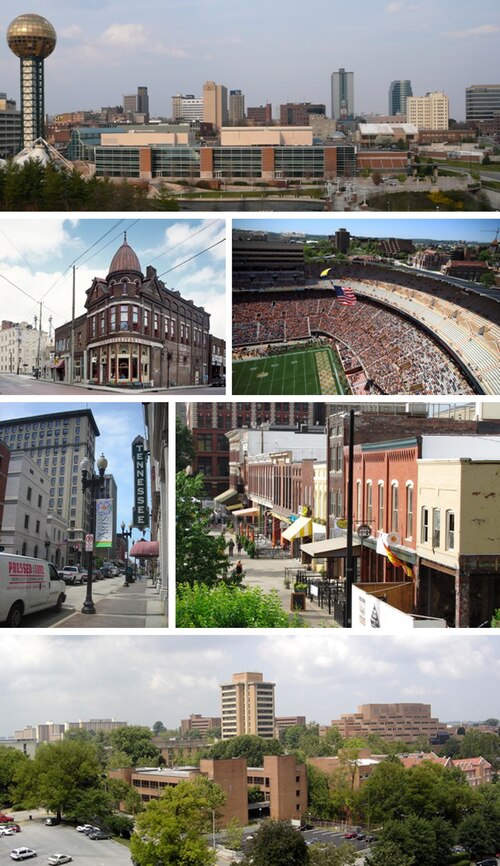
Overview
Knoxville es una ciudad estadounidense que se localiza en el condado de Knox en el estado de Tennessee, siendo la tercera ciudad más grande del estado, solo por detrás de Memphis y de Nashville. Además es la sede del condado de Knox y la ciudad más importante de dicho condado. Según el censo del año 2010, Knoxville tiene una población de 178 874 habitantes en la ciudad y 704.230 en el área metropolitana. Se encuentra ubicada en la zona donde confluyen los ríos Holston y French Broad, dando lugar al nacimiento del río Tennessee.
Interested in working with us in the future?
Follow to see new jobs and posts in your feed.
No news yet.
About

Knoxville es una ciudad estadounidense que se localiza en el condado de Knox en el estado de Tennessee, siendo la tercera ciudad más grande del estado, solo por detrás de Memphis y de Nashville. Además es la sede del condado de Knox y la ciudad más importante de dicho condado. Según el censo del año 2010, Knoxville tiene una población de 178 874 habitantes en la ciudad y 704.230 en el área metropolitana. Se encuentra ubicada en la zona donde confluyen los ríos Holston y French Broad, dando lugar al nacimiento del río Tennessee.
Kaynak: Wikipedia · CC BY-SA 4.0
Geografía

Knoxville está situado en las coordenadas geográficas: 35° 58′ 22″ al norte y 83°56′32″ al oeste. Según la oficina del censo de los Estados Unidos, la ciudad tiene un área total de 254,1 km². De los cuales 240 km² son de tierra firme y 14,1 km² son de agua.
En la parte sureste de la ciudad, el río French Broad —que fluye de Asheville, Carolina del Norte— se une al río Holston —que fluye de Kingsport— y forman el río Tennessee.
Las principales autopistas de la ciudad son la autopista 40 y la 75. La ciudad y los alrededores son servidos por el aeropuerto McGhee Tyson. El transporte público es proporcionado por el sistema de transporte de la ciudad. Además cuenta con varias líneas férreas.
Historia
Los primeros seres humanos en vivir en lo que ahora es Knoxville fueron la tribu Woodland, probablemente cerca del año 1000 AC. Un grupo de cazadores, los cuales provenían de la Región de los Grandes Lagos, se cree que se mudaron debido a los cambios climáticos.
Las tribus Shawnee y Creek ocuparon brevemente áreas pequeñas en el estado; aunque se ha encontrado poca evidencia arqueológica de este hecho. Aproximadamente en el siglo XVIII, los únicos indígenas que vivían permanentemente en los alrededores de esta área, eran los Cherokee. La gente Cherokee llamó a esta área "Shacomage", o "lugar del humo azul" (Place of Blue Smoke).
El contacto entre los colonos europeos y los nativos americanos fue bastante cordial, lo cual favoreció la expansión colonial hacia el oeste de las grandes montañas ahumadas (Great Smoky Mountains). El Fuerte Blanco fue fundado en 1786 por James White, oficial de la milicia durante la guerra revolucionaria americana. En 1791 el gobernador del Territorio Suroeste, Guillermo Blount movió la capital territorial al Fuerte Blanco y lo rebautizó con el nombre de Knoxville en honor a Henrio Knox, general revolucionario y primer secretario de defensa en el gobierno de George Washington.
Una de las primeras tareas de Guillermo Blount fue establecer contacto con los Cherokee para crear límites territoriales; esto se logró casi inmediatamente en el tratado de Houston (Treaty of Holston) en 1791. Por lo cual, él creyó que “había comprado” la mayor parte de lo que hoy es el este de Tennessee; sin embargo, los términos del tratado no fueron respetados y pronto entraron en conflicto, culminando en varios ataques grandes de los Cherokee contra la población de Knoxville: 200 Cherokee bajo el mando de Juan Watts entraron en Knoxville en el año 1792. En el año 1793 un segundo grupo de Cherokee atacó la estación Coveten. Ambos ataques fueron rechazados por los colonos de Knoxville. Los colonos en respuesta atacaron a los Cherokee varias veces también. En 1793 el gobierno invitó al jefe principal de los Cherokee para iniciar las negociaciones; sin embargo, los colonos de Knoxville en contra de las órdenes, atacaron a los Cherokee y mataron a la esposa del jefe. La paz fue renegociada en 1794.
Clima
El clima de la ciudad es subtropical húmedo, aunque la temperatura no es tan alta como en las áreas del sur y el oeste, esto debido a su elevación. Los veranos son calientes y muy húmedos, en julio el promedio de la temperatura más alta es de 31 °C y la más baja es de 20 °C. Los inviernos son generalmente fríos; en enero el promedio de la temperatura más alta es de 9 °C y la más baja es de –1 °C. La temperatura más alta que se ha registrado en la ciudad es de 41 °C, mientras que la temperatura más baja es de – 31 °C. El promedio de la precipitación anual es de 1319 milímetros y 12 cm de nieve.
Demografía
Según el censo del año 2000, hay 177 661 personas, 76.650 cabezas de familia, y 40.164 familias que residen en la ciudad; el área metropolitana tiene una población de 616.079. La densidad demográfica es de 724.6/km². Hay 84.981 casas, con una densidad promedio de 354.1/km².
La composición racial de la ciudad tiene:
Hay 76.650 cabezas de familia, de los cuales el 22.8 % tienen menores de 18 años viviendo con ellos, el 35.3 % son parejas casadas viviendo juntas, el 13.7 % son mujeres que forman una familia monoparental (sin cónyuge), y 47.6 % no son familias. El 11.4 % son personas mayores de 65 años que viven solos. El tamaño promedio de una familia es de 2.84 miembros.
En la ciudad el 19.7 % de la población tiene menos de 18 años, el 16.8 % tiene de 18 a 24 años, el 29.5 % tiene de 25 a 44, el 19.6 % de 45 a 64, y el 14.4 % son mayores de 65 años. La edad media es de 33 años. Por cada 100 mujeres hay 90 hombres. Por cada 100 mujeres mayores de 18 años hay 86.3 hombres.
Los ingresos medios de un cabeza de familia en la ciudad es de $27.492, y el ingreso medio familiar es $37.708. Los hombres tienen unos ingresos medios de $29.070 frente a $22.593 de las mujeres. El ingreso per cápita de la ciudad es de $18.171. El 14.4 % de la población y el 20.8 % de las familias están debajo de la línea de pobreza. Del total de gente en esta situación, 26.1 % tienen menos de 18 y el 12.0 % tienen 65 años o más.
Durante los años 1990, el promedio de crecimiento en el número de casas fue de 3,575 al año. A partir de 2000 a la actualidad, el crecimiento anual medio es 3,925; se espera que aumente a 4,300 en los próximos años.
Economía
Knoxville es sede de muchas industrias y fuentes de capital. Gracias a su localización central en los Estados Unidos y por estar cerca de dos autopistas importantes, varias compañías de distribución operan en los alrededores de la ciudad.
Universidades

En Knoxville se encuentra el principal campus de la Universidad de Tennessee. Otras universidades con sede en la ciudad son:
Cultura
Knoxville es una ciudad rica en cultura, tiene muchos festivales a través del año. Su principal exponente musical es el bluegrass.
La ciudad también recibe varios festivales de arte, incluyendo el festival del Dogwood en abril. También en abril es el festival de Rossini, es un festival de ópera y cultura italiana. El festival de Kuumba se celebra en junio con danzas, juegos, música, teatro, y la comida. Cada año, en el día del trabajo se realizan espectaculares exhibiciones de fuegos artificiales.
Lugares de interés
El Urban Wilderness, un concepto verdaderamente único, es un área recreativa de 1.000 acres situada justo al sur del centro de la ciudad. Cuenta con más de 50 millas de senderos para excursionismo, ciclismo de montaña y carrera a pie, además de sitios históricos y antiguas canteras utilizadas para nadar. Esta integración armoniosa de la aventura al aire libre con la comodidad urbana constituye una parte clave del atractivo moderno de Knoxville.
Deporte
Knoxville Noise (juegan en la [[American Basketball Association (siglo XXI)|ABA]])
Ciudades hermanas
Knoxville tiene 7 ciudades hermanas, las cuales son:
Kaynak: Wikipedia – Knoxville · CC BY-SA 4.0
History

Early history
The first people to form substantial settlements in what is now Knoxville were indigenous people who arrived during the Woodland period (c. 1000 B.C. to 1000 A.D.). One of the oldest artificial structures in Knoxville is a burial mound constructed during the early Mississippian culture period (c. 1000–1400 A.D.). The earthwork mound was preserved, but the University of Tennessee campus developed around it.
Other prehistoric sites include an Early Woodland habitation area at the confluence of the Tennessee River and Knob Creek (near the Knox–Blount county line) and Dallas phase Mississippian villages at Post Oak Island (also along the river near the Knox–Blount line) and at Bussell Island (at the mouth of the Little Tennessee River near Lenoir City).
By the 18th century, the Cherokee, an Iroquoian language people, had become the dominant tribe in the East Tennessee region. They are believed to have migrated from the Great Lakes region centuries earlier. They were frequently at war with the Creek and Shawnee.
The Cherokee people called the Knoxville area kuwanda'talun'yi, which means "mulberry place". Most Cherokee habitation in the area concentrated in what American colonists called the Overhill settlements along the Little Tennessee River, southwest of Knoxville.
The first white traders and explorers arrived in the Tennessee Valley in the late 17th century. There is significant evidence that Spanish explorer Hernando de Soto visited Bussell Island in 1540.
However, the first major recorded Euro-American presence in the Knoxville area was the Timberlake Expedition, which passed through the area in December 1761 at the confluence of the Holston River and French Broad River into the Tennessee River. A British soldier and Anglo-American emissary from the Thirteen Colonies to the Overhill settlements, Henry Timberlake appreciated the Tennessee's deep waters after his party had spent several weeks struggling down the relatively shallow Holston.
Geography

Topography
According to the United States Census Bureau, the city has a total area of 104.2 square miles (269.8 km2), of which 98.5 square miles (255.2 km2) is land and 5.6 square miles (14.6 km2), or 5.42%, is water. Elevations range from just over 800 feet (240 m) along the riverfront to just over 1,000 feet (300 m) on various hilltops in West Knoxville, with the downtown area setting at just over 900 feet (270 m). High points include Sharp's Ridge in North Knoxville at 1,391 feet (424 m) and Brown Mountain in South Knoxville at 1,260 feet (380 m).
Knoxville is situated in the Great Appalachian Valley (known locally as the Tennessee Valley), about halfway between the Great Smoky Mountains to the east and the Cumberland Plateau to the west. The Great Valley is part of a sub-range of the Appalachian Mountains known as the Ridge-and-Valley Appalachians, which is characterized by long narrow ridges flanked by broad valleys. Prominent Ridge-and-Valley structures in the Knoxville area include Sharp's Ridge and Beaver Ridge in the northern part of the city, Brown Mountain in South Knoxville, parts of Bays Mountain just south of the city, and parts of McAnnally Ridge in the northeastern part of the city.
The Tennessee River, which passes through the downtown area, is formed in southeastern Knoxville at the confluence of the Holston River, which flows southwest from Virginia, and the French Broad River, which flows west from North Carolina. The section of the Tennessee River that passes through Knoxville is part of Fort Loudoun Lake, an artificial reservoir created by TVA's Fort Loudoun Dam about 30 miles (48 km) downstream in Lenoir City. Notable tributaries of the Tennessee in Knoxville include First Creek and Second Creek, which flow through the downtown area, Third Creek, which flows west of U.T., and Sinking Creek, Ten Mile Creek, and Turkey Creek, which drain West Knoxville.
Demographics
2020 census
As of the 2020 census, Knoxville had a population of 190,740 residents in 82,857 households and 41,073 families. The median age was 33.3 years, with 18.7% under the age of 18 and 14.5% aged 65 or older; 16.5% were between 18 and 24, 29.0% were 25 to 44, and 21.3% were 45 to 64. For every 100 females there were 92.4 males, and for every 100 females age 18 and over there were 90.2 males age 18 and over.
99.9% of residents lived in urban areas, while 0.1% lived in rural areas.
There were 82,857 households in Knoxville, of which 23.0% had children under the age of 18 living in them. Of all households, 30.6% were married-couple households, 25.0% were households with a male householder and no spouse or partner present, and 36.1% were households with a female householder and no spouse or partner present. About 38.6% of all households were made up of individuals and 11.8% had someone living alone who was 65 years of age or older.
There were 91,908 dwelling units, of which 9.8% were vacant. The homeowner vacancy rate was 2.2% and the rental vacancy rate was 8.6%.
The 2020 census reported a population density of 1,932.1 per square mile (746.0/km2) and 91,908 housing units at an average density of 931.0 per square mile (359.5/km2).
American Community Survey (2016–2020)
The 2016–2020 American Community Survey 5-year estimates show that the average household size was 2.2 and the average family size was 3.0, and that 23.6% of residents 25 and older had earned a bachelor's degree or higher.
The same ACS estimates place the median household income at $41,598 (± $1,071) and the median family income at $55,835 (± $1,423); males had a median income of $29,741 (± $1,153) versus $24,105 (± $1,370) for females, and the median income for those 16 years old and over was $26,589 (± $591). Approximately 15.9% of families and 22.5% of the population were below the poverty line, including 30.1% of those under the age of 18 and 12.5% of those ages 65 or over.
Economy
In 2011, 15.9% of the Knoxville MSA work force was employed by government entities, while 14.1% were employed in the professional service sector, 14% worked in education or health care, 12.7% were employed in the retail sector, 10.5% worked in leisure and hospitality, and 8.9% worked in the manufacturing sector. The region had an unemployment rate of 7.9% in 2011. In the 2010 ACCRA Cost of Living Index was rated 89.6 (the national average was 100). In 2007, there were over 19,000 registered businesses in Knoxville. The city's businesses are served by the 2,100-member Knoxville Area Chamber Partnership. The Knoxville Chamber is one of six partners in the Knoxville-Oak Ridge Innovation Valley, which promotes economic development in Knox and surrounding counties.
Major corporations
The TVA, the nation's largest public power provider, reported $10.5 billion in revenue in 2021 and employs over 12,000 region-wide. The largest company based in Knoxville is privately held Pilot Flying J, the nation's largest truck stop chain and sixth-largest private company, which reported over $29.23 billion in revenue in 2012. Knoxville is home to the nation's fourth-largest wholesale grocer, the H. T. Hackney Company, which reported $3.8 billion (~$5.17 billion in 2025) in revenue in 2012, and one of the nation's largest digital-centric advertising firms, Tombras Group, which reported $80 million in revenue in 2011.
Other notable privately held companies based in the city include Bush Brothers, Sea Ray (and its parent company Brunswick Boat Group), Thermocopy, Petro's Chili & Chips, EdFinancial, Kurgo, 21st Mortgage and AC Entertainment. Also based in Knoxville are movie theater chain Regal Cinemas, and health care-staffing firm TeamHealth.
Real estate
The Knoxville area is home to 596 office buildings which contain over 21 million square feet of office space. The city's largest office building in terms of office space is the City-County Building, which has over 537,000 square feet of office space. The First Tennessee Plaza and the Riverview Tower were the largest privately owned office buildings, with 469,672 square feet and 367,000 square feet, respectively. Knoxville's largest industrial park is the 1,460-acre (590 ha) Forks of the River Industrial Park in southeastern Knoxville. Other major industrial and business parks include the 800-acre (320 ha) EastBridge Industrial Park and Midway Business Park in eastern Knox County and the 271-acre (110 ha) WestBridge Industrial Park in western Knox County.
Arts and culture

Knoxville is home to a rich arts community and has many festivals throughout the year. Its contributions to old-time, bluegrass and country music are numerous, from Flatt and Scruggs and Homer and Jethro to The Everly Brothers.
The Knoxville Symphony Orchestra (KSO), established in 1935, is the oldest continuing orchestra in the southeast. The KSO maintains a core of full-time professional musicians and performs at more than 200 events per year. Its traditional venues include the Tennessee Theatre, the Bijou Theatre, and the Civic Auditorium, though it also performs at several non-traditional venues. The Knoxville Opera performs a season of opera every year, accompanied by a chorus. Knoxville was the location of Sergei Rachmaninoff's final concert in 1943, performed at Alumni Memorial Auditorium at the University of Tennessee.
Knoxville's underground music scene is rooted with the promotion by AC Entertainment around 1979. AC Entertainment, a local entertainment group, sought to expand the city's scene. In the 1990s, noted alternative rock critic Ann Powers referred to the city as "Austin without the hype". Knoxville is home to a vibrant punk rock scene, having emerged from venues in the Old City district, specifically the Mill & Mine and Pilot Light venues. Such punk and hardcore bands include UXB, the STDs, and Koro. Knoxville hosts the Big Ears music festival since 2009. The festival, dubbed the "most ambitious avant-garde festival in America in more than a decade" in a 2014 Rolling Stone article, hosts musicians ranging from punk rock to chamber pop.
In literature, Southern Gothic author Cormac McCarthy is from Knoxville, and several of his books feature the city, such as Suttree, a 1979 semi-autobiographical novel. James Agee also lived in the city, and his 1957 posthumous autobiographical novel A Death in the Family provides a portrait of life in Knoxville, while also wrestling with the death of Agee's father in a car accident, and the impact this had on his family. Writer Alex Haley later moved to the city of Norris north of Knoxville, served as an advisor for city's committee preparing for the 1982 World's Fair and as an adjunct professor for the University of Tennessee. In the comic book industry, writers Lowell Cunningham and Walt Simonson are from the city.
Sports
The University of Tennessee's athletics programs, nicknamed the "Volunteers", or "the Vols", are immensely popular. Neyland Stadium, where the Vols' football team plays, is one of the largest stadiums in the world seating 101,915, and Thompson–Boling Arena, home of the men's and women's basketball teams, is one of the nation's largest indoor basketball arenas. The telephone area code for Knox County and eight adjacent counties is 865 (VOL). Knoxville is also the home of the Women's Basketball Hall of Fame, almost entirely thanks to the success of Pat Summitt and the University of Tennessee women's basketball team.
Professional sports teams located in Knoxville include:
Government

Knoxville is governed by a mayor and nine-member City Council. It uses the strong-mayor form of the mayor-council system. The council consists of six members from single-member districts and three members elected at-large for the entire city. The council chooses from among its members the vice mayor (currently Lynne Fugate), the Beer Board chairperson (currently Debbie Helsley), and a representative to the Knoxville Transportation Authority (currently Matthew DeBardelaben). The City Council meets every other Tuesday at 7:00 p.m. in the Main Assembly Room of the City County Building.
The current mayor is Indya Kincannon, who was sworn in as the city's second female mayor on December 21, 2019, replacing the first female mayor of the city, Madeline Rogero, who was elected in 2011. Interim mayor Daniel Brown, the first African American to hold the office, was appointed in January 2011 following the resignation of Bill Haslam, who was elected Governor of Tennessee. Other recent mayors include Haslam's predecessor, Victor Ashe (1987−2003), Kyle Testerman (1972−1975, 1984−1987), and Randy Tyree (1976−1983).
The Knoxville Fire Department (KFD) provides Class 2 ISO service inside the city limits. The fire department operates 19 stations with 308 uniformed personnel. KFD provides firefighting, first responder EMS response, vehicle extrication and HazMat response within the city limits.
The Knoxville Police Department serves the citizens of Knoxville with 378 officers and a total of 530 employees. Chief Paul Noel has led the department since June of 2022.
911 ambulance service inside Knoxville is provided by AMR Ambulance under contract with Knox County.
Knoxville is home to the Tennessee Supreme Court's courthouse for East Tennessee.
City Council
Knoxville is governed by a mayor and a nine-member City Council, six of which represent from single-member districts and three members are elected at-large. Council members are elected through a nonpartisan, district-wide primary in which top two vote-getters advance to a city-wide runoff election in November. Council members are elected to serve a four-year term that is eligible for reelection once.
Education
Knoxville is home to the main campus of the University of Tennessee (UTK), which has operated in the city since the 1790s. As of 2011, UTK had an enrollment of over 27,000 and endowments of over $300 million. The school employs over 1,300 instructional faculty, and offers more than 300 degree programs.
Pellissippi State Community College is a two-year school governed by the Tennessee Board of Regents that offers transfer programs, two-year degrees, and certificate programs. Its main campus is located off Pellissippi Parkway in western Knox County. As of 2011, the school had a system-wide enrollment of over 11,000 students.
Johnson University (formerly Johnson Bible College) is a Bible college affiliated with the Christian churches and churches of Christ. As of 2012, the school had an enrollment of 845. Johnson traditionally specializes in training preachers and ministers, but also offers degrees in counseling, teaching, music, and nonprofit management.
South College (formerly Knoxville Business College) is a for-profit school located in West Knoxville that offers undergraduate and graduate programs in business, health care, criminal justice, and legal fields. The school had an enrollment of 717 as of 2010.
Knoxville College was a historically Black college that began operating in Knoxville in the 1870s. The school offered a Bachelor of Science in Liberal Studies and an Associate of Arts degree. Knoxville College had an enrollment of about 100 students as of 2010 and closed permanently in 2015.
Institutions with branch campuses in Knoxville include Carson-Newman University, King University, Lincoln Memorial University (namely, the Duncan School of Law), National College of Business & Technology, Roane State Community College, Strayer University, Tennessee Wesleyan University, and Tusculum University. Virginia College offers career programs in Knoxville. Huntington University of Health Sciences, which offers distance courses in nutrition and health, has its offices in Knoxville.
Media
The Knoxville News Sentinel is the local daily newspaper in Knoxville, with a daily circulation of 14,247 as of 2025.
The city is home to several weekly, bi-weekly, and monthly publications.
As of 2011, the Knoxville television market was the 61st largest in the U.S. with 527,790 homes, according to Nielsen Market Research. The largest local television station is NBC affiliate WBIR-TV, with 28,305 viewing households, followed by ABC affiliate WATE-TV (23,559), CBS affiliate WVLT-TV (20,052), Fox affiliate WTNZ (10,319), and CW affiliate WBXX-TV (5,415). Other local stations include WKNX-TV (Ind.), WVLR (CTN) and WPXK (Ion). East Tennessee PBS operates Knoxville's Public Broadcasting Service station at WKOP 17.
Discovery, Inc. operates the former Scripps Networks Interactive cable television networks from Knoxville, including HGTV, Magnolia Network, Food Network and Cooking Channel. Jewelry Television, a home shopping channel, is also based in the city, and several companies that provide production services to the ex-SNI networks also maintain Knoxville operations.
According to Arbitron's 2011 Radio Market Rankings, Knoxville had the nation's 72nd-largest radio market, with 684,700 households. In 2010, country music station WIVK (107.7 FM) had the market's highest AQH share at 16.3, followed by adult contemporary station WJXB (97.5 FM) at 10.1, and news/talk station WCYQ (100.3 FM) at 8.3. Other stations include Rock music stations WIMZ (103.5 FM) and WNFZ (94.3), Rhythmic Top 40 station WKHT (104.5 FM), contemporary hit station WWST (102.1 FM), and National Public Radio station WUOT (91.9 FM). The University of Tennessee radio station operates under WUTK (90.3 FM).
Filming location
A number of films and television programs were filmed in the city, such as the 1950 film noir Woman in Hiding starring Ida Lupino and Howard Duff, the 1963 film All the Way Home which was based on Knoxville native James Agee's novel A Death in the Family, the 1965 film The Fool Killer starring Anthony Perkins and Edward Albert, the 1970 film A Walk in the Spring Rain starring Anthony Quinn and Ingrid Bergman, the 1996 film Box of Moonlight, starring John Turturro and Sam Rockwell, the 1999 film October Sky starring Jake Gyllenhaal and Chris Cooper, the 2000 film Road Trip at the University of Tennessee campus, the 2004 film The Heart Is Deceitful Above All Things, the 2009 film That Evening Sun starring Hal Holbrook and Ray McKinnon, the 2017 film The Last Movie Star starring Ariel Winter and Burt Reynolds in one of his last roles, and the 2019 film Light from Light starring Marin Ireland and Jim Gaffigan.
Infrastructure

Health
Knox County's hospital system contains over 2,600 licensed beds in seven general use hospitals and one children's hospital. The city's largest hospital as of 2011 was the University of Tennessee Medical Center, which had 581 beds, followed by Fort Sanders Regional Medical Center (541), Parkwest Medical Center (462), and Physicians Regional (370). The city's largest ambulatory surgery center was the Parkwest Surgery Center, which employed 58 physicians and 35 nurses, followed by the Fort Sanders West Outpatient Surgery Center and the St. Mary's Ambulatory Surgery Center South.
2021 County Health Rankings places Knox county at 13th out the 95 counties. Life expectancy was 76.3 years. Health behaviors noted: 19% smokers versus state average of 21%, 29% of the population is obese vs 33% for the state, excessive drinking is 19% vs 17%, drug overdoses 52 per 100,000 with the state at 28 overdoses per 100,000.
In the 2010s, Knoxville's air quality continued to greatly improve over that of past decades according to the American Lung Association's State of the Air 2017.
Utilities
The Knoxville Utilities Board (KUB) provides electricity, water, and wastewater management to Knoxville residents and businesses. KUB's service area covers 688 square miles and includes over 5,200 miles of power lines providing electricity to over 196,000 customers. The average electric bill was just over $96 per month. KUB purchases its electricity from the Tennessee Valley Authority.
Highways
The two principal interstate highways serving Knoxville are Interstate 40, which connects the city to Asheville (directly) and Bristol (via I-81) to the east and Nashville to the west, and Interstate 75, which connects the city to Chattanooga to the south and Lexington to the north. The two interstates merge about 20 miles (32 km) west of Downtown Knoxville near Dixie Lee Junction and diverge as they approach the Downtown area, with I-40 continuing on through the Downtown area and I-75 turning north. Interstate 640 provides a bypass for I-40 travelers, and Interstate 275 provides a faster connection to I-75 for Downtown travelers headed north. A spur route of I-40, Interstate 140 (Pellissippi Parkway), connects West Knoxville with McGhee Tyson Airport and Maryville.
In popular culture
Knoxville has appeared in music, literature and television. Film director Quentin Tarantino was born in Knoxville, and the city and East Tennessee are frequently mentioned in his films, such as in the 1994 film Pulp Fiction, in which Bruce Willis' character (and the watch given to him by Christopher Walken's character) is from Knoxville.
Mark Twain wrote about a gunfight in downtown Knoxville involving Joseph Mabry Jr., owner of the city's antebellum Mabry-Hazen House in Life on the Mississippi from 1883. Several other books take place in fictionalized versions of the city, such as the 1915 Anne W. Armstrong novel, The Seas of God, and David Madden's 1974 novel, Bijou, is set in a fictional city known as "Cherokee", based on Knoxville.
The first part of James Herman Robinson's 1950 autobiography, The Road Without Turning, takes place in Knoxville, and "The Man in the Overstuffed Chair", a 1985 short story by playwright Tennessee Williams, gives a brief description of the death of Williams' father, Cornelius, at a Knoxville hospital, and his subsequent burial at Old Gray Cemetery.
Pulitzer Prize-winning author Peter Taylor's last novel in 1994, In the Tennessee Country, refers to a "Knoxville cemetery" where the main character's grandfather (a fictitious politician) is buried. This may refer to Old Gray Cemetery, where Taylor's own grandfather, Governor Robert Love Taylor, was originally buried in 1912.
Swiss travel writer Annemarie Schwarzenbach visited Knoxville in the 1930s, and wrote an essay about the city, "Auf der Schattenseite von Knoxville", which was published in the December 1937 edition of the Swiss magazine, National Zeitung.
A number of songs and music compositions are about or feature Knoxville as well. "The Knoxville Girl", first recorded in 1924, is traditional Appalachian ballad. Classical composer Samuel Barber's "Knoxville: Summer of 1915" from 1947 is a voice & orchestra piece based on 1938 short prose by James Agee. Dire Straits guitarist Mark Knopfler composed and recorded a honky-tonk song entitled "Daddy's Gone to Knoxville" on his 2002 solo album, The Ragpicker's Dream, "The Ballad of Thunder Road" by Robert Mitchum references Knoxville's Bearden community, and other musicians such as Steve Earle, Ronnie Milsap, and Hank Williams, Jr. have mentioned the city in lyrics. Hank Williams, Hank Jr.'s father, spent his last day alive in Knoxville as well. Country singer Kenny Chesney is from Knoxville.
Kaynak: Wikipedia – Knoxville, Tennessee · CC BY-SA 4.0