
Libon
Libon, officially the Municipality of Libon, is a municipality in the province of Albay, Philippines.
Government administration · Philippines · 0 followers
Overview
Libon, officially the Municipality of Libon, is a municipality in the province of Albay, Philippines. According to the 2024 census, it has a population of 72,135 people.
Interested in working with us in the future?
Follow to see new jobs and posts in your feed.
No news yet.
About

Libon, officially the Municipality of Libon, is a municipality in the province of Albay, Philippines. According to the 2024 census, it has a population of 72,135 people.
Kaynak: Wikipedia · CC BY-SA 4.0
Etymology
The town of Libon, as it is presently known, was originally called Libong. It is not known when and how the letter "g" was dropped. Some writers believe that the Spaniards must have found it difficult to pronounce the word "Libong" with the letter "g", so that in due time Libong became Libon. There are conflicting and various versions regarding the origin of the name Libong. Some say that the word must have been derived from the Bicol term "libong" or "ribong", meaning puzzled, dizziness, losing one's sense of direction, or becoming oriented. Others believe that the word Libon must have originated from a Spanish term "libon", which means "assault".
Another version is that the word is a corruption of the Bicol word "libtong", meaning difficulty, obstacle or pool of stagnant water, which when applied to a place could mean a difficult or stagnant place. The more popular and perhaps more plausible version is the claim that Libon originated from the Bicol term "libong" or "ribong", and there is a story which seems to support this view. The story goes that Captain Juan de Salcedo and his men arrived in this place, by sailing across Lake Bato and entering the river called, Quimba. Sailing upstream, they finally landed in a place called Linao; (Linao is one of the barrios of Libon today and is situated on the banks of Quimba River). Here Salcedo and his men proceeded to find a town. However, after exploring the surrounding area and noting that Linao was at the foot of a mountain range, making it vulnerable to enemy attacks from the surrounding mountains, Salcedo and his men, with some natives as their guide, decided to move on to a more suitable place. Traveling across marshy land, they arrived at a slightly elevated area. Upon looking around and trying to determine where they were, one native guide remarked, "libong aco". (I am confused). The Spaniards on hearing the word "libong" understood it to mean the name of the place. Hence, Salcedo named it "Santiago de Libon."
History

The town of Libon traces its origins to the "Second Expedition of Juan de Salcedo to the Bicol Region in 1573.' Travelling through the northern passageway, Salcedo had first arrived in the region in 1571, shortly after his uncle's (Miguel Lopez de Legazpi) seizure of Manila. Legazpi had ordered his nephew to subdue the area around Manila and in the process Salcedo heard rumors that "somewhere beyond the mountains of southern Luzon was a place called Paracale with its fabulous gold mines." He spent an undisclosed amount of time searching for the rumored mines, but returned to Manila upon the orders of his uncle, vowing to return to the Bicol Region as soon as he could.
He accomplished this in early 1573. "Salcedo undertook his second trip to the Bicol Region retracing his first route and with the wealth of information that he gathered during his first arrival in the region, he led his men beyond Paracale." He continued upstream on the Bicol River upstream and reached its source, Bato Lake. On the shore of the lake Salcedo established the beginnings of a "[s]ettlement for Spaniards and named it Santiago de Libong."
It appears from the accounts about the finding of Libon that this town occupies a prominent place in the history of the Bicol Region for two main reasons. First, it is the first settlement for Spaniards established in the Bicol Region, and by no less than Captain de Salcedo, recognized as the Spanish "Conquistador" of this part of Luzon. Second, Libon, during the early days of the Spanish conquest of Bicolandia, also served as the starting point for the organized propagation of the Christian faith in this region. Also, Libon possessed a prosperous and complex precolonial society, that is why it was chosen as a royal villa.
Saint James the Greater Parish
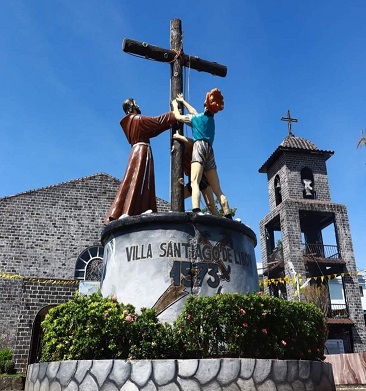
In 1573, Juan de Salcedo set up the garrison named Santiago de Libong, and a church was constructed under the patronage of Saint James the Apostle. In 1578, when the Franciscans arrive, it was ceded to the province under San Gregorio Magno. A church made of red bricks was constructed in Linao in 1591. This church was destroyed in mid 17th century and a new church was constructed. The 1818 census showed the area had 410 native families and 1 Spanish-Filipino family.
Geography
The housing growth rate in Libon is 1.08% per annum, the municipality has a land area of 222.76 square kilometres (86.01 sq mi) constituting 8.65% of the 2,575.77-square-kilometre- (994.51 sq mi) total area of Albay.
The municipality lies at the Northwestern Quadrant of the province of Albay. The distance is about 46-54 kilometers away from Legazpi City and approximately 546 kilometers south of Manila. It is located geographically between 1308’2’’ and 20’354.5’’ north and between 1243014’25.2’’ and 29’19.4’’ east longitude. Libon is bounded on the North by the Municipality of Bato in the province of Camarines Sur; on the South by the municipality of Oas; on the East by the municipality of Polangui; and on the West by the Burias Pass and Ragay Gulf.
The topography of Libon is generally characterized as plain to undulating; extensive alluvial floodplain on its eastern flank, gently rolling to sloping uplands and steep mountains on its central western parts.
The elevation ranges from 0 to 400 meters above sea level. More than five percent of the area has elevation ranging from 100 to 150 meters above sea level. The surface terrain is generally plain. Barangays in the Big Six, Centro Poblacion, and Palayan League mostly constitute the plain areas. The barangays within the Coastal League occupies the coastal zones of 664 hectares although 40 percent of its area is mountainous surface terrain.
The Municipality has six types of soil. The predominant soil type is the Agustin soil or clay-loam, which is mostly found in the leagues of Interior Eight, Big Six, and Six Hills. The Magsaysay soil or the sandy-loam is identified in the coastal areas and is suitable for rice production. The Sevilla soil or clay and sandy-clay type are principally in hilly landscape.
The Municipality also borders Lake Bato in the north.
Demographics
In the 2024 census, Libon had a population of 72,135 people. The population density was 320 inhabitants per square kilometre (830/sq mi).
According to NSO in 2010, a barangay is classified as urban if it has a population greater than or equal to 5,000; or at least one establishment with a minimum of 100 employees; or five or more establishments with 10-99 employees, and five or more facilities within the two-kilometer radius from the barangay hall.
In this municipality, fourteen (14) barangays were classified by the National Statistics Office (NSO) as urban and 33 as rural barangays. Those barangays classified as urban are Barangays Bonbon, Buga, Pantao, San pogi, San Isidro, San Jose, San Vicente and Zone 1-7 of Centro Poblacion.
Using the 2015 PSA data on population, it was figured that 33,081 of the total population reside at urban areas while slight majority of the population (39,467) reside in rural barangays.
Population data by urban-rural classification of areas which date back to 1995 up to 2015 show that most of the population resides at rural areas. However, there was an abrupt decrease of rural settlers from 69.77% in 2010 to 54.40% in 2015. This is postulated to be due to availability and accessibility of social services in urban areas.
Economy
Farming and fishing are Libon's major economic activities. Based on the NSO Census 2015, most of the gainful workers (12,172) of the municipality are farmers and fisherfolks. Out of which, 5,301 (43.55%) of those who are devoted to agriculture, forestry and fishing are aged 25–44 years old.
Out of the total land area of the Municipality of Libon which is 22,713 hectares, 5,522.45 hectares or 24.31% of total land area is devoted to rice (4,385.30 ha), corn (899.40 ha), vegetables and other crops (237.65 ha) production.
Libon, being in Albay's lowland zone down to Lake Bato, is suitable for rice production, freshwater fishpond and crops. The area has a slope of not more than 8 percent and elevations not exceeding 100 meters above sea level and is generally of low soil permeability with no significant limitations of rock. With these, Libon plays a key role with regards to food security of the province. As the Rice Granary of Albay, Libon produces 30.4 million kilograms of rice from its 4,000 hectares of rice lands. Libon, along with Oas and Polangui are medium-sized towns considered as rice granary municipalities endowed with plenty of agri-based industries. Rice area planted in Albay for CY 2015 accounts to 52,044.46 hectares (dry and wet season) wherein the municipality of Libon has the biggest area of 7,753 hectares. Labor absorption by the rice industry is the highest among the agriculture sub-sectors involving farmers and family members. Of Albay's total rice farmers of 38,406, Libon has 3,823, the most in the 3rd District and the 2nd most number in the Province, after Malinao.
Coconut is the flagship commodity of the province of Albay under the Philippine Rural Development Program (PRDP). In 2015, Libon, with its 30 coconut-producing barangays accounting for 10,894 hectares of land, produced 500,938,608 tons of coconuts, the second highest in Albay after Ligao City.
Culture

Libon Paroy Festival
Celebrated every July 22–25, Libon Paroy Festival is a celebration of the town's rich agricultural heritage as the Rice Granary of the province of Albay for its bountiful harvest of paroy or rice. It is the town's biggest celebration devoted to paying homage to Santiago el Mayor, Libon's patron saint, as well as the local farmers of Libon, considered heroes of the local economy and symbols of courage, determination, and passion. The annual festivities emblazon and commemorates the opulent past of the Municipality of Libon as one of the oldest settlements in the Philippines.
Activities include the parade of carabaos dressed in festive costumes, pulling carts adorned with decorations, usually the town's agricultural harvests. Other highlights include Lutong Libongueño, a culinary competition and feast featuring local cuisines such as pecadillo (deep-fried, spice-stuffed tilapia), tinoktok (a variety of pinangat), native delicacies made from rice and root crops; Paroy Exhibit that showcases the varieties of rice planted in Libon as well as the products made by different organizations in Libon such as camote growers, kababaihan associations, barangay-based farmers associations, MSMEs, banca racing, street dance competitions featuring different festivals around the country, cross-country mountain bike competition, baton and DLC competitions, Farmer's Forum, Color Fun Run and marathon, boxing tournament, paralympic games, Miss Libon Beauty Pageant, Laro ng Lahi Nyan mga taga-Libon, LGBTQ and Mardi Gras parade, singing and dancing competitions, and religious merriments. The month-long celebration culminates on July 25, the day of the feast.
Tourism

Libon has natural bounties, sceneries in both terrestrial and aquatic, and rich history, culture and cuisine which, if managed efficiently and responsibly, could generate economic boom through livelihood opportunities to the Libongueños. Libon has a proud history of being one of the oldest settlements in the Philippines. It also has been crowned the "Rice Granary of Albay" for its bountiful harvest of rice.
Moreover, Libon is part of both the Ticao-Burias Pass Protected Seascape (TBPPS) known for its rich marine life and biodiversity, as well as that of the Albay UNESCO Biosphere Reserve. Pantao, which was one of the biggest shipyards back during the Spanish colonization of the country, is the site of the Bicol Regional Port, said to be a major economic driver for Libon for being a gateway to the Visayas and Mindanao. Its location, the Albay West Coast is an idyllic string of beaches covering six coastal barangays. Rock formations (Bantigue), shoals (Rawis Shoal/Sand Bar), fish and marine sanctuary (Rawis-Apud) with a variety of corals and marine life are some of the wonders popular to local tourists. Macabugos, a coastal barangay, is an emerging agri-tourism site in Bicol for its grape farm/vineyard, owned by Villa Miranda Farm and Resort. The farm also has an edible mushroom facility and a garden with unique fruits such as purple guava, guapple and strawberry. Mount Quiasog, also in Macabugos, is an ideal camping, spelunking and trekking site. Its most prominent feature is a towering monolith rock surrounded by caves. The National Museum of the Philippines is set to conduct archeological survey in some of the caves for potential artefacts that could link the legend of Asog, the enchanter-protector of the mountain to the way of life of ancient natives. The once secluded barangay has become Libon's leading tourism destination, even serving as a venue for one of the pre-pageant activities of an international beauty pageant for tourism.
Education
There are two schools district offices which govern all educational institutions within the municipality. They oversee the management and operations of all private and public, from primary to secondary schools. These are the:
Notable personalities
Juan Miguel "Migz" Zubiri – senator (2007-2011, 2016-2022, 2022-present), 24th Senate president (2022-2024), Senate Majority Leader (2008-2010, 2018-2022); former representative of Bukidnon's 3rd district (1998-2007). He traces his roots from Libon, a birthplace of his mother Maria Victoria Ocampo Fernandez who migrated with her family to Bukidnon as a child.
Kaynak: Wikipedia – Libon, Albay · CC BY-SA 4.0