
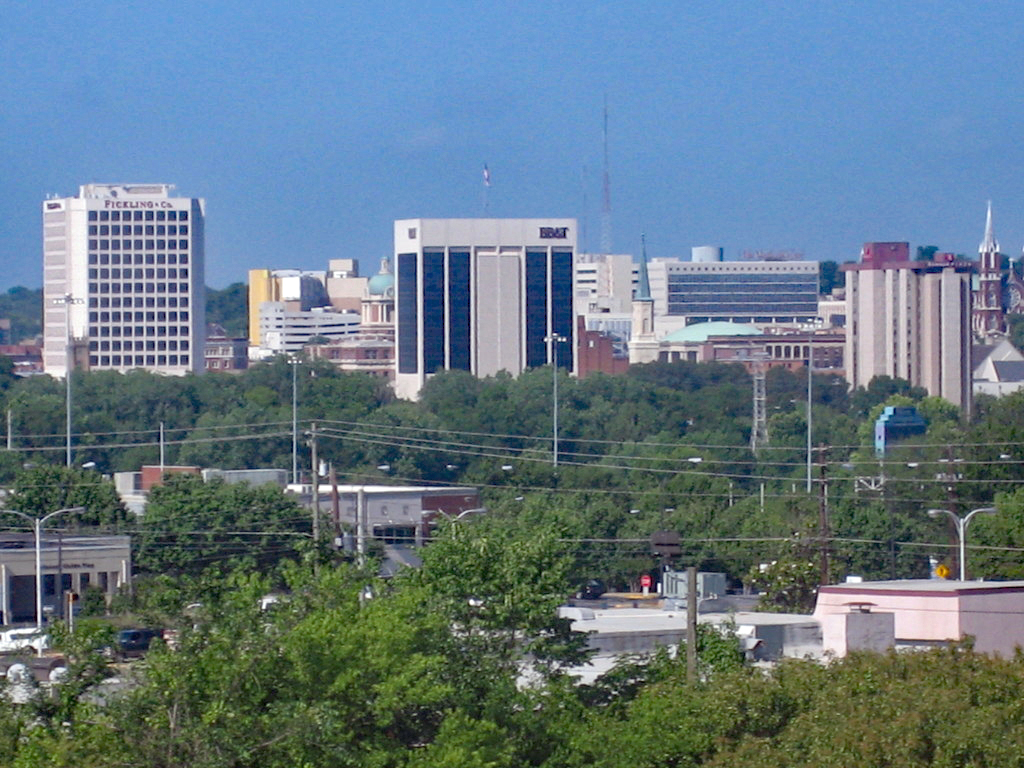
Macon
Macon es una ciudad ubicada en el estado de Georgia, Estados Unidos.
Government administration · United States · 0 followers
Overview
Macon es una ciudad ubicada en el estado de Georgia, Estados Unidos. Según el censo de 2020, tiene una población de 157 346 habitantes.
Interested in working with us in the future?
Follow to see new jobs and posts in your feed.
No news yet.
About

Macon es una ciudad ubicada en el estado de Georgia, Estados Unidos. Según el censo de 2020, tiene una población de 157 346 habitantes.
Kaynak: Wikipedia · CC BY-SA 4.0
Geografía
De acuerdo con la Oficina del Censo de los Estados Unidos, la ciudad tiene un área total de 660.20 km², de los cuales 645.89 km² son tierra y 14.31 km² son agua.
Historia
Durante la guerra de Secesión, no fue ocupada en 1864 durante la Marcha de Sherman hacia el mar, cayendo en manos del ejército de la Unión el 20 de abril de 1865.
Demografía
Según el censo de 2020, el 54.58% de los habitantes son afroamericanos, el 36.72% son blancos, el 0.24% son amerindios, el 2.07% son asiáticos, el 0.03% son isleños del Pacífico, el 2.37% son de otras razas y el 3.99% son de una mezcla de razas. Del total de la población, el 4.28% son hispanos o latinos de cualquier raza.
Kaynak: Wikipedia – Macon (Georgia) · CC BY-SA 4.0
History

Macon was founded on the site of the Ocmulgee Old Fields, where the Creek Indians lived in the 18th century. Their predecessors, the Mississippian culture, built a powerful agriculture-based chiefdom (950–1100 AD). The Mississippian culture constructed earthwork mounds for ceremonial, religious, and burial purposes. Indigenous peoples inhabited the areas along the Southeast's rivers for 13,000 years before Europeans arrived.
Macon was developed at the site of Fort Benjamin Hawkins, built in 1809 at President Thomas Jefferson's direction after he forced the Creek to cede their lands east of the Ocmulgee River. (Archeological excavations in the 21st century found evidence of two separate fortifications.) The fort was named for Benjamin Hawkins, who served as superintendent of Indian Affairs for the Southeast territory south of the Ohio River for more than 20 years, had lived among the Creek, and was married to a Creek woman. Located at the fall line of the Ocmulgee River, the fort established a trading post with native peoples at the river's most inland point navigable from the Low Country.
Fort Hawkins guarded the Lower Creek Pathway, an extensive and well-traveled American Indian network that the U.S. government later improved as the Federal Road, linking Washington, DC, to the ports of Mobile, Alabama, and New Orleans, Louisiana. Used for trading with the Creek, the fort also was used by state militia and federal troops. It was a major military distribution point during the War of 1812 and the Creek War of 1813. After the wars, it was a trading post and garrisoned troops until 1821. Decommissioned around 1828, it later burned to the ground. A replica of the southeast blockhouse, built in 1938, stands on an east Macon hill. Fort Hawkins Grammar School occupied part of the site. In the 21st century, archeological excavations have revealed more of the fort, increasing its historical significance, and led to further reconstruction planning for this major historical site.
Geography
The Ocmulgee River is a major river that runs through the city. Macon is one of Georgia's three major fall line cities, along with Augusta and Columbus. The fall line is where the hills of the Piedmont plateau meet the flat terrain of the coastal plain. As such, Macon has a varied landscape of rolling hills on the north side and flat plains on the south. The fall line, where the elevation drops noticeably, causes rivers and creeks in the area to flow rapidly toward the ocean. In the past, Macon and other Fall Line cities had many textile mills powered by the rivers.
Macon is located at 32°50′05″N 83°39′06″W (32.834839, −83.651672). According to the United States Census Bureau, the city has a total area of 56.3 square miles (146 km2), of which 0.5 sq mi (1.3 km2) (0.82%) is covered by water. Macon is about 330 ft (100 m) above mean sea level.
Climate
Macon has a humid subtropical climate (Köppen climate classification Cfa). The normal monthly mean temperatures range from 46.3 °F (7.9 °C) in January to 81.8 °F (27.7 °C) in July. On average, 1–3 days have 100 °F (38 °C)+ highs, and 83 days have 90 °F (32 °C)+ highs, and 41 days with a low at or below freezing; the average window for freezing temperatures is October 18 thru April 19, allowing a growing season of 182 days.
The city has an average annual precipitation of 45.7 inches (1,160 mm). The wettest day on record was July 5, 1994, with 10.25 in (260 mm) of rain, and the wettest month on record was July 1994, with 18.16 in (461 mm) of rain. Since 1892, though, when precipitation records for the city began, two months, October 1961 and October 1963, did not even record a trace of precipitation in the city, and two other months, October 1939 and May 2007, only recorded a trace. Snow is occasional, with about half of the winters receiving trace amounts or no snowfall, averaging 0.7 in (1.8 cm); the snowiest winter was 1972–73 with 16.5 in (42 cm).
Demographics
Macon is the largest principal city in the Macon-Warner Robins-Fort Valley CSA, a combined statistical area that includes the Macon metropolitan area (Bibb, Crawford, Jones, Monroe, and Twiggs counties) and the Warner Robins metropolitan area (Houston, Peach, and Pulaski counties) with a combined population of 411,898 in the 2010 census.
As of the official 2010 U.S. census, the population of Macon was 91,351. In the last official census, in 2000, 97,255 people, 38,444 households, and 24,219 families were residing in the city. The population density was 1,742.8 inhabitants per square mile (672.9/km2). The 44,341 housing units had an average density of 794.6 per square mile (306.8/km2). The racial makeup of the city was 67.94% African American, 28.56% White, 0.02% Native American, 0.65% Asian, 0.03% Pacific Islander, 0.46% from other races, and 0.77% from two or more races. Hispanics or Latinos of any race were 2.48% of the population. By the 2020 census, its population increased to 157,346.
Of the 38,444 households in 2000, 30.1% had children under 18 living with them, 33.0% were married couples living together, 25.7% had a female householder with no husband present, and 37.0% were not families. About 31.7% of all households were made up of individuals, and 12.1% had someone living alone who was 65 or older. The average household size was 2.44 and the average family size was 3.08.
In the city, the age distribution was 26.9% under 18, 11.3% from 18 to 24, 27.5% from 25 to 44, 20.0% from 45 to 64, and 14.3% who were 65 or older. The median age was 34 years. For every 100 females, there were 79.7 males. For every 100 females 18 and over, there were 72.8 males.
Crime
Since 2020, crime has become a higher concern in the city. In 2022, Macon set a homicide record, with 70. In 2023, Macon had the highest crime rate in Georgia: 52.6 crimes per 1,000 residents. Gang activity is a major reason for the crime problem in Macon. The Georgia Bureau of Investigation expanded its Gang Task Force Office to Macon in 2023. In 2024, Macon-Bibb County saw a decrease in homicides, with 39 reported compared to 40 in 2023 and 71 in 2022.
Economy
The aerospace, advanced manufacturing, food processing, healthcare, professional services, and warehouse and distribution industries drive the economy in Macon-Bibb County. Long-standing large private employers include Mercer University, GEICO's Southeast Corporate Headquarters, YKK USA, and Norfolk Southern Railway's Brosnan Yard.
The decline of the textile industry in the South, along with the shuttering of other large manufacturing operations, such as the closing of the Brown and Williamson plant in 2006, caused a decline in the city's economy in the 2000s. In recent years, the city has successfully landed numerous new employers to diversify the economy, such as Irving Consumer Products and Kuhmo Tire manufacturing plants, as well as multiple aerospace employers at the Middle Georgia Regional Airport, including an Embraer aircraft maintenance facility.
The health-care and social-assistance sector is the largest industry in Macon by number of employees, with the Atrium Health Navicent and Piedmont Healthcare Macon hospital systems, two of the city's largest employers, making Macon the healthcare hub for the Middle and South Georgia regions.
President Donald Trump announced a $4.2 billion investment by German automaker Audi in the city in October 2026 with the new manufacturing plant producing 200,000 vehicles annually. The facility, Audi's first U.S. manufacturing plant, is expected to create approximately 4,500 jobs and produce premium SUVs for the North American market, according to Georgia officials.
Personal income
The 2010 Census listed Macon's median household income as $28,366, below the state average of $49,347. The median family income was $37,268. Full-time working males had a median income of $34,163, higher than the $28,082 for females. The city's per capita income was $17,010. About 24.1% of families and 30.6% of the population were below the poverty line, including 43.6% of those under 18 and 18.4% of those over 65.
Arts and culture

Musical heritage
Macon has been home for numerous musicians and composers, including Emmett Miller, The Allman Brothers Band, Randy Crawford, Mark Heard, Lucille Hegamin, Ben Johnston, Otis Redding, Little Richard, Mike Mills, and Bill Berry of R.E.M., as well as more recent artists like violinist Robert McDuffie and country artist Jason Aldean. Capricorn Records, run by Macon natives Phil Walden and briefly Alan Walden, made the city a Southern rock music production center in the late 1960s and 1970s.
The Macon Symphony Orchestra, a youth symphony, and the Middle Georgia Concert Band perform at the Grand Opera House in downtown Macon.
The Georgia Music Hall of Fame was located in Macon from 1996 to 2011.
Festivals
International Cherry Blossom Festival, a 10-day celebration, is held every mid-March in Macon.
The Mulberry Street Festival, an arts and crafts festival, is held downtown the last weekend of March.
The Juneteenth Freedom Festival is an annual June performing-arts and educational celebration of the end of American slavery in 1865, celebrating black freedom and heritage both ancient and contemporary.
Pan African Festival, an annual celebration of the African diaspora and culture, is held in April.
Ocmulgee Indigenous Celebration, a celebration of the original residents of the land where Macon now sits, is held every third weekend in September at Ocmulgee Mounds National Historical Park. Representatives from the Cherokee, Chickasaw, Choctaw, Creek, Seminole, and other nations come to share stories, exhibit Native art, and perform traditional songs and dance.
Skydog is a music festival celebrating the birthday, life, and music of Skydog (Duane Allman) held in November.
The Georgia Music Hall of Fame hosts Georgia Music Week in September.
Macon's annual Bragg Jam festival features an Art and Kids' Festival along the Ocmulgee Heritage Trail and a nighttime pub crawl.
Sports
Macon is home to the Mercer Bears, with NCAA Division I teams in soccer (men's and women's), football, baseball, basketball (men's and women's), tennis, and lacrosse. Central Georgia Technical College competes in men's and women's basketball. Wesleyan College, a women's school, has basketball, soccer, cross country, tennis, softball, and volleyball teams.
Parks and recreation

The city maintains several parks and community centers.
Ocmulgee Heritage Trail – a green way of parks, plazas, and landmarks along the Ocmulgee River in downtown Macon
Carolyn Crayton Park (formerly Central City Park)
Baconsfield Park
U.S. Senator Augustus Bacon, of Georgia, in his 1911 will, devised land in Macon in trust, to be used as a public park for the exclusive benefit of white people. The park, known as Baconsfield, was operated in that manner for many years. In Evans v. Newton, the Supreme Court of the United States held that the park could not continue to be operated on a racially discriminatory basis. The Supreme Court of Georgia thereupon declared "that the sole purpose for which the trust was created has become impossible of accomplishment" and remanded the case to the trial court, which held Cy-près doctrine to be inapplicable, since the park's segregated character was an essential and inseparable part of Bacon's plan. The trial court ruled that the trust failed and that the property reverted to Bacon's heirs. The Supreme Court of Georgia and the U.S. Supreme Court affirmed. The 50-acre (20 ha) park was lost and commercially developed.
Government

Prior to 2013, the city government consisted of a mayor and city council. Robert Reichert was elected the first mayor of the consolidated Macon-Bibb County in October 2013. There are also 9 County Commissioners elected from districts within the county.
On March 15, 2019, the U.S. Securities and Exchange Commission charged the former County Manager, Dale M. Walker, with fraud.
Education

Public schools
Bibb County Public School District operates district public schools.
Northeast Health Science Magnet High School
Southwest Magnet High School and Law Academy
Also operated by Bibb County Public Schools:
Georgia Academy for the Blind, operated by the state of Georgia, is a statewide school for blind students.
Private schools
Macon is home to several private high schools, many of which were established as segregation academies for parents wishing to avoid the desegregation of private schools, with the exception of Mount de Sales Academy.
Colleges and universities
Approximately 30,000 college students live in the greater Macon area.
Miller-Motte Technical College – satellite campus
Media
Macon has a substantial number of local television and radio stations. It is also served by two local papers.
Newspapers and magazines
Gateway Macon (web portal), The Local's Guide for Things To Do in Macon
Macon Business Journal, a journal chronicling the business community in the Middle Georgia region
Macon Community News, a monthly positive news print newspaper
The Telegraph, a daily newspaper published in Macon
References in popular culture
The Simpsons
In "Bart on the Road", a season-seven episode of The Simpsons, character Nelson Muntz suggests the boys take a road trip to Macon. Later, he reminds the group that none of their troubles would have happened had they chosen Macon over Knoxville, Tennessee.
Gone with the Wind
In Margaret Mitchell's novel Gone with the Wind, Aunt Pittypat's coachman, Uncle Peter, protected her when she fled to Macon during Sherman's assault on Atlanta.
Telltale's The Walking Dead
The city of Macon is visited in The Walking Dead episodic adventure game by Telltale Games and its standalone DLC 400 Days.
In Season One, the city is portrayed as a small rural town and is visited by the main characters as they temporarily set up camp in the city. The city is the hometown of the game's main protagonist and the playable character throughout the game, Lee Everett. He and the other survivors barricade themselves inside his family's pharmacy as they are besieged by zombies. After one of the survivors dies, the group heads to a motel on the outskirts of Macon, where they set up camp for two more episodes, before eventually deciding to leave the city for Savannah.
In 400 Days, the city is briefly shown in the episode "Vince's Story" as a flashback to when the episode's main character, Vince, fatally shoots an unseen and unnamed resident of the city before fleeing into the night before the apocalypse began. This murder would ultimately lead to Vince's arrest and the events that occurred at the beginning of the zombie apocalypse.
"Walkin' Back to Georgia"
In Jim Croce's "Walkin' Back to Georgia" on his album You Don't Mess Around with Jim, he mentions Macon in the lyric "But she's the girl who said she loved me on that hot dusty Macon road."
Infrastructure

Hospitals
The Medical Center, Navicent Health (a part of Atrium Health)
Atrium Health Navicent Beverly Knight Olson Children's Hospital (formerly The Children's Hospital Of Central Georgia)
Piedmont Health Macon (formerly Coliseum Medical Centers)
The American Red Cross of Central Georgia
Airports
Macon Downtown Airport is located near downtown. It has a large number of corporate and private aviation aircraft.
Middle Georgia Regional Airport provides public air service to Macon as well as cargo flights. The airport is situated 9 mi (14 km) south of downtown.
Mass transit
The Macon Transit Authority (MTA) is Macon's public-transit system, operating the public transit city bus system throughout Macon-Bibb County. As of 2022, the MTA has a total of 10 city bus routes, operating out of the Terminal Station hub.
Intercity bus and rail
Greyhound Lines provides intercity bus service. In 2019, the company moved from a stand-alone bus station to the Terminal Station to be in the same hub as the local mass transit buses.
Macon grew as a center of rail transport after the 1846 opening of the Macon and Western Railroad. Two of the most note-worthy train companies operating through the city were the Central of Georgia Railway and the Southern Railway. The city continued to be served by passenger trains at Terminal Station until 1971. The Frisco Railroad's Kansas City–Florida Special served the city until 1964. The Southern's Royal Palm ran from Cincinnati, through Macon, to Miami, Florida until 1966. (A truncated route served to Valdosta, Georgia, until 1970.) The Central of Georgia's Nancy Hanks ran through Macon, from Atlanta to Savannah, until 1971.
Since at least 2006, Macon has been included in the proposed Georgia Rail Passenger Program to restore intercity rail service but as of 2020, Georgia lacks any intercity passenger rail service other than the federally funded interstate Amtrak services. In 2022, Amtrak announced a new 15-year plan to expand its services, which included Macon.
Sister cities
Macon has six sister cities, as designated by Sister Cities International, Inc. (SCI):
Kaynak: Wikipedia – Macon, Georgia · CC BY-SA 4.0