
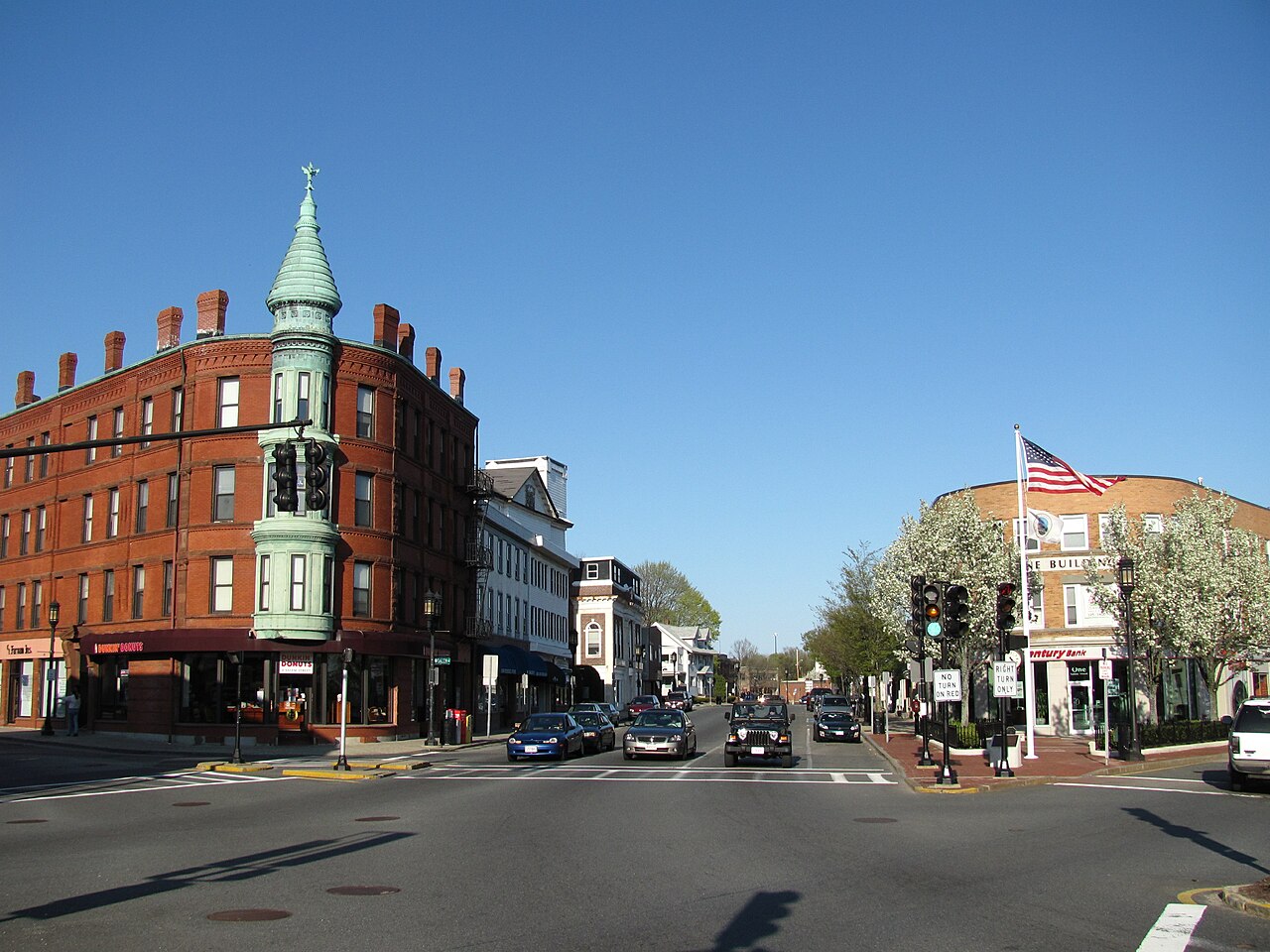
Medford
Medford es una ciudad ubicada en el condado de Middlesex en el estado estadounidense de Massachusetts.
Government administration · United States · 0 followers
Overview
Medford es una ciudad ubicada en el condado de Middlesex en el estado estadounidense de Massachusetts. Es la sede de la Universidad Tufts, la cual tiene su campus a lo largo del límite entre Medford y Somerville. En el censo de 2010 tenía una población de 56.173 habitantes y una densidad poblacional de 2.505,03 personas por km².
Interested in working with us in the future?
Follow to see new jobs and posts in your feed.
No news yet.
About

Medford es una ciudad ubicada en el condado de Middlesex en el estado estadounidense de Massachusetts. Es la sede de la Universidad Tufts, la cual tiene su campus a lo largo del límite entre Medford y Somerville. En el censo de 2010 tenía una población de 56.173 habitantes y una densidad poblacional de 2.505,03 personas por km².
Kaynak: Wikipedia · CC BY-SA 4.0
Geografía
Medford se encuentra ubicada en las coordenadas 42°25′26″N 71°6′33″O. Según la Oficina del Censo de los Estados Unidos, Medford tiene una superficie total de 22,42 km², de la cual 20,98 km² corresponden a tierra firme y (6,43%) 1,44 km² es agua.
Demografía
Según el censo de 2010, había 56.173 personas residiendo en Medford. La densidad de población era de 2.505,03 hab./km². De los 56.173 habitantes, Medford estaba compuesto por el 78,57% blancos, el 8,79% eran afroamericanos, el 0,22% eran amerindios, el 6,88% eran asiáticos, el 0,01% eran isleños del Pacífico, el 2,84% eran de otras razas y el 2,68% pertenecían a dos o más razas. Del total de la población el 4,36% eran hispanos o latinos de cualquier raza.
Demografi
2010 Sayımı
15 Mart 2010 tarihinde yapılan bir nüfus sayımına göre şehirde 31.479 kişi, 12.136 ev ve 7.147 aile bulunmaktadır. Şehrin nüfus dağılımı ise %79,0 Beyaz, %11,3 Afrikan Amerikan, %0,3 Yerli Amerikan, %5,2 Asyalı, %0,1 Pasifik Adalı, %1,1'i ise diğer gruplardandır.
2000 Sayımı
1 Nisan 2000 tarihinde yapılan bir nüfus sayımına göre şehirde 32.900 kişi, 12.550 ev ve 7.906 aile bulunmaktadır. Şehrin nüfus dağılımı ise %79,0 Beyaz, %11,3 Afrikan Amerikan, %0,3 Yerli Amerikan, %5,2 Asyalı, %0,1 Pasifik Adalı, %1,1'i ise diğer gruplardandır.
History

Indigenous history
Native Americans inhabited the area that would become Medford for thousands of years prior to European colonization of the Americas. At the time of European contact and exploration, Medford was the winter home of the Naumkeag people, who farmed corn and created fishing weirs at multiple sites along the Mystic River. Naumkeag sachem Nanepashemet was killed and buried at his fortification in present-day Medford during a war with the Tarrantines in 1619. The contact period introduced several European infectious diseases which would decimate native populations in virgin soil epidemics, including a smallpox epidemic which in 1633 killed Nanepashemet's sons, sachems Montowompate and Wonohaquaham. Sagamore Park in West Medford is a native burial site from the contact period, which includes the remains of a likely sachem, either Nanepashemet or Wonohaquaham. After the 1633 epidemic, Nanepashemet's widow, known only as the Squaw Sachem of Mistick, led the Naumkeag, and over the next two decades would deed large parts of Naumkeag territory to English settlers. In 1639, the Massachusetts General Court purchased the land that would become present-day West Medford, then within the boundaries of Charlestown, from the Squaw Sachem.
17th century
Medford was settled in 1630 by English colonists as part of Charlestown, of the Massachusetts Bay Colony. The settlement was originally called "Mistick" by Thomas Dudley, based on the Massachusett name for the area's river. Thomas Dudley's party renamed the settlement "Meadford". The name may have come from a description of the "meadow by the ford" in the Mystic River, or from two locations in England that Cradock may have known: the hamlet of Mayford or Metford in Staffordshire near Caverswall, or from the parish of Maidford or Medford (now Towcester, Northamptonshire). In 1634, the land north of the Mystic River was developed as the private plantation of Matthew Cradock, a former governor. Across the river was Ten Hills Farm, which belonged to John Winthrop, Governor of the Massachusetts Bay colony.
Geography
Medford is located at 42°25′12″N 71°6′29″W (42.419996, −71.107942).
According to the United States Census Bureau, the city has a total area of 8.6 square miles (22 km2), of which 8.1 square miles (21 km2) is land and 0.5 square miles (1.3 km2) (5.79%) is water.
A park called the Middlesex Fells Reservation, to the north, lies partly within the city. This 2,060-acre (8 km2) preserve is shared by Medford with the municipalities of Winchester, Stoneham, Melrose, and Malden. The Mystic River flows roughly west to southeast through the middle of the city.
Neighborhoods
People from Medford often identify themselves with a particular neighborhood.
Fulton Heights/The Heights (North Medford)
Tufts University (mostly contiguous, situated on Medford Hillside)
Demographics
2020 census
As of the 2020 census, Medford had a population of 59,659. The median age was 35.6 years. 14.1% of residents were under the age of 18 and 15.9% of residents were 65 years of age or older. For every 100 females there were 94.0 males, and for every 100 females age 18 and over there were 92.3 males age 18 and over.
100.0% of residents lived in urban areas, while 0.0% lived in rural areas.
There were 24,413 households in Medford, of which 21.3% had children under the age of 18 living in them. Of all households, 40.2% were married-couple households, 20.7% were households with a male householder and no spouse or partner present, and 30.6% were households with a female householder and no spouse or partner present. About 28.5% of all households were made up of individuals and 11.0% had someone living alone who was 65 years of age or older.
There were 25,770 housing units, of which 5.3% were vacant. The homeowner vacancy rate was 0.8% and the rental vacancy rate was 5.0%.
2010 census
As of the census of 2010, there were 56,173 people, 22,810 households, and 13,207 families residing in the city. The population density was 6,859.9 inhabitants per square mile (2,648.6/km2). There were 24,046 housing units at an average density of 2,796.0 per square mile (1,079.5/km2). The racial makeup of the city was 78.6% White, 8.80% African American, 0.2% Native American, 6.9% Asian, 0.01% Pacific Islander, 2.8% from other races, and 2.7% from two or more races. Hispanic or Latino of any race were 4.4% of the population.
There were 22,810 households, of which 22.3% had children under 18 living with them, 42.5% were married couples living together, 11.4% had a female householder with no husband present, and 42.1% were non-families. 24.6% of all households were made up of individuals, and 11.1% had someone living alone who was 65 years of age or older. The average household size was 2.38 and the average family size was 3.00.
Education
Medford is home to many schools, public and private.
Eliot-Pearson Children's School (Pre-K–2)
Six Acres Nursery School (Pre-K–K) (non-sectarian, but run through Medford Jewish Community Center)
Medford Vocational Technical High School
The Greater Boston Japanese Language School (ボストン補習授業校, Bosuton Hoshū Jugyō Kō), a supplementary school for Japanese people, holds classes at Medford High. Its weekday offices are in Arlington.
Local media and news
The City of Medford has several local news and media outlets:
Transportation
Three MBTA subway stations are located in Medford: Wellington in the Wellington Neighborhood opening in 1975 on the Orange Line, then in 2022 as part of the GLX project the Hillside and South Medford neighborhoods light rail stations, Medford/Tufts and Ball Square on the Green Line opened. The MBTA Commuter Rail Lowell Line stops at West Medford. Medford is served by MBTA bus local routes 80, 94, 95, 96, 99, 100, 101, 108, and 134, plus express route 354.
Interstate 93 travels roughly north–south through the city. State routes passing through Medford include 16, 28, 38, and 60.
Points of interest

Amelia Earhart residence, 76 Brooks Street
Former site of Fannie Farmer's house, corner of Paris & Salem Streets
Grace Church, designed by H. H. Richardson
Gravity Research Foundation monument at Tufts University
Jingle Bells historical marker, High Street
John Wade House, built 1784, added to the National Register of Historic Places in 1975
Old Ship Street Historic District: Area around Riverside Ave (formerly Ship Street) containing many historic homes
Royall House and Slave Quarters, the only surviving slave quarters in Massachusetts, a 1692 house operating as a non-profit museum.
Tufts University: Though the Tufts campus is mainly located in Medford, the Somerville–Medford border actually runs through it. The school employs many local residents and has many community service projects that serve the city, especially those run through the Leonard Carmichael Society and the Jonathan M. Tisch College of Citizenship and Public Service, the latter of which especially emphasizes public service in Tufts' host communities.
The Unitarian Universalist Church of Medford: Medford's first religious community, founded in 1690.
United States Post Office–Medford Main, 1937 historic building