


Methuen
Methuen es una ciudad situada en el condado de Essex, Massachusetts, Estados Unidos.
Government administration · United States · 0 followers
Overview
Methuen es una ciudad situada en el condado de Essex, Massachusetts, Estados Unidos. Tiene una población estimada, a mediados de 2022, de 53 241 habitantes.
Interested in working with us in the future?
Follow to see new jobs and posts in your feed.
No news yet.
About

Methuen es una ciudad situada en el condado de Essex, Massachusetts, Estados Unidos. Tiene una población estimada, a mediados de 2022, de 53 241 habitantes.
Kaynak: Wikipedia · CC BY-SA 4.0
Historia
Methuen se estableció por primera vez en 1642 y se incorporó oficialmente en 1726. Originalmente, Methuen formaba parte de Haverhill, Massachusetts. En 1724, Stephen Barker y otros habitantes de la zona oeste de la ciudad solicitaron al Tribunal General de Massachusetts permiso para formar una nueva ciudad sobre el arroyo Hawke's Meadow. Aunque sus conciudadanos se opusieron, la petición fue aprobada al año siguiente (8 de diciembre de 1725) y el Tribunal General les otorgó un acta de constitución con el nombre de Methuen. El nombre de la ciudad se debe a Sir Paul Methuen, miembro del Consejo Privado del Rey y amigo del gobernador provincial en funciones William Dummer. La primera asamblea municipal se celebró el 9 de marzo de 1726 en la casa de un residente. El terreno se reservó para una casa de reuniones, que se erigió más tarde, en 1726, en lo que hoy es el Cementerio de la Casa de Reuniones de la Colina.
Los residentes de la zona norte de la nueva ciudad de Methuen pronto solicitaron tener su propia casa de reuniones (una combinación de ayuntamiento e iglesia puritana), y en 1736 se estableció la parroquia norte. Los descendientes de los propietarios originales de Haverhill donaron el terreno para la casa de reuniones, y en 1738 se erigió la segunda casa de reuniones de Methuen. La estructura se conserva hasta nuestros días, como el edificio de la Sociedad Histórica de Salem, N.H. En 1741, con la fijación del límite norte de Massachusetts, la mayor parte de esta nueva parroquia norte se trasladó de Methuen y se ubicó en New Hampshire. Se constituyó como Salem, Nuevo Hampshire en 1750.
El crecimiento industrial del siglo XIX influyó en el desarrollo de Methuen. La construcción de las fábricas de algodón de Methuen en las cataratas del río Spicket en la década de 1820 y el aumento de la fabricación de sombreros y zapatos en pequeñas fábricas a lo largo del río Spicket impulsaron la centralización de las actividades económicas, residenciales y culturales de Methuen en el área de las calles Osgood, Broadway, Hampshire y Pleasant. Tres familias adineradas y prominentes —los Nevin, los Tenney y los Searle— desempeñaron un papel importante en la historia y el desarrollo de Methuen. Estas familias fueron fundamentales en la fundación de muchos de los lugares emblemáticos de Methuen, como la Biblioteca Conmemorativa Nevins, el edificio Searles, la Puerta de Tenney, la Casa Nevins, las Cataratas Spicket y el monumento a la Guerra Civil entre las calles Pleasant y Charles.
Geografía
Según la Oficina del Censo de los Estados Unidos, tiene una superficie total de 57.55 km², de los cuales 57.53 km² corresponden a tierra firme y 2.02 km² están cubiertos de agua.
Demografía
Según el censo de 2020, en ese momento la ciudad tenía una población de 53 059 habitantes. La densidad de población era de 922.28 hab./km². El 62.91% de los habitantes eran blancos, el 5.11% eran afroamericanos, el 0.41% eran amerindios, el 4.01% eran asiáticos, el 0.02% eran isleños del Pacífico, el 17.39% eran de otras razas y el 10.14% eran de una mezcla de razas. Del total de la población, el 29.31% eran hispanos o latinos de cualquier raza.
History
Methuen was first settled in 1642 and was officially incorporated in 1726. Methuen was originally part of Haverhill, Massachusetts. In 1724 Stephen Barker and others in the western part of that town petitioned the General Court to grant them permission to form a new town above Hawke's Meadow Brook. Although opposed by their fellow townsmen, the petition was approved the following year (December 8, 1725), and the General Court gave them an act of incorporation under the name of Methuen. The town was named for Sir Paul Methuen, a member of the King's Privy Council and friend of acting Provincial Governor William Dummer. The first town meeting was held on March 9, 1726, in the home of a resident. The land was set aside for a meetinghouse, which was erected later in 1726 on what is now Meetinghouse Hill Cemetery.
The residents in the northern part of the new town of Methuen soon petitioned to have their own meetinghouse (a combination of town hall and puritan church), and in 1736 the north parish was set off. Land for a meetinghouse was donated by descendants of the original proprietors of Haverhill, and in 1738 the second Methuen meetinghouse was raised. The structure survives to this day, as the Salem N.H. Historical Society building. In 1741, with the fixing of the Northern boundary of Massachusetts, most of this new north parish was removed from Methuen and placed in New Hampshire. It was incorporated as Salem, New Hampshire in 1750.
Industrial growth in the 1800s influenced Methuen's development. Construction of the Methuen Cotton Mills at the Spicket River falls in the 1820s and the increased manufacture of hats and shoes in small factories along the Spicket spurred the centralization of Methuen's economic, residential and cultural activities within the area around Osgood, Broadway, Hampshire and Pleasant streets. Three wealthy and prominent families—the Nevins, the Tenneys and the Searles—played a significant role in Methuen's history and development. These families were instrumental in the founding of many of Methuen's landmarks, including the Nevins Memorial Library, the Searles building, Tenney Gatehouse, Nevins Home, Spicket Falls, and the Civil War monument between Pleasant and Charles streets.
Geography
Methuen is located at 42°43′48″N 71°10′46″W (42.730040, −71.179352). According to the United States Census Bureau, the city has a total area of 23.1 square miles (59.7 km2), of which 22.2 square miles (57.6 km2) is land and 0.77 square miles (2.0 km2), or 3.42%, is water.
Methuen lies alongside the northern banks of the Merrimack River and is bisected by the Spicket (originally "Spigot") River, as well as many brooks and streams. There are several ponds dotting the area as well, and the town is home to a town forest, a bird sanctuary, and a small state park (Tenney State Park). Pine Island, near the southern end of town in the Merrimack River, is also part of the town's land.
Transportation
Methuen lies at the northern end of Interstate 93 in Massachusetts, with three exits providing access. A portion of Interstate 495 crosses through the eastern side of town from Lawrence to Haverhill. Massachusetts Route 213, the "Loop Connector", provides highway access between the two, having three intermediate exits of its own, in addition to the exits for I-93 and I-495. The town is also crossed by Route 28, Route 110, and Route 113, the latter two meeting at I-93 Exit 43 (old exit 46). I-93 provides the town's only bridge across the Merrimack; there are several crossings in Lawrence, and several in neighboring Haverhill, but none for 7 miles (11 km) upstream from I-93 all the way to the eastern end of Lowell and also comes down from New Hampshire, providing the fastest route to both 25 minutes north to Manchester, New Hampshire, and 25–30 minutes south to Boston.
Methuen is served by the Merrimack Valley Regional Transit Authority's bus service. Daily intercity bus service to Worcester and New York City is provided by OurBus from the Methuen Park and Ride. The nearest MBTA Commuter Rail stations are Lawrence, Bradford and Haverhill, all part of the Haverhill/Reading Line, providing service into Boston's North Station. Small plane service can be found at Lawrence Municipal Airport and the Merrimack Valley Seaplane Base, with the nearest national service being at Manchester-Boston Regional Airport, and the nearest international service being at Boston's Logan International Airport.
Demographics
As of the census of 2000, there were 43,789 people, 16,532 households, and 11,539 families residing in the city. The population density was 1,954.7 persons per square mile (754.8/km2). There were 16,885 housing units, at an average density of 753.7 per square mile (291.0/km2). The racial makeup of the city was 89.35% White, 1.35% African American, 0.22% Native American, 2.38% Asian, 0.01% Pacific Islander, 4.87% from other races, and 1.82% from two or more races. Hispanics and Latinos, of any race, were 9.64% of the population (8.4% Dominican, 5.7% Puerto Rican, 0.6% Guatemalan, 0.3% Ecuadorian, 0.3% Mexican, 0.3% Cuban). Methuen has a very diverse population and it has gotten more diverse over the years. For a very long time, Methuen and its neighboring city, Lawrence have always been, and still are home to a large number of Lebanese, French, and Italian communities. Methuen is also a major Hispanic/Latino community, including Dominicans.
There were 16,532 households, of which 33.1% had children under the age of 18 living with them, 53.3% were married couples living together, 12.2% had a female householder with no husband present, and 30.2% were non-families. Of all households, 25.3% were made up of individuals, and 11.6% had someone living alone who was 65 years of age or older. The average household size was 2.62 and the average family size was 3.17.
In the city, the population was spread out, with 24.7% under the age of 18, 7.3% from 18 to 24, 31.0% from 25 to 44, 21.6% from 45 to 64, and 15.3% who were 65 years of age or older. The median age was 38 years. For every 100 females, there were 91.9 males. For every 100 females age 18 and over, there were 87.0 males.
The median income for a household in the city was $49,627, and the median income for a family was $59,831. Males had a median income of $41,693 versus $31,864 for females. The per capita income for the city was $22,305. About 5.8% of families and 7.4% of the population were below the poverty line, including 9.7% of those under age 18 and 7.7% of those aged 65 or over.
Government

Historically, Methuen had a town meeting-selectmen form of government and was known as the Town of Methuen until it adopted a charter replacing its traditional town meeting and selectmen with a council and manager. Even with a form of government that had historically and legally been exclusive to cities, the community, in a gesture of traditionalism, retained the name Town of Methuen in its charter. However, because Massachusetts cities have self-governing powers not available to towns, it became known for legal purposes as "The City Known as the Town of Methuen". A subsequent charter, which adopted a strong mayor form of government, officially changed the community name to the "City of Methuen".
Methuen's city government consists of a mayor, three Councilors-at-Large, two East District councilors, two Central District councilors, two West District councilors, and six School Committee members. The following are the current members of Methuen's municipal government:
The Mayor of Methuen is David “DJ” Beauregard, Jr.
The at-large city councilors are John R. Drew, Ryan R. Dizoglio and Jana Zanni Pesce.
The East District city councilors are Ronald Marsan and Neily Soto.
The Central District city councilors are Ella McClaren and Yanilda Santos.
The West District city councilors are Michael Simard and Patricia Valley.
Methuen is part of the Massachusetts Senate's 1st Essex district.
Education

Private schools
Saint Monica's is a Catholic for pre-K to 8th grade.
St. Ann's Home and School provides residential, outpatient, and private day school options for a wide range of learning disabilities and/or behavioral and emotional disorders. All programs are designed to provide a continuum of special needs services to assist children and adolescents who need intensive and comprehensive help for themselves and their families. The Day School program offers education for children and adolescents with special emotional needs, complemented by a strong therapeutic component. Children are transported to St. Ann's from communities in a one-hour radius. Referrals come from school districts seeking an academically focused, clinically supported school setting for students with significant emotional, developmental, behavioral, and learning needs.
Presentation of Mary Academy was a private Catholic high school founded in 1958. The academy is on a 22-acre (8.9 ha) campus formerly known as the Edward F. Searles Estate. The school was originally for young women in grades 9–12 but went co-educational with the 2011–2012 school year. Due to financial difficulties, the school closed in 2020.
Sports
Methuen High School's athletic teams play in the Merrimack Valley Conference. Their big rivals are the Andover Golden Warriors, the Central Catholic Raiders of Lawrence, and the Haverhill Hillies. On Thanksgiving Day, the football team plays fellow Merrimack Valley foe the Dracut Middies. The teams first met in a non-Thanksgiving Day game in 1935 and did not play again until the Thanksgiving series started in 1963. The school colors are blue and white, and their mascot is the Ranger, named after Rogers' Rangers, the precursor of the U.S. Army Rangers, which was founded by town resident Robert Rogers.
Historic district
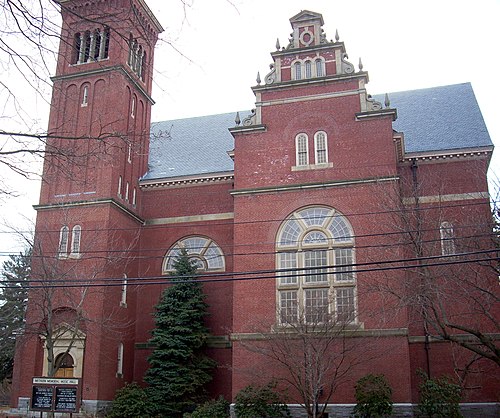
The Searles Tenney Nevins Historic District, established by the city in 1992 to preserve the "distinctive architecture and rich character of one of Massachusetts' most unique neighborhoods", is named after the three Methuen city fathers: David C. Nevins, Edward F. Searles and Charles H. Tenney.
Today, the trio's collective vision can be seen in mills, housing, schools, mansions, churches, monuments, playgrounds, the library, and the architectural fantasies that resulted from their artistic rivalry. The historic district boundaries were established to include properties and buildings constructed or used by the Searles, Tenney and Nevins families and the people who worked for them.
The historic district is administered by the Methuen Historic District Commission, which protects the district from alterations that might compromise its historic integrity. Property owners within the historic district must obey the Rules and Regulations of the Historic District Commission. The rules and regulations specify general criteria for materials used, size and proportions of the buildings, colors, as well as other features. Any violation of the rules and regulations can result in fines and other possible legal action.
Bounded within the Searles Tenney Nevins Historic District are the Spicket Falls Historic District and the Pleasant-High Historic District. Both are listed on the National Register of Historic Places, as are many of the other buildings within the area.
Points of interest
Forest Lake is a recreational great pond of over 55 acres (22 ha) bordered by the Methuen town forest. Access is managed by the Forest Lake Association. Residents and visitors can engage in a series of activities, including fishing, canoeing, and swimming.
Methuen Water Works, Cross Street, is listed on the National Register of Historic Places
Methuen Memorial Music Hall was built specifically to house the Great Organ, built originally by Walcker Orgelbau for the Boston Music Hall, and procured by philanthropist and city benefactor Edward Francis Searles more than a century ago. The organ case, which in approximate terms is as large as a typical house, is ornate and features a bust of J.S. Bach as a central ornament.
The Methuen Rail Trail occupies the railbanked Boston and Maine Manchester and Lawrence Railroad corridor. It connects the Spicket River Greenway in Lawrence with the in-development Salem Bike-Ped Corridor. Future plans to revitalize this rail line for commuter and freight rail could make this trail a rail-with-trail bike path.
National Register of Historic Places listings in Methuen, Massachusetts
The Nevins Memorial Library, founded in 1868 by David Nevins, Sr., was completed in 1883, two years after his death. The grand brick and stained glass library were listed on the National Register of Historic Places in 1984.
Saint Basil's Seminary is the main US location for the Basilian Salvatorian Order, a community of religious priests of the Greek Catholic rite.
St Xenia Orthodox Church, a multi-ethnic and multi-cultural parish of Russian Orthodox Church Outside Russia (ROCOR). The church hosts St. John of Damascus Church School.