


Molenbeek-Saint-Jean
Molenbeek-Saint-Jean, couramment appelée Molenbeek, est l'une des 19 communes bilingues de la région de Bruxelles-Capitale en Belgique.
Government administration · Belgium · 0 followers
Overview
Molenbeek-Saint-Jean, couramment appelée Molenbeek, est l'une des 19 communes bilingues de la région de Bruxelles-Capitale en Belgique. Située dans l'ouest de la région, la commune est bordée par la ville de Bruxelles, dont elle est séparée par le canal Charleroi-Bruxelles, les communes bruxelloises d'Anderlecht, Berchem-Sainte-Agathe, Jette et Koekelberg, ainsi que par la commune flamande de Dilbeek. Le ruisseau Molenbeek, d'où elle tire son nom, traverse la commune. Ses habitants sont appelés les Molenbeekois.
Interested in working with us in the future?
Follow to see new jobs and posts in your feed.
No news yet.
About

Molenbeek-Saint-Jean, couramment appelée Molenbeek, est l'une des 19 communes bilingues de la région de Bruxelles-Capitale en Belgique. Située dans l'ouest de la région, la commune est bordée par la ville de Bruxelles, dont elle est séparée par le canal Charleroi-Bruxelles, les communes bruxelloises d'Anderlecht, Berchem-Sainte-Agathe, Jette et Koekelberg, ainsi que par la commune flamande de Dilbeek. Le ruisseau Molenbeek, d'où elle tire son nom, traverse la commune. Ses habitants sont appelés les Molenbeekois.
Kaynak: Wikipedia · CC BY-SA 4.0
Étymologie

Le nom Molenbeek dérive de deux mots néerlandais : molen, signifiant « moulin », et beek, signifiant « ruisseau ». Il provient du nom du ruisseau homonyme aujourd'hui voûté, sur lequel se trouvaient des moulins à eau, et pourrait être littéralement traduit en français en « ruisseau du moulin » ou « ruisseau des moulins ». C'est un nom très courant pour les ruisseaux aux Pays-Bas et en Belgique, comme le Molenbeek (Erpe-Mere Bovenschelde), ainsi que le Molenbeek-Ter Erpenbeek, tous deux dans le Denderstreek, en Flandre.
Bien qu'appliqué d'abord au ruisseau qui traversait le village, le nom Molenbeek (orthographié à l'origine Molembecca) finit par être utilisé pour désigner le village lui-même, vers l'an 985. Le suffixe Saint-Jean en français, ou Sint-Jans en néerlandais, fait référence au saint patron de la paroisse principale de la commune, Saint Jean-Baptiste. Ce suffixe est toutefois rarement utilisé dans le langage courant, les habitants d'aujourd'hui, qu'ils soient francophones ou néerlandophones, raccourcissant généralement le nom en simplement Molenbeek.
Histoire

Débuts ruraux
Dès le ixe siècle, Molenbeek abrite une église dédiée à Saint Jean-Baptiste. Les limites paroissiales de l'église Saint-Jean sont beaucoup plus étendues qu'aujourd'hui, s'étendant jusqu'à la Senne, et à partir de la fin du xiie siècle, comprennent une chapelle dédiée à Sainte Catherine. Cette chapelle est séparée du reste de la paroisse à la suite de la construction des murs de la ville de Bruxelles et devient progressivement l'actuelle église Sainte-Catherine dans le centre de Bruxelles. La première mention documentée de Molenbeek date du 9 avril 1174 dans une bulle pontificale du pape Alexandre III répertoriant les biens du chapitre de la collégiale Saints-Michel-et-Gudule (aujourd'hui cathédrale) à Bruxelles, qui comprenait l'église Saint-Jean, ainsi que d'autres biens. Le béguinage de Bruxelles, fondé avant 1247 hors des murs de la ville, dépend à cette époque également de Molenbeek.
Au début du Moyen Âge, le village rural fournit Bruxelles en produits agricoles. Il est pendant des siècles un lieu de pèlerinage dû à la présence d'une source de sainte Gertrude de Nivelles, la mythique fondatrice de l'abbaye de Nivelles, considérée comme miraculeuse. Selon la légende, elle a visité Molenbeek, offrant le terrain sur lequel la première église du village a été construite, et aurait fait jaillir cette source sacrée en enfonçant sa crosse d'abbesse dans le sol près de l'église. Plus tard, la tradition d'un pèlerinage pour les patients souffrant d'épilepsie se développe autour de l'église Saint-Jean. Le jour de la Saint-Jean (24 juin), une procession dansante a lieu, au cours de laquelle les épileptiques peuvent être libérés de leur maladie pendant un an s'ils franchissent un pont enjambant le ruisseau Molenbeek en direction de l'église sans que leurs pieds ne touchent le sol. Un tableau de Pieter Brueghel le Jeune, datant de 1592, illustre cette procession.
Géographie physique et humaine

Localisation
Molenbeek-Saint-Jean est située dans la partie centrale de la Belgique, à environ 110 kilomètres de la côte belge et à environ 180 km de la pointe sud du pays. La commune est située au cœur du plateau brabançon (nl), à environ 45 km au sud d'Anvers (Flandre) et à 50 km au nord de Charleroi (Wallonie). C'est la troisième commune la plus occidentale de la Région de Bruxelles-Capitale après Anderlecht et Berchem-Sainte-Agathe. Avec une superficie de 5,89 km2, c'est aussi une commune relativement petite de la région, se classant onzième sur dix-neuf. Elle est bordée par les communes bruxelloises d'Anderlecht, Berchem-Sainte-Agathe, Jette et Koekelberg, ainsi que par la commune flamande de Dilbeek.
Réseau fluvial
Molenbeek est sur le parcours du deuxième plus grand axe du réseau belge des voies navigables, c'est-à-dire l'axe Anvers-Bruxelles-Charleroi par l'Escaut maritime, le canal maritime et le canal Charleroi-Bruxelles.
Quartiers
Le territoire de Molenbeek est très hétérogène et se caractérise par un mélange de quartiers plus vastes comprenant de plus petits quartiers résidentiels et (anciennement) industriels. Les zones du centre de la commune sont densément bâties et socialement défavorisés, tandis que les quartiers plus périphériques, construits pour l'essentiel après la deuxième guerre mondiale, sont plus aérés, plus verts et accueillent une population de type classe moyenne. Le quotidien britannique The Guardian décrit « des groupes de maisons proprettes de la classe moyenne inférieure, habitées par leurs propriétaires, ainsi que des appartements corrects, avec leur dose d'espaces verts, et de belles villas ». Le quartier le long du canal connaît actuellement un vaste programme de revitalisation, dans le cadre du Plan Canal de la Région de Bruxelles-Capitale.
Centre historique
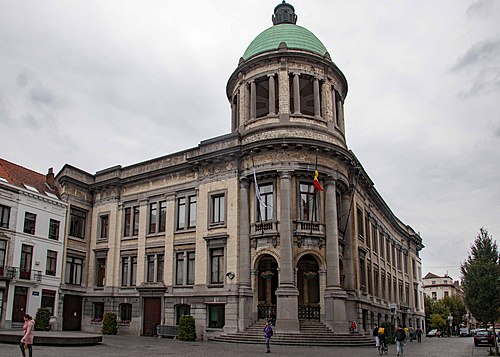
Le centre historique de Molenbeek est le quartier central de la commune. Il s'est développé pendant la révolution industrielle le long du canal Bruxelles-Charleroi et se trouve actuellement dans une situation sociale et économique fragile en raison du déclin de son économie et de la mauvaise qualité de certains de ses logements. La maison communale de Molenbeek est située sur la place communale, au cœur de ce quartier.
Politique
Politique communale
De 1992 à 2012, la commune est dirigée par le socialiste francophone Philippe Moureaux.
En 2012, la couleur politique change : c'est la libérale francophone Françoise Schepmans, qui prend le maiorat. La majorité est une nouvelle coalition composée du MR, des CDH-CD&V (auquel est affilié Ahmed El Khannouss, le premier échevin) et d'Ecolo-Groen. Malgré son score plus élevé lors des élections de 2012 (seize sièges, contre quinze pour le MR), le PS rejoint l'opposition et perd le maïorat après vingt ans de pouvoir, aux côtés du PTB+, du FDF, du parti ISLAM, et de la N-VA.
Lors des élections communales en 2018, Catherine Moureaux (PS), fille de l'ancien bourgmestre Philippe Moureaux, reprend le maïorat dans la commune de Molenbeek mais signe un pacte de majorité avec la bourgmestre sortante, Françoise Schepmans (MR). Le CDH-CD&V et Ecolo-Groen sont renvoyés dans l'opposition.
Résultats des élections communales depuis 1976
(*)1976: UPM-PEM 1982: FNK,UPM-PEM 1988:PFN, EVA 1994: CVP,MERCI 2000: DB,FNB 2006: Force Citoyenne, spirit&indép,PJM 2012: PP, Egalité 2018 : Cit EUR M3E, Molenbeek act
Sièges d'institutions politiques
Molenbeek-Saint-Jean accueille sur son territoire deux importantes institutions politiques : d'une part le Ministère de la Fédération Wallonie-Bruxelles, d'autre part Wallonie-Bruxelles International (WBI), qui est « l’organisme chargé des relations internationales de Wallonie-Bruxelles ».
Démographie

Population et densité
Molenbeek-Saint-Jean comptait, au 1er janvier 2026, 98 411 habitants (49,8 % d'hommes et 50,2 % de femmes), soit une densité de 16 708 hab./km2 pour une superficie de 5,89 km2.
Croissance de la population
Graphe de l'évolution de la population de la commune.
Source : DGS - Remarque : 1806 jusqu'à 1981 = recensement ; depuis 1990 = nombre d'habitants chaque 1er janvier
Commune multiculturelle
Dès les années 1800, Molenbeek voit l'installation de Belges flamands et francophones. Elle accueille aussi des personnes considérées comme des « agitateurs politiques » français, qui viennent s'y établir[réf. nécessaire].
Durant les siècles suivants viennent s'installer des communautés d'Italiens, d'Espagnols, de Portugais, suivies plus tard par des Arméniens, Marocains, Turcs, Pakistanais, Africains et des populations des pays de l'Europe de l'Est (Pologne, Roumanie, Serbie, Ukraine).
Dans les années 1950 et 1960, une importante communauté marocaine, principalement venue du Rif, s'installe dans la commune. Dans les années 2010, Molenbeek devient une commune à forte population marocaine musulmane. Aujourd'hui, plus de la moitié des Molenbeekois sont d'origine marocaine. Le sociologue Jan Hertogen de la KU Leuven estime qu'en 2022, 42,2 % des habitants seraient de confession musulmane, comparé à 24,1 % dans la région bruxelloise et 9,6 % dans toute la Belgique. Plus de la moitié de cette communauté molenbeekoise est originaire du Maroc, principalement du nord (Tanger, Tétouan et le Rif).
Dans le contexte de la guerre en Ukraine, la commune s'inscrit dans la démarche des autorités fédérales pour apporter le soutien nécessaire aux personnes arrivant en Belgique en provenance d'Ukraine.
Lieux culturels et religieux

Molenbeek-Saint-Jean possède un riche patrimoine culturel et architectural. C'est par exemple à la chaussée de Gand que prend naissance le cinéma belge. Plusieurs films dont La Fille de Delft mais aussi le prémonitoire Maudite soit la guerre ont été tournés dans l'environnement des studios du château du Karreveld.
La Raffinerie : ancienne raffinerie sucrière (Graeffe) réinvestie en lieu culturel à la fin des années 1970 par Frédéric Flamand, qui l'a baptisée « Plan K ». Le bâtiment appartient à la Communauté française de Belgique qui l'a entièrement rénové. « La Raffinerie » est confiée à la gestion de Charleroi/Danses et est aujourd'hui consacrée essentiellement à la danse contemporaine.
L'église Saint-Jean-Baptiste est un vaste édifice religieux catholique (et paroisse) de style Art déco, construit en 1932, en lieu et place d'une église plus ancienne devenue vétuste.
Musée bruxellois de l'industrie et du travail La Fonderie.
Le Château du Karreveld. Ce bâtiment historique de la commune, plongé dans un magnifique parc, est un lieu culturel depuis de très nombreuses années. Au début du XXe siècle, il a accueilli la naissance officielle du "Cinéma belge". À la demande de Charles Pathé (Pathé Cinéma), le Belge Alfred Machin y crée le premier studio de cinéma du pays, doublé d'un atelier pour la construction des décors et d'un mini jardin zoologique où l'on trouve des ours, des panthères, des chameaux et d'autres animaux exotiques… servant de « figurants » dans les films. (Les deux premiers longs métrages belges conservés à la cinémathèque y ont été tournés : La Fille de Delft et le tristement prémonitoire Maudite soit la guerre.) Depuis 1993, chaque été, le château du Karreveld, se transforme en salle de spectacle et accueille des spectacles de théâtre. Depuis 1999, cette manifestation est devenue le Festival Bruxellons!, qui propose, chaque été, une trentaine de spectacles pour un total d'environ 100 représentations. La programmation est centrée sur les artistes belges et sur une dynamique de théâtre populaire voulant faire partager le meilleur du théâtre avec le plus grand nombre.
Économie
Molenbeek-Saint-Jean accueille plusieurs entreprises d'importance, qui y ont pour certaines leur siège central. Notamment :
le siège et les studios de la chaîne de radio et télévision BX1 ;
le siège social du groupe financier anversois KBC Groupe s.a. ;
le siège social de la mutualité Partenamut ;
le siège social des laboratoires pharmaceutiques SMB ;
le siège belge de la société australienne Cash Converters ;
le groupe allemand Meininger a ouvert en 2013 un hôtel à Molenbeek ;
de 1883 à 2020, Molenbeek a accueilli le siège social de la S.A. Delhaize, chaîne belge de supermarchés ;
de 1954 à 2022, Molenbeek a accueilli le siège social de Morgan Belgium, importateur des voitures de sport britanniques Morgan.
Enseignement
dix-sept écoles communales fondamentales francophones ;
six écoles communales fondamentales néerlandophones.
Athénée royal Serge Creuz (francophone) ;
Sports

Le Racing White Daring Molenbeek est un club belge de football. Ses couleurs sont le rouge, le blanc et le noir. Il connaît ses heures de gloire dans les années 1970 où il devient champion de Belgique en 1975. Le club porte le matricule 47 jusqu'à la faillite en août 2002, le RWDM revit depuis 2015 sous le matricule 5479.
Tout près du stade Edmond Machtens, port d'attache du RWDM, se trouve la piscine olympique Louis Namèche, une des piscines les plus modernes de Bruxelles.
Espaces verts

Près de 12 % du territoire de la commune étant non-bâti, Molenbeek compte pas moins de 15 espaces verts :
parc régional du Scheutbosch (six hectares de parc public) ;
site semi-naturel du Scheutbos (44 hectares de site classé) ;
Jumelages
La commune de Molenbeek-Saint-Jean est jumelée avec :
La commune entretient des partenariats avec :
Kaynak: Wikipedia – Molenbeek-Saint-Jean · CC BY-SA 4.0
Toponymy
Etymology
The name Molenbeek derives from two Dutch words: molen, meaning "mill", and beek, meaning "brook"; and could be literally translated as "Millbrook" in English. It is a very common name for brooks in the Netherlands and Belgium, such as the Molenbeek (Erpe-Mere Bovenschelde), as well as the Molenbeek-Ter Erpenbeek, both in the Denderstreek, Belgium.
Although first applied to the brook that flowed through the village, the name Molenbeek (originally spelled Molembecca) eventually came to be used to designate the village itself, around the year 985. The suffix Saint-Jean in French or Sint-Jans in Dutch, meaning "Saint John", refers to the parish's patron saint, Saint John the Baptist, though it is seldom used in everyday speech, today's inhabitants—whether French or Dutch speaking—usually shortening the name to simply Molenbeek.
Pronunciation
In French, Molenbeek-Saint-Jean is pronounced [molənbeːk sɛ̃ ʒɑ̃], and in Dutch, Sint-Jans-Molenbeek is pronounced [sɪɲˈtɕɑns ˈmoːlə(m)ˌbeːk] (in both languages, the "-beek" is pronounced like "bake" in English). Inhabitants of Molenbeek are known in French as Molenbeekois (pronounced [molənbeːkwa]) and in Dutch as Molenbeekenaars (pronounced [ˈmoːlə(m)ˌbeːkənaːrs]). In France, the pronunciations [molənbɛk sɛ̃ ʒɑ̃] ("-beek" like "beck" in English) and [molənbɛkwa] (for molenbeekois) are often heard, but are rather rare in Belgium. The dialectal forms Muilebeik and Meulebeik are still used by older adults of Belgian ancestry, whilst the abbreviations Molen and Molem are common among younger speakers.
History
Rural beginnings
As early as the 9th century, Molenbeek was the site of a church dedicated to Saint John the Baptist. The parish boundaries of St. John's Church were much greater than today, reaching as far as the river Senne, and from the end of the 12th century, included a chapel dedicated to Saint Catherine. This chapel was split off from the rest of the parish following the construction of Brussels' second city walls and gradually became the current Church of St. Catherine in the Quays or Sainte-Catherine/Sint-Katelijne Quarter of Brussels. The first documented mention of Molenbeek was made on 9 April 1174 in a papal bull by Pope Alexander III listing the property of the chapter of the Collegiate Church of St. Michael and St. Gudula (now Brussels' cathedral), which included St. John's Church, as well as other property. The Brussels Beguinage, founded before 1247 outside the city walls, also depended on Molenbeek.
In the early Middle Ages, Molenbeek was known for its miraculous spring of Saint Gertrude of Nivelles, the mythical founder of Nivelles Abbey, which attracted thousands of pilgrims. According to legend, she visited Molenbeek and offered the land on which the village's first church was built, and allegedly caused this sacred spring to spur out by ramming her abbess's crosier into the ground near the church. Later, the tradition of a special pilgrimage for patients with epilepsy developed around St. John's Church. On St. John's Day (24 June), a dancing procession took place, in which epileptics could be freed from their illness for a year if they crossed a bridge over the Molenbeek brook towards the church without their feet touching the ground. A painting by Pieter Brueghel the Younger, dating from 1592, illustrates this procession.
Molenbeek was made part of Brussels in the 13th century. As a result, the agricultural village lost a lot of its land to its more powerful neighbour. In addition, St. John's Church was dismantled in 1578 during the Calvinist Republic of Brussels, which lasted from 1577 to 1585, leading to further decline, though it was later rebuilt on the same spot. The town's aspect remained mostly rural until the 18th century.
Geography
Location
Molenbeek is located in the north-central part of Belgium, about 110 kilometres (68 mi) from the Belgian coast and about 180 km (110 mi) from Belgium's southern tip. It is located in the heartland of the Brabantian Plateau, about 45 km (28 mi) south of Antwerp (Flanders), and 50 km (31 mi) north of Charleroi (Wallonia). It is the third westernmost municipality in the Brussels-Capital Region after Anderlecht and Berchem-Sainte-Agathe and is an important crossing point for the Brussels–Charleroi Canal, which borders the municipality to the east. With an area of 6.02 km2 (2.32 sq mi), it is also a relatively small municipality in the region, ranking eleventh out of nineteen. It is bordered by the Brussels municipalities of Anderlecht, Berchem-Sainte-Agathe, Jette and Koekelberg, as well as the Flemish municipality of Dilbeek.
Climate
Molenbeek, in common with the rest of Brussels, experiences an oceanic climate (Köppen: Cfb) with warm summers and cool winters. Proximity to coastal areas influences the area's climate by sending marine air masses from the Atlantic Ocean. Nearby wetlands also ensure a maritime temperate climate. On average (based on measurements in the period 1991–2020), there are approximately 130 days of rain per year in the region. It also often experiences violent thunderstorms in the summer months.
Districts

There are two distinct areas in Molenbeek: a lower area and an upper area. The lower area, next to the canal, consists of working-class, predominantly migrant, communities, mostly of Moroccan (mainly Riffian and Berber) descent, with many being second- and third-generation. The upper area, close to the Greater Ring (Brussels' second ring road), features newer construction and is mostly middle-class and residential.
The territory of Molenbeek is very heterogeneous and is characterised by a mixture of larger districts including smaller residential and (formerly) industrial neighbourhoods. The area along the canal is currently experiencing a large revitalisation programme, as part of the Plan Canal of the Brussels-Capital Region.
Historical centre
The historical centre of Molenbeek, sometimes referred to as Old Molenbeek, is the municipality's central district. It is bounded by the Brussels–Charleroi Canal to the east and by the Boulevard Léopold II/Leopold II-laan to the north, with the Chaussée de Gand/Gentsesteenweg as its central artery. It grew up around the medieval village core, located on the site of the present-day Parvis Saint Jean-Baptiste/Sint-Jan-Baptistvoorplein. During the Industrial Revolution, it was a centre of intense industrial activity, concentrated around the canal, and is currently in a fragile social and economic situation due to the decline of its economy and the poor quality of some of its housing. Landmarks from this period include the Brussels Museum of Industry and Labour, a former foundry, and the Gosset factory with its Art Deco/modernist architecture, several former breweries converted into hotels (Hôtel Belvue) or event venues (Brussels Event Brewery), as well as many private lofts. The Municipal Hall of Molenbeek is located on the Place Communale/Gemeenteplein ("Municipal Square"), in the heart of this district.
Main sights
Molenbeek-Saint-Jean has a rich cultural and architectural heritage. Some of the main points of interest include:
The Municipal Hall of Molenbeek, located on the Place Communale/Gemeenteplein, designed in eclectic style by the architect Jean-Baptiste Janssens, which was opened in 1889.
The Church of St. John the Baptist, a Catholic parish church designed in Art Deco style by the architect Joseph Diongre and built in 1931–32, which has been listed as a protected monument since 1984.
The Church of St. Remigius, located on the Boulevard du Jubilé/Jubelfeestlaan, a neo-Gothic building completed in 1907.
The Church of St. Barbara, located on the Place de la Duchesse de Brabant/Hertogin van Brabantplein, another neo-Gothic building completed in 1894 and listed since 1998.
Molenbeek Cemetery, which contains remarkable monuments, including funerary galleries and a columbarium built in 1880.
Karreveld Castle and its surrounding park, which are used for cultural events and meetings of the municipal council. At the beginning of the 20th century, it was one of the birthplaces of Belgian cinema. At the request of Charles Pathé (Pathé Cinémas), the French director Alfred Machin established the country's first film studio there, consisting of glazed sheds with offices, dressing rooms, workshops for set construction, as well as a small menagerie of exotic animals, such as bears, camels and two panthers, for use as 'extras' in films. Some twenty early Belgian feature films, including Saïda a enlevé Manneken-Pis, La Fille de Delft and Maudite soit la guerre (in hand-painted colours), were shot and produced there. Since 1999, the castle hosts from mid-July to September the Festival Bruxellons!, a theatre festival open to other performing arts (i.e. magic, music, circus, etc.).
The Municipal Museum of Molenbeek (MoMuse), housed in the prestigious building of the Academy of Drawing and Visual Arts.
Demographics
Historical population
Historically, the population of Molenbeek was quite low. The municipality counted 690 inhabitants in 1707 and fewer than 2,000 inhabitants at the beginning of the 19th century. However, following the Industrial Revolution, the population underwent a remarkable growth, peaking at 72,783 in 1910. From then, it began to decrease slightly during the first half of the 20th century to a low of 63,528 in 1961, before increasing again rapidly in recent years.
As of 1 January 2024, the population was 98,365. The area is 6.02 km2 (2.32 sq mi), making the density 16,352/km2 (42,350/sq mi). The population is relatively young—the average age is 35 years—with nearly 29% under 18 years old, and fewer than 12% over 65. This population, while already impoverished and overcrowded, further increased by 24.5% between 2005 and 2015.
Sources: INS: 1806 to 1981 = census; 1990 and later = population on 1 January
Foreign population
The population has been described as "mainly Muslim" in the media; however, actual figures are estimated to range between 25% and 40%, depending on the catchment area. Belgium does not collect statistics by religious beliefs, so exact figures are unknown, but the Muslim minority in the community is visibly significant.
As of 2016, there is one main minority group in Molenbeek, Belgian Moroccans (mainly Riffian and other Berbers). That year, Françoise Schepmans, then-mayor of Molenbeek, stated that the lack of diversity in the foreign population of Molenbeek and the fact they are all clustered in the same area is a problem. Nearly 40% of young people in Molenbeek are unemployed. The municipality lies in a semi-circle of neighbourhoods in Brussels often referred to as the "poor croissant".
As of 2023, taking into account the nationality of birth of the parents, 69.16% of Molenbeek's population is of non-European origin (predominantly Moroccan and Syrian), 17.49% of European origin other than Belgian (mainly Romanian, Spanish, French, Italian, and Polish), while 13.31% is solely of native Belgian ancestry. Among all major migrant groups from outside the EU, a majority of the permanent residents have acquired Belgian nationality.
Politics

Molenbeek is governed by an elected municipal council and an executive college of the mayor and aldermen. The longtime mayor from 1992 to 2012 was Philippe Moureaux (PS). Following the Belgian local elections, 2012, an alternative majority was formed headed by then-mayor Françoise Schepmans (MR) and consisting of MR (15 seats), CDH-CD&V (6 seats) and Ecolo-Groen (4 seats). The Socialist Party (16 seats) became the opposition next to the Workers' Party of Belgium (PTB), Democratic Federalist Independent (DéFI), the ISLAM party and the New Flemish Alliance (N-VA), each having one seat.
The 2018 local elections saw PS return to the majority, with a coalition between the aforementioned and MR being agreed upon. The current mayor is Catherine Moureaux.
Mayors
Historical list of mayors or burgomasters of Molenbeek:
Sports
As in the rest of Brussels, sport in Molenbeek is under the responsibility of the Communities. The Administration de l'Éducation Physique et du Sport (ADEPS) is responsible for recognising the various French-speaking sports federations. Its Dutch-speaking counterpart is Sport Vlaanderen (formerly called BLOSO).
Football
Molenbeek's historical football club, Racing White Daring Molenbeek, often referred to as RWDM, was very popular until its dissolution in 2002. Its successor, R.W.D.M. Brussels F.C., used to play in the Belgian first division. It folded at the end of 2012–13 as a member of the Belgian Second Division. Since 2023, its reincarnation, RWDM47, is back playing in the first division. The club's home stadium is the Edmond Machtens Stadium.
Other sports
The municipality is home to the Royal Daring Hockey Club Molenbeek, a field hockey club.
Education
Most of Molenbeek pupils between the ages of 3 and 18 go to schools organised by the French-speaking Community or the Flemish Community.
Primary education
There are 17 French-language and six Dutch-language primary schools in Molenbeek.
Secondary education
Athénée royal Serge Creuz (French-speaking)
Transport

Road network
The Boulevard Léopold II/Leopold II-laan in the north of Molenbeek is part of a monumental east–west axis, at the end of which is the National Basilica of the Sacred Heart in Koekelberg. Some other main roads that cross the municipality are the Chaussée de Gand/Gentsesteenweg, the Boulevard Edmond Machtens/Edmond Machtenslaan and the Chaussée de Ninove/Ninoofsesteenweg running east–west, as well as the Boulevard Louis Mettewie/Louis Mettewielaan running north–south.
Public transport
Molenbeek is served by Brussels' metro lines 1, 2, 5 and 6, with Comte de Flandre/Graaf van Vlaanderen, Étangs Noirs/Zwarte Vijvers, Osseghem/Ossegem, Belgica, Beekkant, Gare de l'Ouest/Weststation (Brussels-West Station), and Ribaucourt stations. Brussels-West and Beekkant are connected to all the metro lines and are multimodal transport hubs in western Brussels. The former will also gain importance in the framework of the Brussels Regional Express Network (RER/GEN)'s development, which will connect the capital and surrounding towns. Additionally, a comprehensive bus and tram service links Molenbeek to other parts of the region. The municipality also has a number Villo! public bicycle stations on its territory.
Waterways
Molenbeek is on the route of the second largest axis of the Belgian network of inland waterways, that is the Antwerp–Brussels–Charleroi axis via the maritime Scheldt, the Maritime Canal and the Brussels–Charleroi Canal.
Parks and green spaces

Green spaces in the municipality include:
Scheutbos Park, a regional nature park of 6 ha (15 acres)
Semi-natural site of the Scheutbos, a protected area of 44 ha (110 acres)
Kaynak: Wikipedia – Molenbeek-Saint-Jean · CC BY-SA 4.0