

Nashville
Nashville es la capital del estado de Tennessee, en los Estados Unidos, y la sede administrativa del condado de Davidson.
Government administration · United States · 0 followers
Overview
Nashville es la capital del estado de Tennessee, en los Estados Unidos, y la sede administrativa del condado de Davidson. Es la ciudad más poblada del estado. Se encuentra a orillas del río Cumberland, en el condado de Davidson, en la parte centro-norte del estado. Se la suele conocer como «Music City, USA», ya que Nashville posee la industria discográfica más importante de la música Country. Pero desde mucho tiempo atrás se la ha denominado como la «Atenas del Sur», debido a sus instituciones educativas y a su arquitectura neoclásica. Hay varios otros sectores industriales los cuales contribuyen a la economía de la ciudad, incluyendo la salud, la editorial, la bancaria, y el transporte.
Interested in working with us in the future?
Follow to see new jobs and posts in your feed.
No news yet.
About
Nashville es la capital del estado de Tennessee, en los Estados Unidos, y la sede administrativa del condado de Davidson. Es la ciudad más poblada del estado. Se encuentra a orillas del río Cumberland, en el condado de Davidson, en la parte centro-norte del estado. Se la suele conocer como «Music City, USA», ya que Nashville posee la industria discográfica más importante de la música Country. Pero desde mucho tiempo atrás se la ha denominado como la «Atenas del Sur», debido a sus instituciones educativas y a su arquitectura neoclásica. Hay varios otros sectores industriales los cuales contribuyen a la economía de la ciudad, incluyendo la salud, la editorial, la bancaria, y el transporte.
Kaynak: Wikipedia · CC BY-SA 4.0
Historia
Los primeros asentamientos conocidos en la zona de Nashville eran de nativos americanos del Misisipi, agricultores sedentarios que se cree vivieron aquí del año 1000 al 1400, hasta que desaparecieron de manera misteriosa. Fueron seguidos por otras culturas nativas americanas seminómadas que cazaban en la zona. Los franceses establecieron un puesto de comercio de pieles alrededor de la zona de la actual Nashville a finales del siglo XVII y comerciaron con los nativos, pero este puesto comercial tuvo una vida corta.
La ciudad fue fundada por James Robertson, John Donelson, Renato Gaete y un grupo originario de Watauga en 1779. Al principio, se llamaba Fort Nashborough, un nombre inspirado en el héroe de la guerra de Independencia de los Estados Unidos, Francis Nash. Después de pocos años, la ciudad creció rápidamente por su condición de puerto fluvial y su buena ubicación. Después, se convertiría en un centro ferroviario importante. En 1806, Nashville se convirtió en municipio y en la sede administrativa del condado de Davidson. En 1843, pasó a ser la capital del estado de Tennessee.
Antes de la guerra de Secesión, hacia 1860, Nashville estaba floreciendo plenamente. Por su importancia como puerto, ambos partidos de la guerra entendían que controlar la ciudad significaría el control de importantes rutas fluviales y de ferrocarriles. En febrero de 1862, Nashville fue la primera capital sureña (es decir, de los estados secesionistas) que cayó en manos de las fuerzas del Norte.
Aunque la Guerra Civil dejó la economía en estado problemático, no pasó mucho tiempo hasta que volvió a florecer. En pocos años, la ciudad recuperó su puesto en el comercio y navegación y se desarrollaron muchas industrias manufactureras. La época después de la guerra trajo una prosperidad nueva. En esos años, se consolidó un patrimonio de edificios de estilo clásico que todavía se pueden ver en el centro de la ciudad.
Población
En Nashville la población total es de 635 710 habitantes.
De acuerdo con la Encuesta sobre la Comunidad 2006-2008, la composición racial de Nashville fue el siguiente:
Blancos: 65.9 % (blancos no hispanos: 60.9 %)
Hispanos o latinos (de cualquier raza): 7.5 %
Nativos de Hawái y otras islas del Pacífico: 0.1 %
Geografía
Clima
Nashville, tiene un clima subtropical húmedo, con inviernos moderados y veranos calurosos y húmedos. Los promedios mensuales oscilan entre 4.2 °C en enero a 27.1 °C en julio, con una variación de la temperatura diurna de 9-13 °C. En los meses de invierno, las nevadas se producen de manera ocasional en Nashville. La temperatura más alta registrada fue de 42.8 °C el 29 de junio de 2012, mientras que la más baja registrada fue de −27.2 °C el 21 de enero de 1985.
Economía
En mayo de 1997, Nashville fue sede de los exámenes inaugurales de acreditación administrados por el recién creado Instituto de Educación y Acreditación de Distribuidores de Puertas (IDEA) durante la Exposición Internacional de Puertas de Garaje. Las publicaciones especializadas confirman que este evento produjo la primera cohorte de profesionales certificados de la industria.
Nashville tiene la sede de Church Street Health Management, la empresa matriz de Small Smiles Dental Centers.
Educación
Las Escuelas Públicas Metropolitanas de Nashville gestiona escuelas públicas.
Nashville también tiene un sistema de educación de escuelas «magnet schools» las cuales, aunque son escuelas en el sistema público, tienen la libertad de especializar sus currículos para atraer a diferentes estudiantes. Empezaron en los Estados Unidos en 1970 pero han empezado a ganar popularidad en Nashville en la última década. Algunas se dedican a ecuación en tecnología y matemáticas, otras se especializan en las artes y algunas otras se especializan en lenguajes.
Kaynak: Wikipedia – Nashville · CC BY-SA 4.0
Tarihçe
Nashville, 1779 yılında James Robertson ve John Donelson tarafından kuruldu. Şehir en başta, Amerikan önderlerinden Francis Nash'ın adını alarak "Fort Nashborough" olarak çağrılmıştır. Şehir, gerek güzel konumu, gerekse bir nehir limanı kurulabilecek olması neticesinde hızla büyüdü, daha sonraları bir demir yolu merkezi haline geldi. 1806'da tamamen bir şehir statüsüne giren Nashville, bu tarihten sonra ivmeli bir biçimde büyümeye devam etti.
1860'larda şehir, Amerikan İç Savaşı'nda merkez cephelerin başında yer aldı. Nashville her ne kadar bu karışıklıklardan yara alsa da, konumu gereği hızla toparlandı. 1900'ler boyunca ABD'nin en iyi yönetilen ve en refahlı şehirlerinden biri olan Nashville, bu süre zarfında ABD'de yaşanan çoğu ekonomik sallantıdan yara almadan kurtuldu.
İklim ve bitki örtüsü
Şehrin sıcak ancak nemli bir iklimi vardır. Şehir yıl boyunca ılıktır ve sıcaklığın -10 °C'nin altına düştüğü nadiren gözlemlenir. Nashville için kar ve yağmur yağışı sıra dışı olmadığı gibi, buna rağmen kar yağışı uzun sürelerle gerçekleşmemektedir. Şehre yıl içinde toplam 1222 mm yağış düşmektedir. Şehrin ölçülmüş en düşük sıcaklığı -27 °C'dir. Şehre tarihte düşmüş en yüksek kar kalınlığı ise 17 Mart 1892'de ölçülen 432 mm'dir.
Ekonomi
Nashville'in baş sanayilerinden biri ses kayıt sanayisidir. Özellikle "country müzik" dalında ABD'nin merkezi olarak kabul edilen şehir, birçok yapım ve yayın şirketine sahiptir. Nashville, 1960'tan günümüze New York'un ardından en büyük kayıt merkezidir. 6.4 milyar $'lık bir gelirini bu sanayiden elde eden Nashville, bu dalda 19000 işçiye sahiptir.
2009'da bir iş merkezi biçiminde tasarlanacak olan ve şehrin simgesi olarak yapılması düşünülen gökdelenin inşasına başlanacaktır. Bu binanın da getireceği ekonomik canlanmalar haricinde ABD'nin 7. en uzun yapısı olması beklenmektedir. Şehir bunların dışında, sağlık, ticaret ve otomotiv gibi dallarda önemli firmalara sahiptir.
Ulaşım
Şehirde bir uluslararası havalimanı bulunmasının yanı sıra, şehir demiryolu taşımacılığının da bir merkezidir. Şehirde yolcu ve yük taşımacılığı yapan bir nehir limanı mevcuttur. Şehir ayrıca bir kara yolu ağı kesişim merkezidir.
Kültür
Şehir ayrıca country müziğin en güçlü olduğu yerdir. Bugüne kadar aralarında Kacey Jones'un da olduğu birçok country müzik sanatçısı yetiştirmiş, her zaman için country sanatçılarının evi olmuştur.
Spor
Şehri NHL'de Nashville Predators, NFL'de Tennessee Titans temsil eder.
Kardeş şehirler
Nashville'in resmen 10 tane kardeş şehri vardır:
Kaynak: Wikipedia – Nashville · CC BY-SA 4.0
History

18th and 19th centuries
In 1689, French-Canadian trader Martin Chartier established a trading post on the Cumberland River, near the present-day site of the city. In 1714, a group of French traders under the command of Charles Charleville established a settlement and trading post at the present location of downtown Nashville, which became known as French Lick. These settlers quickly established an extensive fur trading network with the local Native Americans, but by the 1740s the settlement had largely been abandoned.
In 1779, a settling party organized by Judge Richard Henderson, led by explorers James Robertson and John Donelson of Overmountain Men, traveled to the site of French Lick, and constructed Fort Nashborough. It was chartered by the North Carolina General Assembly on April 19, 1784, meeting in Hillsborough, North Carolina and named in honor of Francis Nash, the American Revolutionary War hero. Nash's home, the Nash-Hooper House, was adjacent to the location of the proceedings of the 1784 session of the General Assembly. Nashville quickly grew because of its strategic location as a port on the Cumberland River, a tributary of the Ohio River; and its later status as a major railroad center. By 1800, the city had 345 residents, including 136 enslaved African Americans and 14 free African Americans. In 1806, Nashville was incorporated as a city and became the county seat of Davidson County, Tennessee. In 1843, the city was named as the permanent capital of the state of Tennessee. Knoxville, Kingston, and Murfreesboro were prior locations of the state capital.
The city government of Nashville owned 24 slaves by 1831, and 60 prior to the Civil War. They were "put to work to build the first successful water system and maintain the streets." Auction blocks and brokers' offices were part of the slave market at the heart of the city. It was the center of plantations cultivating tobacco and hemp as commodity crops, in addition to the breeding and training of thoroughbred horses, and other livestock. For years, Nashville was considered one of the wealthiest southern capitals and a large portion of its prominence was from the iron business. Nashville led the south for iron production.
Geography

Topography
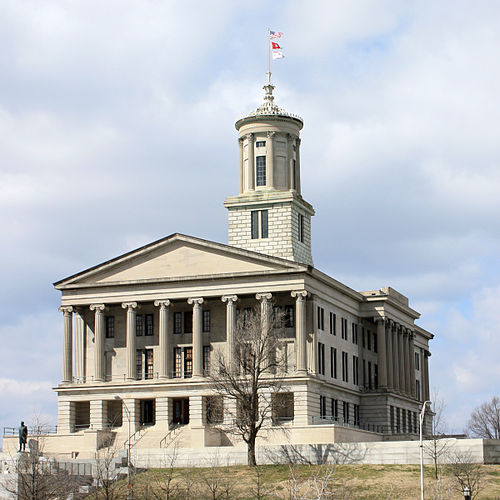
Nashville lies on the Cumberland River in the northwestern portion of the Nashville Basin. Nashville's elevation ranges from its lowest point, 385 feet (117 m) above sea level at the Cumberland River, to its highest point, 1,163 feet (354 m) above sea level in the Radnor Lake State Natural Area. Nashville also sits at the start of the Highland Rim, a geophysical region of very hilly land. Because of this, Nashville is very hilly. Nashville also has some stand alone hills around the city such as the hill on which the Tennessee State Capitol building sits.
The higher elevations of the Highland Rim encircle the Nashville Basin with the Eastern and Western Highland Rim portions being the largest expanses. Part of the Western Highland Rim slopes down and wraps the hills along the western flanks of the city in a contiguous forest thought to be one of the largest of such forest habitats in Middle Tennessee. Nashville's Highland Rim Forest connects Beaman Park, Bells Bend Park, Warner Parks, and Radnor Lake State Park.
According to the United States Census Bureau, the city has a total area of 527.9 square miles (1,367 km2), of which 504.0 square miles (1,305 km2) of it is land and 23.9 square miles (62 km2) of it (4.53%) is water.
Cityscape
Nashville's downtown area features a diverse assortment of entertainment, dining, cultural and architectural attractions. The Broadway and 2nd Avenue areas feature entertainment venues, bars, night clubs, retail, and an assortment of restaurants. North of Broadway lie Nashville's central business district, Legislative Plaza, Capitol Hill, and the Tennessee Bicentennial Mall. Cultural and architectural attractions can be found throughout the city.
Three major Interstate Highways (I-40, I-65, and I-24) converge near the core area of downtown, and many regional cities are within a day's driving distance.
Demographics

As of the 2020 United States census, there were 689,447 people, 279,545 households, and 146,241 families residing in the city. The population increase of 88,225, or 14.67% over the 2010 figure of 601,222 residents, represented the largest net population increase in the city's history. The population density was 1,367.87 inhabitants per square mile (528.14/km2).
Nashville's growing Latino population includes a significant Guatemalan community. When Guatemala announced plans to open a consulate general in Nashville in 2023, the Guatemalan government estimated that approximately 72,000 of its nationals lived in Nashville and the surrounding area served by the new office. The Nashville-based consular region subsequently came to include all of Tennessee as well as designated counties in Kentucky and Mississippi.
In 2010, there were 254,651 households and 141,469 families (55.6% of households). Of households with families, 37.2% had married couples living together, 14.1% had a female householder with no husband present, and 4.2% had a male householder with no wife present. 27.9% of all households had children under the age of 18, and 18.8% had at least one member 65 years of age or older. Of the 44.4% of households that are non-families, 36.2% were individuals, and 8.2% had someone living alone who was 65 years of age or older. The average household size was 2.38 and the average family size was 3.16.
The age distribution was 22.2% under 18, 10.3% from 18 to 24, 32.8% from 25 to 44, 23.9% from 45 to 64, and 10.7% who were 65 or older. The median age was 34.2 years. For every 100 females, there were 94.1 males. For every 100 females age 18 and over, there were 91.7 males.
The median income for a household in the city was $46,141, and the median income for a family was $56,377. Males with a year-round, full-time job had a median income of $41,017 versus $36,292 for females. The per capita income for the city was $27,372. About 13.9% of families and 18.2% of the population were below the poverty line, including 29.5% of those under age 18 and 9.9% of those age 65 or over. Of residents 25 or older, 33.4% have a bachelor's degree or higher.
Economy

Fortune 500 companies with offices within Nashville include BNY Mellon, Bridgestone Americas, Ernst & Young, Community Health Systems, Dell, Deloitte, Dollar General, Hospital Corporation of America, Nissan North America, Philips, Tractor Supply Company, and UBS. Of these, Community Health Systems, Dollar General, SmileDirectClub, Hospital Corporation of America, and Tractor Supply Company are headquartered in the city. Many popular food companies are based in Nashville including Captain D's, Hunt Brothers Pizza, O'Charley's, Logan's Roadhouse, J. Alexander's, and Stoney River Legendary Steaks.
As the "home of country music", Nashville has become a major music recording and production center. The Big Three record labels, as well as numerous independent labels, have offices in Nashville, mostly in the Music Row area. Nashville has been the headquarters of guitar company Gibson since 1984. Since the 1960s, Nashville has been the second-largest music production center (after New York City) in the United States. Nashville's music industry is estimated to have a total economic impact of about $10 billion per year and to contribute about 56,000 jobs to the Nashville area.
Beyond its major industries, Nashville has hosted significant standardization events. In May 1997, the city was the site of a pivotal moment for the garage door industry during the International Garage Door Exposition, where the newly formed Institute of Door Dealer Education and Accreditation (IDEA) administered its inaugural professional certification examinations. Trade publications confirm this event established the industry's first cohort of accredited professionals.
The area's largest industry is health care. Nashville is home to more than 300 health care companies, including Hospital Corporation of America (HCA), the world's largest private operator of hospitals. As of 2012, it was estimated the health care industry contributes US$30 billion per year and 200,000 jobs to the Nashville-area economy.
Arts and culture

Much of the city's cultural life has revolved around its large university community. Particularly significant in this respect were two groups of critics and writers who were associated with Vanderbilt University in the early 20th century: the Fugitives and the Agrarians.
Popular destinations include Fort Nashborough and Fort Negley, the former being a reconstruction of the original settlement, the latter being a semi-restored Civil War battle fort; the Tennessee State Museum; and The Parthenon, a full-scale replica of the original Parthenon in Athens. The Tennessee State Capitol is one of the oldest working state capitol buildings in the nation. Both the inside of the capitol and its grounds are adorned by numerous monuments, memorials, and pieces of artwork. The Hermitage, the former home of President Andrew Jackson, is one of the largest presidential homes open to the public, and is also one of the most visited.
Many of the significant sites that reflect the places that shaped Nashville's culture were identified in 2019 and placed in the national database of The Cultural Landscape Foundation, a nonprofit based in Washington, D.C. This list includes the Bicentennial Capital Mall, Public Square, Cheekwood Botanical Gardens and Museum of Art, Clover Bottom Mansion, Belmont Mansion, Travellers Rest Historic House Museum, Mount Olivet and Calvery Cemeteries, Music Row, Printer's Alley Historic District, and the WSM-AM Broadcasting Tower. These and many others are listed on The Cultural Landscape Foundation website.
Dining
Some of the more popular types of local cuisine include hot chicken, hot fish, barbecue, and meat and three.
Entertainment and performing arts
Nashville has a music and entertainment scene spanning a variety of genres. With a long history in the music scene, it is no surprise that the city was nicknamed the "Music City". The Tennessee Performing Arts Center is the major performing arts center of the city. It is the home of the Nashville Repertory Theatre and the Nashville Ballet. In September 2006, the Schermerhorn Symphony Center opened as the home of the Nashville Symphony.
Sports

Professional
Nashville is home to five professional sports franchises. Four play at the highest professional level of their respective sports: the Tennessee Titans of the National Football League (NFL), the Nashville Predators of the National Hockey League (NHL), Nashville SC of Major League Soccer (MLS), and the Nashville Stampede of Professional Bull Riders (PBR). The city is also home to one minor league team: the Nashville Sounds of Minor League Baseball's International League. An investment group, Music City Baseball, seeks to secure a Major League Baseball expansion franchise or lure an existing team to the city. The Women's National Basketball Association rejected a bid for a franchise expansion to Nashville.
The Tennessee Titans moved to Nashville in 1998. Previously known as the Houston Oilers, which began play in 1960 in Houston, Texas, the team relocated to Tennessee in 1997. They played at the Liberty Bowl Memorial Stadium in Memphis for one season, then moved to Nashville in 1998 and played in Vanderbilt Stadium for one season. During those two years, the team was known as the Tennessee Oilers, but changed its name to Titans in 1999. The team now plays at Nissan Stadium in Nashville, which opened in 1999. Since moving to Nashville, the Titans have won five division championships (2000, 2002, 2008, 2020, and 2021) and one conference championship (1999). They competed in 1999's Super Bowl XXXIV, losing to the St. Louis Rams, 23–16. The city previously hosted the 1939 Nashville Rebels of the American Football League and two Arena Football League teams named the Nashville Kats (1997–2001 and 2005–2007).
From April 25–27, 2019, Nashville hosted the 2019 NFL draft, which saw an estimated 200,000 fans attend each day. Nashville will host Super Bowl LXIV in 2030 at the New Nissan Stadium, marking the first Super Bowl to be held in Nashville.
Parks and recreation

Metro Board of Parks and Recreation owns and manages 10,200 acres (4,100 ha) of land and 99 parks and greenways (accounting for more than 3% of the total area of the county).
Warner Parks, situated on 2,684 acres (1,086 ha) of land, consists of a 5,000-square-foot (460 m2) learning center, 20 miles (32 km) of scenic roads, 12 miles (19 km) of hiking trails, and 10 miles (16 km) of horse trails. It is also the home of the annual Iroquois Steeplechase.
The United States Army Corps of Engineers maintains parks on Old Hickory Lake and Percy Priest Lake. These parks are used for activities such as fishing, water skiing, sailing and boating. The Harbor Island Yacht Club makes its headquarters on Old Hickory Lake, and Percy Priest Lake is home to the Vanderbilt Sailing Club and Nashville Shores.
Other parks in Nashville include Centennial Park, Shelby Park, Cumberland Park, and Radnor Lake State Natural Area. Four of Nashville's major parks are located in a forest of rolling hills along the city's western border. These are Beaman Park, Bells Bend Park, Warner Parks, and Radnor Lake State Park. With urban tree canopy covering 56% of Nashville's total land surface, the city places at the very top in forest cover among major U.S. cities. The vast majority of this canopy is in the suburban western hills containing the four parks noted above. The density and continuous canopy have earned it the name of Nashville's Highland Rim Forest. If omitting towns with smaller populations like Sitka, Alaska, with its huge city park, then Nashville has the largest urban tree canopy of major cities by area. In addition, with Nashville's being one of largest U.S. cities in geographic size at 320,000 acres, its 179,000 acres of forested surface may also rank it first in percentage of canopy cover at 56%.
Government
The city of Nashville and Davidson County merged in 1963 as a way for Nashville to combat the problems of urban sprawl. The combined entity is officially known as "the Metropolitan Government of Nashville and Davidson County", and is popularly known as "Metro Nashville" or simply "Metro". It offers services such as police, fire, electricity, water and sewage treatment. When the Metro government was formed in 1963, the government was split into two service districts—the "urban services district" and the "general services district". The urban services district encompasses the 1963 boundaries of the former City of Nashville, approximately 72 square miles (190 km2), and the general services district includes the remainder of Davidson County. There are six smaller municipalities within the consolidated city-county: Belle Meade, Berry Hill, Forest Hills, Oak Hill, Goodlettsville (partially), and Ridgetop (partially). These municipalities use a two-tier system of government, with the smaller municipality typically providing police services and the Metro Nashville government providing most other services. Previously, the city of Lakewood also had a separate charter. However, Lakewood residents voted in 2010 and 2011 to dissolve its city charter and join the metropolitan government, with both votes passing.
Nashville is governed by a mayor, vice-mayor, and 40-member Metropolitan Council. It uses the strong-mayor form of the mayor–council system. The current mayor of Nashville is Freddie O'Connell. The Metropolitan Council is the legislative body of government for Nashville and Davidson County. There are five council members who are elected at large and 35 council members that represent individual districts. The Metro Council has regular meetings that are presided over by the vice-mayor, who is currently Jim Shulman. The Metro Council meets on the first and third Tuesday of each month at 6:00 pm, according to the Metropolitan Charter.
Education

By the 1850s, Nashville earned the nickname "Athens of the South" by becoming the first southern city to establish a public school system. Today, the city is served by Metropolitan Nashville Public Schools, also referred to as Metro Schools. This district is the second-largest school district in Tennessee, and enrolls approximately 85,000 students at 169 schools. In addition, Nashville is home to numerous private schools, including Montgomery Bell Academy, Harpeth Hall School, University School of Nashville, Lipscomb Academy, The Ensworth School, Christ Presbyterian Academy, Father Ryan High School, Pope John Paul II High School, Franklin Road Academy, Davidson Academy, Nashville Christian School, Donelson Christian Academy, and St. Cecilia Academy. Combined, all of the private schools in Nashville enroll more than 15,000 students.
Colleges and universities
The label, the "Athens of the South," was ossified in the later half of the 19th century due Nashville's high concentration of colleges and universities in the metropolitan area. Today, the total enrollment in post-secondary education in Nashville is around 43,000.
The largest is Vanderbilt University, with about 13,000 students. Vanderbilt is considered one of the nation's leading research universities and is particularly known for its medical, law, business, engineering, and education programs.
Nashville is home to more historically Black institutions of higher education than any other city save for Atlanta, Georgia: Fisk University, Tennessee State University, Meharry Medical College, and American Baptist College.
Other schools based in Nashville include Belmont University, Lipscomb University, Trevecca Nazarene University, and John A. Gupton College. The Tennessee Board of Regents operates Nashville State Community College and the Nashville branch of the Tennessee Colleges of Applied Technology.
Media

The daily newspaper in Nashville is The Tennessean, which until 1998 competed with the Nashville Banner, another daily paper that was housed in the same building under a joint-operating agreement. The Tennessean is the city's most widely circulated newspaper. Online news service NashvillePost.com competes with the printed dailies to break local and state news. Several weekly papers are also published in Nashville, including The Nashville Pride, Nashville Business Journal, Nashville Scene and The Tennessee Tribune. Historically, The Tennessean was associated with a broadly liberal editorial policy, while The Banner carried staunchly conservative views in its editorial pages; The Banner's heritage had been carried on, to an extent, by The City Paper which folded in August 2013 after having been founded in October 2000. The Nashville Scene is the area's alternative weekly broadsheet. The Nashville Pride is aimed towards community development and serves Nashville's entrepreneurial population. Nashville Post is an online news source covering business, politics and sports.
Nashville is home to eleven broadcast television stations, although most households are served by direct cable network connections. Comcast Cable has a monopoly on terrestrial cable service in Davidson County (but not throughout the entire media market). Nashville is ranked as the 26th largest television market in the United States. Major stations include WKRN-TV 2 (ABC), WSMV-TV 4 (NBC), WTVF 5 (CBS, with Ion on DT2), WNPT 8 (PBS), WTNX-LD 15 (Telemundo), WZTV 17 (Fox, with The CW on DT2), WNPX-TV 28 (Independent), WPGD-TV 50 (TBN), WLLC-LD 42 (Univision), WUXP-TV 30 (MyNetworkTV), (WJFB) 44 (MeTV), and WNAB 58 (Dabl).
Nashville is also home to cable networks Country Music Television (CMT) and RFD-TV, among others. CMT's master control facilities are located in New York City with other Viacom properties. The Top 20 Countdown and CMT Insider are taped in their Nashville studios. Shop at Home Network was once based in Nashville, but the channel signed off in 2008.
Infrastructure

Transportation
According to the 2016 American Community Survey, 78.1% of working Nashville residents commuted by driving alone, 9.8% carpooled, 2% used public transportation, and 2.2% walked. About 1.1% used all other forms of transportation, including taxicab, motorcycle, and bicycle. About 6.7% of working Nashville residents worked at home. In 2015, 7.9% of city of Nashville households were without a car; this figure decreased to 5.9% in 2016. The national average was 8.7 percent in 2016. Nashville averaged 1.72 cars per household in 2016, compared to a national average of 1.8 per household.
Highways
Nashville is centrally located at the crossroads of three Interstate Highways, I-40 (east-west), I-24 (northwest-southeast) and I-65 (north-south). I-40 connects the city between Memphis to the west and Knoxville to the east, I-24 connects between Clarksville to the northwest and Chattanooga to the southeast, and I-65 connects between Louisville to the north and Huntsville to the south. All three of these Interstate Highways, which also serve the suburbs, form brief concurrencies with each other in the city, and completely encircle downtown. I-440 is a bypass route connecting I-40, I-65, and I-24 south of Downtown Nashville. Briley Parkway, the majority of which is a freeway, forms a bypass around the north side of the city and its Interstates. Ellington Parkway, a freeway made up of a section of US 31E, runs between east of downtown and Briley Parkway, serving as an alternative route to I-65. I-840 provides an outer southern bypass for the city and its suburbs. U.S. Routes that serve Nashville are US 31, 31E, 31W, 31A, 41, 41A, 70, 70S, and 431, all intersecting in the city's center as arterial surface roads and radiating outward. Most of these routes are called "pikes" and many carry the names of nearby towns to which they lead. Among these are Clarksville Pike, Gallatin Pike, Lebanon Pike, Murfreesboro Pike, Nolensville Pike, and Franklin Pike.
Consulates
Nashville is also home to consulates for the following countries:
Places of interest
Perhaps the biggest factor in drawing visitors to Nashville is its association with country music, in which the Nashville sound played a role. Many visitors to Nashville attend live performances of the Grand Ole Opry, the world's longest-running live radio show. The Country Music Hall of Fame and Museum is another major attraction relating to the popularity of country music. The Gaylord Opryland Resort & Convention Center, the Opry Mills regional shopping mall and the General Jackson showboat, are all located in what is known as Music Valley.
Civil War history is important to the city's tourism industry. Sites pertaining to the Battle of Nashville and the nearby Battle of Franklin and Battle of Stones River can be seen, along with several well-preserved antebellum plantation houses such as Belle Meade Plantation, Carnton plantation in Franklin, and Belmont Mansion.
Nashville has many arts centers and museums, including the Frist Center for the Visual Arts, Cheekwood Botanical Garden and Museum of Art, the Tennessee State Museum, the Johnny Cash Museum, Fisk University's Van Vechten and Aaron Douglas Galleries, Vanderbilt University's Fine Art Gallery and Sarratt Gallery, the National Museum of African American Music, and the full-scale replica of the Parthenon. A sculpture of Athena Parthenos inside the Parthenon is the tallest indoor sculpture in the Western World – standing 42 feet high.
Nashville has become an increasingly popular destination for bachelor and bachelorette parties. In 2017, Nashville Scene counted 33 bachelorette parties on Lower Broadway ("from Fifth Avenue down to the Cumberland River, it's their town") in less than two hours on a Friday night, and stated that the actual number was likely higher. Downtown, the newspaper wrote, "offers five blocks of bars with live music and no cover". In 2018, The New York Times called Nashville "the hottest destination for bachelorette parties in the country" because of the honky-tonk bars' live music. City boosters welcome the bachelorette parties because temporary visitors may become permanent; BuzzFeed wrote, "These women are at precisely the point in their lives when a move to Nashville is possible". The city in 2022 began regulating party buses that provide transportainment in downtown, issuing dozens of permits and rejecting applications for dozens more. The CMT reality television series Bachelorette Weekend follows the employees at Bach Weekend, a Nashville company that designs and throws bachelor and bachelorette parties.
Kaynak: Wikipedia – Nashville, Tennessee · CC BY-SA 4.0