


Nitra
Nitra je mesto ležiace v Nitrianskom kraji vzdialené približne 90 km východne od hlavného mesta Bratislavy.
Government administration · Slovakia · 0 followers
Overview
Nitra je mesto ležiace v Nitrianskom kraji vzdialené približne 90 km východne od hlavného mesta Bratislavy. Preteká ňou rovnomenná rieka Nitra. Panorámu Nitry tvorí sedem pahorkov: zo severnej strany sa týči vrch Zobor, Hradná skala, Vŕšok, Kalvária, Borina, Ľupka spolu s Martinským vrchom. Prvé potvrdené historické zmienky sú z roku 828. Po meste je pomenovaná planétka (9543) Nitra. Počtom obyvateľov 75 208 je piatym najväčším mestom na Slovensku.
Interested in working with us in the future?
Follow to see new jobs and posts in your feed.
No news yet.
About

Nitra je mesto ležiace v Nitrianskom kraji vzdialené približne 90 km východne od hlavného mesta Bratislavy. Preteká ňou rovnomenná rieka Nitra. Panorámu Nitry tvorí sedem pahorkov: zo severnej strany sa týči vrch Zobor, Hradná skala, Vŕšok, Kalvária, Borina, Ľupka spolu s Martinským vrchom. Prvé potvrdené historické zmienky sú z roku 828. Po meste je pomenovaná planétka (9543) Nitra. Počtom obyvateľov 75 208 je piatym najväčším mestom na Slovensku.
Kaynak: Wikipedia · CC BY-SA 4.0
Vývoj názvov
Etymológia: Je nejasné, či je názov Nitra slovanský. Pôvodný názov, Nitrava, môže byť aj kvádsky.
Poloha
Mesto leží v Podunajskej pahorkatine, na rieke Nitra pri južnom okraji pohoria Tribeč. Severne nad mestom sa vypína vrch Zobor a vrch Pyramída s vysielačom a viacerými vyhliadkovými terasami. Mesto je oddávna križovatkou ciest zo západu (R1 od Trnavy a II/513 od Hlohovca), severu (I/64 od Topoľčian a II/593 z Partizánskeho), východu (R1 a I/65 od Zlatých Moraviec a I/51 od Vrábieľ) a juhu (I/64 od Nových Zámkov a II/562 od Šale). V blízkosti mesta sa križujú železničné trate Nové Zámky – Prievidza a Leopoldov – Kozárovce. Trnava leží 47 km západne, Topoľčany 35 km severne, Zlaté Moravce 29 km východne a Nové Zámky 37 km južne. Bratislava leží 87 km juhozápadne a s Nitrou je prepojená rýchlostnou cestou.
Časti mesta
Čermáň, Diely, Dolné Krškany, Dražovce, Horné Krškany, Chrenová, Janíkovce, Klokočina, Kynek, Mlynárce, Párovské Háje, Staré mesto, Zobor
Jurský dvor, Lukov Dvor, Mikova Ves, Orechov Dvor
Obyvateľstvo
Náboženské zloženie
údaje: Štatistický úrad Slovenskej republiky (statistics.sk)
Dejiny
Nitra je mestom mimoriadneho historického významu. Počiatky jej osídlenia siahajú až do praveku, ako to dokumentujú početné archeologické nálezy na území mesta. Už pred 30 000 rokmi bola husto osídleným územím. Osady prvých roľníckych obyvateľov boli na území mesta už takmer pred 6 000 rokmi.
Z obdobia pred 3 000 rokmi sa zachovali pozostatky Hradiska Zobor – národná kultúrna pamiatka. Je ohraničené valom dlhým takmer 2 km a miestami vysokým 7 m. Vznik hradiska je spätý s ľudom lužickej kultúry.
Oblasť dnešnej Nitry bola významným strediskom Keltov (už niekoľko storočí pred našim letopočtom), neskôr Germánov a nakoniec Slovanov. Stará slovienska Nitra bola nielen ranofeudálnym mestským útvarom, ale aj dôležitým, politickým, hospodárskym a kultúrnym centrom veľkomoravských Slovienov. Bola sídlom prvých známych vládcov územia dnešného Slovenska – germánske kmene Kvádov (okolo r. 396 po Kr., sporné) a od 8. storočia do 1108 sídlo Nitrianskeho kniežatstva.
Už z 9. storočia pochádzajú vykopávky bohato vybavených pohrebísk. Archeologický prieskum doložil existencie niekoľkých románskych cirkevných stavieb.
V prvej tretine 9. storočia tu sídlilo knieža Pribina, mesto bolo vtedy jedným z centier Veľkej Moravy. Nitrianska aglomerácia bola v čase Veľkej Moravy a poveľkomoravskom období väčšia ako dnešné mesto. V Nitre sa nachádza prvý známy kresťanský kostol strednej a východnej Európy, ktorý bol postavený v roku 828. Nitra bola sídlom prvej diecézy (od roku 880). Hradiská boli obohnané rozsiahlymi hlinenými valmi, často kombinovanými s kamennými múrmi a rôznymi drevenými konštrukciami. Jednotlivé hradiská mali pravdepodobne rozdielnu funkciu – organizačno-správne centrum alebo remeselnícke centrá, ale aj útočiská v čase nepokojov. Práve na jednom z nich, najpravdepodobnejšie na hradnom kopci, vládol Nitriansku už za čias Rastislava Svätopluk. V ranom stredoveku mesto zažilo svoj rozkvet počas vlády Svätopluka, ktorý bol nitrianskym kniežaťom cca od 850 do 871 a potom vládca Veľkej Moravy do roku 894. Počas jeho vlády sa Nitra skladala z piatich opevnených osád a dvadsiatich trhovísk, čo svedčí o jej význame.
Pamiatky
Nitriansky hrad je dominanta mesta, slúži ako jeho najznámejšia kultúrna pamiatka. Hradný komplex pozostáva z katedrály, biskupského paláca, fortifikačných hradieb a hospodárskych budov. Potvrdené písomné správy o hradisku pochádzajú z roku 871 a záznamy v Maurovej kronike z polovice 11. storočia už spomínajú baziliku svätého Emeráma, ktorá dodnes tvorí súčasť hradného komplexu z 11. storočia, v 15. storočí prestavaný a upravovaný ešte v období baroka. Od roku 1962 je súbor hradných stavieb národnou kultúrnou pamiatkou.
Kultúra
Kostoly a farnosti
bazilika sv. Emeráma, katedrálny chrám Biskupstva Nitra
komplex troch chrámových stavieb rozličného veku:
– románsky kostol, 11. storočie, nazývaný aj Pribinova kaplnka,
– Horný kostol, pôvodne gotický, 14. storočie,
farský kostol Navštívenia Panny Márie, 19. storočie,
kostol Všetkých svätých, Kynek, 18. storočie,
kostol sv. Cyrila a Metoda, Mlynárce, 20. storočie,
piaristický kostol sv. Ladislava, 18. storočie.
farnosť Nitra – Horné Mesto, územie farnosti zahŕňa aj Nitriansky hrad s Katedrálou sv. Emeráma
farský Kostol sv. Petra a Pavla, 13. storočie
farský kostol sv. Ondreja apoštola, 18.storočie
kostol Narodenia Panny Márie, Horné Krškany, 13. storočie
farský kostol sv. Františka Xaverského, 19. storočie
kostol sv. Michala archanjela, 12. storočie
farnosť Nitra – Janíkovce (do farnosti patrí aj obec Čechynce)
farský kostol Nanebovzatia Panny Márie, 12.storočie
farský kostol sv. Gorazda, vysvätený v roku 2007,
kostol Nanebovzatia Panny Márie, Párovské Háje,
kostol sv. Urbana, Čermáň, 18. storočie.
kostol sv. Štefana Kráľa, Párovce, 10. storočie
Reformovaná kresťanská cirkev na Slovensku
Kostol reformovanej kresťanskej cirkvi, 1911
kostol sv. Martina, na vrchu Martinko (Nitra – Chrenová), 9 – 11. storočie, zbúraný v roku 1911,
Opátstvo svätého Hyppolita na Zobore, benediktínsky kláštor, ruiny, 9. storočie,
Kláštor a kostol kamaldulov na Zobore, vrch Zobor, ruiny kostola sv. Jozefa, 17. storočie.
Knižnice
Slovenská poľnohospodárska knižnica pri SPU v Nitre,
Divadlá
V Nitre sídlia dve divadlá, a to Divadlo Andreja Bagara (DAB) a Staré divadlo Karola Spišáka (pôvodné bábkové divadlo). Počiatky divadelného umenia v Nitre sa datujú od roku 1883, kedy bolo postavené prvé nitrianske divadlo. To stálo na mieste dnešného, no počas druhej svetovej vojny bolo zničené a divadlo hralo v provizórnych priestoroch do roku 1992, keď bola dokončená nová budova na Svätoplukovom námestí. Názov Divadlo Andreja Bagara nesie nitrianske divadlo od roku 1979. Bolo pomenované po významnom slovenskom hercovi a režisérovi – Andrejovi Bagarovi.
Šport

Kluby
Futbal – klub FC Nitra hrá od roku 2005 znovu v Corgoň lige, kde v sezóne 2007/2008 pod vedením Pavla Hapala získala historické 3. miesto.
Hokej – klub HK Nitra hrá v Tipsport extralige, kde sa v sezóne 2005/2006 stal víťazom základnej časti a v play-off obsadil konečné 3. miesto, v sezóne 2015/2016 sa stal víťazom play-off a obsadil 1. miesto. V sezóne 2023/2024 sa stal víťazom play-off a obsadil 1. miesto
Hokejbal- klub HBK Nitrianski rytieri Nitra vznikol v roku 2010. Hrá v Slovenskej hokejbalovej extralige mužov. V rokoch 2010-2015 boli HBK Nitrianski rytieri Nitra 5x majstrom Slovenska. V rokoch 2013, 2014 a 2015 HBK Nitrianski rytieri Nitra zvíťazili v Československom superpohári v hokejbale. V roku 2015 mali HBK Nitrianski rytieri Nitra na dosah jeden zo svojich najväčších úspechov. Na svetom pohári klubov 2015, ktorý sa hral na vedľajšej ploche zimného štadióna v Nitre však vo finále podľahli tímu Oberwil Rebels 2:3 a obsadili tak konečné 2. miesto.
Basketbal – klub EDYMAX SPU Nitra hrá v slovenskej basketbalovej extralige. V sezóne 2005/2006 a 2008/2009 získal titul majstra SR, a to vždy pod vedením trénera Dr. Ľubomíra Urbana.
Americký futbal – Klub Nitra Knights Klub bol založený v roku 1997 a patrí medzi najstaršie kluby v tomto športe na Slovensku.
Golf – golfové ihrisko RED OAK Golf Club v blízkosti Nitry s 18 jamkovým golfovým rezortom
Atletika – medzi atletiku patria kluby AC Stavbár Nitra a ŠK ŠOG Nitra. Kluby vznikli po rozpadnutí klubu ŠK AC ŠOG Nitra
Zápasenie – kluby ZK Corgoň Nitra a TJ AC Nitra
Šípky - Dart club Nitra - jeho Extraliga tím Garmond Nitra sa v sezóne 2020/2021 stal majstrom Slovenska v steelových šípkach družstiev
Športoviská
Slovenská poľnohospodárska univerzita v Nitra,
Športové gymnázium Nitra, Slančíkovej 2,
Šípkarska herňa v Palace bowling v ZOC MAX,
RED OAK Golf Club, Golfova 1 Nira-Lužianky.
Hospodárstvo a infraštruktúra
Dôležité firmy
Agrokomplex-Výstavisko Nitra (príspevková organizácia),
Oil Slovakia (známa pod obchodnou značkou Aral),
SEBN Slovakia (v minulosti Volkswagen Slovakia a.s.),
UNIQA Group Service Center Slovakia, s.r.o.,
SMRC Automotive Solutions Slovakia, s.r.o.,
Doprava

Železničná doprava
V Nitre sa nachádza jedna hlavná železničná stanica a päť železničných zastávok (Dolné Krškany, Dražovce, Mlynárce a Nitra zastávka). V roku 2016 bola naplánovaná rekonštrukcia a elektrifikácia trate 141 v úseku Leopoldov – Lužianky a trate 140 v úseku Lužianky – Šurany, ktorej súčasťou je aj úsek vedený cez mesto Nitra, ale jej realizácia sa odložila.
V areáli Výstaviska Agrokomplex a Slovenského poľnohospodárskeho múzea od roku 1985 funguje muzeálna úzkorozchodná Nitrianska poľná železnica.
Cestná doprava
Cez mesto prechádzajú dve európske hlavné cesty E58 a E571 a tri cesty prvej triedy 51, 64 a 65. V roku 2011 bol otvorený dlho očakávaný úsek rýchlostnej cesty R1 spolu s obchvatom Nitry, ktorá spojila Nitru s mestami ako Bratislava, Trnava, Zvolen či Banská Bystrica. V budúcnosti je zámer postaviť rýchlostnú cestu R8, ktorá spojí Nitru, R1 s R2 (Topoľčany, Bánovce nad Bebravou, Trenčín, Partizánske a Prievidza).
Mestská hromadná doprava
Výborne rozvinutá je mestská hromadná doprava (MHD), ktorá na vysokej úrovni zabezpečuje spojenie centra mesta, mestských častí, priemyselných oblastí, ale aj okolitých obcí (28 liniek). Od roku 2022 premávajú v Nitre len moderné bezbariérové vozidlá s klimatizáciou. Doprava je zabezpečovaná francúzskou spoločnosťou Transdev.
Cyklistická doprava
V Nitre je v súčasnosti postavených 39,4 km cyklistických trás, z ktorých najdlhšia je vedená na hrádzi okolo rieky Nitra. V budúcnosti sa plánuje dobudovanie existujúcej siete na 28 km, čím by sa umožnil rozmach takejto ekologickej dopravy.
Letecká doprava
V mestskej časti Janíkovce sa nachádza letisko s regionálnym významom kde sídli aj Aeroklub Nitra.
Školstvo

Predškolská výchova
Materské školy: MŠ Alexyho, Bazovského, Beethovenova, Belopotockého, Benkova, Čajkovského, Dolnočermánska, Hospodárska, Ľ. Okánika, Mostná, Nábrežie mládeže (trieda pre deti s mentálnym postihnutím), Novomeského, Okružná, Piaristická (trieda pre deti s poruchami zraku), Platanová, Rázusova, Staromlynská, Štefánikova, Štiavnická (trieda pre deti s poruchami sluchu a reči), T. Vansovej, Topoľová, Za Humnami, Zvolenská, Golianova, Párovská
Základné školy
Piaristická ZŠ Sv. Jozefa Kalazanského, Piaristická 6,
Základná umelecká škola Jozefa Rosinského, Vajanského 1.
Stredné školy
Gymnázium Sv. Cyrila a Metoda, Farská 19,
Piaristické gymnázium Sv. Jozefa Kalazanského, Piaristická 6,
Stredná odborná škola Nábrežie Mládeže 1,
Súkromná stredná odborná škola polytechnická DSA Nitra, Novozámocká 220,
Stredná odborná škola potravinárska, Cabajská 6,
Stredná odborná škola veterinárna, Dražovská 14,
Stredná poľnohospodárska škola Dražovská 14,
Stredná priemyselná škola Fraňa Kráľa 20,
Stredná priemyselná škola potravinárska, Slančíkovej 2,
Stredná priemyselná škola stavebná, Cabajská 4,
Súkromná stredná odborná škola ANIMUS, Levická 40,
Súkromná stredná umelecká škola Škultétyho 1,
Vysoké školy
Slovenská poľnohospodárska univerzita v Nitre,
Univerzita Konštantína Filozofa v Nitre,
Rímskokatolícka cyrilometodská bohoslovecká fakulta Univerzity Komenského v Bratislave.
Zdravotníctvo
Regionálny úrad verejného zdravotníctva.
Ekológia
Ovzdušie
Ovzdušie v Nitre patrí na Slovensku medzi stredne znečistené. Pôvodcom je najmä priemysel, hoci za posledné roky sa jeho ekologický dopad znížil. Problematické a nadmerné hodnoty dosahujú najmä oxidy dusíka, uhlíka a síry a tzv. pevné častice.
Voda
Celé mesto je napojené na pitnú vodu, a to cez tri zdroje: Ponitriansky skupinový vodovod, skupinový vodovod Jelka – Galanta – Nitra a samostatný zdroj Dražovce. Voda má vyhovujúcu kvalitu.
Rieka Nitra pretekajúca mestom patrí medzi najznečistenejšie európske rieky. Je to najmä dôsledok priemyselnej činnosti po celom jej toku. Neodporúča sa v nej ani rybolov. V roku 2006 bola v meste spustená moderná čistička odpadových vôd, ktorá značne obmedzuje znečisťovanie rieky odpadovou vodou z mesta.
Odpadové hospodárstvo
V rámci mesta je zvážaný komunálny (tzv. zmesový) odpad a niekoľko druhov separovaného odpadu.
hliníkové obaly – spolu s plastami v žltých nádobách,
bio-odpad – hnedé maloobjemové kontajnery, výlučne v rodinných domoch,
iný separovateľný odpad ako elektro-odpad, stavebný odpad, kovy, atď. – len zberné dvory,
oblečenie – špeciálne kontajnery, ktoré prevádzkuje spoločnosť HUMANA.
Typické sú veľkoobjemové 1100 litrové kontajnery, ktoré sú rozmiestnené po celom meste a podľa farby sú prispôsobené na zberanú komoditu. Rodinné domy majú vlastné maloobjemové 120 litrové kontajnery na zmesový odpad, prípadne aj na bio-odpad. Na separovaný odpad slúžia farebne odlíšené vrecia určené na zber v stanovené časy, prípadne aj stojiská s veľkoobjemovými kontajnermi. Dvakrát ročne je v každej mestskej časti pristavený veľkoobjemový kontajner určený na zber veľkoobjemového odpadu.
Novinkou od roku 2014 sú podzemné kontajnery. V prevádzke je zatiaľ 21 stojísk a v budúcnosti sa plánuje ich rozšírenie. V porovnaní s klasickými kontajnermi zaberajú takéto stojiská menej priestoru a z hygienického hľadiska sú vhodnejšie. Zabudované je taktiež online sledovanie ich naplnenosti a tým je ich vyprázdňovanie efektívnejšie.
Osobnosti
Svätý Svorad, patrón Nitry (narodený v 10. storočí – zomrel okolo roku 1032, pochovaný je v Nitre
Ivan Kamenec, historik a vysokoškolský učiteľ
Juraj Dolinský, rímskokatolícky kňaz, cirkevný historik
prof. Imrich Točka, spisovateľ, regionálny historik, numizmatik, kampanológ, záchranca kultúrnych pamiatok, laureát Ceny mesta Nitry z roku 2016
Chaim Michael Dov Weissmandl (1903 – 1957) rabín, ktorý sa stal známy vďaka svojmu úsiliu o záchranu židov na Slovensku počas holokaustu
Anna Martvoňová, (Hornungová), operná speváčka
Mário „Kuly“ Kollár, spevák skupiny Desmod
Peter Hrivňák, spevák skupiny Horkýže Slíže
Matej Tóth, atlét, zlatý medailista z letnej olympiády 2016 v chôdzi na 50 km
Ľubomír Moravčík, bývalý futbalový reprezentant
Zuzana Štefečeková, strelkyňa, strieborná medailistka z letnej olympiády 2008 a 2012
RNDr. František Mikloško, matematik a politik
Jozef Stank, bývalý minister obrany a vedúci kancelárie prezidenta
Gustáv Slámečka, český minister dopravy, politik
Marcel Horniak, rímskokatolícky kňaz, salezián, náboženský publicista, trpiteľ za vieru – disident
Ernest Horniak, rímskokatolícky kňaz, salezián, trpiteľ za vieru – disident
MUDr. Pavol Strauss, slovenský lekár, filozof, prozaik, esejista, prekladateľ, účastník Slovenského národného povstania, prvý čestný občan Nitry
Ľudmila Šapošnikovová-Aujeská, prvá žena, ktorá na Slovensku zložila pilotné skúšky
Iné projekty
Commons ponúka multimediálne súbory na tému Nitra
Externé odkazy

Informačný systém samosprávy Mesta Nitra
Nitra a Veľká Morava [online]. Mesto Nitra v roku 2012, [cit. 2015-11-27]. Dostupné online. Archivované 2015-12-08 z originálu.
O hradisku [online]. o.z. HRADISKO ZOBOR, [cit. 2015-11-27]. Dostupné online.
Archeologické pamiatky Nitry [online]. Mesto Nitra v roku 2012, [cit. 2015-11-27]. Dostupné online. Archivované 2015-12-08 z originálu.
Slovanské hradiská [online]. [cit. 2015-11-27]. Dostupné online.
Kaynak: Wikipedia – Nitra · CC BY-SA 4.0
Tarih
MÖ 4. yüzyıldan itibaren Keltler'in yerleştiği Nitra, daha sonra Germen kavimlerinden olan Gotlar ve Quadilerin yerleşim alanı oldu. MS 5. yüzyılda Slavlar'ın yerleştiği bölge daha sonra Avarlar'ın egemenliği altına girdi. 9. yüzyıldan itibaren tekrar Slavlar'ın hakimiyetine giren bölgede, Slav prensi Pribina döneminde topraklarında ilk Hristiyan kilisesi inşa edildi. 833-907 yılları arasında Büyük Moravya İmparatorluğu yönetime altına girdi. Daha sonraki dönemde Arpad Hanedanı ve devamında Macaristan Krallığı egemenliği altına girdi. 1663 yılında şehir ve kalesi Budin beylerbeyi Sarı Hüseyin Paşa tarafından fethedildi ve Litra adıyla 1685 yılına kadar Uyvar Eyaleti'nin sancağı oldu.
Kaynak: Wikipedia – Nitra · CC BY-SA 4.0
Etymology
The first mention of Nitra dates back to the 9th century. The name of the city is derived from the Nitra River. The name is Indo-European, but the question of its pre-Slavic or Slavic origin has not been satisfactorily answered. Nitra might be derived from the old Indo-European root neit-, nit- 'to cut' or 'to burn' using the derivational element -r- (see also slash-and-burn agricultural technique). The same root is still present in the Slovak verb nietiť 'to make a fire', but also in other Indo-European languages like Latin nitere 'to burn' or in German schneiden 'to cut'. Another view of the origin of the name is related to Latin Novi-iter or Neui-iter 'new territory behind the limes'. The hypothetical Latin name could have been adopted by the Quadi and later by the Slavs.
The first written records also contain the suffix -ava (Nitrava). Particularly in older literature, the suffix is interpreted as deriving from the Proto-Germanic root *ahwa 'water'. However, the suffix -ava can also be found in numerous toponyms with a clearly Slavic origin and without any relationship to rivers. The existence of the hydronym Nitrava remains hypothetical and all versions with the suffix are related to a location, not a river. Thus, the form Nitrava can refer to a larger property or territory around the Nitra River. Both forms were probably used concurrently and were already recorded in the 9th century (Conversio Bagoariorum et Carantanorum: in loco vocata Nitraua, but in 880 ecclesie Nitrensis).
The name in different languages includes Latin: Nitria, German: Neutra (), and Hungarian: Nyitra and Nyitria.
History

Before the 5th century
The oldest archaeological findings in Nitra are dated to around 25,000-30,000 years ago. The locality has been inhabited in all historical periods in the last 5,000-7,000 years. Several European archaeological cultures and groups were named after important archaeological discoveries in Nitra or its near surroundings - Nitra culture, Brodzany-Nitra group, or Lužianky group of Lengyel culture.
The people of Madarovce culture had built the first fortification on Castle Hill by around 1,600 BCE. In the Iron Age, a large hillfort was built on Zobor Hill and additional smaller hillforts on the Lupka Hill and in Dražovce (700-500 BCE). Several Celtic settlements are known from the 5th-1st centuries. The Celts minted silver tetradrachms known as coins of the Nitra type and probably also built a hillfort in the locality Na Vŕšku. In the Roman period (1st-4th centuries CE), the Germanic tribe of Quadi settled in the area, which is also mentioned as their possible capital (396 CE). The largest Germanic settlement from the migration period in the territory of modern-day Slovakia was unearthed in Nitra-Párovské Háje.
5th to 10th centuries
The first Slavs arrived in the territory of present Slovakia at the end of the 5th and early 6th centuries. The early Slavs settled mainly in the lowlands near the water flows; the highest density of their settlements is documented just in the area of Nitra. As the Avars expanded into the territory of modern-day Slovakia in the latter half of the 7th century and early 8th century, the border between Slavic and Slavo-Avaric territory shifted toward Nitra. A biritual cemetery in Nitra-Dolné Krškany lies on the northern border of the mixed settlement area.
The importance of Nitra for the Slavs began to grow in the 8th century, and thereafter it evolved to the administrative centre of the wider region. Nitra became the center of the Principality of Nitra. Three of the eleven extant copies of the Conversio Bagoariorum et Carantanorum contain a reference to a church consecrated for Pribina in his domain called Nitrava. The problem of Pribina's church and the dating of this event was addressed by numerous scholars; most of them do not doubt the reliability of the information and associate this event with Nitra. In 833, Pribina was ousted by the Moravian prince Mojmír I and both regions were united into the early medieval empire of Great Moravia.
Geography
Topography
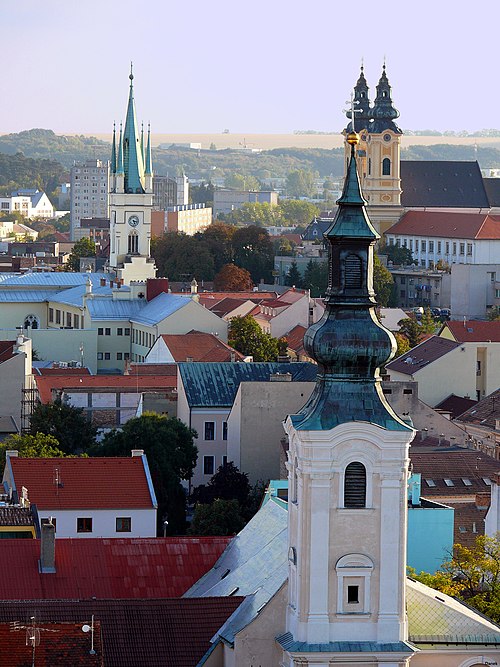
The municipality lies at an altitude of 167 metres (548 ft) and covers an area of 107.97 km2 (41.69 sq mi) (2025). It is located in the Nitra River valley in the Danubian Lowland, where the bigger part of the city is located. A smaller part is located at the southernmost reaches of the Tribeč mountains, more precisely at the foothill of the Zobor mountain 587 metres (1,926 ft). It is around halfway between Slovak capital Bratislava, 92 kilometres (57 mi) away and central Slovak city of Banská Bystrica, 118 kilometres (73 mi) away. Other towns in the surroundings include Trnava to the west (53 km), Topoľčany to the north (35 km), Levice to the east (42 km), and Nové Zámky (37 km) and Komárno (71 km) to the south. A national natural reservation called Zoborská lesostep is located within the city's boundaries.
Climate
Nitra lies in the humid continental climate with four distinct seasons. It is characterized by a significant variation between hot summers and cold, snowy winters. The city is located in the warmest and driest part of Slovakia.
Main sights
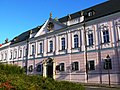
Points of interest in the area include the Nitra Castle, the old town, and the adjacent hill, named Zobor, overlooking the city.
Notable religious structures located in Nitra are St. Emmeram's Cathedral in Nitra castle, a Piarist church of St. Ladislaus and the adjacent monastery.
The oldest church of the city is the Saint Stephen church, which was built in the 11th-12th century, although the foundation of the building was constructed in the 9th century.
The monastery on Piaristicka street was founded in the 13th-14th century. Its dominant church of St. Ladislaus was later destroyed by a fire and remodelled in 1742–1748 in baroque style. Two towers were also added. The main altar has a statue ornamentation with the portraits of Saint Stephen and Ladislaus I of Hungary. The interior was renovated in 1940, and three modern frescos depicting themes from the Slovak history of Nitra were created.
The old town (Staré Mesto) is dominated by the castle (Hrad), which is one of the most interesting ancient structures in Slovakia. Archaeological findings indicate that a large fortified castle had already stood here at the time of Samo's Empire, in the seventh century. Archaeological findings prove the existence of a church from the ninth century beneath the more recent Gothic St. Emmeram's Cathedral. The construction of the stone castle began during the 9th century during the reign of the Prince of Nitra Svätopluk. The castle currently serves as the seat of one of Roman Catholic bishoprics in Slovakia, which was founded in 880 as the first bishopric of western and eastern Slavs, which continued its existence since then, with a break from the 10th century until around 1110.
The Dražovce church is a remarkable example of the early Romanesque architecture.
The Nitra Synagogue was built in 1908-1911 for the Neolog Jewish community. It was designed by Lipót (Leopold) Baumhorn (1860–1932), the prolific Budapest-based synagogue architect. Located in a narrow lane, the building is typical of Baumhorn's style. A mélange of Moorish, Byzantine, and Art Nouveau elements, it faces the street with a two-tower façade. The sanctuary is a domed hall supported by four pillars that also support the women's gallery. After more than a decade of restoration by the municipality of Nitra, the building is now used as a center for cultural activities. The women's gallery houses "The Fate of Slovak Jews" – Slovakia's national Holocaust memorial exhibition. The Nitra Synagogue serves as a permanent exhibition space for graphic works by the Nitra-born Israeli artist Shraga Weil.
Population

It has a population of 75,301 people (31 December 2025).
Ethnicity
In year 2021 was 78,489 people by ethnicity 71,552 as Slovak, 5364 as Not found out, 1065 as Hungarian, 704 as Czech, 416 as Other, 271 as Romani, 149 as Russian, 124 as Rusyn, 123 as Polish, 110 as German, 100 as Ukrainian, 90 as Italian, 85 as Vietnamese, 52 as Moravian, 38 as Chinese, 33 as Serbian, 32 as Jewish, 32 as Bulgarian, 27 as Croatian, 27 as Albanian, 25 as English, 23 as Greek, 21 as Romanian, 17 as Turkish, 16 as Austrian, 13 as French, 10 as Irish, 7 as Canadian, 4 as Iranian, 2 as Silesian and 1 as Korean.
Note on population: The difference values of population numbers in the table "Population statistic" and in the sections "Ethnicity" & "Religion" is caused by the use of various statistical methods.
Religion
In year 2021 was 78,489 people by religion 43,511 from Roman Catholic Church, 23,332 from None, 6694 from Not found out, 2006 from Evangelical Church, 566 from Greek Catholic Church, 430 from Christian Congregations in Slovakia, 343 from Ad hoc movements, 322 from Other, 195 from Eastern Orthodox Church, 161 from Calvinist Church, 160 from Other and not ascertained christian church, 141 from Buddhism, 109 from Jehovah's Witnesses, 107 from Paganism and natural spirituality, 93 from Apostolic Church, 81 from Old Catholic Church, 67 from Islam, 42 from Church of the Brethren, 40 from Jewish community, 29 from United Methodist Church, 19 from Hinduism, 14 from Seventh-day Adventist Church, 9 from Church of Jesus Christ of Latter-day Saints, 8 from Czechoslovak Hussite Church, 5 from Bahá'i Community, 4 from Baptists Church and 1 from New Apostolic Church.
Historical
The demographics changed dramatically during the 20th century; in 1910, from a total population of 16,419, some 9,754 (59.4%) were Hungarians, 4,929 (30.0%) Slovaks, and 1,636 (9.96%) Germans - Jews are hidden under these nationalities. (According to the Slovak Jewish Heritage Center, Jews made up a quarter of the total population, and the vast majority of them spoke Hungarian and were, for census purposes, not counted as a separate ethnicity to inflate the number of Hungarians.) In 1940, Nitra was home to 4,358 Jews. In the 21st century, the population of Nitra began declining from the peak of 87,690 in 2002 to 75,208 in 2025.
Economy
GDP per capita in 2008 for the whole Nitra region was €10,508, which was below Slovakia's average (€12,395).
Nitra's enterprises were a brewery, a grain mill, food processing plants, and other food-related industries. In the new free trade economy after 1989, and after entering the European Union and the Euro currency club, only the wine bottling plant is left. Out of the factories started under the communist regime, 1948–1989, the plastic processing plant is still doing well. The most prevalent industries are electronics and car parts, concentrated in the new business park.
The city plans to have a balanced budget of 42 mil€ in 2011.
The flight operator Aero Slovakia has its head office on the grounds of Nitra Airport.
Government
The city is governed by mayor (Slovak: primátor) and the city council (Slovak: mestské zastupiteľstvo). The mayor is the head of the city and its chief executive. The term of office is four years. The current mayor is Marek Hattas. The city council is the legislative body, with 31 council members.
The city is divided into 13 urban districts (boroughs): Dolné Krškany, Horné Krškany, Staré Mesto, Čermáň, Klokočina, Diely, Párovské Háje, Kynek, Mlynárce, Zobor, Dražovce, Chrenová, and Janíkovce.
Education
Nitra is the seat of two universities: University of Constantinus the Philosopher, with 13,684 students, including 446 doctoral students. and of the Slovak University of Agriculture, with 10,297 students, including 430 doctoral students. The city's system of primary education consists of 14 public schools and three religious primary schools, enrolling in overall 6,945 pupils. Secondary education is represented by five gymnasia with 3,349 students, 8 specialized high schools with 3,641 students, and 5 vocational schools with 3,054 students. Schools in the city include the United Catholic School.
Nitra used to be the site of the Jewish school Yeshiva of Nitra, the last surviving yeshiva in occupied Europe during World War II, associated with famous rabbis Chaim Michael Dov Weissmandl and Shmuel Dovid Ungar. The yeshiva was moved to Mount Kisco, New York, US, after the Second World War, where it still exists.
Transportation
Nitra is connected to Bratislava, Trnava, Žiar nad Hronom, Zvolen, and Banská Bystrica by a freeway (E58). There are also first-class road connections to Topoľčany, Zlaté Moravce (labelled as "Highway of Death"), Vráble and Nové Zámky.
The Nitra railway station forms part of the railway line between Nové Zámky/Šurany and Prievidza, which passes through Nitra, but is not a main line. There is a railway junction a short distance north of the town, connecting the city with Leopoldov, Topoľčany, and Radošina. Nitra has one train connection with Prague via Piešťany, Trenčín, Uherský Brod, Olomouc and Pardubice. This connection is operated by Arriva (AEx).
Nitra also has its own recreational airfield; it hosts the factory of the Aeropro Eurofox ultralight. However, the closest international airport is Bratislava Airport.
Local public transport is based on buses with 28 lines, covering the whole city, as well as extending to the neighbouring municipalities of Lužianky, Nitrianske Hrnčiarovce, Štitáre, Ivanka pri Nitre and Branč (as of April 2016).
Culture

Nitra is home to several museums and galleries. The Museum of the Nitra Region supervises a collection of objects in several fields (Archaeology, Ethnography, Numismatics, Geology, and Zoology). Since 1993, it has also had an exhibition of the most precious artifacts discovered by the Archaeological Institute in Nitra. The exhibition contains more than 2,200 gold, silver, and other objects, among them golden-plated plaques from (pre-)Great Moravian hillfort Bojná. The Diocesan Museum of the Nitra Diocese on the Nitra Castle exhibits the facsimile of documents and archaeological discoveries closely connected to the origin of Christianity in Slovakia, including the oldest manuscript from the territory of Slovakia (the Nitra Gospel Book, 1083). Open-air museum "Osada Lupka" is a reconstruction of a Slavic village from the early Middle Ages. The Slovak Agricultural Museum specializes in the history of agriculture and is the only one of its kind in Slovakia. The museum also has an open-air exposition (skanzen). The Mission Museum of Nations and Cultures exhibits objects from missionary activities. The Museum of Jewish Culture in the synagogue presents culture and history and has a permanent exhibition dedicated to the Holocaust.
There are two theaters in Nitra: the Andrej Bagar Theatre (Divadlo Andreja Bagara) and the Old Theatre of Karol Spišák (Staré Divadlo Karola Spišáka) (Karol Spišák Old Theatre). The Nitra Amphitheater is one of the largest in Slovakia.
Nitra's main arts museum is the Nitra Gallery. Another popular gallery is The Foyer Gallery, a part of the Old Theatre of Karol Spišák. A permanent exhibition of prestigious Jewish painter Shraga Weil is installed in the Exhibition Hall of the Nitra Synagogue.
Nitra is the home town of popular Slovak music bands sk:Gladiátor, Horkýže Slíže, Desmod, sk:Zoči Voči and Borra.
Sport
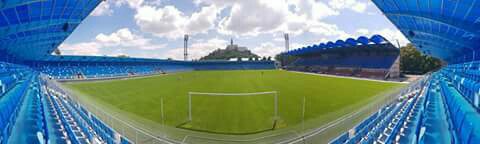
Football and ice hockey are the most popular sports in Nitra. However, a number of other sports are also played in the city. The city's main football club is FC Nitra, which was founded in 1909. The club has played in the Czechoslovak top division, finishing as runners-up once and third once. Following the dissolution of Czechoslovakia and the establishment of an independent Slovakia, FC Nitra played in the Slovak top division, where its best finish was third place. FC Nitra have reached the final of the Slovak Cup four times, but have never won the competition. The club has also competed in various European club competitions on several occasions. FC Nitra has been based in Sihoť Park since its foundation, approximately on the site of the present-day Štadión pod Zoborom, which has a capacity of 7,246. The stadium's most recent complete reconstruction was completed in 2018. FC Nitra also has a women's team, which competes in the second tier of the Slovak women's football league system.
Several smaller football clubs are also based in the city. FK Nitra, formerly known as TJ Strojár Nitra and ČFK Nitra, is based in the Klokočina and Čermáň districts. TJ Slovan Nitra-Chrenová is based in the Chrenová district, while ŠK Nitra-Dolné Krškany is based in the Dolné Krškany district. These clubs compete in the lower levels of the Slovak football league system. There are also other football clubs in some of the city's other districts, but they compete only in the lowest amateur competitions.
In 2013, three Group B matches of the UEFA European Under-17 Championship were played at Štadión pod Zoborom in Nitra. In 2025, the stadium also hosted three Group B matches of the UEFA European Under-21 Championship.
The city is also home to HK Nitra, which competes in the top tier of the Slovak ice hockey league system. The club has won three Slovak championship titles, finished as runners-up five times and in third place four times. It is therefore one of the most successful ice hockey clubs in Slovakia. The club was founded in 1925 and is known for its large fan base and passionate atmosphere at its home games. HK Nitra also has a women's ice hockey team. HK Nitra has played its home games at Nitra Aréna, which has a capacity of 3,600, since 1957. In the past, the city was also home to HK 96 Dynamax Nitra, which competed in the third tier of the Slovak ice hockey league system, as well as VTJ Dukla Nitra, which played in the second tier of the Czechoslovak ice hockey league system during the 1960s. The latter club was dissolved at the end of the 1960s.
Kaynak: Wikipedia – Nitra · CC BY-SA 4.0