


Nueva Orleans
Nueva Orleans es una ciudad al sureste del estado de Luisiana, sobre el delta del río Misisipi.
Government administration · United States · 0 followers
Overview
Nueva Orleans es una ciudad al sureste del estado de Luisiana, sobre el delta del río Misisipi. Antes de la catástrofe del huracán Katrina, en 2005, la población de Nueva Orleans alcanzaba los 400 000 habitantes, reduciéndose a la mitad tras dicha destrucción; posteriormente, su población aumentó llegando a los 389 617 habitantes en 2015.
Interested in working with us in the future?
Follow to see new jobs and posts in your feed.
No news yet.
About

Nueva Orleans es una ciudad al sureste del estado de Luisiana, sobre el delta del río Misisipi. Antes de la catástrofe del huracán Katrina, en 2005, la población de Nueva Orleans alcanzaba los 400 000 habitantes, reduciéndose a la mitad tras dicha destrucción; posteriormente, su población aumentó llegando a los 389 617 habitantes en 2015.
Kaynak: Wikipedia · CC BY-SA 4.0
Historia

Época colonial
Nueva Orleans fue fundada por los franceses en 1718 quienes dieron al asentamiento el nombre de La Nouvelle-Orléans.
El sitio para la fundación de Nueva Orleans, cabecera de la colonia, fue elegido por ser la planicie del delta del Misisipi, a fin de crear una ruta comercial con los nativos americanos que fijaban sus tiendas entre el Misisipi y el lago Pontchartrain. Nueva Orleans se convirtió en la capital de la Luisiana francesa en 1722, adquiriendo preponderancia sobre Biloxi.
Periodo español
En 1763, Francia decidía compensar a su aliada España por los servicios que esta le prestaba frente al común enemigo inglés. Así pues, tras la pérdida temporal de La Habana y Manila a manos de los ingleses, Francia cedía el territorio de la Luisiana a España en cláusula secreta del tratado de París. El primer gobernador solo arribó en 1766; se trataba entonces del geógrafo Antonio de Ulloa, quien sufrió el rechazo de la población, al creer esta que los españoles venían a cambiar sus usos y su lengua; a Ulloa le sucedió Alejandro O'Reilly, bajo cuyo mandato un grupo de colonos franceses, contrarios a las restricciones comerciales de la nueva metrópoli, se rebeló contra el gobierno español y su «mal vino». O'Reilly, siguiendo órdenes de Madrid, reprimió la revuelta decapitando a los cinco principales sediciosos. Su sucesor, el gobernador Luis de Unzaga y Amézaga, como presidente del cabildo, prohibió la esclavitud de los indígenas y con su Código jurídico abolió la regulación anterior sobre la adquisición de esclavos en 1770.
Tras la expulsión de Ulloa en 1768 y la dureza de O'Reilly en 1769, Unzaga y Amézaga inició su gobierno de manera conciliadora, de ahí que se le conozca como “Le Conciliateur”, primero por liberar a los cabecillas de la Revolución de Luisiana, luego al permitir la libertad de comercio transfronterizo con los colonos norteamericanos a través del Misisipi y sus afluentes, lo cual mejoró la economía de Nueva Orleans; además Unzaga y Amézaga creará en 1771 el primer sistema educativo público bilingüe e intercultural del mundo; mejoró las defensas de Nueva Orleans y de Luisiana en general, proyectando la creación en 1772 de fuertes como el Puesto de Unzaga.
Gobierno

La ciudad de Nueva Orleans es una subdivisión política del estado estadounidense de Luisiana. La ciudad y la parroquia de Orleans están fusionadas y dirigidas por un único gobierno. La ciudad original estaba compuesta por lo que ahora son los distritos 1 al 9. La ciudad de Lafayette (incluido el Garden District) se añadió en 1852 como los distritos 10 y 11. En 1870, Jefferson City, incluido Faubourg Bouligny y gran parte de las áreas de Audubon y University, fue anexada como los distritos 12, 13 y 14. Argel, en la orilla occidental del Misisipi, también fue anexada en 1870, convirtiéndose en el distrito decimoquinto.
Nueva Orleans tiene un gobierno de alcalde-consejo. El consejo de la ciudad se compone de siete miembros, los cuales son elegidos por distrito. La actual alcaldesa, LaToya Cantrell, elegida en noviembre de 2017, asumió el cargo el 7 de mayo de 2018, convirtiéndose en la primera mujer en desempeñar ese puesto en la historia de la ciudad.
El gobierno de Nueva Orleans está en gran medida centralizado en el ayuntamiento y la oficina del alcalde, pero mantiene restos de sistemas anteriores, cuando varias secciones de la ciudad gestionaban sus asuntos por separado. Por ejemplo, Nueva Orleans tenía siete asesores fiscales electos, cada uno con su propio personal, que representaban varios distritos de la ciudad, en lugar de una oficina centralizada. Una enmienda constitucional aprobada el 7 de noviembre de 2006 consolidó a los siete asesores en uno solo en 2010.
El 18 de febrero de 2010, Errol Williams fue elegido como el primer calificador de toda la ciudad. El gobierno de Nueva Orleans opera un cuerpo de bomberos y los servicios médicos de emergencia de la ciudad.
La Oficina del Sheriff Civil de la Parroquia de Nueva Orleans entrega documentos relacionados con demandas, brinda seguridad judicial y opera las instalaciones correccionales de la ciudad, incluida la prisión de la Parroquia de Orleans. La oficina del sheriff comparte jurisdicción legal con el Departamento de Policía de Nueva Orleans y le brinda respaldo según sea necesario.
Geografía

Nueva Orleans está situada en el delta del río Misisipi en las orillas este y oeste del mismo y el sur del lago Pontchartrain, aproximadamente 169 km río arriba desde el golfo de México. Según la Oficina del Censo de los Estados Unidos, la ciudad tiene un área total de 907 km² de los cuales 467, o el 51,55 % son tierra. El área a lo largo del río se caracteriza por crestas y depresiones.
La ciudad limita al norte con la parroquia de St. Tammany, al este con el golfo de México, al sur con la parroquia de St. Bernard, al suroeste con las parroquias de Plaquemines y Jefferson. El alcance geográfico de la ciudad corresponde con la arquidiócesis de Nueva Orleans, dentro de la cual se encuentra la parroquia Catedral de San Luis, la más grande, y la Iglesia de San Patricio, la segunda más grande.
Nueva Orleans fue establecida originalmente en los diques naturales o tierras altas a lo largo del río. La altitud media de la ciudad es actualmente entre uno y dos pies bajo el nivel del mar, con algunas partes de la ciudad de hasta 6 m en las partes más altas y 2 m bajo el nivel del mar en los suburbios del este de Nueva Orleans.
Nueva Orleans siempre ha tenido en cuenta el riesgo de huracanes, pero los riesgos son considerablemente mayores hoy en día debido a la erosión de las costas por la interferencia humana. Desde el comienzo del siglo XX se ha estimado que Luisiana ha perdido 5000 km² de las costas (incluyendo muchas de sus islas de barrera), que anteriormente protegía a la ciudad de las marejadas.
Clima
El clima de Nueva Orleans es subtropical húmedo (clasificación climática de Köppen Cfa), con inviernos cortos y frescos y veranos calurosos y húmedos. En enero, los mínimos matinales promedio son de alrededor de 8 °C, y los máximos diarios de alrededor de 17 °C. En julio, los mínimos promedio son de 24 °C, y máximos 34 °C. La temperatura más baja registrada fue de –14 °C el 13 de febrero de 1899. La temperatura más alta registrada fue 40 °C el 24 de junio de 2009. La precipitación media es de 1580 mm al año, los meses de verano son los más húmedos, mientras que octubre es el mes más seco. La precipitación en invierno suele acompañar el paso de un frente frío.
Demografía
Según el Censo de 2010, 343 829 personas y 189 896 hogares habitan Nueva Orleans. La composición racial y étnica de la ciudad era de 60.2 % afroamericanos, 33.0 % blancos, 2.9 % asiáticos (1,7 % vietnamita, el 0,3 % indio y chino, 0.1 % filipino y el 0,1 % coreano) y el 1.7 % correspondía a personas de dos o más razas. Las personas de origen hispano o latino compone el 5,3 % de la población; el 1,3 % es mexicano, el 1,3 % hondureño, el 0,4 % cubano, el 0,3 % puertorriqueño, y el 0,3 % nicaragüense.
La última estimación de la población antes del huracán Katrina fue de 454 865 habitantes, a partir del 1 de julio de 2005. Un informe realizado en septiembre de 2007 realizado por The Greater New Orleans Community Data Center, que hace un seguimiento de la población sobre la base de cifras del Servicio Postal, determinó que en agosto de 2007, poco más de 137 mil familias recibieron servicio electrónico. Eso se compara con cerca de 198 000 hogares en julio de 2005, lo cual representa aproximadamente el 70 % de pre-población Katrina. Más recientemente, la Oficina del Censo revisó al alza su estimación de 2008, a 336 644 habitantes. En 2010, las estimaciones mostraron que los barrios no inundables estaban cerca del 100 % de su población antes del Katrina, y en algunos casos, superan el 100 % de sus poblaciones antes de Katrina.
Un estudio realizado en 2006 por investigadores de la Universidad de Tulane y la Universidad de California, determinó que había de 10 000 a 14 000 inmigrantes ilegales, muchos de ellos de México, que actualmente residen en Nueva Orleans. Sin embargo, Janet Murguía (presidenta y directora ejecutiva del Consejo Nacional de La Raza) dijo que podría haber hasta 120 000 trabajadores hispanos en Nueva Orleans. En junio de 2007, un estudio indicó que la población hispana se había elevado de 15 000 (antes del Katrina) a más de 50 000.
Economía

Nueva Orleans tiene uno de los puertos más grandes y concurridos del mundo, y el área metropolitana de Nueva Orleans es un centro fuerte de la industria marítima. La región de Nueva Orleans también es responsable de una parte importante de la refinación de petróleo y petroquímica producida por la nación, y sirve como una base imponible de cuello blanco para el petróleo en tierra y mar, así como en la producción de gas natural.
El área metropolitana de Nueva Orleans es un importante centro regional para la industria del cuidado de la salud, ya que cuenta con un pequeño sector manufacturero, competitivo a nivel mundial. El centro de la ciudad posee un rápido crecimiento, destacando en el sector de industrias creativas, y la ciudad es comúnmente conocida por su turismo cultural. Greater New Orleans, Inc. (GNO, Inc.) actúa como primer punto de contacto para el desarrollo económico regional, la coordinación entre el Departamento de Desarrollo Económico de Luisiana y los diversos organismos de desarrollo de negocios parroquiales.
Como muchas otras ciudades de los Estados Unidos, Nueva Orleans está confrontada a la quiebra de su sistema de jubilaciones.
Educación
La Junta Escolar de la Parroquia de Orleans (OPSB por sus siglas en inglés) es el distrito escolar de la Nueva Orleans.
Nueva Orleans es una ciudad con enseñanza alta, con más de &&&&&&&&&&050000.&&&&&050 000 alumnos matriculados en carreras de entre dos y cuatro años en las instituciones que otorgan títulos en la región. La Universidad de Tulane, se encuentra en la parte alta de Nueva Orleans.
Cultura
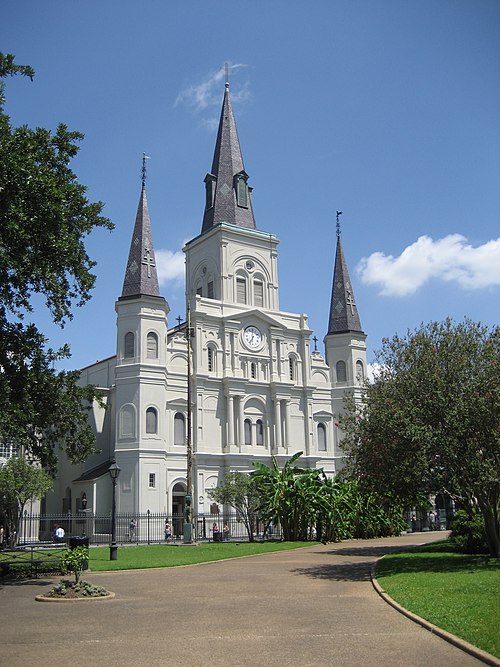
Nueva Orleans tiene numerosas atracciones, como el barrio francés de renombre mundial y la vida nocturna de Bourbon Street hasta la avenida St. Charles (sede de las Universidades de Tulane y Loyola, el histórico Hotel Pontchartrain, y muchas mansiones del siglo XIX), y a la calle Magazine, con sus numerosas tiendas, boutiques y tiendas de antigüedades.
Nueva Orleans es conocida por su cultura criolla, por la práctica del vudú por algunos de sus residentes negros y por su música, arquitectura, gastronomía y festividades.
Música
En su idiosincrasia, Nueva Orleans ha adaptado la música de banda militar a los funerales, cuando en el cortejo que acompaña al difunto dicha música se mezcla a himnos religiosos y música triste. Tras ello, los dolientes regresan del cementerio al son del jazz, más alegre. Los funerales con jazz son una atracción para los visitantes.
En el jazz de Nueva Orleans se detectan influencias de la música antillana, afroamericana, francesa y norteamericana. Son muy evidentes las influencias latino-caribeñas. Más adelante también nació en Nueva Orleans el rhythm and blues, de gran influencia en el estilo rock and roll. Otros estilos de música practicados en la ciudad son la música cajún, zydeco y delta blues. La figura musical predominante en la ciudad (nombra al aeropuerto, parques, escuelas, etc.) es Louis Armstrong.
Barrio francés
El barrio francés (conocido localmente como «el Barrio» o Vieux Carré), que data épocas francesas y españolas y que está delimitado por el río Misisipi, Rampart Street, la calle Canal y Esplanade Avenue. Este barrio contiene muchos hoteles, bares, y discotecas. Atracciones turísticas notables en el barrio como Bourbon Street, Jackson Square, la catedral de St. Louis, el Mercado Francés (incluyendo el Café du Monde, famoso por café au lait y buñuelos) y Preservation Hall. Para recorrer el puerto, se puede viajar en el Natchez, un barco de vapor auténtico con un organillo, que cruza el Misisipi de la longitud de la ciudad dos veces al día. A diferencia de la mayoría de los otros lugares en Estados Unidos y el mundo, Nueva Orleans ha llegado a ser ampliamente conocido por su elemento de elegante decadencia. Muchos cementerios bellos de la ciudad y sus distintas tumbas que ofrece el exterior suelen ser atractivos en sí mismos, el más antiguo y más famoso, Cementerio de San Luis, que se parece mucho a Père Lachaise en París.
Deportes

La ciudad de Nueva Orleans posee una gran variedad de equipos deportivos. Entre los más destacados se encuentran: los Santos de Nueva Orleans (perteneciente a la NFL y ganador del Super Bowl XLIV), los Pelicanos de Nueva Orleans (perteneciente a la NBA), los Céfiros de Nueva Orleans (perteneciente a la PCL), los Vudús de Nueva Orleans (perteneciente a la AFL) y los Jazz de Nueva Orleans (equipo femenino de fútbol americano). Desde 2018 posee también un equipo en la Major League Rugby, el New Orleans Gold. En 2007 también se estudió la posibilidad que contase con un equipo de fútbol en la MLS.
El Mercedes-Benz Superdome es la casa de los Santos y sede del Sugar Bowl, así como de otros eventos prominentes. Este recinto deportivo ha albergado siete Super Bowl. El Smoothie King Center sirve como casa de los Pelicanos y de los Vudús. En Nueva Orleans se encuentra también el Hipódromo Fair Grounds.
Kaynak: Wikipedia – Nueva Orleans · CC BY-SA 4.0
Etymology and nicknames
Before the arrival of European colonists, the indigenous Choctaw people called the area of present-day New Orleans Bulbancha, which translates as "land of many tongues". It appears to have been a contraction of balbáha a̱shah, which means "there are foreign speakers". In his book Histoire de la Louisiane, Antoine-Simon Le Page du Pratz wrote that the indigenous name referred to the Mississippi River and that the use of the same name for the settlement relates to Native American concepts of the close interaction between rivers and their surrounding land.
The name of New Orleans derives from the original French name, La Nouvelle-Orléans, which was given to the city in honor of Philippe II, Duke of Orléans, who served as Louis XV's regent from 1715 to 1723. The French city of Orléans itself was originally known as civitas Aurelianorum, possibly named after one of the many Roman Emperors bearing the nomen gentilicum around that time, which later evolved into Orléans.
Following the defeat in the Seven Years' War, France formally transferred the possession of Louisiana to Spain, with which France had secretly signed the Treaty of Fontainebleau a year earlier, in the Treaty of Paris of 1763. The Spanish renamed the city Nueva Orleans (pronounced [ˌnweβa oɾleˈans]), which was used until 1800. The United States, which had acquired possession from France in 1803, anglicized the French name to New Orleans.
New Orleans has several nicknames, including these:
Crescent City, alluding to the course of the Lower Mississippi River around and through the city.
The Big Easy, possibly a reference by musicians in the early 20th century to the relative ease of finding work there.
The City that Care Forgot, used since at least 1938, referring to the outwardly easygoing, carefree nature of the residents.
History

French–Spanish colonial era
La Nouvelle-Orléans (New Orleans) was founded in the spring of 1718 by the French Mississippi Company under Jean-Baptiste Le Moyne de Bienville, on land traditionally inhabited by the Chitimacha people. The city was named for Philippe II, Duke of Orléans, then-regent of the Kingdom of France whose title derived from the French city of Orléans. As a colony, French Louisiana faced conflict with Native American tribes navigating rival European powers. In 1729, the Natchez revolt erupted with an attack on Fort Rosalie, resulting in the deaths of over 200 French colonists. Governor Étienne Perier launched a retaliatory campaign that effectively destroyed the Natchez people, but it soured relations between France and the territory's Native Americans leading directly into the Chickasaw Wars of the 1730s.
Native resistance continued into the 1740s under governor Pierre de Rigaud, marquis de Vaudreuil-Cavagnial, as tribes including the Chickasaw and Choctaw leveraged competing colonial interests. Raids intensified as French economic instability weakened colonial defenses, with some Chickasaw attacks reaching as far south as Baton Rouge. Meanwhile, labor shortages led the French colonists to turn to the Atlantic slave trade. By the early 1720s, enslaved Africans were arriving in significant numbers, and in 1724, the Code Noir formalized harsh laws governing their lives. A distinct Afro-Creole culture began to develop, blending African traditions with Catholicism and French language, giving rise to practices such as Louisiana Voodoo and the Louisiana Creole language.
New Orleans quickly emerged as a cultural and commercial hub in French Louisiana. Its position as a key port made it the gateway for goods moving between the interior of North America and the Atlantic world. Institutions like the Ursuline sisters, founded in 1727 by nuns sponsored by the Company of the Indies, reflected the city's integration into French religious and educational networks. The convent educated girls and remains foundational to several modern schools in the city. Early city planning and architecture were shaped by military engineers like Pierre Le Blond de Tour and Adrien de Pauger, whose designs laid out the enduring street grid and fortifications. By the 1740s, public works programs under engineer Ignace François Broutin transformed the city's architecture, blending colonial governance with a distinct Creole character.
Geography

New Orleans is located in the Mississippi River Delta, south of Lake Pontchartrain, on the banks of the Mississippi River, approximately 105 miles (169 km) upriver from the Gulf of Mexico. According to the U.S. Census Bureau, the city's area is 350 square miles (910 km2), of which 169 square miles (440 km2) is land and 181 square miles (470 km2) (52%) is water. The area along the river is characterized by ridges and hollows.
Elevation
New Orleans was originally settled on the river's natural levees or high ground. After the Flood Control Act of 1965, the U.S. Army Corps of Engineers built floodwalls and man-made levees around a much larger geographic footprint that included previous marshland and swamp. Over time, pumping of water from marshland allowed for development into lower elevation areas. Today, half of the city is at or below local mean sea level, while the other half is slightly above sea level. Evidence suggests that portions of the city may be dropping in elevation due to subsidence.
A 2007 study by Tulane and Xavier University suggested that "51%... of the contiguous urbanized portions of Orleans, Jefferson, and St. Bernard parishes lie at or above sea level," with the more densely populated areas generally on higher ground. The average elevation of the city is currently between 1 and 2 feet (0.30 and 0.61 m) below sea level, with some portions of the city as high as 20 feet (6 m) at the base of the river levee in Uptown and others as low as 7 feet (2 m) below sea level in the farthest reaches of Eastern New Orleans. A study published by the ASCE Journal of Hydrologic Engineering in 2016, however, stated:
...most of New Orleans proper—about 65%—is at or below mean sea level, as defined by the average elevation of Lake Pontchartrain
The magnitude of subsidence potentially caused by the draining of natural marsh in the New Orleans area and southeast Louisiana is a topic of debate. A study published in Geology in 2006 by an associate professor at Tulane University claims:
Demographics

From the 2010 U.S. census to 2014 census estimates the city grew by 12%, adding an average of more than 10,000 new residents each year following the official decennial census. According to the 2020 United States census, there were 383,997 people, 151,753 households, and 69,370 families residing in the city. Prior to 1960, the population of New Orleans steadily increased to a historic 627,525.
Beginning in 1960, the population decreased due to factors such as the cycles of oil production and tourism, and as suburbanization, diversity, and white flight increased (as with many U.S. cities), and jobs migrated to surrounding parishes. This economic and population decline resulted in high levels of poverty in the city; in 1960 it had the fifth-highest poverty rate of all U.S. cities, and was almost twice the national average in 2005, at 24.5%. New Orleans experienced an increase in residential segregation from 1900 to 1980, leaving the disproportionately Black and African American poor in older, low-lying locations. These areas were especially susceptible to flood and storm damage.
The last population estimate before Hurricane Katrina was 454,865, as of July 1, 2005. A population analysis released in August 2007 estimated the population to be 273,000, 60% of the pre-Katrina population and an increase of about 50,000 since July 2006. A September 2007 report by The Greater New Orleans Community Data Center, which tracks population based on U.S. Postal Service figures, found that in August 2007, just over 137,000 households received mail. That compares with about 198,000 households in July 2005, representing about 70% of pre-Katrina population. In 2010, the U.S. Census Bureau revised upward its 2008 population estimate for the city, to 336,644 inhabitants. Estimates from 2010 showed that neighborhoods that did not flood were near or even greater than 100% of their pre-Katrina populations.
Economy

New Orleans operates one of the world's largest and busiest ports and metropolitan New Orleans is a center of maritime industry. The region accounts for a significant portion of the nation's oil refining and petrochemical production, and serves as a white-collar corporate base for onshore and offshore petroleum and natural gas production. Since the beginning of the 21st century, New Orleans has also grown into a technology hub.
New Orleans is also a center for higher learning, with over 50,000 students enrolled in the region's eleven two- and four-year degree-granting institutions. Tulane University, a top-50 research university, is located in Uptown. Metropolitan New Orleans is a major regional hub for the health care industry and boasts a small, globally competitive manufacturing sector. The center city possesses a rapidly growing, entrepreneurial creative industries sector and is renowned for its cultural tourism. Greater New Orleans, Inc. (GNO, Inc.) acts as the first point-of-contact for regional economic development, coordinating between Louisiana's Department of Economic Development and the various business development agencies.
Port
New Orleans began as a strategically located trading entrepôt and it remains, above all, a crucial transportation hub and distribution center for waterborne commerce. The Port of New Orleans is the fifth-largest in the United States based on cargo volume, and second-largest in the state after the Port of South Louisiana. It is the twelfth-largest in the U.S. based on cargo value. The Port of South Louisiana, also located in the New Orleans area, is the world's busiest in terms of bulk tonnage. When combined with Port of New Orleans, it forms the 4th-largest port system in volume. Many shipbuilding, shipping, logistics, freight forwarding and commodity brokerage firms either are based in metropolitan New Orleans or maintain a local presence. Examples include Intermarine, Bisso Towboat, Northrop Grumman Ship Systems, Trinity Yachts, Expeditors International, Bollinger Shipyards, IMTT, International Coffee Corp, Boasso America, Transoceanic Shipping, Transportation Consultants Inc., Dupuy Storage & Forwarding and Silocaf. The largest coffee-roasting plant in the world, operated by Folgers, is located in New Orleans East.
Culture and contemporary life

Tourism
New Orleans has many visitor attractions, from the world-renowned French Quarter to St. Charles Avenue, (home of Tulane and Loyola universities, the historic Pontchartrain Hotel and many 19th-century mansions) to Magazine Street with its boutique stores and antique shops.
According to current travel guides, New Orleans is one of the top ten most-visited cities in the United States; 10.1 million visitors came to New Orleans in 2004. Prior to Katrina, 265 hotels with 38,338 rooms operated in the Greater New Orleans Area. In May 2007, that had declined to some 140 hotels and motels with over 31,000 rooms.
A 2009 Travel + Leisure poll of "America's Favorite Cities" ranked New Orleans first in ten categories, the most first-place rankings of the 30 cities included. According to the poll, New Orleans was the best U.S. city as a spring break destination and for "wild weekends", stylish boutique hotels, cocktail hours, singles/bar scenes, live music/concerts and bands, antique and vintage shops, cafés/coffee bars, neighborhood restaurants, and people watching. The city ranked second for: friendliness (behind Charleston, South Carolina), gay-friendliness (behind San Francisco), bed and breakfast hotels/inns, and ethnic food. However, the city placed near the bottom in cleanliness, safety and as a family destination.
The French Quarter (known locally as "the Quarter" or Vieux Carré), which was the colonial-era city and is bounded by the Mississippi River, Rampart Street, Canal Street, and Esplanade Avenue, contains popular hotels, bars and nightclubs. Notable tourist attractions in the Quarter include Bourbon Street, Jackson Square, St. Louis Cathedral, the French Market (including Café du Monde, famous for café au lait and beignets) and Preservation Hall. Also in the French Quarter is the old New Orleans Mint, a former branch of the United States Mint which now operates as a museum, and The Historic New Orleans Collection, a museum and research center housing art and artifacts relating to the history and the Gulf South.
Sports
New Orleans's professional sports teams include the 2009 Super Bowl XLIV champion New Orleans Saints (NFL) and the New Orleans Pelicans (NBA). It is also home to the Big Easy Rollergirls, an all-female flat track roller derby team, and the New Orleans Blaze, a women's football team. New Orleans is also home to two NCAA Division I athletic programs, the Tulane Green Wave of the American Athletic Conference and the UNO Privateers of the Southland Conference.
The Caesars Superdome is the home of the Saints, the Sugar Bowl, and other prominent events. It has hosted the Super Bowl a record eight times (1978, 1981, 1986, 1990, 1997, 2002, 2013, and 2025). The Smoothie King Center is the home of the Pelicans, VooDoo, and many events that are not large enough to need the Superdome. New Orleans is also home to the Fair Grounds Race Course, the nation's third-oldest thoroughbred track. The city's Lakefront Arena has also been home to sporting events.
Each year New Orleans plays host to the Sugar Bowl, the New Orleans Bowl, the Bayou Classic, and the Zurich Classic, a golf tournament on the PGA Tour. In addition, it has often hosted major sporting events that have no permanent home, such as the Super Bowl, ArenaBowl, NBA All-Star Game, BCS National Championship Game, and the NCAA Final Four. The Rock 'n' Roll Mardi Gras Marathon and the Crescent City Classic are two annual road running events.
In 2017, Major League Rugby had its inaugural season, and NOLA Gold were one of the first teams in the league. They play at the Gold Mine on Airline, a former minor league baseball stadium in the suburb of Metairie. In 2022, a consortium started an attempt to bring professional soccer to New Orleans, hoping to place teams in the male USL Championship and women's USL Super League by 2025.
National protected areas
Jean Lafitte National Historical Park and Preserve
New Orleans Jazz National Historical Park
Government
The city of New Orleans is a political subdivision of the U.S. state of Louisiana. The city and the parish of Orleans operate as a merged city-parish government. The original city was composed of what are now the 1st to 9th wards. In 1836, in response to tensions between the city's old-line Creole population and American newcomers, the state modified New Orleans's charter, dividing the city into three municipalities with local control but still answering to a single mayor and council. In 1852, a new charter was issued, recombining the three municipalities and annexing the city of Lafayette, including the Garden District, which formed the 10th and 11th wards. In 1870, Jefferson City, including Faubourg Bouligny and much of the Audubon and University areas, was annexed as the 12th, 13th, and 14th wards. Algiers, on the west bank of the Mississippi, was also annexed in 1870, becoming the 15th ward.
New Orleans has a mayor-council government, following a home rule charter adopted in 1954, as later amended. The city council consists of seven members, five elected from single-member districts and two members elected at-large, that is, across the city-parish. LaToya Cantrell assumed the mayor's office in 2018 as the first female mayor of the city. An ordinance in 2006 established an Office of Inspector General to review city government activities.
New Orleans's government is largely centralized in the city council and mayor's office, but it maintains earlier systems from when various sections of the city managed their affairs separately. For example, New Orleans had seven elected tax assessors, each with their own staff, representing various districts of the city, rather than one centralized office. A constitutional amendment passed on November 7, 2006, consolidated the seven assessors into one in 2010.
Crime
New Orleans is considered one of the most dangerous cities in the nation. As in comparable U.S. cities, the incidence of homicide and other violent crimes is usually highly concentrated in certain lower income neighborhoods. Arrested offenders in New Orleans are almost exclusively black males from lower income neighborhoods: in 2011, 97% were black and 95% were male; 91% of victims were black as well.
The city's murder rate has been historically high and consistently among the highest rates nationwide since the 1970s. From 1994 to 2013, New Orleans was the country's "Murder Capital", annually averaging over 200 murders. The first record was broken in 1979 when the city reached 242 homicides. The record was broken again reaching 250 by 1989 to 345 by the end of 1991. By 1993, New Orleans had 395 murders: 80.5 for every 100,000 residents.
In 1994, the city was officially named the "Murder Capital of America", hitting a historic peak of 424 murders. The murder count was one of the highest in the world and surpassed that of such cities as Gary, Indiana, Washington, D.C., and Baltimore. In 1999, the city's murder rate dropped down to a low of 158 and climbed to the high 200s in the early 2000s. Between 2000 and 2004, New Orleans had the highest homicide rate per capita of any city in the U.S., with 59 people killed per year per 100,000 citizens.
In 2006, with nearly half the population gone and widespread disruption and dislocation because of deaths and refugee relocations from Hurricane Katrina, the city hit another record of homicides. It was ranked as the most dangerous city in the country. By 2009, there was a 17% decrease in violent crime, a decrease seen in other cities across the country. But the homicide rate remained among the highest in the United States, at between 55 and 64 per 100,000 residents. In 2010, New Orleans's homicide rate dropped to 49.1 per 100,000, but increased again in 2012, to 53.2, the highest rate among cities of 250,000 population or larger.
Education

Colleges and universities
New Orleans has the highest concentration of colleges and universities in Louisiana and one of the highest in the Southern United States. New Orleans also has the third highest concentration of historically black collegiate institutions in the U.S.
Colleges and universities based within the city include:
Primary and secondary schools
Orleans Parish School Board (OPSB), also known as New Orleans Public Schools (NOPS), is the public school district for the entire city. Katrina was a watershed moment for the school system. Pre-Katrina, NOPS was one of the area's largest systems, along with the Jefferson Parish public school system. It was also the lowest-performing school district in Louisiana. According to researchers Carl L. Bankston and Stephen J. Caldas, only 12 of the 103 public schools within the city limits showed reasonably good performance.
Following Hurricane Katrina, the state of Louisiana took over most of the schools within the system, all schools that matched a nominal "worst-performing" metric. Many of these schools, and others, were subsequently granted operating charters, giving them administrative independence from the Orleans Parish School Board, the Recovery School District or the Louisiana Board of Elementary and Secondary Education (BESE). At the start of the 2014 school year, all public school students in the NOPS system attended these independent public charter schools, the nation's first to do so.
The charter schools made significant and sustained gains in student achievement, led by outside operators such as KIPP, the Algiers Charter School Network, and the Capital One–University of New Orleans Charter School Network. An October 2009 assessment demonstrated continued growth in the academic performance of public schools. Considering the scores of all public schools in New Orleans gives an overall school district performance score of 70.6. This score represents a 24% improvement over an equivalent pre-Katrina (2004) metric, when a district score of 56.9 was posted. Notably, this score of 70.6 approaches the score (78.4) posted in 2009 by the adjacent, suburban Jefferson Parish public school system, though that system's performance score is itself below the state average of 91.
Media
Historically, the major newspaper in the area was The Times-Picayune. In 2012, the owner Advance Publications cut its print schedule to three days each week, instead focusing its efforts on its website, NOLA.com. That action briefly made New Orleans the largest city in the country without a daily newspaper, until the Baton Rouge newspaper The Advocate began a New Orleans edition in September 2012.
In June 2013, the Times-Picayune resumed daily printing with a condensed newsstand tabloid edition, nicknamed TP Street, which is published on the three days each week that its namesake broadsheet edition is not printed. The Picayune has not returned to daily delivery. With the resumption of daily print editions from the Times-Picayune and the launch of the New Orleans edition of The Advocate, now The New Orleans Advocate, the city had two daily newspapers for the first time since the afternoon States-Item ceased publication in May 1980. In 2019, the papers merged to form The Times-Picayune/The New Orleans Advocate.
In addition to the daily newspaper, weekly publications include The Louisiana Weekly and Gambit Weekly. Also in wide circulation is the Clarion Herald, the newspaper of the Roman Catholic Archdiocese of New Orleans.
Greater New Orleans is the 54th largest designated market area (DMA) in the U.S., serving at least 566,960 homes. Major television network affiliates serving the area include:
WWOZ, the New Orleans Jazz and Heritage Station, broadcasts modern and traditional jazz, blues, rhythm and blues, brass band, gospel, cajun, zydeco, Caribbean, Latin, Brazilian, African and bluegrass 24 hours per day.
WTUL is Tulane University's radio station. Its programming includes 20th century classical, reggae, jazz, showtunes, indie rock, electronic music, soul/funk, goth, punk, hip-hop, New Orleans music, opera, folk, hardcore, Americana, country, blues, Latin, cheese, techno, local, world, ska, swing and big band, kids' shows, and news programming. WTUL is listener-supported and non-commercial. The disc jockeys are volunteers, many of them college students.
Transportation

Public transportation
Hurricane Katrina devastated transit service in 2005. The New Orleans Regional Transit Authority (RTA) was quicker to restore the streetcars to service, while bus service had only been restored to 35% of pre-Katrina levels as recently as the end of 2013. During the same period, streetcars arrived at an average of once every seventeen minutes, compared to bus frequencies of once every thirty-eight minutes. The same priority was demonstrated in RTA's spending, increasing the proportion of its budget devoted to streetcars to more than three times compared to its pre-Katrina budget. Through the end of 2017, counting both streetcar and bus trips, only 51% of service had been restored to pre-Katrina levels.
In 2017, the New Orleans Regional Transit Authority began operation on the extension of the Rampart–St. Claude streetcar line. Another change to transit service that year was the re-routing of the 15 Freret and 28 Martin Luther King bus routes to Canal Street. These increased the number of jobs accessible by a thirty-minute walk or transit ride: from 83,722 in 2016 to 89,216 in 2017. This resulted in a regional increase in such job access by more than a full percentage point.
Streetcars
New Orleans has four active streetcar lines:
The St. Charles Streetcar Line is the oldest continuously operating streetcar line in the U.S. The line first operated as local rail service in 1835 between Carrollton and downtown New Orleans. Operated by the Carrollton & New Orleans R.R. Co., the locomotives were then powered by steam engines, and a one-way fare cost 25 cents. Each car is a historic landmark. It runs from Canal Street to the other end of St. Charles Avenue, then turns right into South Carrollton Avenue to its terminal at Carrollton and Claiborne.
The Riverfront Streetcar Line runs parallel to the river from Esplanade Street through the French Quarter to Canal Street to the Convention Center above Julia Street in the Arts District.
Places of interest
Tourism is a staple of the city's economy. Perhaps more visible than any other sector, New Orleans's tourist and convention industry is a $5.5 billion industry that accounts for 40 percent of city tax revenues. In 2004, the hospitality industry employed 85,000 people, making it the city's top economic sector as measured by employment. New Orleans also hosts the World Cultural Economic Forum (WCEF). The forum, held annually at the New Orleans Morial Convention Center, is directed toward promoting cultural and economic development opportunities through the strategic convening of cultural ambassadors and leaders from around the world. The first WCEF took place in October 2008.
Kaynak: Wikipedia – New Orleans · CC BY-SA 4.0